REAL GAS AND
VAN DER WAAL
EQUATION
INTRODUCTION TO
REAL GASES:
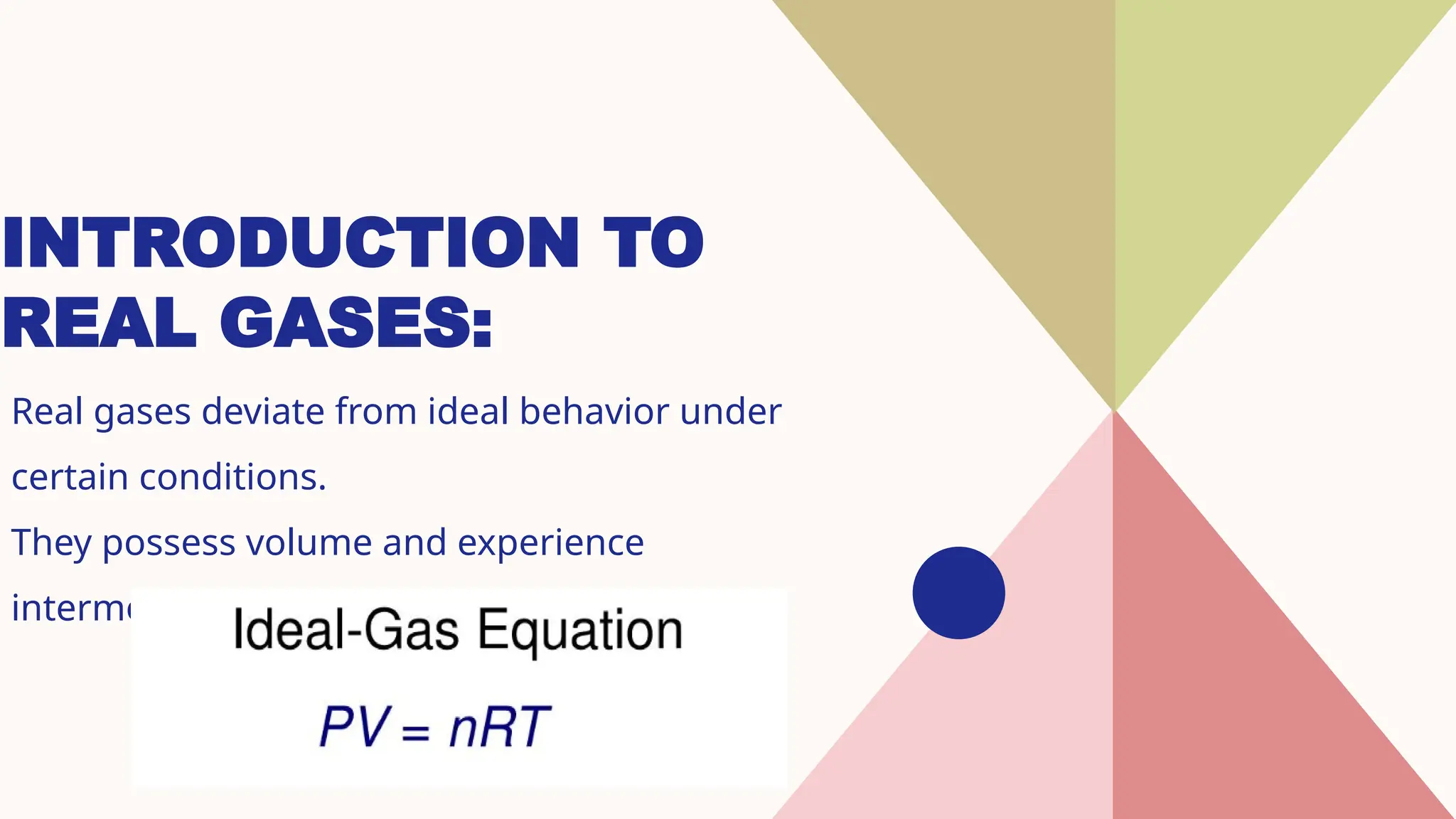
Real gases deviate from ideal behavior under
certain conditions.
They possess volume and experience
intermolecular forces.
3
CHARACTERISTICS OF REAL GASES:
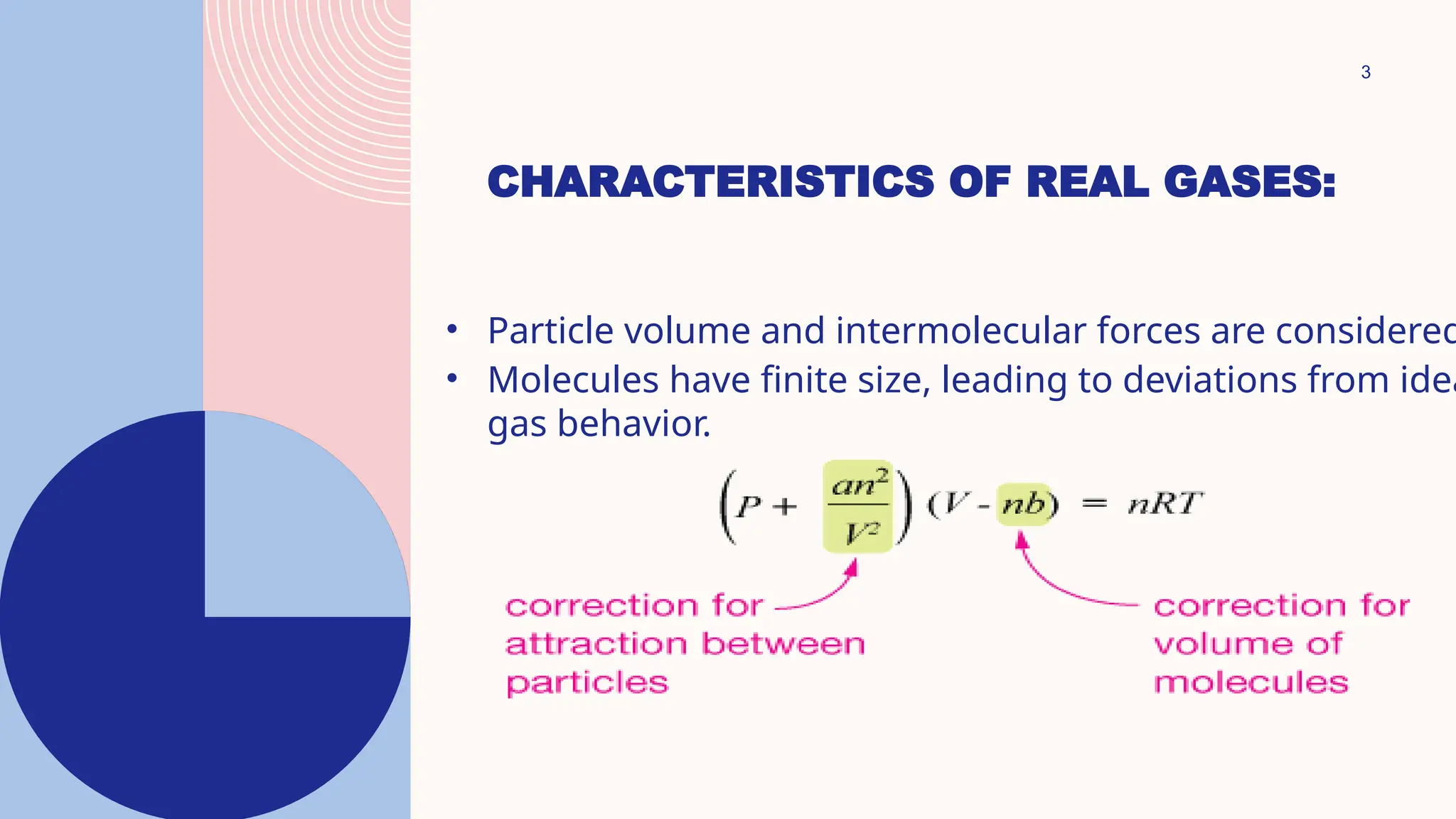
• Particle volume and intermolecular forces are considered
• Molecules have finite size, leading to deviations from idea
gas behavior.
4
DEVIATIONS FROM IDEAL
GAS LAW:
DEVIATIONS FROM IDEAL GAS LAW:
• Factors causing deviations: volume
occupied by gas particles and
intermolecular forces.
• At high pressures and low
temperatures, deviations are more
pronounced.
5
Presentation title
VAN DER WAALS
EQUATION:
Proposed by Johannes Diderik van der Waals in
1873.
Correction to the ideal gas law to account for
particle size and intermolecular forces.
Equation: (P + a(n^2/V^2))(V - nb) = nRT
COMPONENTS OF VAN
DER WAALS EQUATION:
'a' corrects for attractive forces
between gas molecules.
'b' adjusts for the volume occupied
by gas molecules.
7
INTERPRETATION OF
CONSTANTS:
'A' IS RELATED TO MOLECULAR ATTRACTION.
'B' IS RELATED TO MOLECULAR SIZE OR
VOLUME.
APPLICATION AND
SIGNIFICANCE:
Useful in explaining deviations of real
gases from ideal behavior.
Used in calculations involving non-ideal
gas behavior.
LIMITATIONS:
Simplified assumptions; does not
encompass all complexities.
Not applicable in extreme
conditions (very high pressures,
very low temperatures).
9
CONCLUSION:
THE VAN DER WAALS EQUATION OFFERS AN
IMPROVED UNDERSTANDING OF REAL GAS
BEHAVIOR.
SERVES AS A VALUABLE TOOL IN CHEMICAL
AND PHYSICAL CALCULATIONS.
REFERENCES:
The volume of a Real gas is given as
(Vm-b) ,
Where b is the volume occupied per
mole .

Real gas and van der waal equation ppt.pptx

  • 1.
    REAL GAS AND VANDER WAAL EQUATION
  • 2.
    INTRODUCTION TO REAL GASES: Realgases deviate from ideal behavior under certain conditions. They possess volume and experience intermolecular forces.
  • 3.
    3 CHARACTERISTICS OF REALGASES: • Particle volume and intermolecular forces are considered • Molecules have finite size, leading to deviations from idea gas behavior.
  • 4.
    4 DEVIATIONS FROM IDEAL GASLAW: DEVIATIONS FROM IDEAL GAS LAW: • Factors causing deviations: volume occupied by gas particles and intermolecular forces. • At high pressures and low temperatures, deviations are more pronounced.
  • 5.
    5 Presentation title VAN DERWAALS EQUATION: Proposed by Johannes Diderik van der Waals in 1873. Correction to the ideal gas law to account for particle size and intermolecular forces. Equation: (P + a(n^2/V^2))(V - nb) = nRT
  • 6.
    COMPONENTS OF VAN DERWAALS EQUATION: 'a' corrects for attractive forces between gas molecules. 'b' adjusts for the volume occupied by gas molecules.
  • 7.
    7 INTERPRETATION OF CONSTANTS: 'A' ISRELATED TO MOLECULAR ATTRACTION. 'B' IS RELATED TO MOLECULAR SIZE OR VOLUME. APPLICATION AND SIGNIFICANCE: Useful in explaining deviations of real gases from ideal behavior. Used in calculations involving non-ideal gas behavior.
  • 8.
    LIMITATIONS: Simplified assumptions; doesnot encompass all complexities. Not applicable in extreme conditions (very high pressures, very low temperatures).
  • 9.
    9 CONCLUSION: THE VAN DERWAALS EQUATION OFFERS AN IMPROVED UNDERSTANDING OF REAL GAS BEHAVIOR. SERVES AS A VALUABLE TOOL IN CHEMICAL AND PHYSICAL CALCULATIONS. REFERENCES: The volume of a Real gas is given as (Vm-b) , Where b is the volume occupied per mole .