lecture (2)
Followed gases
by: Prof. Sherine Awad
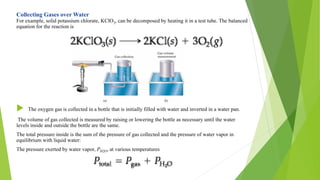
Collecting Gases over Water
For example, solid potassium chlorate, KClO3, can be decomposed by heating it in a test tube. The balanced
equation for the reaction is
 The oxygen gas is collected in a bottle that is initially filled with water and inverted in a water pan.
The volume of gas collected is measured by raising or lowering the bottle as necessary until the water
levels inside and outside the bottle are the same.
The total pressure inside is the sum of the pressure of gas collected and the pressure of water vapor in
equilibrium with liquid water:
The pressure exerted by water vapor, PH2O, at various temperatures
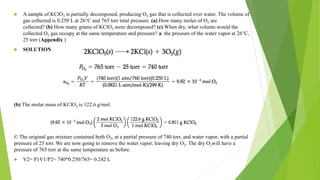
 A sample of KClO3 is partially decomposed, producing O2 gas that is collected over water. The volume of
gas collected is 0.250 L at 26°C and 765 torr total pressure. (a) How many moles of O2 are
collected? (b) How many grams of KClO3 were decomposed? (c) When dry, what volume would the
collected O2 gas occupy at the same temperature and pressure? a the pressure of the water vapor at 26°C,
25 torr (Appendix )
 SOLUTION
(b) The molar mass of KClO3 is 122.6 g/mol.
© The original gas mixture contained both O2, at a partial pressure of 740 torr, and water vapor, with a partial
pressure of 25 torr. We are now going to remove the water vapor, leaving dry O2. The dry O2will have a
pressure of 765 torr at the same temperature as before.
 V2= P1V1/P2= 740*0.250/765= 0.242 L
Molecular theory
 1. Gases consist of large numbers of molecules that are in
continuous, random motion.
 2. The volume of all the molecules of the gas is negligible.
 3. Attractive and repulsive forces between gas molecules are
negligible.
 4. The average kinetic energy of the molecules does not change
with time, as long as the temperature of the gas remains constant.
So, the collisions are perfectly elastic.
 5. The average kinetic energy of the molecules is proportional to the
absolute temperature.
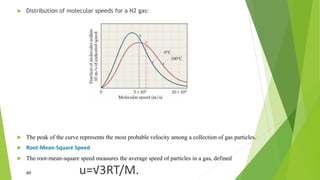
 Distribution of molecular speeds for a N2 gas:
 The peak of the curve represents the most probable velocity among a collection of gas particles.
 Root-Mean-Square Speed
 The root-mean-square speed measures the average speed of particles in a gas, defined
as u=√3RT/M.
Deviation from Ideal Behavior
 The ideal gas law can be written as:
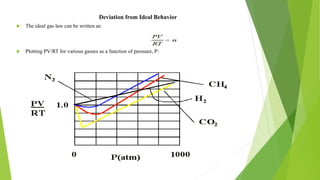
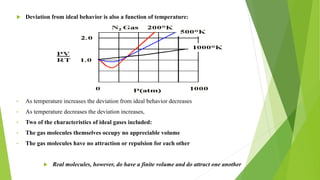
 Plotting PV/RT for various gasses as a function of pressure, P:
• The deviation from ideal behavior is large at high pressure
• At high pressures, and low volumes, the intermolecular distances can become quite short,
and attractive forces between molecules becomes significant
• As pressures increase, and volume decreases, the volume of the gas molecules becomes
significant .
• At high temperatures, the kinetic energy of the molecules can overcome the attractive
influence and the gasses behave more ideal
At higher pressures, and lower volumes, the volume of the molecules influences PV/RT
and its value, again, is higher than ideal
 Deviation from ideal behavior is also a function of temperature:
• As temperature increases the deviation from ideal behavior decreases
• As temperature decreases the deviation increases,
• Two of the characteristics of ideal gases included:
• The gas molecules themselves occupy no appreciable volume
• The gas molecules have no attraction or repulsion for each other
 Real molecules, however, do have a finite volume and do attract one another
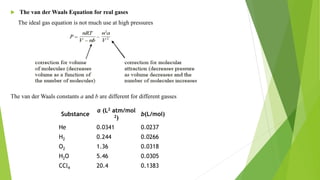
 The van der Waals Equation for real gases
The ideal gas equation is not much use at high pressures
The van der Waals constants a and b are different for different gasses
Substance
a (L2 atm/mol
2)
b(L/mol)
He 0.0341 0.0237
H2 0.244 0.0266
O2 1.36 0.0318
H2O 5.46 0.0305
CCl4 20.4 0.1383
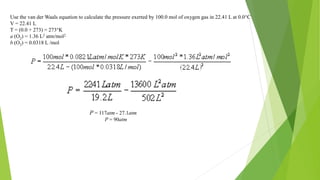
Use the van der Waals equation to calculate the pressure exerted by 100.0 mol of oxygen gas in 22.41 L at 0.0°C
V = 22.41 L
T = (0.0 + 273) = 273°K
a (O2) = 1.36 L2 atm/mol2
b (O2) = 0.0318 L /mol
P = 117atm - 27.1atm
P = 90atm
 Molecular Diffusion and Effusion
 Effusion
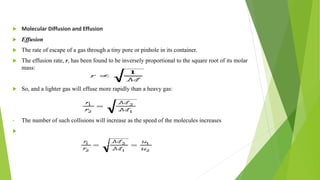
 The rate of escape of a gas through a tiny pore or pinhole in its container.
 The effusion rate, r, has been found to be inversely proportional to the square root of its molar
mass:
 So, and a lighter gas will effuse more rapidly than a heavy gas:
• The number of such collisions will increase as the speed of the molecules increases

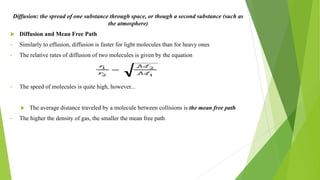
Diffusion: the spread of one substance through space, or though a second substance (such as
the atmosphere)
 Diffusion and Mean Free Path
• Similarly to effusion, diffusion is faster for light molecules than for heavy ones
• The relative rates of diffusion of two molecules is given by the equation
• The speed of molecules is quite high, however...
 The average distance traveled by a molecule between collisions is the mean free path
• The higher the density of gas, the smaller the mean free path
End of chapter 2

gases 2.pdf

  • 1.
  • 2.
    Collecting Gases overWater For example, solid potassium chlorate, KClO3, can be decomposed by heating it in a test tube. The balanced equation for the reaction is  The oxygen gas is collected in a bottle that is initially filled with water and inverted in a water pan. The volume of gas collected is measured by raising or lowering the bottle as necessary until the water levels inside and outside the bottle are the same. The total pressure inside is the sum of the pressure of gas collected and the pressure of water vapor in equilibrium with liquid water: The pressure exerted by water vapor, PH2O, at various temperatures
  • 3.
     A sampleof KClO3 is partially decomposed, producing O2 gas that is collected over water. The volume of gas collected is 0.250 L at 26°C and 765 torr total pressure. (a) How many moles of O2 are collected? (b) How many grams of KClO3 were decomposed? (c) When dry, what volume would the collected O2 gas occupy at the same temperature and pressure? a the pressure of the water vapor at 26°C, 25 torr (Appendix )  SOLUTION (b) The molar mass of KClO3 is 122.6 g/mol. © The original gas mixture contained both O2, at a partial pressure of 740 torr, and water vapor, with a partial pressure of 25 torr. We are now going to remove the water vapor, leaving dry O2. The dry O2will have a pressure of 765 torr at the same temperature as before.  V2= P1V1/P2= 740*0.250/765= 0.242 L
  • 4.
    Molecular theory  1.Gases consist of large numbers of molecules that are in continuous, random motion.  2. The volume of all the molecules of the gas is negligible.  3. Attractive and repulsive forces between gas molecules are negligible.  4. The average kinetic energy of the molecules does not change with time, as long as the temperature of the gas remains constant. So, the collisions are perfectly elastic.  5. The average kinetic energy of the molecules is proportional to the absolute temperature.
  • 5.
     Distribution ofmolecular speeds for a N2 gas:  The peak of the curve represents the most probable velocity among a collection of gas particles.  Root-Mean-Square Speed  The root-mean-square speed measures the average speed of particles in a gas, defined as u=√3RT/M.
  • 6.
    Deviation from IdealBehavior  The ideal gas law can be written as:  Plotting PV/RT for various gasses as a function of pressure, P:
  • 7.
    • The deviationfrom ideal behavior is large at high pressure • At high pressures, and low volumes, the intermolecular distances can become quite short, and attractive forces between molecules becomes significant • As pressures increase, and volume decreases, the volume of the gas molecules becomes significant . • At high temperatures, the kinetic energy of the molecules can overcome the attractive influence and the gasses behave more ideal At higher pressures, and lower volumes, the volume of the molecules influences PV/RT and its value, again, is higher than ideal
  • 8.
     Deviation fromideal behavior is also a function of temperature: • As temperature increases the deviation from ideal behavior decreases • As temperature decreases the deviation increases, • Two of the characteristics of ideal gases included: • The gas molecules themselves occupy no appreciable volume • The gas molecules have no attraction or repulsion for each other  Real molecules, however, do have a finite volume and do attract one another
  • 9.
     The vander Waals Equation for real gases The ideal gas equation is not much use at high pressures The van der Waals constants a and b are different for different gasses Substance a (L2 atm/mol 2) b(L/mol) He 0.0341 0.0237 H2 0.244 0.0266 O2 1.36 0.0318 H2O 5.46 0.0305 CCl4 20.4 0.1383
  • 10.
    Use the vander Waals equation to calculate the pressure exerted by 100.0 mol of oxygen gas in 22.41 L at 0.0°C V = 22.41 L T = (0.0 + 273) = 273°K a (O2) = 1.36 L2 atm/mol2 b (O2) = 0.0318 L /mol P = 117atm - 27.1atm P = 90atm
  • 11.
     Molecular Diffusionand Effusion  Effusion  The rate of escape of a gas through a tiny pore or pinhole in its container.  The effusion rate, r, has been found to be inversely proportional to the square root of its molar mass:  So, and a lighter gas will effuse more rapidly than a heavy gas: • The number of such collisions will increase as the speed of the molecules increases 
  • 12.
    Diffusion: the spreadof one substance through space, or though a second substance (such as the atmosphere)  Diffusion and Mean Free Path • Similarly to effusion, diffusion is faster for light molecules than for heavy ones • The relative rates of diffusion of two molecules is given by the equation • The speed of molecules is quite high, however...  The average distance traveled by a molecule between collisions is the mean free path • The higher the density of gas, the smaller the mean free path
  • 13.