Table of Contents
1)Spectrum of Capital
2) What is Venture Capital?
3) Overview of the Venture Funding Process
4) How Do I Value My Company?
5) How Venture Rounds Work
6) Key Venture Concepts Explained
7) What Do I Need to Know About a Capital Table?
8) Convertible Notes & SAFEs
9) Summary & Key Takeaways
2
What is VentureCapital
4
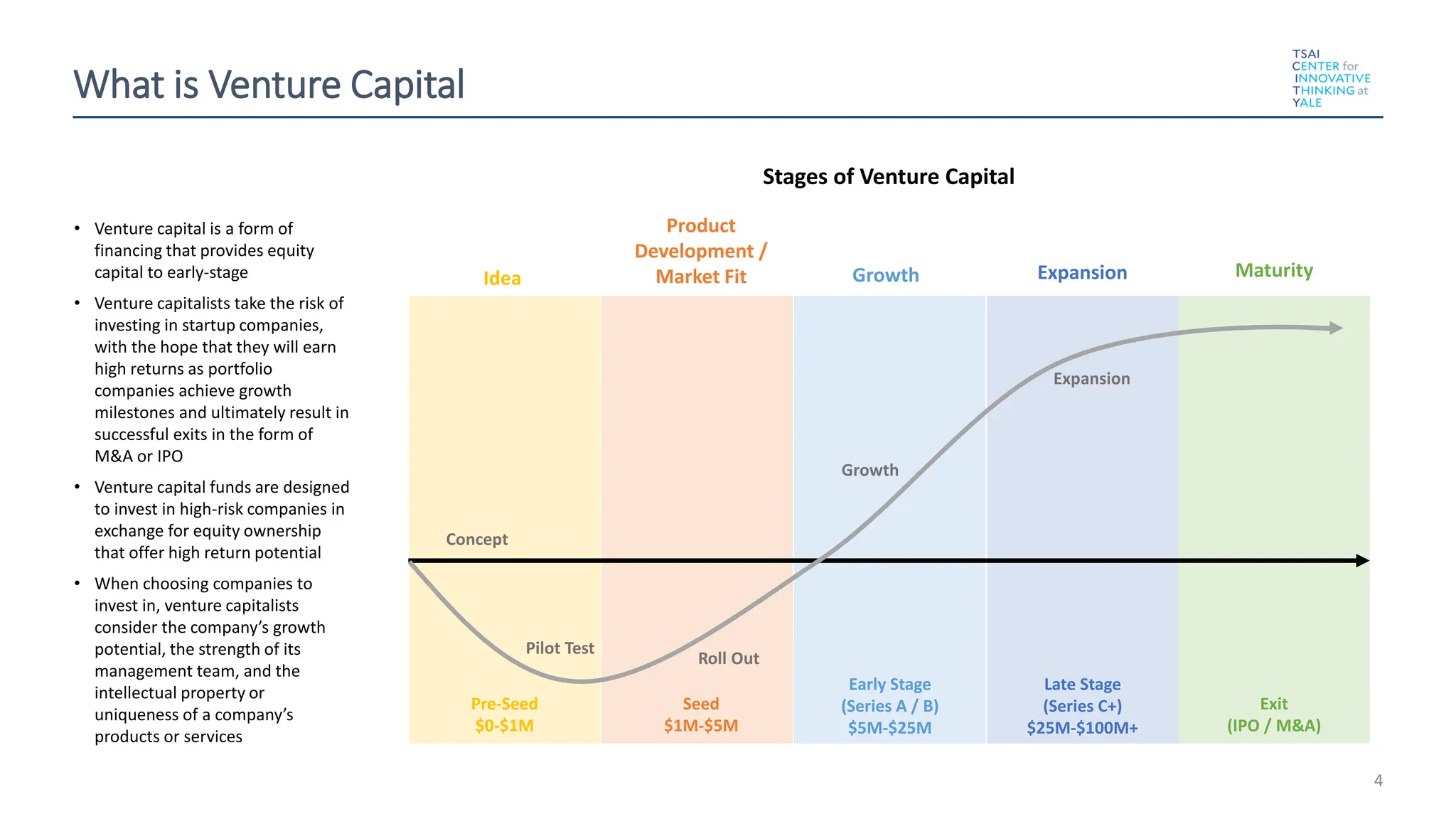
Pre-Seed
$0-$1M
Seed
$1M-$5M
Early Stage
(Series A / B)
$5M-$25M
Late Stage
(Series C+)
$25M-$100M+
Exit
(IPO / M&A)
Idea
Product
Development /
Market Fit Growth Expansion Maturity
Concept
Pilot Test
Roll Out
Growth
Expansion
• Venture capital is a form of
financing that provides equity
capital to early-stage
• Venture capitalists take the risk of
investing in startup companies,
with the hope that they will earn
high returns as portfolio
companies achieve growth
milestones and ultimately result in
successful exits in the form of
M&A or IPO
• Venture capital funds are designed
to invest in high-risk companies in
exchange for equity ownership
that offer high return potential
• When choosing companies to
invest in, venture capitalists
consider the company’s growth
potential, the strength of its
management team, and the
intellectual property or
uniqueness of a company’s
products or services
Stages of Venture Capital
7
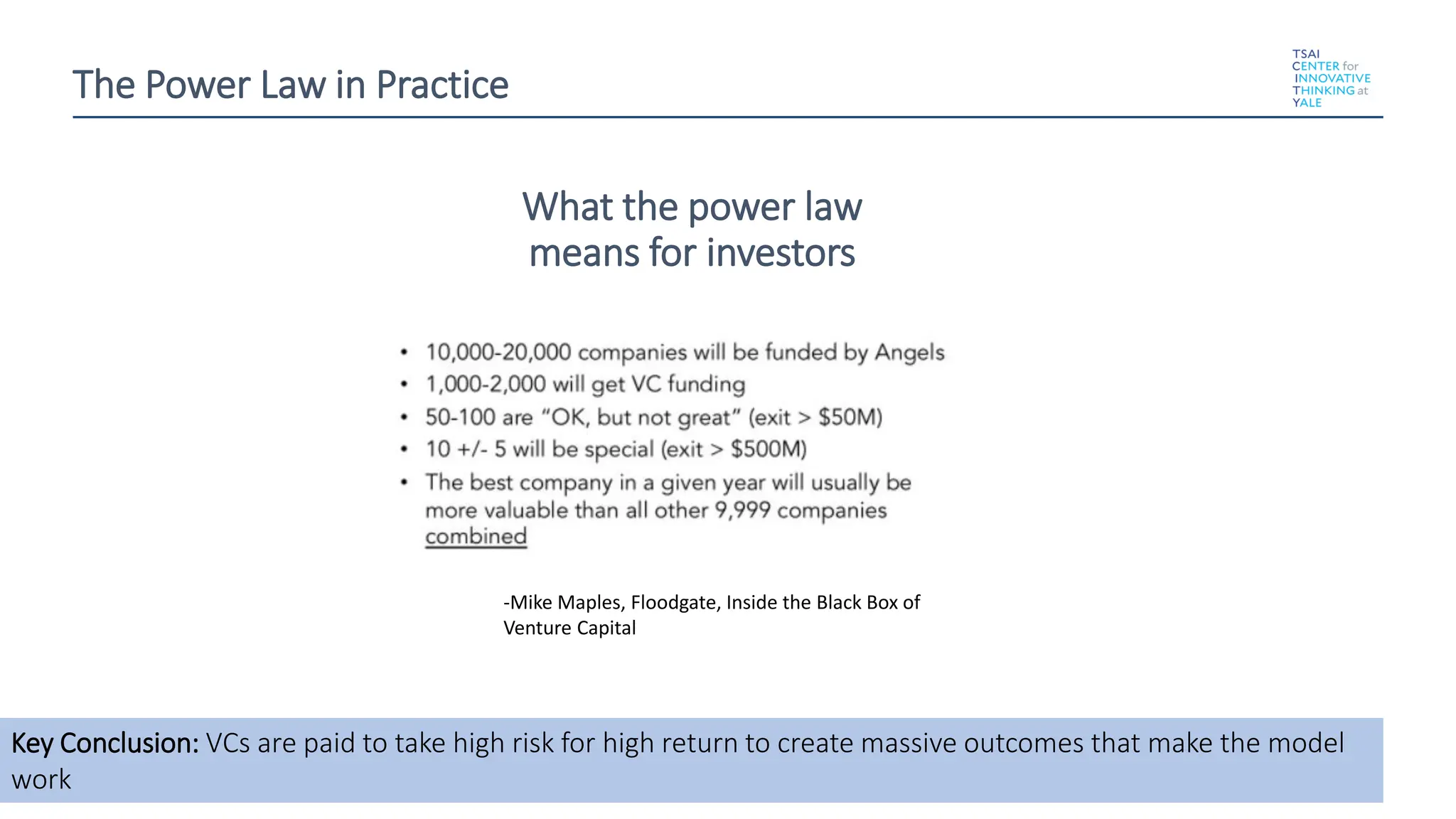
-Mike Maples, Floodgate,Inside the Black Box of
Venture Capital
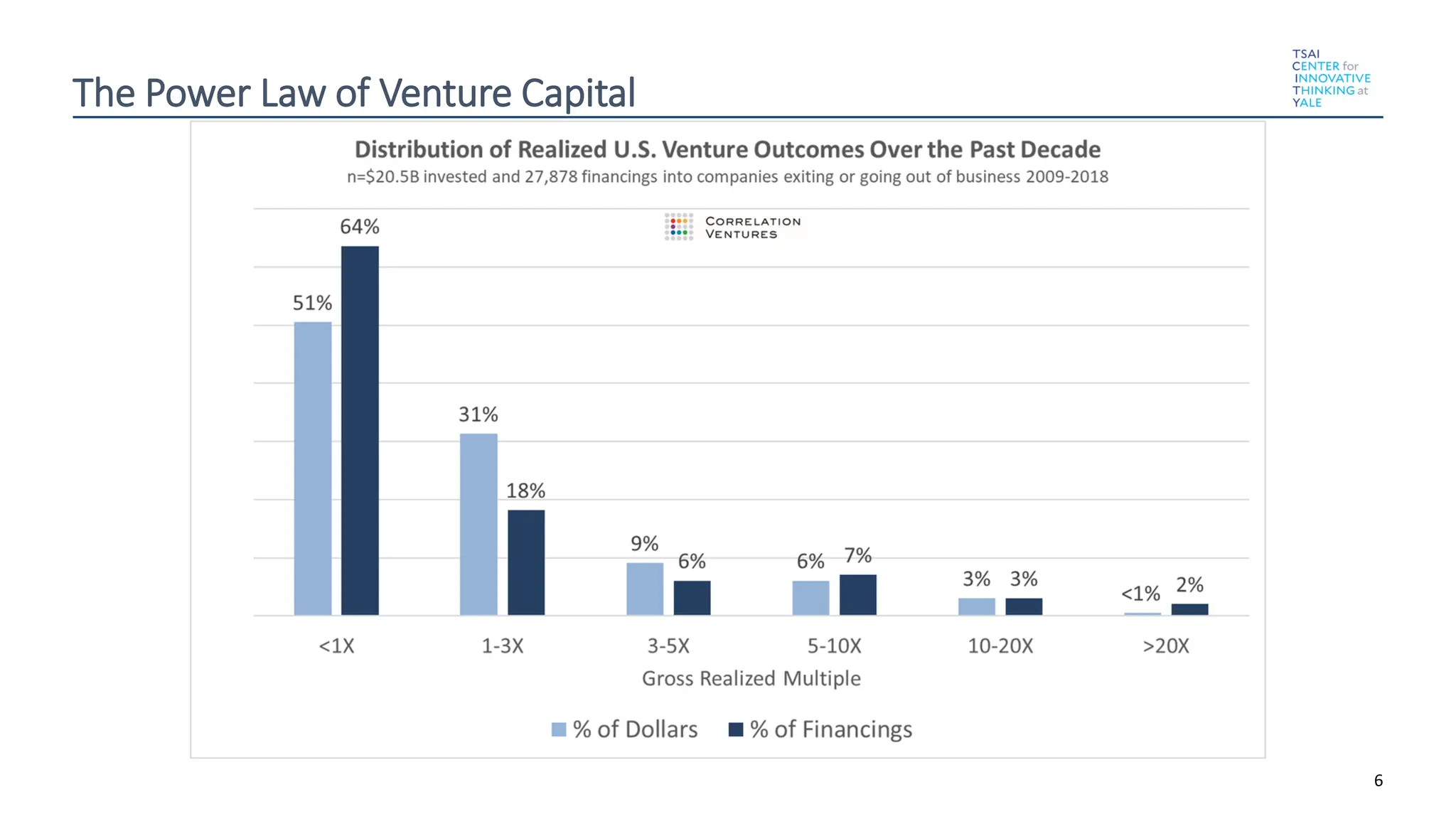
What the power law
means for investors
Key Conclusion: VCs are paid to take high risk for high return to create massive outcomes that make the model
work
The Power Law in Practice
8.
8
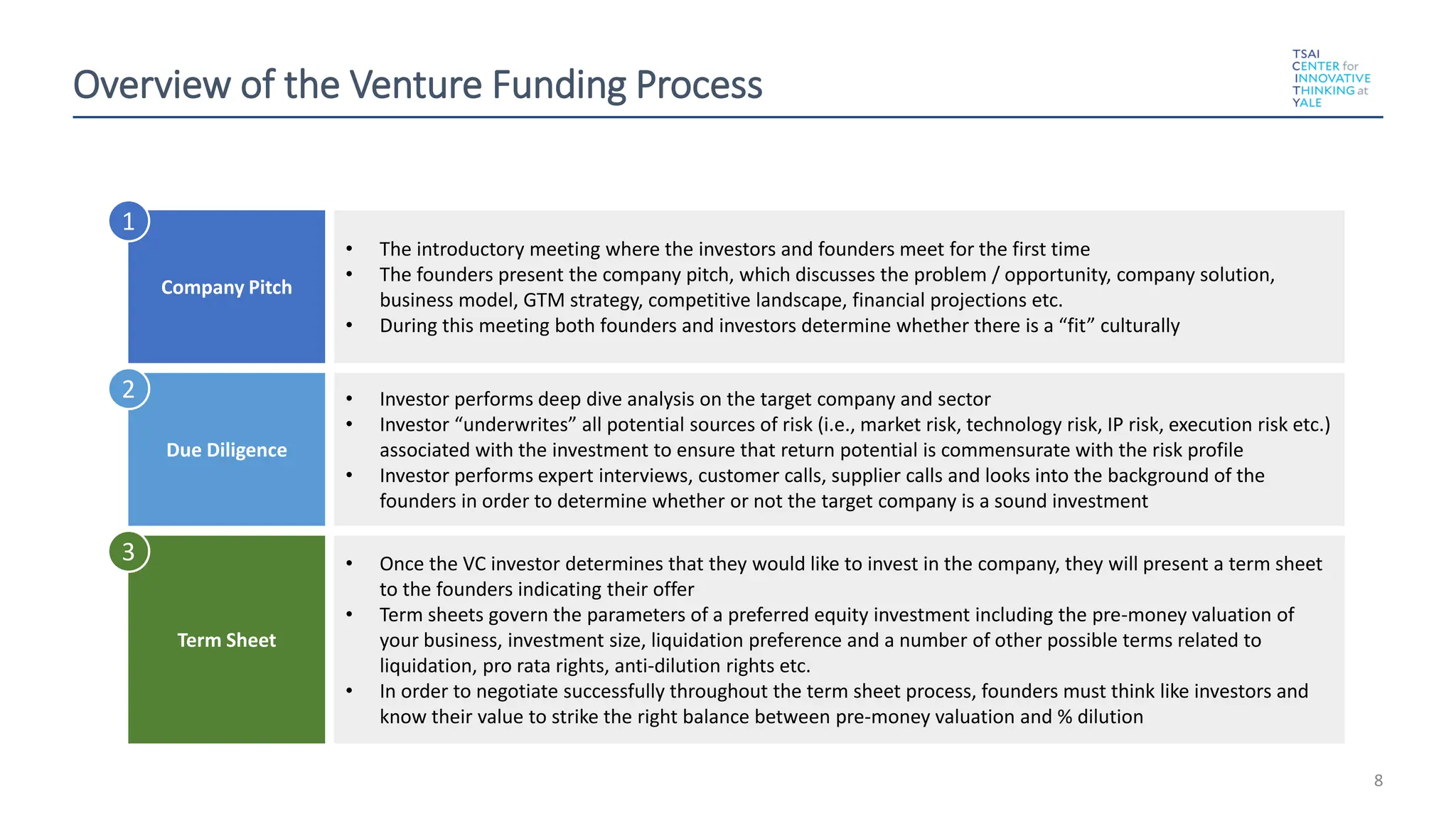
Overview of theVenture Funding Process
• The introductory meeting where the investors and founders meet for the first time
• The founders present the company pitch, which discusses the problem / opportunity, company solution,
business model, GTM strategy, competitive landscape, financial projections etc.
• During this meeting both founders and investors determine whether there is a “fit” culturally
Company Pitch
• Investor performs deep dive analysis on the target company and sector
• Investor “underwrites” all potential sources of risk (i.e., market risk, technology risk, IP risk, execution risk etc.)
associated with the investment to ensure that return potential is commensurate with the risk profile
• Investor performs expert interviews, customer calls, supplier calls and looks into the background of the
founders in order to determine whether or not the target company is a sound investment
Due Diligence
• Once the VC investor determines that they would like to invest in the company, they will present a term sheet
to the founders indicating their offer
• Term sheets govern the parameters of a preferred equity investment including the pre-money valuation of
your business, investment size, liquidation preference and a number of other possible terms related to
liquidation, pro rata rights, anti-dilution rights etc.
• In order to negotiate successfully throughout the term sheet process, founders must think like investors and
know their value to strike the right balance between pre-money valuation and % dilution
Term Sheet
1
2
3
9.
What to Includein Your Company Pitch?
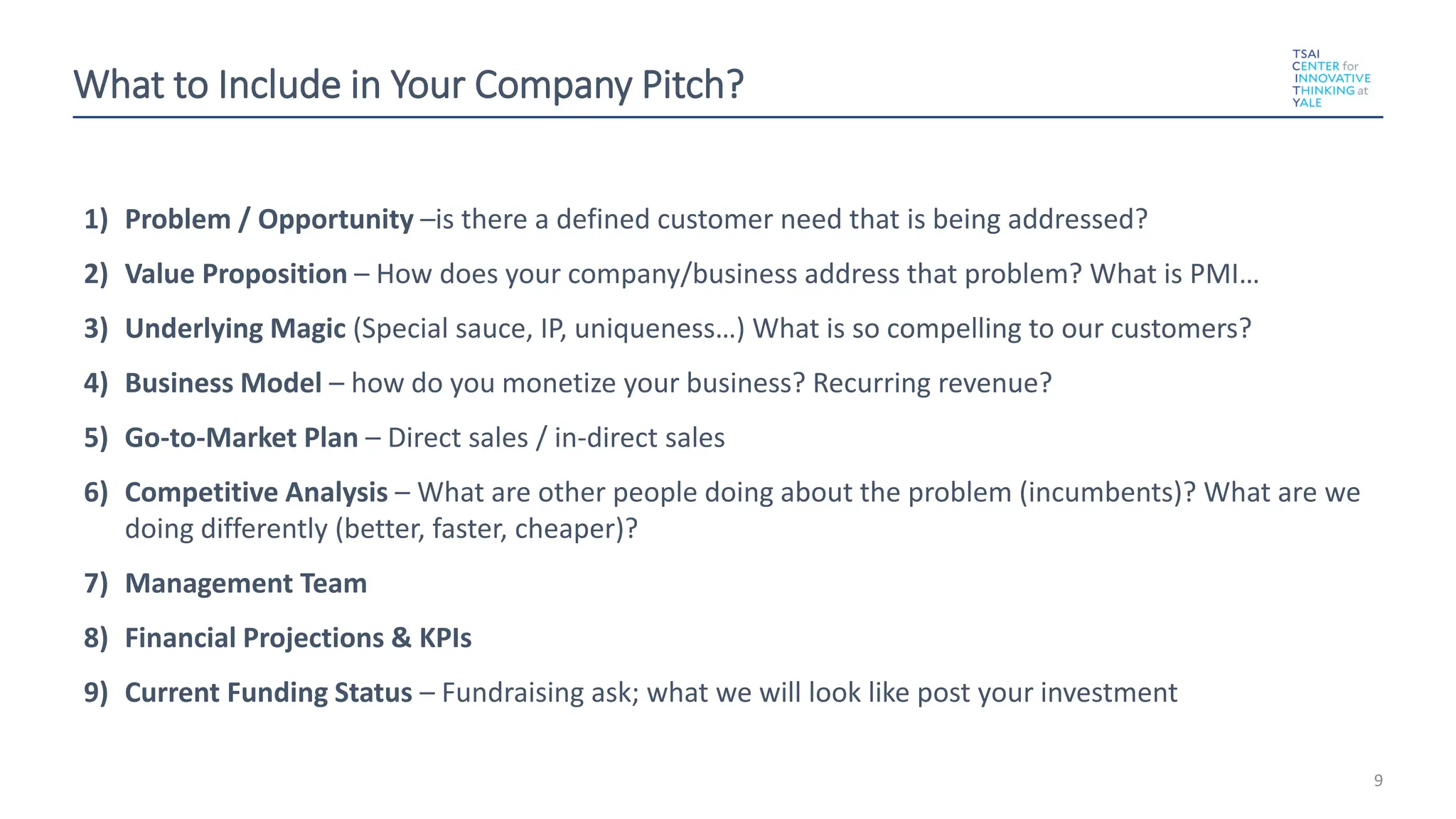
1) Problem / Opportunity –is there a defined customer need that is being addressed?
2) Value Proposition – How does your company/business address that problem? What is PMI…
3) Underlying Magic (Special sauce, IP, uniqueness…) What is so compelling to our customers?
4) Business Model – how do you monetize your business? Recurring revenue?
5) Go-to-Market Plan – Direct sales / in-direct sales
6) Competitive Analysis – What are other people doing about the problem (incumbents)? What are we
doing differently (better, faster, cheaper)?
7) Management Team
8) Financial Projections & KPIs
9) Current Funding Status – Fundraising ask; what we will look like post your investment
9
10.
Valuation: How toValue Your Company?
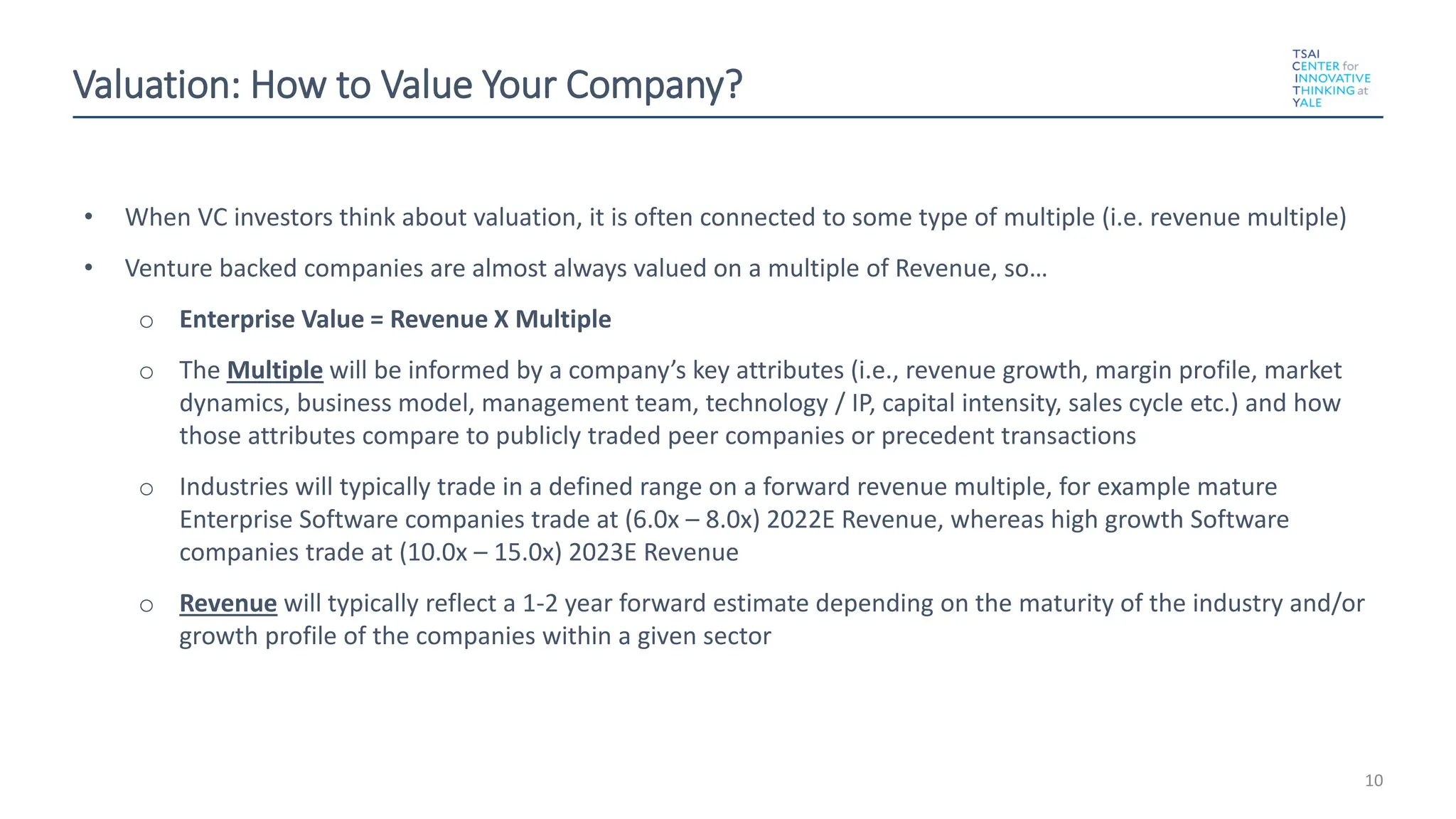
• When VC investors think about valuation, it is often connected to some type of multiple (i.e. revenue multiple)
• Venture backed companies are almost always valued on a multiple of Revenue, so…
o Enterprise Value = Revenue X Multiple
o The Multiple will be informed by a company’s key attributes (i.e., revenue growth, margin profile, market
dynamics, business model, management team, technology / IP, capital intensity, sales cycle etc.) and how
those attributes compare to publicly traded peer companies or precedent transactions
o Industries will typically trade in a defined range on a forward revenue multiple, for example mature
Enterprise Software companies trade at (6.0x – 8.0x) 2022E Revenue, whereas high growth Software
companies trade at (10.0x – 15.0x) 2023E Revenue
o Revenue will typically reflect a 1-2 year forward estimate depending on the maturity of the industry and/or
growth profile of the companies within a given sector
10
11.
Valuation: Early Stagevs. Growth/Late Stage Companies
11
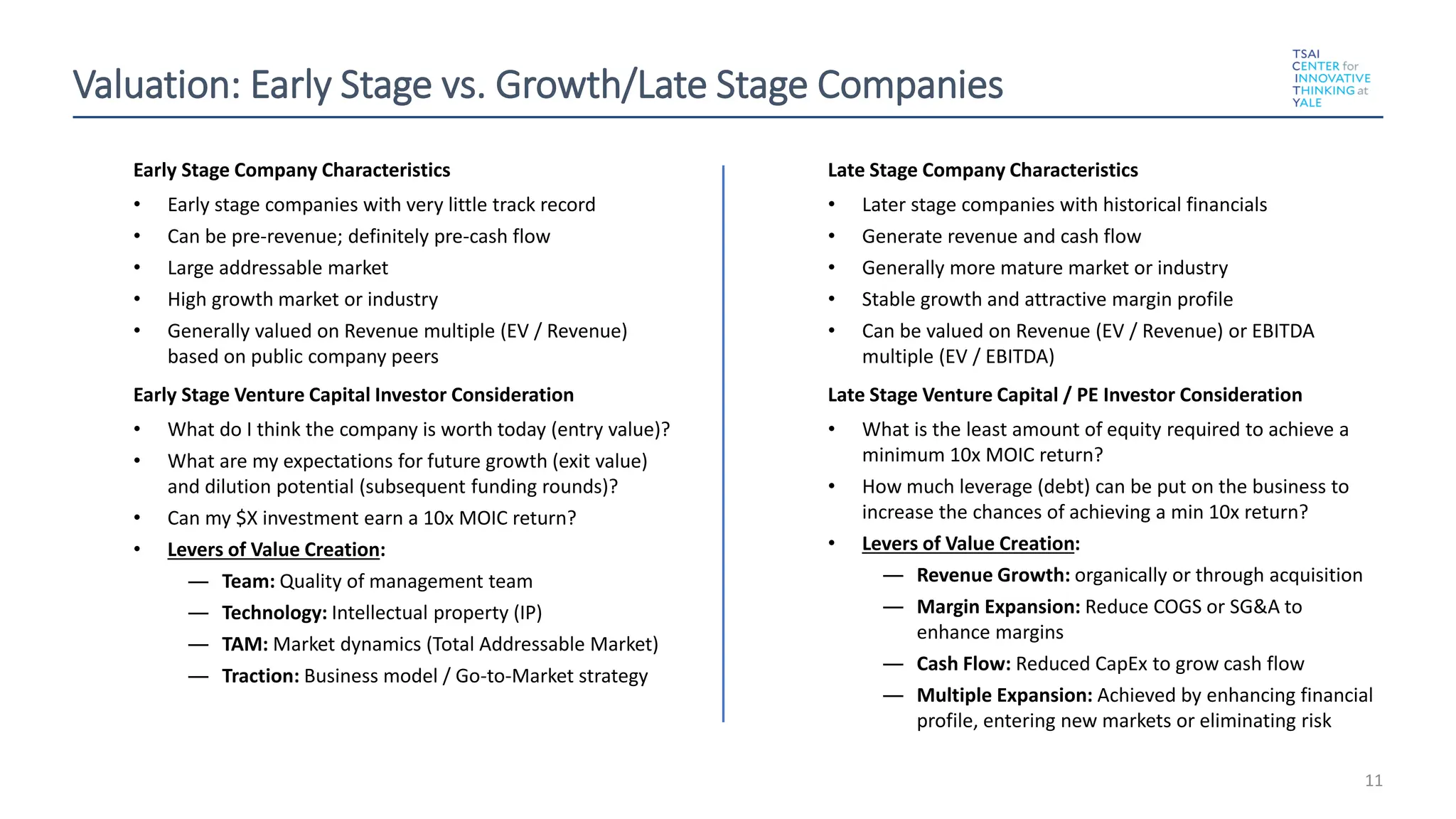
Early Stage Company Characteristics
• Early stage companies with very little track record
• Can be pre-revenue; definitely pre-cash flow
• Large addressable market
• High growth market or industry
• Generally valued on Revenue multiple (EV / Revenue)
based on public company peers
Early Stage Venture Capital Investor Consideration
• What do I think the company is worth today (entry value)?
• What are my expectations for future growth (exit value)
and dilution potential (subsequent funding rounds)?
• Can my $X investment earn a 10x MOIC return?
• Levers of Value Creation:
― Team: Quality of management team
― Technology: Intellectual property (IP)
― TAM: Market dynamics (Total Addressable Market)
― Traction: Business model / Go-to-Market strategy
Late Stage Company Characteristics
• Later stage companies with historical financials
• Generate revenue and cash flow
• Generally more mature market or industry
• Stable growth and attractive margin profile
• Can be valued on Revenue (EV / Revenue) or EBITDA
multiple (EV / EBITDA)
Late Stage Venture Capital / PE Investor Consideration
• What is the least amount of equity required to achieve a
minimum 10x MOIC return?
• How much leverage (debt) can be put on the business to
increase the chances of achieving a min 10x return?
• Levers of Value Creation:
― Revenue Growth: organically or through acquisition
― Margin Expansion: Reduce COGS or SG&A to
enhance margins
― Cash Flow: Reduced CapEx to grow cash flow
― Multiple Expansion: Achieved by enhancing financial
profile, entering new markets or eliminating risk
#1
#2
#3
13
How does thiswork in practice from the investor perspective…
Valuation: Venture Capital Method
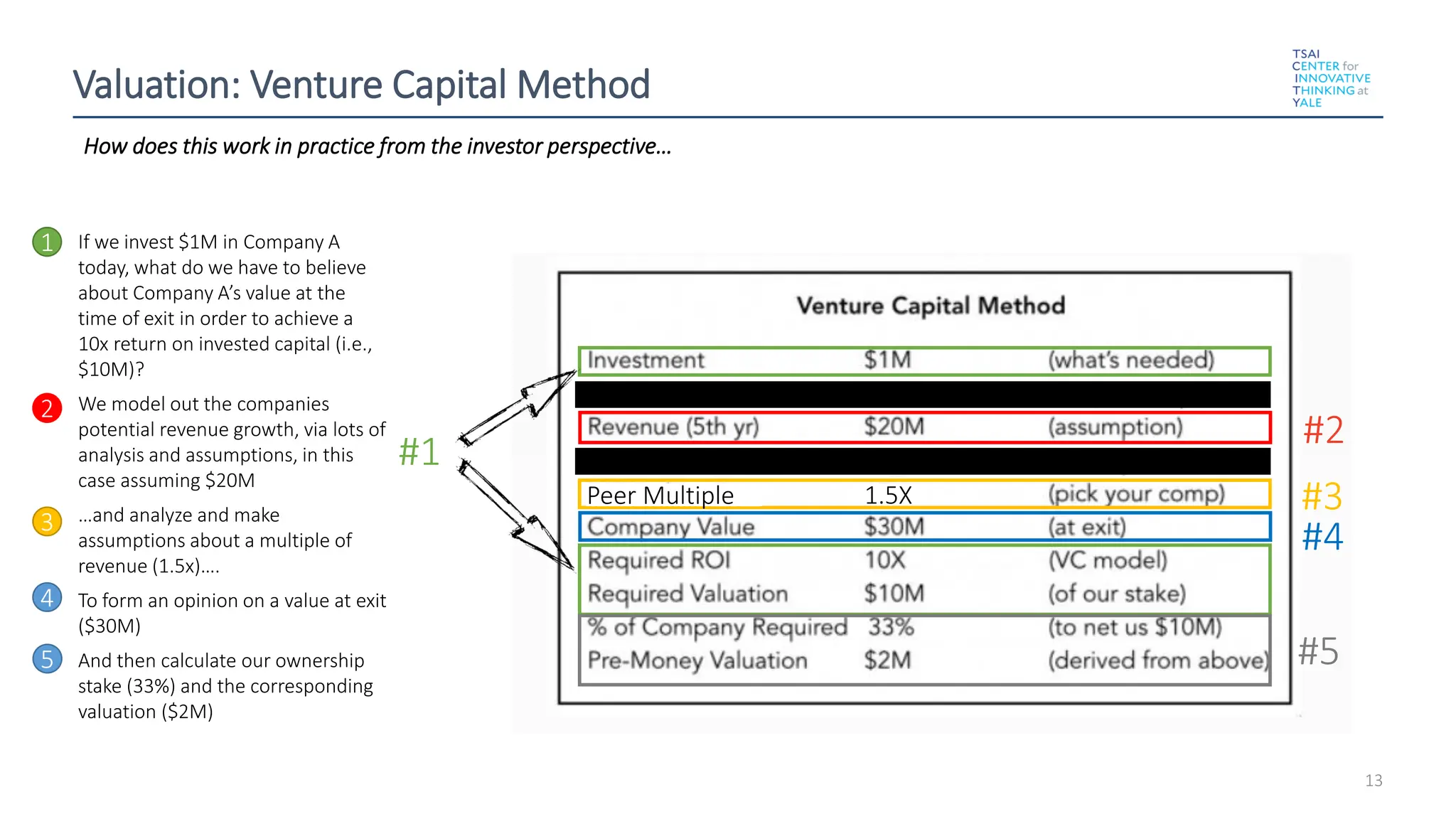
• If we invest $1M in Company A
today, what do we have to believe
about Company A’s value at the
time of exit in order to achieve a
10x return on invested capital (i.e.,
$10M)?
• We model out the companies
potential revenue growth, via lots of
analysis and assumptions, in this
case assuming $20M
• …and analyze and make
assumptions about a multiple of
revenue (1.5x)….
• To form an opinion on a value at exit
($30M)
• And then calculate our ownership
stake (33%) and the corresponding
valuation ($2M)
1
2
3
4
1.5X
Peer Multiple
5
#4
#5
14.
Thinking About Valuation,Mark
Suster
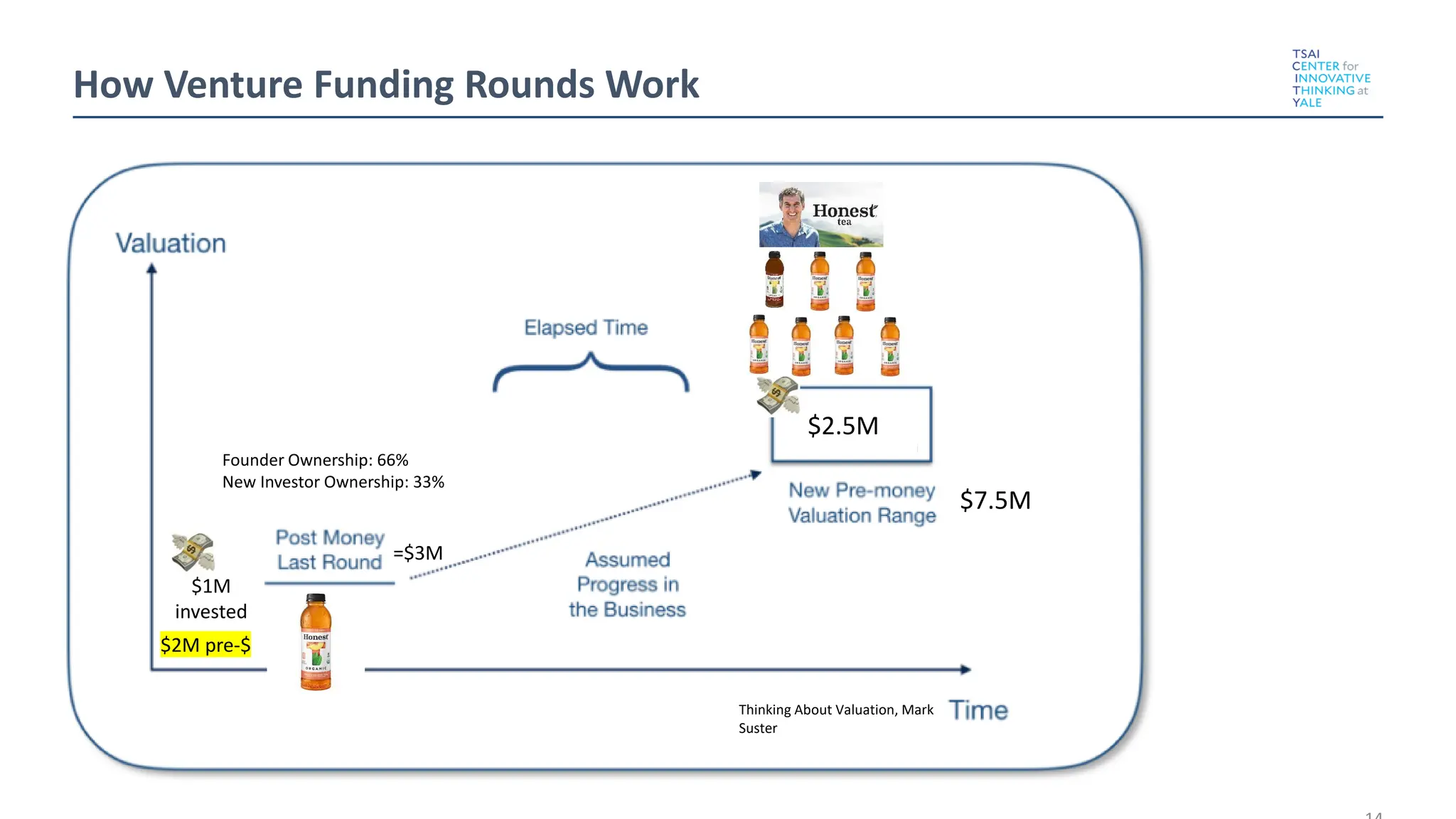
$1M
invested
$2M pre-$
=$3M
Founder Ownership: 66%
New Investor Ownership: 33%
$2.5M
$7.5M
How Venture Funding Rounds Work
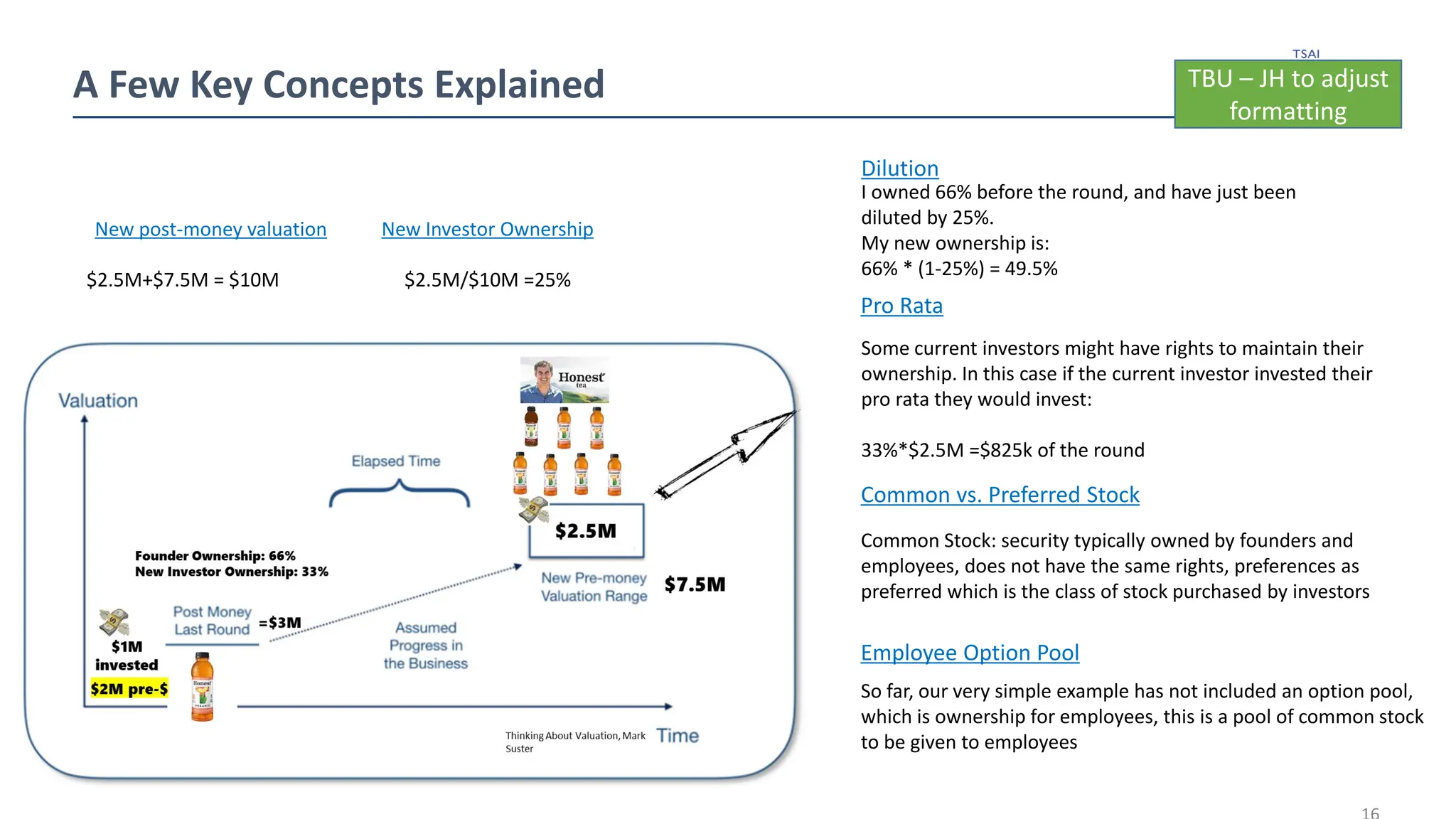
New post-money valuation
$2.5M+$7.5M= $10M
I owned 66% before the round, and have just been
diluted by 25%.
My new ownership is:
66% * (1-25%) = 49.5%
Pro Rata
Some current investors might have rights to maintain their
ownership. In this case if the current investor invested their
pro rata they would invest:
33%*$2.5M =$825k of the round
New Investor Ownership
$2.5M/$10M =25%
Dilution
A Few Key Concepts Explained
Common vs. Preferred Stock
Common Stock: security typically owned by founders and
employees, does not have the same rights, preferences as
preferred which is the class of stock purchased by investors
Employee Option Pool
So far, our very simple example has not included an option pool,
which is ownership for employees, this is a pool of common stock
to be given to employees
TBU – JH to adjust
formatting
17.
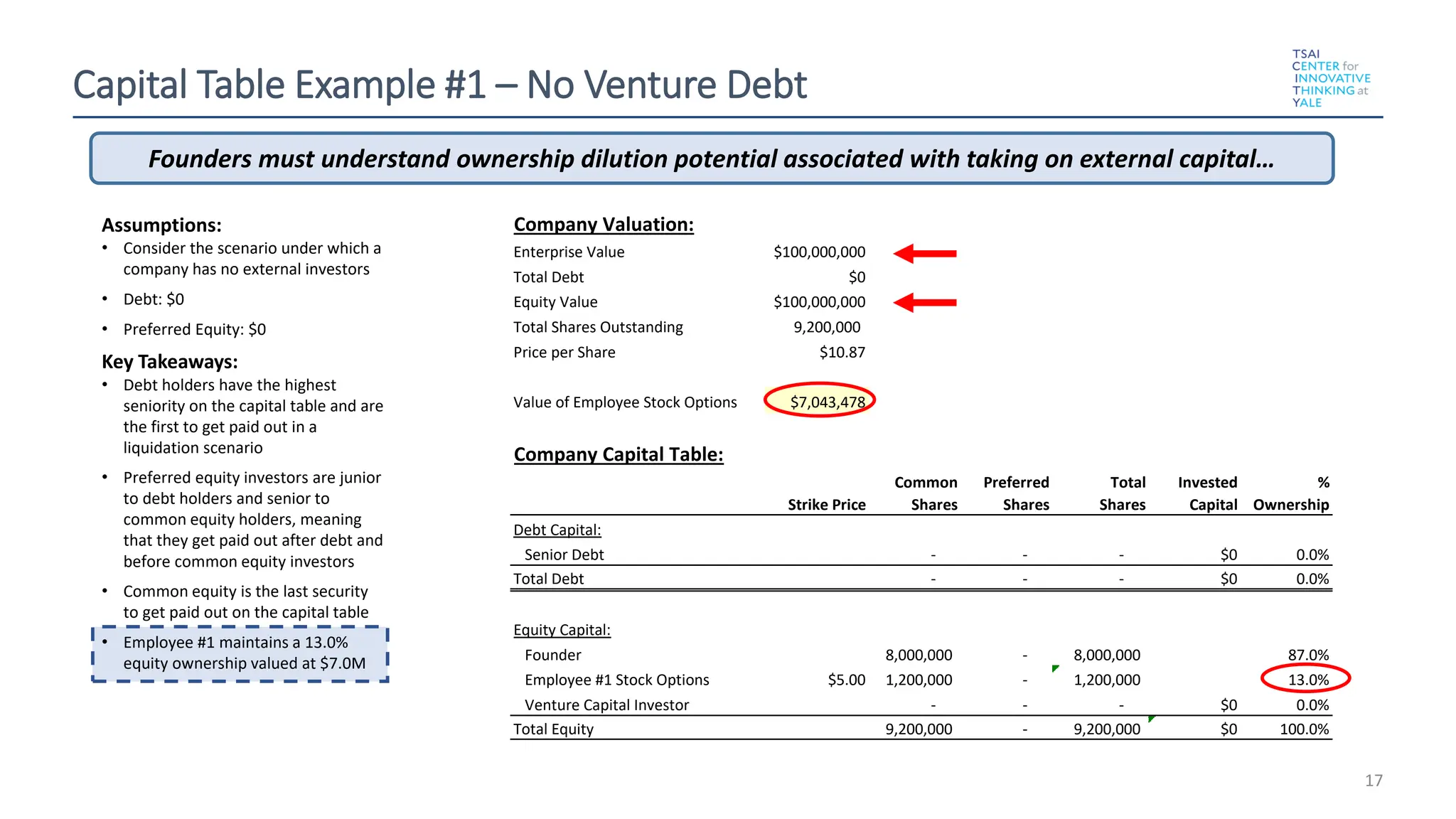
Capital Table Example#1 – No Venture Debt
17
Company Valuation:
Enterprise Value $100,000,000
Total Debt $0
Equity Value $100,000,000
Total Shares Outstanding 9,200,000
Price per Share $10.87
Value of Employee Stock Options $7,043,478
Company Capital Table:
Strike Price
Common
Shares
Preferred
Shares
Total
Shares
Invested
Capital
%
Ownership
Debt Capital:
Senior Debt - - - $0 0.0%
Total Debt - - - $0 0.0%
Equity Capital:
Founder 8,000,000 - 8,000,000 87.0%
Employee #1 Stock Options $5.00 1,200,000 - 1,200,000 13.0%
Venture Capital Investor - - - $0 0.0%
Total Equity 9,200,000 - 9,200,000 $0 100.0%
Assumptions:
• Consider the scenario under which a
company has no external investors
• Debt: $0
• Preferred Equity: $0
Key Takeaways:
• Debt holders have the highest
seniority on the capital table and are
the first to get paid out in a
liquidation scenario
• Preferred equity investors are junior
to debt holders and senior to
common equity holders, meaning
that they get paid out after debt and
before common equity investors
• Common equity is the last security
to get paid out on the capital table
• Employee #1 maintains a 13.0%
equity ownership valued at $7.0M
Founders must understand ownership dilution potential associated with taking on external capital…
18.
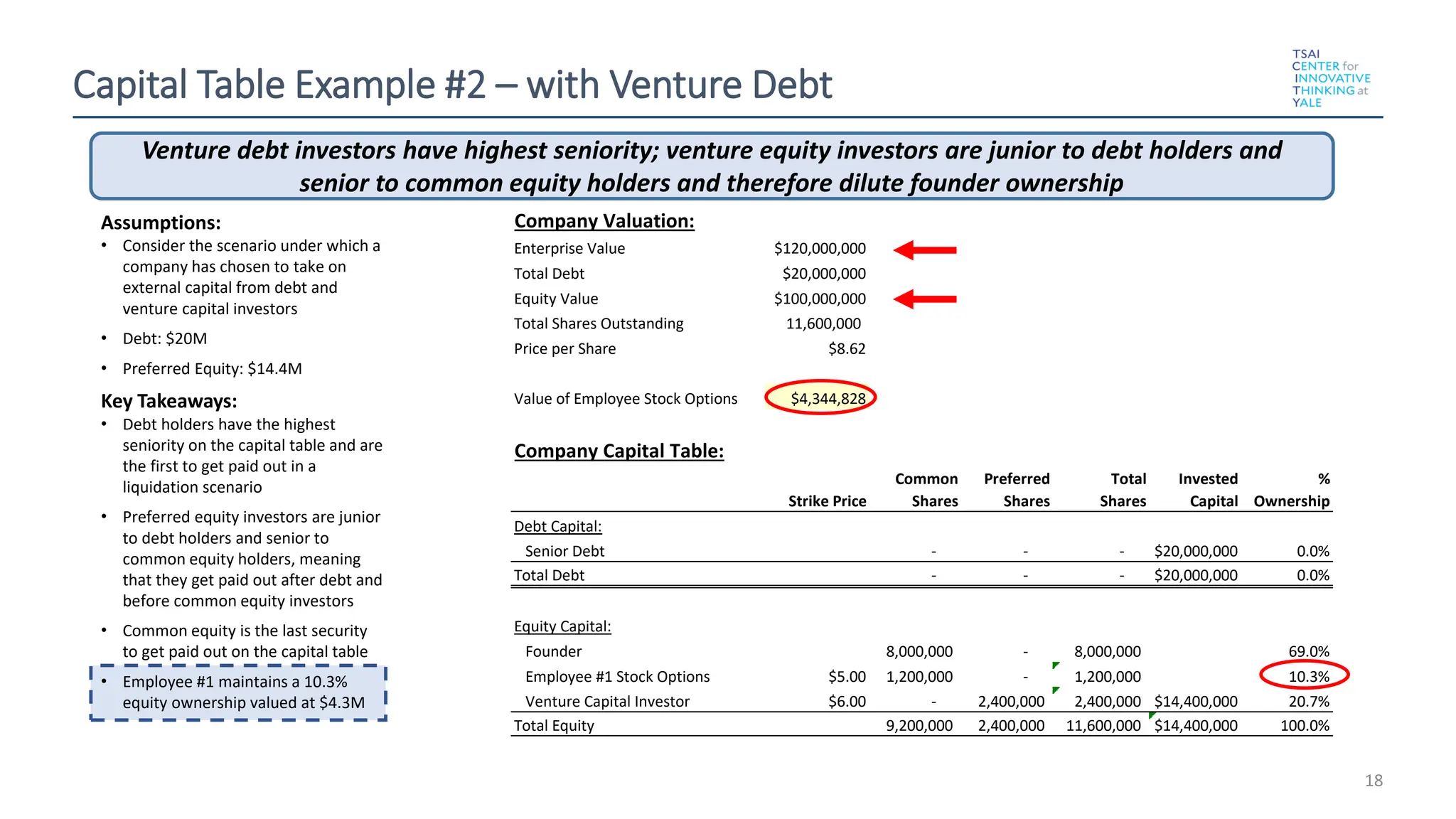
Capital Table Example#2 – with Venture Debt
18
Company Valuation:
Enterprise Value $120,000,000
Total Debt $20,000,000
Equity Value $100,000,000
Total Shares Outstanding 11,600,000
Price per Share $8.62
Value of Employee Stock Options $4,344,828
Company Capital Table:
Strike Price
Common
Shares
Preferred
Shares
Total
Shares
Invested
Capital
%
Ownership
Debt Capital:
Senior Debt - - - $20,000,000 0.0%
Total Debt - - - $20,000,000 0.0%
Equity Capital:
Founder 8,000,000 - 8,000,000 69.0%
Employee #1 Stock Options $5.00 1,200,000 - 1,200,000 10.3%
Venture Capital Investor $6.00 - 2,400,000 2,400,000 $14,400,000 20.7%
Total Equity 9,200,000 2,400,000 11,600,000 $14,400,000 100.0%
Assumptions:
• Consider the scenario under which a
company has chosen to take on
external capital from debt and
venture capital investors
• Debt: $20M
• Preferred Equity: $14.4M
Key Takeaways:
• Debt holders have the highest
seniority on the capital table and are
the first to get paid out in a
liquidation scenario
• Preferred equity investors are junior
to debt holders and senior to
common equity holders, meaning
that they get paid out after debt and
before common equity investors
• Common equity is the last security
to get paid out on the capital table
• Employee #1 maintains a 10.3%
equity ownership valued at $4.3M
Venture debt investors have highest seniority; venture equity investors are junior to debt holders and
senior to common equity holders and therefore dilute founder ownership
19.
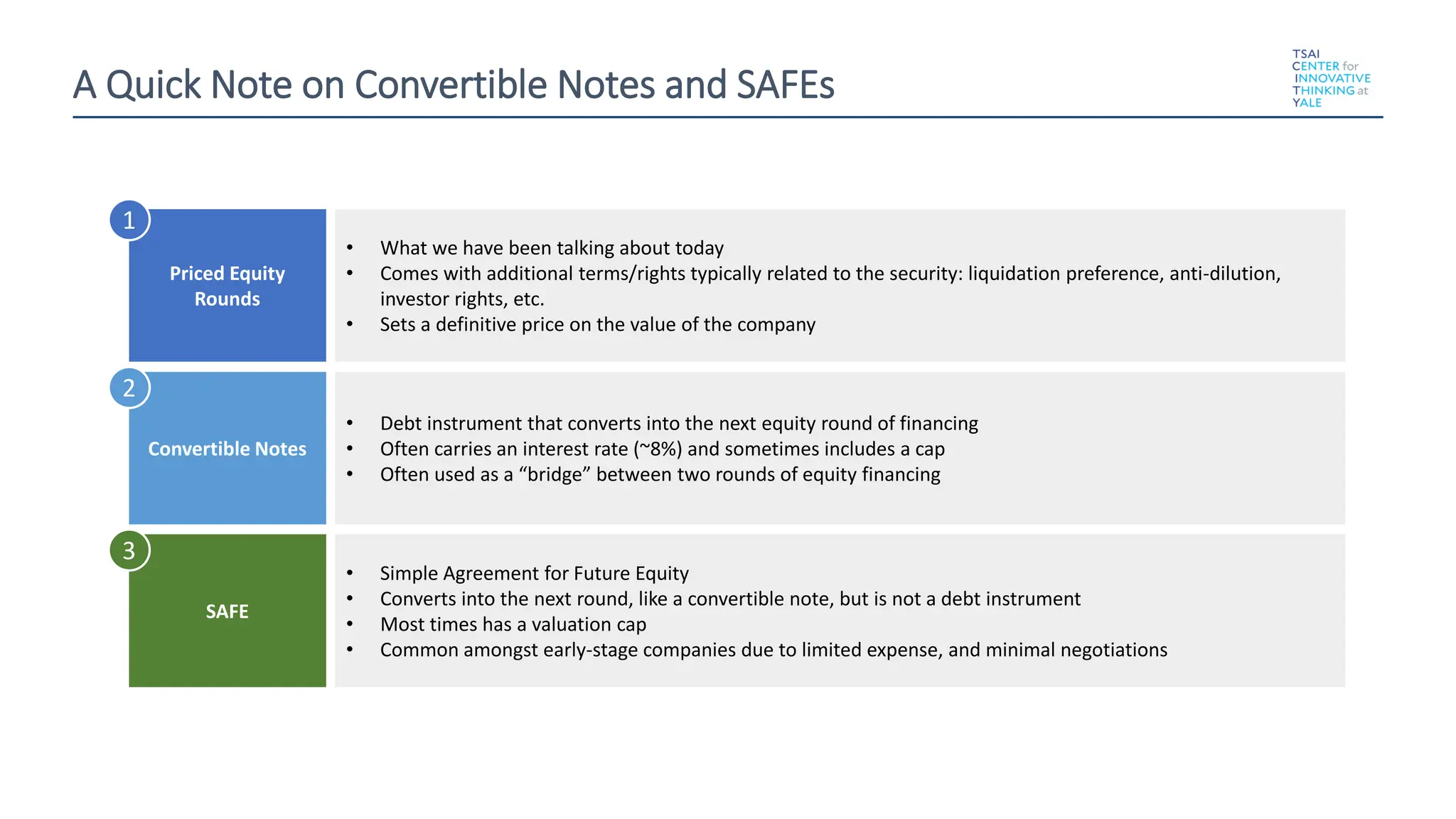
A Quick Noteon Convertible Notes and SAFEs
• What we have been talking about today
• Comes with additional terms/rights typically related to the security: liquidation preference, anti-dilution,
investor rights, etc.
• Sets a definitive price on the value of the company
Priced Equity
Rounds
• Debt instrument that converts into the next equity round of financing
• Often carries an interest rate (~8%) and sometimes includes a cap
• Often used as a “bridge” between two rounds of equity financing
Convertible Notes
• Simple Agreement for Future Equity
• Converts into the next round, like a convertible note, but is not a debt instrument
• Most times has a valuation cap
• Common amongst early-stage companies due to limited expense, and minimal negotiations
SAFE
1
2
3
20.
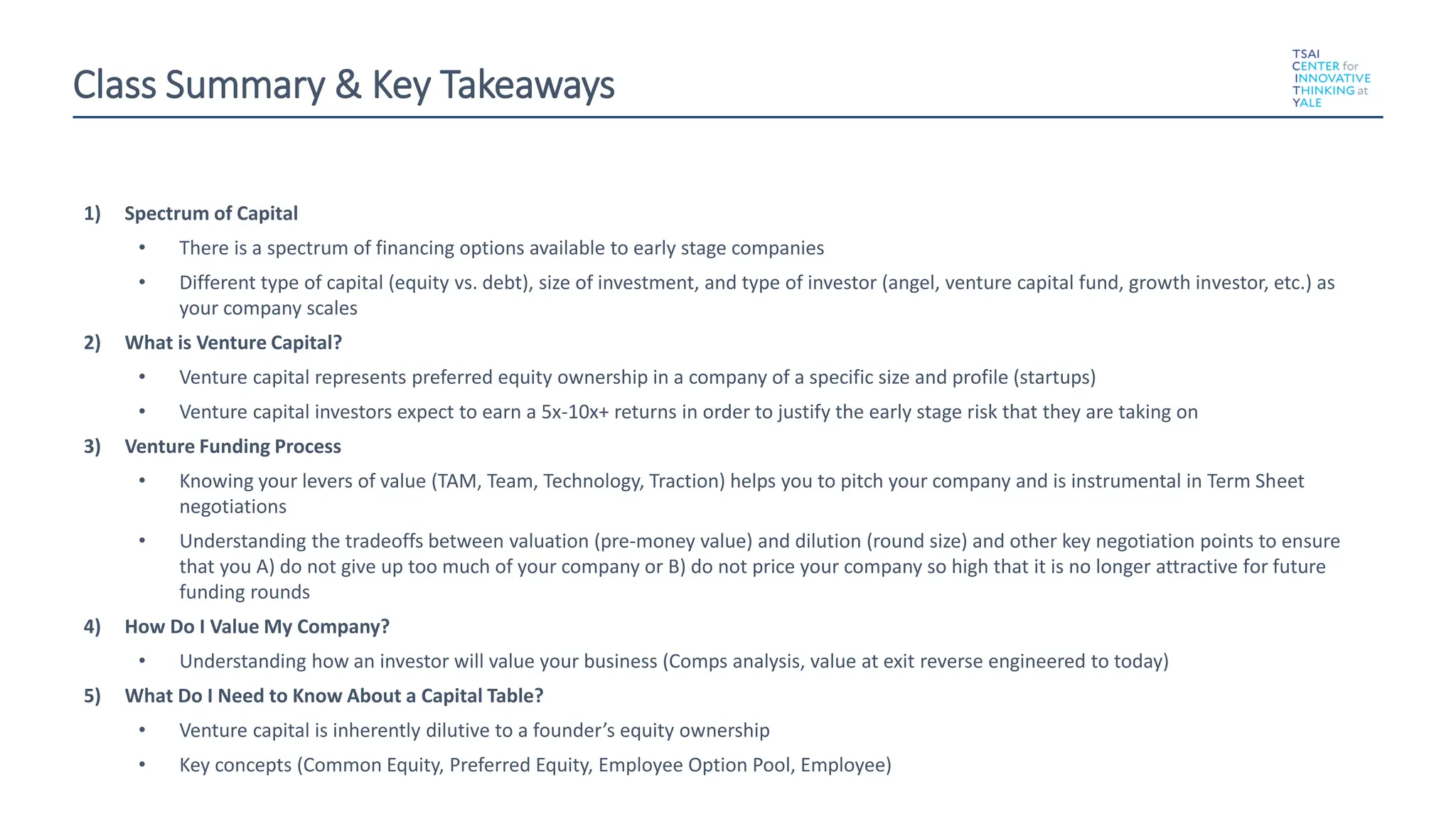
Class Summary &Key Takeaways
1) Spectrum of Capital
• There is a spectrum of financing options available to early stage companies
• Different type of capital (equity vs. debt), size of investment, and type of investor (angel, venture capital fund, growth investor, etc.) as
your company scales
2) What is Venture Capital?
• Venture capital represents preferred equity ownership in a company of a specific size and profile (startups)
• Venture capital investors expect to earn a 5x-10x+ returns in order to justify the early stage risk that they are taking on
3) Venture Funding Process
• Knowing your levers of value (TAM, Team, Technology, Traction) helps you to pitch your company and is instrumental in Term Sheet
negotiations
• Understanding the tradeoffs between valuation (pre-money value) and dilution (round size) and other key negotiation points to ensure
that you A) do not give up too much of your company or B) do not price your company so high that it is no longer attractive for future
funding rounds
4) How Do I Value My Company?
• Understanding how an investor will value your business (Comps analysis, value at exit reverse engineered to today)
5) What Do I Need to Know About a Capital Table?
• Venture capital is inherently dilutive to a founder’s equity ownership
• Key concepts (Common Equity, Preferred Equity, Employee Option Pool, Employee)
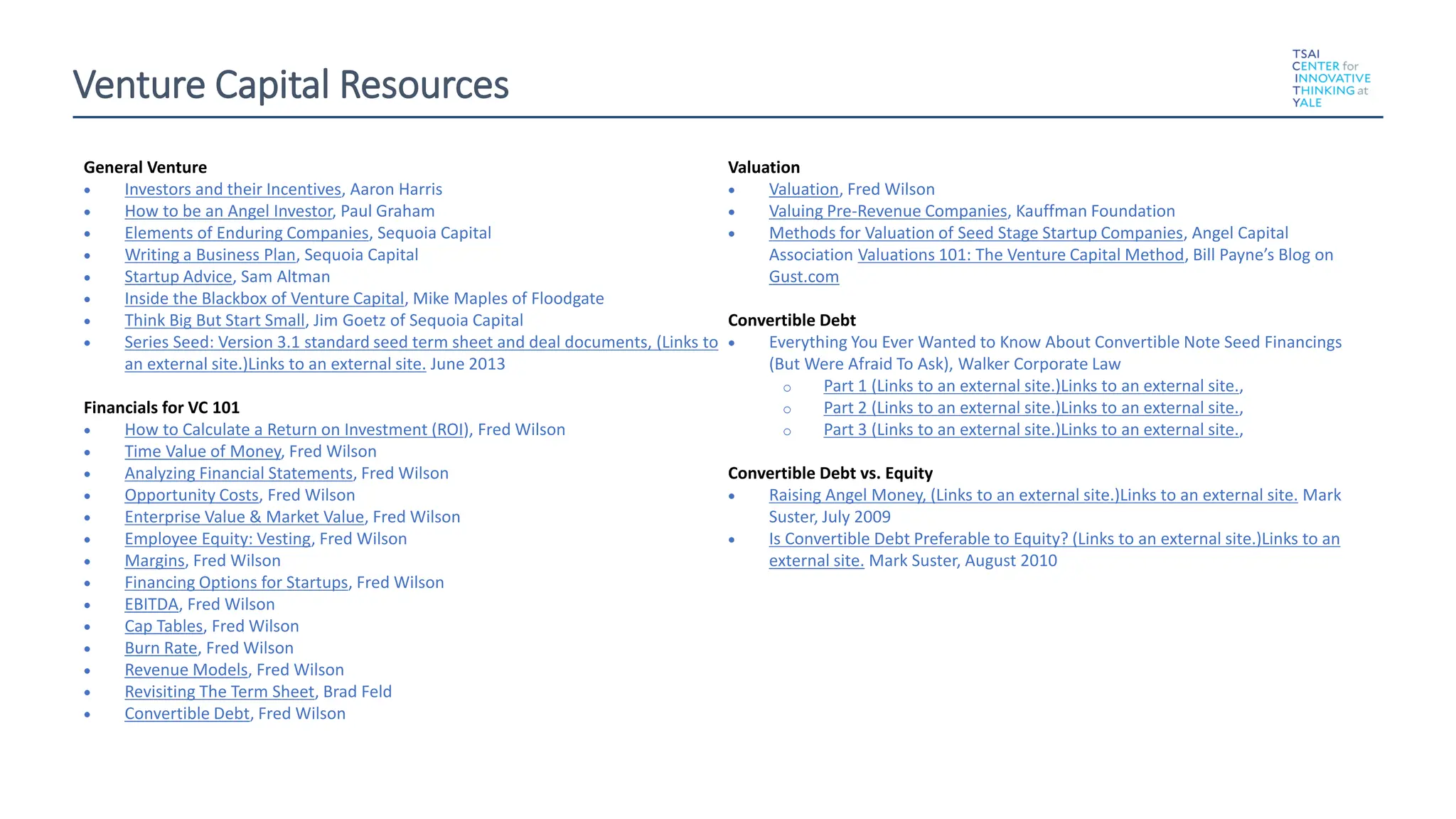
Venture Capital Resources
GeneralVenture
• Investors and their Incentives, Aaron Harris
• How to be an Angel Investor, Paul Graham
• Elements of Enduring Companies, Sequoia Capital
• Writing a Business Plan, Sequoia Capital
• Startup Advice, Sam Altman
• Inside the Blackbox of Venture Capital, Mike Maples of Floodgate
• Think Big But Start Small, Jim Goetz of Sequoia Capital
• Series Seed: Version 3.1 standard seed term sheet and deal documents, (Links to
an external site.)Links to an external site. June 2013
Financials for VC 101or VC 101:
• How to Calculate a Return on Investment (ROI), Fred Wilson
• Time Value of Money, Fred Wilson
• Analyzing Financial Statements, Fred Wilson
• Opportunity Costs, Fred Wilson
• Enterprise Value & Market Value, Fred Wilson
• Employee Equity: Vesting, Fred Wilson
• Margins, Fred Wilson
• Financing Options for Startups, Fred Wilson
• EBITDA, Fred Wilson
• Cap Tables, Fred Wilson
• Burn Rate, Fred Wilson
• Revenue Models, Fred Wilson
• Revisiting The Term Sheet, Brad Feld
• Convertible Debt, Fred Wilson
Valuation
• Valuation, Fred Wilson
• Valuing Pre-Revenue Companies, Kauffman Foundation
• Methods for Valuation of Seed Stage Startup Companies, Angel Capital
Association Valuations 101: The Venture Capital Method, Bill Payne’s Blog on
Gust.com
Convertible Debt
• Everything You Ever Wanted to Know About Convertible Note Seed Financings
(But Were Afraid To Ask), Walker Corporate Law
o Part 1 (Links to an external site.)Links to an external site.,
o Part 2 (Links to an external site.)Links to an external site.,
o Part 3 (Links to an external site.)Links to an external site.,
Convertible Debt vs. Equity
• Raising Angel Money, (Links to an external site.)Links to an external site. Mark
Suster, July 2009
• Is Convertible Debt Preferable to Equity? (Links to an external site.)Links to an
external site. Mark Suster, August 2010