VENTURE
CAPITAL
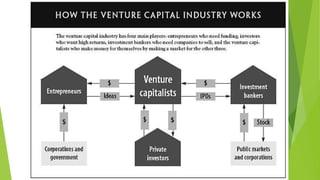
VENTURE CAPITAL
 The provision of funding for a start-up. For example, suppose a company with little access to
capital is attempting to open a new market or access an old one with a better product. It
may not be able to receive loans, either because of an unproven track record or because it
is already significantly in debt, and it may have exhausted financing from family and friends.
Venture capital allows this company to begin and build upon its operations by providing
necessary funding. Usually, the provider of venture capital takes equity in the company in
exchange for the money. Venture capital firms may also provide needed expertise in how to
run a business than can help the start-up become successful.
VENTURE CAPITAL INVESTMENT
PROCESS
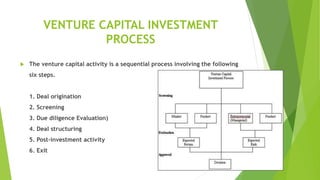
 The venture capital activity is a sequential process involving the following
six steps.
1. Deal origination
2. Screening
3. Due diligence Evaluation)
4. Deal structuring
5. Post-investment activity
6. Exit
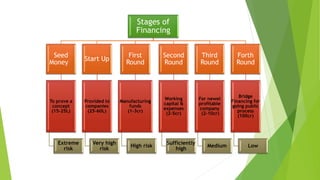
Stages of
Financing
Seed
Money
To prove a
concept
(15-25L)
Extreme
risk
Start Up
Provided to
companies
(25-60L)
Very high
risk
First
Round
Manufacturing
funds
(1-3cr)
High risk
Second
Round
Working
capital &
expenses
(2-5cr)
Sufficiently
high
Third
Round
For newel
profitable
company
(2-10cr)
Medium
Forth
Round
Bridge
Financing for
going public
process
(100cr)
Low
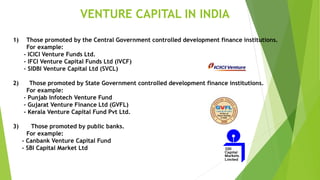
1) Those promoted by the Central Government controlled development finance institutions.
For example:
- ICICI Venture Funds Ltd.
- IFCI Venture Capital Funds Ltd (IVCF)
- SIDBI Venture Capital Ltd (SVCL)
2) Those promoted by State Government controlled development finance institutions.
For example:
- Punjab Infotech Venture Fund
- Gujarat Venture Finance Ltd (GVFL)
- Kerala Venture Capital Fund Pvt Ltd.
3) Those promoted by public banks.
For example:
- Canbank Venture Capital Fund
- SBI Capital Market Ltd
VENTURE CAPITAL IN INDIA
4)Those promoted by private sector
companies.
For example:
- IL&FS Trust Company Ltd
- Infinity Venture India Fund
5)Those established as an overseas venture capital fund.
For example:
- Walden International Investment Group
- HSBC Private Equity
management Mauritius Ltd
PIRAMAL GROUP
 The family office of Ajay Piramal is stepping into venture capital investing
to get a slice of the fast-growing entrepreneurial ecosystem in the country.
Known as being one of the savviest value investors in India Inc, Piramal is
backing the newly floated Montane Ventures, an early-stage fund, as its
anchor investor, a first such move by an Indian business conglomerate.
 Piramal's family office, sources said, is ploughing as much as $50 million
into Montane Ventures, which plans to raise up to $150 million with
participation from external investors, going forward. The Piramal group,
however, did not disclose how much the family office has invested in the
fund.
 Celebrated as an ace dealmaker, having reaped windfall gains by selling
stake in telecoms major Vodafone, Piramal, whose diversified group has
interests across pharmaceutical, finance and private equity, would stand
out as one of the first Indian business leaders to propel a pure-play
venture capital fund.
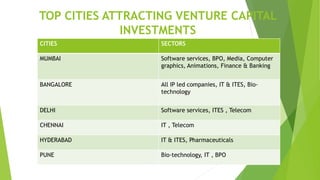
TOP CITIES ATTRACTING VENTURE CAPITAL
INVESTMENTS
CITIES SECTORS
MUMBAI Software services, BPO, Media, Computer
graphics, Animations, Finance & Banking
BANGALORE All IP led companies, IT & ITES, Bio-
technology
DELHI Software services, ITES , Telecom
CHENNAI IT , Telecom
HYDERABAD IT & ITES, Pharmaceuticals
PUNE Bio-technology, IT , BPO
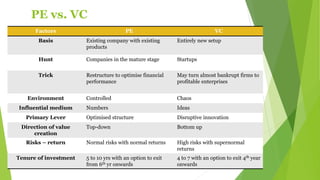
Factors PE VC
Basis Existing company with existing
products
Entirely new setup
Hunt Companies in the mature stage Startups
Trick Restructure to optimise financial
performance
May turn almost bankrupt firms to
profitable enterprises
Environment Controlled Chaos
Influential medium Numbers Ideas
Primary Lever Optimised structure Disruptive innovation
Direction of value
creation
Top-down Bottom up
Risks – return Normal risks with normal returns High risks with supernormal
returns
Tenure of investment 5 to 10 yrs with an option to exit
from 6th yr onwards
4 to 7 with an option to exit 4th year
onwards
PE vs. VC
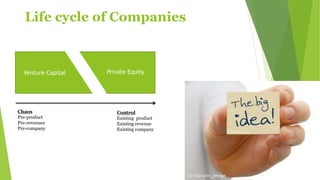
Life cycle of Companies
Venture Capital Private Equity
Chaos
Pre-product
Pre-revenues
Pre-company
Control
Existing product
Existing revenue
Existing company
SEBI Regulations
 AIF Regulations 2012 repealed the earlier regulations regarding VCF
 VCFs used as a common vehicle for all investments
 Original aim of promoting early-stage company seems to be neglected
 Features:
 VCFs should primarily invest in unlisted securities of startups, emerging
or early stage Venture Capital units
 To invest in new products, new services, technology or IP right based
activities or new business model
 Laid further investment restrictions with respect to corpus to be invested
MICRO VENTURE CAPITAL (MICRO VC)
• Micro venture capital is money invested to seed early-stage emerging companies with
amounts of finance that is typically less than that of traditional venture capital. In contrast
to traditional venture capital which is money used to invest in companies looking to fund
growth (also referred to as a Series A round of funding), micro venture capital consists of
smaller seed investments, typically between 50 lacs to 1.5Cr., in companies that have yet
to gain traction. In India the number of micro venture capital firms have continued to rise
rapidly over the last 5/6 years, and have become an important source of finance for start-
up companies.
• Characteristics Of Micro VC’s
A. Initial investment at the seed stage
B. Investment on behalf of 3rd party Limited Partners
C. Most commonly have fund sizes that are less than around 100 Cr.
• Most micro venture capital firms pursue start-ups that are at their seed stage because of
their lower initial cost basis. Though there is a high probability that the majority of these
start-ups will not survive long enough to reach a Series-A round of funding, micro venture
capital firms are willing to make the investment because start-ups generally do not require
large sums of capital to bring a product to market, and because they believe that it
requires only a few successful companies for them to see profitable returns.
• Normally big VC funds have very small investing teams & that limit the domain knowledge. In
early stage you need to know wide range of domain expertise.
• Normally such investments are less than a VC investment but more than a wealthy individuals
or angel funds.
Example : Kroc Flint & Candler launched 100 Cr. Fund & have invested in 2/30 start-ups where
the investment was ranging from 0.7 Cr. To 1.5Cr.
• The Micro VC help companies grow their ideas into viable business models
• The risk is high but if the bet goes well then returns are really very rich. 20 to 30 times the
investment.
Example : Utilis, Unicorn ventures & Endiya partners meet the crucial needs of the companies
making the first institutional investment in a start-up just about when it figures out that the
product is market fit.
• Presently there are 12 Micro VCs are operating in India. These Micro VC’s keep the flow alive
which allows the bigger players like SAIF partners etc. to invest in Series-A deals in matured
start-ups.
• The big players have also started to form Micro VC’s with an idea of scooping up a huge &
successful start-up.
• Professional from VC funds have started quitting their jobs & are showing inclination towards
micro VC’s
• Challenges
1. Such investor will face fewer Series-A deals as the same will go to bigger VC’s & the
important deals will never come to Micro VC’s.
2. Most of Micro VC’s are equipped with professionals & who neither have entrepreneurial
background nor thorough understanding of how VC works.
THANKYOU
MANALI DALVI 13
ABHISHEK DARIRA 14
NANCY FERNANDES 15
HARESH GALA 16
SUNIL GODBOLE 17

Venture capital

  • 1.
  • 2.
    VENTURE CAPITAL  Theprovision of funding for a start-up. For example, suppose a company with little access to capital is attempting to open a new market or access an old one with a better product. It may not be able to receive loans, either because of an unproven track record or because it is already significantly in debt, and it may have exhausted financing from family and friends. Venture capital allows this company to begin and build upon its operations by providing necessary funding. Usually, the provider of venture capital takes equity in the company in exchange for the money. Venture capital firms may also provide needed expertise in how to run a business than can help the start-up become successful.
  • 3.
    VENTURE CAPITAL INVESTMENT PROCESS The venture capital activity is a sequential process involving the following six steps. 1. Deal origination 2. Screening 3. Due diligence Evaluation) 4. Deal structuring 5. Post-investment activity 6. Exit
  • 4.
    Stages of Financing Seed Money To provea concept (15-25L) Extreme risk Start Up Provided to companies (25-60L) Very high risk First Round Manufacturing funds (1-3cr) High risk Second Round Working capital & expenses (2-5cr) Sufficiently high Third Round For newel profitable company (2-10cr) Medium Forth Round Bridge Financing for going public process (100cr) Low
  • 5.
    1) Those promotedby the Central Government controlled development finance institutions. For example: - ICICI Venture Funds Ltd. - IFCI Venture Capital Funds Ltd (IVCF) - SIDBI Venture Capital Ltd (SVCL) 2) Those promoted by State Government controlled development finance institutions. For example: - Punjab Infotech Venture Fund - Gujarat Venture Finance Ltd (GVFL) - Kerala Venture Capital Fund Pvt Ltd. 3) Those promoted by public banks. For example: - Canbank Venture Capital Fund - SBI Capital Market Ltd VENTURE CAPITAL IN INDIA
  • 6.
    4)Those promoted byprivate sector companies. For example: - IL&FS Trust Company Ltd - Infinity Venture India Fund 5)Those established as an overseas venture capital fund. For example: - Walden International Investment Group - HSBC Private Equity management Mauritius Ltd
  • 7.
    PIRAMAL GROUP  Thefamily office of Ajay Piramal is stepping into venture capital investing to get a slice of the fast-growing entrepreneurial ecosystem in the country. Known as being one of the savviest value investors in India Inc, Piramal is backing the newly floated Montane Ventures, an early-stage fund, as its anchor investor, a first such move by an Indian business conglomerate.  Piramal's family office, sources said, is ploughing as much as $50 million into Montane Ventures, which plans to raise up to $150 million with participation from external investors, going forward. The Piramal group, however, did not disclose how much the family office has invested in the fund.  Celebrated as an ace dealmaker, having reaped windfall gains by selling stake in telecoms major Vodafone, Piramal, whose diversified group has interests across pharmaceutical, finance and private equity, would stand out as one of the first Indian business leaders to propel a pure-play venture capital fund.
  • 8.
    TOP CITIES ATTRACTINGVENTURE CAPITAL INVESTMENTS CITIES SECTORS MUMBAI Software services, BPO, Media, Computer graphics, Animations, Finance & Banking BANGALORE All IP led companies, IT & ITES, Bio- technology DELHI Software services, ITES , Telecom CHENNAI IT , Telecom HYDERABAD IT & ITES, Pharmaceuticals PUNE Bio-technology, IT , BPO
  • 10.
    Factors PE VC BasisExisting company with existing products Entirely new setup Hunt Companies in the mature stage Startups Trick Restructure to optimise financial performance May turn almost bankrupt firms to profitable enterprises Environment Controlled Chaos Influential medium Numbers Ideas Primary Lever Optimised structure Disruptive innovation Direction of value creation Top-down Bottom up Risks – return Normal risks with normal returns High risks with supernormal returns Tenure of investment 5 to 10 yrs with an option to exit from 6th yr onwards 4 to 7 with an option to exit 4th year onwards PE vs. VC
  • 11.
    Life cycle ofCompanies Venture Capital Private Equity Chaos Pre-product Pre-revenues Pre-company Control Existing product Existing revenue Existing company
  • 12.
    SEBI Regulations  AIFRegulations 2012 repealed the earlier regulations regarding VCF  VCFs used as a common vehicle for all investments  Original aim of promoting early-stage company seems to be neglected  Features:  VCFs should primarily invest in unlisted securities of startups, emerging or early stage Venture Capital units  To invest in new products, new services, technology or IP right based activities or new business model  Laid further investment restrictions with respect to corpus to be invested
  • 13.
    MICRO VENTURE CAPITAL(MICRO VC) • Micro venture capital is money invested to seed early-stage emerging companies with amounts of finance that is typically less than that of traditional venture capital. In contrast to traditional venture capital which is money used to invest in companies looking to fund growth (also referred to as a Series A round of funding), micro venture capital consists of smaller seed investments, typically between 50 lacs to 1.5Cr., in companies that have yet to gain traction. In India the number of micro venture capital firms have continued to rise rapidly over the last 5/6 years, and have become an important source of finance for start- up companies. • Characteristics Of Micro VC’s A. Initial investment at the seed stage B. Investment on behalf of 3rd party Limited Partners C. Most commonly have fund sizes that are less than around 100 Cr. • Most micro venture capital firms pursue start-ups that are at their seed stage because of their lower initial cost basis. Though there is a high probability that the majority of these start-ups will not survive long enough to reach a Series-A round of funding, micro venture capital firms are willing to make the investment because start-ups generally do not require large sums of capital to bring a product to market, and because they believe that it requires only a few successful companies for them to see profitable returns.
  • 14.
    • Normally bigVC funds have very small investing teams & that limit the domain knowledge. In early stage you need to know wide range of domain expertise. • Normally such investments are less than a VC investment but more than a wealthy individuals or angel funds. Example : Kroc Flint & Candler launched 100 Cr. Fund & have invested in 2/30 start-ups where the investment was ranging from 0.7 Cr. To 1.5Cr. • The Micro VC help companies grow their ideas into viable business models • The risk is high but if the bet goes well then returns are really very rich. 20 to 30 times the investment. Example : Utilis, Unicorn ventures & Endiya partners meet the crucial needs of the companies making the first institutional investment in a start-up just about when it figures out that the product is market fit. • Presently there are 12 Micro VCs are operating in India. These Micro VC’s keep the flow alive which allows the bigger players like SAIF partners etc. to invest in Series-A deals in matured start-ups.
  • 15.
    • The bigplayers have also started to form Micro VC’s with an idea of scooping up a huge & successful start-up. • Professional from VC funds have started quitting their jobs & are showing inclination towards micro VC’s • Challenges 1. Such investor will face fewer Series-A deals as the same will go to bigger VC’s & the important deals will never come to Micro VC’s. 2. Most of Micro VC’s are equipped with professionals & who neither have entrepreneurial background nor thorough understanding of how VC works.
  • 16.
    THANKYOU MANALI DALVI 13 ABHISHEKDARIRA 14 NANCY FERNANDES 15 HARESH GALA 16 SUNIL GODBOLE 17

Editor's Notes

  • #5 1. Seed Money: Low level financing needed to prove a new idea. 2. Start-up: Early stage firms that need funding for expenses associated with marketing and product development. 3. First-Round: Early sales and manufacturing funds. 4. Second-Round: Working capital for early stage companies that are selling product, but not yet turning a profit . 5. Third-Round: Also called Mezzanine financing, this is expansion money for a newly profitable company 6. Fourth-Round: Also called bridge financing, it is intended to finance the "going public" process Financial Stage Period (Funds locked in years) Risk Perception Activity to be financed Seed Money 7-10 Extreme Idea or R&D for product development Start Up 5-9 Very High Initializing operations or developing prototypes First Stage 3-7 High Start commercials production and marketing Financial Stage Period (Funds locked in years) Risk Perception Activity to be financed Second Stage 3-5 Sufficiently high Expand market and growing working capital need Third Stage 1-3 Medium Market expansion, acquisition & product development for profit making company Fourth Stage 1-3 Low Facilitating public issue
  • #11 http://www.mergersandinquisitions.com/private-equity-vs-venture-capital/