Vaccines –Production And
Application
Sana Shaikh
MSc – I; sem - I
Department Of Biochemistry
Institute Of Science

13.09.2013

1
Index
Slide no

Topics

3

Vaccine – An Introduction

4

Vaccine – History

5

Vaccine - Production

7

Application Of vaccine- Measels Vaccine

8

Application Of Vaccine- Polio Vaccine

9

Application Of Vaccine- Typhoid Vaccine

10

Application Of Vaccine- Hepatites B Vaccine

11

Application Of Vaccine- Tetenus Vaccine

12

Current Research

14

Refernces

13.09.2013

2
Vaccines –
An Introduction
• A vaccine is a biological preparation that improves immunity to a
particular disease.
• The term vaccine derives from Edward Jenner's 1796 use of cow
pox to inoculate humans, providing them protection against smallpox
• Vaccines may be prophylactic or therapeutic .
• Vaccines are killed, attenuated,toxoid, protein subunit or conjugate.
• Vaccines do not guarantee complete protection from a disease.

13.09.2013

3
History

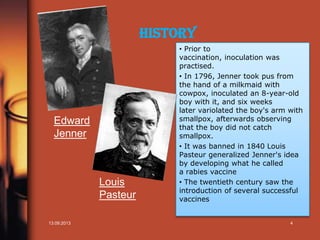
Edward
Jenner

Louis
Pasteur
13.09.2013

• Prior to
vaccination, inoculation was
practised.
• In 1796, Jenner took pus from
the hand of a milkmaid with
cowpox, inoculated an 8-year-old
boy with it, and six weeks
later variolated the boy's arm with
smallpox, afterwards observing
that the boy did not catch
smallpox.
• It was banned in 1840 Louis
Pasteur generalized Jenner's idea
by developing what he called
a rabies vaccine
• The twentieth century saw the
introduction of several successful
vaccines

4
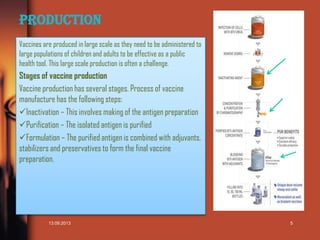
Production
Vaccines are produced in large scale as they need to be administered to
large populations of children and adults to be effective as a public
health tool. This large scale production is often a challenge.

Stages of vaccine production
Vaccine production has several stages. Process of vaccine
manufacture has the following steps:
Inactivation – This involves making of the antigen preparation
Purification – The isolated antigen is purified
Formulation – The purified antigen is combined with adjuvants,
stabilizers and preservatives to form the final vaccine
preparation.

13.09.2013

5
Applications
Vaccines have been used to prevent many
disease.Now for almost all the disease .
We would be considering Vaccines for
Measles, Poliomyelitis,Typhoid,
Hepatitis B, anti –tetanus.

13.09.2013

6
Measels Vaccine
• Measles vaccine is a highly effective vaccine used against measles.
• The measles-mumps-rubella-varicella combo (MMRV vaccine)
vaccine has been available since 2005
• Measles is rarely given as individual vaccine nowadays and is often
given in combination with mumps and rubella. Two types of vaccines
are available for measles currently.
• Mumps Measles Rubella vaccine, live (MMR-II)
• Mumps Measles Rubella and varicella virus vaccine.
Dose Schedule
1st dose at the age of 12 months
2nd dose at the age of four to six years

13.09.2013

7
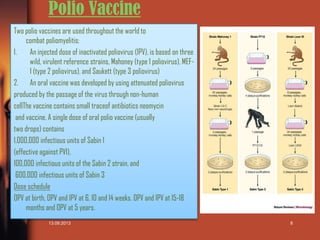
Polio Vaccine
Two polio vaccines are used throughout the world to
combat poliomyelitis;
1.
An injected dose of inactivated poliovirus (IPV), is based on three
wild, virulent reference strains, Mahoney (type 1 poliovirus), MEF1 (type 2 poliovirus), and Saukett (type 3 poliovirus)
2. An oral vaccine was developed by using attenuated poliovirus
produced by the passage of the virus through non-human
cellThe vaccine contains small traceof antibiotics neomycin
and vaccine. A single dose of oral polio vaccine (usually
two drops) contains
1,000,000 infectious units of Sabin 1
(effective against PV1),
100,000 infectious units of the Sabin 2 strain, and
600,000 infectious units of Sabin 3
Dose schedule
OPV at birth, OPV and IPV at 6, 10 and 14 weeks. OPV and IPV at 15-18
months and OPV at 5 years.
13.09.2013

8
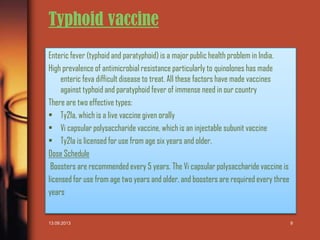
Typhoid vaccine
Enteric fever (typhoid and paratyphoid) is a major public health problem in India.
High prevalence of antimicrobial resistance particularly to quinolones has made
enteric feva difficult disease to treat. All these factors have made vaccines
against typhoid and paratyphoid fever of immense need in our country
There are two effective types:
• Ty21a, which is a live vaccine given orally
• Vi capsular polysaccharide vaccine, which is an injectable subunit vaccine
• Ty21a is licensed for use from age six years and older.
Dose Schedule
Boosters are recommended every 5 years. The Vi capsular polysaccharide vaccine is
licensed for use from age two years and older, and boosters are required every three
years

13.09.2013

9
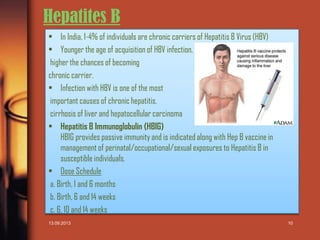
Hepatites B
• In India, 1-4% of individuals are chronic carriers of Hepatitis B Virus (HBV)
• Younger the age of acquisition of HBV infection,
higher the chances of becoming
chronic carrier.
• Infection with HBV is one of the most
important causes of chronic hepatitis,
cirrhosis of liver and hepatocellular carcinoma
• Hepatitis B Immunoglobulin (HBIG)
HBIG provides passive immunity and is indicated along with Hep B vaccine in
management of perinatal/occupational/sexual exposures to Hepatitis B in
susceptible individuals.
• Dose Schedule
a. Birth, 1 and 6 months
b. Birth, 6 and 14 weeks
c. 6, 10 and 14 weeks
13.09.2013

10
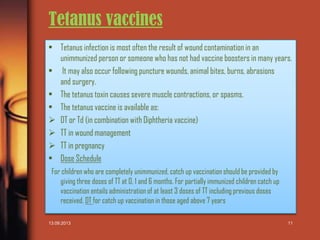
Tetanus vaccines
• Tetanus infection is most often the result of wound contamination in an
unimmunized person or someone who has not had vaccine boosters in many years.
• It may also occur following puncture wounds, animal bites, burns, abrasions
and surgery.
• The tetanus toxin causes severe muscle contractions, or spasms.
• The tetanus vaccine is available as:
 DT or Td (in combination with Diphtheria vaccine)
 TT in wound management
 TT in pregnancy
• Dose Schedule
For children who are completely unimmunized, catch up vaccination should be provided by
giving three doses of TT at 0, 1 and 6 months. For partially immunized children catch up
vaccination entails administration of at least 3 doses of TT including previous doses
received. DT for catch up vaccination in those aged above 7 years
13.09.2013

11
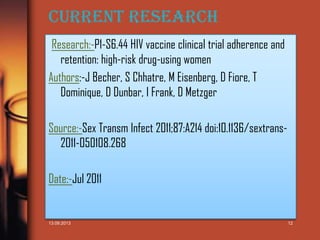
Current research
Research:-P1-S6.44 HIV vaccine clinical trial adherence and
retention: high-risk drug-using women
Authors:-J Becher, S Chhatre, M Eisenberg, D Fiore, T
Dominique, D Dunbar, I Frank, D Metzger
Source:-Sex Transm Infect 2011;87:A214 doi:10.1136/sextrans2011-050108.268
Date:-Jul 2011

13.09.2013

12
Abstract
•

•

Background Clinical trial protocol adherence and retention are often considered
challenges that are especially difficult to achieve among certain high-risk populations. The
HIV infection rate among heterosexual African-American women is increasing, making their
participation in clinical trials of HIV behavioural and biomedical prevention interventions
more important. We identify drug use and sex risk factors associated with adherence to
protocol and study retention among this population during the course of an HIV vaccine
trial.
Conclusions Factors commonly assumed to interfere with trial participation were not
associated with adherence to study protocol or retention. These findings suggest that drug
use and sexual risk behaviours do not impede completion of vaccinations and protocol
required visits in clinical trials of experimental HIV vaccines.

13.09.2013

13
Reference
• http://en.wikipedia.org/wiki/Vaccine
• http://www.vaccines.gov/who_and_when/index.html
• http://www.news-medical.net/health/Vaccine-Production.aspx
• http://www.greenmedinfo.com/Abstract Title:
Hepatitis B vaccine induces apoptotic death in Hepa1-6 cells.Abstract Author(s):
Heyam Hamza, Jianhua Cao, Xinyun Li, Changchun Li, Mengjin Zhu, Shuhong Zhao
 http://www.vaccineschedule.in
• ttp://www.immunizationinfo.org
• http://tav.sagepub.com/; Therapeutic Advances in Vaccines; May 2013 -

September

• http://sti.bmj.com/content/87/Sex Transm
Infect 2011;87:A214 doi:10.1136/sextrans-2011-050108.26

13.09.2013

14
13.09.2013

15

Vaccines –production and application

  • 1.
    Vaccines –Production And Application SanaShaikh MSc – I; sem - I Department Of Biochemistry Institute Of Science 13.09.2013 1
  • 2.
    Index Slide no Topics 3 Vaccine –An Introduction 4 Vaccine – History 5 Vaccine - Production 7 Application Of vaccine- Measels Vaccine 8 Application Of Vaccine- Polio Vaccine 9 Application Of Vaccine- Typhoid Vaccine 10 Application Of Vaccine- Hepatites B Vaccine 11 Application Of Vaccine- Tetenus Vaccine 12 Current Research 14 Refernces 13.09.2013 2
  • 3.
    Vaccines – An Introduction •A vaccine is a biological preparation that improves immunity to a particular disease. • The term vaccine derives from Edward Jenner's 1796 use of cow pox to inoculate humans, providing them protection against smallpox • Vaccines may be prophylactic or therapeutic . • Vaccines are killed, attenuated,toxoid, protein subunit or conjugate. • Vaccines do not guarantee complete protection from a disease. 13.09.2013 3
  • 4.
    History Edward Jenner Louis Pasteur 13.09.2013 • Prior to vaccination,inoculation was practised. • In 1796, Jenner took pus from the hand of a milkmaid with cowpox, inoculated an 8-year-old boy with it, and six weeks later variolated the boy's arm with smallpox, afterwards observing that the boy did not catch smallpox. • It was banned in 1840 Louis Pasteur generalized Jenner's idea by developing what he called a rabies vaccine • The twentieth century saw the introduction of several successful vaccines 4
  • 5.
    Production Vaccines are producedin large scale as they need to be administered to large populations of children and adults to be effective as a public health tool. This large scale production is often a challenge. Stages of vaccine production Vaccine production has several stages. Process of vaccine manufacture has the following steps: Inactivation – This involves making of the antigen preparation Purification – The isolated antigen is purified Formulation – The purified antigen is combined with adjuvants, stabilizers and preservatives to form the final vaccine preparation. 13.09.2013 5
  • 6.
    Applications Vaccines have beenused to prevent many disease.Now for almost all the disease . We would be considering Vaccines for Measles, Poliomyelitis,Typhoid, Hepatitis B, anti –tetanus. 13.09.2013 6
  • 7.
    Measels Vaccine • Measlesvaccine is a highly effective vaccine used against measles. • The measles-mumps-rubella-varicella combo (MMRV vaccine) vaccine has been available since 2005 • Measles is rarely given as individual vaccine nowadays and is often given in combination with mumps and rubella. Two types of vaccines are available for measles currently. • Mumps Measles Rubella vaccine, live (MMR-II) • Mumps Measles Rubella and varicella virus vaccine. Dose Schedule 1st dose at the age of 12 months 2nd dose at the age of four to six years 13.09.2013 7
  • 8.
    Polio Vaccine Two poliovaccines are used throughout the world to combat poliomyelitis; 1. An injected dose of inactivated poliovirus (IPV), is based on three wild, virulent reference strains, Mahoney (type 1 poliovirus), MEF1 (type 2 poliovirus), and Saukett (type 3 poliovirus) 2. An oral vaccine was developed by using attenuated poliovirus produced by the passage of the virus through non-human cellThe vaccine contains small traceof antibiotics neomycin and vaccine. A single dose of oral polio vaccine (usually two drops) contains 1,000,000 infectious units of Sabin 1 (effective against PV1), 100,000 infectious units of the Sabin 2 strain, and 600,000 infectious units of Sabin 3 Dose schedule OPV at birth, OPV and IPV at 6, 10 and 14 weeks. OPV and IPV at 15-18 months and OPV at 5 years. 13.09.2013 8
  • 9.
    Typhoid vaccine Enteric fever(typhoid and paratyphoid) is a major public health problem in India. High prevalence of antimicrobial resistance particularly to quinolones has made enteric feva difficult disease to treat. All these factors have made vaccines against typhoid and paratyphoid fever of immense need in our country There are two effective types: • Ty21a, which is a live vaccine given orally • Vi capsular polysaccharide vaccine, which is an injectable subunit vaccine • Ty21a is licensed for use from age six years and older. Dose Schedule Boosters are recommended every 5 years. The Vi capsular polysaccharide vaccine is licensed for use from age two years and older, and boosters are required every three years 13.09.2013 9
  • 10.
    Hepatites B • InIndia, 1-4% of individuals are chronic carriers of Hepatitis B Virus (HBV) • Younger the age of acquisition of HBV infection, higher the chances of becoming chronic carrier. • Infection with HBV is one of the most important causes of chronic hepatitis, cirrhosis of liver and hepatocellular carcinoma • Hepatitis B Immunoglobulin (HBIG) HBIG provides passive immunity and is indicated along with Hep B vaccine in management of perinatal/occupational/sexual exposures to Hepatitis B in susceptible individuals. • Dose Schedule a. Birth, 1 and 6 months b. Birth, 6 and 14 weeks c. 6, 10 and 14 weeks 13.09.2013 10
  • 11.
    Tetanus vaccines • Tetanusinfection is most often the result of wound contamination in an unimmunized person or someone who has not had vaccine boosters in many years. • It may also occur following puncture wounds, animal bites, burns, abrasions and surgery. • The tetanus toxin causes severe muscle contractions, or spasms. • The tetanus vaccine is available as:  DT or Td (in combination with Diphtheria vaccine)  TT in wound management  TT in pregnancy • Dose Schedule For children who are completely unimmunized, catch up vaccination should be provided by giving three doses of TT at 0, 1 and 6 months. For partially immunized children catch up vaccination entails administration of at least 3 doses of TT including previous doses received. DT for catch up vaccination in those aged above 7 years 13.09.2013 11
  • 12.
    Current research Research:-P1-S6.44 HIVvaccine clinical trial adherence and retention: high-risk drug-using women Authors:-J Becher, S Chhatre, M Eisenberg, D Fiore, T Dominique, D Dunbar, I Frank, D Metzger Source:-Sex Transm Infect 2011;87:A214 doi:10.1136/sextrans2011-050108.268 Date:-Jul 2011 13.09.2013 12
  • 13.
    Abstract • • Background Clinical trialprotocol adherence and retention are often considered challenges that are especially difficult to achieve among certain high-risk populations. The HIV infection rate among heterosexual African-American women is increasing, making their participation in clinical trials of HIV behavioural and biomedical prevention interventions more important. We identify drug use and sex risk factors associated with adherence to protocol and study retention among this population during the course of an HIV vaccine trial. Conclusions Factors commonly assumed to interfere with trial participation were not associated with adherence to study protocol or retention. These findings suggest that drug use and sexual risk behaviours do not impede completion of vaccinations and protocol required visits in clinical trials of experimental HIV vaccines. 13.09.2013 13
  • 14.
    Reference • http://en.wikipedia.org/wiki/Vaccine • http://www.vaccines.gov/who_and_when/index.html •http://www.news-medical.net/health/Vaccine-Production.aspx • http://www.greenmedinfo.com/Abstract Title: Hepatitis B vaccine induces apoptotic death in Hepa1-6 cells.Abstract Author(s): Heyam Hamza, Jianhua Cao, Xinyun Li, Changchun Li, Mengjin Zhu, Shuhong Zhao  http://www.vaccineschedule.in • ttp://www.immunizationinfo.org • http://tav.sagepub.com/; Therapeutic Advances in Vaccines; May 2013 - September • http://sti.bmj.com/content/87/Sex Transm Infect 2011;87:A214 doi:10.1136/sextrans-2011-050108.26 13.09.2013 14
  • 15.