ART 100
Summer 2015
Class 6
Writing the
Description
Assignment
writing course papers
paperclip description assignment
due 7.6.15 by 5 PM
description paper
due 7.7.15 by 5 PM
analysis paper
due 7.14.15 by 5 PM
paperclip assignment
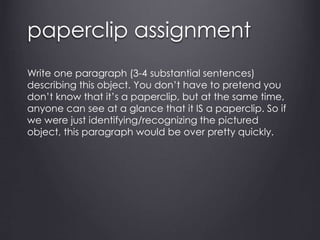
Write one paragraph (3-4 substantial sentences)
describing this object. You don’t have to pretend you
don’t know that it’s a paperclip, but at the same time,
anyone can see at a glance that it IS a paperclip. So if
we were just identifying/recognizing the pictured
object, this paragraph would be over pretty quickly.
Instead, the idea of this paragraph is to practice what
we discussed last time—the possibility of using an
intensive visual study of the paperclip to restore the
strangeness of perception.
If the process of doing this seems strange, awkward,
slow, difficult, and unfamiliar, then you are doing it
correctly. This assignment asks you to “defamiliarize” an
ordinary object through sustained visual attention,
much as Viktor Shklovsky claims that art can “make the
stone stony.”
TIPS for good descriptive
paragraphs:
• Show the reader in language as vivid and concrete
as possible what you are SEEING, not what you are
thinking, remembering, or speculating about.
• Avoid sharing your reactions; rather FOCUS ON THE
OBJECT itself and try to evoke its appearance as
completely as possible and as specifically as possible.
• Think about using your writing as a vehicle to express
the look of a visual thing; try to find words that are
richly descriptive and precise to bring to mind the
shape, color, texture, and so on that you are seeing
in the object.
• Avoid the extremes of science and poetry in your
description; aim to evoke in simple language what
this thing actually looks like.
description assignment
FIRST
The first and most important step is LOOKING at the
image. Take your time. Give yourself a chance just to
look at the picture, without necessarily thinking anything
in particular or worrying about what you are going to
say.
SECOND
Start to think more specifically about the IMPACT the
piece is having on you. At this stage it’s okay to jot
down some notes if you want to.
• Is the work overpowering or reticent? Colorful or
pale? Enticing or repulsive? Friendly or aggressive?
• What does the image remind you of or make you
think of?
• How does it make you feel? What kind of mood or
atmosphere is it creating?
THIRD
What is this a picture of?
If you know the genre—for example, portrait,
landscape, still life—mention that. If you don’t know,
that is fine.
What is the subject of the picture? In some cases, this is
pretty simple, but at other times it can be quite
complex.
FINALLY
At this point, you are ready to write your description. A
good description will include (in any order, you decide
how to work this all in):
• the artist, title and date (taken directly from the
caption and spelled correctly!)
• the subject matter
• the style
• the overall impact of the piece
OVERALL
In writing your description, think of yourself as a
seasoned guide who knows the territory. You know
what the image feels like, you know what it looks like
both in terms of its style and subject matter. Most likely
you are beginning to have some sense about what it
may mean. Your job now is to take your reader on a
tour of the work, carefully guiding the reader from point
to point in the work, indicating what to observe and
why it is significant.
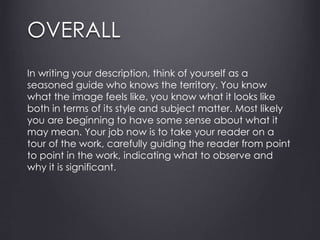
Paul Cézanne
The Artist's Uncle, as a Monk
1866
oil on canvas
25 5/8 x 21 1/2 in.
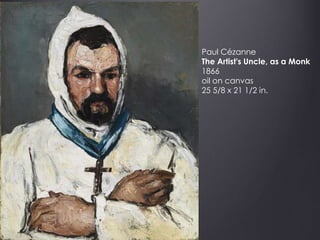
detail of face
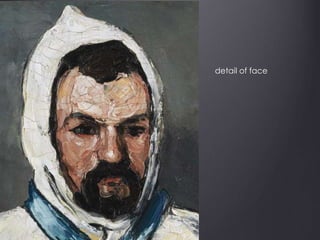
Roy LICHTENSTEIN, Blam!, 1962, oil on canvas, 68 x 80 inches
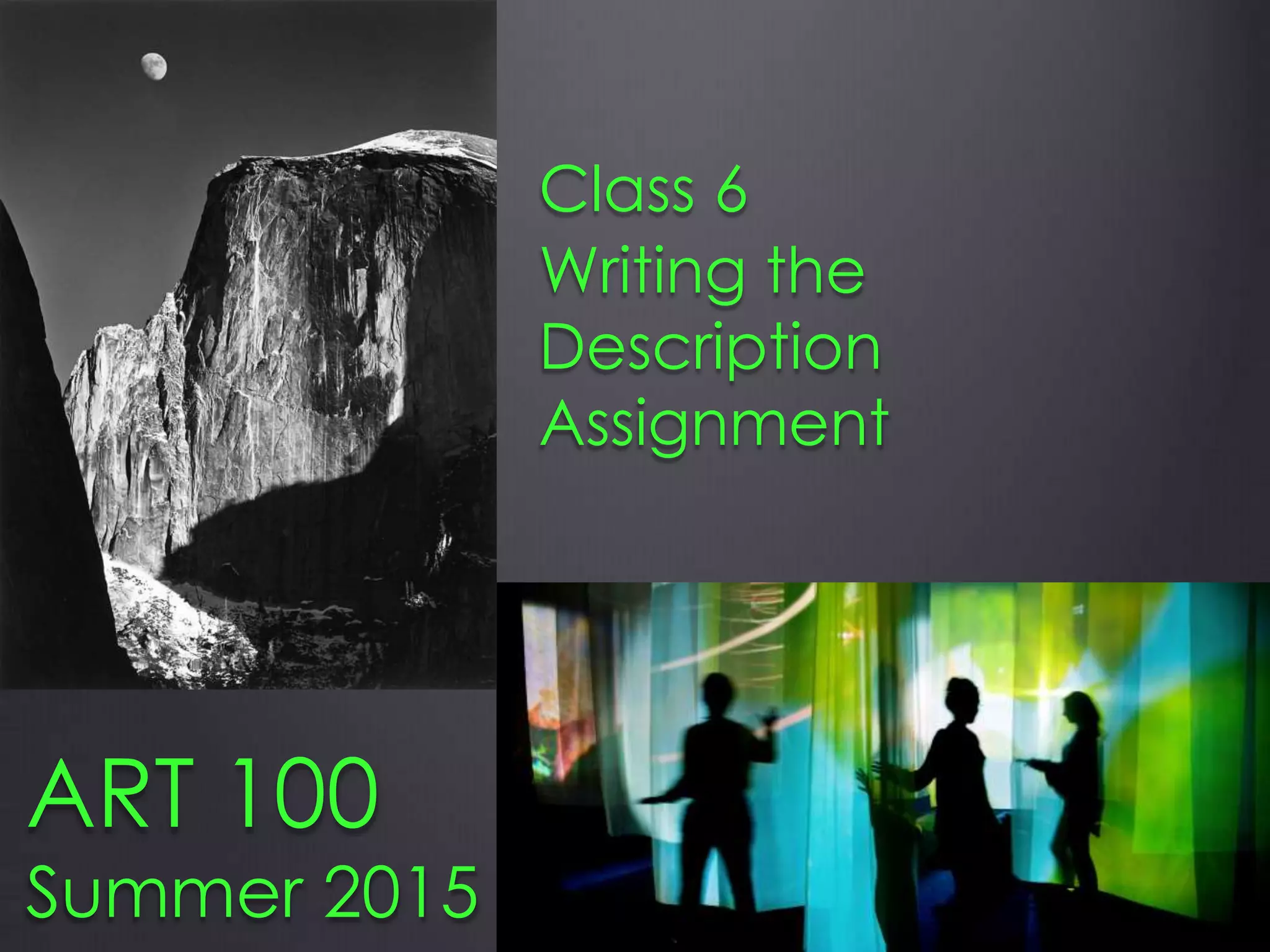
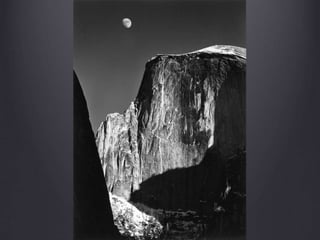
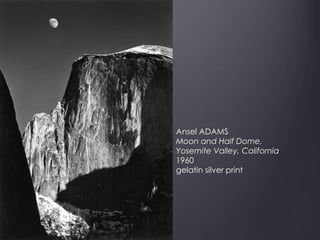
Ansel ADAMS
Moon and Half Dome,
Yosemite Valley, California
1960
gelatin silver print
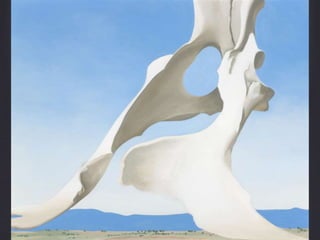
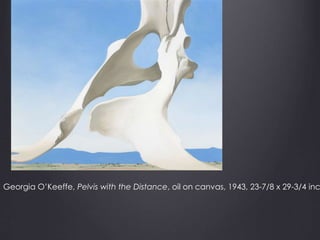
Georgia O’Keeffe, Pelvis with the Distance, oil on canvas, 1943, 23-7/8 x 29-3/4 inc
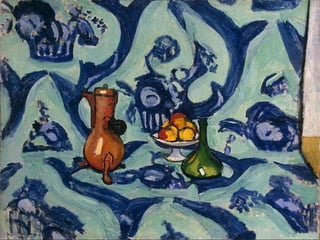
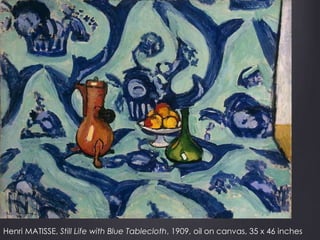
Henri MATISSE, Still Life with Blue Tablecloth, 1909, oil on canvas, 35 x 46 inches

UVCSummer15Class6

  • 1.
    ART 100 Summer 2015 Class6 Writing the Description Assignment
  • 2.
    writing course papers paperclipdescription assignment due 7.6.15 by 5 PM description paper due 7.7.15 by 5 PM analysis paper due 7.14.15 by 5 PM
  • 3.
    paperclip assignment Write oneparagraph (3-4 substantial sentences) describing this object. You don’t have to pretend you don’t know that it’s a paperclip, but at the same time, anyone can see at a glance that it IS a paperclip. So if we were just identifying/recognizing the pictured object, this paragraph would be over pretty quickly.
  • 4.
    Instead, the ideaof this paragraph is to practice what we discussed last time—the possibility of using an intensive visual study of the paperclip to restore the strangeness of perception.
  • 5.
    If the processof doing this seems strange, awkward, slow, difficult, and unfamiliar, then you are doing it correctly. This assignment asks you to “defamiliarize” an ordinary object through sustained visual attention, much as Viktor Shklovsky claims that art can “make the stone stony.”
  • 6.
    TIPS for gooddescriptive paragraphs: • Show the reader in language as vivid and concrete as possible what you are SEEING, not what you are thinking, remembering, or speculating about. • Avoid sharing your reactions; rather FOCUS ON THE OBJECT itself and try to evoke its appearance as completely as possible and as specifically as possible. • Think about using your writing as a vehicle to express the look of a visual thing; try to find words that are richly descriptive and precise to bring to mind the shape, color, texture, and so on that you are seeing in the object. • Avoid the extremes of science and poetry in your description; aim to evoke in simple language what this thing actually looks like.
  • 7.
  • 8.
    FIRST The first andmost important step is LOOKING at the image. Take your time. Give yourself a chance just to look at the picture, without necessarily thinking anything in particular or worrying about what you are going to say.
  • 9.
    SECOND Start to thinkmore specifically about the IMPACT the piece is having on you. At this stage it’s okay to jot down some notes if you want to. • Is the work overpowering or reticent? Colorful or pale? Enticing or repulsive? Friendly or aggressive? • What does the image remind you of or make you think of? • How does it make you feel? What kind of mood or atmosphere is it creating?
  • 10.
    THIRD What is thisa picture of? If you know the genre—for example, portrait, landscape, still life—mention that. If you don’t know, that is fine. What is the subject of the picture? In some cases, this is pretty simple, but at other times it can be quite complex.
  • 11.
    FINALLY At this point,you are ready to write your description. A good description will include (in any order, you decide how to work this all in): • the artist, title and date (taken directly from the caption and spelled correctly!) • the subject matter • the style • the overall impact of the piece
  • 12.
    OVERALL In writing yourdescription, think of yourself as a seasoned guide who knows the territory. You know what the image feels like, you know what it looks like both in terms of its style and subject matter. Most likely you are beginning to have some sense about what it may mean. Your job now is to take your reader on a tour of the work, carefully guiding the reader from point to point in the work, indicating what to observe and why it is significant.
  • 13.
    Paul Cézanne The Artist'sUncle, as a Monk 1866 oil on canvas 25 5/8 x 21 1/2 in.
  • 14.
  • 16.
    Roy LICHTENSTEIN, Blam!,1962, oil on canvas, 68 x 80 inches
  • 18.
    Ansel ADAMS Moon andHalf Dome, Yosemite Valley, California 1960 gelatin silver print
  • 20.
    Georgia O’Keeffe, Pelviswith the Distance, oil on canvas, 1943, 23-7/8 x 29-3/4 inc
  • 22.
    Henri MATISSE, StillLife with Blue Tablecloth, 1909, oil on canvas, 35 x 46 inches