Interpretation
    Monism or Pluralism
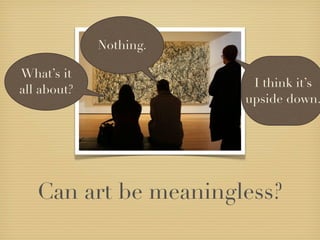
Nothing.

What’s it
                         I think it’s
all about?
                        upside down.


   Can art be meaningless?
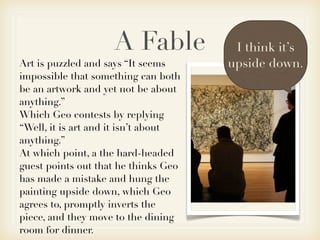
A Fable            What’s it
Imagine Geo, a noted                 all about?
philosopher who dabbles in art,
unveiling his latest artwork to an
appreciating crowd.
The work is abstract and
prompts the usual remarks about
how dramatic the colors are, it's
smart sense of space, it's playful
use of form and tone. There is,
however, one hard-headed guest
does not get it, and asks “What is
it about?”
A Fable
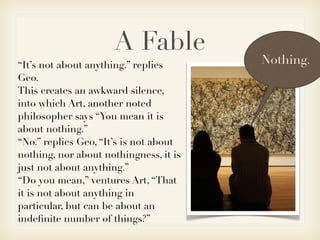
“It’s not about anything.” replies      Nothing.
Geo.
This creates an awkward silence,
into which Art, another noted
philosopher says “You mean it is
about nothing.”
“No.” replies Geo, “It’s is not about
nothing, nor about nothingness, it is
just not about anything.”
“Do you mean,” ventures Art, “That
it is not about anything in
particular, but can be about an
indefinite number of things?”
A Fable
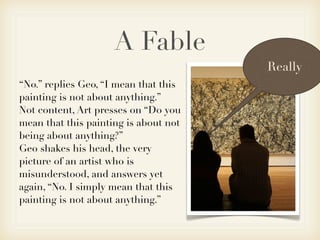
                                       Really
“No.” replies Geo, “I mean that this
painting is not about anything.”
Not content, Art presses on “Do you
mean that this painting is about not
being about anything?”
Geo shakes his head, the very
picture of an artist who is
misunderstood, and answers yet
again, “No. I simply mean that this
painting is not about anything.”
A Fable            I think it’s
Art is puzzled and says “It seems     upside down.
impossible that something can both
be an artwork and yet not be about
anything.”
Which Geo contests by replying
“Well, it is art and it isn’t about
anything.”
At which point, a the hard-headed
guest points out that he thinks Geo
has made a mistake and hung the
painting upside down, which Geo
agrees to, promptly inverts the
piece, and they move to the dining
room for dinner.
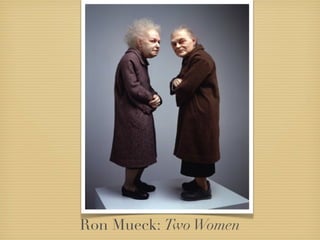
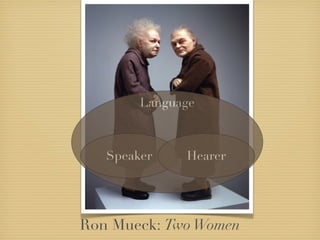
Ron Mueck: Two Women
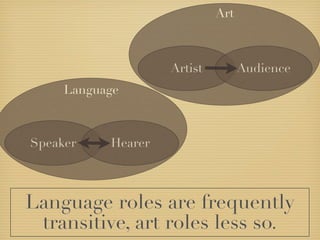
Language


   Speaker    Hearer


Ron Mueck: Two Women
Art


    Artist         Audience


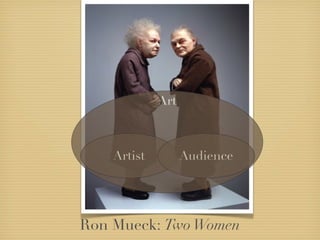
Ron Mueck: Two Women
Art


                    Artist         Audience
     Language


Speaker    Hearer


Language roles are frequently
 transitive, art roles less so.
Interpretation


 Can questions of interpretation ever be
given correct answers?Need there always
be a multiplicity of equally good answers?
Must we always be in a state of uncertainty
about these answers?
Tansey, Innocent Eye Test
Critical Monism or
              Pluralism
Retrieval is the project of understanding a work as the
product, for the most part, of design by its historical
creator.This involves attempting to understand the writer's
intentions and the vicissitudes they undergo. It involves as
well understanding back-ground conditions such as "aesthetic
norms, innovations in the medium, rules of decorum,
ideological or scientific world views, ... systems of symbolism,
the state of the tradition" current when the artist made the
work. It is plausible that retrievals (this project as a whole
or one of its proper parts),if they are possible at all, make
factual claims. If so, such interpretations are true or false
and are to be assessed as such. This is not to say they are the
only interpretations that can be assessed for truth


                        Robert Stecker
Camels, George Steinmetz
Cindy Sherman
Francesca Woodman, Photo by Ariana McNulty
Ariana McNulty
Relativism due to
        Underdetermination
His first premise is that external evidence (facts external to
the work) are irrelevant to determining the truth of
interpretations. Matthews's second premise is that critics
typically know all the relevant internal evidence in support-
of their interpretations. Matthews's final premise is that it is
a conceptual truth that interpretations are not known to be
true at the time they are proposed. It follows that, since
interpreters of literary works know all the relevant evidence
in favor of their interpretations,but this is insufficient to
give them knowledge that their interpretations are true, the
evidence for these interpretations underdetermines their
truth.


                      Robert Matthews
Relativism due to
        Underdetermination
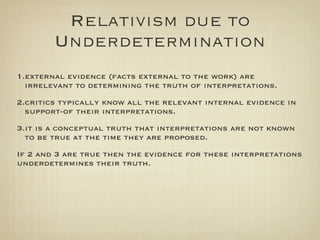
1.external evidence (facts external to the work) are
  irrelevant to determining the truth of interpretations.
2.critics typically know all the relevant internal evidence in
  support-of their interpretations.
3.it is a conceptual truth that interpretations are not known
  to be true at the time they are proposed.
If 2 and 3 are true then the evidence for these interpretations
underdetermines their truth.
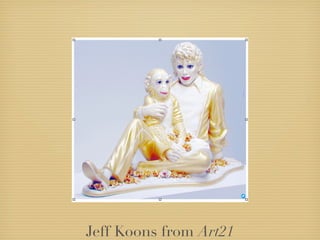
Jeff Koons from Art21
First Thought Best Thought
According to Stecker, one way of interpreting
an artwork (historical explanations) is to
figure out what the actual maker of the thing
was trying to do, and in fact did, in making it.
the other way (the desire for understanding)
is to seek an understanding of a work: a way
of taking a work that makes sense of it as
whole. Some interpretations are incorrect—
untrue— others can be unacceptable even if
it only makes true statements because it
doesn't explain what puzzles us about a work.


  Consider Koons interpretations of his own
  artworks given Stecker’s concepts.

Interpreting Art

  • 1.
    Interpretation Monism or Pluralism
  • 2.
    Nothing. What’s it I think it’s all about? upside down. Can art be meaningless?
  • 3.
    A Fable What’s it Imagine Geo, a noted all about? philosopher who dabbles in art, unveiling his latest artwork to an appreciating crowd. The work is abstract and prompts the usual remarks about how dramatic the colors are, it's smart sense of space, it's playful use of form and tone. There is, however, one hard-headed guest does not get it, and asks “What is it about?”
  • 4.
    A Fable “It’s notabout anything.” replies Nothing. Geo. This creates an awkward silence, into which Art, another noted philosopher says “You mean it is about nothing.” “No.” replies Geo, “It’s is not about nothing, nor about nothingness, it is just not about anything.” “Do you mean,” ventures Art, “That it is not about anything in particular, but can be about an indefinite number of things?”
  • 5.
    A Fable Really “No.” replies Geo, “I mean that this painting is not about anything.” Not content, Art presses on “Do you mean that this painting is about not being about anything?” Geo shakes his head, the very picture of an artist who is misunderstood, and answers yet again, “No. I simply mean that this painting is not about anything.”
  • 6.
    A Fable I think it’s Art is puzzled and says “It seems upside down. impossible that something can both be an artwork and yet not be about anything.” Which Geo contests by replying “Well, it is art and it isn’t about anything.” At which point, a the hard-headed guest points out that he thinks Geo has made a mistake and hung the painting upside down, which Geo agrees to, promptly inverts the piece, and they move to the dining room for dinner.
  • 7.
  • 8.
    Language Speaker Hearer Ron Mueck: Two Women
  • 9.
    Art Artist Audience Ron Mueck: Two Women
  • 10.
    Art Artist Audience Language Speaker Hearer Language roles are frequently transitive, art roles less so.
  • 11.
    Interpretation Can questionsof interpretation ever be given correct answers?Need there always be a multiplicity of equally good answers? Must we always be in a state of uncertainty about these answers?
  • 12.
  • 13.
    Critical Monism or Pluralism Retrieval is the project of understanding a work as the product, for the most part, of design by its historical creator.This involves attempting to understand the writer's intentions and the vicissitudes they undergo. It involves as well understanding back-ground conditions such as "aesthetic norms, innovations in the medium, rules of decorum, ideological or scientific world views, ... systems of symbolism, the state of the tradition" current when the artist made the work. It is plausible that retrievals (this project as a whole or one of its proper parts),if they are possible at all, make factual claims. If so, such interpretations are true or false and are to be assessed as such. This is not to say they are the only interpretations that can be assessed for truth Robert Stecker
  • 14.
  • 15.
  • 16.
    Francesca Woodman, Photoby Ariana McNulty
  • 17.
  • 18.
    Relativism due to Underdetermination His first premise is that external evidence (facts external to the work) are irrelevant to determining the truth of interpretations. Matthews's second premise is that critics typically know all the relevant internal evidence in support- of their interpretations. Matthews's final premise is that it is a conceptual truth that interpretations are not known to be true at the time they are proposed. It follows that, since interpreters of literary works know all the relevant evidence in favor of their interpretations,but this is insufficient to give them knowledge that their interpretations are true, the evidence for these interpretations underdetermines their truth. Robert Matthews
  • 19.
    Relativism due to Underdetermination 1.external evidence (facts external to the work) are irrelevant to determining the truth of interpretations. 2.critics typically know all the relevant internal evidence in support-of their interpretations. 3.it is a conceptual truth that interpretations are not known to be true at the time they are proposed. If 2 and 3 are true then the evidence for these interpretations underdetermines their truth.
  • 20.
  • 21.
    First Thought BestThought According to Stecker, one way of interpreting an artwork (historical explanations) is to figure out what the actual maker of the thing was trying to do, and in fact did, in making it. the other way (the desire for understanding) is to seek an understanding of a work: a way of taking a work that makes sense of it as whole. Some interpretations are incorrect— untrue— others can be unacceptable even if it only makes true statements because it doesn't explain what puzzles us about a work. Consider Koons interpretations of his own artworks given Stecker’s concepts.