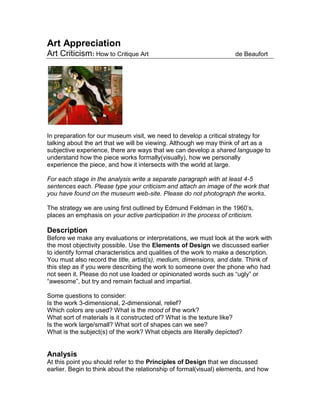
Art Appreciation<br />Art Criticism: How to Critique Artde Beaufort<br />In preparation for our museum visit, we need to develop a critical strategy for talking about the art that we will be viewing. Although we may think of art as a subjective experience, there are ways that we can develop a shared language to understand how the piece works formally(visually), how we personally experience the piece, and how it intersects with the world at large. <br />For each stage in the analysis write a separate paragraph with at least 4-5 sentences each. Please type your criticism and attach an image of the work that you have found on the museum web-site. Please do not photograph the works.<br />The strategy we are using first outlined by Edmund Feldman in the 1960’s, places an emphasis on your active participation in the process of criticism.<br />Description<br />Before we make any evaluations or interpretations, we must look at the work with the most objectivity possible. Use the Elements of Design we discussed earlier to identify formal characteristics and qualities of the work to make a description. You must also record the title, artist(s), medium, dimensions, and date. Think of this step as if you were describing the work to someone over the phone who had not seen it. Please do not use loaded or opinionated words such as “ugly” or “awesome”, but try and remain factual and impartial.<br />Some questions to consider:<br />Is the work 3-dimensional, 2-dimensional, relief?<br />Which colors are used? What is the mood of the work?<br />What sort of materials is it constructed of? What is the texture like?<br />Is the work large/small? What sort of shapes can we see?<br />What is the subject(s) of the work? What objects are literally depicted?<br />Analysis<br />At this point you should refer to the Principles of Design that we discussed earlier. Begin to think about the relationship of formal(visual) elements, and how the work is composed and organized. We are becoming more specific here, but we are still not ready to make interpretations or guess why the artist has made certain choices.<br />Some questions to consider:<br />Has the artist achieved unity or is the work chaotic?<br />Where is the emphasis or focal point? <br />How has the artist used scale and proportion?<br />What type of balance and rhythm exist in the work? Is there repetition?<br />What is the relationship between the objects or subjects depicted?<br />Interpretation<br />Moving beyond a discussion of the visual characteristics of the work itself, let’s now begin to examine how the work affects us. Try to identify themes and ideas that seem to be meaningful, and interpret the feelings, emotions, and other experiential associations that the work elicits. When appropriate, please use the Verbs of Communication we discussed earlier during this part of the critique. At this point you can feel free to use the loaded value words we avoided earlier (“ugly”, “awesome”, etc.) to describe the expressive qualities of the piece.<br />Some questions to consider:<br />How does the work relate to the world it was made in, (the historical/social context)?<br />How does the work relate to today’s world?<br />What does the piece remind you of, how does it make you feel?<br />What is the meaning of the piece? What it is about?<br />Evaluation<br />In this final, (and sometimes optional), stage of criticism, we need to decide the degree to which the work fails or succeeds in fulfilling its purpose. Keep in mind that not all art communicates a literal “message” but often the meaning of the work is the feelings or thoughts if leaves you with and the ideas that it forces you to examine. In this sense, have you come to see the work or its subject in a new light through the process of criticism<br />Some questions to consider:<br />Why does this work have(or not have) value? What is it that makes the work worth considering among others? What is valuable to you in a work of art? Are there things that others may value that you do not?<br />Does the piece communicate an idea or feeling well, or do you remain unmoved?<br />If it fails or succeeds in your estimation, can you point to specific remarks you noticed earlier in our criticism to emphasize your evaluation?<br />Why Critique?<br />Why can’t we just enjoy art with out all the fuss? After all, we know what we like, and are fully entitled to our own beliefs, feelings, and judgments. The short answer is that art criticism, and the dialogue that emerges from it, open us up to a larger conversation about the human experience. By closely examining artwork through description and analysis, we come to see the formal subtleties and intricacies not just of the object in question, but within a larger field of visual experience that exists all around us. Unlike goldfish, we are aware of the “water” of flowing imagery that we swim through everyday.  By interpreting the art, we begin to ask questions about the world we live in, and by doing so, we begin to forge connections between our own experiences and those of others. When we evaluate work, we examine not just what we personally value, but are examining cultural values that may shift over time. The work we used as an example, The Birthday, by Marc Chagall, was highly valued in the early days of Modernism, but was used as an example of degenerate art by the Nazi Regime, who valued militarism and authoritarian idealism more than experimentation and individualism. It’s important to ask questions not just about art-work, but about the society we live in so that we are active participants and citizens rather than passive consumers of a pre-packaged experience.<br />
Art critique
Art critique

Art critique

  • 1.
    Art Appreciation<br />ArtCriticism: How to Critique Artde Beaufort<br />In preparation for our museum visit, we need to develop a critical strategy for talking about the art that we will be viewing. Although we may think of art as a subjective experience, there are ways that we can develop a shared language to understand how the piece works formally(visually), how we personally experience the piece, and how it intersects with the world at large. <br />For each stage in the analysis write a separate paragraph with at least 4-5 sentences each. Please type your criticism and attach an image of the work that you have found on the museum web-site. Please do not photograph the works.<br />The strategy we are using first outlined by Edmund Feldman in the 1960’s, places an emphasis on your active participation in the process of criticism.<br />Description<br />Before we make any evaluations or interpretations, we must look at the work with the most objectivity possible. Use the Elements of Design we discussed earlier to identify formal characteristics and qualities of the work to make a description. You must also record the title, artist(s), medium, dimensions, and date. Think of this step as if you were describing the work to someone over the phone who had not seen it. Please do not use loaded or opinionated words such as “ugly” or “awesome”, but try and remain factual and impartial.<br />Some questions to consider:<br />Is the work 3-dimensional, 2-dimensional, relief?<br />Which colors are used? What is the mood of the work?<br />What sort of materials is it constructed of? What is the texture like?<br />Is the work large/small? What sort of shapes can we see?<br />What is the subject(s) of the work? What objects are literally depicted?<br />Analysis<br />At this point you should refer to the Principles of Design that we discussed earlier. Begin to think about the relationship of formal(visual) elements, and how the work is composed and organized. We are becoming more specific here, but we are still not ready to make interpretations or guess why the artist has made certain choices.<br />Some questions to consider:<br />Has the artist achieved unity or is the work chaotic?<br />Where is the emphasis or focal point? <br />How has the artist used scale and proportion?<br />What type of balance and rhythm exist in the work? Is there repetition?<br />What is the relationship between the objects or subjects depicted?<br />Interpretation<br />Moving beyond a discussion of the visual characteristics of the work itself, let’s now begin to examine how the work affects us. Try to identify themes and ideas that seem to be meaningful, and interpret the feelings, emotions, and other experiential associations that the work elicits. When appropriate, please use the Verbs of Communication we discussed earlier during this part of the critique. At this point you can feel free to use the loaded value words we avoided earlier (“ugly”, “awesome”, etc.) to describe the expressive qualities of the piece.<br />Some questions to consider:<br />How does the work relate to the world it was made in, (the historical/social context)?<br />How does the work relate to today’s world?<br />What does the piece remind you of, how does it make you feel?<br />What is the meaning of the piece? What it is about?<br />Evaluation<br />In this final, (and sometimes optional), stage of criticism, we need to decide the degree to which the work fails or succeeds in fulfilling its purpose. Keep in mind that not all art communicates a literal “message” but often the meaning of the work is the feelings or thoughts if leaves you with and the ideas that it forces you to examine. In this sense, have you come to see the work or its subject in a new light through the process of criticism<br />Some questions to consider:<br />Why does this work have(or not have) value? What is it that makes the work worth considering among others? What is valuable to you in a work of art? Are there things that others may value that you do not?<br />Does the piece communicate an idea or feeling well, or do you remain unmoved?<br />If it fails or succeeds in your estimation, can you point to specific remarks you noticed earlier in our criticism to emphasize your evaluation?<br />Why Critique?<br />Why can’t we just enjoy art with out all the fuss? After all, we know what we like, and are fully entitled to our own beliefs, feelings, and judgments. The short answer is that art criticism, and the dialogue that emerges from it, open us up to a larger conversation about the human experience. By closely examining artwork through description and analysis, we come to see the formal subtleties and intricacies not just of the object in question, but within a larger field of visual experience that exists all around us. Unlike goldfish, we are aware of the “water” of flowing imagery that we swim through everyday. By interpreting the art, we begin to ask questions about the world we live in, and by doing so, we begin to forge connections between our own experiences and those of others. When we evaluate work, we examine not just what we personally value, but are examining cultural values that may shift over time. The work we used as an example, The Birthday, by Marc Chagall, was highly valued in the early days of Modernism, but was used as an example of degenerate art by the Nazi Regime, who valued militarism and authoritarian idealism more than experimentation and individualism. It’s important to ask questions not just about art-work, but about the society we live in so that we are active participants and citizens rather than passive consumers of a pre-packaged experience.<br />