✓is concerned with meaning; how representation, in the broad
sense (language, images, objects) generates meanings or the
processes by which we comprehend or attribute meaning.
✓ For visual images, semiotics is an inquiry that is wider than
the study of symbolism and the use of semiotic analysis
challenges concepts such as naturalism and realism (the
notion that images or objects can objectively depict
something and intentionality).
✓is the study of signs and signifying
practices. A sign can be defined, basically, as
any entity (words, images, objects etc.) that
refers to something else.
✓ That is, semiotics shows how the relationship
between the sign and the ‘something else’ results
from what the society has taught.
THE THREE MAIN TYPES OF SIGNS
✓Sign/Symbol – anything conveys meaning
✓Signifier/Icon – words, images, sound
✓Signified/ Index – mental concepts that comes to
mind
✓ is the opposite of an icon, so it does not
resemble the signifier that is being
represented.
✓ Symbols are learnt culturally, which explains
why cultures can develop unique traits.
✓ Example of a symbol is male and female
icons representing the presence of toilet
facilities. These icons have become
symbols because it takes on an extra
meaning.
✓has a physical resemblance to the
signified. A good example of an icon is a
photograph of a moustache as the
audience knows what it is straight away.
✓ describes the physical connection between a
signifier and the signified. This means that the
signifier cannot exist without the physical
presence of the signified.
✓ Example of this is that smoke cannot exist
without fire. The signifier is the smoke which
leads to signified being a fire.
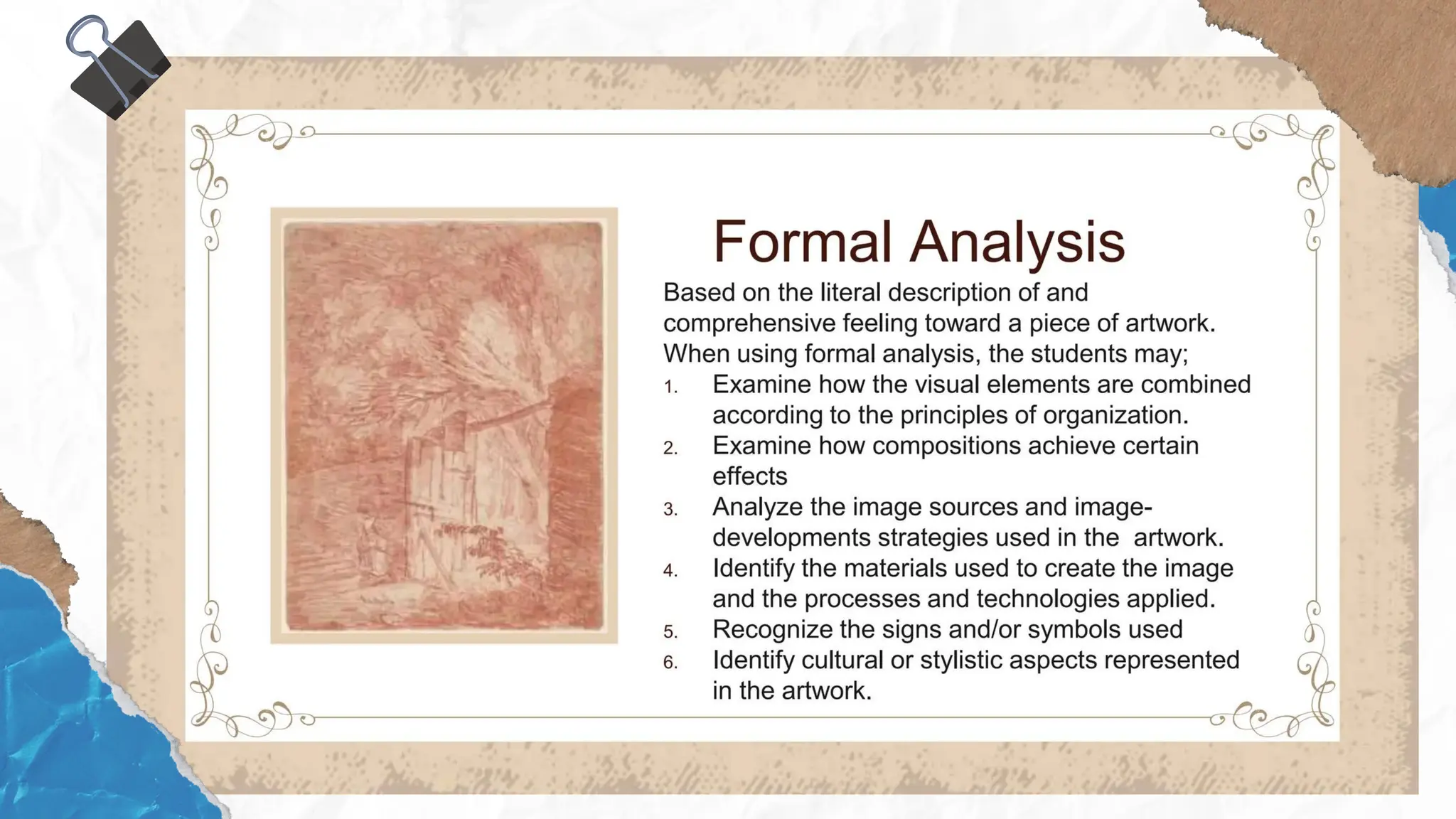
✓ The formalistic approach directs that art be
analyzed by reviewing form and style. Elements
like color, shapes, textures, and line are
emphasized, while the context of the work is
de-emphasized, and made a secondary
characteristic—at times taken completely out of
consequence.
✓ The assessment of a piece of artwork is based
on the artist’s skill and not on the choice of
subject matter, with the value based primarily
on the use of elements with little regard for the
viewer’s perception of the context.
✓ Formalist film theory is a theory of film
study that is focused on the formal, or
technical, elements of a film: i.e., the
lighting, scoring, sound and set design, use
of color, shot composition, and editing.
✓ Clement Greenberg - supporter of Abstract
Expressionism. He believed fully in the
detachment of context and subject matter
from the form of art, and disallowed the
idea that there were other
considerations (i.e., popular culture,
political sentiment, or media influence).
✓ He firmly believed that Abstract Art
was the truest expression of art, as the
observer would not understand the subject
matter of the art itself, and only the artist’s
true use of color, medium, and space
showed through.
✓ Jackson Pollock -personified the theory
of Formalism and popular Abstract
✓ Expressionist(1940’s–1960’s)
✓ Convergence (1952), exemplified the avant-
garde and radical artwork of the time,
where artists created freely, outside of
established guidelines and emphases.
✓ His unusual methods, oversized canvases and
use of non-traditional materials (using knives
and sticks in place of brushes), was welcomed
in a growing taste for abstract art.
✓ “Convergence” is also among the last drip
paintings that Pollock made before completely
changing his style. Every inch of the painting
tells the story of Jackson Pollock in 1952.
CONVERGENCE - Jackson Pollock
✓Feminist criticism looks at art as a
reflection of the artist’s values and
attitudes towards women.
✓It is concerned on how art reveals
these subconscious ideas to show
how women have been marginalized
or discriminated economically, politically,
socially and psychologically.
✓Feminist criticism is also concerned
with less obvious forms of
marginalization such as the exclusion
of women writers from the art canon
which gave the tendency to
underrepresent the contribution of
women artists.
✓The male gaze by Laura Mulvey
✓is present in media that portrays
women as objects of sexual desire and
defines their identity in relation to a
male character.
✓Representation of women as being
dominated by a male point of view.
✓This approach "examines how sexual
identity influences the creation and
reception of literary works."
✓Commercial or Mainstream Films:
typically produced by major studios with
the aim of attracting a wide audience for
financial success. In terms of gender-
related themes, these films can vary
widely. Some may reinforce traditional
gender stereotypes and roles, while
others might challenge or subvert these
norms.
✓Independent Films: Independent films, often
referred to as indie films, are produced
outside the major studio system. These
films tend to prioritize artistic and creative
expression over commercial success.
Independent cinema has been known to
explore unconventional gender narratives
and present diverse representations of
gender and identity.
✓Pink Films: Pink films, or pinku eiga in
Japanese are a type of film that emerged in
Japan and often includes explicit content, but
not to the extent of pornography. These films
often explore themes related to sexuality,
relationships, and gender dynamics. While
pink films can be explicit in nature, they can
also offer social commentary and address
complex gender issues.
This approach is most concerned with the
relationship between art and structures of
power. It infers that art is embedded in a
social, economic and political structure
that determines its final meaning.
Ideological criticism translates art and
artifacts as symbols that reflect political
ideals and reinforce one version of reality
over another.
Realism, sometimes called naturalism,
in the arts is generally the attempt to
represent subject matter truthfully,
without artificiality and avoiding
artistic conventions, or implausible,
exotic, and supernatural elements.
-Validates the importance of artistic work as it is
built on a literary or artistic key for the decoding.
•Freud himself wrote, "The dream-thoughts which
we first come across as we proceed with our
analysis often strike us by the unusual form in
which they are expressed; they are not clothed in
the prosaic language usually employed by our
thoughts, but are on the contrary represented
symbolically by means of similes and metaphors, in
images resembling those of poetic speech
•The cultural/historical approach in visual arts
examines artworks within the broader
contexts of the time and culture in which they
were created. This method goes beyond purely
aesthetic analysis to consider how historical
events, cultural values, social structures, and
political climates shape and are reflected in art.
Compare and contrast
the different approaches
in reading visual arts in
your own perspective
based on the class
discussion.
ARTS AND TRENS LESSONS MIDTERM L1-L2.pdf

ARTS AND TRENS LESSONS MIDTERM L1-L2.pdf

  • 2.
    ✓is concerned withmeaning; how representation, in the broad sense (language, images, objects) generates meanings or the processes by which we comprehend or attribute meaning. ✓ For visual images, semiotics is an inquiry that is wider than the study of symbolism and the use of semiotic analysis challenges concepts such as naturalism and realism (the notion that images or objects can objectively depict something and intentionality).
  • 3.
    ✓is the studyof signs and signifying practices. A sign can be defined, basically, as any entity (words, images, objects etc.) that refers to something else. ✓ That is, semiotics shows how the relationship between the sign and the ‘something else’ results from what the society has taught.
  • 4.
    THE THREE MAINTYPES OF SIGNS ✓Sign/Symbol – anything conveys meaning ✓Signifier/Icon – words, images, sound ✓Signified/ Index – mental concepts that comes to mind
  • 5.
    ✓ is theopposite of an icon, so it does not resemble the signifier that is being represented. ✓ Symbols are learnt culturally, which explains why cultures can develop unique traits.
  • 6.
    ✓ Example ofa symbol is male and female icons representing the presence of toilet facilities. These icons have become symbols because it takes on an extra meaning.
  • 7.
    ✓has a physicalresemblance to the signified. A good example of an icon is a photograph of a moustache as the audience knows what it is straight away.
  • 8.
    ✓ describes thephysical connection between a signifier and the signified. This means that the signifier cannot exist without the physical presence of the signified. ✓ Example of this is that smoke cannot exist without fire. The signifier is the smoke which leads to signified being a fire.
  • 9.
    ✓ The formalisticapproach directs that art be analyzed by reviewing form and style. Elements like color, shapes, textures, and line are emphasized, while the context of the work is de-emphasized, and made a secondary characteristic—at times taken completely out of consequence.
  • 10.
    ✓ The assessmentof a piece of artwork is based on the artist’s skill and not on the choice of subject matter, with the value based primarily on the use of elements with little regard for the viewer’s perception of the context.
  • 11.
    ✓ Formalist filmtheory is a theory of film study that is focused on the formal, or technical, elements of a film: i.e., the lighting, scoring, sound and set design, use of color, shot composition, and editing.
  • 12.
    ✓ Clement Greenberg- supporter of Abstract Expressionism. He believed fully in the detachment of context and subject matter from the form of art, and disallowed the idea that there were other considerations (i.e., popular culture, political sentiment, or media influence).
  • 13.
    ✓ He firmlybelieved that Abstract Art was the truest expression of art, as the observer would not understand the subject matter of the art itself, and only the artist’s true use of color, medium, and space showed through.
  • 14.
    ✓ Jackson Pollock-personified the theory of Formalism and popular Abstract ✓ Expressionist(1940’s–1960’s) ✓ Convergence (1952), exemplified the avant- garde and radical artwork of the time, where artists created freely, outside of established guidelines and emphases.
  • 15.
    ✓ His unusualmethods, oversized canvases and use of non-traditional materials (using knives and sticks in place of brushes), was welcomed in a growing taste for abstract art. ✓ “Convergence” is also among the last drip paintings that Pollock made before completely changing his style. Every inch of the painting tells the story of Jackson Pollock in 1952.
  • 16.
  • 17.
    ✓Feminist criticism looksat art as a reflection of the artist’s values and attitudes towards women. ✓It is concerned on how art reveals these subconscious ideas to show how women have been marginalized or discriminated economically, politically, socially and psychologically.
  • 18.
    ✓Feminist criticism isalso concerned with less obvious forms of marginalization such as the exclusion of women writers from the art canon which gave the tendency to underrepresent the contribution of women artists.
  • 19.
    ✓The male gazeby Laura Mulvey ✓is present in media that portrays women as objects of sexual desire and defines their identity in relation to a male character. ✓Representation of women as being dominated by a male point of view.
  • 20.
    ✓This approach "examineshow sexual identity influences the creation and reception of literary works."
  • 21.
    ✓Commercial or MainstreamFilms: typically produced by major studios with the aim of attracting a wide audience for financial success. In terms of gender- related themes, these films can vary widely. Some may reinforce traditional gender stereotypes and roles, while others might challenge or subvert these norms.
  • 22.
    ✓Independent Films: Independentfilms, often referred to as indie films, are produced outside the major studio system. These films tend to prioritize artistic and creative expression over commercial success. Independent cinema has been known to explore unconventional gender narratives and present diverse representations of gender and identity.
  • 23.
    ✓Pink Films: Pinkfilms, or pinku eiga in Japanese are a type of film that emerged in Japan and often includes explicit content, but not to the extent of pornography. These films often explore themes related to sexuality, relationships, and gender dynamics. While pink films can be explicit in nature, they can also offer social commentary and address complex gender issues.
  • 24.
    This approach ismost concerned with the relationship between art and structures of power. It infers that art is embedded in a social, economic and political structure that determines its final meaning. Ideological criticism translates art and artifacts as symbols that reflect political ideals and reinforce one version of reality over another.
  • 25.
    Realism, sometimes callednaturalism, in the arts is generally the attempt to represent subject matter truthfully, without artificiality and avoiding artistic conventions, or implausible, exotic, and supernatural elements.
  • 26.
    -Validates the importanceof artistic work as it is built on a literary or artistic key for the decoding. •Freud himself wrote, "The dream-thoughts which we first come across as we proceed with our analysis often strike us by the unusual form in which they are expressed; they are not clothed in the prosaic language usually employed by our thoughts, but are on the contrary represented symbolically by means of similes and metaphors, in images resembling those of poetic speech
  • 27.
    •The cultural/historical approachin visual arts examines artworks within the broader contexts of the time and culture in which they were created. This method goes beyond purely aesthetic analysis to consider how historical events, cultural values, social structures, and political climates shape and are reflected in art.
  • 28.
    Compare and contrast thedifferent approaches in reading visual arts in your own perspective based on the class discussion.