“DESIGN AND SYNTHESIS OF BRANCHED ZWITTERIONIC GEMINI LIQUIDS MODIFYING
PROPERTIES OF WETTABILITY AND INHIBITORY CORROSION FOR HETEROGENEOUS
RESERVOIRS LITHOLOGY”
BY: Q.I. JORGE FRANCISCO RAMÍREZ PÉREZ
 Summary
◦ Electromagnetic spectrum
◦ Color
 Applications
 Spectrophotometer
 Lambert-Beer Law
 Calibration Curve
 Application Example
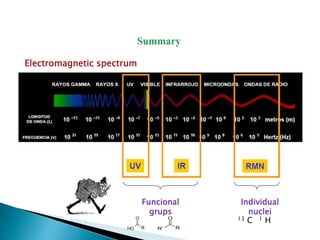
Funcional
grups
Individual
nuclei
Electromagnetic spectrum
OH R
O
R´ R
O 13 C 1 H
Color
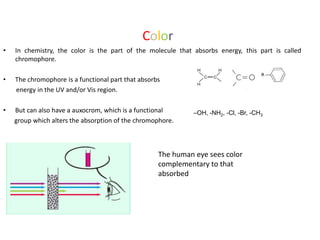
• In chemistry, the color is the part of the molecule that absorbs energy, this part is called
chromophore.
• The chromophore is a functional part that absorbs
energy in the UV and/or Vis region.
• But can also have a auxocrom, which is a functional
group which alters the absorption of the chromophore.
–OH, -NH2, -Cl, -Br, -CH3
The human eye sees color
complementary to that
absorbed
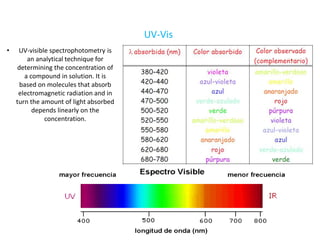
UV-Vis
• UV-visible spectrophotometry is
an analytical technique for
determining the concentration of
a compound in solution. It is
based on molecules that absorb
electromagnetic radiation and in
turn the amount of light absorbed
depends linearly on the
concentration.
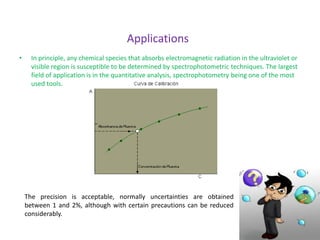
• In principle, any chemical species that absorbs electromagnetic radiation in the ultraviolet or
visible region is susceptible to be determined by spectrophotometric techniques. The largest
field of application is in the quantitative analysis, spectrophotometry being one of the most
used tools.
Applications
The precision is acceptable, normally uncertainties are obtained
between 1 and 2%, although with certain precautions can be reduced
considerably.
Spectrophotometer
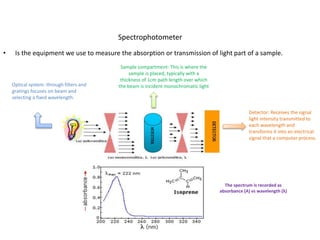
• Is the equipment we use to measure the absorption or transmission of light part of a sample.
The spectrum is recorded as
absorbance (A) vs wavelength (λ)
Optical system: through filters and
gratings focuses on beam and
selecting a fixed wavelength.
Sample compartment: This is where the
sample is placed, typically with a
thickness of 1cm path length over which
the beam is incident monochromatic light
Detector: Receives the signal
light intensity transmitted to
each wavelength and
transforms it into an electrical
signal that a computer process.
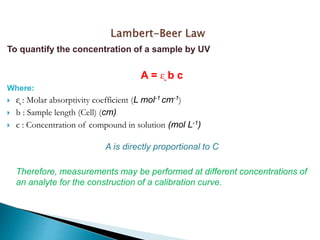
To quantify the concentration of a sample by UV
A = ᶓ b c
Where:
 ᶓ : Molar absorptivity coefficient (L mol-1 cm-1)
 b : Sample length (Cell) (cm)
 c : Concentration of compound in solution (mol L-1)
A is directly proportional to C
Therefore, measurements may be performed at different concentrations of
an analyte for the construction of a calibration curve.
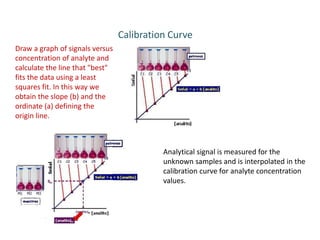
Calibration Curve
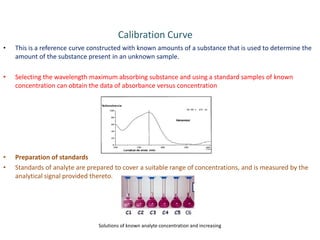
• This is a reference curve constructed with known amounts of a substance that is used to determine the
amount of the substance present in an unknown sample.
• Selecting the wavelength maximum absorbing substance and using a standard samples of known
concentration can obtain the data of absorbance versus concentration
• Preparation of standards
• Standards of analyte are prepared to cover a suitable range of concentrations, and is measured by the
analytical signal provided thereto.
Solutions of known analyte concentration and increasing
Draw a graph of signals versus
concentration of analyte and
calculate the line that "best"
fits the data using a least
squares fit. In this way we
obtain the slope (b) and the
ordinate (a) defining the
origin line.
Calibration Curve
Analytical signal is measured for the
unknown samples and is interpolated in the
calibration curve for analyte concentration
values​​.
0
0.5
1
1.5
2
2.5
190
192
194
196
198
200
202
204
206
208
210
212
214
216
218
220
222
224
226
228
230
Absorbance
Wavelength (nm)
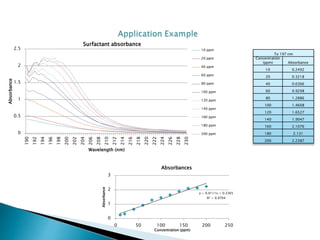
Surfactant absorbance
10 ppm
20 ppm
40 ppm
60 ppm
80 ppm
100 ppm
120 ppm
140 ppm
160 ppm
180 ppm
200 ppm
To 197 nm
Concentratión
(ppm) Absorbance
10 0.2492
20 0.3218
40 0.6366
60 0.9298
80 1.2886
100 1.4608
120 1.6527
140 1.9047
160 2.1076
180 2.131
200 2.2387
y = 0.0111x + 0.2365
R² = 0.9704
0
1
2
3
0 50 100 150 200 250
Absorbance
Concentration (ppm)
Absorbances

Uv vis absorbance measurement

  • 1.
    “DESIGN AND SYNTHESISOF BRANCHED ZWITTERIONIC GEMINI LIQUIDS MODIFYING PROPERTIES OF WETTABILITY AND INHIBITORY CORROSION FOR HETEROGENEOUS RESERVOIRS LITHOLOGY” BY: Q.I. JORGE FRANCISCO RAMÍREZ PÉREZ
  • 2.
     Summary ◦ Electromagneticspectrum ◦ Color  Applications  Spectrophotometer  Lambert-Beer Law  Calibration Curve  Application Example
  • 3.
  • 4.
    Color • In chemistry,the color is the part of the molecule that absorbs energy, this part is called chromophore. • The chromophore is a functional part that absorbs energy in the UV and/or Vis region. • But can also have a auxocrom, which is a functional group which alters the absorption of the chromophore. –OH, -NH2, -Cl, -Br, -CH3 The human eye sees color complementary to that absorbed
  • 5.
    UV-Vis • UV-visible spectrophotometryis an analytical technique for determining the concentration of a compound in solution. It is based on molecules that absorb electromagnetic radiation and in turn the amount of light absorbed depends linearly on the concentration.
  • 6.
    • In principle,any chemical species that absorbs electromagnetic radiation in the ultraviolet or visible region is susceptible to be determined by spectrophotometric techniques. The largest field of application is in the quantitative analysis, spectrophotometry being one of the most used tools. Applications The precision is acceptable, normally uncertainties are obtained between 1 and 2%, although with certain precautions can be reduced considerably.
  • 7.
    Spectrophotometer • Is theequipment we use to measure the absorption or transmission of light part of a sample. The spectrum is recorded as absorbance (A) vs wavelength (λ) Optical system: through filters and gratings focuses on beam and selecting a fixed wavelength. Sample compartment: This is where the sample is placed, typically with a thickness of 1cm path length over which the beam is incident monochromatic light Detector: Receives the signal light intensity transmitted to each wavelength and transforms it into an electrical signal that a computer process.
  • 8.
    To quantify theconcentration of a sample by UV A = ᶓ b c Where:  ᶓ : Molar absorptivity coefficient (L mol-1 cm-1)  b : Sample length (Cell) (cm)  c : Concentration of compound in solution (mol L-1) A is directly proportional to C Therefore, measurements may be performed at different concentrations of an analyte for the construction of a calibration curve.
  • 9.
    Calibration Curve • Thisis a reference curve constructed with known amounts of a substance that is used to determine the amount of the substance present in an unknown sample. • Selecting the wavelength maximum absorbing substance and using a standard samples of known concentration can obtain the data of absorbance versus concentration • Preparation of standards • Standards of analyte are prepared to cover a suitable range of concentrations, and is measured by the analytical signal provided thereto. Solutions of known analyte concentration and increasing
  • 10.
    Draw a graphof signals versus concentration of analyte and calculate the line that "best" fits the data using a least squares fit. In this way we obtain the slope (b) and the ordinate (a) defining the origin line. Calibration Curve Analytical signal is measured for the unknown samples and is interpolated in the calibration curve for analyte concentration values​​.
  • 11.
    0 0.5 1 1.5 2 2.5 190 192 194 196 198 200 202 204 206 208 210 212 214 216 218 220 222 224 226 228 230 Absorbance Wavelength (nm) Surfactant absorbance 10ppm 20 ppm 40 ppm 60 ppm 80 ppm 100 ppm 120 ppm 140 ppm 160 ppm 180 ppm 200 ppm To 197 nm Concentratión (ppm) Absorbance 10 0.2492 20 0.3218 40 0.6366 60 0.9298 80 1.2886 100 1.4608 120 1.6527 140 1.9047 160 2.1076 180 2.131 200 2.2387 y = 0.0111x + 0.2365 R² = 0.9704 0 1 2 3 0 50 100 150 200 250 Absorbance Concentration (ppm) Absorbances