SEMINAR Presentation


Utility and Cardinal Utility analysis
            BA Economics Programme

                   Faris K.V.
                Muhammed Noufal
                Muhammed Jaseel
                 Jamsheed P.T.


   SAFI Institute of Advanced Study, Vazhayoor
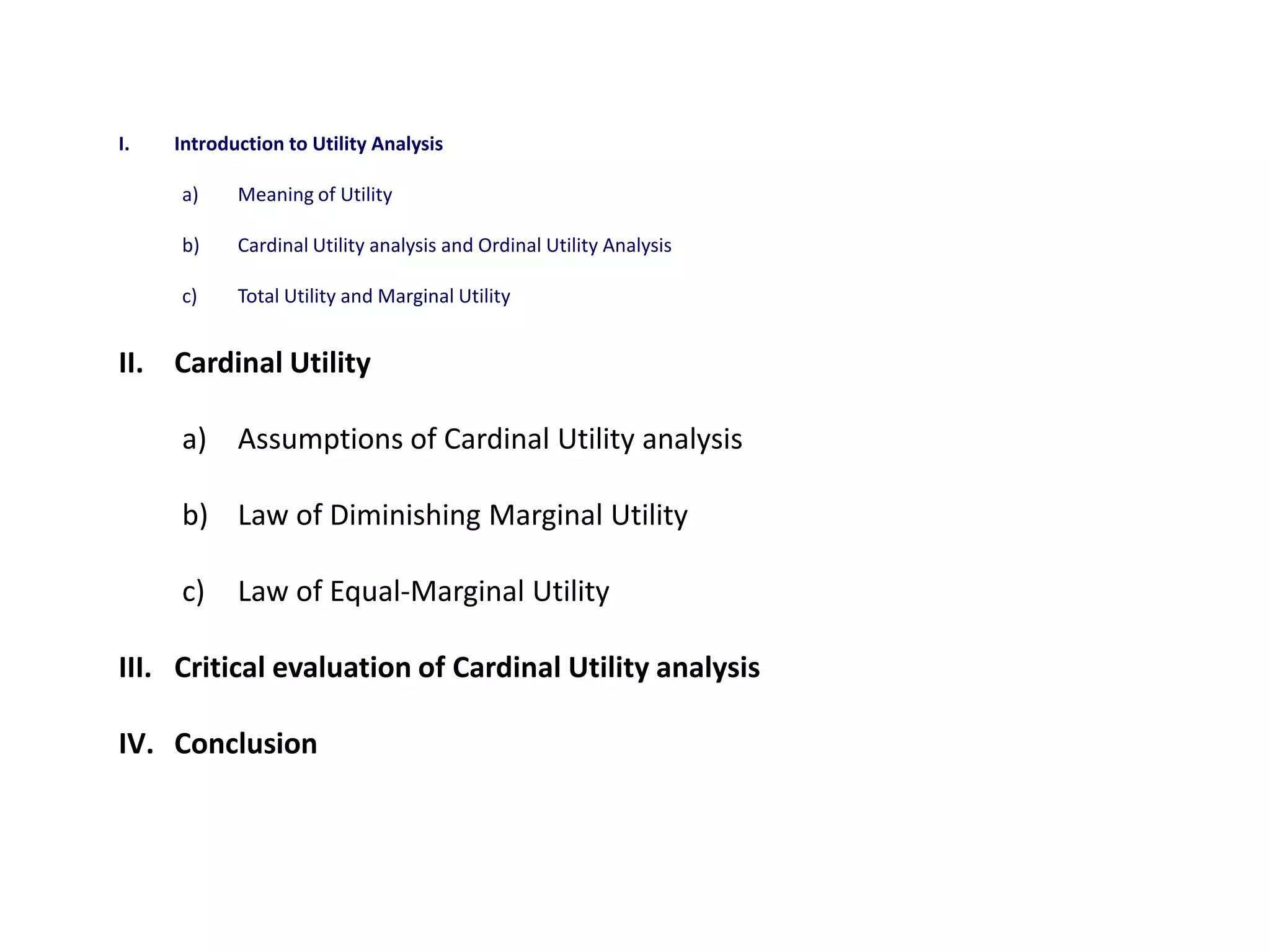
Contents

I.   Introduction to Utility Analysis

     a) Meaning of Utility

     b) Cardinal Utility analysis and Ordinal Utility Analysis

     c)   Total Utility and Marginal Utility

II. Cardinal Utility

     a) Assumptions of Cardinal Utility analysis

     b) Law of Diminishing Marginal Utility

     c)   Law of Equal-Marginal Utility

III. Critical evaluation of Cardinal Utility analysis

IV. Conclusion
1. Introduction to Utility Analysis


a) Meaning of Utility
b) Cardinal Utility analysis and Ordinal Utility Analysis
c)   Total Utility and Marginal Utility
Meaning of Utility
I.   Introduction to Utility Analysis
                               Meaning of Utility


   Utility means - The power of a commodity that satisfy the wants of
    consumer - want satisfying power


   Introduced by Jermy Bentham
   Measurement ‘Utils’
   Subjective entity
Cardinal Utility analysis and Ordinal Utility Analysis


                                        Utility Analysis


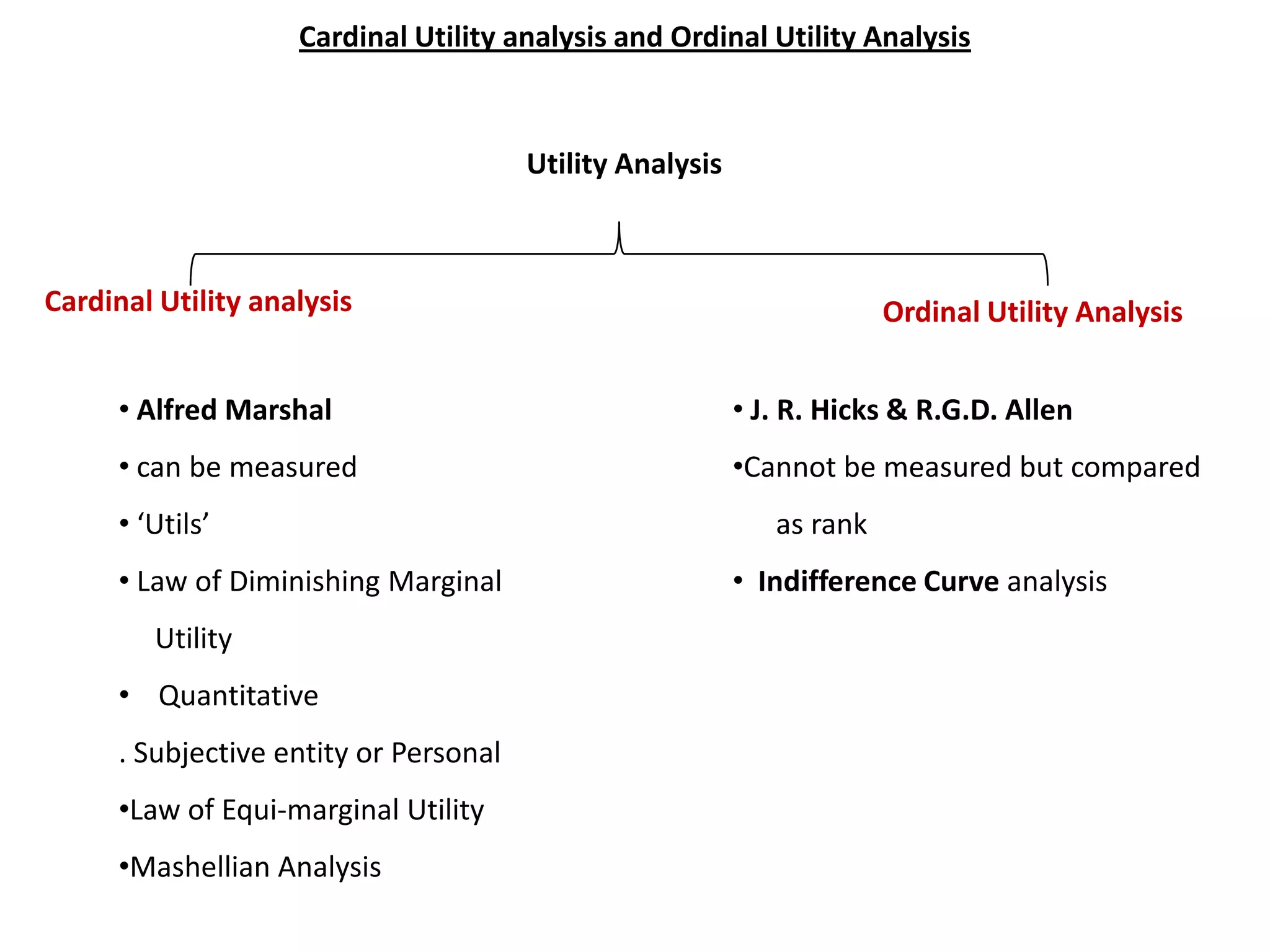
Cardinal Utility analysis                                               Ordinal Utility Analysis


      • Alfred Marshal                                     • J. R. Hicks & R.G.D. Allen
      • can be measured                                    •Cannot be measured but compared
      • ‘Utils’                                               as rank
      • Law of Diminishing Marginal                        • Indifference Curve analysis
         Utility
      • Quantitative
      . Subjective entity or Personal
      •Law of Equi-marginal Utility
      •Mashellian Analysis
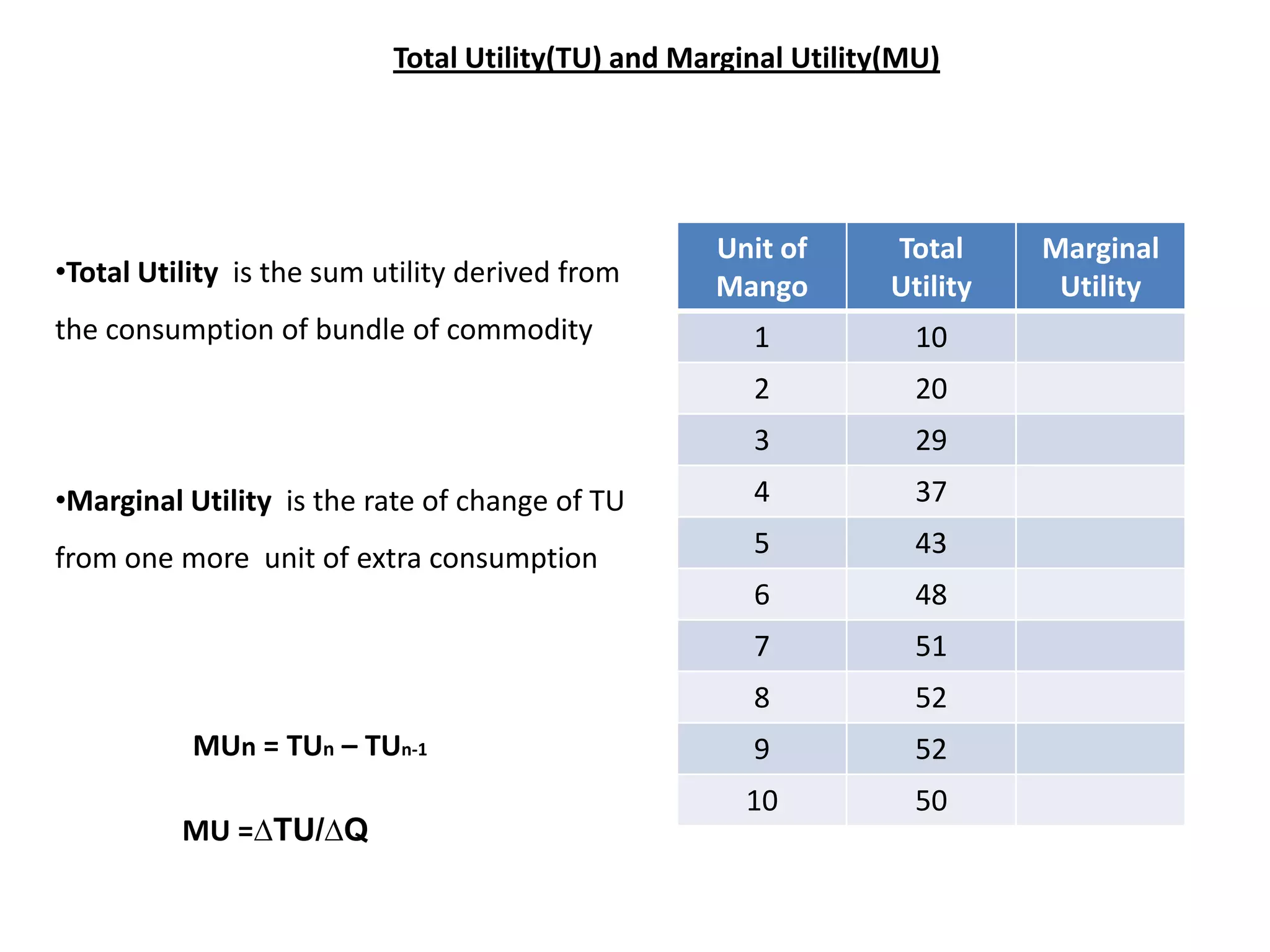
Total Utility(TU) and Marginal Utility(MU)


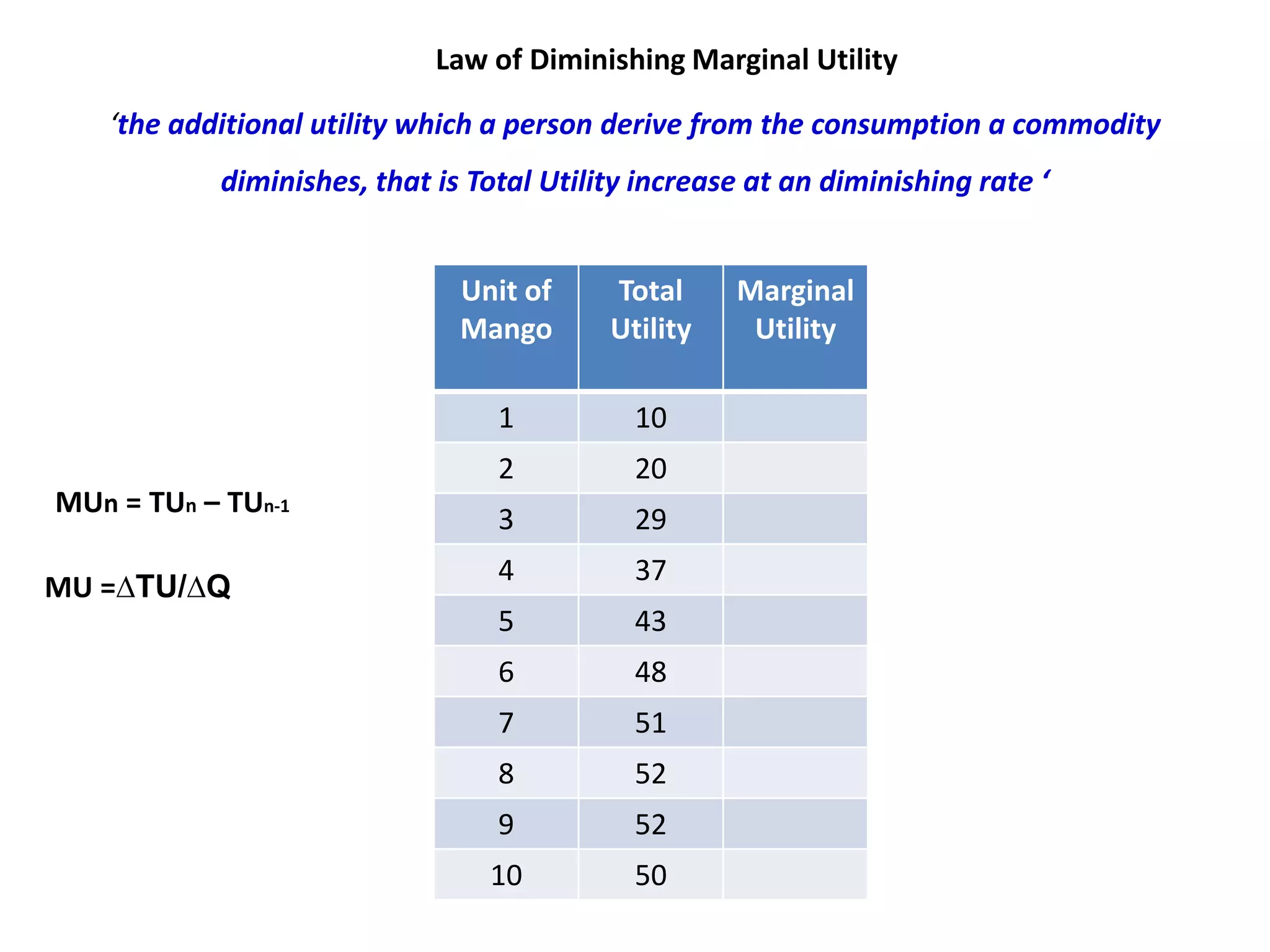
                                                   Unit of       Total     Marginal
•Total Utility is the sum utility derived from     Mango         Utility    Utility
the consumption of bundle of commodity                1            10
                                                      2            20
                                                      3            29
•Marginal Utility is the rate of change of TU         4            37

from one more unit of extra consumption               5            43
                                                      6            48
                                                      7            51
                                                      8            52
           MUn = TUn – TUn-1                          9            52
                                                      10           50
          MU =∆TU/∆Q
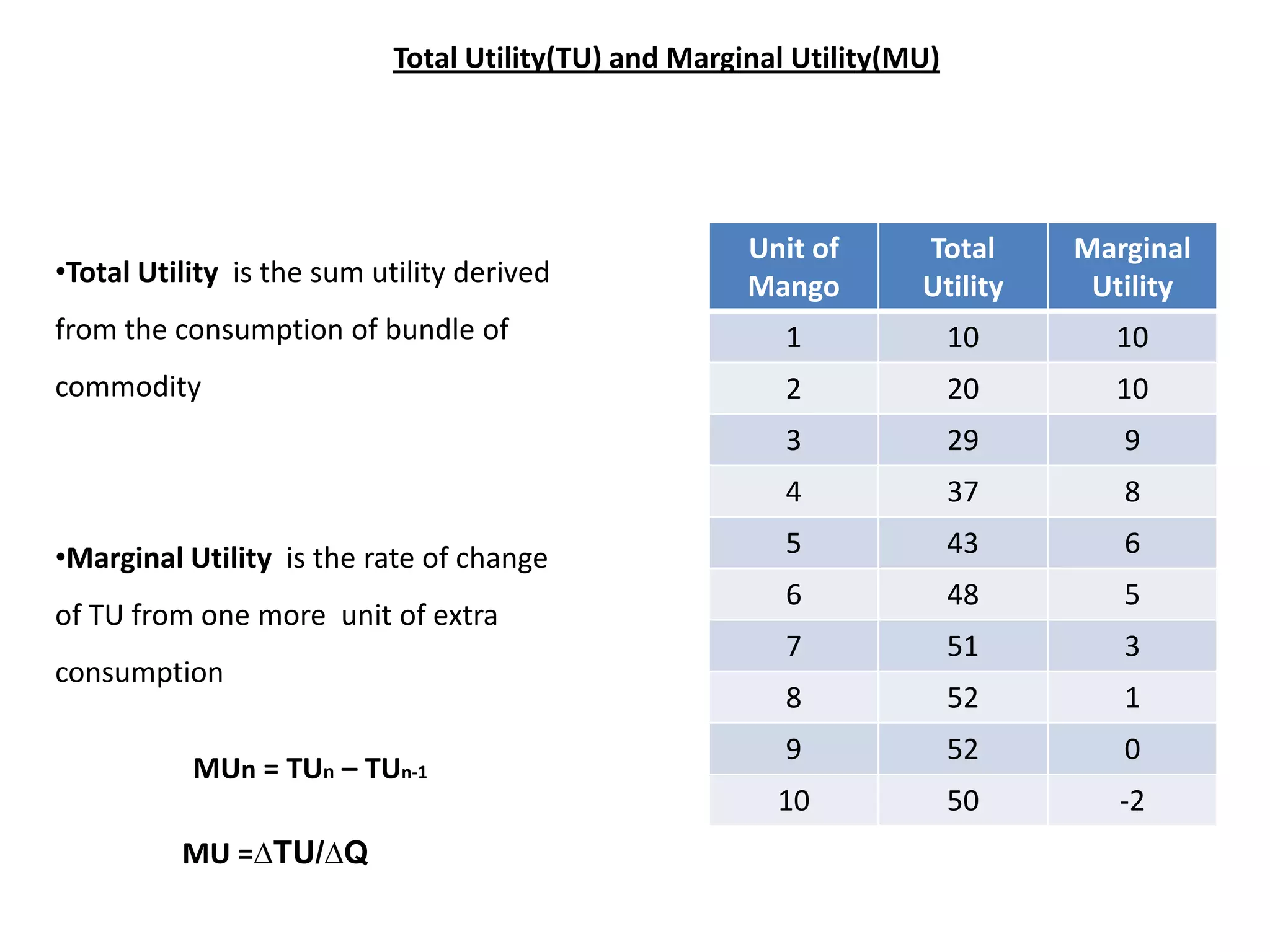
Total Utility(TU) and Marginal Utility(MU)


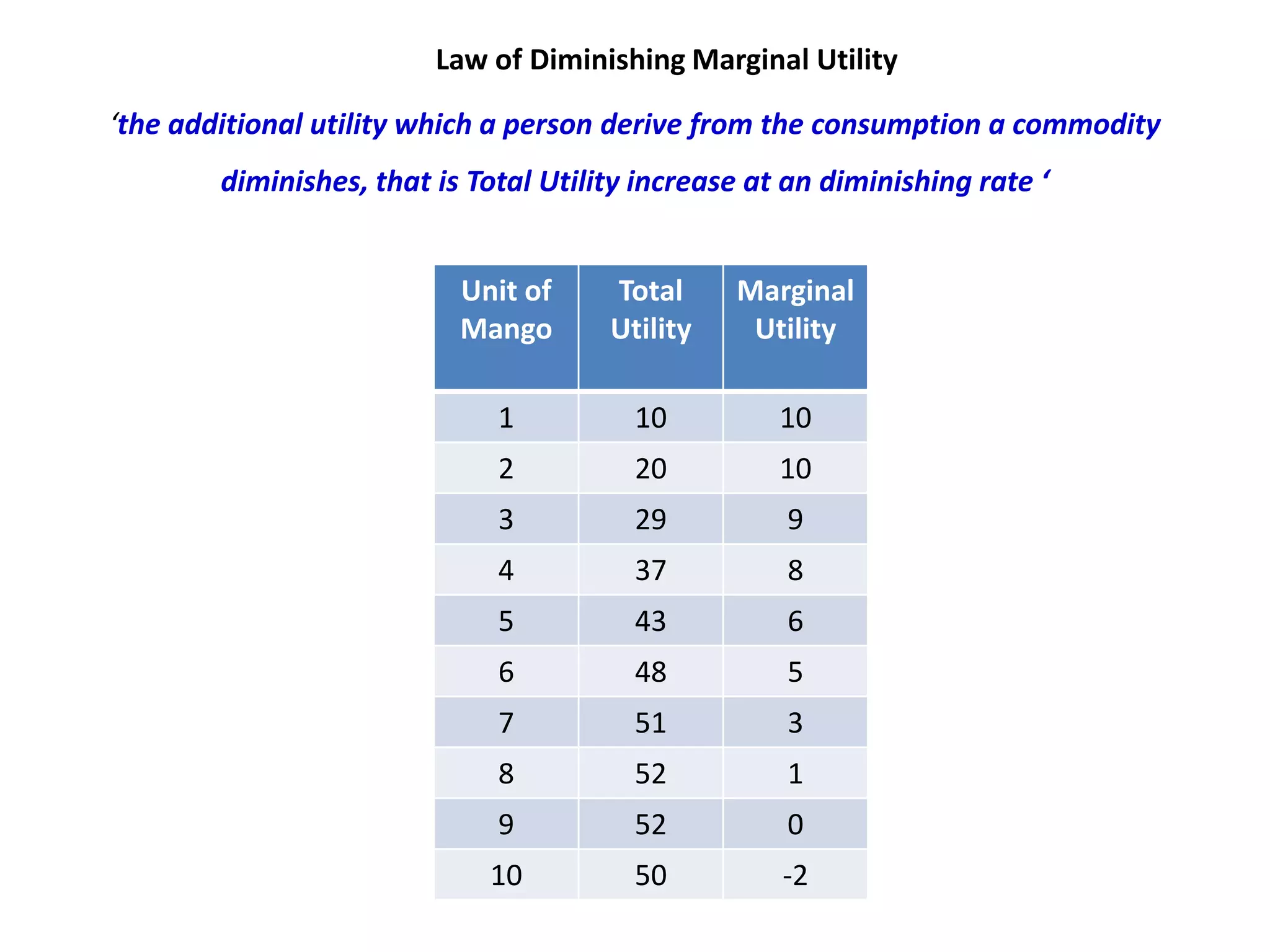
                                                       Unit of      Total     Marginal
•Total Utility is the sum utility derived              Mango        Utility    Utility
from the consumption of bundle of                         1              10     10
commodity                                                 2              20     10
                                                          3              29      9
                                                          4              37      8

•Marginal Utility is the rate of change                   5              43      6
                                                          6              48      5
of TU from one more unit of extra
                                                          7              51      3
consumption
                                                          8              52      1
                                                          9              52      0
           MUn = TUn – TUn-1
                                                         10              50      -2
          MU =∆TU/∆Q
I.   Introduction to Utility Analysis

     a)     Meaning of Utility

     b)     Cardinal Utility analysis and Ordinal Utility Analysis

     c)     Total Utility and Marginal Utility


II. Cardinal Utility

     a) Assumptions of Cardinal Utility analysis

     b) Law of Diminishing Marginal Utility

     c)     Law of Equal-Marginal Utility

III. Critical evaluation of Cardinal Utility analysis

IV. Conclusion
2. Cardinal Utility Analysis


a) Assumptions of Cardinal Utility analysis

b) Law of Diminishing Marginal Utility

c)   Law of Equal-Marginal Utility
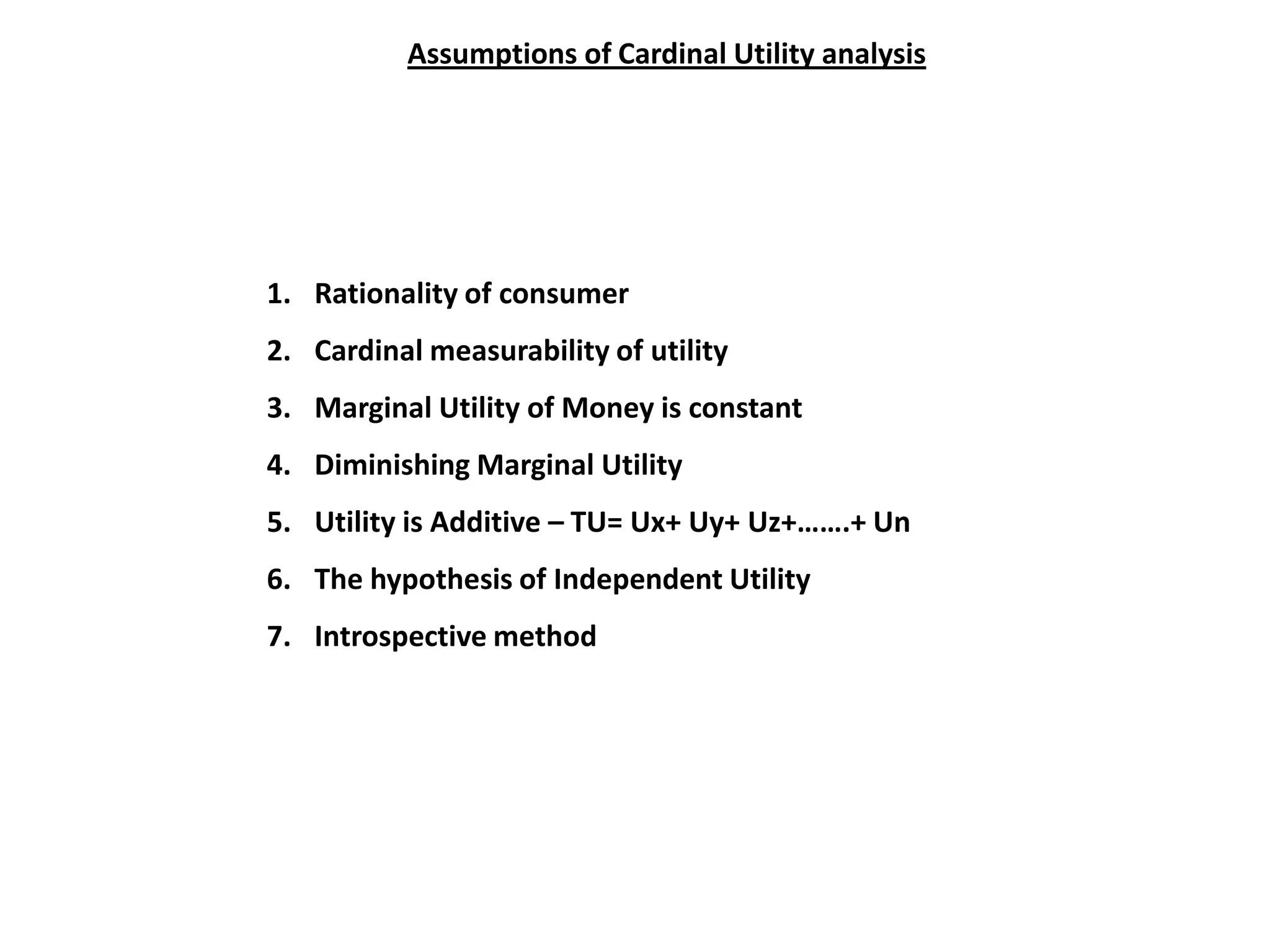
Assumptions of Cardinal Utility analysis


1. Rationality of consumer
2. Cardinal measurability of utility
3. Marginal Utility of Money is constant
4. Diminishing Marginal Utility
5. Utility is Additive – TU= Ux+ Uy+ Uz+…….+ Un
6. The hypothesis of Independent Utility
7. Introspective method
Law of Diminishing Marginal Utility
         Gossen First law
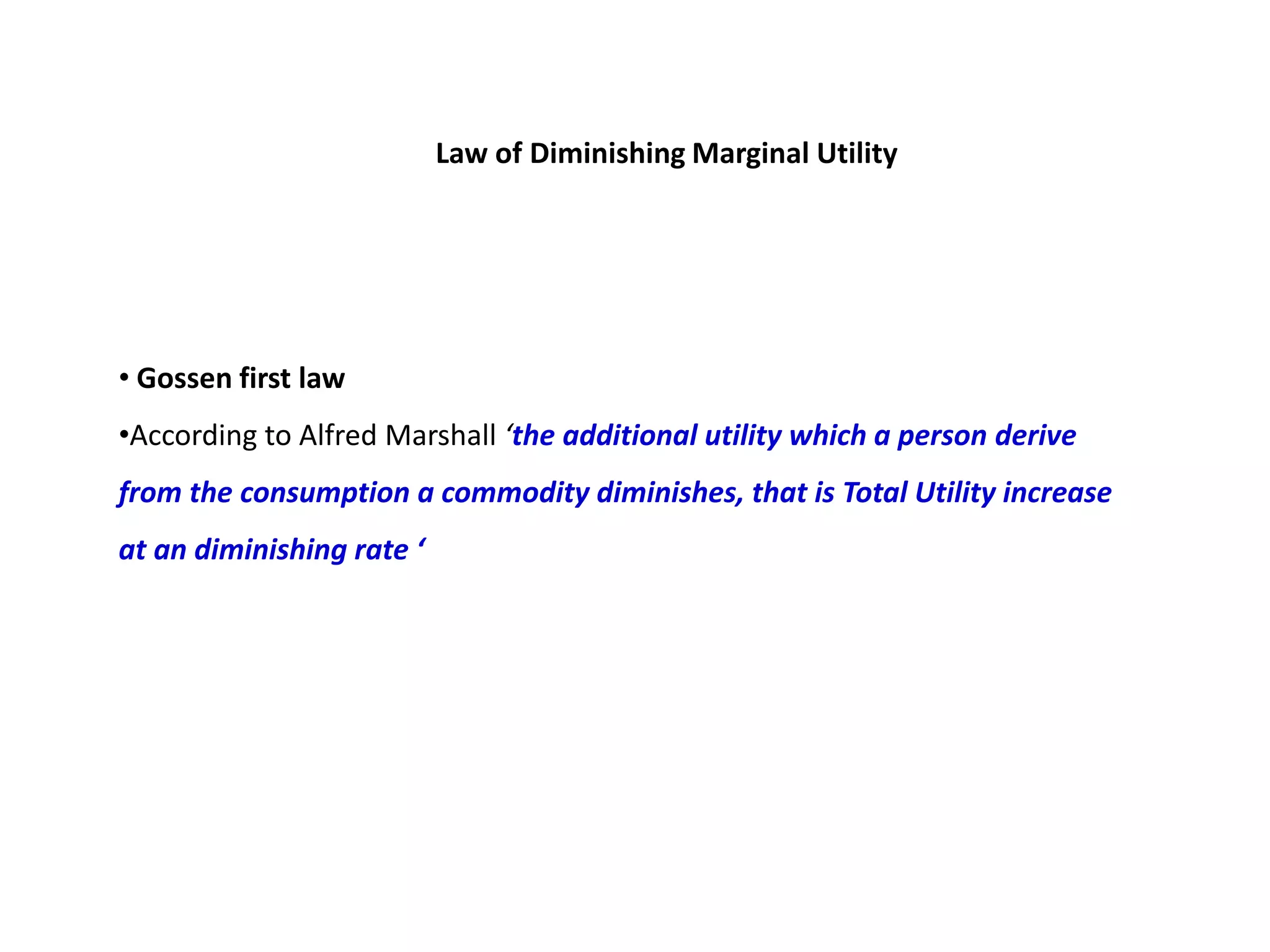
Law of Diminishing Marginal Utility


• Gossen first law
•According to Alfred Marshall ‘the additional utility which a person derive
from the consumption a commodity diminishes, that is Total Utility increase
at an diminishing rate ‘
Law of Diminishing Marginal Utility

   ‘the additional utility which a person derive from the consumption a commodity
           diminishes, that is Total Utility increase at an diminishing rate ‘


                              Unit of     Total     Marginal
                              Mango       Utility    Utility

                                 1          10
                                 2          20
MUn = TUn – TUn-1
                                 3          29
                                 4          37
MU =∆TU/∆Q
                                 5          43
                                 6          48
                                 7          51
                                 8          52
                                 9          52
                                10          50
Law of Diminishing Marginal Utility

‘the additional utility which a person derive from the consumption a commodity
        diminishes, that is Total Utility increase at an diminishing rate ‘


                           Unit of     Total     Marginal
                           Mango       Utility    Utility

                              1          10          10
                              2          20          10
                              3          29          9
                              4          37          8
                              5          43          6
                              6          48          5
                              7          51          3
                              8          52          1
                              9          52          0
                             10          50          -2
Law of Diminishing Marginal Utility


  ‘the additional utility which a person derive from the consumption a commodity
          diminishes, that is Total Utility increase at an diminishing rate ‘


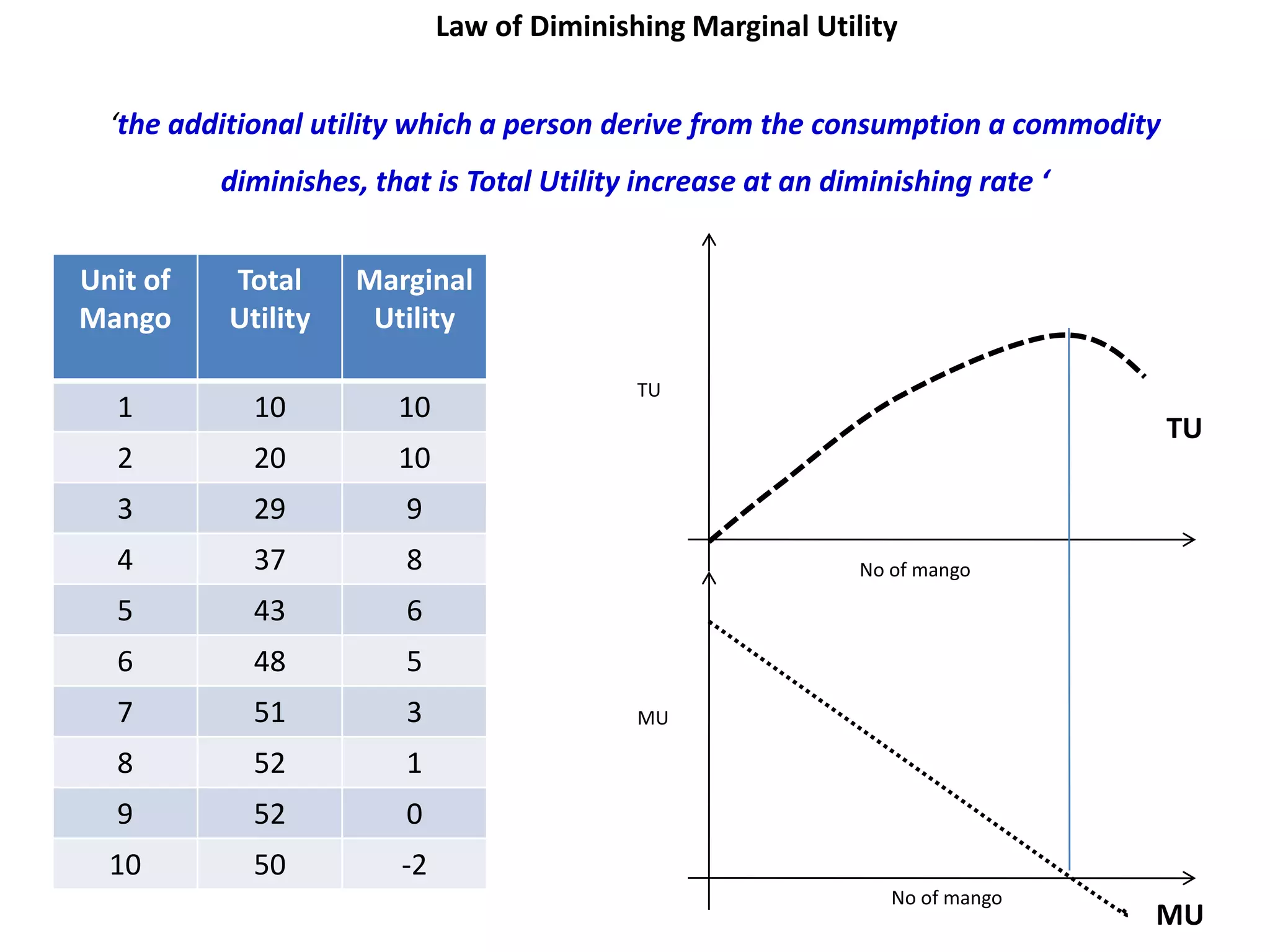
Unit of   Total     Marginal
Mango     Utility    Utility

                                            TU
  1         10          10
                                                                                   TU
  2         20          10
  3         29           9
  4         37           8                                   No of mango

  5         43           6
  6         48           5
  7         51           3                  MU

  8         52           1
  9         52           0
  10        50          -2
                                                                No of mango
                                                                                MU
Law of Diminishing Marginal Utility


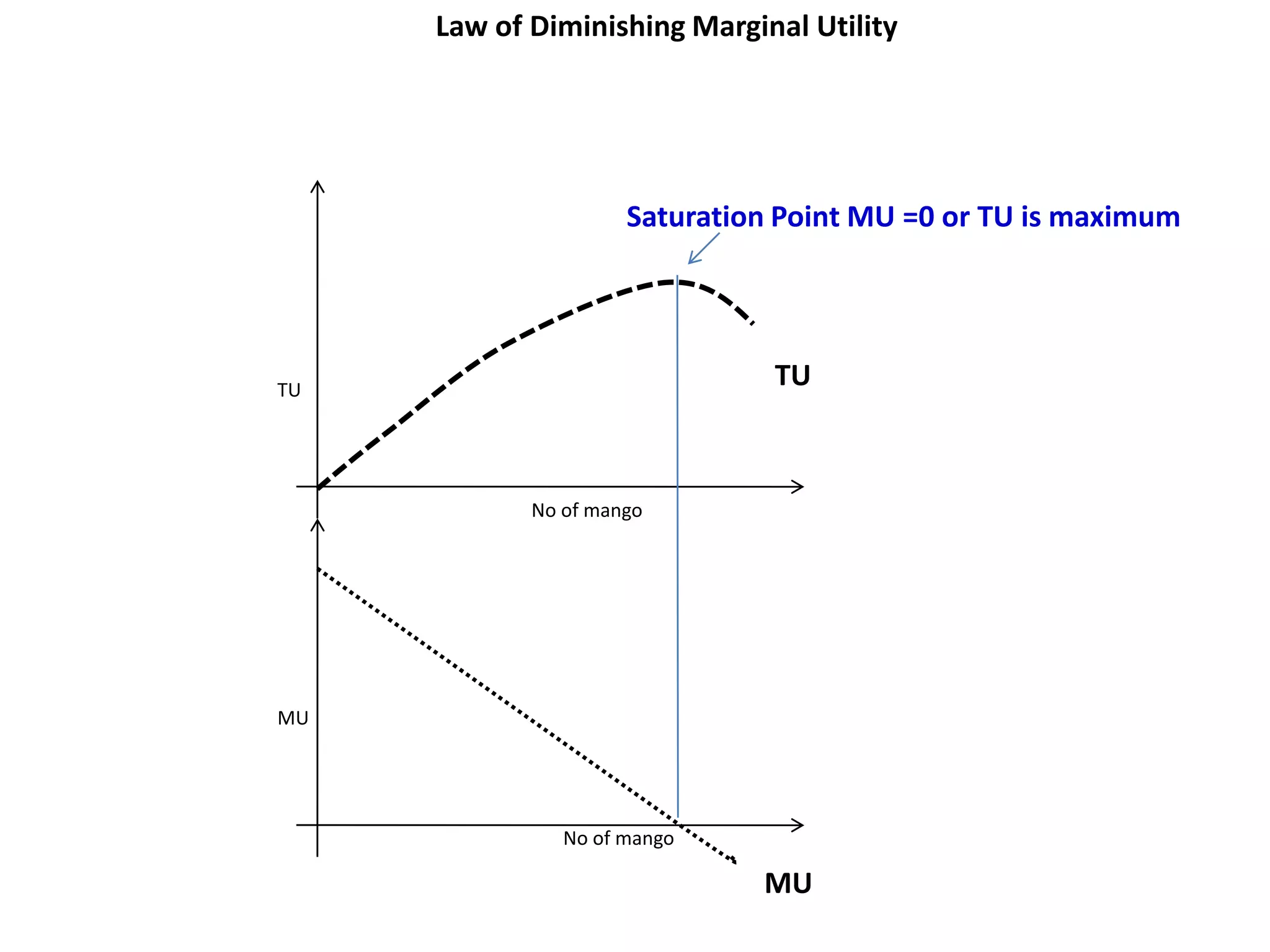
                     Saturation Point MU =0 or TU is maximum


TU
                               TU


            No of mango


MU


               No of mango

                              MU
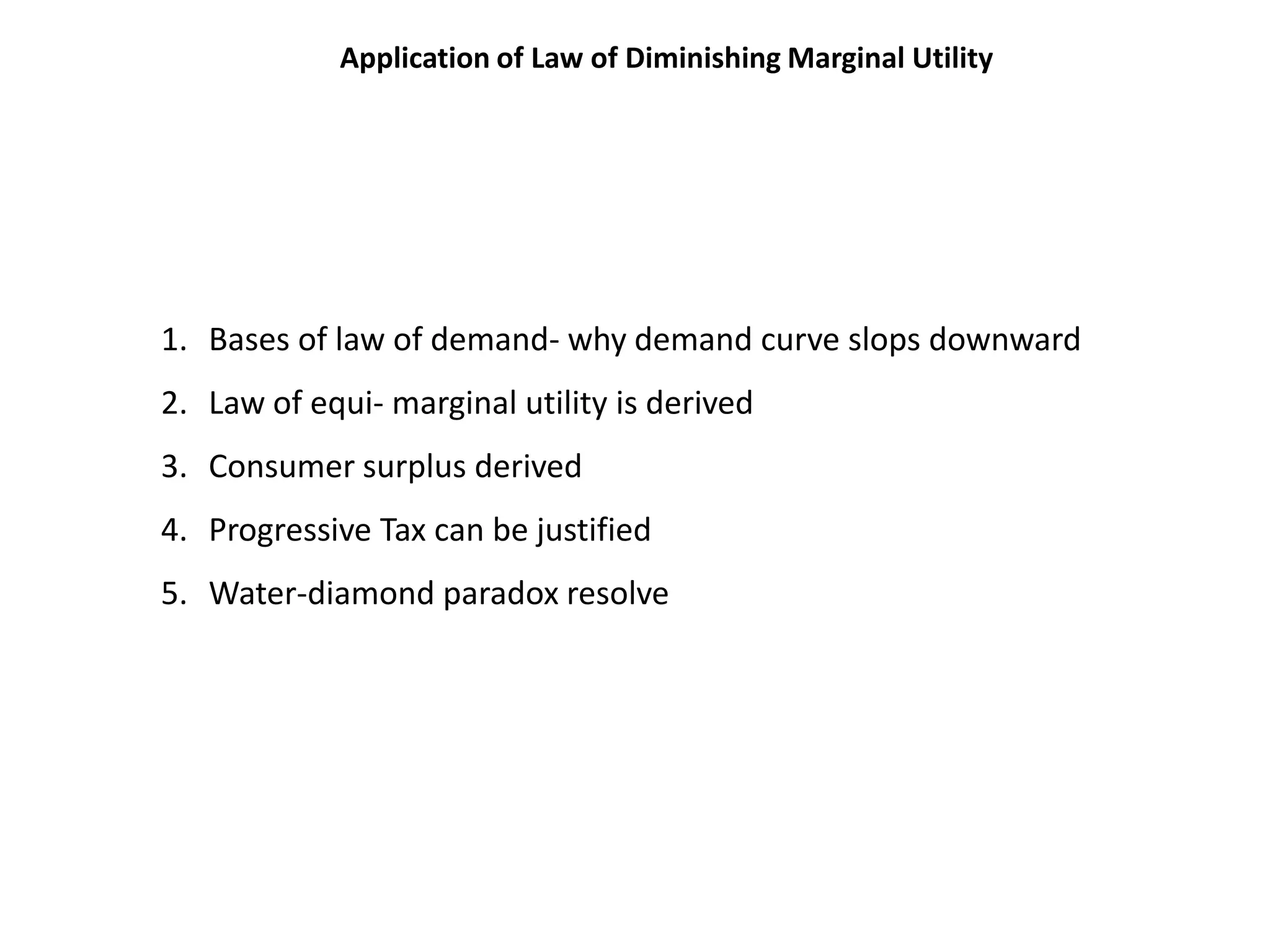
Application of Law of Diminishing Marginal Utility


1. Bases of law of demand- why demand curve slops downward
2. Law of equi- marginal utility is derived
3. Consumer surplus derived
4. Progressive Tax can be justified
5. Water-diamond paradox resolve
Law of Equal-Marginal Utility
Consumer’s Equilibrium under Marshellian analysis
             (Goosen’s Second Law)
Law of Equal-Marginal Utility
                   Consumer’s Equilibrium under Marshellian analysis


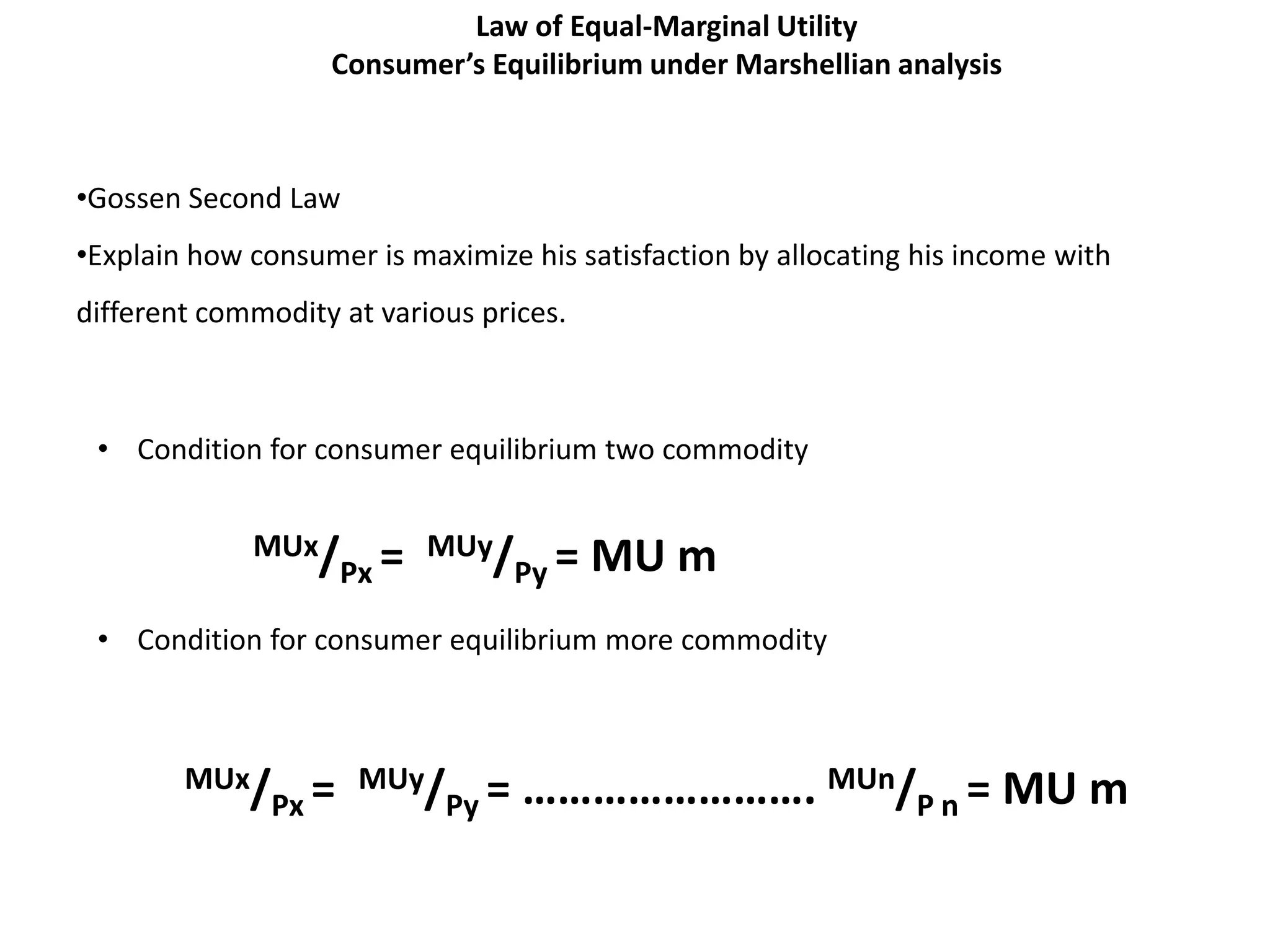
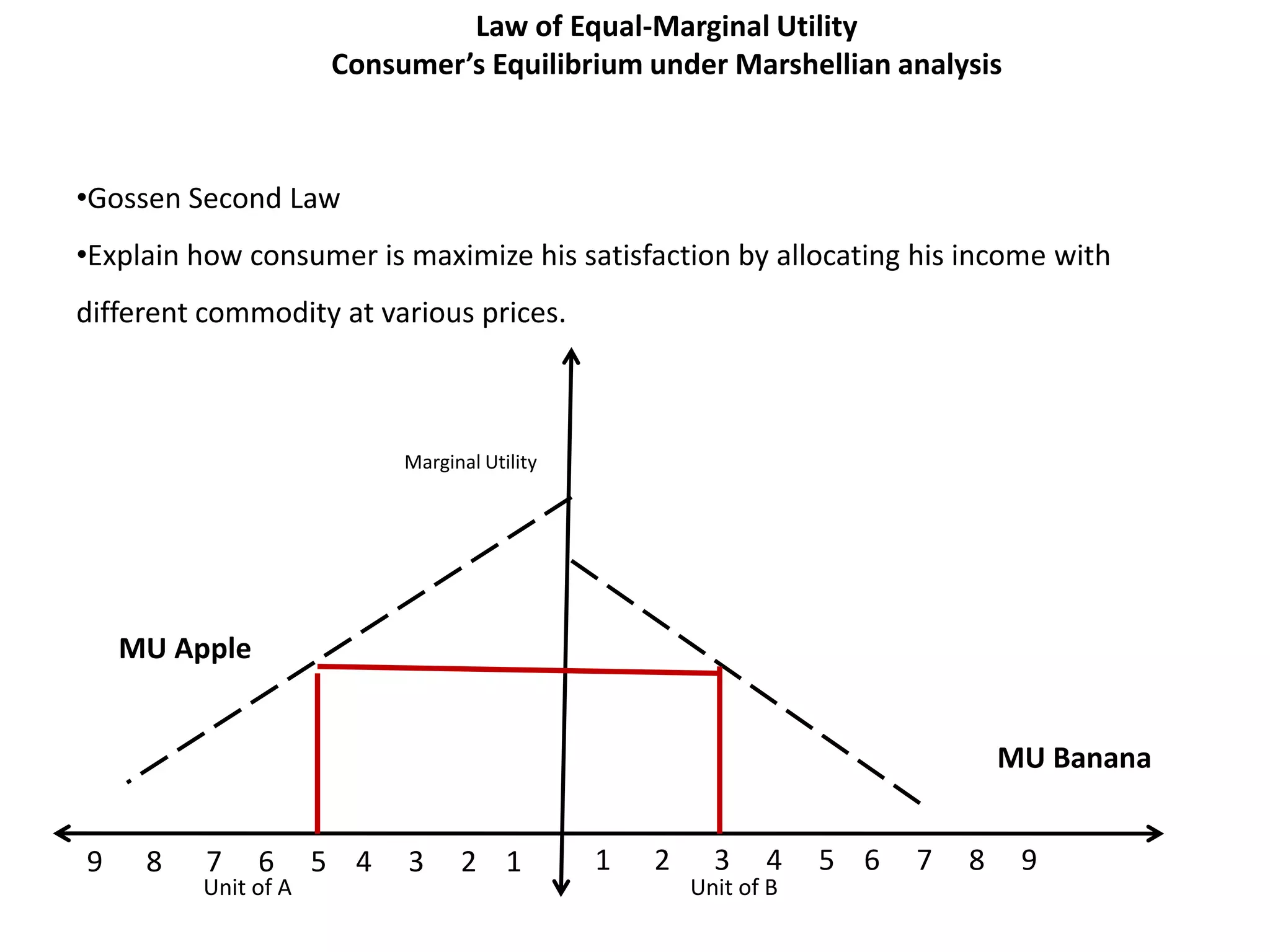
•Gossen Second Law
•Explain how consumer is maximize his satisfaction by allocating his income with
different commodity at various prices.


 • Condition for consumer equilibrium two commodity


             MUx/ = MUy/ =               MU m
                 Px     Py

 • Condition for consumer equilibrium more commodity


        MUx/ = MUy/ =             ……………………. MUn/P n = MU m
            Px     Py
Law of Equal-Marginal Utility
                          Consumer’s Equilibrium under Marshellian analysis


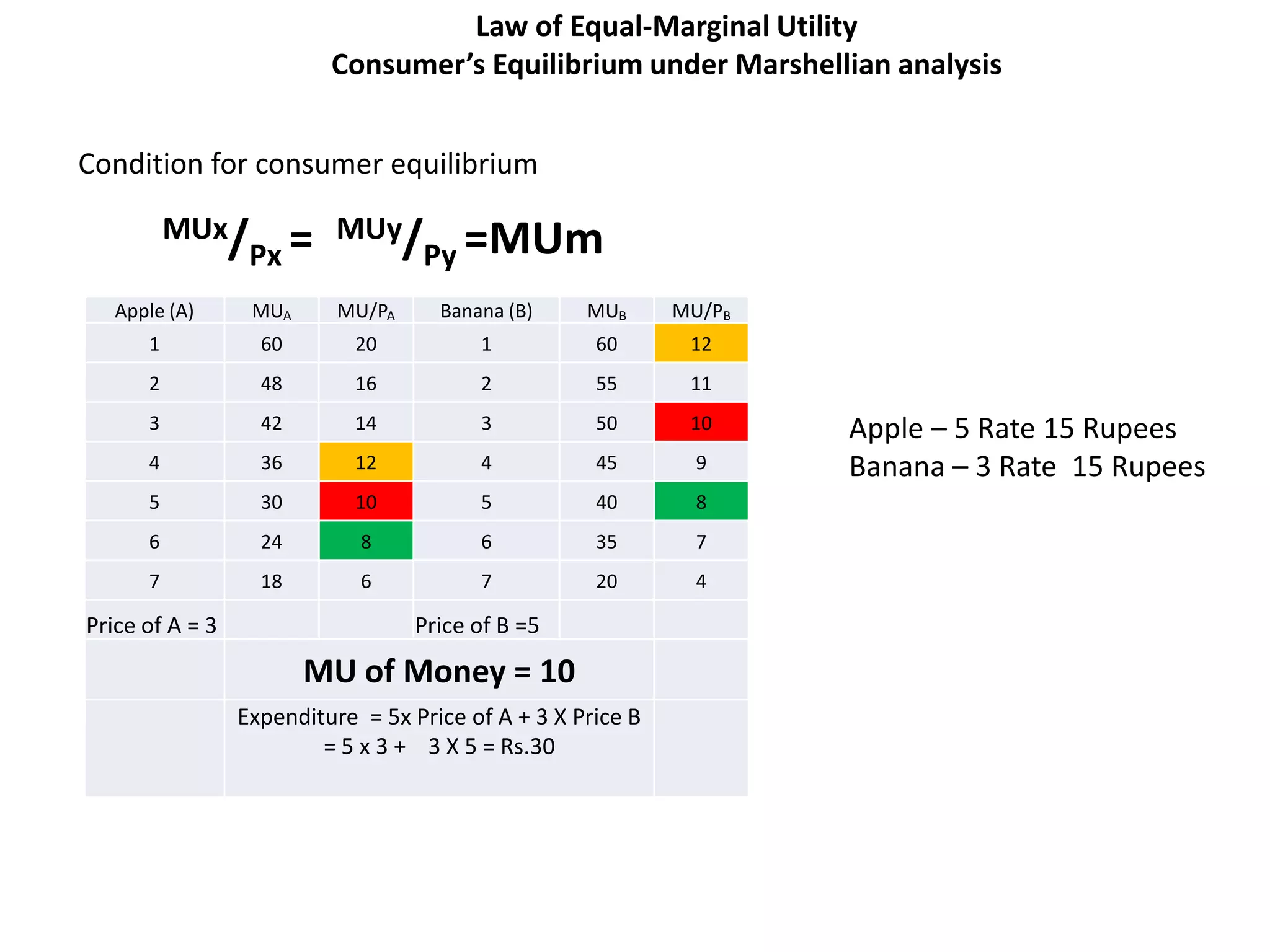
Condition for consumer equilibrium

          MUx/ = MUy/ =MUm
              Px     Py
   Apple (A)      MUA      MU/PA     Banana (B)     MUB      MU/PB
      1            60       20           1           60       12
      2            48       16           2           55       11
      3            42       14           3           50       10     Apple – 5 Rate 15 Rupees
      4            36       12           4           45        9     Banana – 3 Rate 15 Rupees
      5            30       10           5           40        8
      6            24        8           6           35        7
      7            18        6           7           20        4

Price of A = 3                     Price of B =5
                        MU of Money = 10
                 Expenditure = 5x Price of A + 3 X Price B
                         = 5 x 3 + 3 X 5 = Rs.30
Law of Equal-Marginal Utility
                      Consumer’s Equilibrium under Marshellian analysis


•Gossen Second Law
•Explain how consumer is maximize his satisfaction by allocating his income with
different commodity at various prices.


                           Marginal Utility


    MU Apple


                                                                                MU Banana


9    8    7    6     5 4   3     2 1          1   2     3    4    5 6   7   8    9
         Unit of A                                    Unit of B
Critical evaluation of Cardinal Utility analysis


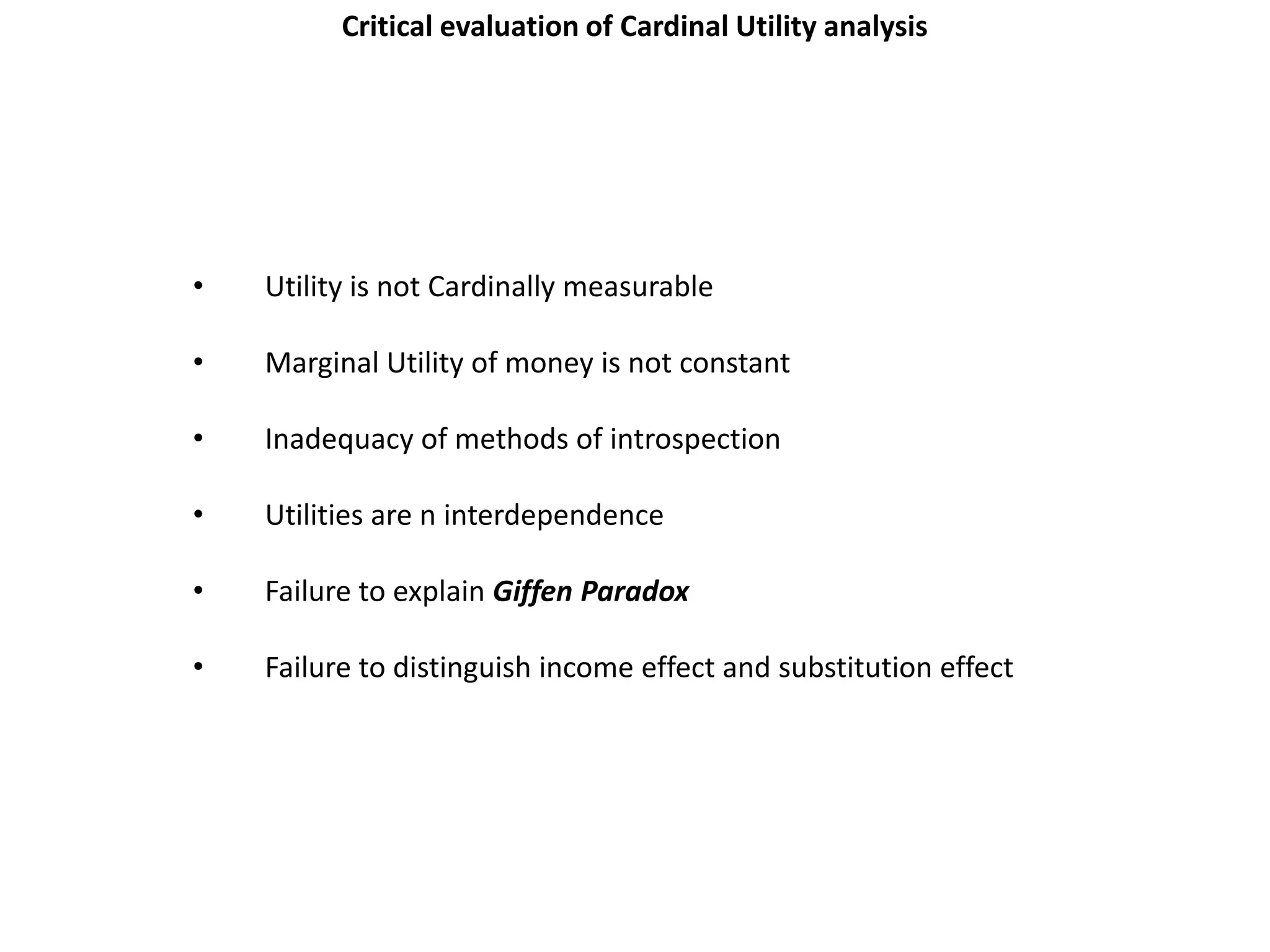
•   Utility is not Cardinally measurable

•   Marginal Utility of money is not constant

•   Inadequacy of methods of introspection

•   Utilities are n interdependence

•   Failure to explain Giffen Paradox

•   Failure to distinguish income effect and substitution effect

Conclusion
? ? ? ? ? ?? ? ? ? ? ? ??
              ?

  ? ? ? ? ? ?? ? ? ? ? ? ??
                                      ?
                  ?

    ? ? ? ? ? ?? ? ? ? ? ? ??
                                              ?
                      ?

       ? ? ? ? ? ?? ? ? ? ? ? ??
                                                  ?
                          ?

          ? ? ? ? ? ?? ? ? ? ? ? ??
                                                          ?
                              ?

            ? ? ? ? ? ?? ? ? ? ? ? ??
                                                              ?
                                  ?
                                                                  ?
              ? ? ? ? ? ?? ? ? ? ? ? ? ?
                                      ?
                                                                      ?

               ? ? ? ? ? ?? ? ? ? ? ? ??
     Thanks
                                          ?

                  ? ? ?? ? ?? ? ? ?? ? ??
                                                                      ?
                                              ?
                                                                          ?
                     ? ? ? ? ? ? ? ? ? ? ? ? ??       ?
                                                                              ?

Utility and cardinal utility analysis

  • 1.
    SEMINAR Presentation Utility andCardinal Utility analysis BA Economics Programme Faris K.V. Muhammed Noufal Muhammed Jaseel Jamsheed P.T. SAFI Institute of Advanced Study, Vazhayoor
  • 2.
    Contents I. Introduction to Utility Analysis a) Meaning of Utility b) Cardinal Utility analysis and Ordinal Utility Analysis c) Total Utility and Marginal Utility II. Cardinal Utility a) Assumptions of Cardinal Utility analysis b) Law of Diminishing Marginal Utility c) Law of Equal-Marginal Utility III. Critical evaluation of Cardinal Utility analysis IV. Conclusion
  • 3.
    1. Introduction toUtility Analysis a) Meaning of Utility b) Cardinal Utility analysis and Ordinal Utility Analysis c) Total Utility and Marginal Utility
  • 4.
  • 5.
    I. Introduction to Utility Analysis Meaning of Utility  Utility means - The power of a commodity that satisfy the wants of consumer - want satisfying power  Introduced by Jermy Bentham  Measurement ‘Utils’  Subjective entity
  • 6.
    Cardinal Utility analysisand Ordinal Utility Analysis
  • 7.
    Cardinal Utility analysisand Ordinal Utility Analysis Utility Analysis Cardinal Utility analysis Ordinal Utility Analysis • Alfred Marshal • J. R. Hicks & R.G.D. Allen • can be measured •Cannot be measured but compared • ‘Utils’ as rank • Law of Diminishing Marginal • Indifference Curve analysis Utility • Quantitative . Subjective entity or Personal •Law of Equi-marginal Utility •Mashellian Analysis
  • 8.
    Total Utility(TU) andMarginal Utility(MU)
  • 9.
    Total Utility(TU) andMarginal Utility(MU) Unit of Total Marginal •Total Utility is the sum utility derived from Mango Utility Utility the consumption of bundle of commodity 1 10 2 20 3 29 •Marginal Utility is the rate of change of TU 4 37 from one more unit of extra consumption 5 43 6 48 7 51 8 52 MUn = TUn – TUn-1 9 52 10 50 MU =∆TU/∆Q
  • 10.
    Total Utility(TU) andMarginal Utility(MU) Unit of Total Marginal •Total Utility is the sum utility derived Mango Utility Utility from the consumption of bundle of 1 10 10 commodity 2 20 10 3 29 9 4 37 8 •Marginal Utility is the rate of change 5 43 6 6 48 5 of TU from one more unit of extra 7 51 3 consumption 8 52 1 9 52 0 MUn = TUn – TUn-1 10 50 -2 MU =∆TU/∆Q
  • 11.
    I. Introduction to Utility Analysis a) Meaning of Utility b) Cardinal Utility analysis and Ordinal Utility Analysis c) Total Utility and Marginal Utility II. Cardinal Utility a) Assumptions of Cardinal Utility analysis b) Law of Diminishing Marginal Utility c) Law of Equal-Marginal Utility III. Critical evaluation of Cardinal Utility analysis IV. Conclusion
  • 12.
    2. Cardinal UtilityAnalysis a) Assumptions of Cardinal Utility analysis b) Law of Diminishing Marginal Utility c) Law of Equal-Marginal Utility
  • 13.
    Assumptions of CardinalUtility analysis
  • 14.
    Assumptions of CardinalUtility analysis 1. Rationality of consumer 2. Cardinal measurability of utility 3. Marginal Utility of Money is constant 4. Diminishing Marginal Utility 5. Utility is Additive – TU= Ux+ Uy+ Uz+…….+ Un 6. The hypothesis of Independent Utility 7. Introspective method
  • 15.
    Law of DiminishingMarginal Utility Gossen First law
  • 16.
    Law of DiminishingMarginal Utility • Gossen first law •According to Alfred Marshall ‘the additional utility which a person derive from the consumption a commodity diminishes, that is Total Utility increase at an diminishing rate ‘
  • 17.
    Law of DiminishingMarginal Utility ‘the additional utility which a person derive from the consumption a commodity diminishes, that is Total Utility increase at an diminishing rate ‘ Unit of Total Marginal Mango Utility Utility 1 10 2 20 MUn = TUn – TUn-1 3 29 4 37 MU =∆TU/∆Q 5 43 6 48 7 51 8 52 9 52 10 50
  • 18.
    Law of DiminishingMarginal Utility ‘the additional utility which a person derive from the consumption a commodity diminishes, that is Total Utility increase at an diminishing rate ‘ Unit of Total Marginal Mango Utility Utility 1 10 10 2 20 10 3 29 9 4 37 8 5 43 6 6 48 5 7 51 3 8 52 1 9 52 0 10 50 -2
  • 19.
    Law of DiminishingMarginal Utility ‘the additional utility which a person derive from the consumption a commodity diminishes, that is Total Utility increase at an diminishing rate ‘ Unit of Total Marginal Mango Utility Utility TU 1 10 10 TU 2 20 10 3 29 9 4 37 8 No of mango 5 43 6 6 48 5 7 51 3 MU 8 52 1 9 52 0 10 50 -2 No of mango MU
  • 20.
    Law of DiminishingMarginal Utility Saturation Point MU =0 or TU is maximum TU TU No of mango MU No of mango MU
  • 21.
    Application of Lawof Diminishing Marginal Utility
  • 22.
    Application of Lawof Diminishing Marginal Utility 1. Bases of law of demand- why demand curve slops downward 2. Law of equi- marginal utility is derived 3. Consumer surplus derived 4. Progressive Tax can be justified 5. Water-diamond paradox resolve
  • 23.
    Law of Equal-MarginalUtility Consumer’s Equilibrium under Marshellian analysis (Goosen’s Second Law)
  • 24.
    Law of Equal-MarginalUtility Consumer’s Equilibrium under Marshellian analysis •Gossen Second Law •Explain how consumer is maximize his satisfaction by allocating his income with different commodity at various prices. • Condition for consumer equilibrium two commodity MUx/ = MUy/ = MU m Px Py • Condition for consumer equilibrium more commodity MUx/ = MUy/ = ……………………. MUn/P n = MU m Px Py
  • 25.
    Law of Equal-MarginalUtility Consumer’s Equilibrium under Marshellian analysis Condition for consumer equilibrium MUx/ = MUy/ =MUm Px Py Apple (A) MUA MU/PA Banana (B) MUB MU/PB 1 60 20 1 60 12 2 48 16 2 55 11 3 42 14 3 50 10 Apple – 5 Rate 15 Rupees 4 36 12 4 45 9 Banana – 3 Rate 15 Rupees 5 30 10 5 40 8 6 24 8 6 35 7 7 18 6 7 20 4 Price of A = 3 Price of B =5 MU of Money = 10 Expenditure = 5x Price of A + 3 X Price B = 5 x 3 + 3 X 5 = Rs.30
  • 26.
    Law of Equal-MarginalUtility Consumer’s Equilibrium under Marshellian analysis •Gossen Second Law •Explain how consumer is maximize his satisfaction by allocating his income with different commodity at various prices. Marginal Utility MU Apple MU Banana 9 8 7 6 5 4 3 2 1 1 2 3 4 5 6 7 8 9 Unit of A Unit of B
  • 27.
    Critical evaluation ofCardinal Utility analysis
  • 28.
    Critical evaluation ofCardinal Utility analysis • Utility is not Cardinally measurable • Marginal Utility of money is not constant • Inadequacy of methods of introspection • Utilities are n interdependence • Failure to explain Giffen Paradox • Failure to distinguish income effect and substitution effect
  • 29.
  • 30.
    ? ? ?? ? ?? ? ? ? ? ? ?? ? ? ? ? ? ? ?? ? ? ? ? ? ?? ? ? ? ? ? ? ? ?? ? ? ? ? ? ?? ? ? ? ? ? ? ? ?? ? ? ? ? ? ?? ? ? ? ? ? ? ? ?? ? ? ? ? ? ?? ? ? ? ? ? ? ? ?? ? ? ? ? ? ?? ? ? ? ? ? ? ? ? ?? ? ? ? ? ? ? ? ? ? ? ? ? ? ? ?? ? ? ? ? ? ?? Thanks ? ? ? ?? ? ?? ? ? ?? ? ?? ? ? ? ? ? ? ? ? ? ? ? ? ? ? ? ?? ? ?