PAJANCOA&RI, Karaikal- 609603
DEPARTMENT OF AGRICULTURALECONOMICSANDEXTENSION
AEC 501- Microeconomics theory and applications
Assignment on :- Cardinal utilityapproach
COURSE TEACHER: Dr. A.Pouchepparadjou
Presented by
Gopishankar.S
Cardinal utility approach
 The cardinal utility approach was founded by Alfred Marshall.
 He was one of the most influential economists of his time.
 Alfred Marshall was regarded as the father of neoclassical economics.
 He contributed to the introduction of demand and supply concepts as well.
 As of now, we will discuss Alfred Marshall Cardinal Utility Approach.
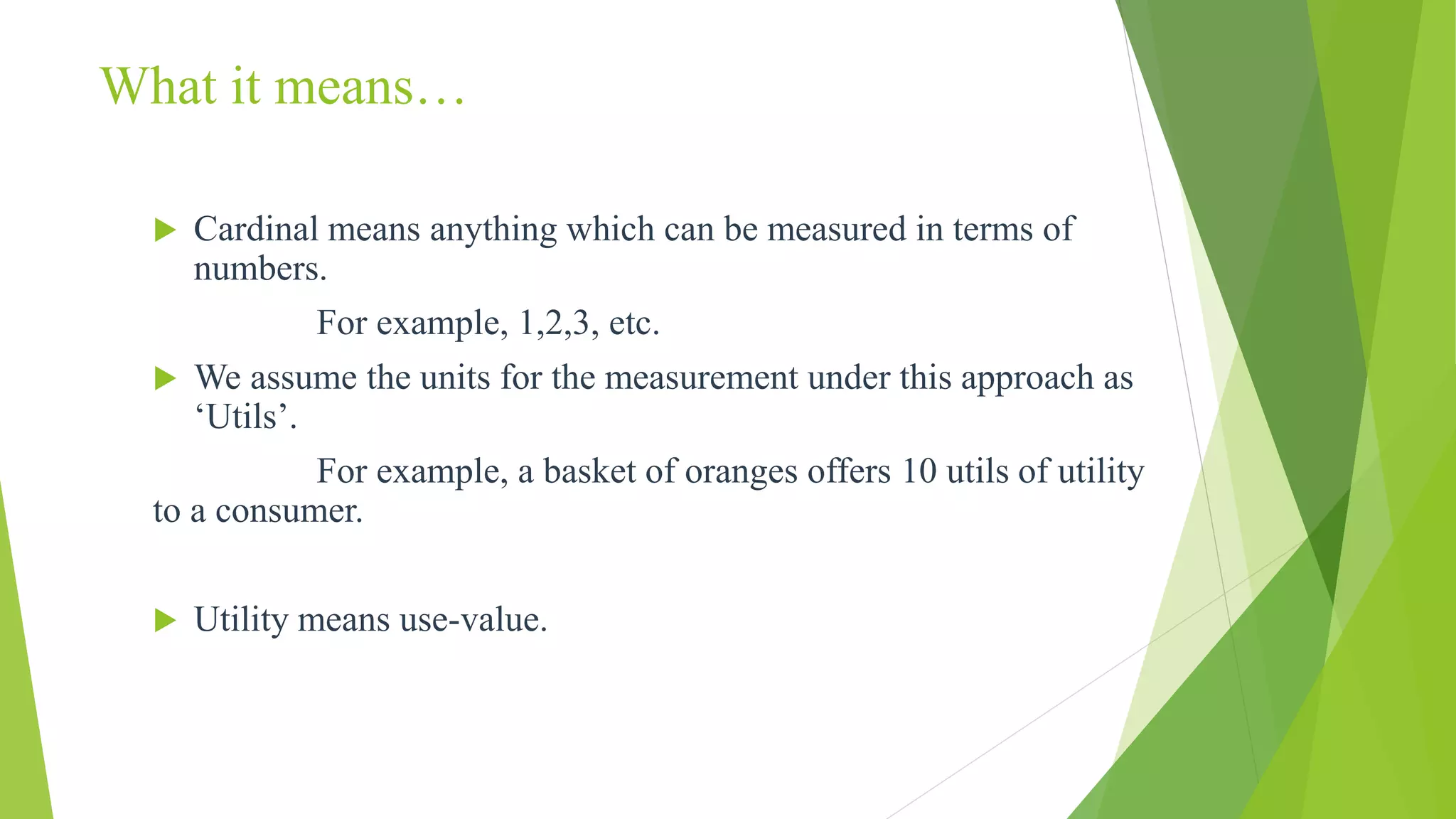
 Cardinal means anything which can be measured in terms of
numbers.
For example, 1,2,3, etc.
 We assume the units for the measurement under this approach as
‘Utils’.
For example, a basket of oranges offers 10 utils of utility
to a consumer.
 Utility means use-value.
What it means…
The basic characteristics of utility:-
 The utility is a quantitative measure of satisfaction, which means it can
be represented in terms of numbers or quantity.
 Utility depends on the intensity of wants.
 For example, the Air conditioner will be more valued in the summer season
compared to the winter season, due to the high intensity of wants of air
conditioners.
 The utility is subjective, which means, it varies from person to
person and from place to time.
 For example, some people will prefer watching movies in the theatre
compared to walking in the parks, others might prefer walking
compared to watching movies.
 The utility can be cardinal, that is it can be measured in numbers
or utility can be ordinal, that is it can be ranked.
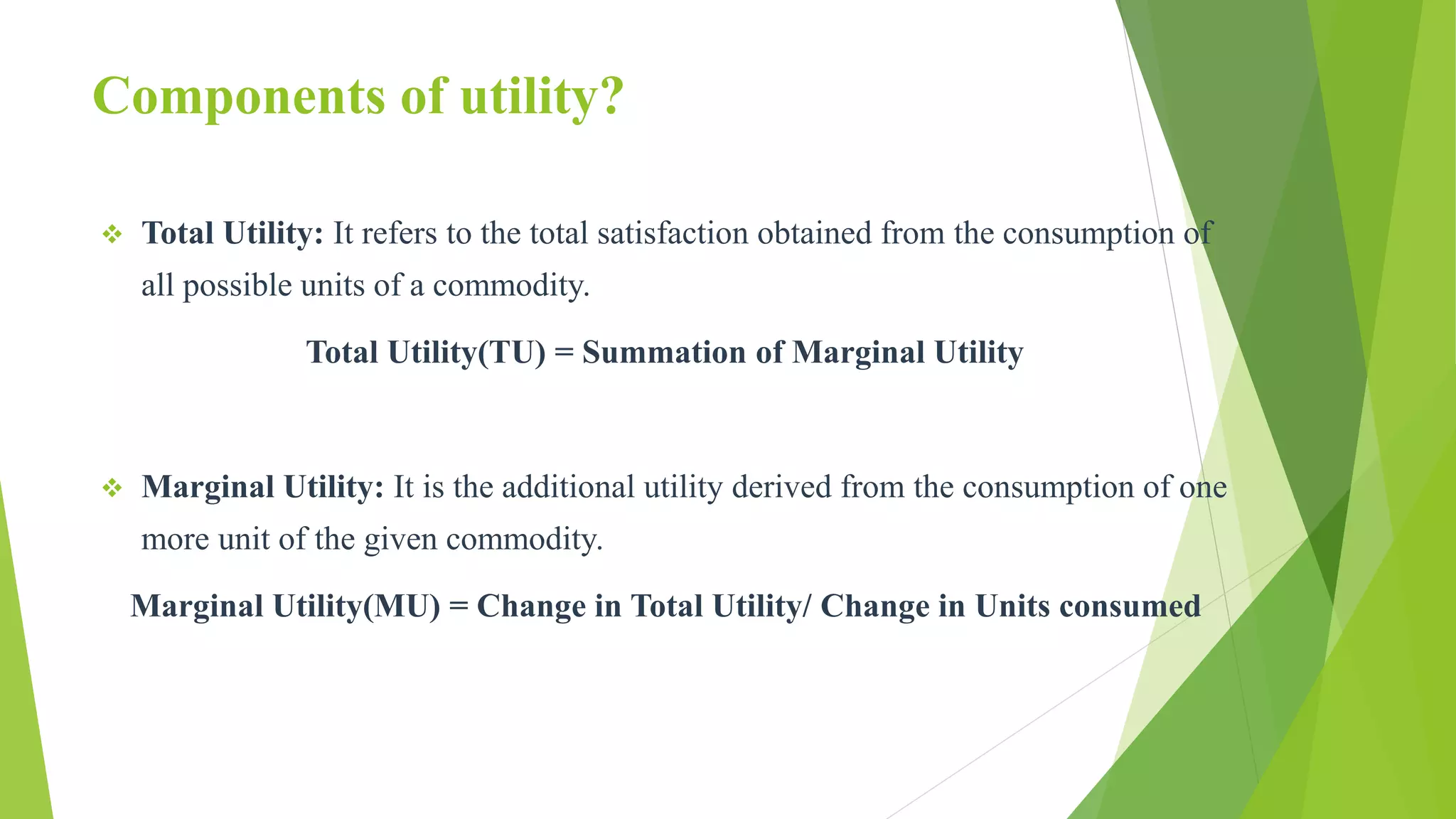
Components of utility?
 Total Utility: It refers to the total satisfaction obtained from the consumption of
all possible units of a commodity.
Total Utility(TU) = Summation of Marginal Utility
 Marginal Utility: It is the additional utility derived from the consumption of one
more unit of the given commodity.
Marginal Utility(MU) = Change in Total Utility/ Change in Units consumed
Cardinal utility approach
 Law of diminishing marginal utility
 Law of equi-marginal utility
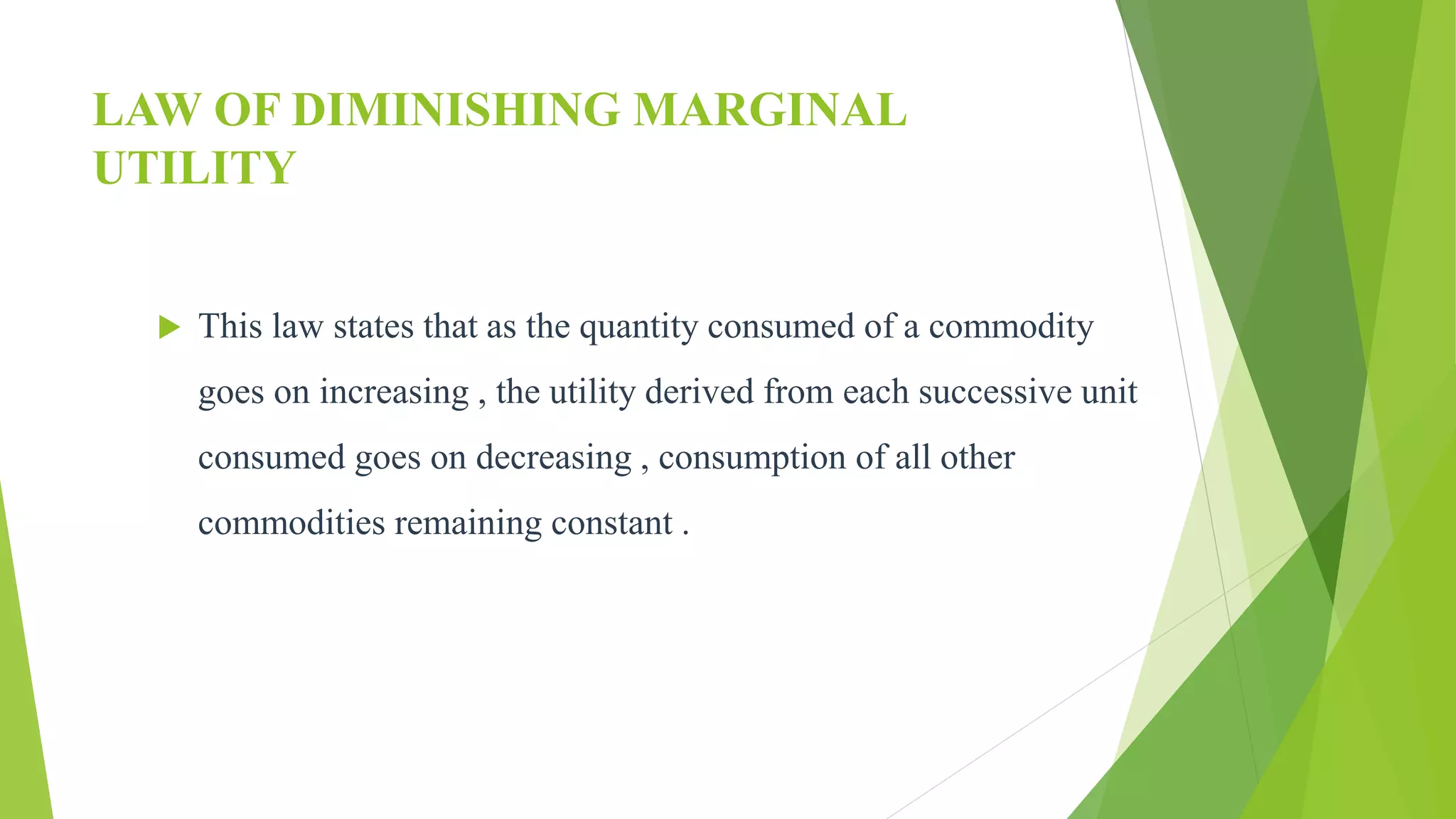
LAW OF DIMINISHING MARGINAL
UTILITY
 This law states that as the quantity consumed of a commodity
goes on increasing , the utility derived from each successive unit
consumed goes on decreasing , consumption of all other
commodities remaining constant .
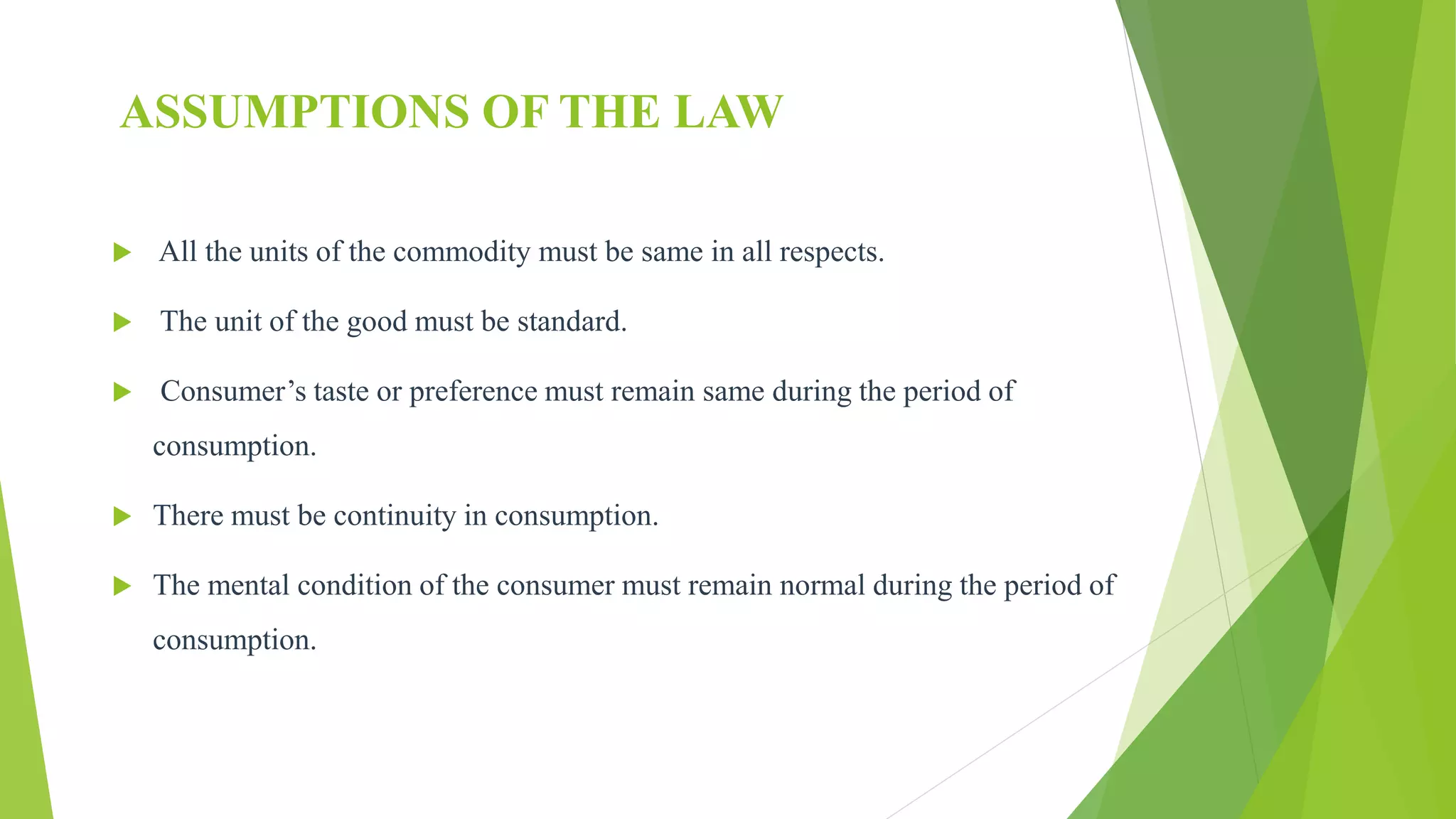
ASSUMPTIONS OF THE LAW
 All the units of the commodity must be same in all respects.
 The unit of the good must be standard.
 Consumer’s taste or preference must remain same during the period of
consumption.
 There must be continuity in consumption.
 The mental condition of the consumer must remain normal during the period of
consumption.
Explanation of law
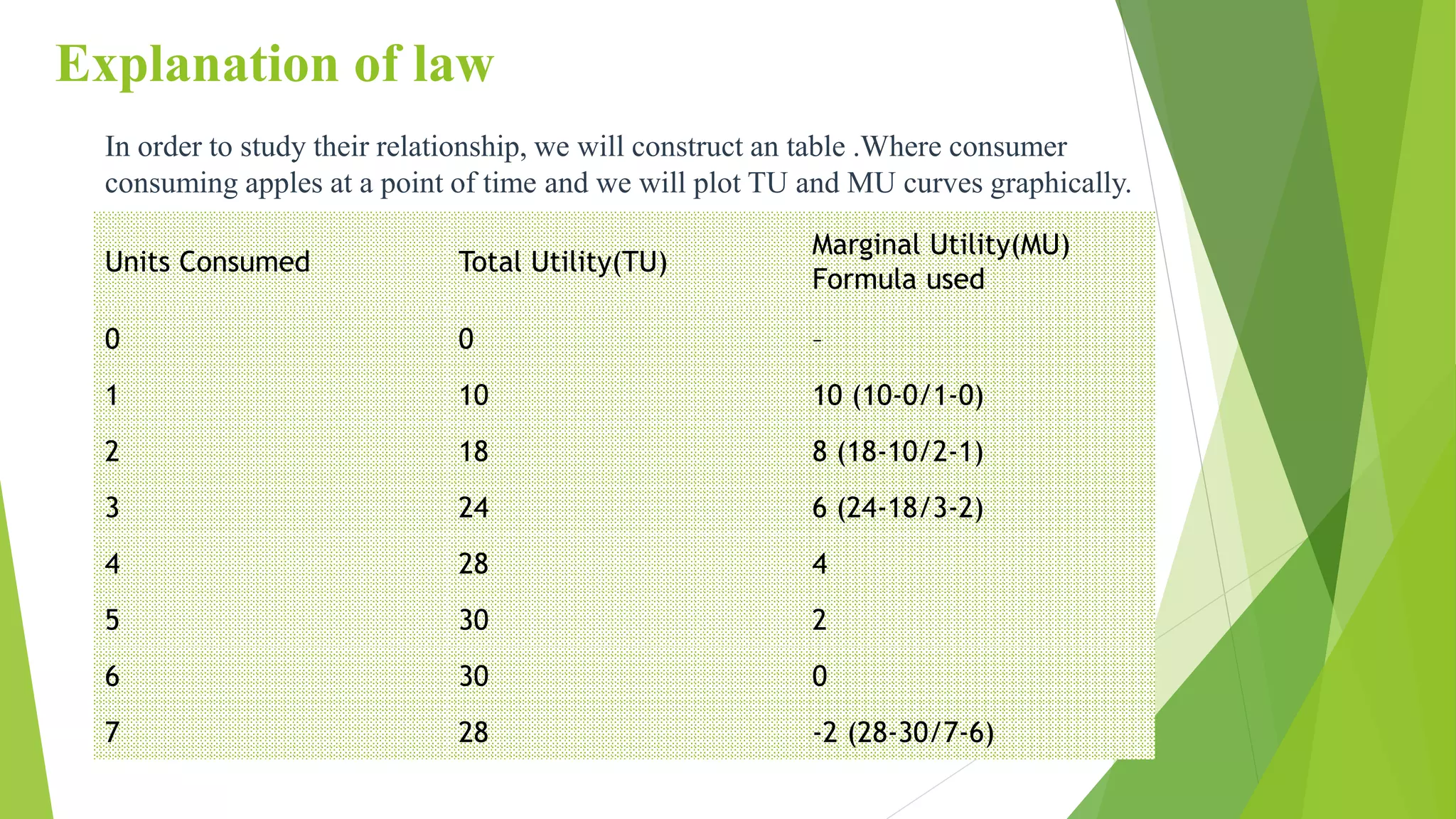
Units Consumed Total Utility(TU)
Marginal Utility(MU)
Formula used
0 0 –
1 10 10 (10-0/1-0)
2 18 8 (18-10/2-1)
3 24 6 (24-18/3-2)
4 28 4
5 30 2
6 30 0
7 28 -2 (28-30/7-6)
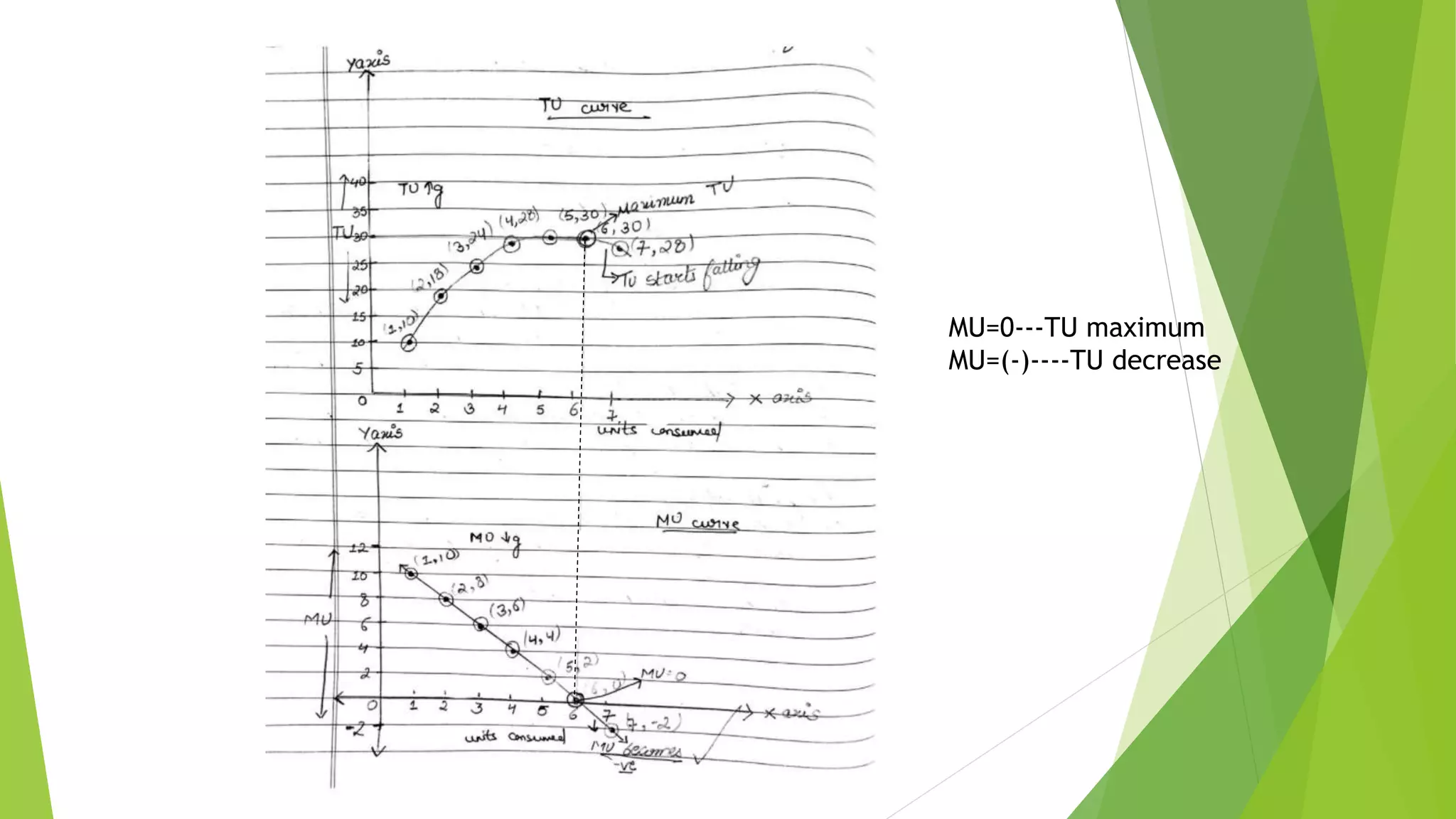
In order to study their relationship, we will construct an table .Where consumer
consuming apples at a point of time and we will plot TU and MU curves graphically.
MU=0---TU maximum
MU=(-)----TU decrease
Limitations of the law
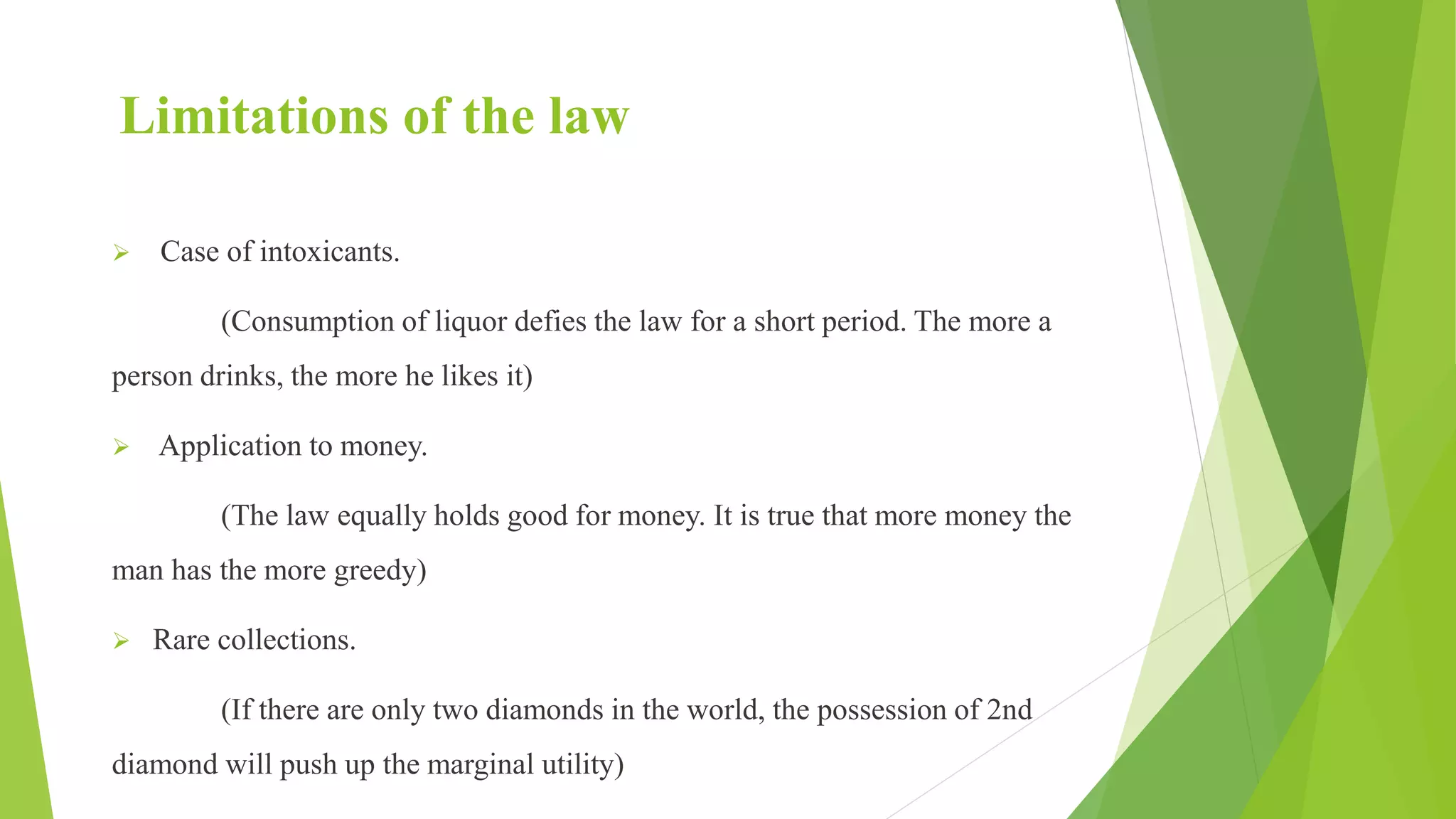
 Case of intoxicants.
(Consumption of liquor defies the law for a short period. The more a
person drinks, the more he likes it)
 Application to money.
(The law equally holds good for money. It is true that more money the
man has the more greedy)
 Rare collections.
(If there are only two diamonds in the world, the possession of 2nd
diamond will push up the marginal utility)
LAW OF EQUI-MARGINAL UTILITY
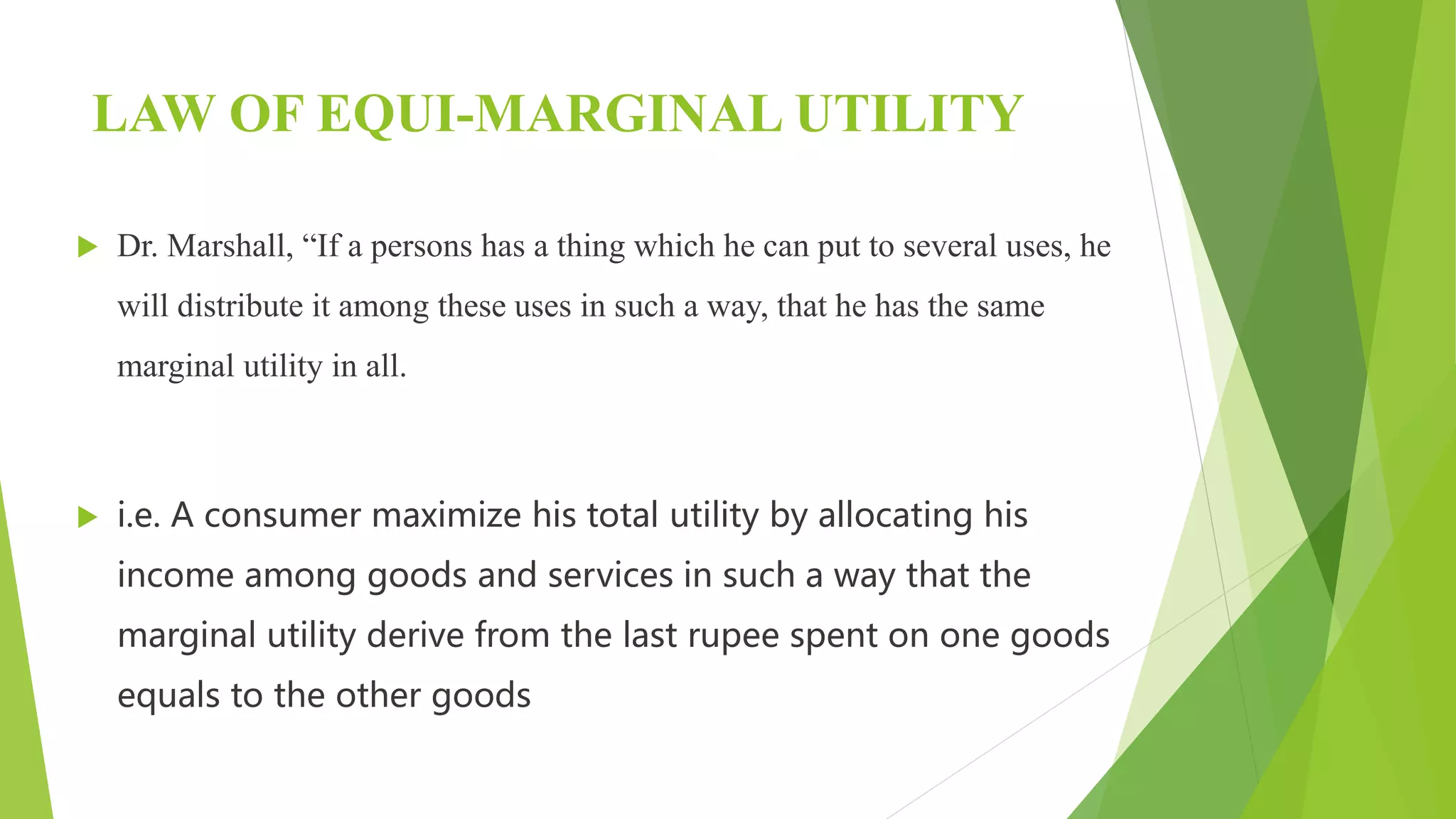
 Dr. Marshall, “If a persons has a thing which he can put to several uses, he
will distribute it among these uses in such a way, that he has the same
marginal utility in all.
 i.e. A consumer maximize his total utility by allocating his
income among goods and services in such a way that the
marginal utility derive from the last rupee spent on one goods
equals to the other goods
Importance of the law
1. Consumption
2. Production
3. Exchange
4. Price discrimination
5. Distribution
6. Public finance and International trade
7. Distribution of assets and Distribution of time Saving and investment
Limitations of Law of Equi-marginal
Utility
 Non availability of goods
 Influence of fashion, customs and habits
 Tastes and preferences are not constant
 Indivisibility of goods
 Change in income and price
 Complementary goods
 Marginal utility of money does not remain constant (Inflation effect)
REFERENCES
 Ahuja, H.L.(1970). Advanced Economic Theory. Delhi: S Chand and
Company Limited
 Dwibedi, D.N. (2003). Microeconomics Theory and Applications.
Delhi: Vikas Publishing House Pvt. Ltd.
 Kanel, N.R. and et.al (2016). Microeconomics. Kathmandu: Buddha
Publications
Thank you…

cardinal utility approach (gopi).pptx

  • 1.
    PAJANCOA&RI, Karaikal- 609603 DEPARTMENTOF AGRICULTURALECONOMICSANDEXTENSION AEC 501- Microeconomics theory and applications Assignment on :- Cardinal utilityapproach COURSE TEACHER: Dr. A.Pouchepparadjou Presented by Gopishankar.S
  • 2.
    Cardinal utility approach The cardinal utility approach was founded by Alfred Marshall.  He was one of the most influential economists of his time.  Alfred Marshall was regarded as the father of neoclassical economics.  He contributed to the introduction of demand and supply concepts as well.  As of now, we will discuss Alfred Marshall Cardinal Utility Approach.
  • 3.
     Cardinal meansanything which can be measured in terms of numbers. For example, 1,2,3, etc.  We assume the units for the measurement under this approach as ‘Utils’. For example, a basket of oranges offers 10 utils of utility to a consumer.  Utility means use-value. What it means…
  • 4.
    The basic characteristicsof utility:-  The utility is a quantitative measure of satisfaction, which means it can be represented in terms of numbers or quantity.  Utility depends on the intensity of wants.  For example, the Air conditioner will be more valued in the summer season compared to the winter season, due to the high intensity of wants of air conditioners.
  • 5.
     The utilityis subjective, which means, it varies from person to person and from place to time.  For example, some people will prefer watching movies in the theatre compared to walking in the parks, others might prefer walking compared to watching movies.  The utility can be cardinal, that is it can be measured in numbers or utility can be ordinal, that is it can be ranked.
  • 6.
    Components of utility? Total Utility: It refers to the total satisfaction obtained from the consumption of all possible units of a commodity. Total Utility(TU) = Summation of Marginal Utility  Marginal Utility: It is the additional utility derived from the consumption of one more unit of the given commodity. Marginal Utility(MU) = Change in Total Utility/ Change in Units consumed
  • 7.
    Cardinal utility approach Law of diminishing marginal utility  Law of equi-marginal utility
  • 8.
    LAW OF DIMINISHINGMARGINAL UTILITY  This law states that as the quantity consumed of a commodity goes on increasing , the utility derived from each successive unit consumed goes on decreasing , consumption of all other commodities remaining constant .
  • 9.
    ASSUMPTIONS OF THELAW  All the units of the commodity must be same in all respects.  The unit of the good must be standard.  Consumer’s taste or preference must remain same during the period of consumption.  There must be continuity in consumption.  The mental condition of the consumer must remain normal during the period of consumption.
  • 10.
    Explanation of law UnitsConsumed Total Utility(TU) Marginal Utility(MU) Formula used 0 0 – 1 10 10 (10-0/1-0) 2 18 8 (18-10/2-1) 3 24 6 (24-18/3-2) 4 28 4 5 30 2 6 30 0 7 28 -2 (28-30/7-6) In order to study their relationship, we will construct an table .Where consumer consuming apples at a point of time and we will plot TU and MU curves graphically.
  • 11.
  • 12.
    Limitations of thelaw  Case of intoxicants. (Consumption of liquor defies the law for a short period. The more a person drinks, the more he likes it)  Application to money. (The law equally holds good for money. It is true that more money the man has the more greedy)  Rare collections. (If there are only two diamonds in the world, the possession of 2nd diamond will push up the marginal utility)
  • 13.
    LAW OF EQUI-MARGINALUTILITY  Dr. Marshall, “If a persons has a thing which he can put to several uses, he will distribute it among these uses in such a way, that he has the same marginal utility in all.  i.e. A consumer maximize his total utility by allocating his income among goods and services in such a way that the marginal utility derive from the last rupee spent on one goods equals to the other goods
  • 14.
    Importance of thelaw 1. Consumption 2. Production 3. Exchange 4. Price discrimination 5. Distribution 6. Public finance and International trade 7. Distribution of assets and Distribution of time Saving and investment
  • 15.
    Limitations of Lawof Equi-marginal Utility  Non availability of goods  Influence of fashion, customs and habits  Tastes and preferences are not constant  Indivisibility of goods  Change in income and price  Complementary goods  Marginal utility of money does not remain constant (Inflation effect)
  • 16.
    REFERENCES  Ahuja, H.L.(1970).Advanced Economic Theory. Delhi: S Chand and Company Limited  Dwibedi, D.N. (2003). Microeconomics Theory and Applications. Delhi: Vikas Publishing House Pvt. Ltd.  Kanel, N.R. and et.al (2016). Microeconomics. Kathmandu: Buddha Publications
  • 17.