Normal Uterus
Normal Structure
 Myometrium – smooth muscle
 Endometrium – endometrial glands and stroma,
glands lined by columnar epithelium
Normal function
Endometrium is stimulated by hormones (estrogen,
progesterone)
 Proliferative phase
 Secretory phase
 Menstrual phase
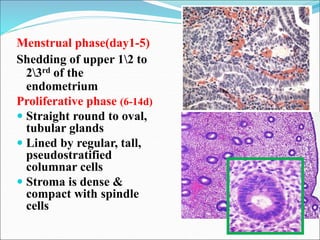
Menstrual phase(day1-5)
Shedding of upper 12 to
23rd of the
endometrium
Proliferative phase (6-14d)
 Straight round to oval,
tubular glands
 Lined by regular, tall,
pseudostratified
columnar cells
 Stroma is dense &
compact with spindle
cells
Secretory phase (15-28day)
 Glands are tortuous,
serrated/saw toothed
 Secretions in the lumen
 Cells show vacuolation
Stromal changes –
 Edema & Increase
in ground substance
 Spiral arterioles
 Predecidual change
(Cytoplasmic eosinophilia)
FUNCTONAL ENDOMETRIAL DISORDERS
Dysfunctional Uterine Bleeding (DUB)
 Abnormal uterine bleeding(AUB) without any organic
(structural ) abnormalities but due to hormonal
disturbances.
Etiology:
 Prepuberty - Precocious puberty (hypothalamic, pituitary,
or ovarian origin)
 Adolescence -Anovulation, coagulopathy
 Reproductive age – Anovulation, inadequate luteal phase
 Perimenopausal – Anovulation, atrophy
Etiopathogenesis:
Most common cause - Anovulatory cycle
Lack of ovulation is the result of –
 Endocrine disorder (Pituitary, thyroid, Adrenal)
 Primary lesions of ovary - Granulosa cell tumors or
polycystic ovaries (produce excess estrogen)
 Generalized metabolic disorder – obesity (estrogen
production from fat by steroidogenic enzymes)
Results in excessive & prolonged estrogenic effects
without the development of progestational phase
ENDOMETRIOSIS & ADENOMYOSIS
ENDOMETRIOSIS
The presence of endometrial glands or stroma in
abnormal locations outside the uterus.
Sites in the descending order of frequency –
 Ovaries
 Uterine ligament , Rectovaginal septum
 Pelvic peritoneum , Laparotomy scars
 Rarely in umbilicus , vagina or appendix
ADENOMYOSIS
The presence of endometrial tissue in the
myometrium.
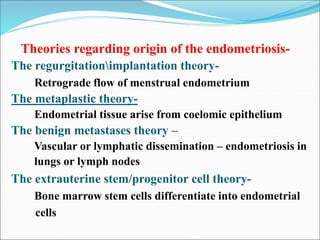
Theories regarding origin of the endometriosis-
The regurgitationimplantation theory-
Retrograde flow of menstrual endometrium
The metaplastic theory-
Endometrial tissue arise from coelomic epithelium
The benign metastases theory –
Vascular or lymphatic dissemination – endometriosis in
lungs or lymph nodes
The extrauterine stem/progenitor cell theory-
Bone marrow stem cells differentiate into endometrial
cells
Additional insights of endometriosis based on
molecular analysis
 Release of proinflammatory factors – stimulate local
synthesis of estrogen
 Increased aromatase enzyme in stromal cells–increased
estrogen production (Aromatose is absent in normal stroma)
 Epigenetic alterations - increase responsiveness to
estrogen & decreased responsiveness to progesterone
 Mutations in genes (PTEN and ARID1A) in endometriotic
cysts, atypical endometriosis associated carcinoma
(endometroid carcinoma)
These abnormalities are present not only in ectopic
endometriotic tissue, but also in normal endometrium.
Gross Morphology
ENDOMETRIOSIS-
 The foci of endometriosis responds to hormonal
stimulation - periodic bleeding –
red-blue, yellow-brown, black appearance, situated just
beneath the mucosal or serosal surface of involved organ.
 Advanced disease - fibrous adhesions.
 Endometriotic Ovary – uni/bilateral, distorted, with
large cystic masses filled with brown blood debris
(chocolate cysts) or endometriomas.
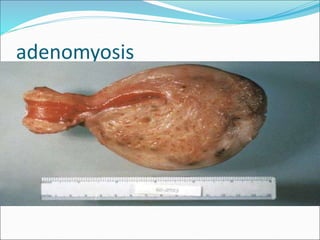
ADENOMYOSIS- enlarged uterus with coarsely
trabecular, ill defined hemorrhagic areas within
myometrium.
Microscopic examination
Endometriosis-
 Endometrial glands and stroma.
 Hemorrhage, hemosiderin laden macrophages.
 Surrounding inflammation and fibrosis.
 Atypical endometriosis – Premalignant.
Adenomyosis –
 Presence of endometrial glands and stroma within
myometrium separated from basalis by at least 2-3mm( 1
LPF below).
 Sometimes only stroma is seen – Stromal adenomyosis.
 Adenomyoma – Circumscribed mass of smooth muscle
tissue(leiomyoma) with adenomyosis.
adenomyosis
ENDOMETRIOSIS
ENDOMETRIAL HYPERPLASIA
Increased proliferation of the endometrial glands relative to the
stroma, resulting in an increased gland to-stroma ratio.
 Etiopathogenesis
Prolonged unopposed estrogen stimulation -
by anovulation or increased estrogen production as in
 Obesity (peripheral conversion of androgens to estrogens)
 Menopause - Prolonged administration of estrogenic substances
(estrogen replacement therapy)
 Polycystic ovarian syndrome, cortical stromal hyperplasia
 Functioning granulosa cell tumors of the ovary
 Inactivation of the PTEN (tumor suppressor gene) - endometrial
cells become more sensitive to estrogenic stimulation - endometrial
hyperplasia - cancer
Morphology
In recent past, most widely used system : 4 categories
1. Simple hyperplasia without atypia;
2. Complex hyperplasia without atypia;
3. Simple hyperplasia with atypia;
4. Complex hyperplasia with atypia.
The most current WHO classification: 2 major groups-
1. Non-atypical hyperplasia and
2. Atypical hyperplasia (Endometrial intraepithelial neoplasia)
ENDOMETRIAL HYPERPLASIA- WHO
Classification
Non-atypical hyperplasia
Increased gland to stroma
ratio without nuclear atypia.
Simple hyperplasia :
 Glands - various sizes,
shapes & cystic alterations
Complex hyperplasia:
 Complexity of gland
architecture - papillary infolds
or out-pouchings, crowding
Atypical hyperplasia
(Endometrial intraepithelial neoplasia)
 Increased gland to stroma ratio with
cytological & architectural atypia.
 Complex patterns of proliferating glands -
Gland enlargement, crowding, Back-to-back
arrangement and branching.
 Nuclear atypia – vesicular chromatin, nucleoli.
23% to 48% of women with a diagnosis of atypical hyperplasia
are found to have carcinoma when a hysterectomy is performed.
TUMORS OF ENDOMETRIUM
 Tumors of endometrial glands
Endometrioid carcinoma
Serous carcinoma
Clear cell carcinoma/ mucinous carcinoma
Tumors of endometrium with stromal differentiation
 Mixed Malignant Mullerian Tumor (MMMT) or
Carcinosarcoma–malignancy of both glands & stroma
 Adenosarcoma- benign glands with stromal
malignancy
 Pure stromal neoplasms
Benign - stromal nodule
Malignant - stromal sarcoma
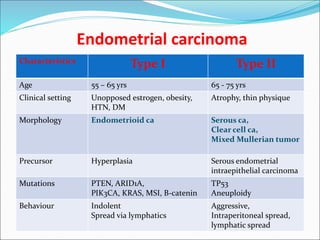
Endometrial carcinoma
Characteristics
Type I Type II
Age 55 – 65 yrs 65 - 75 yrs
Clinical setting Unopposed estrogen, obesity,
HTN, DM
Atrophy, thin physique
Morphology Endometrioid ca Serous ca,
Clear cell ca,
Mixed Mullerian tumor
Precursor Hyperplasia Serous endometrial
intraepithelial carcinoma
Mutations PTEN, ARID1A,
PIK3CA, KRAS, MSI, B-catenin
TP53
Aneuploidy
Behaviour Indolent
Spread via lymphatics
Aggressive,
Intraperitoneal spread,
lymphatic spread
ENDOMETRIOD CARCINOMA(Type-I)
 Accounts for 7% of all invasive cancer in women
 Peak incidence in the 55-65yrs
Etiopathogenesis
 Stepwise acquisition of several genetic alterations
 PI3K/AKT pathway – hallmark of endometrioid ca
 Muatations in PTEN(tumor suppressor gene) occurs before
invasion(Non atypical hyperplasia)-
 DNA mismatch repair mutations/microsatellite instability -
HNPCC syndrome, KRAS mutations(Atypical hyperplasia)-
 PIK3CA(oncogene)(39%), B- catenin mutation– increase
PI3K/AKT signaling cause invasion(Endometroid carcinoma).
 Loss of function/ mutation in ARID1A – also found in
endometroid CA.
Gross morphology
 Grossly 2 types-
 Localized polypoid tumor.
 Diffuse tumor involving entire endometrial surface.
 Spread by direct continuity, to myometrium, other
adjacent structures.
 Dissemination to regional lymph nodes & ultimately
distant metastasis - lungs, liver, bones.
Microscopic examination
Adenocarcinoma( characterized by gland patterns
resembling normal endometrial epithelium) - 3 step
grading system
 Grade I - well differentiated – composed entirely of
well formed glands without intervening stroma.
 Grade II - moderately differentiated – well formed
glands mixed with solid sheets (upto 50% tumor area)
of malignant cells.
 Grade III - poorly differentiated – more than 50% solid
sheets of cells with barely recognizable glands.
 Upto 20% of carcinomas have squamous
differentiation.
Type II endometrial CA
 Women are older- 65 to 75 yrs.
 Setting of endometrial atrophy.
 Poorly differentiated- grade 3.
 Most common type is serous.
 Other types are clear cell, MMMT.
 TP53 mutations in over 90% cases.
 Precursor lesion- serous endometrial intraepithelial
carcinoma.
 Poorer prognosis is due to the propensity to exfoliate.
 Travel to the fallopian tubes, implant on peritoneal
surfaces.
Morphology-
 Gross- Arise in small atrophic uteri.
 They are large bulky tumors, deeply invasive.
 M/E- Papillary growth pattern or glandular.
 Cells having marked cytologic atypia.
 High N-C ratio, hyperchromasia, atypical mitoses,
prominent nucleoli.
Clinical features
 Postmenopausal women.
 May be asymptomatic for a period of time.
 Postmenopausal bleeding.
 Prognosis depends on stage, grade, subtype.
MMMT
 Aka carcinosarcoma.
 They are endometrial carcinomas with a malignant
mesenchymal component.
 Gross: Fleshier than adenocarcinoma, may be bulky
and polypoid, and protrude through cervical os.
 M/E: Composed of adenocarcinoma (endometrioid,
serous, clear cell) mixed with malignant mesenchymal
(sarcomatous) elements.
Staging of endometrial carcinoma
Stage I- carcinoma confined to uterine corpus
Ia - < 50% myometrial invasion
Ib - >50% myometrial invasion
Stage II- carcinoma has involved the corpus & the
cervix
Stage III- carcinoma has extended outside the uterus
but not outside the true pelvis
Stage IV- carcinoma has extended outside the true
pelvis or has involved the bladder or rectum
Staging of endometrial carcinoma
uterus.ppt

uterus.ppt

  • 2.
    Normal Uterus Normal Structure Myometrium – smooth muscle  Endometrium – endometrial glands and stroma, glands lined by columnar epithelium Normal function Endometrium is stimulated by hormones (estrogen, progesterone)  Proliferative phase  Secretory phase  Menstrual phase
  • 3.
    Menstrual phase(day1-5) Shedding ofupper 12 to 23rd of the endometrium Proliferative phase (6-14d)  Straight round to oval, tubular glands  Lined by regular, tall, pseudostratified columnar cells  Stroma is dense & compact with spindle cells
  • 4.
    Secretory phase (15-28day) Glands are tortuous, serrated/saw toothed  Secretions in the lumen  Cells show vacuolation Stromal changes –  Edema & Increase in ground substance  Spiral arterioles  Predecidual change (Cytoplasmic eosinophilia)
  • 5.
    FUNCTONAL ENDOMETRIAL DISORDERS DysfunctionalUterine Bleeding (DUB)  Abnormal uterine bleeding(AUB) without any organic (structural ) abnormalities but due to hormonal disturbances. Etiology:  Prepuberty - Precocious puberty (hypothalamic, pituitary, or ovarian origin)  Adolescence -Anovulation, coagulopathy  Reproductive age – Anovulation, inadequate luteal phase  Perimenopausal – Anovulation, atrophy
  • 6.
    Etiopathogenesis: Most common cause- Anovulatory cycle Lack of ovulation is the result of –  Endocrine disorder (Pituitary, thyroid, Adrenal)  Primary lesions of ovary - Granulosa cell tumors or polycystic ovaries (produce excess estrogen)  Generalized metabolic disorder – obesity (estrogen production from fat by steroidogenic enzymes) Results in excessive & prolonged estrogenic effects without the development of progestational phase
  • 7.
    ENDOMETRIOSIS & ADENOMYOSIS ENDOMETRIOSIS Thepresence of endometrial glands or stroma in abnormal locations outside the uterus. Sites in the descending order of frequency –  Ovaries  Uterine ligament , Rectovaginal septum  Pelvic peritoneum , Laparotomy scars  Rarely in umbilicus , vagina or appendix ADENOMYOSIS The presence of endometrial tissue in the myometrium.
  • 8.
    Theories regarding originof the endometriosis- The regurgitationimplantation theory- Retrograde flow of menstrual endometrium The metaplastic theory- Endometrial tissue arise from coelomic epithelium The benign metastases theory – Vascular or lymphatic dissemination – endometriosis in lungs or lymph nodes The extrauterine stem/progenitor cell theory- Bone marrow stem cells differentiate into endometrial cells
  • 9.
    Additional insights ofendometriosis based on molecular analysis  Release of proinflammatory factors – stimulate local synthesis of estrogen  Increased aromatase enzyme in stromal cells–increased estrogen production (Aromatose is absent in normal stroma)  Epigenetic alterations - increase responsiveness to estrogen & decreased responsiveness to progesterone  Mutations in genes (PTEN and ARID1A) in endometriotic cysts, atypical endometriosis associated carcinoma (endometroid carcinoma) These abnormalities are present not only in ectopic endometriotic tissue, but also in normal endometrium.
  • 10.
    Gross Morphology ENDOMETRIOSIS-  Thefoci of endometriosis responds to hormonal stimulation - periodic bleeding – red-blue, yellow-brown, black appearance, situated just beneath the mucosal or serosal surface of involved organ.  Advanced disease - fibrous adhesions.  Endometriotic Ovary – uni/bilateral, distorted, with large cystic masses filled with brown blood debris (chocolate cysts) or endometriomas. ADENOMYOSIS- enlarged uterus with coarsely trabecular, ill defined hemorrhagic areas within myometrium.
  • 11.
    Microscopic examination Endometriosis-  Endometrialglands and stroma.  Hemorrhage, hemosiderin laden macrophages.  Surrounding inflammation and fibrosis.  Atypical endometriosis – Premalignant. Adenomyosis –  Presence of endometrial glands and stroma within myometrium separated from basalis by at least 2-3mm( 1 LPF below).  Sometimes only stroma is seen – Stromal adenomyosis.  Adenomyoma – Circumscribed mass of smooth muscle tissue(leiomyoma) with adenomyosis.
  • 13.
  • 14.
  • 15.
    ENDOMETRIAL HYPERPLASIA Increased proliferationof the endometrial glands relative to the stroma, resulting in an increased gland to-stroma ratio.  Etiopathogenesis Prolonged unopposed estrogen stimulation - by anovulation or increased estrogen production as in  Obesity (peripheral conversion of androgens to estrogens)  Menopause - Prolonged administration of estrogenic substances (estrogen replacement therapy)  Polycystic ovarian syndrome, cortical stromal hyperplasia  Functioning granulosa cell tumors of the ovary  Inactivation of the PTEN (tumor suppressor gene) - endometrial cells become more sensitive to estrogenic stimulation - endometrial hyperplasia - cancer
  • 16.
    Morphology In recent past,most widely used system : 4 categories 1. Simple hyperplasia without atypia; 2. Complex hyperplasia without atypia; 3. Simple hyperplasia with atypia; 4. Complex hyperplasia with atypia. The most current WHO classification: 2 major groups- 1. Non-atypical hyperplasia and 2. Atypical hyperplasia (Endometrial intraepithelial neoplasia)
  • 17.
    ENDOMETRIAL HYPERPLASIA- WHO Classification Non-atypicalhyperplasia Increased gland to stroma ratio without nuclear atypia. Simple hyperplasia :  Glands - various sizes, shapes & cystic alterations Complex hyperplasia:  Complexity of gland architecture - papillary infolds or out-pouchings, crowding
  • 18.
    Atypical hyperplasia (Endometrial intraepithelialneoplasia)  Increased gland to stroma ratio with cytological & architectural atypia.  Complex patterns of proliferating glands - Gland enlargement, crowding, Back-to-back arrangement and branching.  Nuclear atypia – vesicular chromatin, nucleoli. 23% to 48% of women with a diagnosis of atypical hyperplasia are found to have carcinoma when a hysterectomy is performed.
  • 20.
    TUMORS OF ENDOMETRIUM Tumors of endometrial glands Endometrioid carcinoma Serous carcinoma Clear cell carcinoma/ mucinous carcinoma Tumors of endometrium with stromal differentiation  Mixed Malignant Mullerian Tumor (MMMT) or Carcinosarcoma–malignancy of both glands & stroma  Adenosarcoma- benign glands with stromal malignancy  Pure stromal neoplasms Benign - stromal nodule Malignant - stromal sarcoma
  • 21.
    Endometrial carcinoma Characteristics Type IType II Age 55 – 65 yrs 65 - 75 yrs Clinical setting Unopposed estrogen, obesity, HTN, DM Atrophy, thin physique Morphology Endometrioid ca Serous ca, Clear cell ca, Mixed Mullerian tumor Precursor Hyperplasia Serous endometrial intraepithelial carcinoma Mutations PTEN, ARID1A, PIK3CA, KRAS, MSI, B-catenin TP53 Aneuploidy Behaviour Indolent Spread via lymphatics Aggressive, Intraperitoneal spread, lymphatic spread
  • 22.
    ENDOMETRIOD CARCINOMA(Type-I)  Accountsfor 7% of all invasive cancer in women  Peak incidence in the 55-65yrs Etiopathogenesis  Stepwise acquisition of several genetic alterations  PI3K/AKT pathway – hallmark of endometrioid ca  Muatations in PTEN(tumor suppressor gene) occurs before invasion(Non atypical hyperplasia)-  DNA mismatch repair mutations/microsatellite instability - HNPCC syndrome, KRAS mutations(Atypical hyperplasia)-  PIK3CA(oncogene)(39%), B- catenin mutation– increase PI3K/AKT signaling cause invasion(Endometroid carcinoma).  Loss of function/ mutation in ARID1A – also found in endometroid CA.
  • 24.
    Gross morphology  Grossly2 types-  Localized polypoid tumor.  Diffuse tumor involving entire endometrial surface.  Spread by direct continuity, to myometrium, other adjacent structures.  Dissemination to regional lymph nodes & ultimately distant metastasis - lungs, liver, bones.
  • 25.
    Microscopic examination Adenocarcinoma( characterizedby gland patterns resembling normal endometrial epithelium) - 3 step grading system  Grade I - well differentiated – composed entirely of well formed glands without intervening stroma.  Grade II - moderately differentiated – well formed glands mixed with solid sheets (upto 50% tumor area) of malignant cells.  Grade III - poorly differentiated – more than 50% solid sheets of cells with barely recognizable glands.  Upto 20% of carcinomas have squamous differentiation.
  • 27.
    Type II endometrialCA  Women are older- 65 to 75 yrs.  Setting of endometrial atrophy.  Poorly differentiated- grade 3.  Most common type is serous.  Other types are clear cell, MMMT.  TP53 mutations in over 90% cases.
  • 28.
     Precursor lesion-serous endometrial intraepithelial carcinoma.  Poorer prognosis is due to the propensity to exfoliate.  Travel to the fallopian tubes, implant on peritoneal surfaces.
  • 30.
    Morphology-  Gross- Arisein small atrophic uteri.  They are large bulky tumors, deeply invasive.  M/E- Papillary growth pattern or glandular.  Cells having marked cytologic atypia.  High N-C ratio, hyperchromasia, atypical mitoses, prominent nucleoli.
  • 32.
    Clinical features  Postmenopausalwomen.  May be asymptomatic for a period of time.  Postmenopausal bleeding.  Prognosis depends on stage, grade, subtype.
  • 33.
    MMMT  Aka carcinosarcoma. They are endometrial carcinomas with a malignant mesenchymal component.  Gross: Fleshier than adenocarcinoma, may be bulky and polypoid, and protrude through cervical os.  M/E: Composed of adenocarcinoma (endometrioid, serous, clear cell) mixed with malignant mesenchymal (sarcomatous) elements.
  • 35.
    Staging of endometrialcarcinoma Stage I- carcinoma confined to uterine corpus Ia - < 50% myometrial invasion Ib - >50% myometrial invasion Stage II- carcinoma has involved the corpus & the cervix Stage III- carcinoma has extended outside the uterus but not outside the true pelvis Stage IV- carcinoma has extended outside the true pelvis or has involved the bladder or rectum
  • 36.