PREVIOUS NEXTPREVIOUS NEXT
Using Oracle's Empirica Topics to Document Your
Signal Management Process
March 7, 2012
Rodney Lemery, MPH, PhD
Vice President, Safety and
Pharmacovigilance
BioPharm Systems, Inc.
PREVIOUS NEXT
Agenda
• Summary of Signal Management
— CIOMS VIII Suggestions
— Definitions
• Signal Management using Oracle Empirica Products
— Detection
• Use of e-Signal for data mining
— Prioritization
• Accel-Tracker (Prioritization Workflow)
— Evaluation
• Accel-Tracker (Evaluation Workflow)
PREVIOUS NEXT
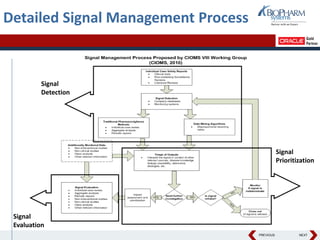
Detailed Signal Management Process
Signal
Detection
Signal
Prioritization
Signal
Evaluation
PREVIOUS NEXT
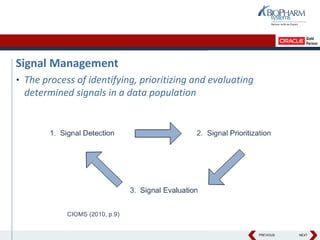
Signal Management
• The process of identifying, prioritizing and evaluating
determined signals in a data population
PREVIOUS NEXT
Signal Detection
• The act of looking for and/or identifying signals using event
data from any source. (CIOMS, 2010 p.116)
Signal Prioritization
• The controversial act of applying plausibility criteria to identified
signals in order to place the signals in context and apply
appropriate resources. (Waller, 2010 p.50)
Signal Evaluation
• The act of formally gathering additional data to evaluate the
identified signal for the purpose of risk management. (Waller,
2010 p. 50,51)
PREVIOUS NEXT
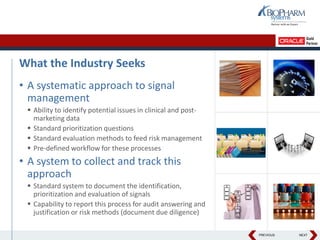
What the Industry Seeks
• A systematic approach to signal
management
ď‚§ Ability to identify potential issues in clinical and post-
marketing data
ď‚§ Standard prioritization questions
ď‚§ Standard evaluation methods to feed risk management
ď‚§ Pre-defined workflow for these processes
• A system to collect and track this
approach
ď‚§ Standard system to document the identification,
prioritization and evaluation of signals
ď‚§ Capability to report this process for audit answering and
justification or risk methods (document due diligence)
PREVIOUS NEXT
Accel-Tracker
— Using the Empirica Suite (e-Signal and e-Topics) tool as the basic software,
BioPharm has created an accelerator that allows a company to document
the formal signal prioritization and evaluation methods suggested by the
CIOMS VIII working group and a series of decision support articles from the
literature
— The following slides will walk us through a practical example of signal
management, starting with signal identification and followed by signal
prioritization and signal evaluation, resulting in risk identification/mitigation
PREVIOUS NEXT
Signal Detection
• The Empirica Suite contains the same signal detection tool (used by
the FDA) to identify potential signals based on disproportionality
reporting ratios
• As we’ve seen above, the CIOMS VIII group recommends that signal
management begins with signal detection
— This can be either data mining large repositories or identification of cases or case
series in traditional individual case safety review
• While the process begins with signal detection of individual case
safety reports, eventually the collected ICSRs become large enough for
data mining techniques; the prioritization of the signals becomes an
important aspect of signal management (Waller, 2010, p.50)
1. Ensures focus on appropriate signals – “Hay in a hay stack”
2. Focuses appropriate resource allocation time/energy/money
PREVIOUS NEXT
Signal Detection Example
• Assuming we are the marketing authorization holder for the
US-marketed product Risedronate (Risedronic Acid)
â–« This is a bisphosphonate used in the treatment of degenerative bone
disease. Its mode of action is the strengthening of bone as well as
the inhibition of bone reabsorbtion.
â–« It was approved on March 27th, 1998 under the trade name
“Actonel”
• We can establish FDA/AERS queries in the e-Signal tool to
identify “hot-spots” of the MedDRA dictionary levels
PREVIOUS NEXT
Signal Detection Example
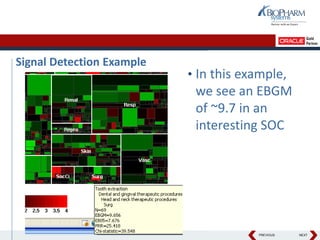
• In this example,
we see an EBGM
of ~9.7 in an
interesting SOC
PREVIOUS NEXT
• The rapid review of SOC data from FDA/AERS seems to
indicate that we may have a signal for some kind of
degradation of the oral cavity warranting tooth extraction to
correct. This signal may warrant further investigation, but we
do not want to waste resources on the following:
• Known issues with the product already well documented
(expected events or well-established safety profiles)
• Co-morbidities or complications due to natural disease progression -
Disease states epidemiologically related to the treatment population
without regard to product exposure
(confounding by indication)
Signal Prioritization
PREVIOUS NEXT
Signal Prioritization
• Prioritization of signals is a critical aspect of signal
management when mining large repositories of data
(Waller, 2010, p.50)
1. Simplifies the often daunting task of signal management
2. Focuses appropriate resource allocation time/energy/money
PREVIOUS NEXT
Signal Management Challenge: Where do we begin?
• No real standard in the prioritization process (Waller, 2010, p. 50)
— The WHO uses a method similar to Emergency Room triage processes in hospital
settings to quickly evaluate the aspects of a case that make it critical for research
while placing other cases on hold until a later investigation period
— The MHRA uses an analytic methodology comprised of two mathematical scores
contributing to a final score that will prioritize the case
— Other articles exist in the literature suggesting valid decision support methods
PREVIOUS NEXT
Accel-Tracker
— Using the e-Topics tool as the basic software, BioPharm has created an
accelerator that allows a company to document the formal signal
prioritization and evaluation methods suggested by the CIOMS VIII working
group and a series of decision support articles from the literature
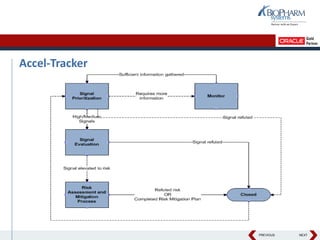
— Once a signal is identified, a topic is created in e-Topics and assigned to the
appropriate work-group in a standard workflow within the system
PREVIOUS NEXT
Accel-Tracker
PREVIOUS NEXT
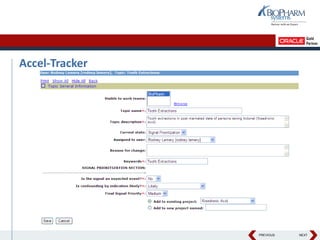
Accel-Tracker
— Once the signal is placed into the initial Signal Prioritization step, the Accel-
Tracker system allows the formal prioritization, according to the CIOMS VIII
methodology and a series of decision support articles in the literature
— This is a series of questions that allow the categorization of the signal
according to signal strength (S), novelty (N), clinical importance (I), potential
for prevention techniques (P) (CIOMS, 2010; Heeley, Waller & Moseley,
2005; Waller, 2010; Waller, Heeley & Moseley, 2005; Waller & Lee, 1999)
PREVIOUS NEXT
Accel-Tracker
PREVIOUS NEXT
Accel-Tracker
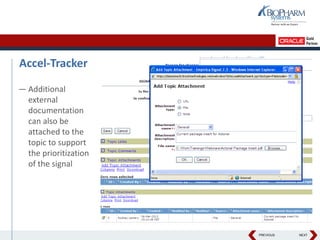
— Additional
external
documentation
can also be
attached to the
topic to support
the prioritization
of the signal
PREVIOUS NEXT
Accel-Tracker
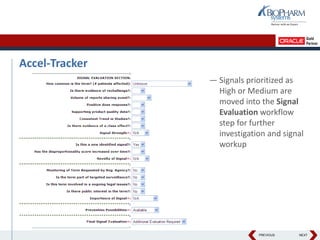
— Signals prioritized as
High or Medium are
moved into the Signal
Evaluation workflow
step for further
investigation and signal
workup
PREVIOUS NEXT
Accel-Tracker
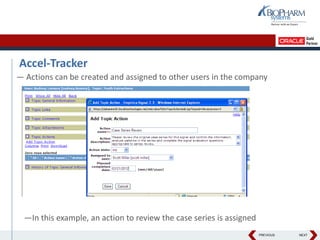
— Actions can be created and assigned to other users in the company
—In this example, an action to review the case series is assigned
PREVIOUS NEXT
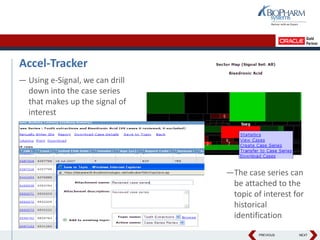
Accel-Tracker
— Using e-Signal, we can drill
down into the case series
that makes up the signal of
interest
—The case series can
be attached to the
topic of interest for
historical
identification
PREVIOUS NEXT
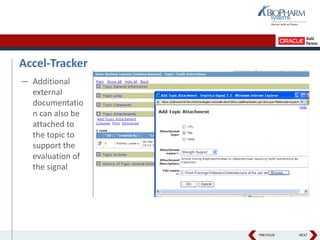
Accel-Tracker
— Additional
external
documentatio
n can also be
attached to
the topic to
support the
evaluation of
the signal
PREVIOUS NEXT
Accel-Tracker
— After research on the signal is collected, Accel-Tracker can document
the results of evaluation through the exposure of several custom
questions designed to assist in the formal evaluation of signals
— The signal can be classified and optionally elevated to a Potential or
Identified Risk to begin the Risk Analysis and Mitigation process
PREVIOUS NEXT
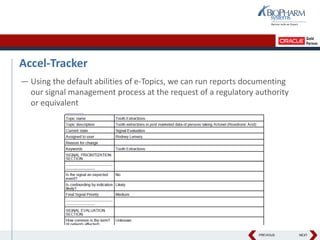
Accel-Tracker
— Using the default abilities of e-Topics, we can run reports documenting
our signal management process at the request of a regulatory authority
or equivalent
PREVIOUS NEXT
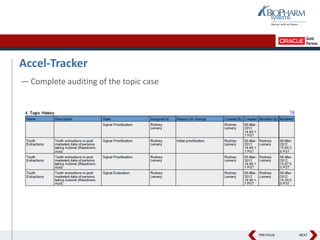
Accel-Tracker
— Complete auditing of the topic case
PREVIOUS NEXT
Summary
— Using existing literature and Empirica Suite, configured with the Accel-
Tracker settings, we can provide a systematic method for signal
management in a single solution that accomplishes the following:
• Ability to identify potential issues in clinical and post-marketing data
• Standard prioritization questions
• Standard evaluation methods to feed risk management
• Pre-defined workflow for these processes
• Capability to report this process for audit answering and justification
or risk methods (document due diligence)
PREVIOUS NEXT
Ways to Engage…
• For those not quite ready…
— Collaborate on requirements
• For those in the midst of an e-Topics implementation
— Refine your approach with Accel-Tracker
• In-depth system demonstration of Accel-Tracker
• On-site proof of concept
• Looking to harmonize relevant business processes?
PREVIOUS NEXT
References
• Bennett Levitan, B., Yee, C. L., Russo,L., Bayney, R., Thomas, A. P. and Klincewicz, S. L..
(2008). A Model for Decision Support in Signal Triage. Drug Safety. 31 (9), pp. 727-735
• Council for International Organizations of Medical Sciences (CIOMS). (2010). Practical
Aspects of Signal Detection in Pharmacovigilance. Report of CIOMS Working Group VIII,
Geneva .
• Heeley E, Waller P, and Moseley J. (2005). Testing and implementing signal impact
analysis in a regulatory setting: results of a pilot study. Drug Safety 28 (10), pp. 901-6
• Waller P, Heeley E, and Moseley J. (2005). Impact analysis of signals detected from
spontaneous adverse drug reaction reporting. Drug Safety 28 (1), pp. 843-50
• Waller P, Lee E. (1999). Responding to drug safety issues. Pharmacoepidemiology and
Drug Safety 8 (7), pp. 535-52
• Waller, P. (2010). An Introduction to Pharmacovigilance. Wiley-Blackwell. Oxford, UK
PREVIOUS NEXT
Questions & Answers
Rodney Lemery, MPH, PhD
Vice President, Safety and Pharmacovigilance
BioPharm Systems
(650) 292-5310
rlemery@biopharm.com
info@biopharm.com

Using Oracle's Empirica Topics to Document Your Signal Management Process

  • 1.
    PREVIOUS NEXTPREVIOUS NEXT UsingOracle's Empirica Topics to Document Your Signal Management Process March 7, 2012 Rodney Lemery, MPH, PhD Vice President, Safety and Pharmacovigilance BioPharm Systems, Inc.
  • 2.
    PREVIOUS NEXT Agenda • Summaryof Signal Management — CIOMS VIII Suggestions — Definitions • Signal Management using Oracle Empirica Products — Detection • Use of e-Signal for data mining — Prioritization • Accel-Tracker (Prioritization Workflow) — Evaluation • Accel-Tracker (Evaluation Workflow)
  • 3.
    PREVIOUS NEXT Detailed SignalManagement Process Signal Detection Signal Prioritization Signal Evaluation
  • 4.
    PREVIOUS NEXT Signal Management •The process of identifying, prioritizing and evaluating determined signals in a data population
  • 5.
    PREVIOUS NEXT Signal Detection •The act of looking for and/or identifying signals using event data from any source. (CIOMS, 2010 p.116) Signal Prioritization • The controversial act of applying plausibility criteria to identified signals in order to place the signals in context and apply appropriate resources. (Waller, 2010 p.50) Signal Evaluation • The act of formally gathering additional data to evaluate the identified signal for the purpose of risk management. (Waller, 2010 p. 50,51)
  • 6.
    PREVIOUS NEXT What theIndustry Seeks • A systematic approach to signal management  Ability to identify potential issues in clinical and post- marketing data  Standard prioritization questions  Standard evaluation methods to feed risk management  Pre-defined workflow for these processes • A system to collect and track this approach  Standard system to document the identification, prioritization and evaluation of signals  Capability to report this process for audit answering and justification or risk methods (document due diligence)
  • 7.
    PREVIOUS NEXT Accel-Tracker — Usingthe Empirica Suite (e-Signal and e-Topics) tool as the basic software, BioPharm has created an accelerator that allows a company to document the formal signal prioritization and evaluation methods suggested by the CIOMS VIII working group and a series of decision support articles from the literature — The following slides will walk us through a practical example of signal management, starting with signal identification and followed by signal prioritization and signal evaluation, resulting in risk identification/mitigation
  • 8.
    PREVIOUS NEXT Signal Detection •The Empirica Suite contains the same signal detection tool (used by the FDA) to identify potential signals based on disproportionality reporting ratios • As we’ve seen above, the CIOMS VIII group recommends that signal management begins with signal detection — This can be either data mining large repositories or identification of cases or case series in traditional individual case safety review • While the process begins with signal detection of individual case safety reports, eventually the collected ICSRs become large enough for data mining techniques; the prioritization of the signals becomes an important aspect of signal management (Waller, 2010, p.50) 1. Ensures focus on appropriate signals – “Hay in a hay stack” 2. Focuses appropriate resource allocation time/energy/money
  • 9.
    PREVIOUS NEXT Signal DetectionExample • Assuming we are the marketing authorization holder for the US-marketed product Risedronate (Risedronic Acid) ▫ This is a bisphosphonate used in the treatment of degenerative bone disease. Its mode of action is the strengthening of bone as well as the inhibition of bone reabsorbtion. ▫ It was approved on March 27th, 1998 under the trade name “Actonel” • We can establish FDA/AERS queries in the e-Signal tool to identify “hot-spots” of the MedDRA dictionary levels
  • 10.
    PREVIOUS NEXT Signal DetectionExample • In this example, we see an EBGM of ~9.7 in an interesting SOC
  • 11.
    PREVIOUS NEXT • Therapid review of SOC data from FDA/AERS seems to indicate that we may have a signal for some kind of degradation of the oral cavity warranting tooth extraction to correct. This signal may warrant further investigation, but we do not want to waste resources on the following: • Known issues with the product already well documented (expected events or well-established safety profiles) • Co-morbidities or complications due to natural disease progression - Disease states epidemiologically related to the treatment population without regard to product exposure (confounding by indication) Signal Prioritization
  • 12.
    PREVIOUS NEXT Signal Prioritization •Prioritization of signals is a critical aspect of signal management when mining large repositories of data (Waller, 2010, p.50) 1. Simplifies the often daunting task of signal management 2. Focuses appropriate resource allocation time/energy/money
  • 13.
    PREVIOUS NEXT Signal ManagementChallenge: Where do we begin? • No real standard in the prioritization process (Waller, 2010, p. 50) — The WHO uses a method similar to Emergency Room triage processes in hospital settings to quickly evaluate the aspects of a case that make it critical for research while placing other cases on hold until a later investigation period — The MHRA uses an analytic methodology comprised of two mathematical scores contributing to a final score that will prioritize the case — Other articles exist in the literature suggesting valid decision support methods
  • 14.
    PREVIOUS NEXT Accel-Tracker — Usingthe e-Topics tool as the basic software, BioPharm has created an accelerator that allows a company to document the formal signal prioritization and evaluation methods suggested by the CIOMS VIII working group and a series of decision support articles from the literature — Once a signal is identified, a topic is created in e-Topics and assigned to the appropriate work-group in a standard workflow within the system
  • 15.
  • 16.
    PREVIOUS NEXT Accel-Tracker — Oncethe signal is placed into the initial Signal Prioritization step, the Accel- Tracker system allows the formal prioritization, according to the CIOMS VIII methodology and a series of decision support articles in the literature — This is a series of questions that allow the categorization of the signal according to signal strength (S), novelty (N), clinical importance (I), potential for prevention techniques (P) (CIOMS, 2010; Heeley, Waller & Moseley, 2005; Waller, 2010; Waller, Heeley & Moseley, 2005; Waller & Lee, 1999)
  • 17.
  • 18.
    PREVIOUS NEXT Accel-Tracker — Additional external documentation canalso be attached to the topic to support the prioritization of the signal
  • 19.
    PREVIOUS NEXT Accel-Tracker — Signalsprioritized as High or Medium are moved into the Signal Evaluation workflow step for further investigation and signal workup
  • 20.
    PREVIOUS NEXT Accel-Tracker — Actionscan be created and assigned to other users in the company —In this example, an action to review the case series is assigned
  • 21.
    PREVIOUS NEXT Accel-Tracker — Usinge-Signal, we can drill down into the case series that makes up the signal of interest —The case series can be attached to the topic of interest for historical identification
  • 22.
    PREVIOUS NEXT Accel-Tracker — Additional external documentatio ncan also be attached to the topic to support the evaluation of the signal
  • 23.
    PREVIOUS NEXT Accel-Tracker — Afterresearch on the signal is collected, Accel-Tracker can document the results of evaluation through the exposure of several custom questions designed to assist in the formal evaluation of signals — The signal can be classified and optionally elevated to a Potential or Identified Risk to begin the Risk Analysis and Mitigation process
  • 24.
    PREVIOUS NEXT Accel-Tracker — Usingthe default abilities of e-Topics, we can run reports documenting our signal management process at the request of a regulatory authority or equivalent
  • 25.
  • 26.
    PREVIOUS NEXT Summary — Usingexisting literature and Empirica Suite, configured with the Accel- Tracker settings, we can provide a systematic method for signal management in a single solution that accomplishes the following: • Ability to identify potential issues in clinical and post-marketing data • Standard prioritization questions • Standard evaluation methods to feed risk management • Pre-defined workflow for these processes • Capability to report this process for audit answering and justification or risk methods (document due diligence)
  • 27.
    PREVIOUS NEXT Ways toEngage… • For those not quite ready… — Collaborate on requirements • For those in the midst of an e-Topics implementation — Refine your approach with Accel-Tracker • In-depth system demonstration of Accel-Tracker • On-site proof of concept • Looking to harmonize relevant business processes?
  • 28.
    PREVIOUS NEXT References • BennettLevitan, B., Yee, C. L., Russo,L., Bayney, R., Thomas, A. P. and Klincewicz, S. L.. (2008). A Model for Decision Support in Signal Triage. Drug Safety. 31 (9), pp. 727-735 • Council for International Organizations of Medical Sciences (CIOMS). (2010). Practical Aspects of Signal Detection in Pharmacovigilance. Report of CIOMS Working Group VIII, Geneva . • Heeley E, Waller P, and Moseley J. (2005). Testing and implementing signal impact analysis in a regulatory setting: results of a pilot study. Drug Safety 28 (10), pp. 901-6 • Waller P, Heeley E, and Moseley J. (2005). Impact analysis of signals detected from spontaneous adverse drug reaction reporting. Drug Safety 28 (1), pp. 843-50 • Waller P, Lee E. (1999). Responding to drug safety issues. Pharmacoepidemiology and Drug Safety 8 (7), pp. 535-52 • Waller, P. (2010). An Introduction to Pharmacovigilance. Wiley-Blackwell. Oxford, UK
  • 29.
    PREVIOUS NEXT Questions &Answers Rodney Lemery, MPH, PhD Vice President, Safety and Pharmacovigilance BioPharm Systems (650) 292-5310 rlemery@biopharm.com info@biopharm.com