PREVIOUS NEXTPREVIOUS NEXT
Streamlining a Global Life Sciences Company's
Pharmacovigilance Operations
Facilitating Globalization with a standard approach to process reengineering
July 18, 2012
Rodney Lemery, MPH, PhD
Vice President, Safety and
Pharmacovigilance
BioPharm Systems, Inc.
PREVIOUS NEXT
Agenda
• Summary of Situation
• Project Overview
• Review of Current State
• Description of Methods Used
• Origin of Methodology
• Techniques Used
• Results of Methods
• Lessons Learned
• What This Means for You
PREVIOUS NEXT
Summary of Situation
Project Overview
• A leading U.S.-based pharmaceutical company founded in the early 1980s
issued a RFP asking for assistance in the globalization of their current
Argus Safety system
• The company would be integrating three separate non-Argus safety
applications into their central Argus database
• To accommodate this, procedures and work instructions not currently
representing a global environment required analysis and updates to
prepare the company for the use of the application in this new paradigm
PREVIOUS NEXT
Summary of Situation
Process Overview
• Company’s acquisition of a global generics company resulted in the need
to incorporate international case management, local labeling and other
globalization aspects of process into their existing drug safety quality
system
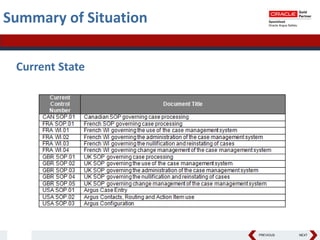
 0 Policies
 10 Procedures
 4 Work Instructions
PREVIOUS NEXT
Summary of Situation
Current State
PREVIOUS NEXT
Summary of Situation
Client Needs
• Update of global procedures governing non-Argus systems
into Argus specific documents
• Consolidation of all country specific procedures and work
instructions into a more global process
PREVIOUS NEXT
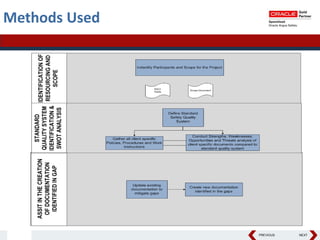
Methods Used
PREVIOUS NEXT
Methods Used
Origin of Methods
• Process re-engineering methods are diverse and range from
the simple to the complex
• Recent research has shown that the use of the Strengths,
Opportunities, Weaknesses and Threats (SWOT) analysis is a
powerful tool in strategic planning and process initiatives
(Helms and Nixon, 2010)
• Well entrenched in peer-reviewed journals
• Used beyond strategic planning
• Time tested
PREVIOUS NEXT
Methods Used
Origin of Methods
• In order to facilitate accountability in the process improvement
initiative, BioPharm use a tool referred to as a RACI Diagram
(Costello, 2012)
• Responsible
• Accountable/Approve
• Consulted
• Informed
• BioPharm has also determined that the SWOT report can easily
be transformed into a gap analysis summary
• In turn the gap analysis provides traceability to a strategic
mitigation plan (road map) for the identified gaps
PREVIOUS NEXT
Methods Used
PREVIOUS NEXT
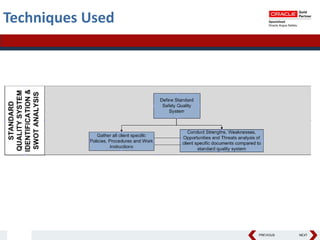
Techniques Used
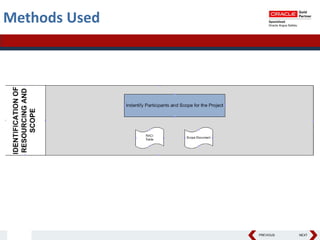
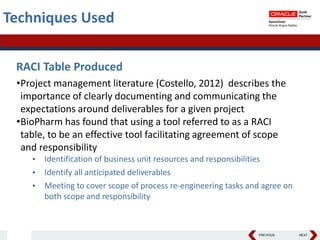
RACI Table Produced
•Project management literature (Costello, 2012) describes the
importance of clearly documenting and communicating the
expectations around deliverables for a given project
•BioPharm has found that using a tool referred to as a RACI
table, to be an effective tool facilitating agreement of scope
and responsibility
• Identification of business unit resources and responsibilities
• Identify all anticipated deliverables
• Meeting to cover scope of process re-engineering tasks and agree on
both scope and responsibility
PREVIOUS NEXT
Techniques Used
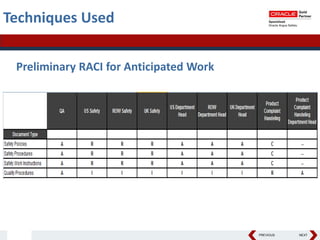
Preliminary RACI for Anticipated Work
PREVIOUS NEXT
Techniques Used
PREVIOUS NEXT
Techniques Used
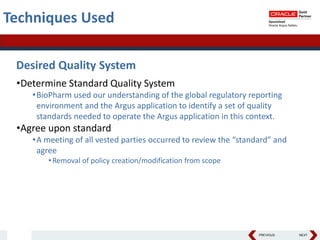
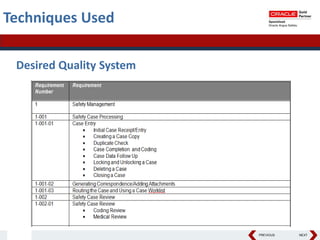
Desired Quality System
•Determine Standard Quality System
•BioPharm used our understanding of the global regulatory reporting
environment and the Argus application to identify a set of quality
standards needed to operate the Argus application in this context.
•Agree upon standard
•A meeting of all vested parties occurred to review the “standard” and
agree
•Removal of policy creation/modification from scope
PREVIOUS NEXT
Techniques Used
Desired Quality System
PREVIOUS NEXT
Techniques Used
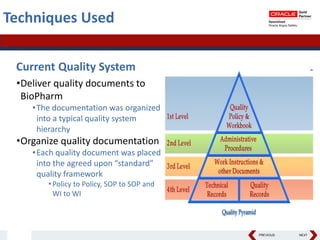
Current Quality System
•Deliver quality documents to
BioPharm
•The documentation was organized
into a typical quality system
hierarchy
•Organize quality documentation
•Each quality document was placed
into the agreed upon “standard”
quality framework
•Policy to Policy, SOP to SOP and
WI to WI
PREVIOUS NEXT
Techniques Used
SWOT Analysis
•Conduct SWOT against Desired State
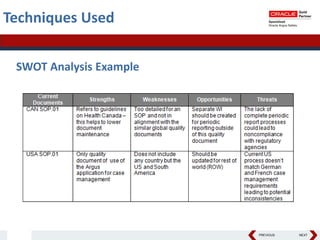
•BioPharm conducted a standard Strengths, Weaknesses, Opportunities
and Threats (SWOT) analysis on the quality documents compared to the
agreed upon “desired” framework
•Consensus Building
•A meeting to review the SWOT analysis results will occur to gain
consensus and understanding among the business units
•Extract the gaps from any Weaknesses or Threats
PREVIOUS NEXT
Techniques Used
SWOT Analysis Example
PREVIOUS NEXT
Techniques Used
Further Analysis (optional)
•Conduct Review of Inter-Unit Documents
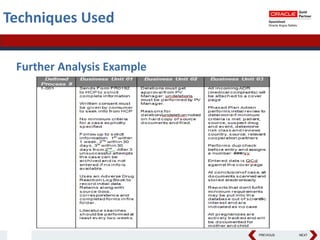
•Related business unit quality documents can also be compared to one
another in tabular form and used to facilitate the discussion of “issues”
among the quality documents that need to be harmonized
•Consensus Building
•A meeting to review the analysis results will occur to gain consensus and
understanding among the business units
•Extract the gaps from any Weaknesses or Threats
PREVIOUS NEXT
Techniques Used
Further Analysis Example
PREVIOUS NEXT
Techniques Used
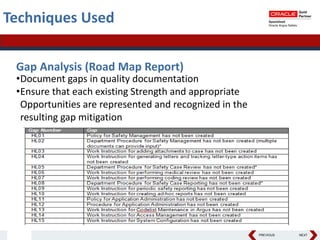
Gap Analysis (Road Map Report)
•Document gaps in quality documentation
•Ensure that each existing Strength and appropriate
Opportunities are represented and recognized in the
resulting gap mitigation
PREVIOUS NEXT
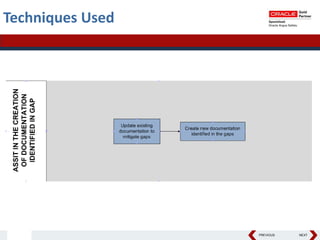
Techniques Used
PREVIOUS NEXT
Techniques Used
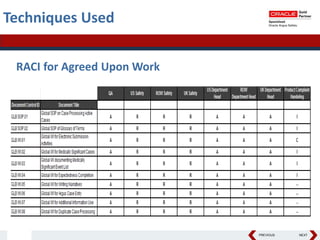
RACI for Agreed Upon Work
PREVIOUS NEXT
Techniques Used
Quality Documentation Creation
•BioPharm created a number of updates to these documents
and facilitated numerous meetings to reach consensus on the
practices of the safety team
•Iterative and interactive meetings were scheduled using
WebEx to facilitate a spirit of collaboration
PREVIOUS NEXT
Results
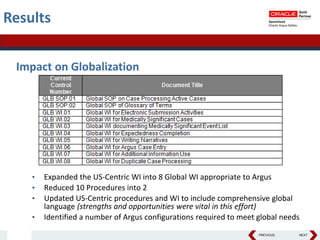
Impact on Globalization
• Expanded the US-Centric WI into 8 Global WI appropriate to Argus
• Reduced 10 Procedures into 2
• Updated US-Centric procedures and WI to include comprehensive global
language (strengths and opportunities were vital in this effort)
• Identified a number of Argus configurations required to meet global needs
PREVIOUS NEXT
Lessons Learned
• The collection of quality documentation is important and
accurate, comprehensive and timely delivery for analysis
was critical
• The use of the gap analysis report as a tool for project
focus and effort is vital
• Iterative and interactive meetings aid in the fostering of
ownership (of the quality documents ) to the appropriate
department participants
• Global participation is often divergent and difficult; it is
still crucial to ensure all vested parties are heard and
their procedural needs are addressed
• MS Word comment fields were used to annotate these needs
PREVIOUS NEXT
Lessons Learned
• Even after all of the consolidation meetings occur,
business procedures may differ too widely among
the business units
• Consolidation should be a goal not a finite rule
• Possible that consolidation occurs only at the policy and
procedure levels not at the departmental/work instruction
level
• Local labeling work instructions, competent authority reporting
etc.
• Procedural work often identifies system level
configuration needs
PREVIOUS NEXT
Ways to Engage…
• For those ready
• Proof of concept or scope discussions to see if this method would fit
your needs
• For those not quite ready
• Schedule early engagement calls to provide guidance on similar projects
• For those in the midst of a process re-engineering
• Refine your approach with guidance calls to review your approach and
evaluate if BioPharm’s methods might be useful to your organization
What this means for you?
PREVIOUS NEXT
• Helms, M. M., Nixon, J. (2010). Exploring SWOT
analysis – where are we now?: A review of academic
research from the last decade. Journal of Strategy and
Management, 3(3) pp.215 – 251
• Costello, T. (2012). RACI; Getting Projects “Unstuck”.
IT Professional, 14(2), pp. 62-64
References
PREVIOUS NEXT
Questions & Answers / Contact Information
Rodney Lemery, MPH, PhD
Vice President, Safety and Pharmacovigilance
+1 650 292 5310 (U.S.)
rlemery@biopharm.com
Rod Roderick
Vice President of Business Development
+1 877 654 0033 (U.S.)
rroderick@biopharm.com
Rudolf Coetzee
Director of Business Development, EMEA
+44 (0) 1865 910200 (U.K.)
rcoetzee@biopharm.com
For more information about our offerings, you can reach any team member above or
email info@biopharm.com.

2013 OHSUG - Facilitating Pharmacovigilance Globalization with Process Reengineering

  • 1.
    PREVIOUS NEXTPREVIOUS NEXT Streamlininga Global Life Sciences Company's Pharmacovigilance Operations Facilitating Globalization with a standard approach to process reengineering July 18, 2012 Rodney Lemery, MPH, PhD Vice President, Safety and Pharmacovigilance BioPharm Systems, Inc.
  • 2.
    PREVIOUS NEXT Agenda • Summaryof Situation • Project Overview • Review of Current State • Description of Methods Used • Origin of Methodology • Techniques Used • Results of Methods • Lessons Learned • What This Means for You
  • 3.
    PREVIOUS NEXT Summary ofSituation Project Overview • A leading U.S.-based pharmaceutical company founded in the early 1980s issued a RFP asking for assistance in the globalization of their current Argus Safety system • The company would be integrating three separate non-Argus safety applications into their central Argus database • To accommodate this, procedures and work instructions not currently representing a global environment required analysis and updates to prepare the company for the use of the application in this new paradigm
  • 4.
    PREVIOUS NEXT Summary ofSituation Process Overview • Company’s acquisition of a global generics company resulted in the need to incorporate international case management, local labeling and other globalization aspects of process into their existing drug safety quality system  0 Policies  10 Procedures  4 Work Instructions
  • 5.
    PREVIOUS NEXT Summary ofSituation Current State
  • 6.
    PREVIOUS NEXT Summary ofSituation Client Needs • Update of global procedures governing non-Argus systems into Argus specific documents • Consolidation of all country specific procedures and work instructions into a more global process
  • 7.
  • 8.
    PREVIOUS NEXT Methods Used Originof Methods • Process re-engineering methods are diverse and range from the simple to the complex • Recent research has shown that the use of the Strengths, Opportunities, Weaknesses and Threats (SWOT) analysis is a powerful tool in strategic planning and process initiatives (Helms and Nixon, 2010) • Well entrenched in peer-reviewed journals • Used beyond strategic planning • Time tested
  • 9.
    PREVIOUS NEXT Methods Used Originof Methods • In order to facilitate accountability in the process improvement initiative, BioPharm use a tool referred to as a RACI Diagram (Costello, 2012) • Responsible • Accountable/Approve • Consulted • Informed • BioPharm has also determined that the SWOT report can easily be transformed into a gap analysis summary • In turn the gap analysis provides traceability to a strategic mitigation plan (road map) for the identified gaps
  • 10.
  • 11.
    PREVIOUS NEXT Techniques Used RACITable Produced •Project management literature (Costello, 2012) describes the importance of clearly documenting and communicating the expectations around deliverables for a given project •BioPharm has found that using a tool referred to as a RACI table, to be an effective tool facilitating agreement of scope and responsibility • Identification of business unit resources and responsibilities • Identify all anticipated deliverables • Meeting to cover scope of process re-engineering tasks and agree on both scope and responsibility
  • 12.
  • 13.
  • 14.
    PREVIOUS NEXT Techniques Used DesiredQuality System •Determine Standard Quality System •BioPharm used our understanding of the global regulatory reporting environment and the Argus application to identify a set of quality standards needed to operate the Argus application in this context. •Agree upon standard •A meeting of all vested parties occurred to review the “standard” and agree •Removal of policy creation/modification from scope
  • 15.
  • 16.
    PREVIOUS NEXT Techniques Used CurrentQuality System •Deliver quality documents to BioPharm •The documentation was organized into a typical quality system hierarchy •Organize quality documentation •Each quality document was placed into the agreed upon “standard” quality framework •Policy to Policy, SOP to SOP and WI to WI
  • 17.
    PREVIOUS NEXT Techniques Used SWOTAnalysis •Conduct SWOT against Desired State •BioPharm conducted a standard Strengths, Weaknesses, Opportunities and Threats (SWOT) analysis on the quality documents compared to the agreed upon “desired” framework •Consensus Building •A meeting to review the SWOT analysis results will occur to gain consensus and understanding among the business units •Extract the gaps from any Weaknesses or Threats
  • 18.
  • 19.
    PREVIOUS NEXT Techniques Used FurtherAnalysis (optional) •Conduct Review of Inter-Unit Documents •Related business unit quality documents can also be compared to one another in tabular form and used to facilitate the discussion of “issues” among the quality documents that need to be harmonized •Consensus Building •A meeting to review the analysis results will occur to gain consensus and understanding among the business units •Extract the gaps from any Weaknesses or Threats
  • 20.
  • 21.
    PREVIOUS NEXT Techniques Used GapAnalysis (Road Map Report) •Document gaps in quality documentation •Ensure that each existing Strength and appropriate Opportunities are represented and recognized in the resulting gap mitigation
  • 22.
  • 23.
  • 24.
    PREVIOUS NEXT Techniques Used QualityDocumentation Creation •BioPharm created a number of updates to these documents and facilitated numerous meetings to reach consensus on the practices of the safety team •Iterative and interactive meetings were scheduled using WebEx to facilitate a spirit of collaboration
  • 25.
    PREVIOUS NEXT Results Impact onGlobalization • Expanded the US-Centric WI into 8 Global WI appropriate to Argus • Reduced 10 Procedures into 2 • Updated US-Centric procedures and WI to include comprehensive global language (strengths and opportunities were vital in this effort) • Identified a number of Argus configurations required to meet global needs
  • 26.
    PREVIOUS NEXT Lessons Learned •The collection of quality documentation is important and accurate, comprehensive and timely delivery for analysis was critical • The use of the gap analysis report as a tool for project focus and effort is vital • Iterative and interactive meetings aid in the fostering of ownership (of the quality documents ) to the appropriate department participants • Global participation is often divergent and difficult; it is still crucial to ensure all vested parties are heard and their procedural needs are addressed • MS Word comment fields were used to annotate these needs
  • 27.
    PREVIOUS NEXT Lessons Learned •Even after all of the consolidation meetings occur, business procedures may differ too widely among the business units • Consolidation should be a goal not a finite rule • Possible that consolidation occurs only at the policy and procedure levels not at the departmental/work instruction level • Local labeling work instructions, competent authority reporting etc. • Procedural work often identifies system level configuration needs
  • 28.
    PREVIOUS NEXT Ways toEngage… • For those ready • Proof of concept or scope discussions to see if this method would fit your needs • For those not quite ready • Schedule early engagement calls to provide guidance on similar projects • For those in the midst of a process re-engineering • Refine your approach with guidance calls to review your approach and evaluate if BioPharm’s methods might be useful to your organization What this means for you?
  • 29.
    PREVIOUS NEXT • Helms,M. M., Nixon, J. (2010). Exploring SWOT analysis – where are we now?: A review of academic research from the last decade. Journal of Strategy and Management, 3(3) pp.215 – 251 • Costello, T. (2012). RACI; Getting Projects “Unstuck”. IT Professional, 14(2), pp. 62-64 References
  • 30.
    PREVIOUS NEXT Questions &Answers / Contact Information Rodney Lemery, MPH, PhD Vice President, Safety and Pharmacovigilance +1 650 292 5310 (U.S.) rlemery@biopharm.com Rod Roderick Vice President of Business Development +1 877 654 0033 (U.S.) rroderick@biopharm.com Rudolf Coetzee Director of Business Development, EMEA +44 (0) 1865 910200 (U.K.) rcoetzee@biopharm.com For more information about our offerings, you can reach any team member above or email info@biopharm.com.