Chapter VI
Signal Detection and Risk Management
Prepared by
Dr. Mahadevamma L and Dr. Uday Venkat Mateti
Karnataka State Pharmacy Council Upskilling and Certification Program of LSSSDC under PMKVY
4.0
Signal Detection and
Risk Management
What is a Signal in
Pharmacovigilance
According to the WHO and UMC definition, a
safety signal refers to information on a new or
known side effect that may be caused by a
medicine and is typically generated from more
than a single report of a suspected side effect.
Signal in
Pharmacovigilance
• The information in a signal can be new or
additional and can be about both the adverse and
beneficial effects of an intervention. It can also
inform about an already-known association
between a medicine and an adverse drug effect.
• The information reported in a signal is not
conclusive it may change substantially over time
as more data accumulates.
• Once a signal has been detected the relationship
between a medicine and the occurrence of a side
effect is further evaluated in what is called
causality assessment.
Pharmacovigilance
Cycle
Signal Detection in
Pharmacovigilance
• Systematic Identification Process
• Signal detection is a critical, systematic process
in pharmacovigilance that involves identifying
and assessing potential safety concerns related
to pharmaceutical products. It utilizes both
qualitative and quantitative methodologies to
analyze vast safety data from diverse sources,
ensuring timely intervention to protect public
health.
Role of Signal
Detection in Patient
Safety
• Early Identification of Risks
• Signal detection is essential for the early
identification of potential adverse drug
reactions (ADRs). This enables healthcare
professionals to take timely actions to
mitigate risks and enhance patient safety,
ultimately reducing morbidity and mortality
associated with drug therapies.
Lessons
from Past
Drug Safety
Issues
Regulatory Framework and Guidelines for Signal Detection
Methodologies for
Signal Detection
Overview of Qualitative Signal Detection
Methods:
• In-depth Safety Signal Analysis
• Qualitative signal detection methods provide a
comprehensive framework for analyzing
individual case safety reports (ICSRs) and
qualitative data. They identify nuanced safety
signals that may not be evident through
quantitative approaches, thereby enhancing the
understanding of adverse drug reactions (ADRs)
and their contextual factors.
Key Quantitative
Signal Detection
Techniques
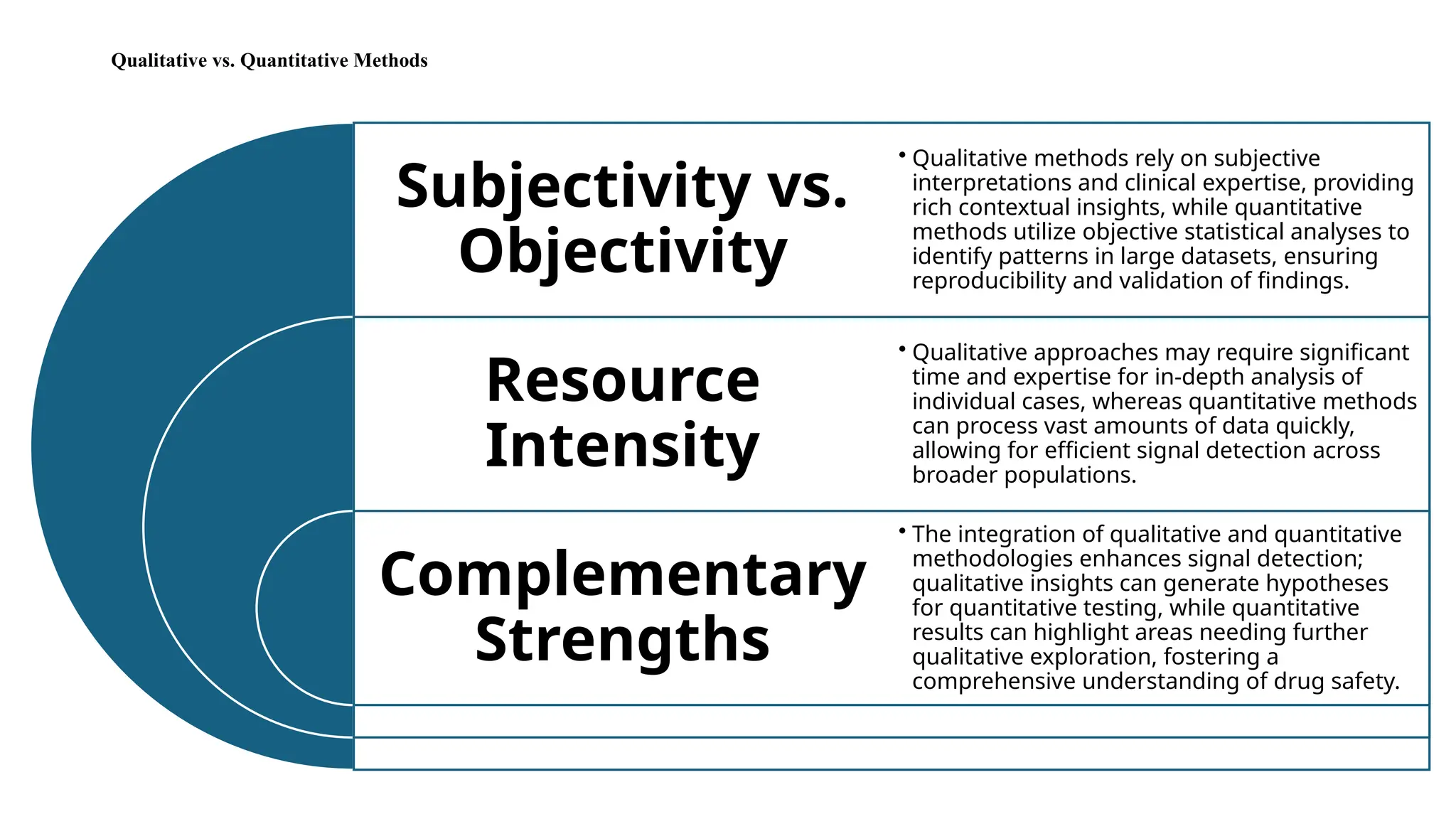
Qualitative vs. Quantitative Methods
Subjectivity vs.
Objectivity
Resource
Intensity
Complementary
Strengths
• Qualitative methods rely on subjective
interpretations and clinical expertise, providing
rich contextual insights, while quantitative
methods utilize objective statistical analyses to
identify patterns in large datasets, ensuring
reproducibility and validation of findings.
• Qualitative approaches may require significant
time and expertise for in-depth analysis of
individual cases, whereas quantitative methods
can process vast amounts of data quickly,
allowing for efficient signal detection across
broader populations.
• The integration of qualitative and quantitative
methodologies enhances signal detection;
qualitative insights can generate hypotheses
for quantitative testing, while quantitative
results can highlight areas needing further
qualitative exploration, fostering a
comprehensive understanding of drug safety.
Integration of Methodologies in Pharmacovigilance
Practices
Synergistic Approach
• Combining qualitative
and quantitative
methodologies
enhances signal
detection by
leveraging the
strengths of both,
allowing for a more
comprehensive
analysis of drug safety
signals and improving
the overall
effectiveness of
pharmacovigilance
practices.
Hybrid Signal Detection Systems
• Implementing
hybrid systems
that utilize both
statistical
algorithms and
expert reviews
can streamline
the signal
detection
process, ensuring
rapid
identification of
potential safety
issues while
maintaining
thoroughness in
case evaluations.
Training and Collaboration
• Fostering a
culture of
continuous
training in both
qualitative and
quantitative
methods among
pharmacovigilan
ce professionals,
along with
collaborative
efforts across
stakeholders,
can significantly
improve the
accuracy and
reliability of
safety
monitoring
Signal Management Process
Signal
Evaluation and
Prioritization
• Signal evaluation and prioritization refers to assessing the
potential seriousness of a detected safety signal and deciding
which signals require immediate further investigation based
on factors like the severity of the adverse event, patient
exposure, and impact on public health. In contrast, "signal
validation" verifies whether a detected signal has enough
evidence to warrant further analysis. It is considered a
genuine safety concern, confirming its existence before
prioritizing it further.
Key points about
Signal
Evaluation and
Prioritization:
Signal evaluation:
• This involves a comprehensive review of the available data
related to a detected signal, including the frequency of the
adverse event, the seriousness of the event, and the potential
causal relationship with the drug
Signal prioritization:
• Once a signal is evaluated, it is ranked based on its potential
impact on public health and the drug's risk-benefit profile,
determining which signals need immediate attention and
further investigation.
Key points about Signal Validation:
Data review:
This step involves
scrutinizing individual
case safety reports
(ICSRs) and other
relevant data sources to
assess whether the
observed pattern of
adverse events is
statistically significant
and not likely due to
chance.
Purpose:
To confirm whether a
detected signal is real
and not due to chance or
reporting bias, by
evaluating the available
evidence for a causal
relationship between the
drug and the adverse
event.
Process:
This typically involves
reviewing case reports,
considering the
frequency of the adverse
event in exposed patients
compared to unexposed
patients, and analyzing
the consistency of the
data across different
sources.
Practical Applications and Future Directions in
Signal Detection
• Successful Signal Detection in Action
Thalidomide's Impact on
Regulations
The thalidomide tragedy led to
significant regulatory reforms,
emphasizing the necessity for
rigorous post-marketing
surveillance and the
establishment of spontaneous
reporting systems to enhance
drug safety monitoring and
prevent future occurrences of
similar adverse events.
Vioxx and Risk
Communication
The withdrawal of Vioxx
highlighted the importance of
effective risk communication
strategies, as regulatory
authorities implemented stricter
labeling requirements and
initiated public health
campaigns to inform healthcare
providers and patients about the
associated cardiovascular risks.
Vaccine Safety Monitoring
Innovations
The monitoring of the HPV
vaccine safety utilized advanced
data mining techniques,
showcasing the effectiveness of
integrating spontaneous
reporting with enhanced
surveillance systems to identify
rare adverse events, thereby
reinforcing public trust in
vaccination programs.
Future Trends in Signal Detection Methodologies
AI-Driven Analytics
Integrating AI and machine learning will
enhance the ability to process and analyze
large datasets, leading to more accurate and
timely identification of potential safety
signals in pharmacovigilance.
Real-World Data Utilization
Leveraging real-world data sources, such as
patient registries and electronic health
records, will provide a more comprehensive
understanding of drug safety, improving the
robustness of signal detection
methodologies.
Collaborative Reporting Systems
Future methodologies will increasingly
incorporate collaborative frameworks that
engage healthcare professionals and
patients in reporting adverse drug
reactions, enriching data sources, and
fostering a culture of safety and
transparency.
Challenges in
Signal Detection
and Management
Risk
Management
• Definition: PV risk management is a structured
approach to identifying, assessing, and mitigating the
risks associated with medicinal products throughout
their lifecycle.
Key Components:
• Risk Identification
• Risk Assessment
• Risk Mitigation
• Risk Communication
Key Concepts in Risk Management
Risk: The probability of an adverse event occurring and its severity.
Benefit-Risk Balance: Evaluation of the therapeutic benefit versus the risk of harm
from a drug.
Risk Minimization: Actions taken to reduce the likelihood or severity of risks, such
as changes in drug use or additional safety measures.
Risk Communication: Sharing information about the risks and benefits of a product
with stakeholders.
Regulatory
Frameworks
for Risk
Management in
PV
• International Guidelines:
• ICH E2E: International Conference on Harmonisation -
Post-marketing requirements.
• ICH E2E Pharmacovigilance Guidelines: Detailed
pharmacovigilance practices, including Risk
Management Plan (RMP).
• FDA REMS (Risk Evaluation and Mitigation
Strategies) for specific drugs in the U.S.
• EU Risk Management Plans: EU regulations for drug
safety across the European market.
The Risk Management Process in PV
Risk
Identification:
• Detect potential
risks via
spontaneous
reporting, clinical
trials, literature
reviews, etc.
• Tools: Adverse
Event Reporting,
Risk Signals,
Data Mining.
Risk Assessment:
• Analyze the
likelihood,
severity, and
potential
impact of
identified risks.
• Tools: Signal
Detection,
Epidemiologic
al Studies, Risk
Stratification.
Risk
Minimization:
• Develop
strategies to
reduce risks (e.g.,
label changes,
restricted
distribution).
• Tools: Risk
Minimization
Action Plans
(RiskMAPs),
Post-Marketing
Surveillance.
Risk
Communication:
• Share risk
information with
healthcare
providers,
patients, and
regulatory
bodies.
• Tools: Safety
Communications,
Product
Labeling, REMS.
Risk
Management
Plan (RMP)
• A detailed document outlining the steps to monitor,
assess, and minimize risks associated with a
medicinal product.
What is RMP?
• Safety specification: Identifies safety concerns.
• Pharmacovigilance plan: Describes post-marketing
surveillance activities.
• Risk minimization activities: Strategies to reduce
risks.
• Evaluation of effectiveness: Measures to assess the
success of risk minimization actions.
Key Elements of RMP:
Tools &
Techniques in
Risk
Management
Signal Detection: Identifying unexpected or unanticipated
adverse reactions through spontaneous reports.
Causality Assessment: Determining the likelihood that an
adverse event is caused by a specific drug.
Risk-Benefit Analysis: Weighing the positive therapeutic
effects against the potential harm.
Epidemiological Studies: Conducting post-marketing
studies to understand long-term safety profiles.
Case Study:
Risk
Management
in Action
Example: Safety concerns related to Vioxx (Rifecoxib).
• Background: Vioxx was removed from the market after post-marketing studies
revealed a significant risk of cardiovascular events.
• Risk Management Approach:
• Risk Identification: Signal detection from clinical trials and adverse event
reports.
• Risk Assessment: Epidemiological studies showed increased heart attack risk.
• Risk Minimization: Market withdrawal, Risk communication to healthcare
providers.
Outcome: The importance of post-market surveillance and
robust risk management plans.
Challenges in
Risk
Management
for PV
Data Quality: Incomplete or inaccurate data from adverse
event reporting.
Global Variations: Differences in regulatory standards and
safety reporting across regions.
Evolving Risk Profiles: New risks emerging after long-term
drug usage.
Communication: Effectively communicating risks to
healthcare providers and patients.
Pharmacovigilance Resource Constraints: Limited budgets
and staff for effective monitoring and reporting.
Future Trends in
Risk
Management
Big Data & AI: The use of data analytics and artificial
intelligence in signal detection and risk prediction.
Real-World Evidence (RWE): Leveraging patient data from
electronic health records, insurance claims, etc., to assess
drug safety.
Personalized Medicine: Tailoring risk management based
on patient characteristics (e.g., genetics, comorbidities).
Global Harmonization: Efforts toward aligning
pharmacovigilance practices across regions for better drug
safety.
Summary Effective risk
management in
PV is critical for
maintaining
drug safety.
A structured
approach that
includes risk
identification,
assessment,
minimization, and
communication is
necessary.
Regulatory bodies
play a crucial role
in ensuring that
safety measures
are in place.
Future
advancements in
technology and
data analytics
will further
enhance
pharmacovigila
nce capabilities.
Signal Detection-ADR management pptx.pptx

Signal Detection-ADR management pptx.pptx

  • 1.
    Chapter VI Signal Detectionand Risk Management Prepared by Dr. Mahadevamma L and Dr. Uday Venkat Mateti Karnataka State Pharmacy Council Upskilling and Certification Program of LSSSDC under PMKVY 4.0
  • 2.
  • 3.
    What is aSignal in Pharmacovigilance According to the WHO and UMC definition, a safety signal refers to information on a new or known side effect that may be caused by a medicine and is typically generated from more than a single report of a suspected side effect.
  • 4.
    Signal in Pharmacovigilance • Theinformation in a signal can be new or additional and can be about both the adverse and beneficial effects of an intervention. It can also inform about an already-known association between a medicine and an adverse drug effect. • The information reported in a signal is not conclusive it may change substantially over time as more data accumulates. • Once a signal has been detected the relationship between a medicine and the occurrence of a side effect is further evaluated in what is called causality assessment.
  • 5.
  • 6.
    Signal Detection in Pharmacovigilance •Systematic Identification Process • Signal detection is a critical, systematic process in pharmacovigilance that involves identifying and assessing potential safety concerns related to pharmaceutical products. It utilizes both qualitative and quantitative methodologies to analyze vast safety data from diverse sources, ensuring timely intervention to protect public health.
  • 7.
    Role of Signal Detectionin Patient Safety • Early Identification of Risks • Signal detection is essential for the early identification of potential adverse drug reactions (ADRs). This enables healthcare professionals to take timely actions to mitigate risks and enhance patient safety, ultimately reducing morbidity and mortality associated with drug therapies.
  • 8.
  • 9.
    Regulatory Framework andGuidelines for Signal Detection
  • 10.
    Methodologies for Signal Detection Overviewof Qualitative Signal Detection Methods: • In-depth Safety Signal Analysis • Qualitative signal detection methods provide a comprehensive framework for analyzing individual case safety reports (ICSRs) and qualitative data. They identify nuanced safety signals that may not be evident through quantitative approaches, thereby enhancing the understanding of adverse drug reactions (ADRs) and their contextual factors.
  • 11.
  • 12.
    Qualitative vs. QuantitativeMethods Subjectivity vs. Objectivity Resource Intensity Complementary Strengths • Qualitative methods rely on subjective interpretations and clinical expertise, providing rich contextual insights, while quantitative methods utilize objective statistical analyses to identify patterns in large datasets, ensuring reproducibility and validation of findings. • Qualitative approaches may require significant time and expertise for in-depth analysis of individual cases, whereas quantitative methods can process vast amounts of data quickly, allowing for efficient signal detection across broader populations. • The integration of qualitative and quantitative methodologies enhances signal detection; qualitative insights can generate hypotheses for quantitative testing, while quantitative results can highlight areas needing further qualitative exploration, fostering a comprehensive understanding of drug safety.
  • 13.
    Integration of Methodologiesin Pharmacovigilance Practices Synergistic Approach • Combining qualitative and quantitative methodologies enhances signal detection by leveraging the strengths of both, allowing for a more comprehensive analysis of drug safety signals and improving the overall effectiveness of pharmacovigilance practices. Hybrid Signal Detection Systems • Implementing hybrid systems that utilize both statistical algorithms and expert reviews can streamline the signal detection process, ensuring rapid identification of potential safety issues while maintaining thoroughness in case evaluations. Training and Collaboration • Fostering a culture of continuous training in both qualitative and quantitative methods among pharmacovigilan ce professionals, along with collaborative efforts across stakeholders, can significantly improve the accuracy and reliability of safety monitoring
  • 14.
  • 15.
    Signal Evaluation and Prioritization • Signalevaluation and prioritization refers to assessing the potential seriousness of a detected safety signal and deciding which signals require immediate further investigation based on factors like the severity of the adverse event, patient exposure, and impact on public health. In contrast, "signal validation" verifies whether a detected signal has enough evidence to warrant further analysis. It is considered a genuine safety concern, confirming its existence before prioritizing it further.
  • 16.
    Key points about Signal Evaluationand Prioritization: Signal evaluation: • This involves a comprehensive review of the available data related to a detected signal, including the frequency of the adverse event, the seriousness of the event, and the potential causal relationship with the drug Signal prioritization: • Once a signal is evaluated, it is ranked based on its potential impact on public health and the drug's risk-benefit profile, determining which signals need immediate attention and further investigation.
  • 17.
    Key points aboutSignal Validation: Data review: This step involves scrutinizing individual case safety reports (ICSRs) and other relevant data sources to assess whether the observed pattern of adverse events is statistically significant and not likely due to chance. Purpose: To confirm whether a detected signal is real and not due to chance or reporting bias, by evaluating the available evidence for a causal relationship between the drug and the adverse event. Process: This typically involves reviewing case reports, considering the frequency of the adverse event in exposed patients compared to unexposed patients, and analyzing the consistency of the data across different sources.
  • 18.
    Practical Applications andFuture Directions in Signal Detection • Successful Signal Detection in Action Thalidomide's Impact on Regulations The thalidomide tragedy led to significant regulatory reforms, emphasizing the necessity for rigorous post-marketing surveillance and the establishment of spontaneous reporting systems to enhance drug safety monitoring and prevent future occurrences of similar adverse events. Vioxx and Risk Communication The withdrawal of Vioxx highlighted the importance of effective risk communication strategies, as regulatory authorities implemented stricter labeling requirements and initiated public health campaigns to inform healthcare providers and patients about the associated cardiovascular risks. Vaccine Safety Monitoring Innovations The monitoring of the HPV vaccine safety utilized advanced data mining techniques, showcasing the effectiveness of integrating spontaneous reporting with enhanced surveillance systems to identify rare adverse events, thereby reinforcing public trust in vaccination programs.
  • 19.
    Future Trends inSignal Detection Methodologies AI-Driven Analytics Integrating AI and machine learning will enhance the ability to process and analyze large datasets, leading to more accurate and timely identification of potential safety signals in pharmacovigilance. Real-World Data Utilization Leveraging real-world data sources, such as patient registries and electronic health records, will provide a more comprehensive understanding of drug safety, improving the robustness of signal detection methodologies. Collaborative Reporting Systems Future methodologies will increasingly incorporate collaborative frameworks that engage healthcare professionals and patients in reporting adverse drug reactions, enriching data sources, and fostering a culture of safety and transparency.
  • 20.
  • 21.
    Risk Management • Definition: PVrisk management is a structured approach to identifying, assessing, and mitigating the risks associated with medicinal products throughout their lifecycle. Key Components: • Risk Identification • Risk Assessment • Risk Mitigation • Risk Communication
  • 22.
    Key Concepts inRisk Management Risk: The probability of an adverse event occurring and its severity. Benefit-Risk Balance: Evaluation of the therapeutic benefit versus the risk of harm from a drug. Risk Minimization: Actions taken to reduce the likelihood or severity of risks, such as changes in drug use or additional safety measures. Risk Communication: Sharing information about the risks and benefits of a product with stakeholders.
  • 23.
    Regulatory Frameworks for Risk Management in PV •International Guidelines: • ICH E2E: International Conference on Harmonisation - Post-marketing requirements. • ICH E2E Pharmacovigilance Guidelines: Detailed pharmacovigilance practices, including Risk Management Plan (RMP). • FDA REMS (Risk Evaluation and Mitigation Strategies) for specific drugs in the U.S. • EU Risk Management Plans: EU regulations for drug safety across the European market.
  • 24.
    The Risk ManagementProcess in PV Risk Identification: • Detect potential risks via spontaneous reporting, clinical trials, literature reviews, etc. • Tools: Adverse Event Reporting, Risk Signals, Data Mining. Risk Assessment: • Analyze the likelihood, severity, and potential impact of identified risks. • Tools: Signal Detection, Epidemiologic al Studies, Risk Stratification. Risk Minimization: • Develop strategies to reduce risks (e.g., label changes, restricted distribution). • Tools: Risk Minimization Action Plans (RiskMAPs), Post-Marketing Surveillance. Risk Communication: • Share risk information with healthcare providers, patients, and regulatory bodies. • Tools: Safety Communications, Product Labeling, REMS.
  • 25.
    Risk Management Plan (RMP) • Adetailed document outlining the steps to monitor, assess, and minimize risks associated with a medicinal product. What is RMP? • Safety specification: Identifies safety concerns. • Pharmacovigilance plan: Describes post-marketing surveillance activities. • Risk minimization activities: Strategies to reduce risks. • Evaluation of effectiveness: Measures to assess the success of risk minimization actions. Key Elements of RMP:
  • 26.
    Tools & Techniques in Risk Management SignalDetection: Identifying unexpected or unanticipated adverse reactions through spontaneous reports. Causality Assessment: Determining the likelihood that an adverse event is caused by a specific drug. Risk-Benefit Analysis: Weighing the positive therapeutic effects against the potential harm. Epidemiological Studies: Conducting post-marketing studies to understand long-term safety profiles.
  • 27.
    Case Study: Risk Management in Action Example:Safety concerns related to Vioxx (Rifecoxib). • Background: Vioxx was removed from the market after post-marketing studies revealed a significant risk of cardiovascular events. • Risk Management Approach: • Risk Identification: Signal detection from clinical trials and adverse event reports. • Risk Assessment: Epidemiological studies showed increased heart attack risk. • Risk Minimization: Market withdrawal, Risk communication to healthcare providers. Outcome: The importance of post-market surveillance and robust risk management plans.
  • 28.
    Challenges in Risk Management for PV DataQuality: Incomplete or inaccurate data from adverse event reporting. Global Variations: Differences in regulatory standards and safety reporting across regions. Evolving Risk Profiles: New risks emerging after long-term drug usage. Communication: Effectively communicating risks to healthcare providers and patients. Pharmacovigilance Resource Constraints: Limited budgets and staff for effective monitoring and reporting.
  • 29.
    Future Trends in Risk Management BigData & AI: The use of data analytics and artificial intelligence in signal detection and risk prediction. Real-World Evidence (RWE): Leveraging patient data from electronic health records, insurance claims, etc., to assess drug safety. Personalized Medicine: Tailoring risk management based on patient characteristics (e.g., genetics, comorbidities). Global Harmonization: Efforts toward aligning pharmacovigilance practices across regions for better drug safety.
  • 30.
    Summary Effective risk managementin PV is critical for maintaining drug safety. A structured approach that includes risk identification, assessment, minimization, and communication is necessary. Regulatory bodies play a crucial role in ensuring that safety measures are in place. Future advancements in technology and data analytics will further enhance pharmacovigila nce capabilities.