PREVIOUS NEXTPREVIOUS NEXT
Using Oracle's Empirica Topics to Document Your
Signal Management Process
July 26, 2013
Rodney Lemery, MPH, PhD
Vice President, Safety and
Pharmacovigilance
BioPharm Systems, Inc.
PREVIOUS NEXT
Agenda
• Signal Management using Oracle Empirica
Products
 Detection
 Use of e-Signal for data mining
 Prioritization
 Evaluation
PREVIOUS NEXT
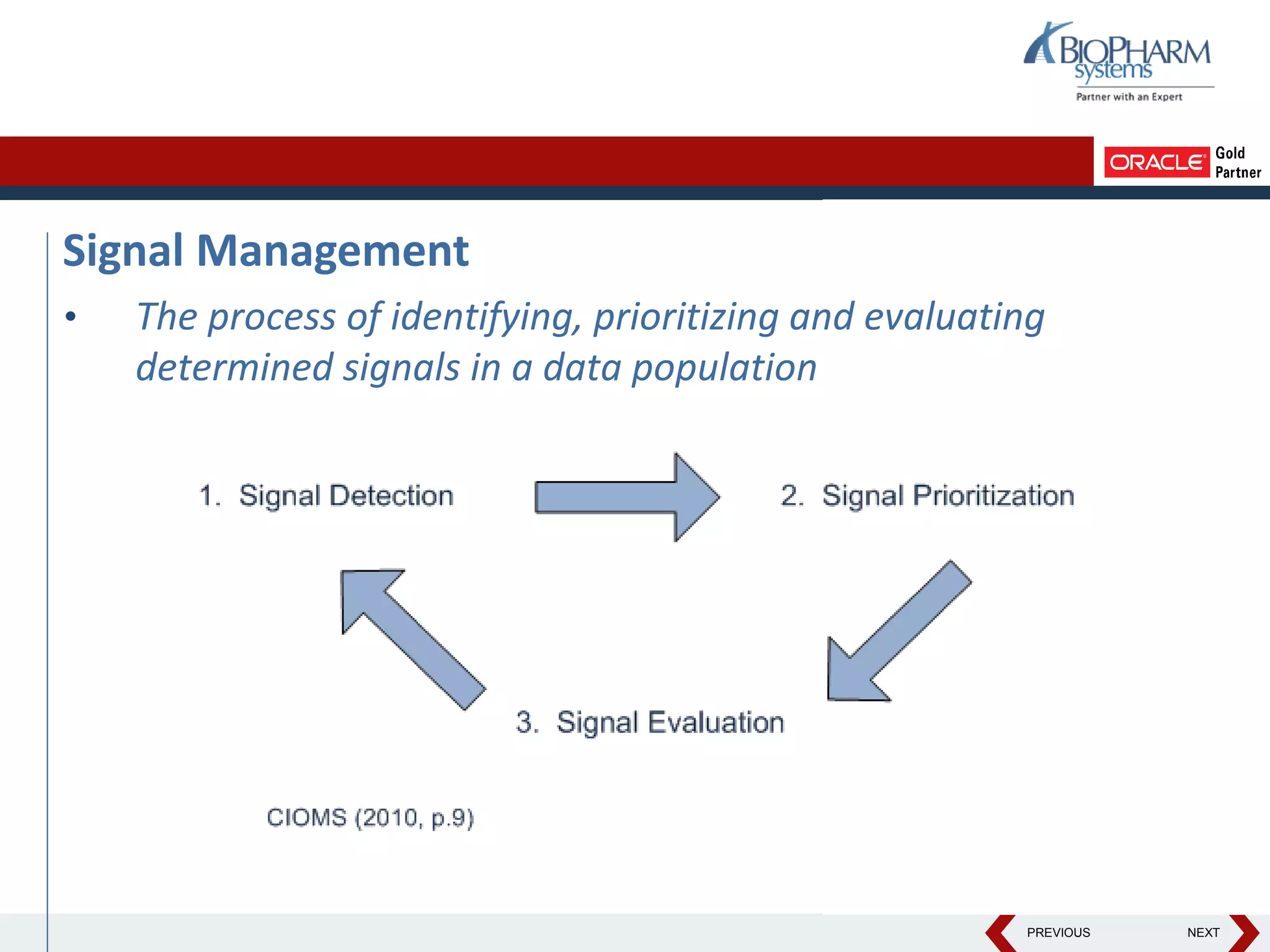
Signal Management
• The process of identifying, prioritizing and evaluating
determined signals in a data population
PREVIOUS NEXT
Current Regulatory Environment
As of July 2, 2012, the EMA has required among other things…
● “All validation, prioritisation, assessment, timelines, decisions, actions, plans,
reporting as well as all other key steps should be recorded and tracked
systematically. Tracking systems should be used for documentation and should
also include signals, for which the validation process conducted was not
suggestive of a new potentially causal association, or a new aspect of a known
association. All records need to be archived” (EMA, 2012).
In June of 2002, the US Congress reauthorized (for a second
time) the Prescription Drug User Fee Act (PDUFA III)
● “Specifically, FDA issued three concept papers. Each paper focused on
one aspect of risk management, including
o (1) conducting premarketing risk assessment
o (2) developing and implementing risk minimization tools
o (3) performing post marketing pharmacovigilance and pharmacoepidemiologic
assessments.” (FDA, 2005)
PREVIOUS NEXT
What the Industry Seeks
• A systematic approach to signal
management
 Ability to identify potential issues in clinical and post-
marketing data
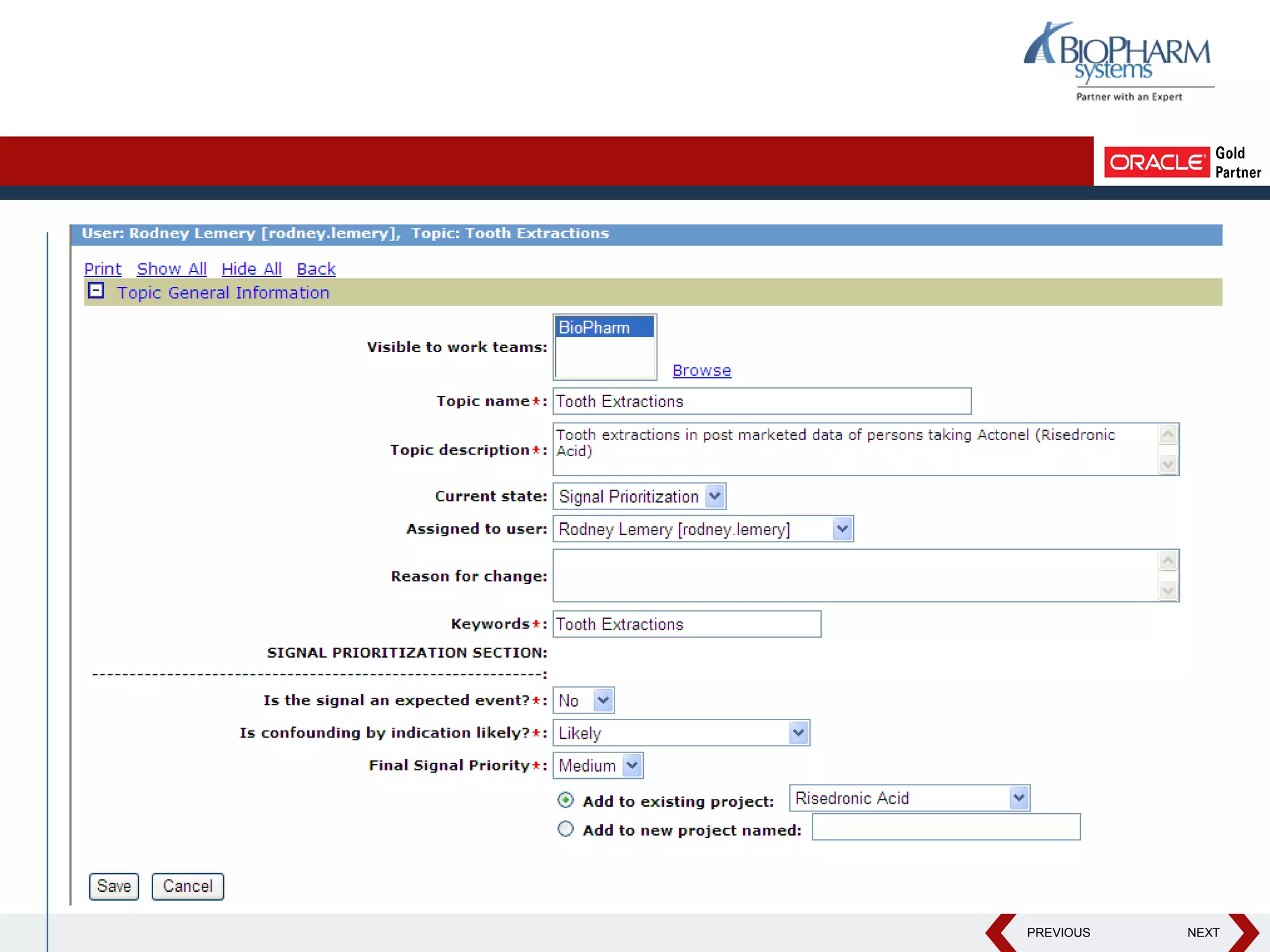
 Standard prioritization questions
 Standard evaluation methods to feed risk management
 Pre-defined workflow for these processes
• A system to collect and track this
approach
 Standard system to document the identification,
prioritization and evaluation of signals
 Capability to report this process for audit answering
and justification or risk methods (document due
diligence)
PREVIOUS NEXT
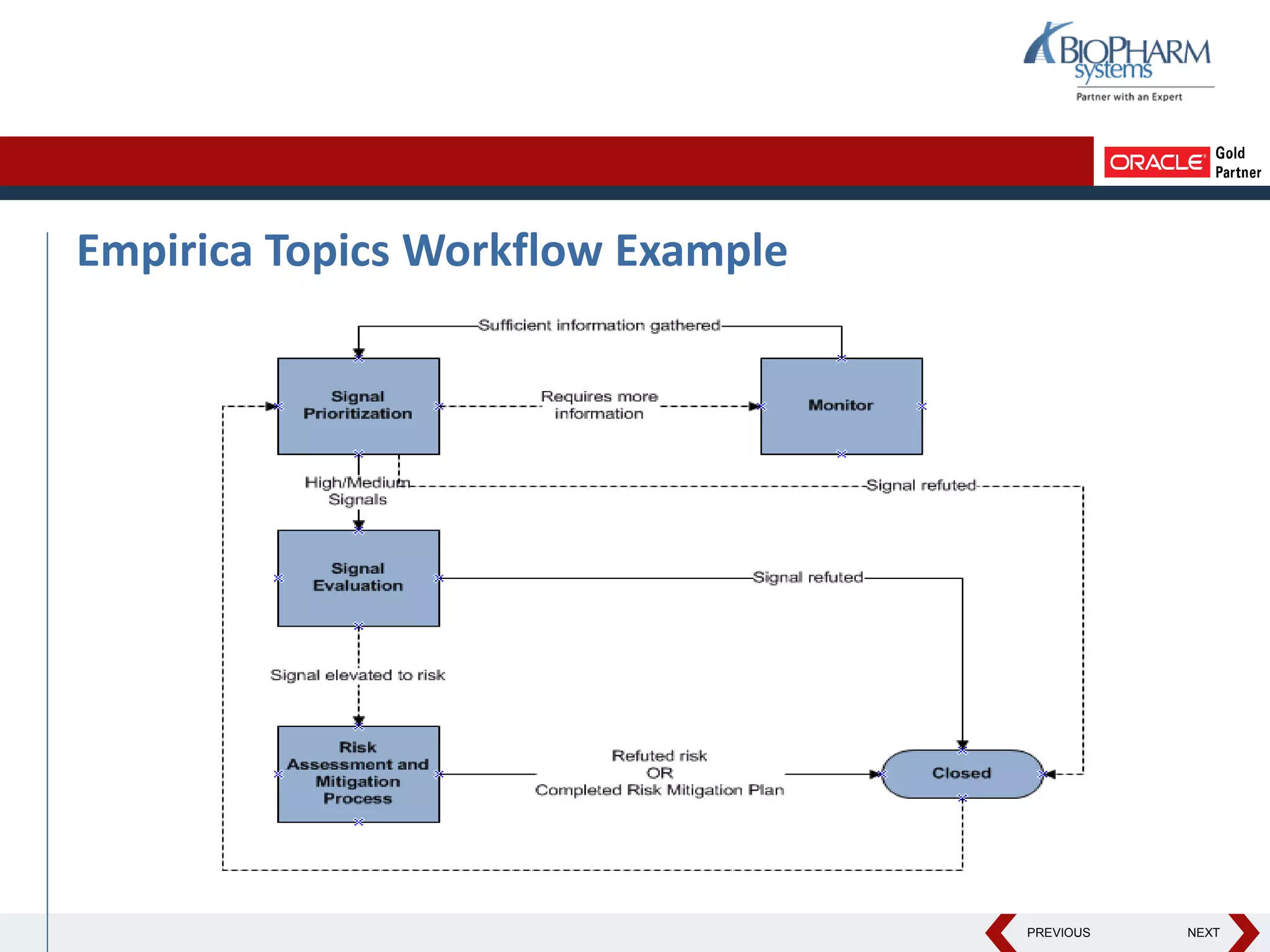
Empirica Topics Workflow Example
PREVIOUS NEXT
PREVIOUS NEXT
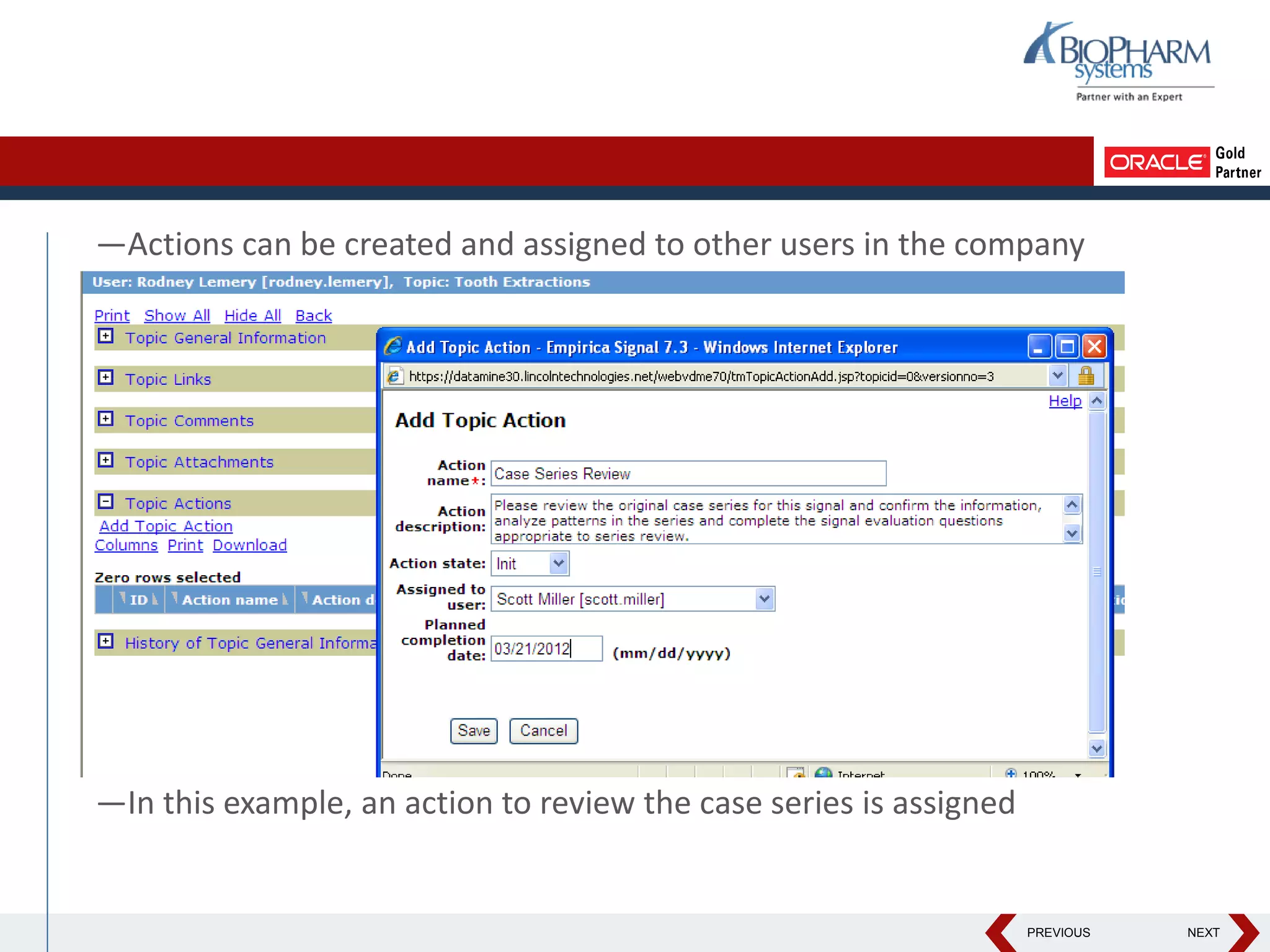
—Actions can be created and assigned to other users in the company
—In this example, an action to review the case series is assigned
PREVIOUS NEXT
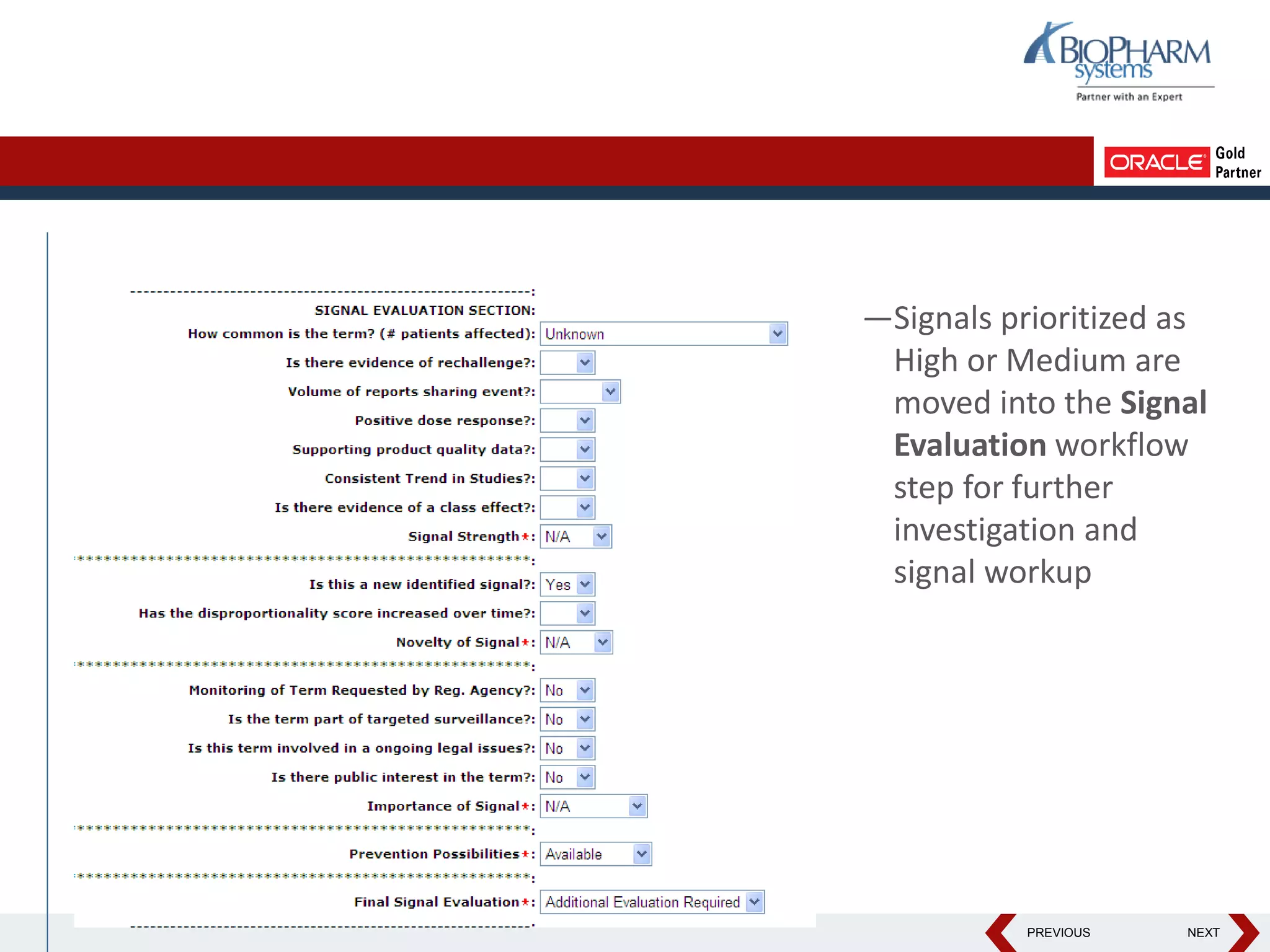
—Signals prioritized as
High or Medium are
moved into the Signal
Evaluation workflow
step for further
investigation and
signal workup
PREVIOUS NEXT
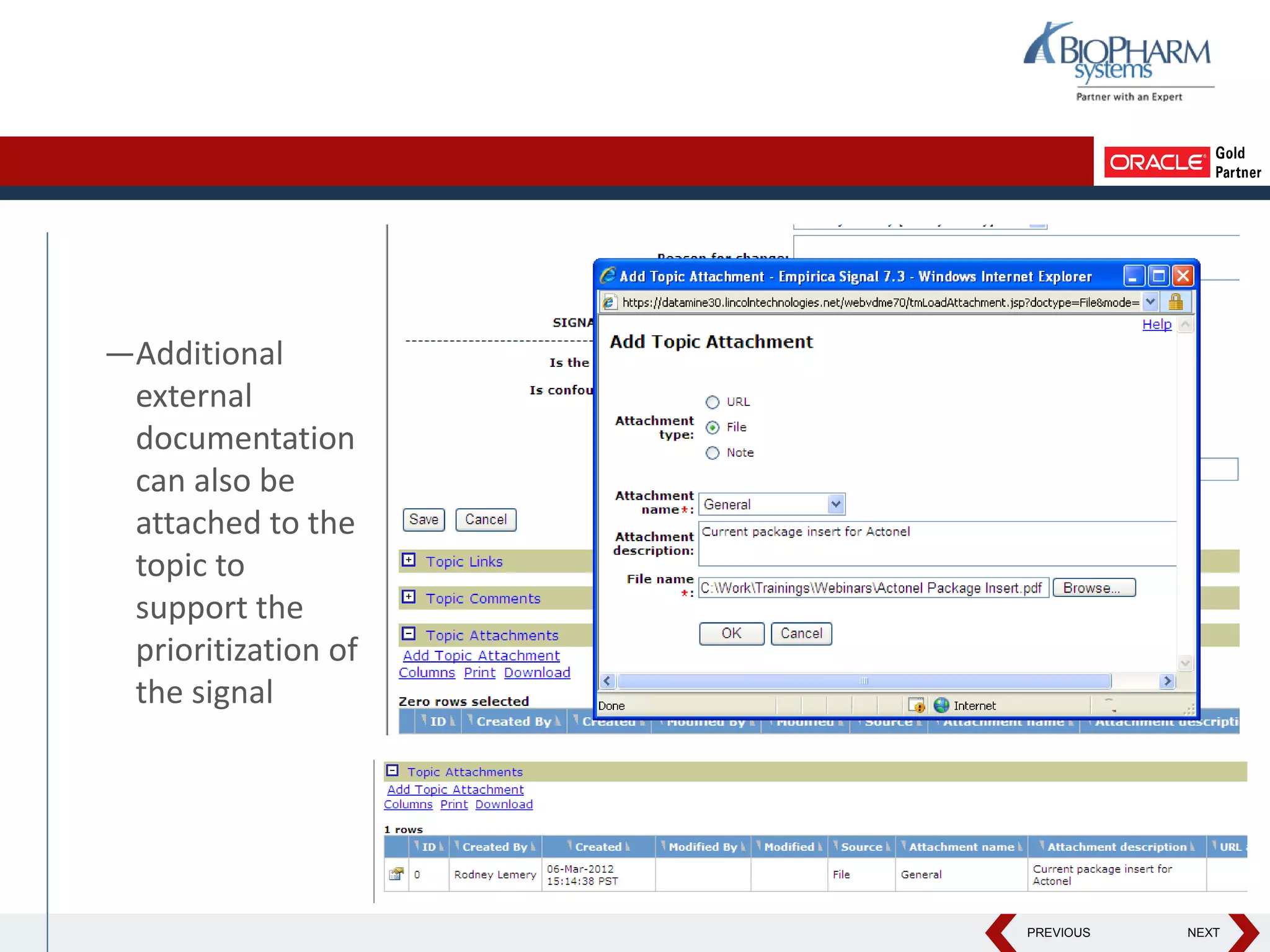
—Additional
external
documentation
can also be
attached to the
topic to
support the
prioritization of
the signal
PREVIOUS NEXT
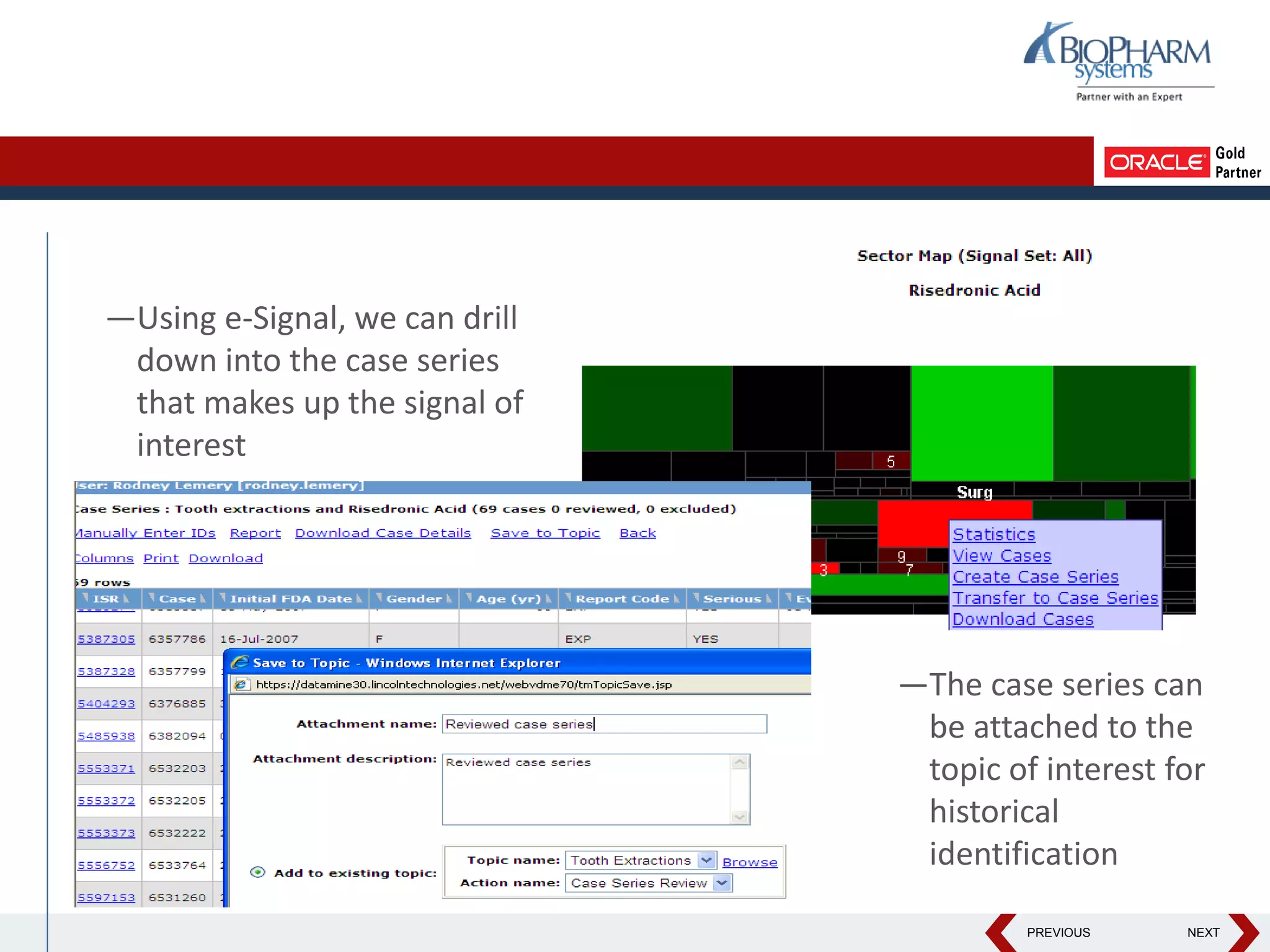
—Using e-Signal, we can drill
down into the case series
that makes up the signal of
interest
—The case series can
be attached to the
topic of interest for
historical
identification
PREVIOUS NEXT
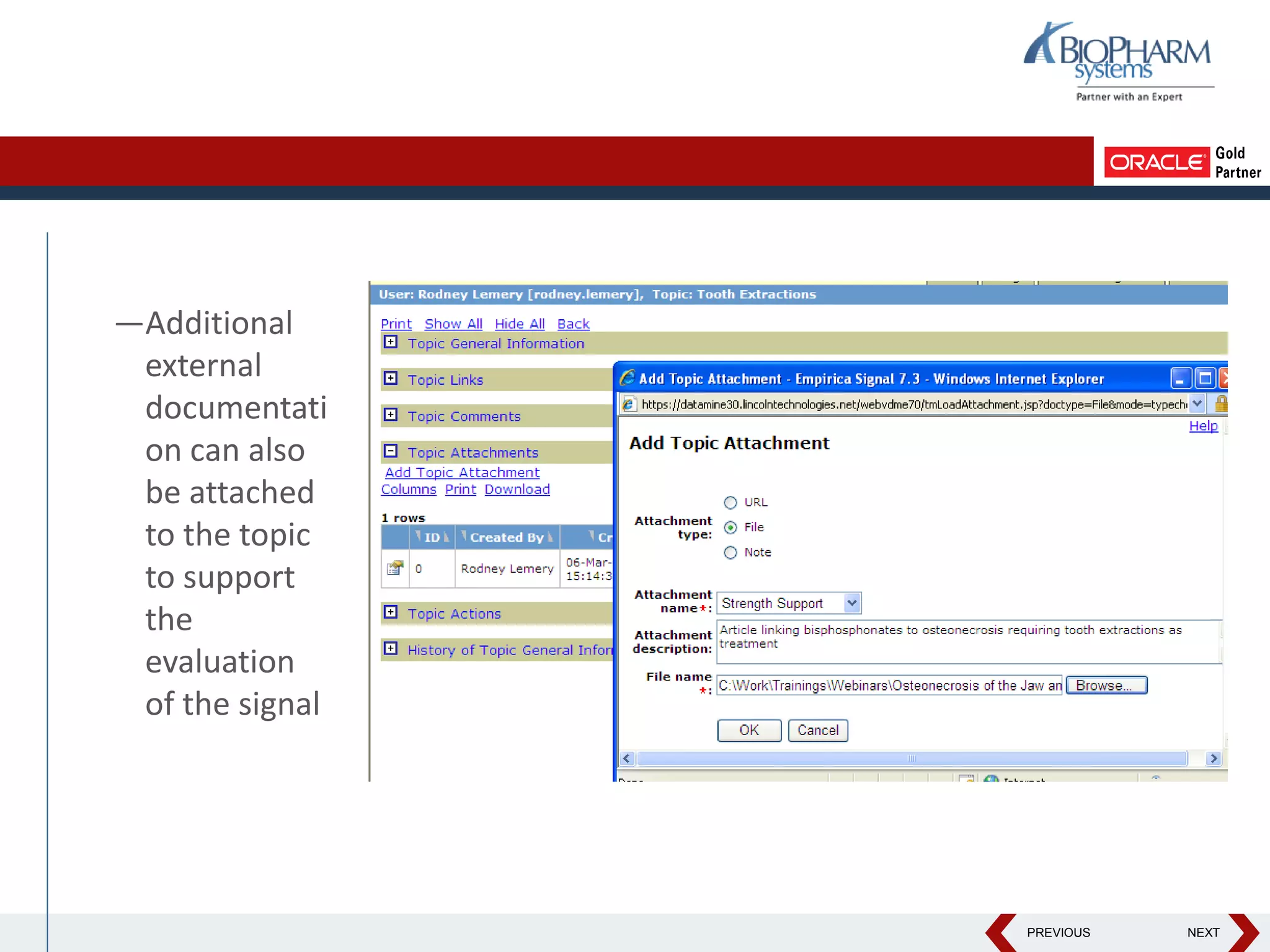
—Additional
external
documentati
on can also
be attached
to the topic
to support
the
evaluation
of the signal
PREVIOUS NEXT
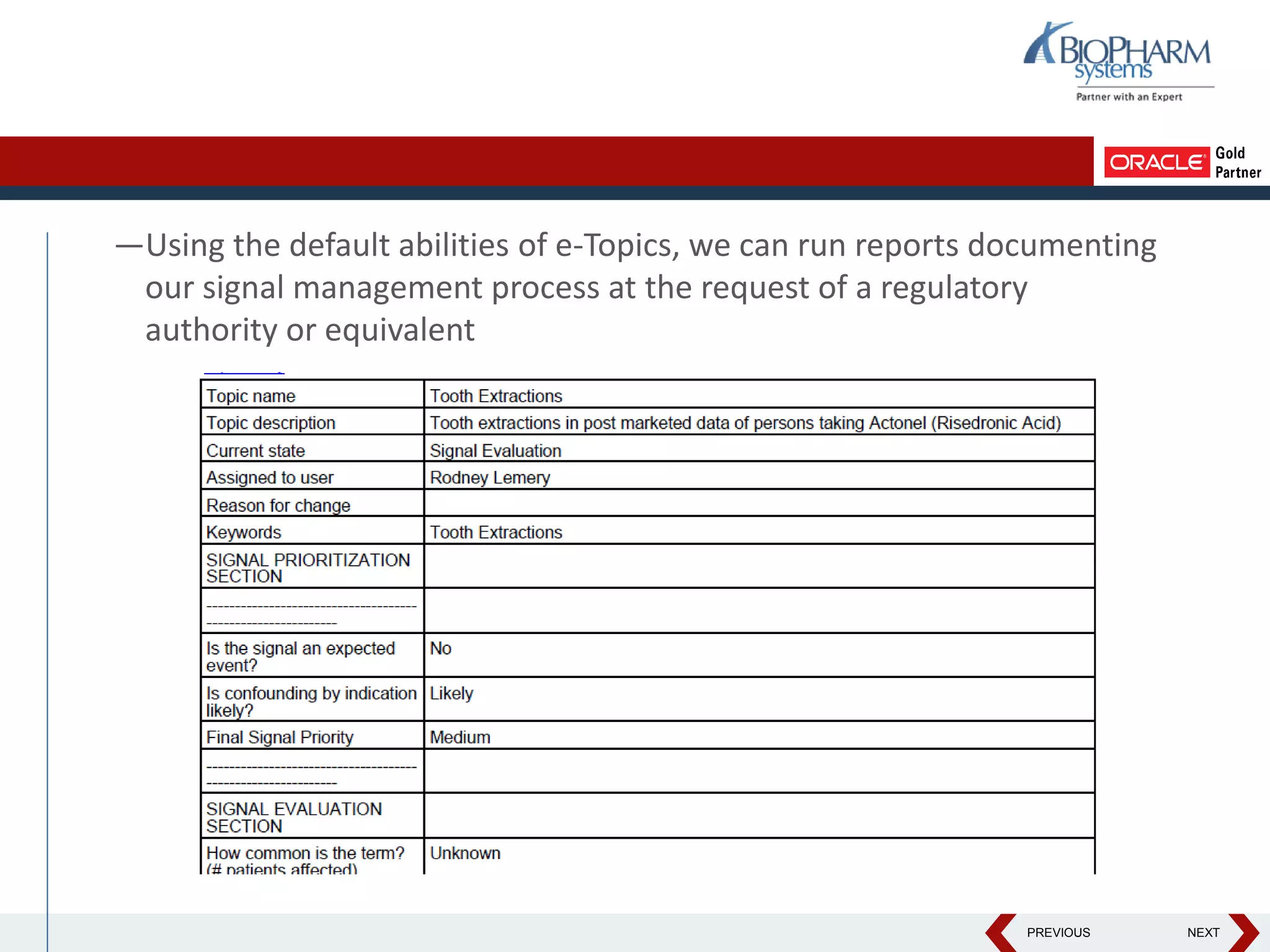
—Using the default abilities of e-Topics, we can run reports documenting
our signal management process at the request of a regulatory
authority or equivalent
PREVIOUS NEXT
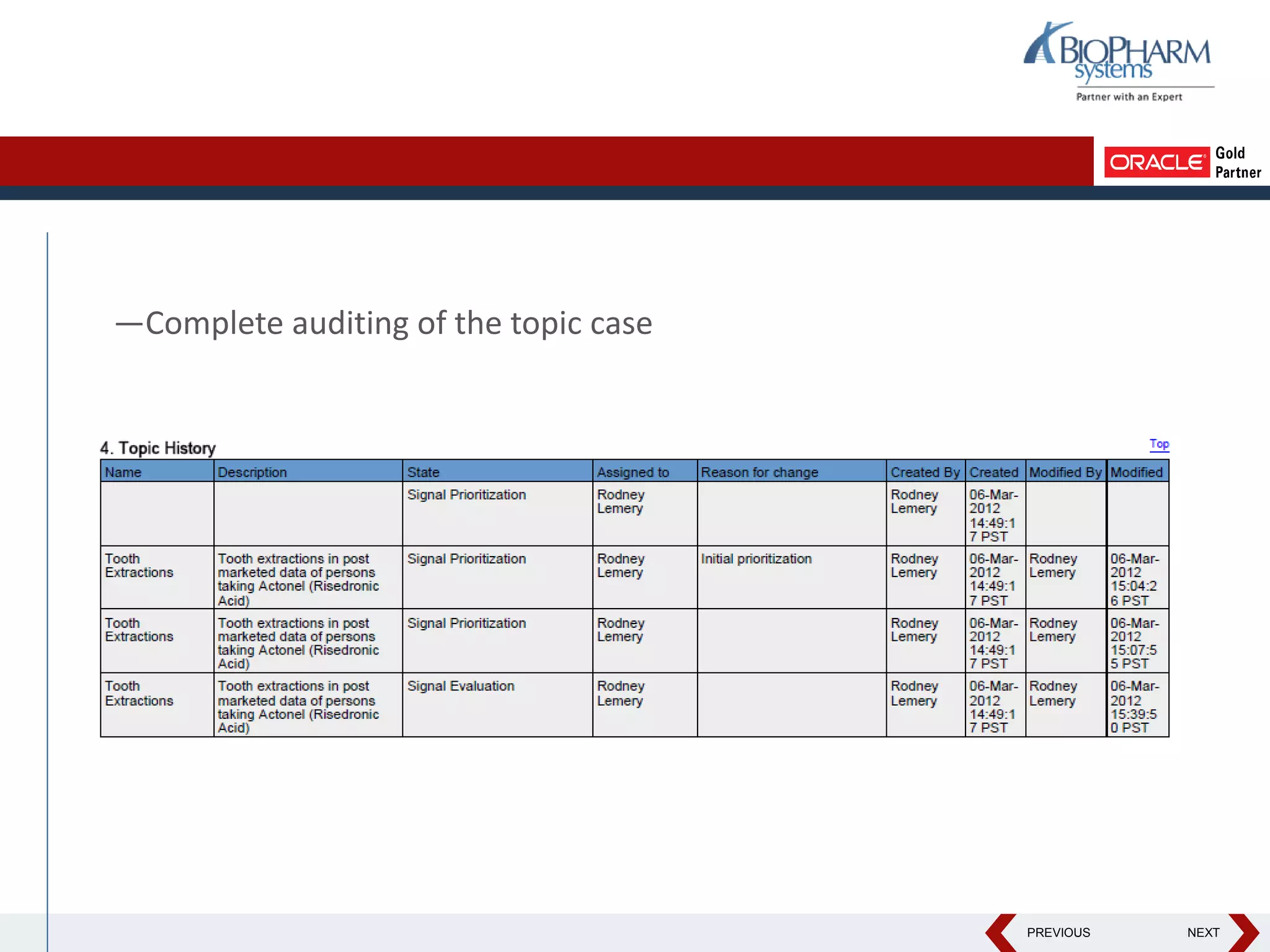
—Complete auditing of the topic case
PREVIOUS NEXT
Summary
—Using existing literature and Empirica Suite can be configured to
provide a systematic method for signal management in a single
solution that accomplishes the following:
—Ability to identify potential issues in clinical and post-marketing
data
—Standard prioritization questions
—Standard evaluation methods to feed risk management
—Pre-defined workflow for these processes
—Capability to report this process for audit answering and
justification or risk methods (document due diligence)
PREVIOUS NEXT
References
• Bennett Levitan, B., Yee, C. L., Russo,L., Bayney, R., Thomas, A. P. and Klincewicz, S.
L.. (2008). A Model for Decision Support in Signal Triage. Drug Safety. 31 (9), pp.
727-735
• Council for International Organizations of Medical Sciences (CIOMS). (2010).
Practical Aspects of Signal Detection in Pharmacovigilance. Report of CIOMS
Working Group VIII, Geneva .
• Heeley E, Waller P, and Moseley J. (2005). Testing and implementing signal impact
analysis in a regulatory setting: results of a pilot study. Drug Safety 28 (10), pp.
901-6
• Waller P, Heeley E, and Moseley J. (2005). Impact analysis of signals detected
from spontaneous adverse drug reaction reporting. Drug Safety 28 (1), pp. 843-50
• Waller P, Lee E. (1999). Responding to drug safety issues. Pharmacoepidemiology
and Drug Safety 8 (7), pp. 535-52
• Waller, P. (2010). An Introduction to Pharmacovigilance. Wiley-Blackwell. Oxford,
UK
PREVIOUS NEXT
Questions & Answers
2000 Alameda de las Pulgas
Suite 154
San Mateo, CA 94403-1270
www.biopharm.com
Rodney L. Lemery MPH, PhD
Vice Pres. Safety and PV
Tel (650) 292-5310
Fax (650) 292-5301
rlemery@biopharm.com

2013 OHSUG - Using Oracle's Empirica Topics to Document Your Signal Management Process

  • 1.
    PREVIOUS NEXTPREVIOUS NEXT UsingOracle's Empirica Topics to Document Your Signal Management Process July 26, 2013 Rodney Lemery, MPH, PhD Vice President, Safety and Pharmacovigilance BioPharm Systems, Inc.
  • 2.
    PREVIOUS NEXT Agenda • SignalManagement using Oracle Empirica Products  Detection  Use of e-Signal for data mining  Prioritization  Evaluation
  • 3.
    PREVIOUS NEXT Signal Management •The process of identifying, prioritizing and evaluating determined signals in a data population
  • 4.
    PREVIOUS NEXT Current RegulatoryEnvironment As of July 2, 2012, the EMA has required among other things… ● “All validation, prioritisation, assessment, timelines, decisions, actions, plans, reporting as well as all other key steps should be recorded and tracked systematically. Tracking systems should be used for documentation and should also include signals, for which the validation process conducted was not suggestive of a new potentially causal association, or a new aspect of a known association. All records need to be archived” (EMA, 2012). In June of 2002, the US Congress reauthorized (for a second time) the Prescription Drug User Fee Act (PDUFA III) ● “Specifically, FDA issued three concept papers. Each paper focused on one aspect of risk management, including o (1) conducting premarketing risk assessment o (2) developing and implementing risk minimization tools o (3) performing post marketing pharmacovigilance and pharmacoepidemiologic assessments.” (FDA, 2005)
  • 5.
    PREVIOUS NEXT What theIndustry Seeks • A systematic approach to signal management  Ability to identify potential issues in clinical and post- marketing data  Standard prioritization questions  Standard evaluation methods to feed risk management  Pre-defined workflow for these processes • A system to collect and track this approach  Standard system to document the identification, prioritization and evaluation of signals  Capability to report this process for audit answering and justification or risk methods (document due diligence)
  • 6.
  • 7.
  • 8.
    PREVIOUS NEXT —Actions canbe created and assigned to other users in the company —In this example, an action to review the case series is assigned
  • 9.
    PREVIOUS NEXT —Signals prioritizedas High or Medium are moved into the Signal Evaluation workflow step for further investigation and signal workup
  • 10.
    PREVIOUS NEXT —Additional external documentation can alsobe attached to the topic to support the prioritization of the signal
  • 11.
    PREVIOUS NEXT —Using e-Signal,we can drill down into the case series that makes up the signal of interest —The case series can be attached to the topic of interest for historical identification
  • 12.
    PREVIOUS NEXT —Additional external documentati on canalso be attached to the topic to support the evaluation of the signal
  • 13.
    PREVIOUS NEXT —Using thedefault abilities of e-Topics, we can run reports documenting our signal management process at the request of a regulatory authority or equivalent
  • 14.
  • 15.
    PREVIOUS NEXT Summary —Using existingliterature and Empirica Suite can be configured to provide a systematic method for signal management in a single solution that accomplishes the following: —Ability to identify potential issues in clinical and post-marketing data —Standard prioritization questions —Standard evaluation methods to feed risk management —Pre-defined workflow for these processes —Capability to report this process for audit answering and justification or risk methods (document due diligence)
  • 16.
    PREVIOUS NEXT References • BennettLevitan, B., Yee, C. L., Russo,L., Bayney, R., Thomas, A. P. and Klincewicz, S. L.. (2008). A Model for Decision Support in Signal Triage. Drug Safety. 31 (9), pp. 727-735 • Council for International Organizations of Medical Sciences (CIOMS). (2010). Practical Aspects of Signal Detection in Pharmacovigilance. Report of CIOMS Working Group VIII, Geneva . • Heeley E, Waller P, and Moseley J. (2005). Testing and implementing signal impact analysis in a regulatory setting: results of a pilot study. Drug Safety 28 (10), pp. 901-6 • Waller P, Heeley E, and Moseley J. (2005). Impact analysis of signals detected from spontaneous adverse drug reaction reporting. Drug Safety 28 (1), pp. 843-50 • Waller P, Lee E. (1999). Responding to drug safety issues. Pharmacoepidemiology and Drug Safety 8 (7), pp. 535-52 • Waller, P. (2010). An Introduction to Pharmacovigilance. Wiley-Blackwell. Oxford, UK
  • 17.
    PREVIOUS NEXT Questions &Answers 2000 Alameda de las Pulgas Suite 154 San Mateo, CA 94403-1270 www.biopharm.com Rodney L. Lemery MPH, PhD Vice Pres. Safety and PV Tel (650) 292-5310 Fax (650) 292-5301 rlemery@biopharm.com