Welcome
Signal Detection
Name: Hannah Christina
Qualification: M.Sc. Biotechnology
Student ID: 040/022023
6/03/2023
www.clinosol.com | follow us on social media
@clinosolresearch
1
6th March, 2023
Index
 Introduction
 Definition of Signal Detection
 Importance of Signal Detection
 Types of Signal Detection
 Sources of Signals
 Signal Management
 Methods of Signal Detection
 Regulatory requirements for Signal Detection
 Challenges in Signal Detection
 Importance of Signal Detection in improving patient safety
 Future directives
 References
 Acknowledgement
www.clinosol.com | follow us on social media
@clinosolresearch
2
6/03/2023
Introduction
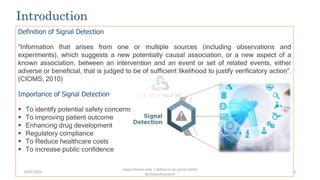
Definition of Signal Detection
“Information that arises from one or multiple sources (including observations and
experiments), which suggests a new potentially causal association, or a new aspect of a
known association, between an intervention and an event or set of related events, either
adverse or beneficial, that is judged to be of sufficient likelihood to justify verificatory action”.
(CIOMS, 2010)
Importance of Signal Detection
 To identify potential safety concerns
 To improving patient outcome
 Enhancing drug development
 Regulatory compliance
 To Reduce healthcare costs
 To increase public confidence
www.clinosol.com | follow us on social media
@clinosolresearch
3
6/03/2023
Types of Signals
 Clinical Signals
- Indications of potential safety with a medical product (drug or device), that are observed during
clinical research
- Indicative of adverse drug reactions (ADRs)
- Indicative of other safety concerns like, drug interactions, contraindications or misuse/ abuse of
the products
- Identified through, analysis of adverse event data (AED), laboratory tests, imaging, etc.
- Detection and evaluation: statistical analysis, expert opinion and regulatory guidance
 Safety signals
- Indications of potential safety issues with a medical product, that can be identified during clinical
research, post-marketing surveillance, etc.
- Its important to carefully monitor for safety signals throughout the product lifecycle, to ensure that
the medical products are safe and effective for use by patients.
- An effective safety detection and management is a critical aspect of pharmacovigilance (PV)
www.clinosol.com | follow us on social media
@clinosolresearch
4
6/03/2023
Types of Signals…….
www.clinosol.com | follow us on social media
@clinosolresearch
5
 Quality signals
- Indications of potential quality issues with a medical product, that can be identified during
manufacturing , testing, etc.
- Indicative of problems with manufacturing process – contamination, impurities, or deviation from
established procedure
- Indicative of problems – with product testing – inaccurate or unreliable results
- Detection and evaluation: inspection of manufacturing facilities, product testing, and analysis of
AED
 Efficacy Signals
- Indications of the effectiveness of a medical product, in treating a particular condition or disease
- Identified: Clinical trials, post marketing studies, and real-world data analyses
- Indicative of positive treatment outcomes- improvement in symptoms, disease progression, or
patient survival
- Depending on the nature and strength of the efficacy signal, it will be used to support regulatory
approval, labeling claims, or marketing strategies
6/03/2023
Source of Signals
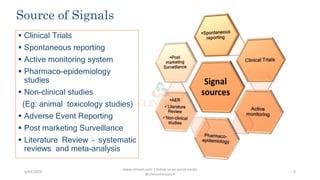
 Clinical Trials
 Spontaneous reporting
 Active monitoring system
 Pharmaco-epidemiology
studies
 Non-clinical studies
(Eg: animal toxicology studies)
 Adverse Event Reporting
 Post marketing Surveillance
 Literature Review – systematic
reviews and meta-analysis
www.clinosol.com | follow us on social media
@clinosolresearch
6
6/03/2023
www.clinosol.com | follow us on social media
@clinosolresearch
7
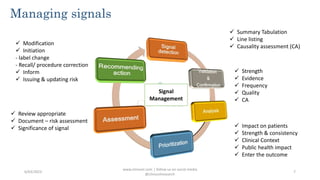
Managing signals
6/03/2023
Signal
Management
 Summary Tabulation
 Line listing
 Causality assessment (CA)
 Strength
 Evidence
 Frequency
 Quality
 CA
 Impact on patients
 Strength & consistency
 Clinical Context
 Public health impact
 Enter the outcome
 Review appropriate
 Document – risk assessment
 Significance of signal
 Modification
 Initiation
- label change
- Recall/ procedure correction
 Inform
 Issuing & updating risk
Methods of Signal Detection
 Data Mining:
This is a technique used for identifying patterns
and links in large datasets.
 Quantitative signal detection:
- Done through disproportionality statistics
- Different ways to calculate disproportionality -
Reporting Odds Ratio (ROR), Proportional
Reporting Ration (PRR) and Bayesian method
(Empirical Bayer's Geometric Mean [EBGM] &
Information Component [IC])
www.clinosol.com | follow us on social media
@clinosolresearch
8
Formulae to calculate ROR
ROR = (a/b)/(c/d)
Where,
a = no. of primary case reports on Drug X
and Adverse Event Y
b = no. of primary case report involving
Drug X and NOT Adverse Event Y
c= no. of primary case reports involving
NOT Drug X and Adverse Event Y
D= no. of primary case reports involving
NOT Drug X and NOT Adverse Event Y.
6/03/2023
Methods of Signal Detection
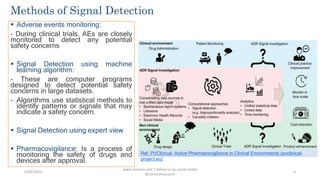
 Adverse events monitoring:
- During clinical trials, AEs are closely
monitored to detect any potential
safety concerns
 Signal Detection using machine
learning algorithm:
- These are computer programs
designed to detect potential safety
concerns in large datasets.
- Algorithms use statistical methods to
identify patterns or signals that may
indicate a safety concern.
 Signal Detection using expert view
 Pharmacovigilance: Is a process of
monitoring the safety of drugs and
devices after approval.
www.clinosol.com | follow us on social media
@clinosolresearch
9
Ref: PVClinical: Active Pharmacovigilance in Clinical Environments (pvclinical-
project.eu)
6/03/2023
Regulatory requirements for Signal Detection
www.clinosol.com | follow us on social media
@clinosolresearch
10
 ICH (International Council for Harmonization)
guidelines
 FDA (Food and Drug Administration) post
market safety surveillance requirements
 EMA (European Medicines Agency)
pharmacovigilance requirement
Challenges in Signal Detection
 Incomplete and inaccurate data
 Signal validation and interpretation
 Signal prioritization and management
 False positive signals
6/03/2023
 Identifies previously unknown or unexpected effects of drugs or devices
 Detects potential safety concerns and adverse AEs early on
 Provides information for healthcare professionals and patients
 Enables researchers to design new targeted and effective clinical trials
 Improves overall quality of medical treatments and the outcome
 Ensures regulatory compliance with post-market surveillance requirements
www.clinosol.com | follow us on social media
@clinosolresearch
11
Importance of Signal Detection in improving patient safety
Future Directives of Signal Detection
 Use of RWD to provide valuable insights into the safety and efficacy of drugs and
devices in real world settings
 Incorporation of advanced analytic technique
 Development of multimodal approach using multiple sources of data
 Incorporation of a patient-centered approach – improvising the accuracy and relevance
of signal detection
 Development of collaborative network (industries, regulatory, and academia)
6/03/2023
References
 Dasic, G., Jones, T., Frajzyngier, V., Rojo, R., Madsen, A., & Valdez, H. (2018). Safety signal
detection and evaluation in clinical development programs: A case study of
tofacitinib. Pharmacology research & perspectives, 6 (1), e00371.
https://doi.org/10.1002/prp2.371
 Malikova MA. Practical applications of regulatory requirements for signal detection and
communications in pharmacovigilance. Therapeutic Advances in Drug Safety. 2020;11.
doi:10.1177/2042098620909614
 Bate, A. and Evans, S.J.W. (2009), Quantitative signal detection using spontaneous ADR
reporting. Pharmacoepidem. Drug Safe., 18: 427-436. https://doi.org/10.1002/pds.1742
 Signal Detection in Pharmacovigilance (primevigilance.com)
 What is a signal? | UMC (who-umc.org)
 Pharmacovigilance Signal Detection: The Complete Guide (adverahealth.com)
www.clinosol.com | follow us on social media
@clinosolresearch
12
6/03/2023
Acknowledgement
 I would like to thank team ClinoSol Research and Ms. Shifa for the constant
guidance
 Special thanks to,
- Mr. Mujeebuddin Shaik, Founder and CEO, ClinoSol Research, Hyderabad,
India
- Ms. Uma Priya, Director, ClinoSol Research, Hyderabad, India, for all the
support and encouragement
www.clinosol.com | follow us on social media
@clinosolresearch
13
6/03/2023
Thank You!
www.clinosol.com
(India | Canada)
9121151622/623/624
info@clinosol.com
www.clinosol.com | follow us on social media
@clinosolresearch
14
6/03/2023

Signal Detection in Pharmacovigilance

  • 1.
    Welcome Signal Detection Name: HannahChristina Qualification: M.Sc. Biotechnology Student ID: 040/022023 6/03/2023 www.clinosol.com | follow us on social media @clinosolresearch 1 6th March, 2023
  • 2.
    Index  Introduction  Definitionof Signal Detection  Importance of Signal Detection  Types of Signal Detection  Sources of Signals  Signal Management  Methods of Signal Detection  Regulatory requirements for Signal Detection  Challenges in Signal Detection  Importance of Signal Detection in improving patient safety  Future directives  References  Acknowledgement www.clinosol.com | follow us on social media @clinosolresearch 2 6/03/2023
  • 3.
    Introduction Definition of SignalDetection “Information that arises from one or multiple sources (including observations and experiments), which suggests a new potentially causal association, or a new aspect of a known association, between an intervention and an event or set of related events, either adverse or beneficial, that is judged to be of sufficient likelihood to justify verificatory action”. (CIOMS, 2010) Importance of Signal Detection  To identify potential safety concerns  To improving patient outcome  Enhancing drug development  Regulatory compliance  To Reduce healthcare costs  To increase public confidence www.clinosol.com | follow us on social media @clinosolresearch 3 6/03/2023
  • 4.
    Types of Signals Clinical Signals - Indications of potential safety with a medical product (drug or device), that are observed during clinical research - Indicative of adverse drug reactions (ADRs) - Indicative of other safety concerns like, drug interactions, contraindications or misuse/ abuse of the products - Identified through, analysis of adverse event data (AED), laboratory tests, imaging, etc. - Detection and evaluation: statistical analysis, expert opinion and regulatory guidance  Safety signals - Indications of potential safety issues with a medical product, that can be identified during clinical research, post-marketing surveillance, etc. - Its important to carefully monitor for safety signals throughout the product lifecycle, to ensure that the medical products are safe and effective for use by patients. - An effective safety detection and management is a critical aspect of pharmacovigilance (PV) www.clinosol.com | follow us on social media @clinosolresearch 4 6/03/2023
  • 5.
    Types of Signals……. www.clinosol.com| follow us on social media @clinosolresearch 5  Quality signals - Indications of potential quality issues with a medical product, that can be identified during manufacturing , testing, etc. - Indicative of problems with manufacturing process – contamination, impurities, or deviation from established procedure - Indicative of problems – with product testing – inaccurate or unreliable results - Detection and evaluation: inspection of manufacturing facilities, product testing, and analysis of AED  Efficacy Signals - Indications of the effectiveness of a medical product, in treating a particular condition or disease - Identified: Clinical trials, post marketing studies, and real-world data analyses - Indicative of positive treatment outcomes- improvement in symptoms, disease progression, or patient survival - Depending on the nature and strength of the efficacy signal, it will be used to support regulatory approval, labeling claims, or marketing strategies 6/03/2023
  • 6.
    Source of Signals Clinical Trials  Spontaneous reporting  Active monitoring system  Pharmaco-epidemiology studies  Non-clinical studies (Eg: animal toxicology studies)  Adverse Event Reporting  Post marketing Surveillance  Literature Review – systematic reviews and meta-analysis www.clinosol.com | follow us on social media @clinosolresearch 6 6/03/2023
  • 7.
    www.clinosol.com | followus on social media @clinosolresearch 7 Managing signals 6/03/2023 Signal Management  Summary Tabulation  Line listing  Causality assessment (CA)  Strength  Evidence  Frequency  Quality  CA  Impact on patients  Strength & consistency  Clinical Context  Public health impact  Enter the outcome  Review appropriate  Document – risk assessment  Significance of signal  Modification  Initiation - label change - Recall/ procedure correction  Inform  Issuing & updating risk
  • 8.
    Methods of SignalDetection  Data Mining: This is a technique used for identifying patterns and links in large datasets.  Quantitative signal detection: - Done through disproportionality statistics - Different ways to calculate disproportionality - Reporting Odds Ratio (ROR), Proportional Reporting Ration (PRR) and Bayesian method (Empirical Bayer's Geometric Mean [EBGM] & Information Component [IC]) www.clinosol.com | follow us on social media @clinosolresearch 8 Formulae to calculate ROR ROR = (a/b)/(c/d) Where, a = no. of primary case reports on Drug X and Adverse Event Y b = no. of primary case report involving Drug X and NOT Adverse Event Y c= no. of primary case reports involving NOT Drug X and Adverse Event Y D= no. of primary case reports involving NOT Drug X and NOT Adverse Event Y. 6/03/2023
  • 9.
    Methods of SignalDetection  Adverse events monitoring: - During clinical trials, AEs are closely monitored to detect any potential safety concerns  Signal Detection using machine learning algorithm: - These are computer programs designed to detect potential safety concerns in large datasets. - Algorithms use statistical methods to identify patterns or signals that may indicate a safety concern.  Signal Detection using expert view  Pharmacovigilance: Is a process of monitoring the safety of drugs and devices after approval. www.clinosol.com | follow us on social media @clinosolresearch 9 Ref: PVClinical: Active Pharmacovigilance in Clinical Environments (pvclinical- project.eu) 6/03/2023
  • 10.
    Regulatory requirements forSignal Detection www.clinosol.com | follow us on social media @clinosolresearch 10  ICH (International Council for Harmonization) guidelines  FDA (Food and Drug Administration) post market safety surveillance requirements  EMA (European Medicines Agency) pharmacovigilance requirement Challenges in Signal Detection  Incomplete and inaccurate data  Signal validation and interpretation  Signal prioritization and management  False positive signals 6/03/2023
  • 11.
     Identifies previouslyunknown or unexpected effects of drugs or devices  Detects potential safety concerns and adverse AEs early on  Provides information for healthcare professionals and patients  Enables researchers to design new targeted and effective clinical trials  Improves overall quality of medical treatments and the outcome  Ensures regulatory compliance with post-market surveillance requirements www.clinosol.com | follow us on social media @clinosolresearch 11 Importance of Signal Detection in improving patient safety Future Directives of Signal Detection  Use of RWD to provide valuable insights into the safety and efficacy of drugs and devices in real world settings  Incorporation of advanced analytic technique  Development of multimodal approach using multiple sources of data  Incorporation of a patient-centered approach – improvising the accuracy and relevance of signal detection  Development of collaborative network (industries, regulatory, and academia) 6/03/2023
  • 12.
    References  Dasic, G.,Jones, T., Frajzyngier, V., Rojo, R., Madsen, A., & Valdez, H. (2018). Safety signal detection and evaluation in clinical development programs: A case study of tofacitinib. Pharmacology research & perspectives, 6 (1), e00371. https://doi.org/10.1002/prp2.371  Malikova MA. Practical applications of regulatory requirements for signal detection and communications in pharmacovigilance. Therapeutic Advances in Drug Safety. 2020;11. doi:10.1177/2042098620909614  Bate, A. and Evans, S.J.W. (2009), Quantitative signal detection using spontaneous ADR reporting. Pharmacoepidem. Drug Safe., 18: 427-436. https://doi.org/10.1002/pds.1742  Signal Detection in Pharmacovigilance (primevigilance.com)  What is a signal? | UMC (who-umc.org)  Pharmacovigilance Signal Detection: The Complete Guide (adverahealth.com) www.clinosol.com | follow us on social media @clinosolresearch 12 6/03/2023
  • 13.
    Acknowledgement  I wouldlike to thank team ClinoSol Research and Ms. Shifa for the constant guidance  Special thanks to, - Mr. Mujeebuddin Shaik, Founder and CEO, ClinoSol Research, Hyderabad, India - Ms. Uma Priya, Director, ClinoSol Research, Hyderabad, India, for all the support and encouragement www.clinosol.com | follow us on social media @clinosolresearch 13 6/03/2023
  • 14.
    Thank You! www.clinosol.com (India |Canada) 9121151622/623/624 info@clinosol.com www.clinosol.com | follow us on social media @clinosolresearch 14 6/03/2023

Editor's Notes

  • #8 Signal detection Validation and confirmation Analysis Prioritization Assessment Recommending action