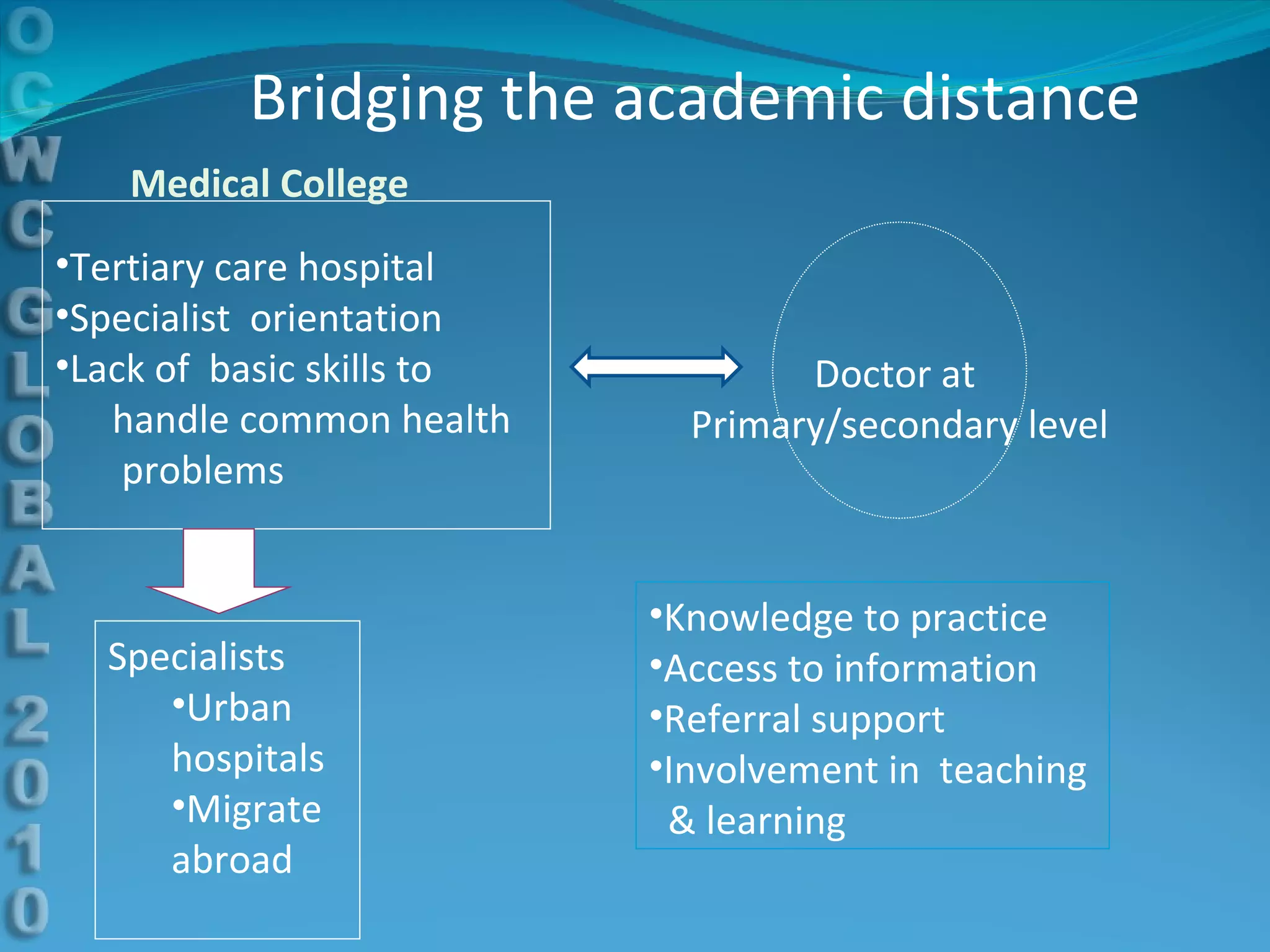
Tertiary care hospital Specialist  orientation Lack of  basic skills to  handle common health  problems Doctor at  Primary/secondary level Specialists Urban hospitals Migrate abroad Medical College Knowledge to practice Access to information Referral support Involvement in  teaching  & learning Bridging the academic distance
OVERVIEW Back ground of CMC Mission Hospitals Linkage E-Learning with Mission  Hospitals so far How E-Learning can be useful for Mission Hospitals Integrating Primary/Secondary Education – An IDEA !
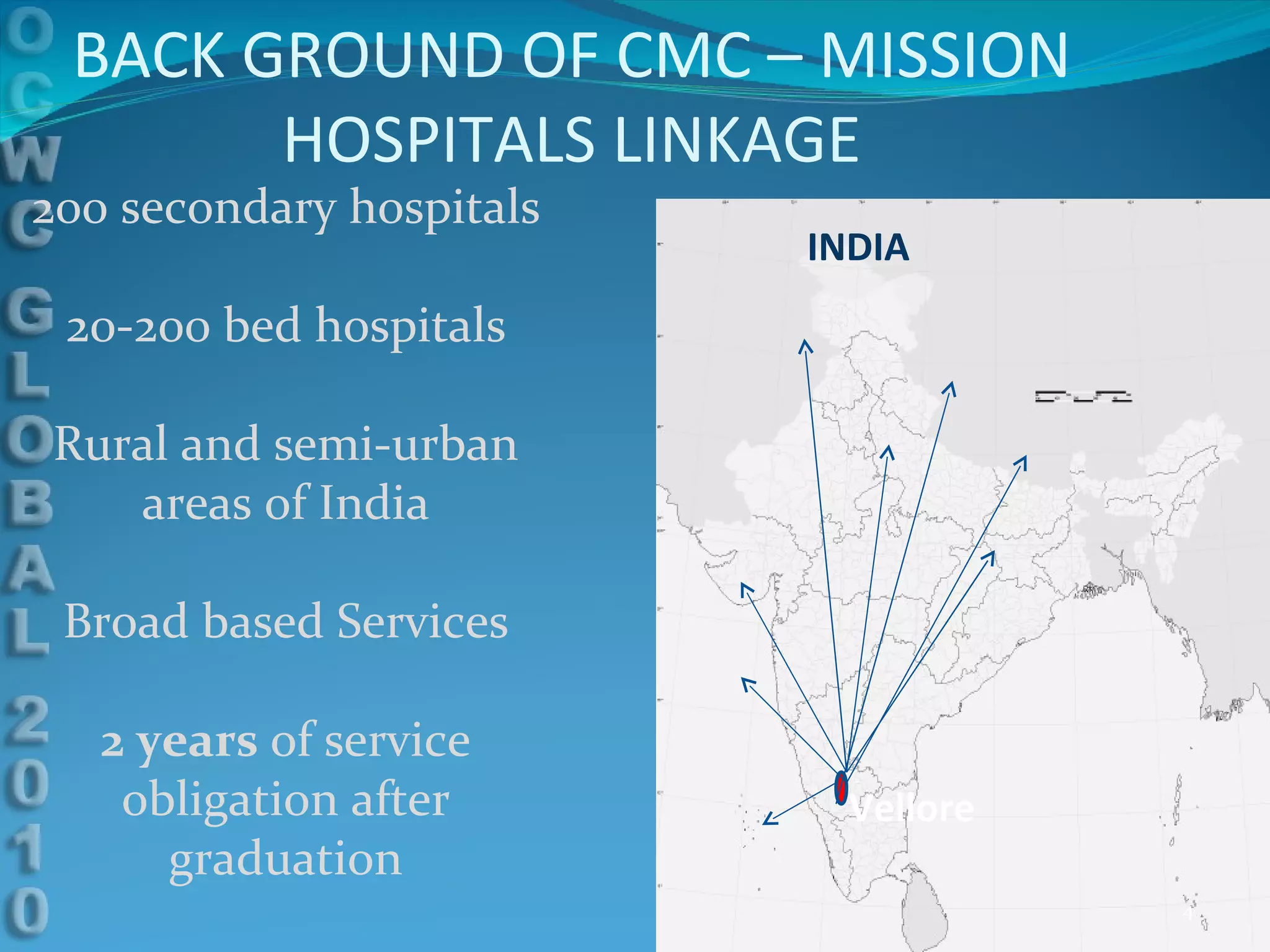
Vellore INDIA 200 secondary hospitals 20-200 bed hospitals Rural and semi-urban areas of India Broad based Services 2 years  of   service obligation after graduation BACK GROUND OF CMC – MISSION HOSPITALS LINKAGE
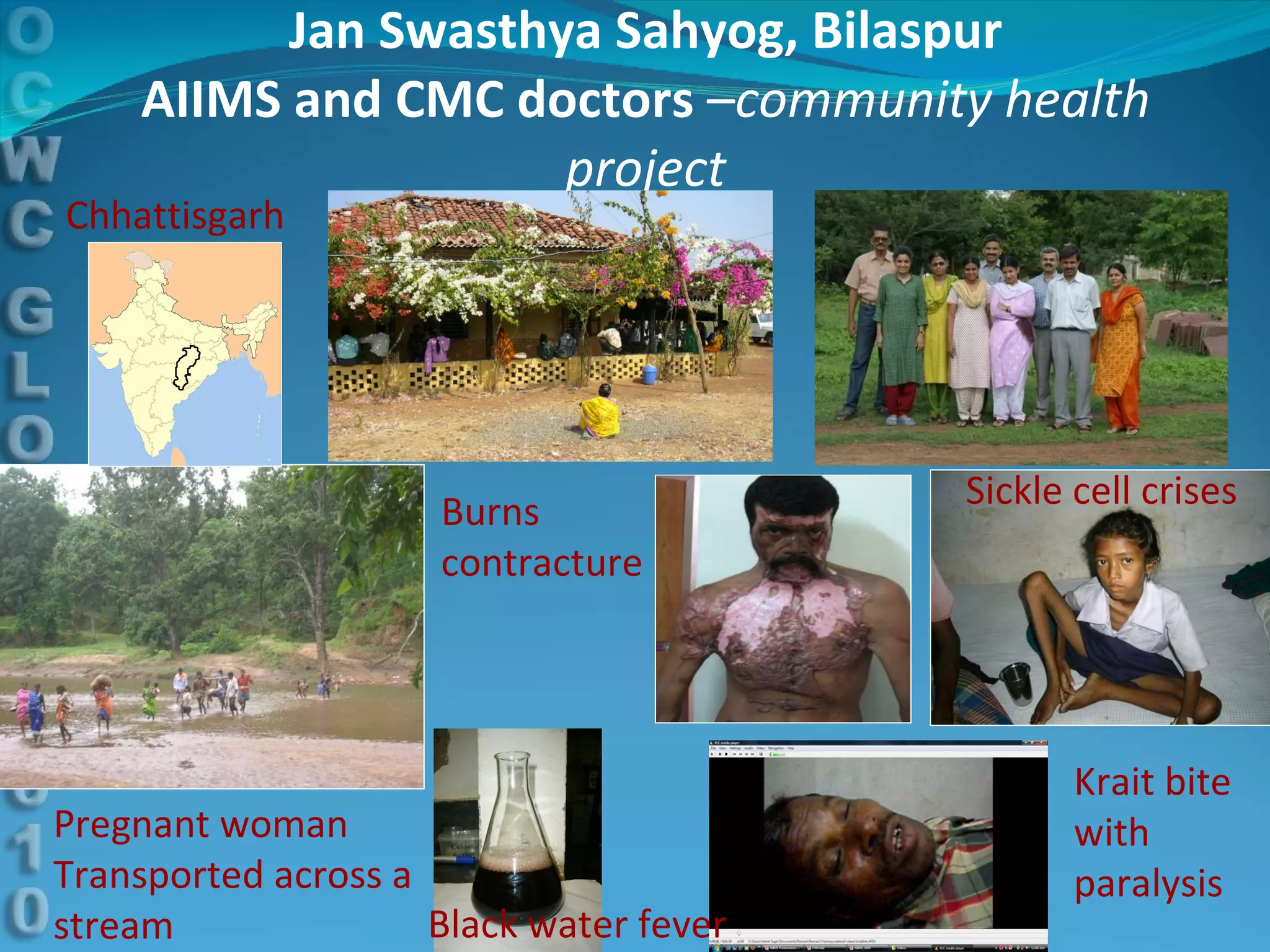
Jan Swasthya Sahyog, Bilaspur AIIMS and CMC doctors  – community health project Chhattisgarh Pregnant woman  Transported across a  stream Black water fever Burns contracture Sickle cell crises Krait bite with  paralysis
RESPONSE TO THESE CHALLENGES Secondary Hospital Program (SHP) Fellowship In Secondary Hospital Medicine ( FSHM)
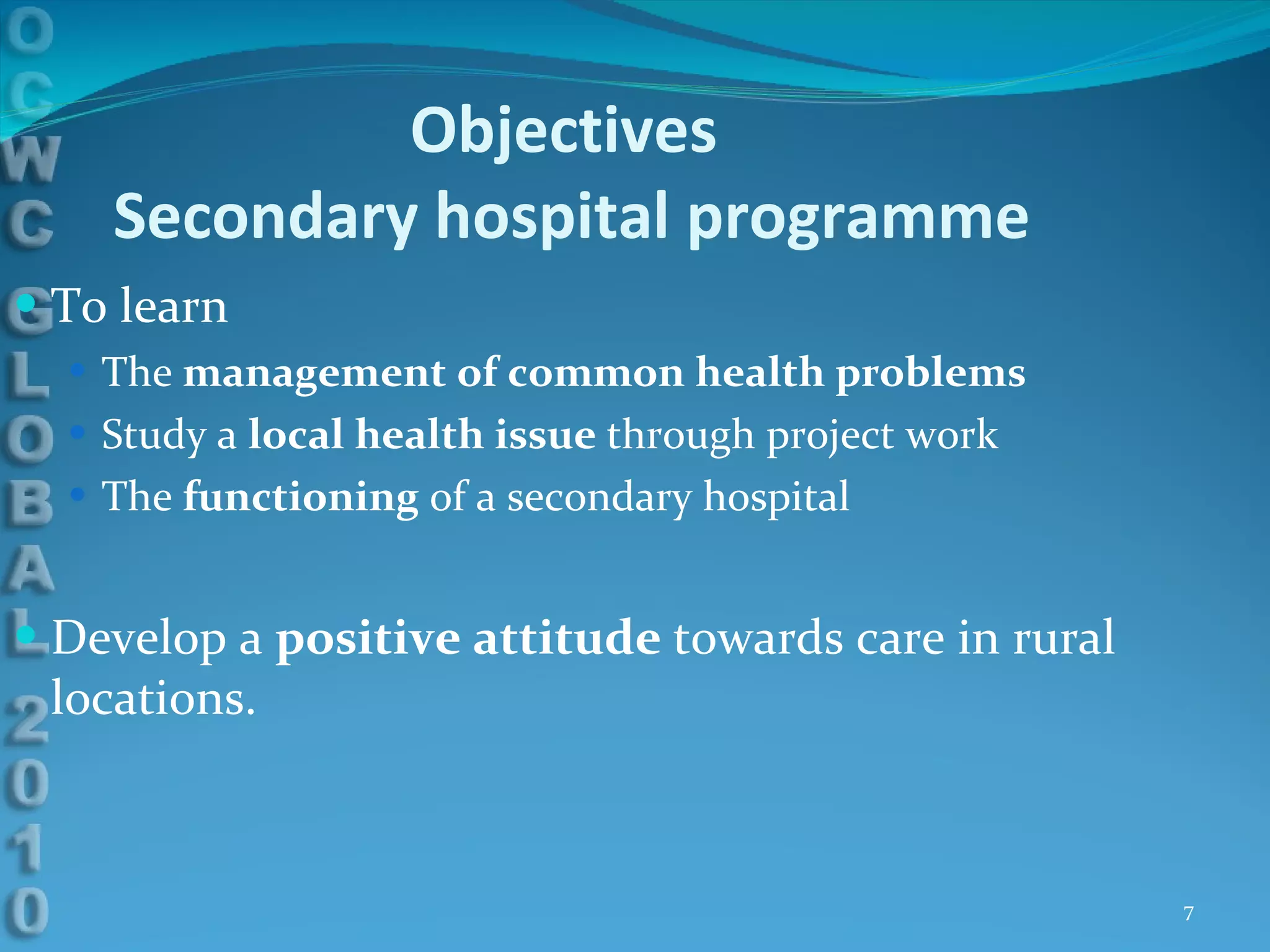
Objectives  Secondary hospital programme To learn The  management of common health problems Study a  local health issue  through project work The  functioning  of a secondary hospital  Develop a  positive attitude  towards care in rural locations.
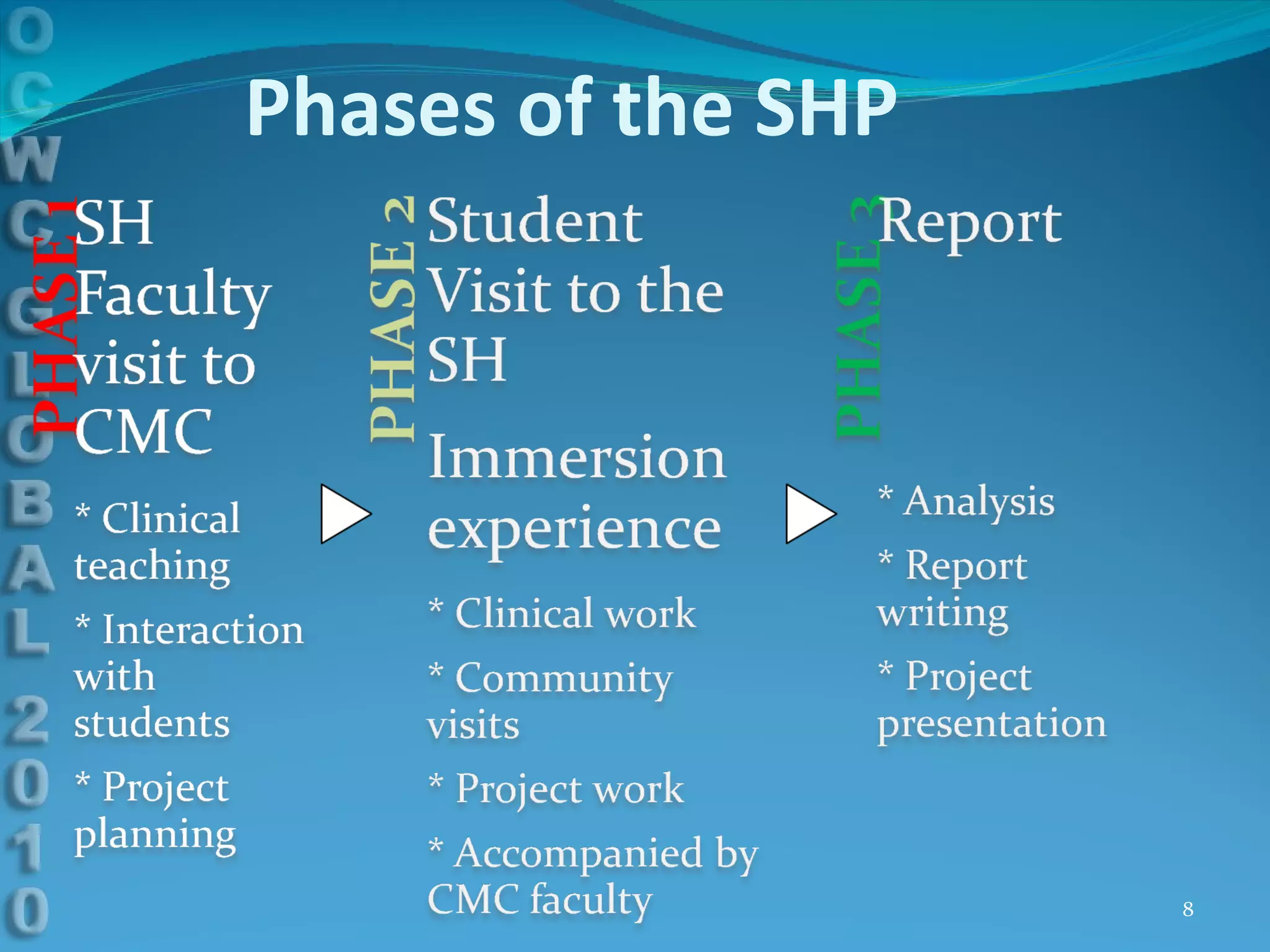
Phases of the SHP
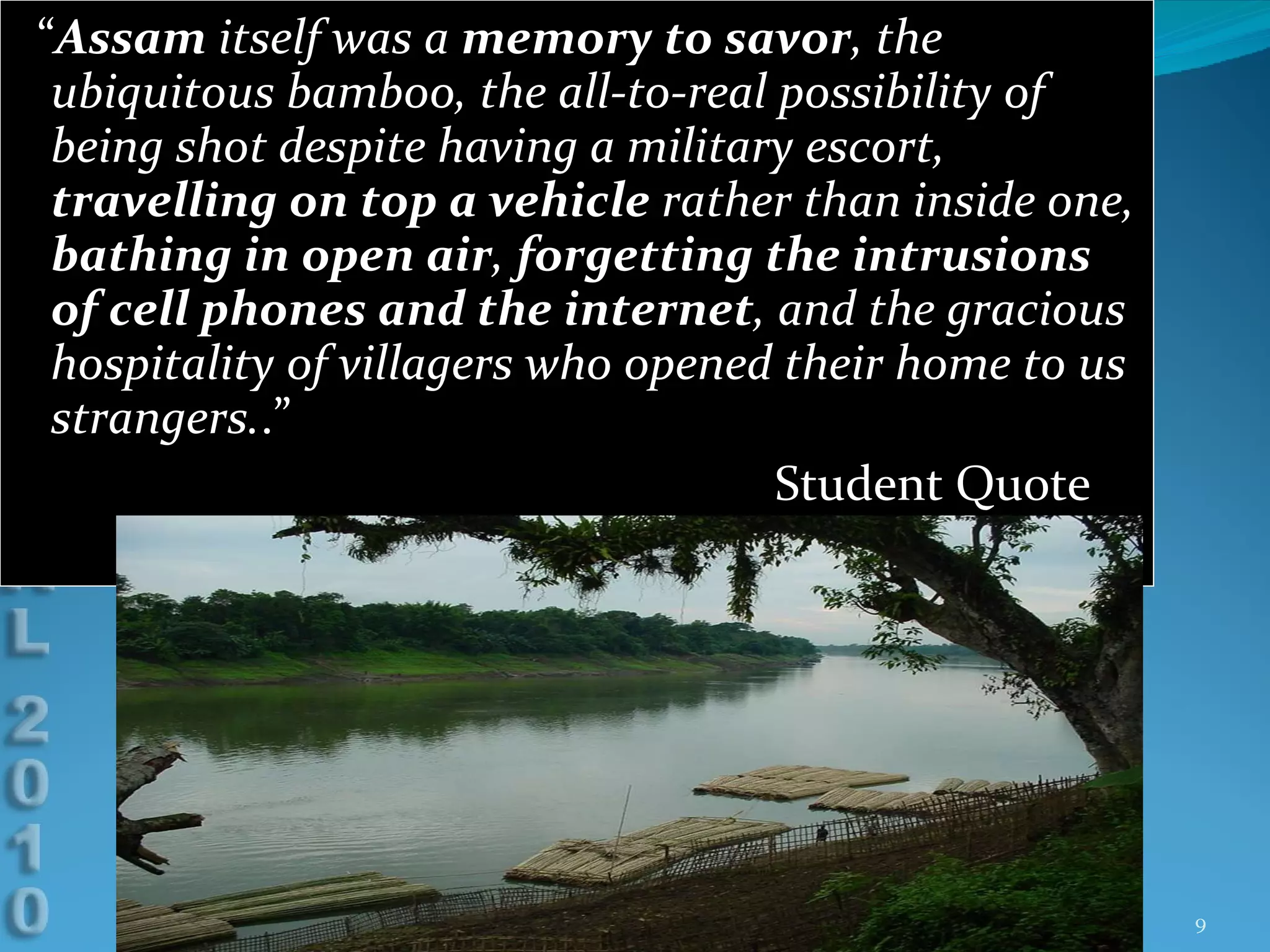
“ Assam  itself was a  memory to savor , the ubiquitous bamboo, the all-to-real possibility of being shot despite having a military escort,  travelling on top a vehicle  rather than inside one,  bathing in open air ,  forgetting the intrusions of cell phones and the internet , and the gracious hospitality of villagers who opened their home to us strangers. .”  Student Quote
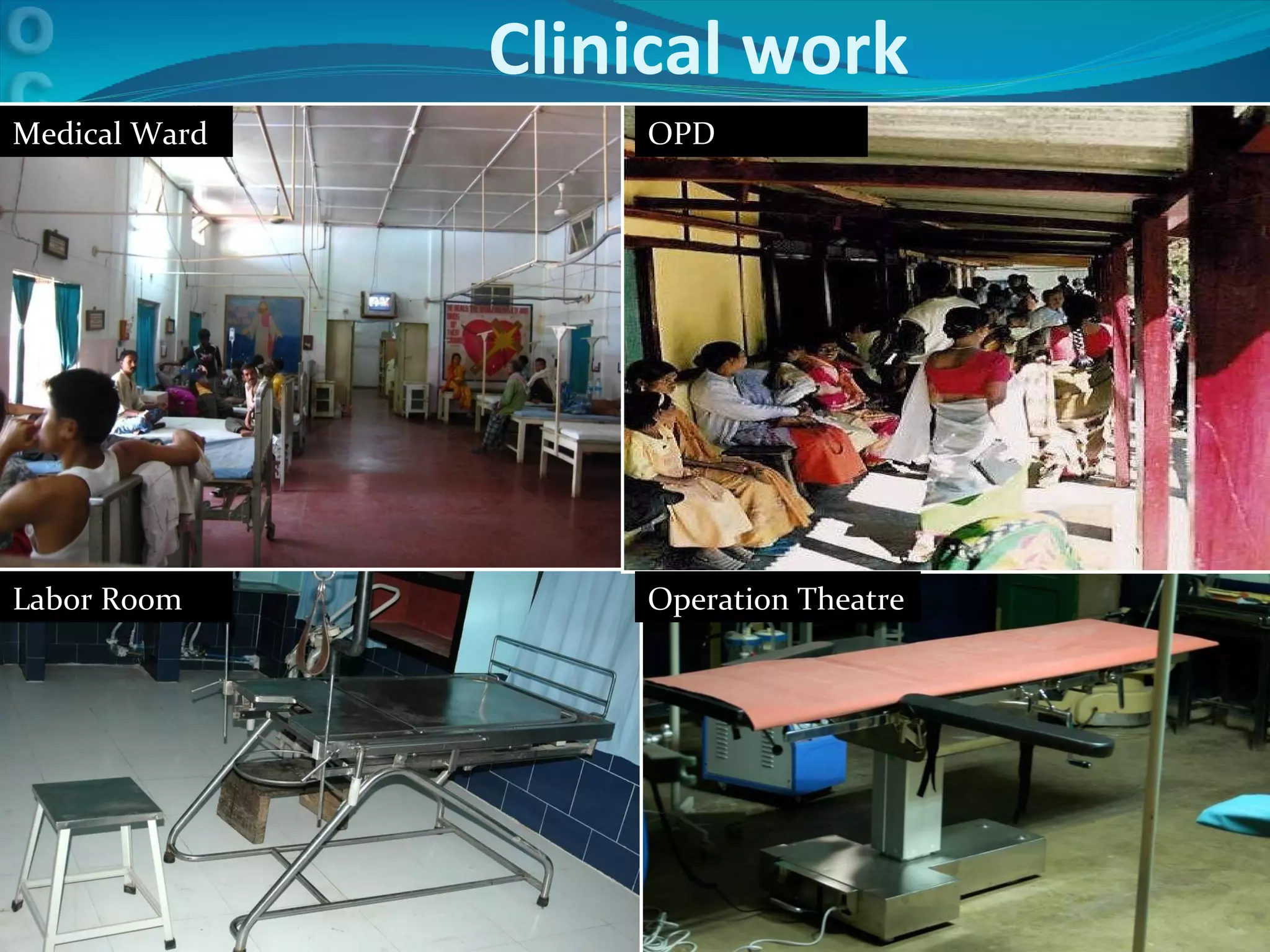
Clinical work Medical Ward OPD Labor Room Operation Theatre
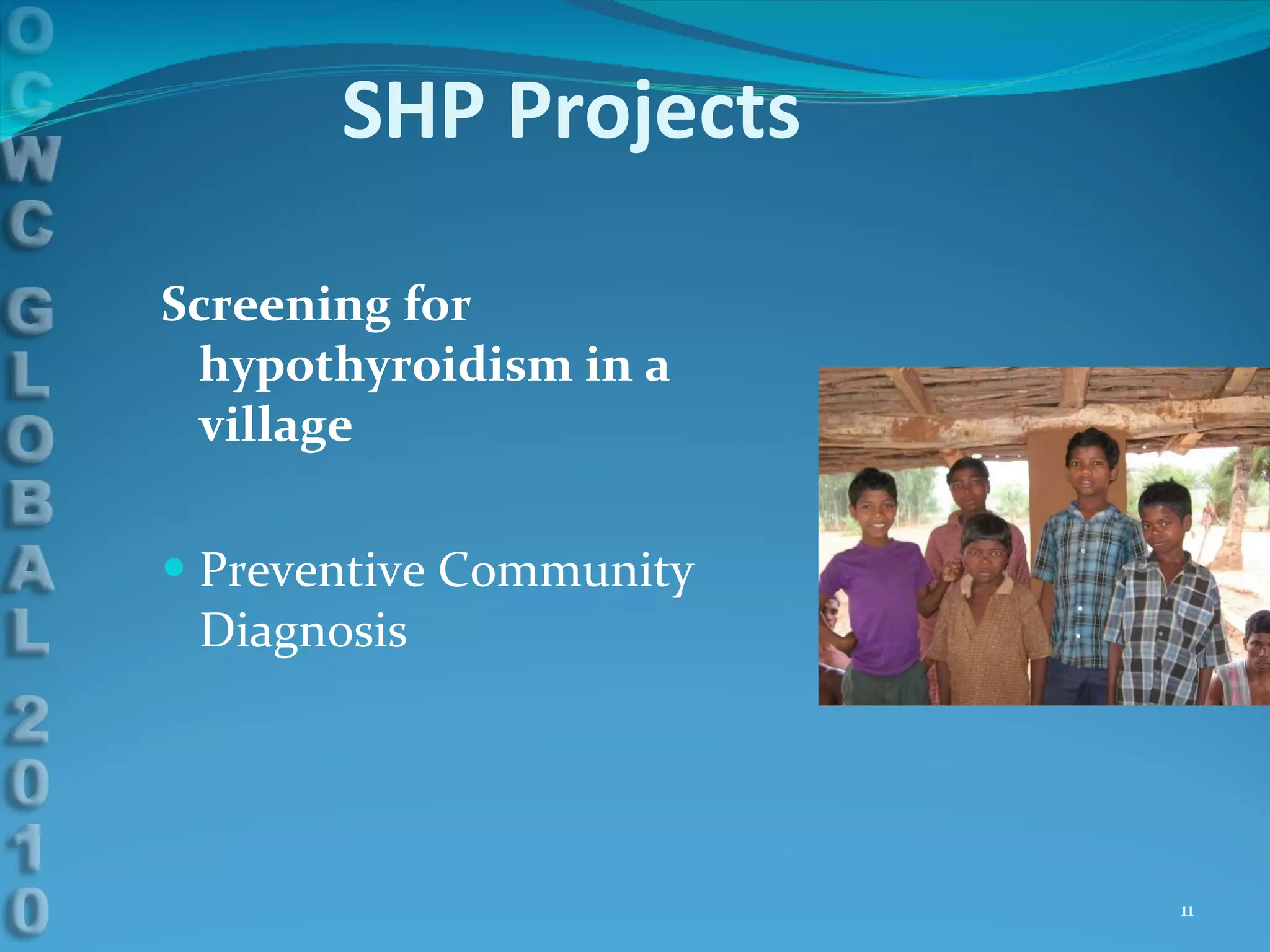
SHP Projects Screening for hypothyroidism in a village Preventive Community Diagnosis
“ What shocked me was the hard work, perseverance and commitment of the people who work hand-in-hand as one of the team.  I realized that the life and work in rural areas with the less privileged and no great facilities is ‘ no less ’ to the work done in a tertiary hospital ” Student Quote ROLE MODEL TEACHERS
Secondary hospital programme The SHP provides a  distinctive learning experience . Sensitizes  the student to  cost-effective community-based health care  in remote locations with their unique health issues Provides  role models  and  prepares  the student for rural work.
Use of Technology for SHP Announcements and timetables Student posting of videos/photo journey of their visit Feedback
Difficulties graduates face in service obligation Transition problems  from tertiary  to secondary care - Broad based skills - Undifferentiated illness - Limited lab and specialty support - Cost-effective medicine Lack of academic learning Social isolation Administrative problems
Integrated PG Diploma in Family Medicine Distance course to support post-MBBS doctors working in rural hospitals
Integrated Postgraduate diploma in Family Medicine  Objectives Knowledge and skills in managing common problems at a secondary level Function well as a team member Addressing a local health issue through project work Social and academic support
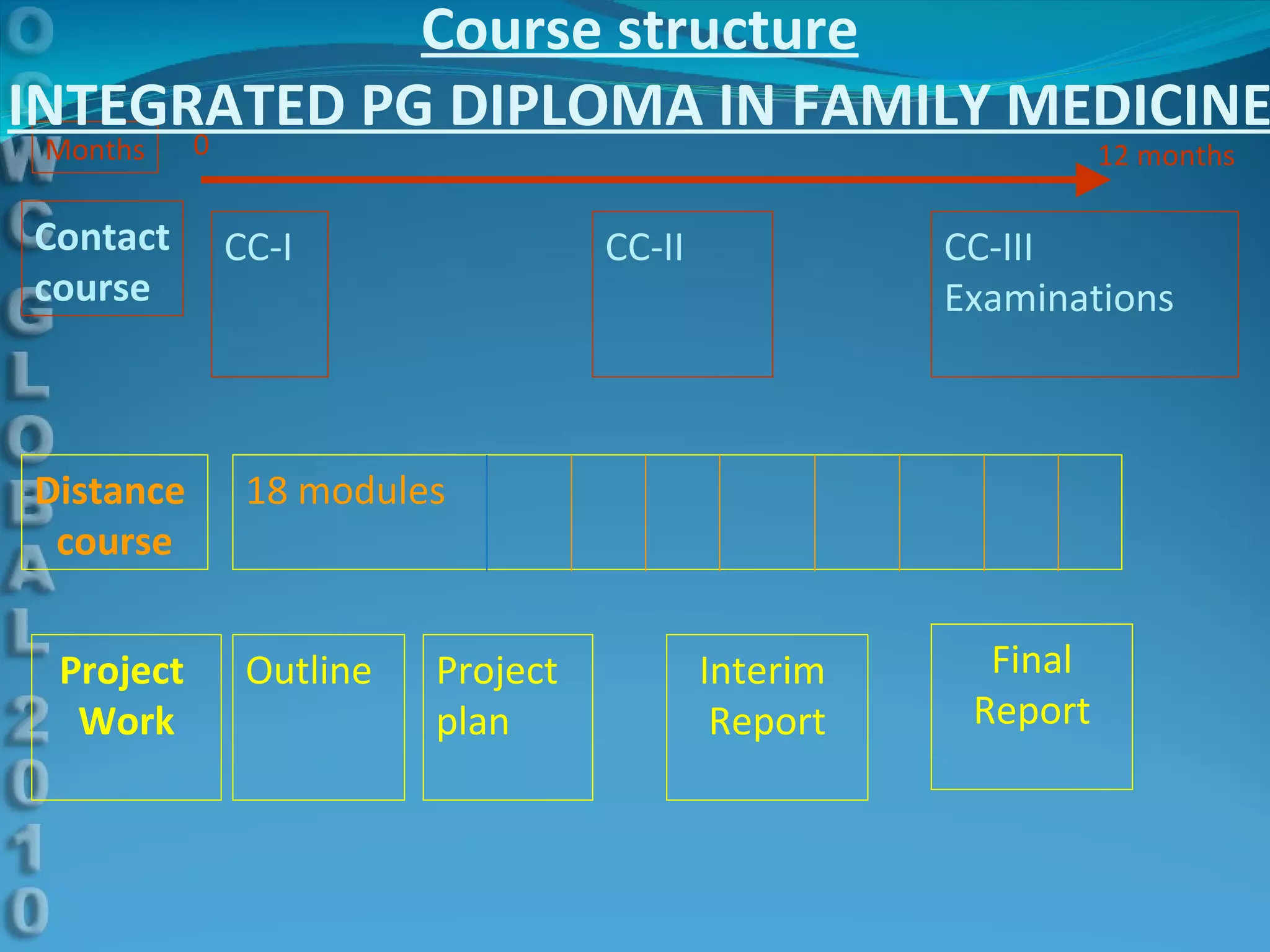
12 months 0 Months CC-I CC-II Contact course Distance  course 18 modules Project  Work Outline Project plan Interim  Report Course structure INTEGRATED PG DIPLOMA IN FAMILY MEDICINE CC-III Examinations Final Report
 
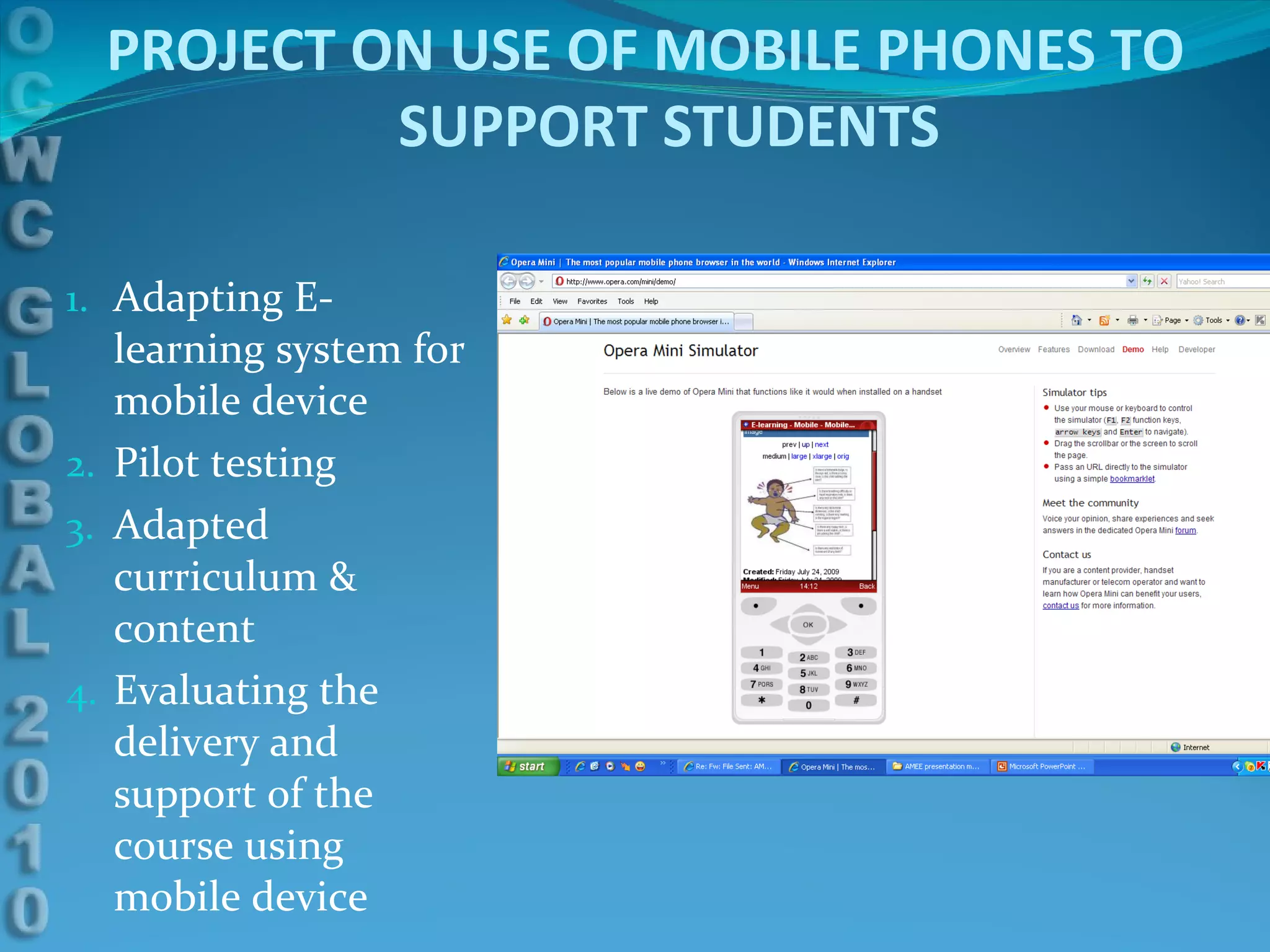
Adapting E-learning system for mobile device Pilot testing Adapted curriculum & content Evaluating the delivery and support of the course using mobile device PROJECT ON USE OF MOBILE PHONES TO SUPPORT STUDENTS
E-Learning with Mission  Hospitals so far The Evolution Methodology Intial introduction to E-Learning Needs Assessment Infrastructure Support Project development Workshop
Evolution of CMC –Mission Hospitals E-Learning Linkage Informal Voluntary visit by CMC Faculty Visiting faculty from Mission Hospitals for Skills upgradation Oberverships  by Medical Students  Formal Obligation after  Graduate & Post  Graduate Training Obligatory two weeks service for faculty  Structured  Program SHP FSHM
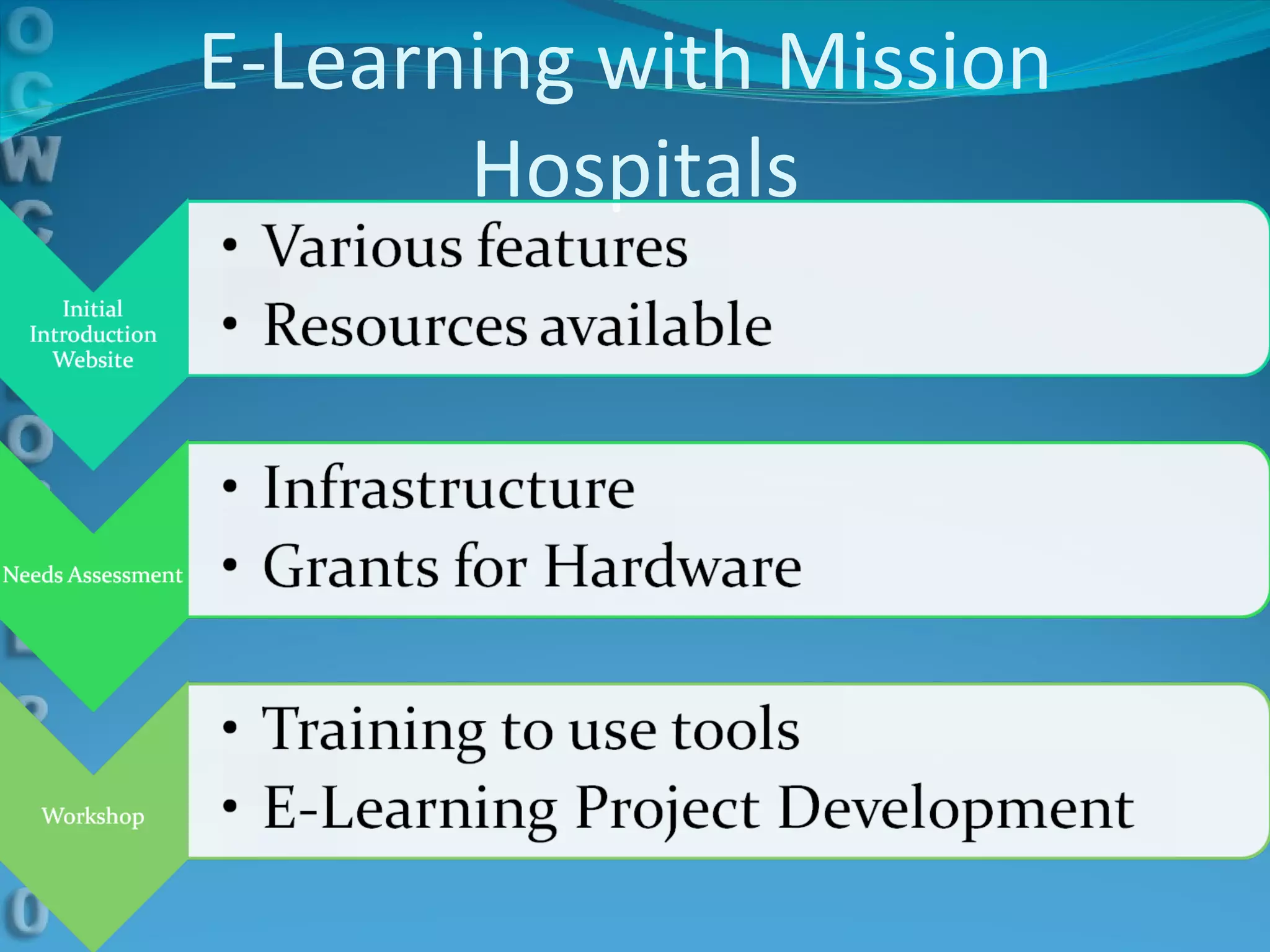
E-Learning with Mission  Hospitals
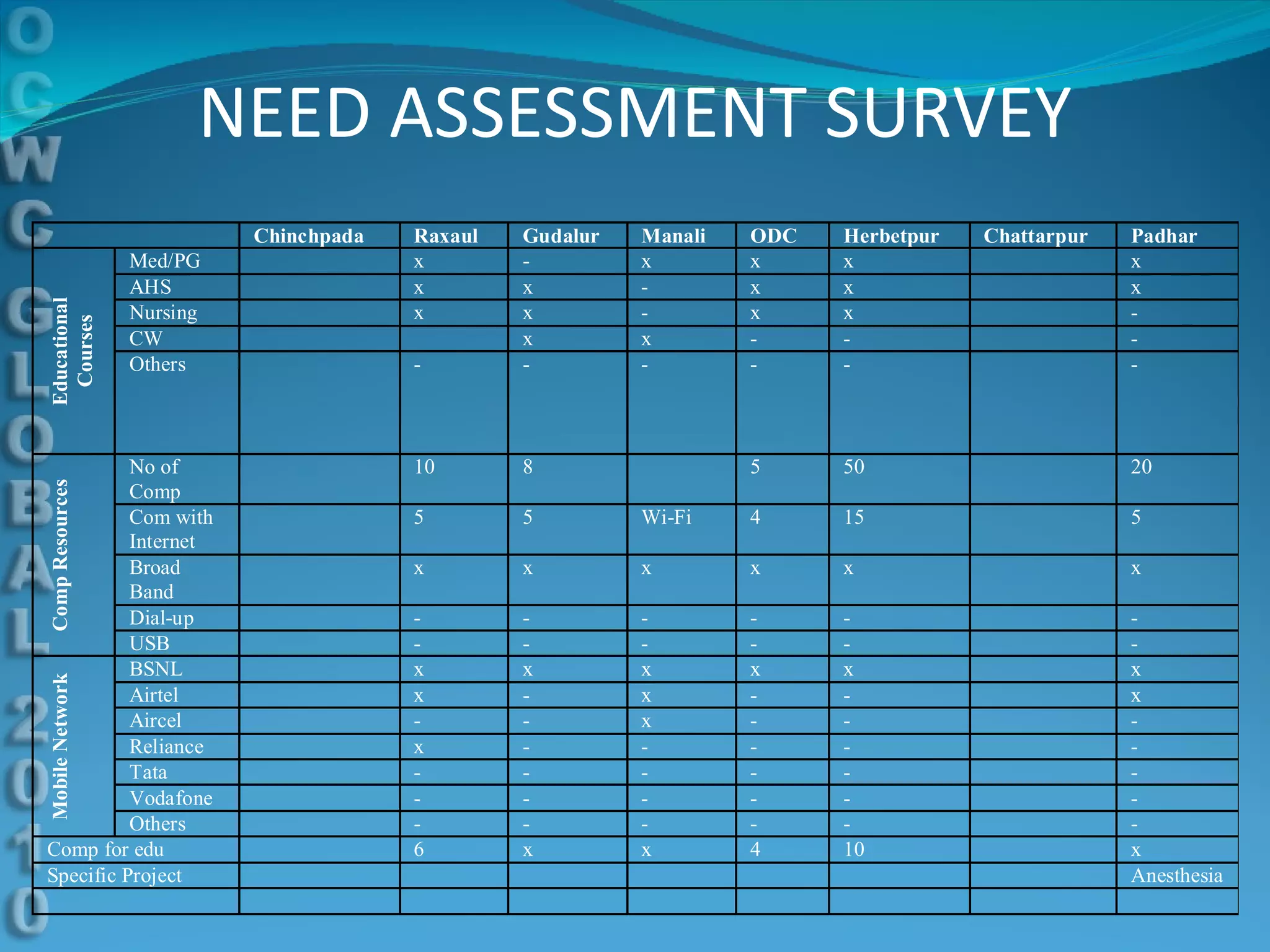
NEED ASSESSMENT SURVEY
Results of Need Assessment Almost all the hospital have  a medical education programme running or in the process of starting Everyone had  sufficient hardware available with internet facility Everyone had broad band connectivity
Results of Need Assessment Everyone have  cellular / internet connectivity Everyone has a  computer available  for educational purpose. All of them are  keen to access  E-learning website Most of them are  keen to initiate  E-learning projects
IMPLICATIONS FOR ACTION Feasible to provide E-learning website access Need to identify potential partners and initiate project Need more communication and feedback if we need to start a definite project
INFRASTRUCTURE SUPPORT Grant  to acquire hardware to  establish E-Learning  at the secondary hospital
 
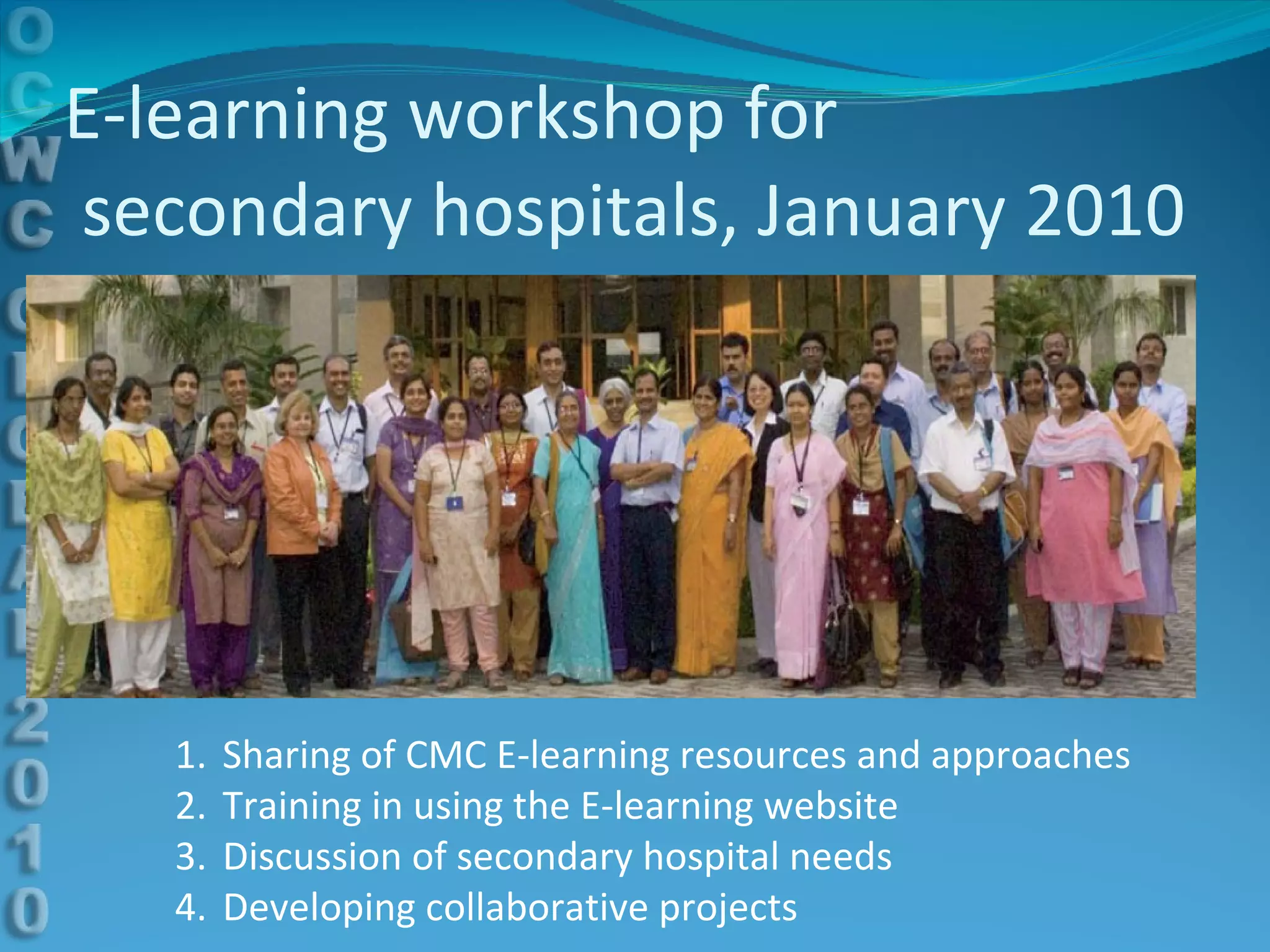
E-learning workshop for  secondary hospitals, January 2010 Sharing of CMC E-learning resources and approaches Training in using the E-learning website Discussion of secondary hospital needs Developing collaborative projects
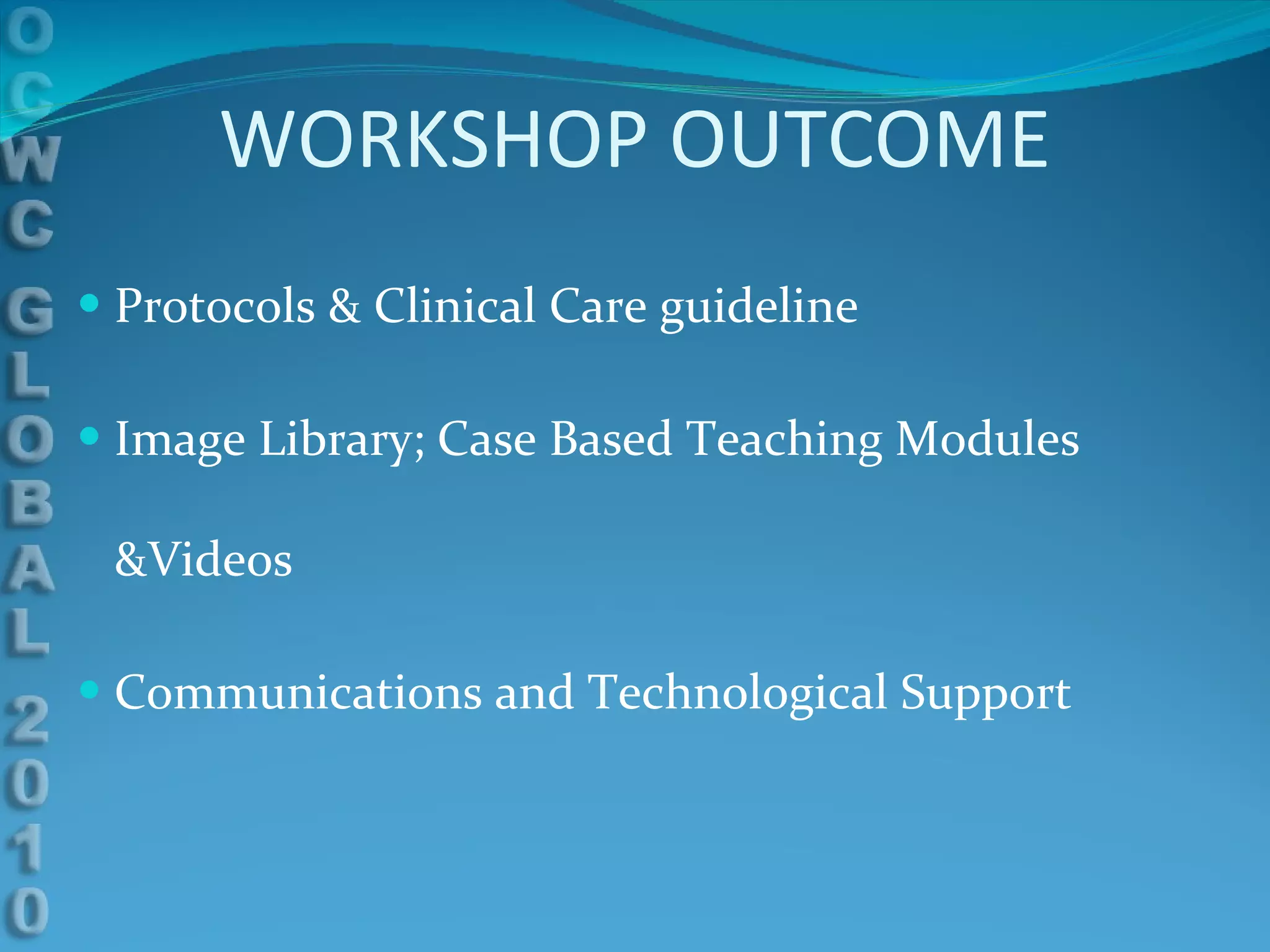
WORKSHOP OUTCOME Protocols & Clinical Care guideline Image Library; Case Based Teaching Modules &Videos Communications and Technological Support
 
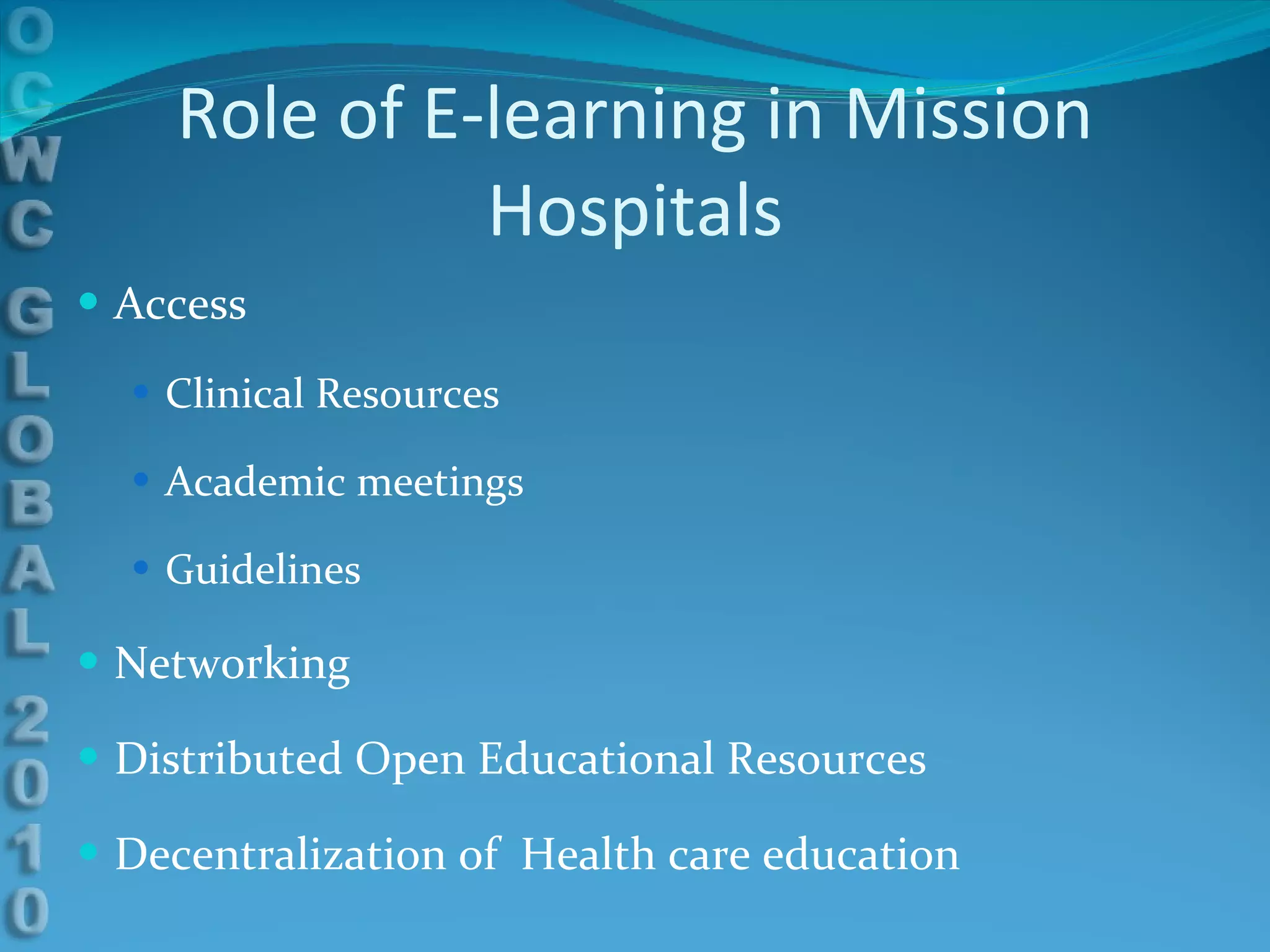
Role of E-learning in Mission Hospitals Access Clinical Resources Academic meetings Guidelines Networking Distributed Open Educational Resources Decentralization of  Health care education
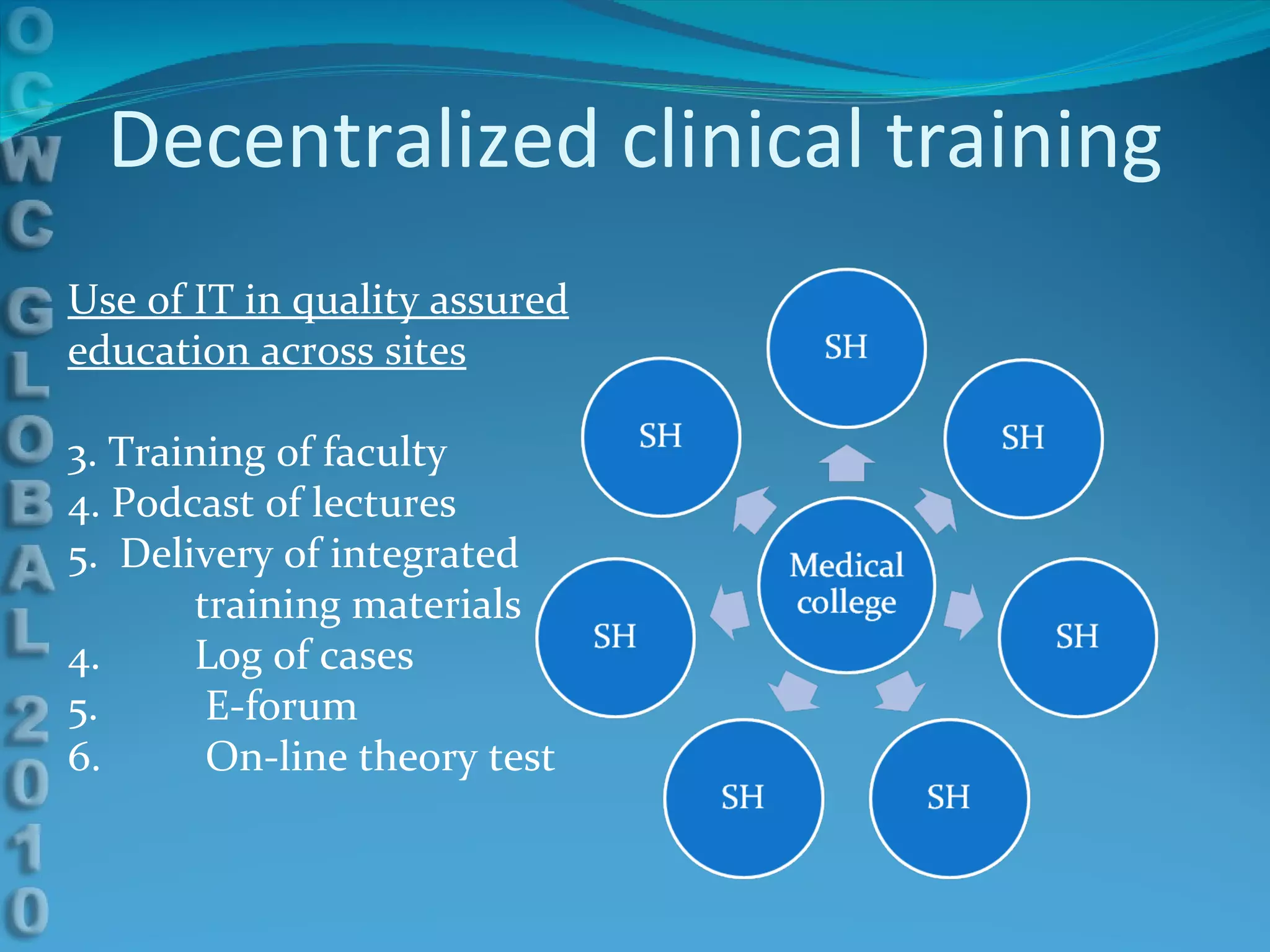
Decentralized clinical training Use of IT in quality assured education across sites Training of faculty  Podcast of lectures Delivery of integrated training materials 4.  Log of cases 5.   E-forum 6.   On-line theory test
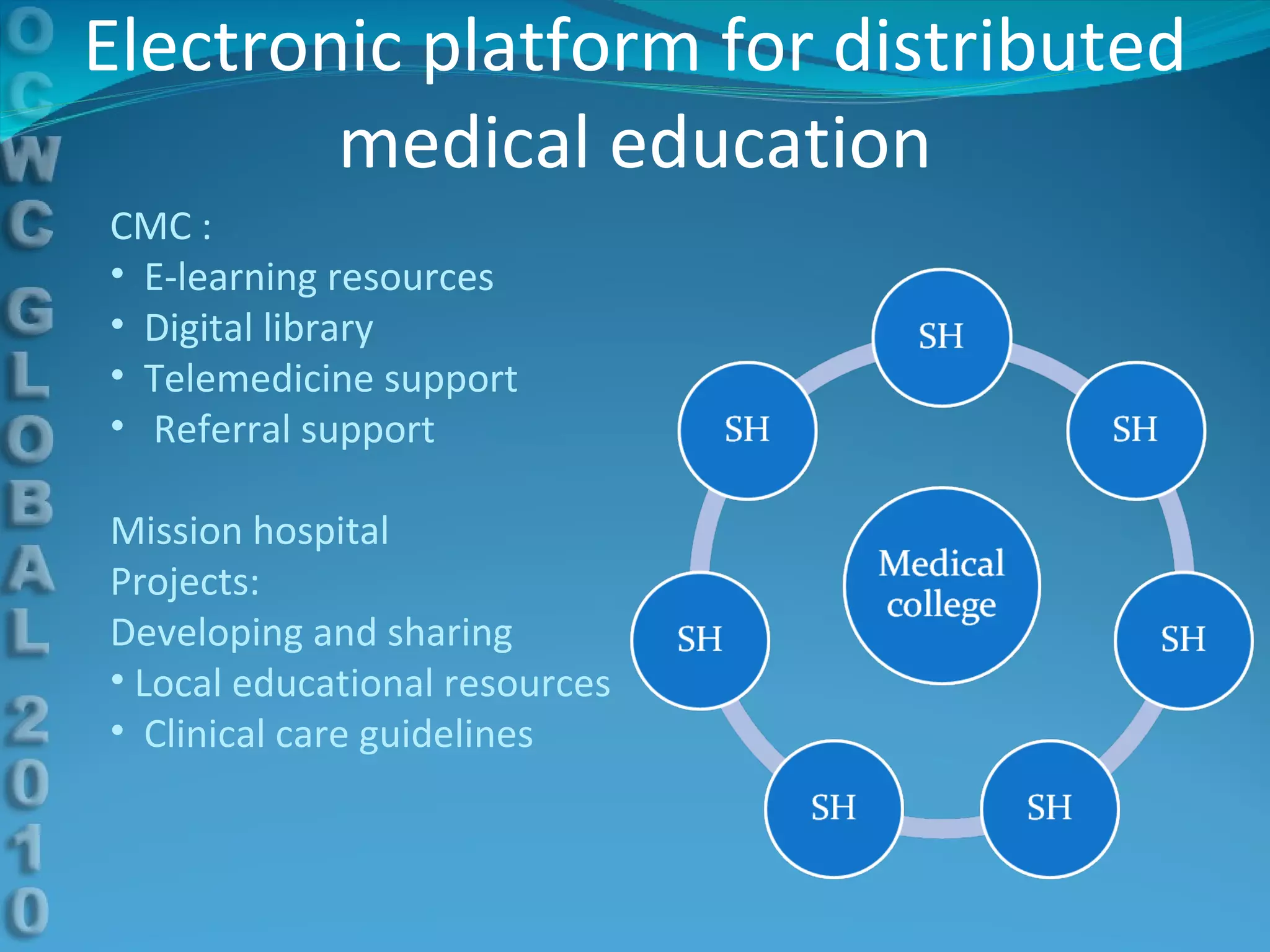
Electronic platform for distributed medical education CMC : E-learning resources Digital library Telemedicine support Referral support Mission hospital Projects: Developing and sharing Local educational resources Clinical care guidelines
FUTURE
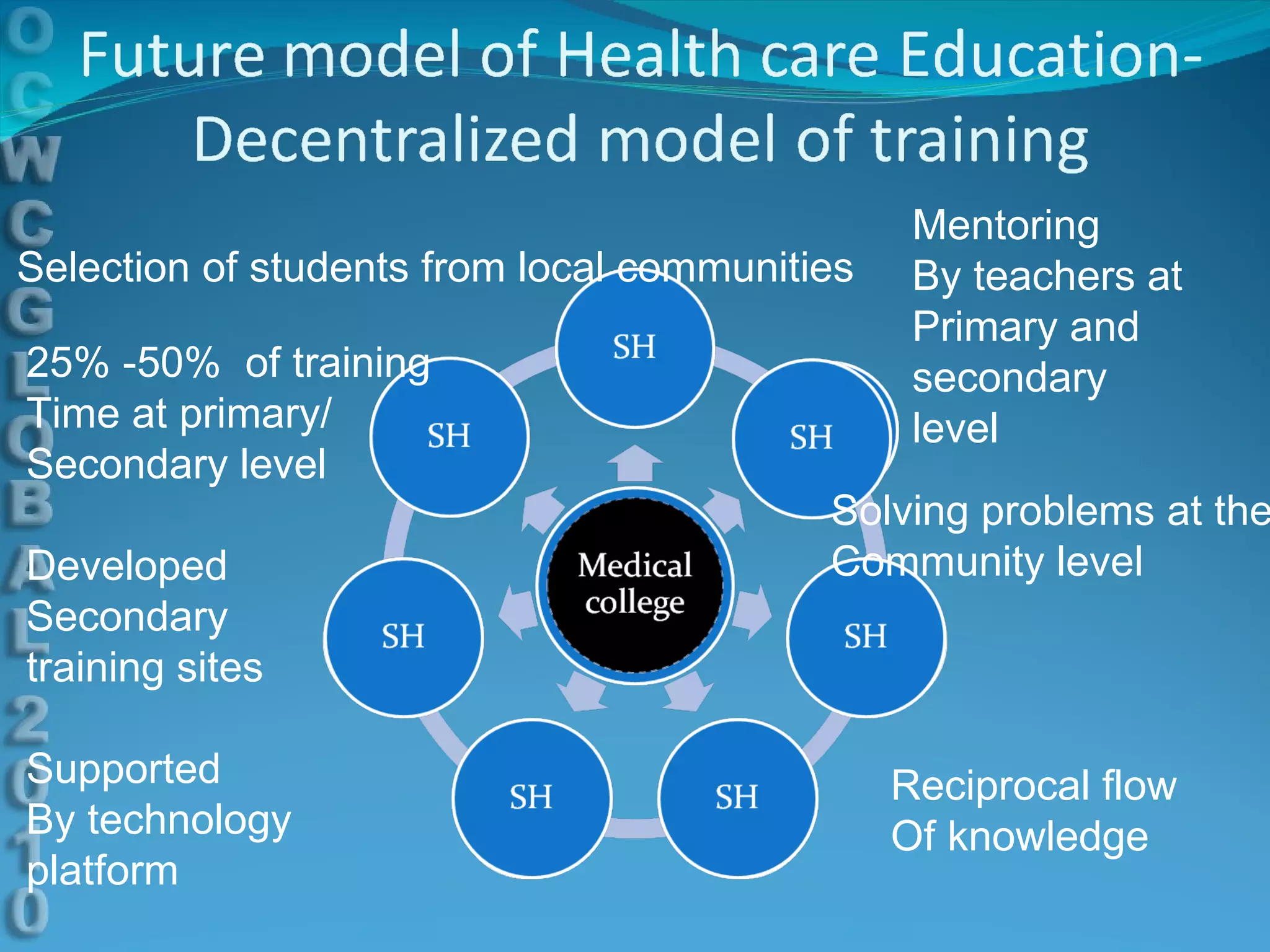
Selection of students from local communities 25% -50%  of training Time at primary/ Secondary level Developed  Secondary training sites Supported By technology  platform Mentoring  By teachers at  Primary and secondary level Solving problems at the  Community level Reciprocal flow Of knowledge
Integrating High School Education To provide complimentary educational resources to children of health care workers in remote areas of need This will improve the educational standards of the children in rural areas and they can potentially  go on to become the next generation of health care professionals.
THANK YOU FOR YOUR KIND ATTENTION THANK YOU FOR YOUR  KIND ATTENTION [email_address]

Using OER for Health Care Education

  • 1.
  • 2.
    Tertiary care hospitalSpecialist orientation Lack of basic skills to handle common health problems Doctor at Primary/secondary level Specialists Urban hospitals Migrate abroad Medical College Knowledge to practice Access to information Referral support Involvement in teaching & learning Bridging the academic distance
  • 3.
    OVERVIEW Back groundof CMC Mission Hospitals Linkage E-Learning with Mission Hospitals so far How E-Learning can be useful for Mission Hospitals Integrating Primary/Secondary Education – An IDEA !
  • 4.
    Vellore INDIA 200secondary hospitals 20-200 bed hospitals Rural and semi-urban areas of India Broad based Services 2 years of service obligation after graduation BACK GROUND OF CMC – MISSION HOSPITALS LINKAGE
  • 5.
    Jan Swasthya Sahyog,Bilaspur AIIMS and CMC doctors – community health project Chhattisgarh Pregnant woman Transported across a stream Black water fever Burns contracture Sickle cell crises Krait bite with paralysis
  • 6.
    RESPONSE TO THESECHALLENGES Secondary Hospital Program (SHP) Fellowship In Secondary Hospital Medicine ( FSHM)
  • 7.
    Objectives Secondaryhospital programme To learn The management of common health problems Study a local health issue through project work The functioning of a secondary hospital Develop a positive attitude towards care in rural locations.
  • 8.
  • 9.
    “ Assam itself was a memory to savor , the ubiquitous bamboo, the all-to-real possibility of being shot despite having a military escort, travelling on top a vehicle rather than inside one, bathing in open air , forgetting the intrusions of cell phones and the internet , and the gracious hospitality of villagers who opened their home to us strangers. .” Student Quote
  • 10.
    Clinical work MedicalWard OPD Labor Room Operation Theatre
  • 11.
    SHP Projects Screeningfor hypothyroidism in a village Preventive Community Diagnosis
  • 12.
    “ What shockedme was the hard work, perseverance and commitment of the people who work hand-in-hand as one of the team. I realized that the life and work in rural areas with the less privileged and no great facilities is ‘ no less ’ to the work done in a tertiary hospital ” Student Quote ROLE MODEL TEACHERS
  • 13.
    Secondary hospital programmeThe SHP provides a distinctive learning experience . Sensitizes the student to cost-effective community-based health care in remote locations with their unique health issues Provides role models and prepares the student for rural work.
  • 14.
    Use of Technologyfor SHP Announcements and timetables Student posting of videos/photo journey of their visit Feedback
  • 15.
    Difficulties graduates facein service obligation Transition problems from tertiary to secondary care - Broad based skills - Undifferentiated illness - Limited lab and specialty support - Cost-effective medicine Lack of academic learning Social isolation Administrative problems
  • 16.
    Integrated PG Diplomain Family Medicine Distance course to support post-MBBS doctors working in rural hospitals
  • 17.
    Integrated Postgraduate diplomain Family Medicine Objectives Knowledge and skills in managing common problems at a secondary level Function well as a team member Addressing a local health issue through project work Social and academic support
  • 18.
    12 months 0Months CC-I CC-II Contact course Distance course 18 modules Project Work Outline Project plan Interim Report Course structure INTEGRATED PG DIPLOMA IN FAMILY MEDICINE CC-III Examinations Final Report
  • 19.
  • 20.
    Adapting E-learning systemfor mobile device Pilot testing Adapted curriculum & content Evaluating the delivery and support of the course using mobile device PROJECT ON USE OF MOBILE PHONES TO SUPPORT STUDENTS
  • 21.
    E-Learning with Mission Hospitals so far The Evolution Methodology Intial introduction to E-Learning Needs Assessment Infrastructure Support Project development Workshop
  • 22.
    Evolution of CMC–Mission Hospitals E-Learning Linkage Informal Voluntary visit by CMC Faculty Visiting faculty from Mission Hospitals for Skills upgradation Oberverships by Medical Students Formal Obligation after Graduate & Post Graduate Training Obligatory two weeks service for faculty Structured Program SHP FSHM
  • 23.
  • 24.
  • 25.
    Results of NeedAssessment Almost all the hospital have a medical education programme running or in the process of starting Everyone had sufficient hardware available with internet facility Everyone had broad band connectivity
  • 26.
    Results of NeedAssessment Everyone have cellular / internet connectivity Everyone has a computer available for educational purpose. All of them are keen to access E-learning website Most of them are keen to initiate E-learning projects
  • 27.
    IMPLICATIONS FOR ACTIONFeasible to provide E-learning website access Need to identify potential partners and initiate project Need more communication and feedback if we need to start a definite project
  • 28.
    INFRASTRUCTURE SUPPORT Grant to acquire hardware to establish E-Learning at the secondary hospital
  • 29.
  • 30.
    E-learning workshop for secondary hospitals, January 2010 Sharing of CMC E-learning resources and approaches Training in using the E-learning website Discussion of secondary hospital needs Developing collaborative projects
  • 31.
    WORKSHOP OUTCOME Protocols& Clinical Care guideline Image Library; Case Based Teaching Modules &Videos Communications and Technological Support
  • 32.
  • 33.
    Role of E-learningin Mission Hospitals Access Clinical Resources Academic meetings Guidelines Networking Distributed Open Educational Resources Decentralization of Health care education
  • 34.
    Decentralized clinical trainingUse of IT in quality assured education across sites Training of faculty Podcast of lectures Delivery of integrated training materials 4. Log of cases 5. E-forum 6. On-line theory test
  • 35.
    Electronic platform fordistributed medical education CMC : E-learning resources Digital library Telemedicine support Referral support Mission hospital Projects: Developing and sharing Local educational resources Clinical care guidelines
  • 36.
  • 37.
    Selection of studentsfrom local communities 25% -50% of training Time at primary/ Secondary level Developed Secondary training sites Supported By technology platform Mentoring By teachers at Primary and secondary level Solving problems at the Community level Reciprocal flow Of knowledge
  • 38.
    Integrating High SchoolEducation To provide complimentary educational resources to children of health care workers in remote areas of need This will improve the educational standards of the children in rural areas and they can potentially go on to become the next generation of health care professionals.
  • 39.
    THANK YOU FORYOUR KIND ATTENTION THANK YOU FOR YOUR KIND ATTENTION [email_address]

Editor's Notes

  • #2 A very Good Afternoon to all of you .I wish to thank the organizers for giving this wonderful opportunity to come to Hanoi and present this workshop. Dr.Mary has already made a detailed presentation about the E-Learning system at TUFTS and how the partnership began between TUFTS and CMC. And Dr Anand has described how E-Learning has got integrated in the medical education at CMC Vellore.
  • #3 This will ultimately lead to a major paradigm shift in medical education Today most of medical education occurs in the tertiary care, by specialist doctors with high technology. Students are not competent to practice by the time they finish their training. They have lack of exposure to primary care. Therefore they prefer to pursue a career in urban settings or migrate abroad. How can we shift training from the tertiary care level to primary and secondary level. In the shifting of training we have to ensure the quality and adequacy of the exposure. We have to ensure that there are sufficient resources in manpower, infrastructure and technology to make this possible. Doctors working in rural setting face different problems. Practical problems and lack academic information. There is the need for appropriate knowledge for daily practice of common problems. There is also requirements for specialist knowledge for episodic and complex problems and referral support. Information has to be made available at the time of need. Can the reverse flow of knowledge from the primary and secondary level lead to a reorientation of tertiary care training and better mutual understanding of the roles of primary/secondary and tertiary care. Technology is one of the ways to strengthen /being able to do this-enable free flow of information both ways
  • #4 Over the next 30 minutes I would like to present 1.Back ground of CMC Mission Hospitals Linkage 2.E-Learning with Mission Hospitals so far 3.How E-Learning can be useful for Mission Hospitals 4.Integrating Primary/Secondary Education – An IDEA
  • #6 This is the setting of work in rural India- acute health care need, multi-competence, care linked to the community. We are not able to get sufficient doctors and other health professionals to do similar work. How do we use technology to expose and challenge students to such work. What continuing educational supports are necessary to support such work.
  • #8 The objectives of the program are for the student to learn - The approach and management to common health problems as managed in a secondary hospital - To study in-depth a local health issue through project work - The understand the functioning of a SH And probably the most important of this program – to develop a positive attitude towards care in rural locations
  • #9 SHP is divided into 3 phases and I will describe each phase.
  • #10 Education begins the minute the students leave for the secondary hospital - be it travelling on top of a vehicle rather than inside one, bathing in the open air, or forgetting the intrusions of cell phones and the internet. Often their journey takes them up to 2 days to reach their destination
  • #11 The students participate in the work of the hospital and have novel experiences – be it in a spartan general medical ward or an overflowing outpatient department or emergency room.
  • #12 I would like to give you an example of a project that was done by a group in Orissa. This young boy, he is actually 17years old, had presented to the OPD where he was diagnosed to have childhood hypothyroidism. The students subsequently screened the village for childhood hypothyroidism through a door-to-door survey and were able to identify 3 new cases. Though the study was simple the students were able understand the concept of preventive community diagnosis and that even a medical student, can make a big difference through simple interventions Other projects done ranged from assessing expenditure patterns of patients in secondary hospitals to assessing community awareness about HIV.
  • #13 The program gives a unique opportunity for the students to interact with and be challenged by role model teachers - the secondary hospital faculty. As a student commented “I realized that the life and work in rural areas with the less privileged and no great facilities is ‘ no less ’ to the work done in a tertiary hospital”
  • #14 The SHP provides a distinctive learning experience. It sensitizes the student to cost effective community-based health care with its unique health issues, provides role models and prepares the student for rural work. The SHP may serve as a replicable teaching model for orienting medical students to the challenges of medical practice in rural and underserved areas. Feedback from students of FSHM
  • #15 At the moment we are using E-learning in a minimal way for the SHP. We would like your suggestions and ideas of how to maximise the use technology to make use of this huge learning resource at the community level. We feel that this a potential for sharing and collaboration with other disciplines.
  • #21 We seek active collaboration as we develop the mobile project both on technology side as well as the education side.
  • #24 As E-Learning started getting integrated in the medical education at CMC the faculty and students showed remarkable adaptability and acceptance to this method of education. Some of the Mission hospitals are already involved in health care training and education programmes. Very often they express lack of teaching resources and teaching faculty as a major hindrance to their education program. Over the years exchange of health care resources and professionals has been established in various capacity. But often after initial efforts they were not sustainable because of inability of physical presence of an academic faculty in the remote areas and inequity in the availability of uptodate medical literature. With the success of e-Learning at the cademic center we felt it will be appropriate to make the resources available to these hospitals.
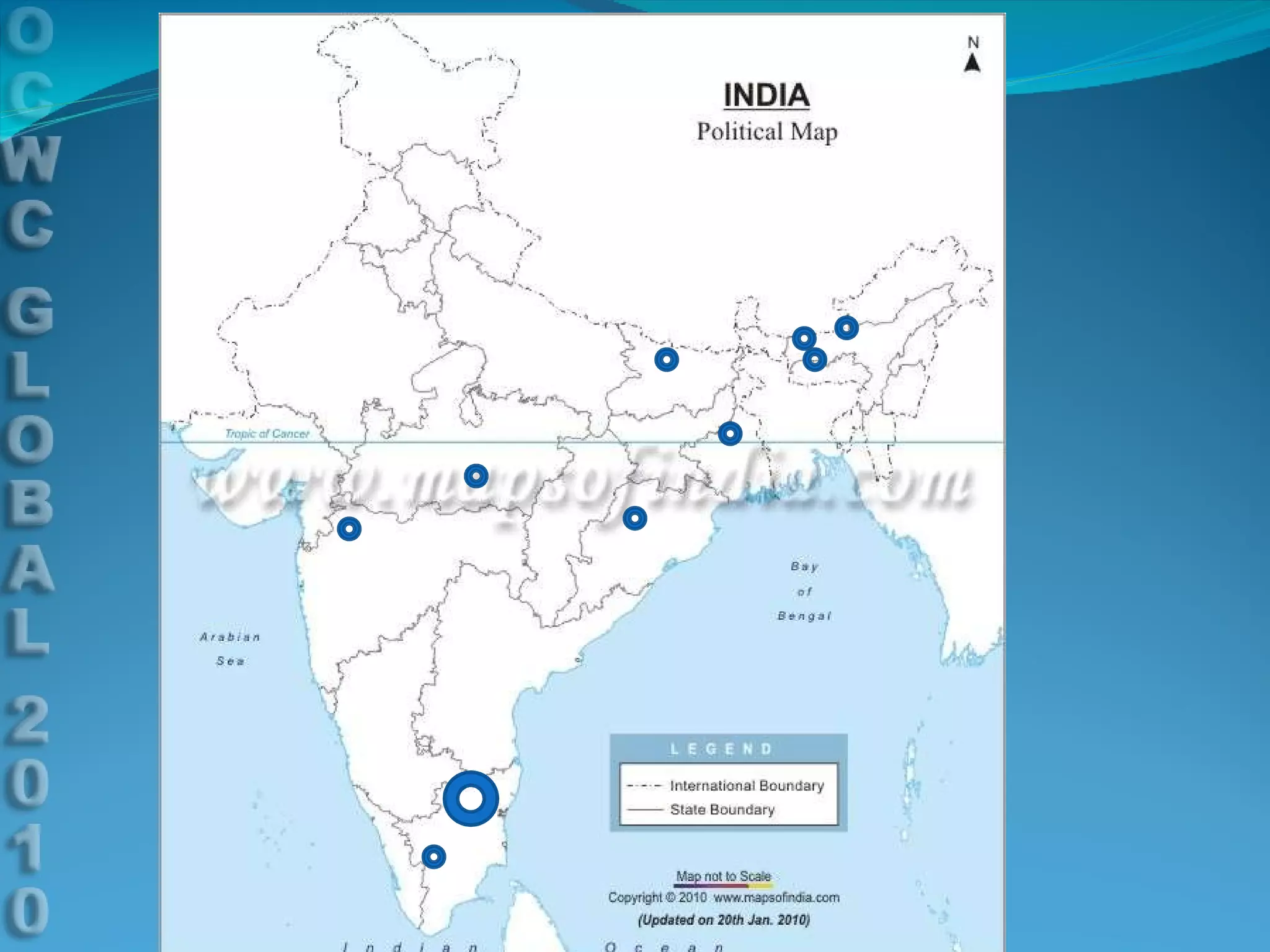
  • #30 Here we see the large circle represents the location of CMC Vellore which is in the Southern state and the smaller circles represent the secondary mission hospitals which are involved in education and form the initial cohort of the CMC – Mission hospital E-Learning initiative
  • #32 At the end of the workshop the participants were asked how they would like to proceed regarding content development and they all came up with various suggestions and after reaching a consensus three task groups were formed to take the responsibility of content development. These groups were
  • #35 The SHP postings are short. As we decentralise clinical training for longer periods of time, there is more potential to use information technology. Experiences from other fields of education would be useful to us to ensure adequacy of learning across sites.
  • #36 This is the stage we are at in developing an electronic platform. We started off with the idea of a hub and spokes model. However we are moving to a more collaborative model with mutual sharing and two way flow of information. The secondary hospitals are picking up the projects in their own way adapting knowledge for their local contexts. IN the process knowledge is changing itself, the secondary hospital as a location is changing. Reverse flow of information is taking place in tertiary which is changing the environment of teaching and learning. This is the stage we are at. This is the stage we are at and there is obvious potential. How do we see this project progressing. What can contribute to this enterprise. Conceptual guidance. Can you take these concept and develop them in your own situation.
  • #39 It has been noted that individuals coming from remote areas are the ones who are more likely to have long term commitment to serve in remote areas. It is not only going to address the current need but also enable to create a potential human resource which is more likely to remain and sustain such health care facilities in remote areas.