



CARE IN HOSPITAL SETTINGS
BY: SHALINI SOOD
M.Sc (Medical Surgical)
INDEX
SR . NO CONTENT
1 HOSPITAL
• Introduction
• Definition
• Characteristics
• Practices in hospital
• Interdisciplinary team of hospital
• Types of hospital
• Functions of hospital
• Advantages of hospital
• 2 AMBULATORY CARE
• Definition
• Classification
• Purposes
• Ambulatory care in nursing
• Ambulatory care Setting sites
• Roles of nurse
• 3 ACUTE HEALTH CARE
• Definition
• Departments
• Areas where AHC is done
• Role of nurse
INDEX
SR NO. CONTENTS
4. CRITICAL HEALTH CARE
• Definition
• Occupational hazards
• Role of nurse
5. LONG TERM CARE
• Definition
• Types
• Role of nurse
6. HOME HEALTH CARE
• Definition
• HHNA
• Mission
INDEX
SR. NO CONTENTS
7. CARE IN HOSPITAL SETTINGS
• Introduction
• Staffing Pattern
• Bed strength
• Areas of the hospital
• Practices
8. STRESS
• Introduction
• Definition
• Types of stress
• Relationship between stress and disease
INDEX
SR NO. CONTENTS
9.
10.
11.
12.
NURSING CARE USING NURSING PROCESS APPROACH
• Introduction
• Nursing process
• Nursing process approach
• SUMMERIZATION
• RECAPTUALIZATION
• REFERENCES
INTRODUCTION
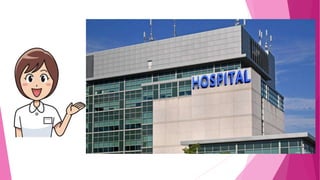
HOSPITAL
 The word hospital “ derived from the latin word ‘hospitalalis’ which in turn
derived from French word ‘hospes’ that means “ a host or a guest” .
 A hospital is a health care institution providing treatment to patients with
specialized staff and equipment .
 Hospitals are institutions , which are mainly designed for care for the sick ,
injured and well .
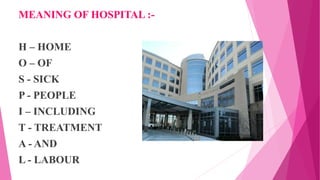
MEANING OF HOSPITAL :-
H – HOME
O – OF
S - SICK
P - PEOPLE
I – INCLUDING
T - TREATMENT
A - AND
L - LABOUR
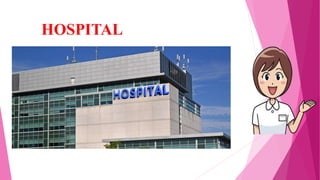
HOSPITAL
DEFINITION OF HOSPITAL :-
According to WHO -
A hospital is a residential establishment
which provides short term and long term
medical care consisting of observational
,diagnostic , therapeutic , and rehabilitative
services for persons suffering from a disease
or injury.
CHARACTERSTICS OF HOSPITAL
1. ALWAYS PUT PATIENT FIRST :
Its one thing to say you put patients first .
Its completely different to actually establish that mantra
into every department and interaction .
Every employee , have a clinical or patient – facing role
, has a patient – centered mind set and ‘patients come
first’ is embedded in their DNA .
CHARACTERSTICS OF HOSPITAL :-
2. DELIVER COMPASSIONATE CARE :-
Patient enter through hospital doors at the most vulnerable
time in their lives.
The best hospital deeply understands that empathy is a
critical component of delivering patients care .
They treat patients and their family members very politely .
CHARACTERSTICS OF HOSPITAL
3. COMMIT TO EXCELLENCE :-
It speaks to a systematic , purposeful commitment to
excellence .
It means their staff is dedicated to reviewing and measuring
everything they do on a routine basis and use new
technologies to do it even better .
CHARACTERSTICS OF HOSPITAL
4. FOSTER A CULTURE OF INNOVATION :-
It means continuing to improve communication and collaboration
among care teams by building on the platform they have in place .
Innovation is all about finding new ways to make care better .
PRACTICES
IN
HOSPITAL
PRACTICES IN HOSPITAL
1. Giving Care to Needy People :-
The first practice which is done in hospital is
providing care to needy peoples .
Its our duty to provide immediate care to the patients
so that effective results can be there .
PRACTICES IN HOSPITAL :-
2. Make programs interactive.
Group work, quizzes and other activities can help make training
programs less lecture-based and more interactive — something
that not only helps employees retain information but also
makes the training more enjoyable for them.
PRACTICES IN HOSPITAL :-
3. Ensure training reflects changing skills.
Hospital training programs have always covered issues such
as compliance and clinical competency, but increasingly
hospitals are developing programs around newly sought-
after skills, such as customer service and patient-centered
care.
PRACTICES IN HOSPITAL :-
4. Consider employee demands beyond
training.
Employees at hospitals have multiple responsibilities, and
training should be designed so that it can be completed
without taking away from those responsibilities.
PRACTICES IN HOSPITAL :-
5. Evaluate the effectiveness of training
programs.
Finally, hospitals should always assess the effectiveness of
their training programs through surveys and testing of skills.
After all, a training program that doesn't effectively improve
some skill or competency is a waste of health system
resources and employees' time.
PRACTICES IN HOSPITAL :-
6. Create training programs for different
learning styles
Training programs should include material that appeals to
various learning styles: verbal, visual, hands-on, etc.
"You have to be willing to use a variety of different
teaching methods,"
INTERDISCIPLINARY
TEAM
OF
HOSPITAL
INTERDISPLINARY TEAM OF
HOSPITAL
INTRODUCTION :-
Interdisplinary team work is complex process in which different
types of health care professionals work together to
 Share experience ,
 Knowledge and
 Skills ,
To see the impact on patient health care .
DEFINITION OF INTERDISCIPLINARY
TEAM:-
 Interdisciplinary team is a group of health care
professionals from diverse fields who work in a coordinated
fashion toward a common goal for the patient.
 Interdisciplinary team is a team of professionals who are all
from the same profession, such as physical therapists
collaborating on the same case.
DEFINITION OF INTERDISCIPLINARY
TEAM :-
 A dynamic process involving two or more health
professionals with complementary backgrounds , skills ,
sharing common health goals and exercising concerted
physical and mental efforts in assessing , planning or
evaluating patient care .
MEMBERS OF INTERDISCIPLINARY
TEAM :-
 Physician
 Nurse
 Midwifes
 Dietician
 Pharmacist
 Social worker
 Psychologist
 Physiotherapist
 Occupational therapist
TYPES
OF
HOSPITAL
TYPES OF HOSPITAL :-
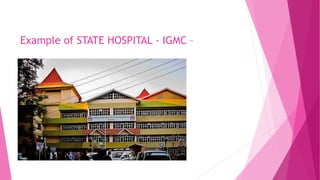
1. State hospital :-
A hospital present in a state , which provide
medical facilities and having large no. of
beds having all types of facilities . Total
bed strength – 872 in Hospital IGMC
Over the years, Indira Gandhi Medical
College is expanding itself in terms of its
infrastructure, facilities provided and care .
Example of STATE HOSPITAL - IGMC –
Types of Hospital :-
2. District or Intermediate
A district hospital typically is the major health
care facility in its region, with large numbers of
beds for intensive care, critical care, and long-term
care.
Even today, district hospitals are the sole public
hospitals
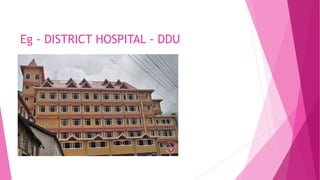
Eg – DDU (Lord Ripon)
Bed strength - 300
Eg - DISTRICT HOSPITAL - DDU
Types of Hospital
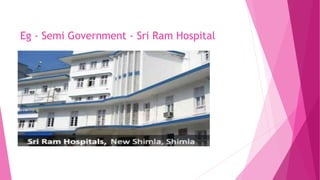
3. Semi – Government Hospital
Hospitals, run both by the government and private entity.
Eg – Sri Ram hospital in Shimla , Bed strength – 50 beds
The hospital is well equipped with all facilities and is a
well-known hospital in the city. The hospital is reputed for
its uninhibited services to the people of their city.
Eg - Semi Government - Sri Ram Hospital
Types of Hospital :-
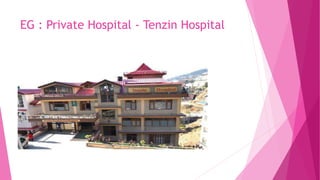
4. Private Hospital
Privately owned or controlled by an individual or group of
physician or citizens or by private organization . Total
beds in Tenzin Hospital - 100
Purpose is to provide services for profit making .
EG : Private Hospital - Tenzin Hospital
Types of Hospital :-
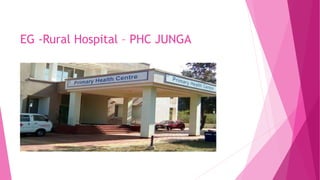
5. Rural Hospitals
Usually fitted with 100 or fewer beds, rural hospitals
are located outside large urban areas and operate on
small budgets. They generally provide basic care. If
needed, they’ll transport patients in need of more
critical care to larger hospitals in their regions.
CHC (Community Health Centre)
 Community health center is one of a network of clinics
staffed by a group of general practitioners and Nurses
providing healthcare services to people in a certain area.
Typical services covered are family practice
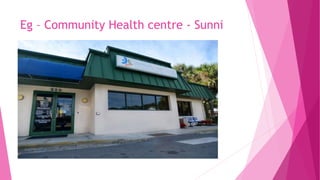
EG – CHC in Sunni is 75 bedded provides pediatric and
women care .
Eg – Community Health centre - Sunni
EG -Rural Hospital – PHC JUNGA
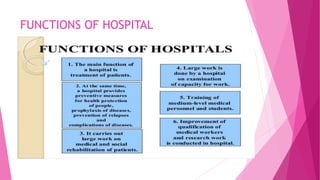
FUNCTIONS OF HOSPITAL
Advantages of Hospitalization :-
1. Can get cure from disease
2. Prevent spreading of disease
3. Promote health
4. Promote psychological support
5. Promote socialization
6. Increase chance for communication .
7. Increase chance for interpersonal relation .
TYPES
OF
CARES
IN
HOSPITAL
TYPES :-
1. Ambulatory Care
2. Acute Health Care
3. Critical Health Care
4. Home Health Care
5. Long term care
AMBULATORY CARE
1. AMBULATION
 An Ambulatory care patient is “ an individual
presenting for personal health services who is
neither bedridden nor currently admitted to any
health care institution .
By – National Ambulatory Medical Care Survey
(NAMCS)
AMBULATORY CARE
 It is a personal health care consultation , treatment or
intervention using advanced medical technology or
procedures delivered on an outpatient basis ( i.e where the
patient’s stay at the hospital or clinic , from the time of
registration to discharge .
 Ambulatory health care is provided for the patients in the
community or in hospital settings.
AMBULATION CLASSIFICATION
1. Non Functional :-
 Patient cannot ambulate , ambulates in parallel bars only
, or requires supervision or physical assistance from
more than 1 person to ambulate
2. Ambulator – dependent for physical assistance :-
 Patient requires manual contacts of not more than one
person during ambulation . Manual contacts are
continuous and necessary to support body weight .
AMBULATORY CLASSIFICATION
3. Ambulatory – dependent for physical assistance :-
 Patient requires manual contacts of not more than one
person during ambulation . Manual contacts consists of
continuous or intermittent light touch for assistance .
4. Ambulator – dependent for supervision :-
 Patient can physically ambulate on level surfaces without
manual contact with another person but for safety requires
stand by guarding .
AMBULATORY CLASSIFICATION
5. Ambulatory –Independent level :-
 Patient can ambulate independently on level surfaces
but requires supervision .
6. Ambulatory – Independent :-
 Patient can ambulate independently on non level
surfaces , stairs and inclines .
PURPOSES OF AMBULATORY CARE
1. To promote life-long health habits .
2. Promote and practice preventive medicine .
3. Treat those physical and mental illnesses that do not
require hospitalization. Provide treatment for acute
illnesses and injuries.
4. Guide patients to proper specialty care when necessary.
5. Assist in rehabilitative care or end-of-life care when
necessary.
AMBULATORY CARE IN NURSING
Ambulatory care nursing includes :-
 Clinical ,
 Management ,
 Educational ,
 Research activities
provided by registered nurse for individuals who seeks
care and assistance with health maintenance and or
health promotion .
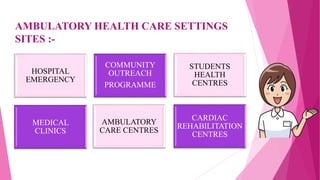
AMBULATORY HEALTH CARE SETTINGS
SITES :-
HOSPITAL
EMERGENCY
COMMUNITY
OUTREACH
PROGRAMME
STUDENTS
HEALTH
CENTRES
MEDICAL
CLINICS
AMBULATORY
CARE CENTRES
CARDIAC
REHABILITATION
CENTRES
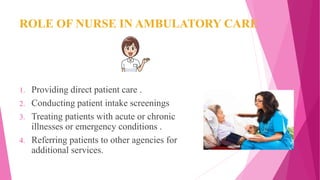
ROLE OF NURSE IN AMBULATORY CARE
1. Providing direct patient care .
2. Conducting patient intake screenings
3. Treating patients with acute or chronic
illnesses or emergency conditions .
4. Referring patients to other agencies for
additional services.
Roles in Ambulatory Care
5. Teaching patients self care activities
6. Offering health education programmes that
promote health maintenance .
7. Nurses also work as clinical managers , direct
the operation of clinics and supervise other
health team members.
8. Providing advice and emotional support to
patients family members .
ACUTE
HEALTH
CARE
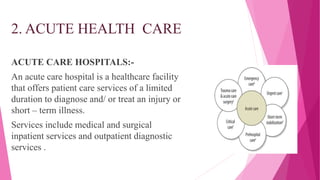
2. ACUTE HEALTH CARE
ACUTE CARE HOSPITALS:-
An acute care hospital is a healthcare facility
that offers patient care services of a limited
duration to diagnose and/ or treat an injury or
short – term illness.
Services include medical and surgical
inpatient services and outpatient diagnostic
services .
PERSONAL DEPARTMENTS OF ACUTE HEALTH CARE
PROFESSIONAL SERVICES
 MEDICAL STAFF
 PRIVATE OR GROUP PRACTICE
PHYSICIANS
 NURSING SERVICES
 PHARMACY
 PHARMACISTS AND TECHNICIANS
 REHABILITATION SERVICES
 PHYSICAL THERAPISTS
 OCCUPATIONAL THERAPISTS
SUPPORT SERVICES
 ADMINISTRATION
 BIOMEDICAL ENGINEERING
DEPARTMENT
 BUSINESS DEPARTMENTS
 DIETARY DEPARTMENT
 CENTRAL SERVICE
 LABORATORY LAUNDRY
 ENVIRONMENTAL SERVICES
 VOLUNTEER SERVICES
 MEDICAL RECORDS
AREAS WHERE ACUTE HEALTH CARE IS
DONE
 Emergency care
 Urgent care
 Trauma care
 Critical care
 Neonatal and pediatric intensive care
 Rehabilitative care
 Psychiatric acute care
 Acute care surgery
ROLE OF NURSE IN ACUTE CARE
• PROVIDER OF DIRECT CARE
• RESEARCHER • EDUCATOR • MANAGER
3 . CRITICAL CARE
 Critically ill patients are defined as those
patients who are at high risk for life –
threatening health problems .
 Critical care is a term used to describe “ the
care of patients who are extremely ill and
whose clinical condition is unstable or
potentially unstable’’
 Critical care nursing is the field of nursing
with a focused care of the critically ill or
unstable patients .
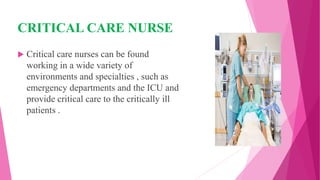
CRITICAL CARE NURSE
 Critical care nurses can be found
working in a wide variety of
environments and specialties , such as
emergency departments and the ICU and
provide critical care to the critically ill
patients .
OCCUPATIONAL HARAZDS IN
CRITICAL CARE
It includes :-
 INFECTIOUS HAZARDS
 HIV Exposure
 Viral Hepatitis Exposure
OCCUPATIONAL HAZARDS IN CRITICAL
CARE
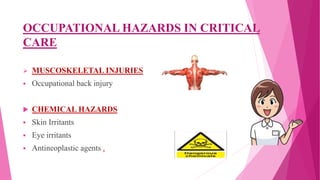
 MUSCOSKELETAL INJURIES
 Occupational back injury
 CHEMICAL HAZARDS
 Skin Irritants
 Eye irritants
 Antineoplastic agents .
Role of Nurse in Critical Care
 Counselling
 Respect and support the right of the patient
 Help the patient obtain necessary care.
 Respect the values , beliefs and rights of the
patient .
 Provide education
 Support the decisions
 Safeguard the quality of care
LONG
TERM
CARE
4. LONG TERM CARE
 Long term care is a variety of services
that includes medical and non – medical
care to people who have a chronic
illness or disability .
 Long term care helps meet health of
personal needs .
 It can be provided at home , in the
community , in assisted living or in
nursing homes.
LONG TERM CARE NURSE
A long term care nurse cares for
patients who have a disability of
illness in need of extended care.
Many of their live in long term care
facilities , rehabilitation centers or
nursing homes .
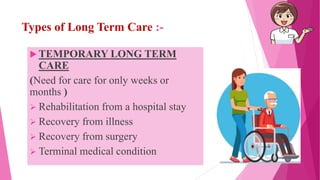
Types of Long Term Care :-
 TEMPORARY LONG TERM
CARE
(Need for care for only weeks or
months )
 Rehabilitation from a hospital stay
 Recovery from illness
 Recovery from surgery
 Terminal medical condition
Types of long term care :-
 ONGOING LONG TERM CARE :-
( Need for care for many months or years )
 Chronic medical conditions
 Chronic severe pain
 Permanent disabilities
 Dementia
 Need for Supervision .
Role of Nurse in Long Term Care :-
ROLES
• Assessment
• Care Planning
• Caregiving
• Routines and Schedules
• Maintain Environment
• Communication
• Management
• Follow up
HOME
HEALTH
CARE
Home Health Care :-
 Home Care( also referred as domiciliary care or social care) is health care or
supportive care provided in the patient’s home by health care professionals (often
referred to as home health care or formal care)
 Home Health Nursing is about patients receiving nursing care in their home .
Home health nurses have a new environment every day and face many challenges.
 Patients are going home from the hospital with more acute problems and the
home health nurse must rise to the occasion .
Home Health Care Nurse
 A Home Health Care Nurse works with patients
in their homes.
 These nurses mainly work with the elderly , but
sometimes work with younger children who
have developmental or mobility issues .
 A home health care nurse is great for people that
would rather work outside of a hospital .
Home Health Care Nurses
Association (HHNA)
The Home Healthcare Nurses Association
(HHNA) is a National professional Nursing
organization of members involved in home
health care and hospice nursing practice ,
education , administration and research .
HHNA provides leadership and a unified voice
so that home care may improve their speciality
as it relates to home care and hospice .
Mission of HHNA :-
 The HHNA is committed to
improving the specialty of home care
and hospice nursing and influencing
public policy as it relates to home care
and hospice.
 HHNA is a forum that recruits and
brings together energized home care
and hospice nurses who want to
become leaders in their field and
enable them to speak out in a unified
voice .
CARE
IN
HOSPITAL
SETTINGS
INTRODUCTION OF DEEN
DAYAL UPADHYAYA
(DDU)
ESTABLISHMENT OF DDU
 Formerly known as the Ripon Hospital,
the Deen Dayal Upadhyay Hospital is the first
hospital of Shimla.
 This medical facility occupies a huge area and
one of its entrances is located at Ram Bazaar.
 The hospital was proposed by Lord Ripon,
former Viceroy of India, and its construction
began in 1882.
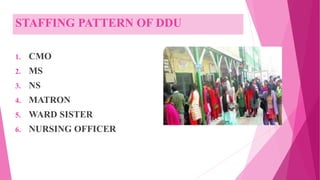
STAFFING PATTERN OF DDU
1. CMO
2. MS
3. NS
4. MATRON
5. WARD SISTER
6. NURSING OFFICER
BED STRENGTH :-
 Sanctioned Bed : 300
 In Running :250
 Occupied Bed : 210
Areas of the Hospital :-
 Medical Ward
 Surgical Ward
 Ortho ward
 ENT
 Eye Ward
 Children Ward
 Gynae Ward
 Maternity Ward
 Labour Room
 PP Ward
Practices done in DDU Hospital
 Caesarean
 Ortho Surgery
 General Surgery
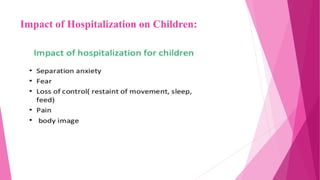
Impact of Hospitalization on Children:
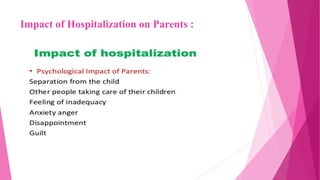
Impact of Hospitalization on Parents :
Impact of Hospitalization on Patients :
1. Fear
2. Anxiety
3. Anger
4. Financial crisis
5. Restless
6. Body
STRESS
STRESS :-
INTRODUCTION :-
It is derived from the latin word “ stringi’’which
means , to be drawn tight .
Stress is described as a physiological or psychological
stimulus that can produce mental tension or
physiological reactions that may lead to illness”
DEFINITION :-
According to Selyle (1956) –
Stress is defined as the pressure experienced by a
person in response to life demands.
These demands are referred to as stressors and include
a range of life events , physical factors (eg : cold,
hunger , haemorrhage , pain ) , environmental
conditions and personal thoughts .
Types of Stressor :-
1. Physical Stressors
2. Physiological Stressors
3. Social Stressors
4. Environmental Stressors
TYPES
Physical Stressors :-
 Cold
 Heat
 Chemical Agents
 Lack of Rest and Sleep
 Excessive drinking
 Isolation
TYPES
Physiological Stressors :-
• Pain
• Fatigue
• Illness
• Injuries
• Inadequate sleep
• Hormonal fluctuations etc
TYPES OF STRESS
Psychological Stressors :-
 Fear
 Anxiety
 Phobia
 Losing a loved 1
 Financial problems
TYPES
Environmental Stressors :-
 Noise
 Pollution
 Traffic
 Weather
 Crowd etc
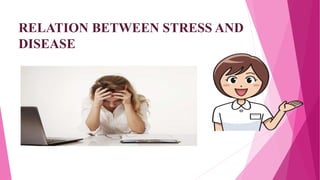
RELATION BETWEEN STRESS AND
DISEASE
RELATIONSHIP BETWEEN STRESS
AND DISEASE
 Relating life events to illness has been a major
focus on psychosocial studies.
 Researchers suggest that people under constant
stress have a high incidence of psychosomatic
disease.
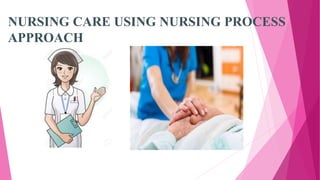
NURSING CARE USING NURSING PROCESS
APPROACH
INTRODUCTION :-
Nursing is concerned with caring for individuals , families , or
groups .
Nurses not only care for clients when they are ill , but also
play a significant role in health education and promotion
Nurses attend to client needs related to hygiene , activity , diet
, the environment medical treatment , and physical , emotional
, and spiritual comfort.
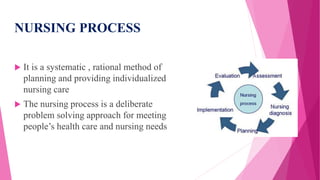
NURSING PROCESS
 It is a systematic , rational method of
planning and providing individualized
nursing care
 The nursing process is a deliberate
problem solving approach for meeting
people’s health care and nursing needs
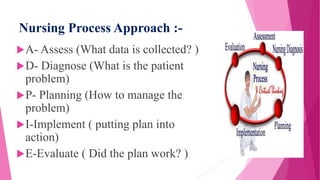
Nursing Process Approach :-
A- Assess (What data is collected? )
D- Diagnose (What is the patient
problem)
P- Planning (How to manage the
problem)
I-Implement ( putting plan into
action)
E-Evaluate ( Did the plan work? )
Nursing care using Nursing Process Approach :-
 Initial Nursing Assessment
 Problem Focused
 Emergency (24 hours service)
 Time lapsed reassessment
 Identify health problems
 Finding out risks and strengths
 Formulate diagnostic statements
SUMMERIZATION
We have studied related hospital , types of
hospital, different types of care eg acute
care , critical care , ambulatory care , long
term care and home health care , care in
hospital settings and related stress and
types of stress and atlast we read about
nursing approach .
RECAPTUALIZATION
Q- What do you mean by Ambulatory care ?
Q- What do you mean by Long Term Care ?
Q- What do mean by Stress ?
References
1. Brunner & Suddarths, “Text book of Medical Surgical
Nursing” 13th edition published by Sangeetha P, Page
no.45-97.
2. Black M. Joyce, “Medical Surgical Nursing” 1st south
asia edition published by Elsevier, Page No.59-91.
3. http://www.careinhospitalsettingsmedicalsurgicalexami
nation.com followed on 23 -4-2020
Contd…
4. http://www.careinhospital
settingsmedicalsurgicalnursing.com followed on –
23-4-2020
5. http://www.homehealthcareinmedicalsurgicalnursing
.com followed on 24-4-2020
CARE IN HOSPITAL SETTINGS

CARE IN HOSPITAL SETTINGS

  • 1.
    CARE IN HOSPITALSETTINGS BY: SHALINI SOOD M.Sc (Medical Surgical)
  • 2.
    INDEX SR . NOCONTENT 1 HOSPITAL • Introduction • Definition • Characteristics • Practices in hospital • Interdisciplinary team of hospital • Types of hospital • Functions of hospital • Advantages of hospital • 2 AMBULATORY CARE • Definition • Classification • Purposes • Ambulatory care in nursing • Ambulatory care Setting sites • Roles of nurse • 3 ACUTE HEALTH CARE • Definition • Departments • Areas where AHC is done • Role of nurse
  • 3.
    INDEX SR NO. CONTENTS 4.CRITICAL HEALTH CARE • Definition • Occupational hazards • Role of nurse 5. LONG TERM CARE • Definition • Types • Role of nurse 6. HOME HEALTH CARE • Definition • HHNA • Mission
  • 4.
    INDEX SR. NO CONTENTS 7.CARE IN HOSPITAL SETTINGS • Introduction • Staffing Pattern • Bed strength • Areas of the hospital • Practices 8. STRESS • Introduction • Definition • Types of stress • Relationship between stress and disease
  • 5.
    INDEX SR NO. CONTENTS 9. 10. 11. 12. NURSINGCARE USING NURSING PROCESS APPROACH • Introduction • Nursing process • Nursing process approach • SUMMERIZATION • RECAPTUALIZATION • REFERENCES
  • 7.
  • 8.
    HOSPITAL  The wordhospital “ derived from the latin word ‘hospitalalis’ which in turn derived from French word ‘hospes’ that means “ a host or a guest” .  A hospital is a health care institution providing treatment to patients with specialized staff and equipment .  Hospitals are institutions , which are mainly designed for care for the sick , injured and well .
  • 9.
    MEANING OF HOSPITAL:- H – HOME O – OF S - SICK P - PEOPLE I – INCLUDING T - TREATMENT A - AND L - LABOUR
  • 10.
  • 11.
    DEFINITION OF HOSPITAL:- According to WHO - A hospital is a residential establishment which provides short term and long term medical care consisting of observational ,diagnostic , therapeutic , and rehabilitative services for persons suffering from a disease or injury.
  • 12.
    CHARACTERSTICS OF HOSPITAL 1.ALWAYS PUT PATIENT FIRST : Its one thing to say you put patients first . Its completely different to actually establish that mantra into every department and interaction . Every employee , have a clinical or patient – facing role , has a patient – centered mind set and ‘patients come first’ is embedded in their DNA .
  • 13.
    CHARACTERSTICS OF HOSPITAL:- 2. DELIVER COMPASSIONATE CARE :- Patient enter through hospital doors at the most vulnerable time in their lives. The best hospital deeply understands that empathy is a critical component of delivering patients care . They treat patients and their family members very politely .
  • 14.
    CHARACTERSTICS OF HOSPITAL 3.COMMIT TO EXCELLENCE :- It speaks to a systematic , purposeful commitment to excellence . It means their staff is dedicated to reviewing and measuring everything they do on a routine basis and use new technologies to do it even better .
  • 15.
    CHARACTERSTICS OF HOSPITAL 4.FOSTER A CULTURE OF INNOVATION :- It means continuing to improve communication and collaboration among care teams by building on the platform they have in place . Innovation is all about finding new ways to make care better .
  • 16.
  • 17.
    PRACTICES IN HOSPITAL 1.Giving Care to Needy People :- The first practice which is done in hospital is providing care to needy peoples . Its our duty to provide immediate care to the patients so that effective results can be there .
  • 18.
    PRACTICES IN HOSPITAL:- 2. Make programs interactive. Group work, quizzes and other activities can help make training programs less lecture-based and more interactive — something that not only helps employees retain information but also makes the training more enjoyable for them.
  • 19.
    PRACTICES IN HOSPITAL:- 3. Ensure training reflects changing skills. Hospital training programs have always covered issues such as compliance and clinical competency, but increasingly hospitals are developing programs around newly sought- after skills, such as customer service and patient-centered care.
  • 20.
    PRACTICES IN HOSPITAL:- 4. Consider employee demands beyond training. Employees at hospitals have multiple responsibilities, and training should be designed so that it can be completed without taking away from those responsibilities.
  • 21.
    PRACTICES IN HOSPITAL:- 5. Evaluate the effectiveness of training programs. Finally, hospitals should always assess the effectiveness of their training programs through surveys and testing of skills. After all, a training program that doesn't effectively improve some skill or competency is a waste of health system resources and employees' time.
  • 22.
    PRACTICES IN HOSPITAL:- 6. Create training programs for different learning styles Training programs should include material that appeals to various learning styles: verbal, visual, hands-on, etc. "You have to be willing to use a variety of different teaching methods,"
  • 23.
  • 24.
    INTERDISPLINARY TEAM OF HOSPITAL INTRODUCTION:- Interdisplinary team work is complex process in which different types of health care professionals work together to  Share experience ,  Knowledge and  Skills , To see the impact on patient health care .
  • 25.
    DEFINITION OF INTERDISCIPLINARY TEAM:- Interdisciplinary team is a group of health care professionals from diverse fields who work in a coordinated fashion toward a common goal for the patient.  Interdisciplinary team is a team of professionals who are all from the same profession, such as physical therapists collaborating on the same case.
  • 26.
    DEFINITION OF INTERDISCIPLINARY TEAM:-  A dynamic process involving two or more health professionals with complementary backgrounds , skills , sharing common health goals and exercising concerted physical and mental efforts in assessing , planning or evaluating patient care .
  • 27.
    MEMBERS OF INTERDISCIPLINARY TEAM:-  Physician  Nurse  Midwifes  Dietician  Pharmacist  Social worker  Psychologist  Physiotherapist  Occupational therapist
  • 28.
  • 29.
    TYPES OF HOSPITAL:- 1. State hospital :- A hospital present in a state , which provide medical facilities and having large no. of beds having all types of facilities . Total bed strength – 872 in Hospital IGMC Over the years, Indira Gandhi Medical College is expanding itself in terms of its infrastructure, facilities provided and care .
  • 30.
    Example of STATEHOSPITAL - IGMC –
  • 31.
    Types of Hospital:- 2. District or Intermediate A district hospital typically is the major health care facility in its region, with large numbers of beds for intensive care, critical care, and long-term care. Even today, district hospitals are the sole public hospitals Eg – DDU (Lord Ripon) Bed strength - 300
  • 32.
    Eg - DISTRICTHOSPITAL - DDU
  • 33.
    Types of Hospital 3.Semi – Government Hospital Hospitals, run both by the government and private entity. Eg – Sri Ram hospital in Shimla , Bed strength – 50 beds The hospital is well equipped with all facilities and is a well-known hospital in the city. The hospital is reputed for its uninhibited services to the people of their city.
  • 34.
    Eg - SemiGovernment - Sri Ram Hospital
  • 35.
    Types of Hospital:- 4. Private Hospital Privately owned or controlled by an individual or group of physician or citizens or by private organization . Total beds in Tenzin Hospital - 100 Purpose is to provide services for profit making .
  • 36.
    EG : PrivateHospital - Tenzin Hospital
  • 37.
    Types of Hospital:- 5. Rural Hospitals Usually fitted with 100 or fewer beds, rural hospitals are located outside large urban areas and operate on small budgets. They generally provide basic care. If needed, they’ll transport patients in need of more critical care to larger hospitals in their regions.
  • 38.
    CHC (Community HealthCentre)  Community health center is one of a network of clinics staffed by a group of general practitioners and Nurses providing healthcare services to people in a certain area. Typical services covered are family practice EG – CHC in Sunni is 75 bedded provides pediatric and women care .
  • 39.
    Eg – CommunityHealth centre - Sunni
  • 40.
    EG -Rural Hospital– PHC JUNGA
  • 41.
  • 42.
    Advantages of Hospitalization:- 1. Can get cure from disease 2. Prevent spreading of disease 3. Promote health 4. Promote psychological support 5. Promote socialization 6. Increase chance for communication . 7. Increase chance for interpersonal relation .
  • 43.
  • 44.
    TYPES :- 1. AmbulatoryCare 2. Acute Health Care 3. Critical Health Care 4. Home Health Care 5. Long term care
  • 45.
  • 46.
    1. AMBULATION  AnAmbulatory care patient is “ an individual presenting for personal health services who is neither bedridden nor currently admitted to any health care institution . By – National Ambulatory Medical Care Survey (NAMCS)
  • 47.
    AMBULATORY CARE  Itis a personal health care consultation , treatment or intervention using advanced medical technology or procedures delivered on an outpatient basis ( i.e where the patient’s stay at the hospital or clinic , from the time of registration to discharge .  Ambulatory health care is provided for the patients in the community or in hospital settings.
  • 48.
    AMBULATION CLASSIFICATION 1. NonFunctional :-  Patient cannot ambulate , ambulates in parallel bars only , or requires supervision or physical assistance from more than 1 person to ambulate 2. Ambulator – dependent for physical assistance :-  Patient requires manual contacts of not more than one person during ambulation . Manual contacts are continuous and necessary to support body weight .
  • 49.
    AMBULATORY CLASSIFICATION 3. Ambulatory– dependent for physical assistance :-  Patient requires manual contacts of not more than one person during ambulation . Manual contacts consists of continuous or intermittent light touch for assistance . 4. Ambulator – dependent for supervision :-  Patient can physically ambulate on level surfaces without manual contact with another person but for safety requires stand by guarding .
  • 50.
    AMBULATORY CLASSIFICATION 5. Ambulatory–Independent level :-  Patient can ambulate independently on level surfaces but requires supervision . 6. Ambulatory – Independent :-  Patient can ambulate independently on non level surfaces , stairs and inclines .
  • 51.
    PURPOSES OF AMBULATORYCARE 1. To promote life-long health habits . 2. Promote and practice preventive medicine . 3. Treat those physical and mental illnesses that do not require hospitalization. Provide treatment for acute illnesses and injuries. 4. Guide patients to proper specialty care when necessary. 5. Assist in rehabilitative care or end-of-life care when necessary.
  • 52.
    AMBULATORY CARE INNURSING Ambulatory care nursing includes :-  Clinical ,  Management ,  Educational ,  Research activities provided by registered nurse for individuals who seeks care and assistance with health maintenance and or health promotion .
  • 53.
    AMBULATORY HEALTH CARESETTINGS SITES :- HOSPITAL EMERGENCY COMMUNITY OUTREACH PROGRAMME STUDENTS HEALTH CENTRES MEDICAL CLINICS AMBULATORY CARE CENTRES CARDIAC REHABILITATION CENTRES
  • 54.
    ROLE OF NURSEIN AMBULATORY CARE 1. Providing direct patient care . 2. Conducting patient intake screenings 3. Treating patients with acute or chronic illnesses or emergency conditions . 4. Referring patients to other agencies for additional services.
  • 55.
    Roles in AmbulatoryCare 5. Teaching patients self care activities 6. Offering health education programmes that promote health maintenance . 7. Nurses also work as clinical managers , direct the operation of clinics and supervise other health team members. 8. Providing advice and emotional support to patients family members .
  • 56.
  • 57.
    2. ACUTE HEALTHCARE ACUTE CARE HOSPITALS:- An acute care hospital is a healthcare facility that offers patient care services of a limited duration to diagnose and/ or treat an injury or short – term illness. Services include medical and surgical inpatient services and outpatient diagnostic services .
  • 58.
    PERSONAL DEPARTMENTS OFACUTE HEALTH CARE PROFESSIONAL SERVICES  MEDICAL STAFF  PRIVATE OR GROUP PRACTICE PHYSICIANS  NURSING SERVICES  PHARMACY  PHARMACISTS AND TECHNICIANS  REHABILITATION SERVICES  PHYSICAL THERAPISTS  OCCUPATIONAL THERAPISTS SUPPORT SERVICES  ADMINISTRATION  BIOMEDICAL ENGINEERING DEPARTMENT  BUSINESS DEPARTMENTS  DIETARY DEPARTMENT  CENTRAL SERVICE  LABORATORY LAUNDRY  ENVIRONMENTAL SERVICES  VOLUNTEER SERVICES  MEDICAL RECORDS
  • 59.
    AREAS WHERE ACUTEHEALTH CARE IS DONE  Emergency care  Urgent care  Trauma care  Critical care  Neonatal and pediatric intensive care  Rehabilitative care  Psychiatric acute care  Acute care surgery
  • 60.
    ROLE OF NURSEIN ACUTE CARE • PROVIDER OF DIRECT CARE • RESEARCHER • EDUCATOR • MANAGER
  • 62.
    3 . CRITICALCARE  Critically ill patients are defined as those patients who are at high risk for life – threatening health problems .  Critical care is a term used to describe “ the care of patients who are extremely ill and whose clinical condition is unstable or potentially unstable’’  Critical care nursing is the field of nursing with a focused care of the critically ill or unstable patients .
  • 63.
    CRITICAL CARE NURSE Critical care nurses can be found working in a wide variety of environments and specialties , such as emergency departments and the ICU and provide critical care to the critically ill patients .
  • 64.
    OCCUPATIONAL HARAZDS IN CRITICALCARE It includes :-  INFECTIOUS HAZARDS  HIV Exposure  Viral Hepatitis Exposure
  • 65.
    OCCUPATIONAL HAZARDS INCRITICAL CARE  MUSCOSKELETAL INJURIES  Occupational back injury  CHEMICAL HAZARDS  Skin Irritants  Eye irritants  Antineoplastic agents .
  • 66.
    Role of Nursein Critical Care  Counselling  Respect and support the right of the patient  Help the patient obtain necessary care.  Respect the values , beliefs and rights of the patient .  Provide education  Support the decisions  Safeguard the quality of care
  • 67.
  • 68.
    4. LONG TERMCARE  Long term care is a variety of services that includes medical and non – medical care to people who have a chronic illness or disability .  Long term care helps meet health of personal needs .  It can be provided at home , in the community , in assisted living or in nursing homes.
  • 69.
    LONG TERM CARENURSE A long term care nurse cares for patients who have a disability of illness in need of extended care. Many of their live in long term care facilities , rehabilitation centers or nursing homes .
  • 70.
    Types of LongTerm Care :-  TEMPORARY LONG TERM CARE (Need for care for only weeks or months )  Rehabilitation from a hospital stay  Recovery from illness  Recovery from surgery  Terminal medical condition
  • 71.
    Types of longterm care :-  ONGOING LONG TERM CARE :- ( Need for care for many months or years )  Chronic medical conditions  Chronic severe pain  Permanent disabilities  Dementia  Need for Supervision .
  • 72.
    Role of Nursein Long Term Care :- ROLES • Assessment • Care Planning • Caregiving • Routines and Schedules • Maintain Environment • Communication • Management • Follow up
  • 73.
  • 74.
    Home Health Care:-  Home Care( also referred as domiciliary care or social care) is health care or supportive care provided in the patient’s home by health care professionals (often referred to as home health care or formal care)  Home Health Nursing is about patients receiving nursing care in their home . Home health nurses have a new environment every day and face many challenges.  Patients are going home from the hospital with more acute problems and the home health nurse must rise to the occasion .
  • 75.
    Home Health CareNurse  A Home Health Care Nurse works with patients in their homes.  These nurses mainly work with the elderly , but sometimes work with younger children who have developmental or mobility issues .  A home health care nurse is great for people that would rather work outside of a hospital .
  • 76.
    Home Health CareNurses Association (HHNA) The Home Healthcare Nurses Association (HHNA) is a National professional Nursing organization of members involved in home health care and hospice nursing practice , education , administration and research . HHNA provides leadership and a unified voice so that home care may improve their speciality as it relates to home care and hospice .
  • 77.
    Mission of HHNA:-  The HHNA is committed to improving the specialty of home care and hospice nursing and influencing public policy as it relates to home care and hospice.  HHNA is a forum that recruits and brings together energized home care and hospice nurses who want to become leaders in their field and enable them to speak out in a unified voice .
  • 78.
  • 79.
  • 80.
    ESTABLISHMENT OF DDU Formerly known as the Ripon Hospital, the Deen Dayal Upadhyay Hospital is the first hospital of Shimla.  This medical facility occupies a huge area and one of its entrances is located at Ram Bazaar.  The hospital was proposed by Lord Ripon, former Viceroy of India, and its construction began in 1882.
  • 81.
    STAFFING PATTERN OFDDU 1. CMO 2. MS 3. NS 4. MATRON 5. WARD SISTER 6. NURSING OFFICER
  • 82.
    BED STRENGTH :- Sanctioned Bed : 300  In Running :250  Occupied Bed : 210
  • 83.
    Areas of theHospital :-  Medical Ward  Surgical Ward  Ortho ward  ENT  Eye Ward  Children Ward  Gynae Ward  Maternity Ward  Labour Room  PP Ward
  • 84.
    Practices done inDDU Hospital  Caesarean  Ortho Surgery  General Surgery
  • 85.
  • 86.
  • 87.
    Impact of Hospitalizationon Patients : 1. Fear 2. Anxiety 3. Anger 4. Financial crisis 5. Restless 6. Body
  • 88.
  • 89.
    STRESS :- INTRODUCTION :- Itis derived from the latin word “ stringi’’which means , to be drawn tight . Stress is described as a physiological or psychological stimulus that can produce mental tension or physiological reactions that may lead to illness”
  • 90.
    DEFINITION :- According toSelyle (1956) – Stress is defined as the pressure experienced by a person in response to life demands. These demands are referred to as stressors and include a range of life events , physical factors (eg : cold, hunger , haemorrhage , pain ) , environmental conditions and personal thoughts .
  • 91.
    Types of Stressor:- 1. Physical Stressors 2. Physiological Stressors 3. Social Stressors 4. Environmental Stressors
  • 92.
    TYPES Physical Stressors :- Cold  Heat  Chemical Agents  Lack of Rest and Sleep  Excessive drinking  Isolation
  • 93.
    TYPES Physiological Stressors :- •Pain • Fatigue • Illness • Injuries • Inadequate sleep • Hormonal fluctuations etc
  • 94.
    TYPES OF STRESS PsychologicalStressors :-  Fear  Anxiety  Phobia  Losing a loved 1  Financial problems
  • 95.
    TYPES Environmental Stressors :- Noise  Pollution  Traffic  Weather  Crowd etc
  • 96.
  • 97.
    RELATIONSHIP BETWEEN STRESS ANDDISEASE  Relating life events to illness has been a major focus on psychosocial studies.  Researchers suggest that people under constant stress have a high incidence of psychosomatic disease.
  • 98.
    NURSING CARE USINGNURSING PROCESS APPROACH
  • 99.
    INTRODUCTION :- Nursing isconcerned with caring for individuals , families , or groups . Nurses not only care for clients when they are ill , but also play a significant role in health education and promotion Nurses attend to client needs related to hygiene , activity , diet , the environment medical treatment , and physical , emotional , and spiritual comfort.
  • 100.
    NURSING PROCESS  Itis a systematic , rational method of planning and providing individualized nursing care  The nursing process is a deliberate problem solving approach for meeting people’s health care and nursing needs
  • 101.
    Nursing Process Approach:- A- Assess (What data is collected? ) D- Diagnose (What is the patient problem) P- Planning (How to manage the problem) I-Implement ( putting plan into action) E-Evaluate ( Did the plan work? )
  • 102.
    Nursing care usingNursing Process Approach :-  Initial Nursing Assessment  Problem Focused  Emergency (24 hours service)  Time lapsed reassessment  Identify health problems  Finding out risks and strengths  Formulate diagnostic statements
  • 103.
    SUMMERIZATION We have studiedrelated hospital , types of hospital, different types of care eg acute care , critical care , ambulatory care , long term care and home health care , care in hospital settings and related stress and types of stress and atlast we read about nursing approach .
  • 104.
    RECAPTUALIZATION Q- What doyou mean by Ambulatory care ? Q- What do you mean by Long Term Care ? Q- What do mean by Stress ?
  • 105.
    References 1. Brunner &Suddarths, “Text book of Medical Surgical Nursing” 13th edition published by Sangeetha P, Page no.45-97. 2. Black M. Joyce, “Medical Surgical Nursing” 1st south asia edition published by Elsevier, Page No.59-91. 3. http://www.careinhospitalsettingsmedicalsurgicalexami nation.com followed on 23 -4-2020
  • 106.
    Contd… 4. http://www.careinhospital settingsmedicalsurgicalnursing.com followedon – 23-4-2020 5. http://www.homehealthcareinmedicalsurgicalnursing .com followed on 24-4-2020