Unless otherwise indicated, this presentation is licensed CC-BY 4.0.
Please attribute TU Delft Extension School / Willem van Valkenburg
TU Delft Online Learning @ Open Education Global Conference

CREATING SUPPORT FOR OPEN ED.
Image CC BY NC SA Karl S Johnson
Nice to Meet You!
Willem van Valkenburg
TU Delft | Online Learning
Manager Production & Delivery | Board Member OEC
Martijn Ouwehand
TU Delft | Online Learning
Account manager | Product Manager OpenCourseWare | Product
Manager Blended Learning
ABOUT TU DELFT ONLINE LEARNING
Background
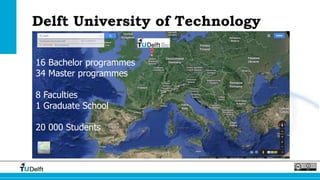
Delft University of Technology
16 Bachelor programmes
34 Master programmes
8 Faculties
1 Graduate School
20 000 Students
TU Delft Mission
Our mission is to:
• explore the frontiers of the engineering sciences
• solve societal challenges
• support a competitive and sustainable economy
through
• excellent creative research
• science, engineering and design in one approach
• excellent education
• valorisation, spin through, spin out
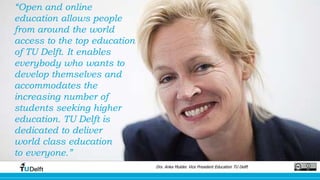
“Open and online
education allows people
from around the world
access to the top education
of TU Delft. It enables
everybody who wants to
develop themselves and
accommodates the
increasing number of
students seeking higher
education. TU Delft is
dedicated to deliver
world class education
to everyone.”
Drs. Anka Mulder. Vice President Education TU Delft
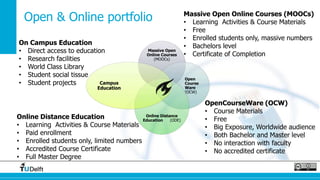
Massive Open
Online Courses
(MOOCs)
Open
Course
Ware
(OCW)
Online Distance
Education (ODE)
Campus
Education
Open & Online portfolio
OpenCourseWare (OCW)
• Course Materials
• Free
• Big Exposure, Worldwide audience
• Both Bachelor and Master level
• No interaction with faculty
• No accredited certificate
Massive Open Online Courses (MOOCs)
• Learning Activities & Course Materials
• Free
• Enrolled students only, massive numbers
• Bachelors level
• Certificate of Completion
Online Distance Education
• Learning Activities & Course Materials
• Paid enrollment
• Enrolled students only, limited numbers
• Accredited Course Certificate
• Full Master Degree
On Campus Education
• Direct access to education
• Research facilities
• World Class Library
• Student social tissue
• Student projects
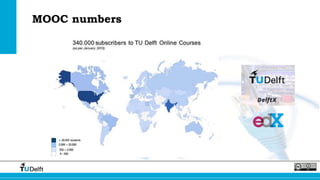
MOOC numbers
INSTITUTIONAL MOTIVES
Why?
Why do Universities participate in
Open Education?
Why? Philosophical
• Expanding access to education & knowledge
• Building on others’ ideas
• Creating possibilities for new educational systems
• Maximizing educational euros
Why? Institutional benefits
Showcasing existing courses and educational quality
• transparency = respect & trust
• good public relations
Why? Institutional benefits
• Strengthen teaching and learning outcomes
• Provide examples of excellence for faculty and students
• Professional development
• Supports student learning
• Can lead to partnerships, collaborations, recognition
Why? Outreach benefits
• Bridge between secondary and higher education
• Skill and knowledge courses available to prepare students for higher education
• Assist disadvantaged learners and those returning to education
• Insure good fit between student and institution
Why? Outreach benefits
• Workforce development
• Updating skills
• Retraining sectors that are downsizing or becoming dated
• Pathways to short courses or certificates
Why? Innovation
• Current global higher ed system can’t reach everyone who wants an education.
• Cost and access barriers to current system.
• Systems don’t serve everyone equally well.
UNESCO's world conference on Higher Education projects that post-
secondary education will need to provide places for an additional 98 million
learners over the next 15 years. Stated differently, this would require
"require more than four major universities (30,000 students) to open every
week for the next fifteen years". (Daniel 2011.)
FROM THEORY TO PRACTICE
How
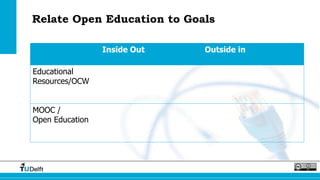
Inside Out Outside in
Educational
Resources/OCW
MOOC /
Open Education
Relate Open Education to Goals
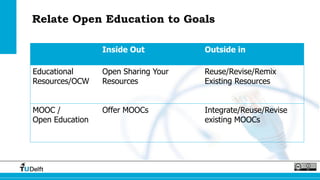
Inside Out Outside in
Educational
Resources/OCW
Open Sharing Your
Resources
Reuse/Revise/Remix
Existing Resources
MOOC /
Open Education
Offer MOOCs Integrate/Reuse/Revise
existing MOOCs
Relate Open Education to Goals
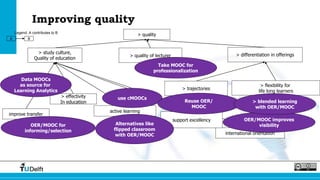
Improving quality
active learning
international orientation
> differentiation in offerings
> quality
> study culture,
Quality of education
> effectivity
In education
> flexibility for
life long learners
> quality of lecturer
> trajectories
improve transfer
support excellency
OER/MOOC for
informing/selection
Alternatives like
flipped classroom
with OER/MOOC
use cMOOCs
Reuse OER/
MOOC
OER/MOOC improves
visibility
> blended learning
with OER/MOOC
A B
Legend: A contributes to B
Take MOOC for
professionalization
Data MOOCs
as source for
Learning Analytics
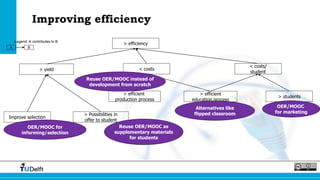
Improving efficiency
A B
Legend: A contributes to B
> efficiency
> yield < costs
Improve selection
> Possibilities in
offer to student
> efficient
education process
> students
< costs/
student
Reuse OER/MOOC as
supplementary materials
for students
Alternatives like
flipped classroom
OER/MOOC
for marketing
OER/MOOC for
informing/selection
> efficient
production process
Reuse OER/MOOC instead of
development from scratch
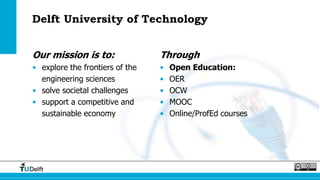
Delft University of Technology
Our mission is to:
• explore the frontiers of the
engineering sciences
• solve societal challenges
• support a competitive and
sustainable economy
Through
• Open Education:
• OER
• OCW
• MOOC
• Online/ProfEd courses
Exercise (25 min)
1. Define the mission and goals of your institution
2. How could Open Education support this mission/those goals?
• Forms of Open education
• Relation to institutional motives
Exercise (10 min)
1. Write down which concerns you’ve heard or expect
2. Think of counter arguments
3. Plenary discussion
Frequently Cited concerns
• Attendance “My students won’t come to class if the lectures are online”
• Cost
• Drain on Faculty Time
• Erosion of Distance Education Revenue
• Faculty Resistance to Sharing
• Intellectual Property
• Undermining Potential Publication for Profit
Counter arguments
“What is good enough for your own students,
should be good enough for the rest of the world”
“Publicly funded resources should be
openly licensed resources”
“In order for open education to reach its
varied potentials, openness must become a
core cultural value for each and every faculty
member.” David Wiley
HOW TO ORGANIZE?
How?
Exercise (10 min)
1. What kind of expertise is needed?
Elements of support
•Vision/strategic
• Institution
• Pedagogy
•Operational
• Copyrights/licensing
• pedagogy
GETTING IT RUNNING
How?
Strategies
•Bottom Up: Individual initiatives
• Start small
•Find your champions
•Celebrate successes
Advocates and allies
• Both Top AND Bottom
• Education support
• Technical support
• Marketing
• Strategy institution
Exercise (10 min)
1. Make a list of allies, advocates at your university that can form a
group to advance Open Education: staff, faculty, administrators
2. Which arguments for Open Education would they be sensitive to?
SUPPORT
Who to call?
Toolkit
• What are the most significant aspects of your institution’s mission and
culture?
• What are your institution’s explicit short and long-term goals?
• What are your institution’s explicit concerns?
• What OCW-relevant processes does your institution already have in place?
• What is likely to be the most effective scope of an OCW project at your
institution?
• What are likely to be the “pain points” for your institution?
Support
• Action Labs/presentations:
• (open) licensing MOOCs Wednesday, 14:00, Break out Room 1 (Lynx)
• Open Education Information Centre Friday 14:00, Main Hall
• Everything you wanted to know about MOOCs Friday 10:30, Break out Room 3 (Den)
• Open Education Professional Directory http://www.oeconsortium.org/directory/
• Open Education Consortium Toolkit http://www.oeconsortium.org/resources/toolkits/
• Lumen Learning http://lumenlearning.com

OE global2015 Pre-conference workshop

  • 1.
    Unless otherwise indicated,this presentation is licensed CC-BY 4.0. Please attribute TU Delft Extension School / Willem van Valkenburg TU Delft Online Learning @ Open Education Global Conference CREATING SUPPORT FOR OPEN ED. Image CC BY NC SA Karl S Johnson
  • 2.
    Nice to MeetYou! Willem van Valkenburg TU Delft | Online Learning Manager Production & Delivery | Board Member OEC Martijn Ouwehand TU Delft | Online Learning Account manager | Product Manager OpenCourseWare | Product Manager Blended Learning
  • 3.
    ABOUT TU DELFTONLINE LEARNING Background
  • 4.
    Delft University ofTechnology 16 Bachelor programmes 34 Master programmes 8 Faculties 1 Graduate School 20 000 Students
  • 5.
    TU Delft Mission Ourmission is to: • explore the frontiers of the engineering sciences • solve societal challenges • support a competitive and sustainable economy through • excellent creative research • science, engineering and design in one approach • excellent education • valorisation, spin through, spin out
  • 6.
    “Open and online educationallows people from around the world access to the top education of TU Delft. It enables everybody who wants to develop themselves and accommodates the increasing number of students seeking higher education. TU Delft is dedicated to deliver world class education to everyone.” Drs. Anka Mulder. Vice President Education TU Delft
  • 7.
    Massive Open Online Courses (MOOCs) Open Course Ware (OCW) OnlineDistance Education (ODE) Campus Education Open & Online portfolio OpenCourseWare (OCW) • Course Materials • Free • Big Exposure, Worldwide audience • Both Bachelor and Master level • No interaction with faculty • No accredited certificate Massive Open Online Courses (MOOCs) • Learning Activities & Course Materials • Free • Enrolled students only, massive numbers • Bachelors level • Certificate of Completion Online Distance Education • Learning Activities & Course Materials • Paid enrollment • Enrolled students only, limited numbers • Accredited Course Certificate • Full Master Degree On Campus Education • Direct access to education • Research facilities • World Class Library • Student social tissue • Student projects
  • 8.
  • 9.
  • 10.
    Why do Universitiesparticipate in Open Education?
  • 11.
    Why? Philosophical • Expandingaccess to education & knowledge • Building on others’ ideas • Creating possibilities for new educational systems • Maximizing educational euros
  • 12.
    Why? Institutional benefits Showcasingexisting courses and educational quality • transparency = respect & trust • good public relations
  • 13.
    Why? Institutional benefits •Strengthen teaching and learning outcomes • Provide examples of excellence for faculty and students • Professional development • Supports student learning • Can lead to partnerships, collaborations, recognition
  • 14.
    Why? Outreach benefits •Bridge between secondary and higher education • Skill and knowledge courses available to prepare students for higher education • Assist disadvantaged learners and those returning to education • Insure good fit between student and institution
  • 15.
    Why? Outreach benefits •Workforce development • Updating skills • Retraining sectors that are downsizing or becoming dated • Pathways to short courses or certificates
  • 16.
    Why? Innovation • Currentglobal higher ed system can’t reach everyone who wants an education. • Cost and access barriers to current system. • Systems don’t serve everyone equally well. UNESCO's world conference on Higher Education projects that post- secondary education will need to provide places for an additional 98 million learners over the next 15 years. Stated differently, this would require "require more than four major universities (30,000 students) to open every week for the next fifteen years". (Daniel 2011.)
  • 17.
    FROM THEORY TOPRACTICE How
  • 18.
    Inside Out Outsidein Educational Resources/OCW MOOC / Open Education Relate Open Education to Goals
  • 19.
    Inside Out Outsidein Educational Resources/OCW Open Sharing Your Resources Reuse/Revise/Remix Existing Resources MOOC / Open Education Offer MOOCs Integrate/Reuse/Revise existing MOOCs Relate Open Education to Goals
  • 20.
    Improving quality active learning internationalorientation > differentiation in offerings > quality > study culture, Quality of education > effectivity In education > flexibility for life long learners > quality of lecturer > trajectories improve transfer support excellency OER/MOOC for informing/selection Alternatives like flipped classroom with OER/MOOC use cMOOCs Reuse OER/ MOOC OER/MOOC improves visibility > blended learning with OER/MOOC A B Legend: A contributes to B Take MOOC for professionalization Data MOOCs as source for Learning Analytics
  • 21.
    Improving efficiency A B Legend:A contributes to B > efficiency > yield < costs Improve selection > Possibilities in offer to student > efficient education process > students < costs/ student Reuse OER/MOOC as supplementary materials for students Alternatives like flipped classroom OER/MOOC for marketing OER/MOOC for informing/selection > efficient production process Reuse OER/MOOC instead of development from scratch
  • 22.
    Delft University ofTechnology Our mission is to: • explore the frontiers of the engineering sciences • solve societal challenges • support a competitive and sustainable economy Through • Open Education: • OER • OCW • MOOC • Online/ProfEd courses
  • 23.
    Exercise (25 min) 1.Define the mission and goals of your institution 2. How could Open Education support this mission/those goals? • Forms of Open education • Relation to institutional motives
  • 24.
    Exercise (10 min) 1.Write down which concerns you’ve heard or expect 2. Think of counter arguments 3. Plenary discussion
  • 25.
    Frequently Cited concerns •Attendance “My students won’t come to class if the lectures are online” • Cost • Drain on Faculty Time • Erosion of Distance Education Revenue • Faculty Resistance to Sharing • Intellectual Property • Undermining Potential Publication for Profit
  • 26.
    Counter arguments “What isgood enough for your own students, should be good enough for the rest of the world” “Publicly funded resources should be openly licensed resources”
  • 27.
    “In order foropen education to reach its varied potentials, openness must become a core cultural value for each and every faculty member.” David Wiley
  • 28.
  • 29.
    Exercise (10 min) 1.What kind of expertise is needed?
  • 30.
    Elements of support •Vision/strategic •Institution • Pedagogy •Operational • Copyrights/licensing • pedagogy
  • 31.
  • 32.
    Strategies •Bottom Up: Individualinitiatives • Start small •Find your champions •Celebrate successes
  • 33.
    Advocates and allies •Both Top AND Bottom • Education support • Technical support • Marketing • Strategy institution
  • 34.
    Exercise (10 min) 1.Make a list of allies, advocates at your university that can form a group to advance Open Education: staff, faculty, administrators 2. Which arguments for Open Education would they be sensitive to?
  • 35.
  • 36.
    Toolkit • What arethe most significant aspects of your institution’s mission and culture? • What are your institution’s explicit short and long-term goals? • What are your institution’s explicit concerns? • What OCW-relevant processes does your institution already have in place? • What is likely to be the most effective scope of an OCW project at your institution? • What are likely to be the “pain points” for your institution?
  • 37.
    Support • Action Labs/presentations: •(open) licensing MOOCs Wednesday, 14:00, Break out Room 1 (Lynx) • Open Education Information Centre Friday 14:00, Main Hall • Everything you wanted to know about MOOCs Friday 10:30, Break out Room 3 (Den) • Open Education Professional Directory http://www.oeconsortium.org/directory/ • Open Education Consortium Toolkit http://www.oeconsortium.org/resources/toolkits/ • Lumen Learning http://lumenlearning.com

Editor's Notes

  • #25 Explain How this helps TU Delft execute its mission OER/OCW: increasing Access, transparency, ideology, sharing, quality increase MOOC/online/ProfEd courses: reach, learning experience, numbers All: profiling institution, connecting and supporting learners to tackle societal challenges,…
  • #27 Perhaps we should move this exercise back, to after the examples?
  • #29 Based on step 1 and 2, we’ll discuss the input of 2-3 people plenary
  • #34 Based on step 1 and 2, we’ll discuss the input of 2-3 people plenary
  • #37 MIT Institution wide All courses at once Big support staff Big budget TU Delft Low cost 0,4 FTE Gradual publication Low hanging fruits Ambassadors …
  • #39 Based on step 1 and 2, we’ll discuss the input of 2-3 people plenary
  • #41 http://www.oeconsortium.org/resources/toolkits/toolkit-making-the-case/