Educator’s Lived Experiences With
Open Textbooks
What  are  the  experiences  of  educators  regarding  
the  implementation  of  open  textbooks  as  a  part  of  
their  educational  practice?
Sub-­question:  examining  the  potential  barriers  that  
educators  and  institutions  face  when  trying  to  
implement  open  textbooks
There  are  not  quite  as  many  definitions  
of  open  education  as  there  are  types  of  
Jelly  fish,  but  there’s  still  a  lot  
Strategy  of  Inquiry  
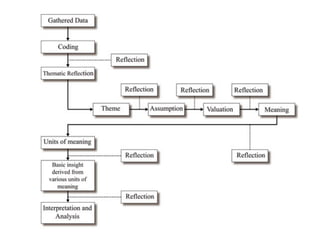
The  aim  of  interpretive  phenomenological  
analysis  (IPA)  is  to  explore,  in  detail,  how  
participants  are  make  sense  of  their  world.  
(Smith  &  Osborne,  2007)
While,  “the  participants  were  trying  to  make  
sense  of  their  world;;  the  researcher  was  
trying  to  make  sense  of  the  participants  
trying  to  make  sense  of  their  world”  (Smith  
et  al,  2009)
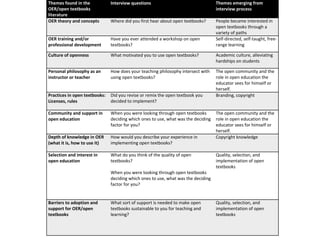
Themes  found  in  the  
OER/open  textbooks  
literature
Interview  questions Themes  emerging  from  
interview  process
OER  theory  and  concepts Where  did  you  first  hear  about  open  textbooks? People  became  interested  in  
open  textbooks  through  a  
variety  of  paths
OER  training  and/or  
professional  development
Have  you  ever  attended  a  workshop  on  open  
textbooks?
Self-­‐directed,  self-­‐taught,  free-­‐
range  learning
Culture  of  openness What  motivated  you  to  use  open  textbooks? Academic  culture,  alleviating  
hardships  on  students  
Personal  philosophy  as  an  
instructor  or  teacher
How  does  your  teaching  philosophy  intersect  with  
using  open  textbooks?
The  open  community  and  the  
role  in  open  education  the  
educator  sees  for  himself  or  
herself.  
Practices  in  open  textbooks:  
Licenses,  rules  
Did  you  revise  or  remix  the  open  textbook  you  
decided  to  implement?  
Branding,  copyright
Community  and  support  in  
open  education  
When  you  were  looking  through  open  textbooks  
deciding  which  ones  to  use,  what  was  the  deciding  
factor  for  you?  
The  open  community  and  the  
role  in  open  education  the  
educator  sees  for  himself  or  
herself.
Depth  of  knowledge  in  OER  
(what  it  is,  how  to  use  it)
How  would  you  describe  your  experience  in  
implementing  open  textbooks?
Copyright  knowledge  
Selection  and  interest  in  
open  education  
What  do  you  think  of  the  quality  of  open  
textbooks?
When  you  were  looking  through  open  textbooks  
deciding  which  ones  to  use,  what  was  the  deciding  
factor  for  you?  
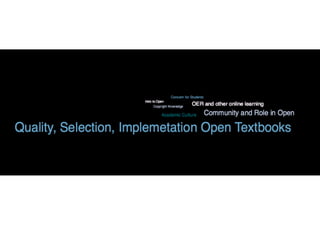
Quality,  selection,  and  
implementation  of  open  
textbooks
Barriers  to  adoption  and  
support  for  OER/open  
textbooks
What  sort  of  support  is  needed  to  make  open  
textbooks  sustainable  to  you  for  teaching  and  
learning?
Quality,  selection,  and  
implementation  of  open  
textbooks
• People  became  interested  in  open  textbooks  through  a  
variety  of  paths
• OER  and  other  online  learning  practices
• The  open  community  and  the  role  in  open  education  that  
the  educator  sees  for  themselves
• Concern  for  students  
• Academic  culture:  support  and  barriers  for  implementing  
open  textbooks
• Copyright  knowledge
• Quality,  selection  and  implementation  of  open  textbooks  
I  was  just  looking  for  online  readings,  but  in  the  
process  of  looking  for  readings  online  I  found  an  
online  textbook  in  cross  cultural  psych  and  
certainly  our  students  have  problems  affording  
their  textbooks  so  we  started  using  that  as  a  
textbook  and  certainly  I  was  very  happy  with  it  
and  it  sort  of  evolved  from  there. (F2)
Well  very  early  in  my  career,  the  whole  distance  
education  model  is  based  on  a  philosophy  of  open  
learning  and  openness  it's  really  founded  on  
widening  access  to  learning  opportunities  and  then  
since  this  predates  the  developments  in  Creative  
Commons  licensing  and  other  forms  of  open  
licensing  which  were  really…  I  mean  the  first  open  
licenses  were  about  the  early  1980s  which  would  
have  been  the  GNU  documentation  license. (M2)
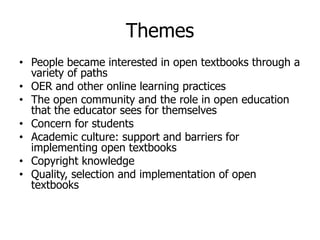
Themes
• People  became  interested  in  open  textbooks  through  a  
variety  of  paths
• OER  and  other  online  learning  practices
• The  open  community  and  the  role  in  open  education  
that  the  educator  sees  for  themselves
• Concern  for  students  
• Academic  culture:  support  and  barriers  for  
implementing  open  textbooks
• Copyright  knowledge
• Quality,  selection  and  implementation  of  open  
textbooks  
I  know  that,  when  I'm  working  with  faculty  and  I  send  
them  an  OpenStax college  book,  because  those  look  so  
pretty  [laugh]  and  they  look  like  a  textbook  you're  
comfortable  with,  it's  a  lot  easier  to  convince  somebody  to  
adopt  that.  But,  I  also  know  that  there  are  some  super  
amazing,  quality  open  resources  out  there  that  look  like  
web  pages  that  were  made  in  1996.  And  they're  not  bad  
resources.  They're  just  not  as  easy  to  read.  So,  it's  one  of  
the  things  that  we  have  to  deal  with,  as  a  community  of  
open  users,  is  making  things  kind  of  fit  what  we  expect  a  
resource  to  look  like  now.  (F3)
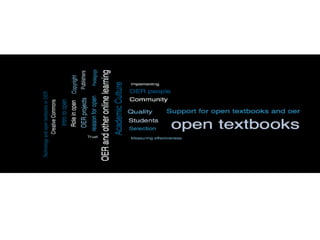
open  textbooks  and  OER  operate  as  an  ecology.  
They  are  part  of  a  holistic  concept,  not  an  
individual  feature.  Despite  OER  use  being  strongly
correlated  to  the  rise of  accessible  technology,  
merely  focusing  on  technology  reduces  a  nuanced
phenomenon  to  technological  determinism.
Out  of  eleven  participants,  few  had  become  
interested  in  the  actual  open  textbook  material;;.  
Rather,  inspiration  came  by  attending  seminars  and  
sessions  that  discussed  the  philosophy  of  open  and  
the  ability  to  give  access  to  materials  to  those  who  
may  not  otherwise  be  able  to  afford  them.  

OE Global 2015 - Paradis

  • 1.
    Educator’s Lived ExperiencesWith Open Textbooks
  • 2.
    What  are  the experiences  of  educators  regarding   the  implementation  of  open  textbooks  as  a  part  of   their  educational  practice? Sub-­question:  examining  the  potential  barriers  that   educators  and  institutions  face  when  trying  to   implement  open  textbooks
  • 3.
    There  are  not quite  as  many  definitions   of  open  education  as  there  are  types  of   Jelly  fish,  but  there’s  still  a  lot  
  • 4.
    Strategy  of  Inquiry  The  aim  of  interpretive  phenomenological   analysis  (IPA)  is  to  explore,  in  detail,  how   participants  are  make  sense  of  their  world.   (Smith  &  Osborne,  2007)
  • 6.
    While,  “the  participants were  trying  to  make   sense  of  their  world;;  the  researcher  was   trying  to  make  sense  of  the  participants   trying  to  make  sense  of  their  world”  (Smith   et  al,  2009)
  • 8.
    Themes  found  in the   OER/open  textbooks   literature Interview  questions Themes  emerging  from   interview  process OER  theory  and  concepts Where  did  you  first  hear  about  open  textbooks? People  became  interested  in   open  textbooks  through  a   variety  of  paths OER  training  and/or   professional  development Have  you  ever  attended  a  workshop  on  open   textbooks? Self-­‐directed,  self-­‐taught,  free-­‐ range  learning Culture  of  openness What  motivated  you  to  use  open  textbooks? Academic  culture,  alleviating   hardships  on  students   Personal  philosophy  as  an   instructor  or  teacher How  does  your  teaching  philosophy  intersect  with   using  open  textbooks? The  open  community  and  the   role  in  open  education  the   educator  sees  for  himself  or   herself.   Practices  in  open  textbooks:   Licenses,  rules   Did  you  revise  or  remix  the  open  textbook  you   decided  to  implement?   Branding,  copyright Community  and  support  in   open  education   When  you  were  looking  through  open  textbooks   deciding  which  ones  to  use,  what  was  the  deciding   factor  for  you?   The  open  community  and  the   role  in  open  education  the   educator  sees  for  himself  or   herself. Depth  of  knowledge  in  OER   (what  it  is,  how  to  use  it) How  would  you  describe  your  experience  in   implementing  open  textbooks? Copyright  knowledge   Selection  and  interest  in   open  education   What  do  you  think  of  the  quality  of  open   textbooks? When  you  were  looking  through  open  textbooks   deciding  which  ones  to  use,  what  was  the  deciding   factor  for  you?   Quality,  selection,  and   implementation  of  open   textbooks Barriers  to  adoption  and   support  for  OER/open   textbooks What  sort  of  support  is  needed  to  make  open   textbooks  sustainable  to  you  for  teaching  and   learning? Quality,  selection,  and   implementation  of  open   textbooks
  • 10.
    • People  became interested  in  open  textbooks  through  a   variety  of  paths • OER  and  other  online  learning  practices • The  open  community  and  the  role  in  open  education  that   the  educator  sees  for  themselves • Concern  for  students   • Academic  culture:  support  and  barriers  for  implementing   open  textbooks • Copyright  knowledge • Quality,  selection  and  implementation  of  open  textbooks  
  • 11.
    I  was  just looking  for  online  readings,  but  in  the   process  of  looking  for  readings  online  I  found  an   online  textbook  in  cross  cultural  psych  and   certainly  our  students  have  problems  affording   their  textbooks  so  we  started  using  that  as  a   textbook  and  certainly  I  was  very  happy  with  it   and  it  sort  of  evolved  from  there. (F2)
  • 12.
    Well  very  early in  my  career,  the  whole  distance   education  model  is  based  on  a  philosophy  of  open   learning  and  openness  it's  really  founded  on   widening  access  to  learning  opportunities  and  then   since  this  predates  the  developments  in  Creative   Commons  licensing  and  other  forms  of  open   licensing  which  were  really…  I  mean  the  first  open   licenses  were  about  the  early  1980s  which  would   have  been  the  GNU  documentation  license. (M2)
  • 13.
    Themes • People  became interested  in  open  textbooks  through  a   variety  of  paths • OER  and  other  online  learning  practices • The  open  community  and  the  role  in  open  education   that  the  educator  sees  for  themselves • Concern  for  students   • Academic  culture:  support  and  barriers  for   implementing  open  textbooks • Copyright  knowledge • Quality,  selection  and  implementation  of  open   textbooks  
  • 14.
    I  know  that, when  I'm  working  with  faculty  and  I  send   them  an  OpenStax college  book,  because  those  look  so   pretty  [laugh]  and  they  look  like  a  textbook  you're   comfortable  with,  it's  a  lot  easier  to  convince  somebody  to   adopt  that.  But,  I  also  know  that  there  are  some  super   amazing,  quality  open  resources  out  there  that  look  like   web  pages  that  were  made  in  1996.  And  they're  not  bad   resources.  They're  just  not  as  easy  to  read.  So,  it's  one  of   the  things  that  we  have  to  deal  with,  as  a  community  of   open  users,  is  making  things  kind  of  fit  what  we  expect  a   resource  to  look  like  now.  (F3)
  • 15.
    open  textbooks  and OER  operate  as  an  ecology.   They  are  part  of  a  holistic  concept,  not  an   individual  feature.  Despite  OER  use  being  strongly correlated  to  the  rise of  accessible  technology,   merely  focusing  on  technology  reduces  a  nuanced phenomenon  to  technological  determinism.
  • 16.
    Out  of  eleven participants,  few  had  become   interested  in  the  actual  open  textbook  material;;.   Rather,  inspiration  came  by  attending  seminars  and   sessions  that  discussed  the  philosophy  of  open  and   the  ability  to  give  access  to  materials  to  those  who   may  not  otherwise  be  able  to  afford  them.