Extraversion & Introversion
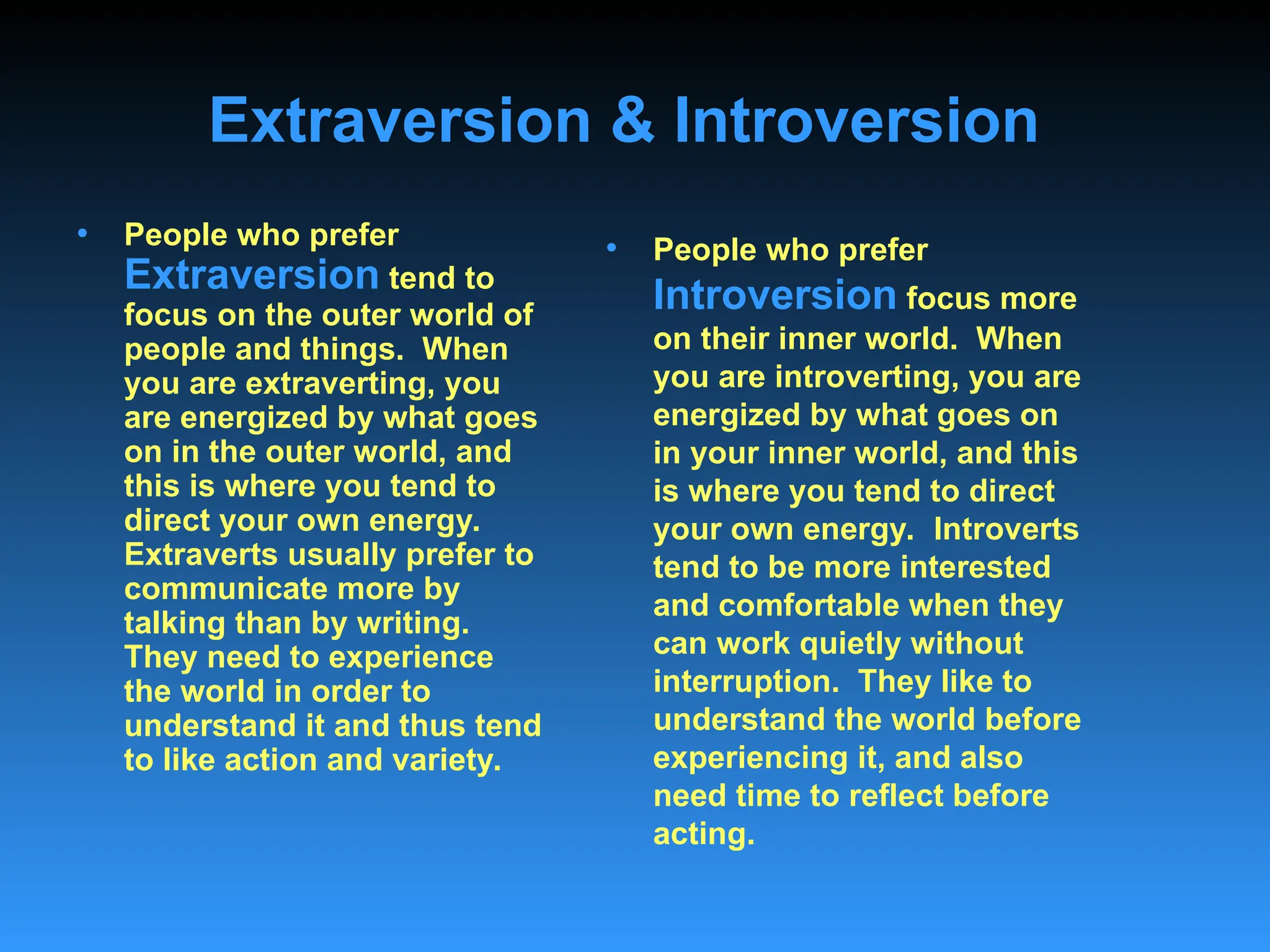
• People who prefer
Extraversion tend to
focus on the outer world of
people and things. When
you are extraverting, you
are energized by what goes
on in the outer world, and
this is where you tend to
direct your own energy.
Extraverts usually prefer to
communicate more by
talking than by writing.
They need to experience
the world in order to
understand it and thus tend
to like action and variety.
• People who prefer
Introversion focus more
on their inner world. When
you are introverting, you are
energized by what goes on
in your inner world, and this
is where you tend to direct
your own energy. Introverts
tend to be more interested
and comfortable when they
can work quietly without
interruption. They like to
understand the world before
experiencing it, and also
need time to reflect before
acting.
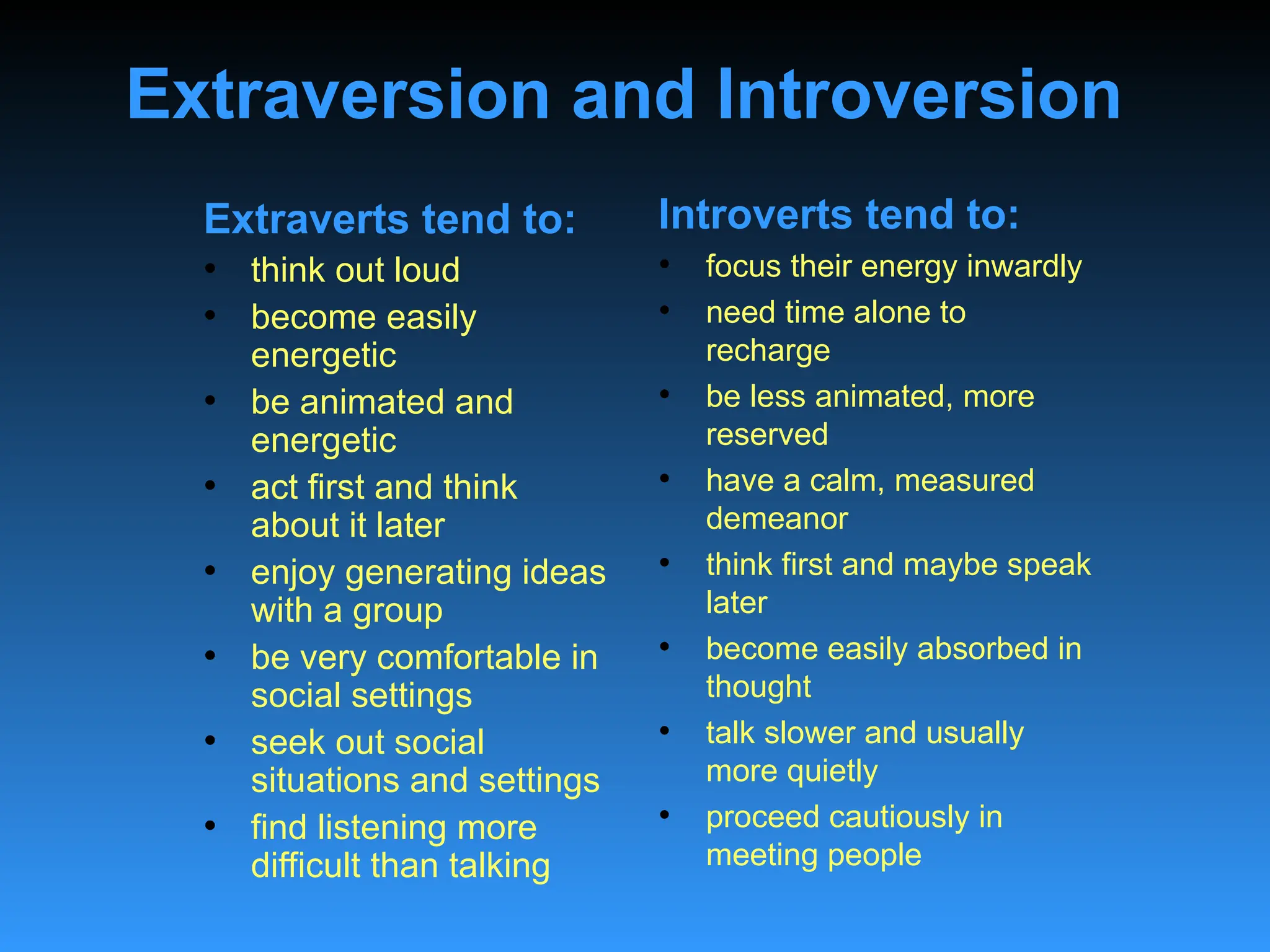
Extraversion and Introversion
Extraverts tend to:
• think out loud
• become easily
energetic
• be animated and
energetic
• act first and think
about it later
• enjoy generating ideas
with a group
• be very comfortable in
social settings
• seek out social
situations and settings
• find listening more
difficult than talking
Introverts tend to:
• focus their energy inwardly
• need time alone to
recharge
• be less animated, more
reserved
• have a calm, measured
demeanor
• think first and maybe speak
later
• become easily absorbed in
thought
• talk slower and usually
more quietly
• proceed cautiously in
meeting people
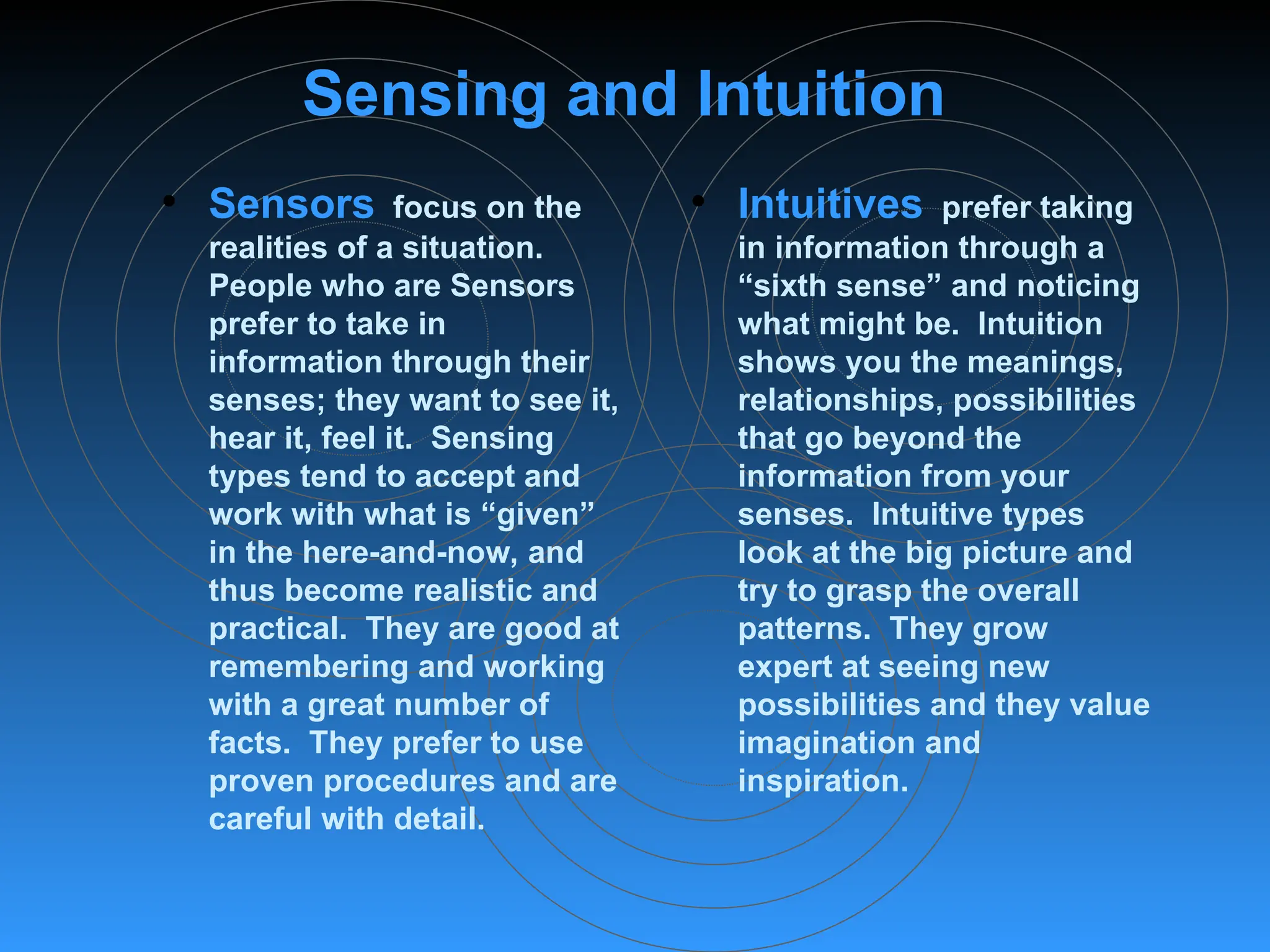
Sensing and Intuition
• Sensors focus on the
realities of a situation.
People who are Sensors
prefer to take in
information through their
senses; they want to see it,
hear it, feel it. Sensing
types tend to accept and
work with what is “given”
in the here-and-now, and
thus become realistic and
practical. They are good at
remembering and working
with a great number of
facts. They prefer to use
proven procedures and are
careful with detail.
• Intuitives prefer taking
in information through a
“sixth sense” and noticing
what might be. Intuition
shows you the meanings,
relationships, possibilities
that go beyond the
information from your
senses. Intuitive types
look at the big picture and
try to grasp the overall
patterns. They grow
expert at seeing new
possibilities and they value
imagination and
inspiration.
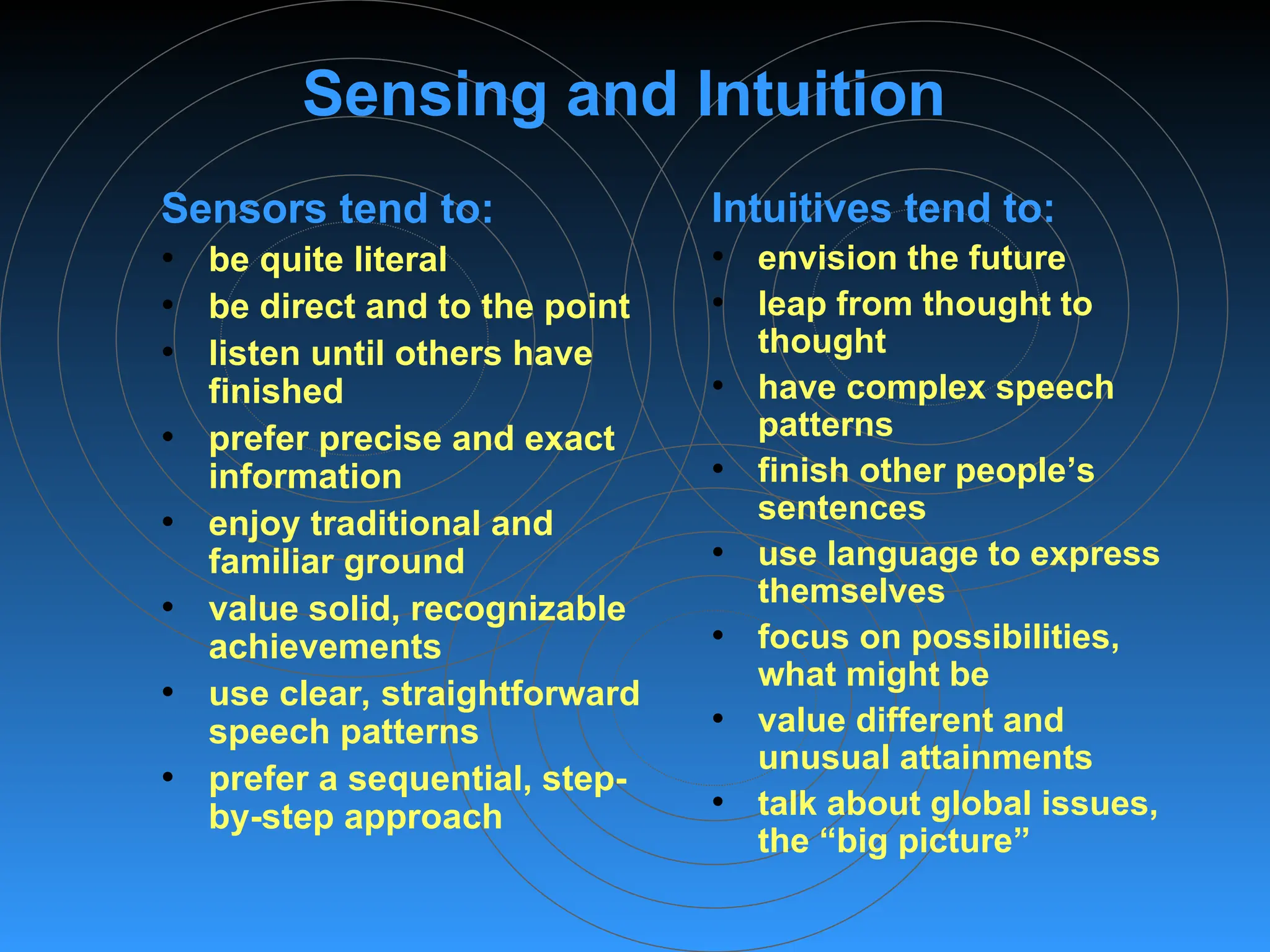
Sensing and Intuition
Sensors tend to:
• be quite literal
• be direct and to the point
• listen until others have
finished
• prefer precise and exact
information
• enjoy traditional and
familiar ground
• value solid, recognizable
achievements
• use clear, straightforward
speech patterns
• prefer a sequential, step-
by-step approach
Intuitives tend to:
• envision the future
• leap from thought to
thought
• have complex speech
patterns
• finish other people’s
sentences
• use language to express
themselves
• focus on possibilities,
what might be
• value different and
unusual attainments
• talk about global issues,
the “big picture”
Thinking and Feeling
• Thinkers make
decisions objectively,
on the basis of cause
and effect, by analyzing
and weighing the
evidence. They focus
on the logical
consequences of any
choice or action.
Thinking types seek an
objective standard of
truth; they are good at
analyzing what is wrong
with something.
• Feelers make
decisions based on
person-centered values.
When deciding, they
consider how important
the choices are to
themselves and others.
They like dealing with
people and tend to be
sympathetic,
appreciative, and tactful.
They value harmony and
work to make it happen.
Thinking and Feeling
Thinkers tend to:
• get right to the point
• often appear
businesslike
• are usually very
assertive
• choose truthfulness
over tactfulness
• give praise sparingly;
point out negatives
• convince others with
impersonal reasoning
• make decisions with
their heads, not hearts
Feelers tend to:
• decide with the heart
• engage in social niceties
• get their feelings hurt
easily
• avoid arguments and
conflict
• be sensitive to the
feelings of others
• act warm and friendly
toward others
• pay attention to the
feelings of others
• be generous with praise;
slow to criticize
Judging and Perceiving
• Those who prefer
judging like to live in a
planned, orderly way,
wanting to regulate life
and control it. They
want to make decisions,
come to closure, and
then carry on. They like
to be structured and
organized and want
thing settled.
• Those who prefer
perceiving like to
live in a flexible,
spontaneous way,
gathering information
and keeping options
open. They seek to
understand life rather
than control it. They
prefer to stay open to
experience, enjoying
and trusting their ability
to adapt to the moment.
Judging and Perceiving
Judgers tend to
• Make decisions; decide
quickly
• Enjoy setting and
reaching goals
• Discuss schedules and
timetables
• Like to take charge and be
in control
• Be more serious, formal,
conventional
• Postpone play until all the
work is done
• Regulate and control their
life and yours
• Enjoy having things
settled, taken care of
Perceivers tend to:
• Be good at adapting
• Be somewhat
disorganized
• Deal with issues as they
arise
• Procrastinate, put off
decisions
• Be more playful, casual,
unconventional
• Keep their lives as
flexible as possible
• Find rules and structure
confining, limiting
• Desire many
experiences and miss
nothing
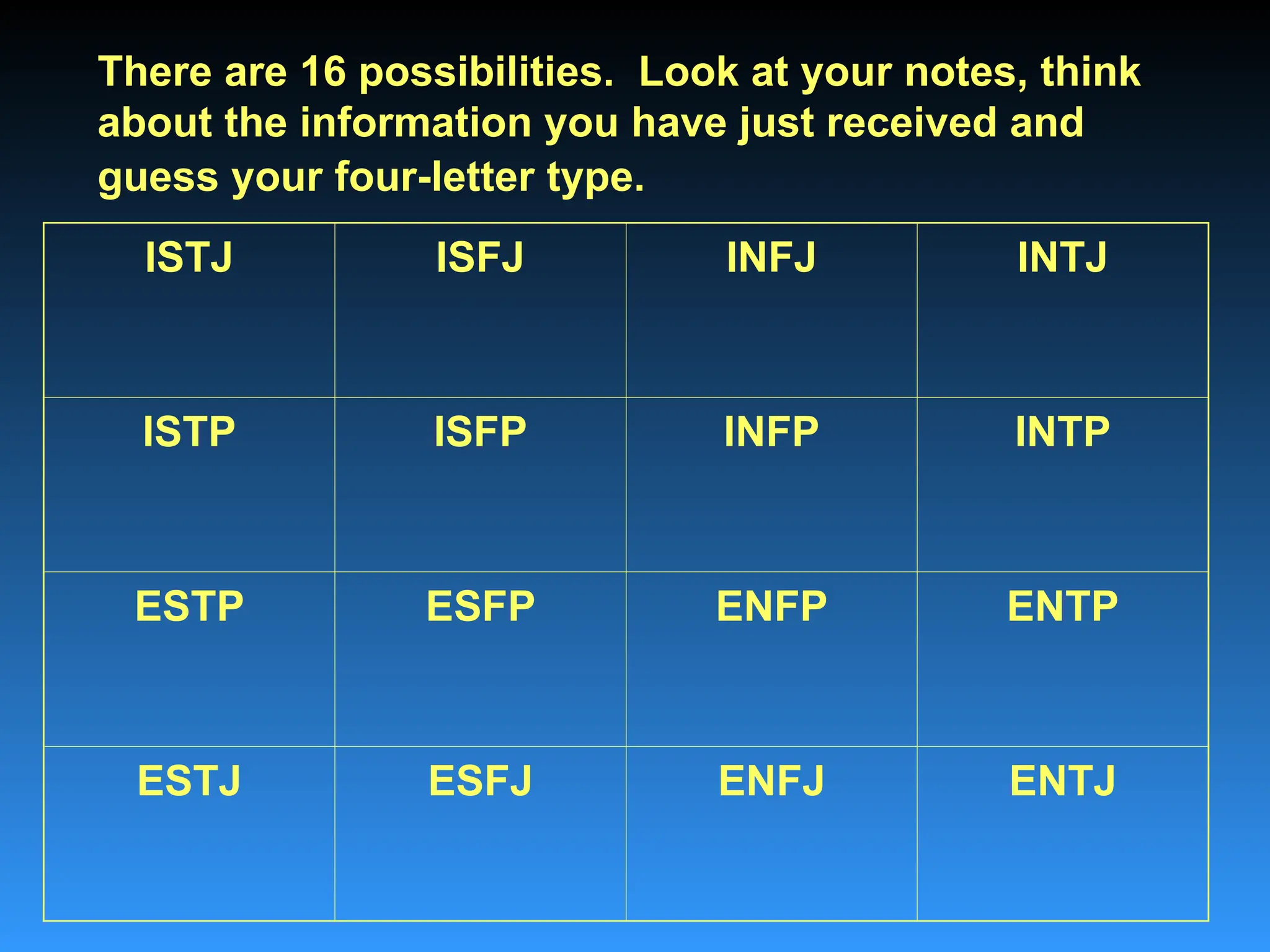
There are 16 possibilities. Look at your notes, think
about the information you have just received and
guess your four-letter type.
ISTJ ISFJ INFJ INTJ
ISTP ISFP INFP INTP
ESTP ESFP ENFP ENTP
ESTJ ESFJ ENFJ ENTJ
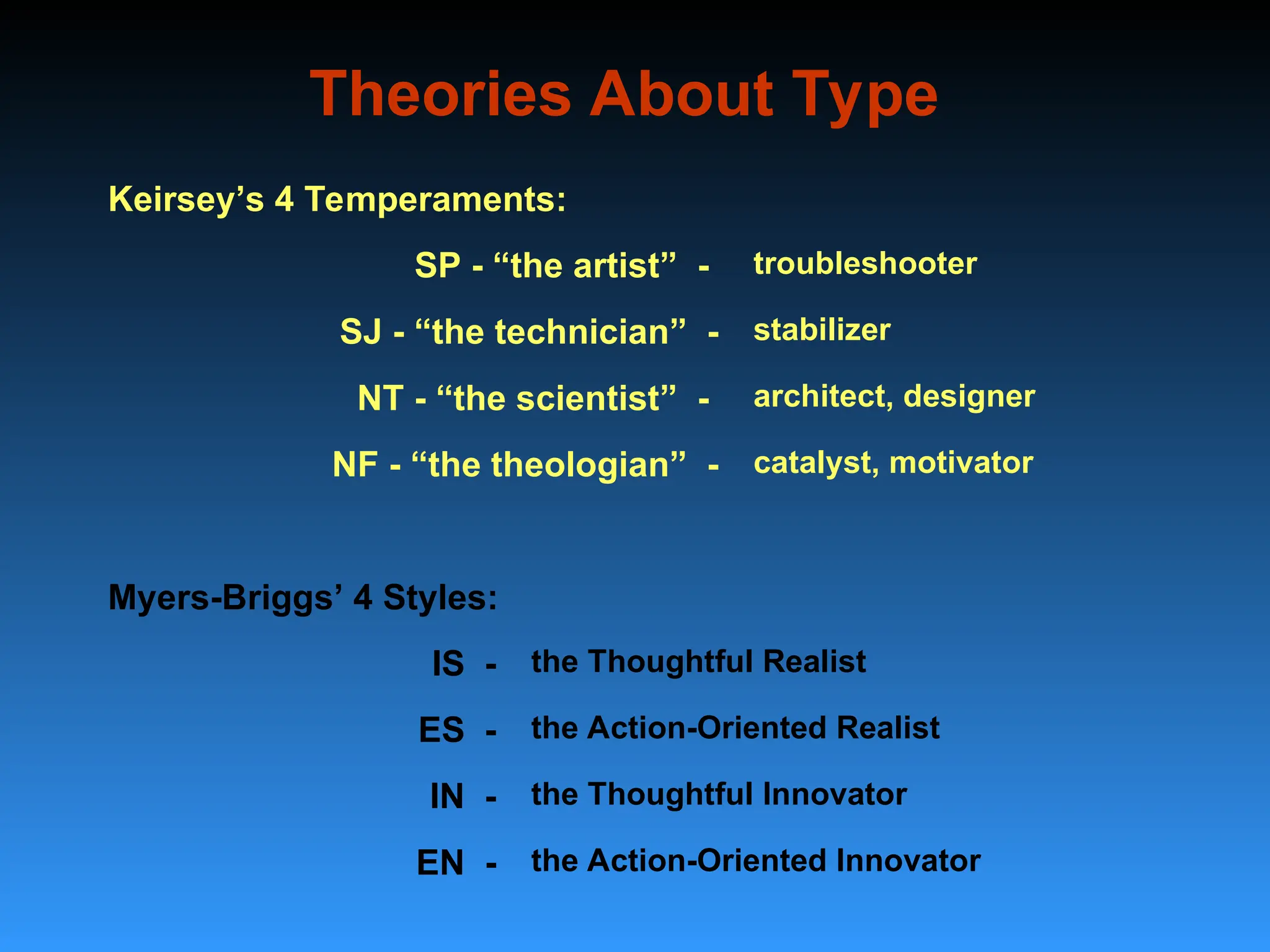
Theories About Type
Keirsey’s 4 Temperaments:
SP - “the artist” - troubleshooter
SJ - “the technician” - stabilizer
NT - “the scientist” - architect, designer
NF - “the theologian” - catalyst, motivator
Myers-Briggs’ 4 Styles:
IS - the Thoughtful Realist
ES - the Action-Oriented Realist
IN - the Thoughtful Innovator
EN - the Action-Oriented Innovator
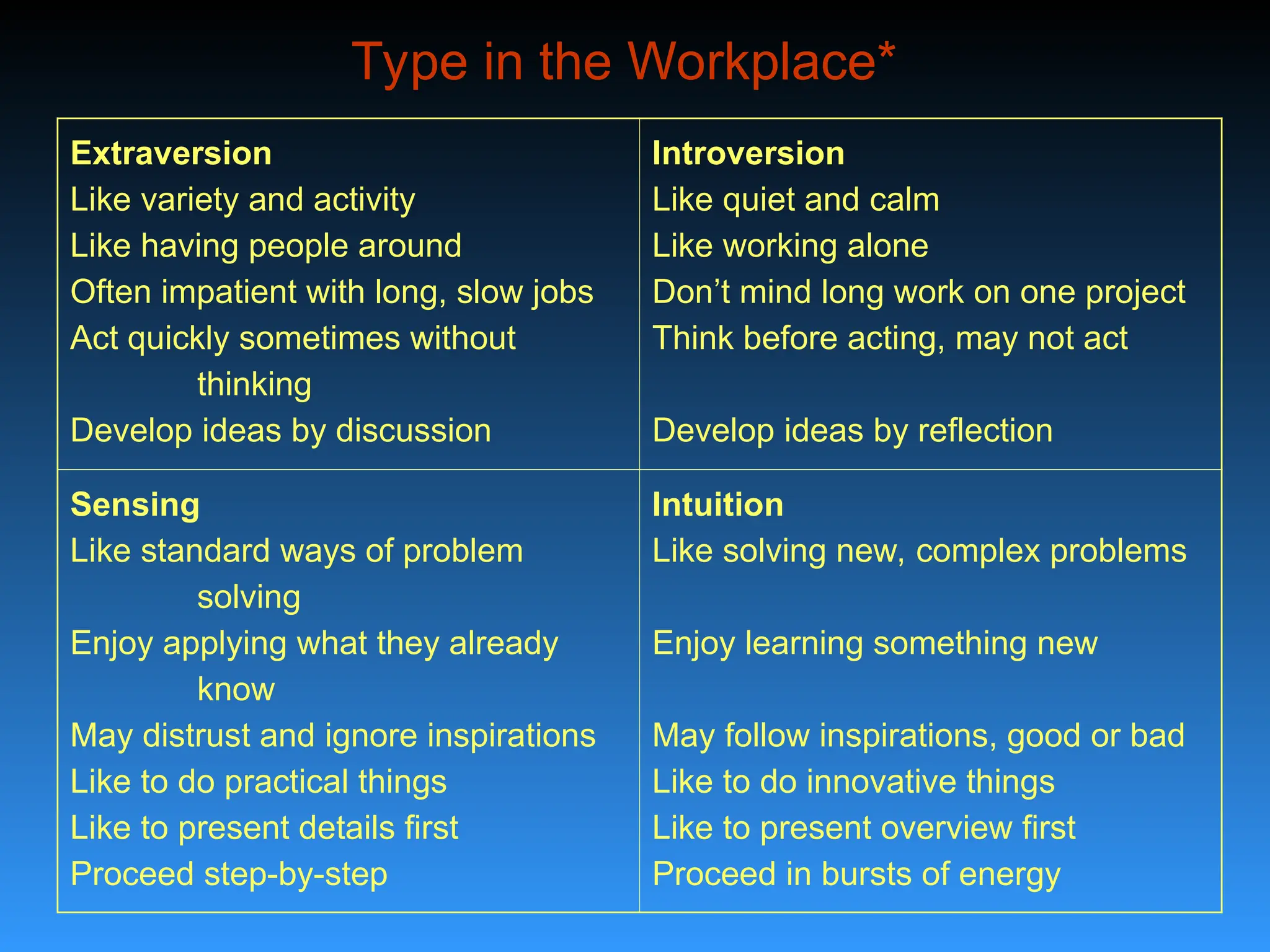
Type in the Workplace*
Extraversion
Like variety and activity
Like having people around
Often impatient with long, slow jobs
Act quickly sometimes without
thinking
Develop ideas by discussion
Introversion
Like quiet and calm
Like working alone
Don’t mind long work on one project
Think before acting, may not act
Develop ideas by reflection
Sensing
Like standard ways of problem
solving
Enjoy applying what they already
know
May distrust and ignore inspirations
Like to do practical things
Like to present details first
Proceed step-by-step
Intuition
Like solving new, complex problems
Enjoy learning something new
May follow inspirations, good or bad
Like to do innovative things
Like to present overview first
Proceed in bursts of energy
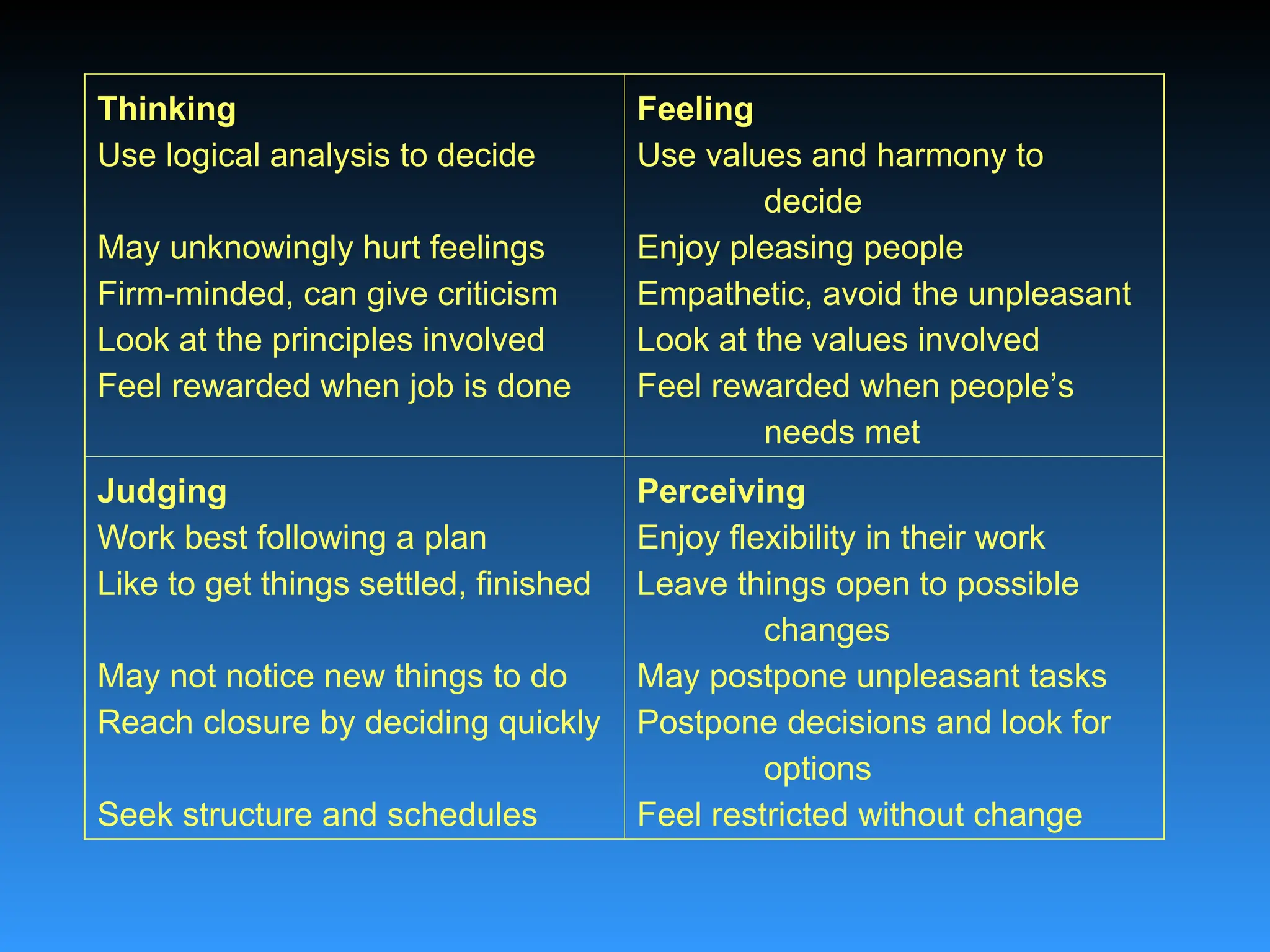
Thinking
Use logical analysis to decide
May unknowingly hurt feelings
Firm-minded, can give criticism
Look at the principles involved
Feel rewarded when job is done
Feeling
Use values and harmony to
decide
Enjoy pleasing people
Empathetic, avoid the unpleasant
Look at the values involved
Feel rewarded when people’s
needs met
Judging
Work best following a plan
Like to get things settled, finished
May not notice new things to do
Reach closure by deciding quickly
Seek structure and schedules
Perceiving
Enjoy flexibility in their work
Leave things open to possible
changes
May postpone unpleasant tasks
Postpone decisions and look for
options
Feel restricted without change
Questions?
Comments?
Concerns?

Lecture2-MBTI Personality and Human Resource Management.ppt

  • 1.
    Extraversion & Introversion •People who prefer Extraversion tend to focus on the outer world of people and things. When you are extraverting, you are energized by what goes on in the outer world, and this is where you tend to direct your own energy. Extraverts usually prefer to communicate more by talking than by writing. They need to experience the world in order to understand it and thus tend to like action and variety. • People who prefer Introversion focus more on their inner world. When you are introverting, you are energized by what goes on in your inner world, and this is where you tend to direct your own energy. Introverts tend to be more interested and comfortable when they can work quietly without interruption. They like to understand the world before experiencing it, and also need time to reflect before acting.
  • 2.
    Extraversion and Introversion Extravertstend to: • think out loud • become easily energetic • be animated and energetic • act first and think about it later • enjoy generating ideas with a group • be very comfortable in social settings • seek out social situations and settings • find listening more difficult than talking Introverts tend to: • focus their energy inwardly • need time alone to recharge • be less animated, more reserved • have a calm, measured demeanor • think first and maybe speak later • become easily absorbed in thought • talk slower and usually more quietly • proceed cautiously in meeting people
  • 3.
    Sensing and Intuition •Sensors focus on the realities of a situation. People who are Sensors prefer to take in information through their senses; they want to see it, hear it, feel it. Sensing types tend to accept and work with what is “given” in the here-and-now, and thus become realistic and practical. They are good at remembering and working with a great number of facts. They prefer to use proven procedures and are careful with detail. • Intuitives prefer taking in information through a “sixth sense” and noticing what might be. Intuition shows you the meanings, relationships, possibilities that go beyond the information from your senses. Intuitive types look at the big picture and try to grasp the overall patterns. They grow expert at seeing new possibilities and they value imagination and inspiration.
  • 4.
    Sensing and Intuition Sensorstend to: • be quite literal • be direct and to the point • listen until others have finished • prefer precise and exact information • enjoy traditional and familiar ground • value solid, recognizable achievements • use clear, straightforward speech patterns • prefer a sequential, step- by-step approach Intuitives tend to: • envision the future • leap from thought to thought • have complex speech patterns • finish other people’s sentences • use language to express themselves • focus on possibilities, what might be • value different and unusual attainments • talk about global issues, the “big picture”
  • 5.
    Thinking and Feeling •Thinkers make decisions objectively, on the basis of cause and effect, by analyzing and weighing the evidence. They focus on the logical consequences of any choice or action. Thinking types seek an objective standard of truth; they are good at analyzing what is wrong with something. • Feelers make decisions based on person-centered values. When deciding, they consider how important the choices are to themselves and others. They like dealing with people and tend to be sympathetic, appreciative, and tactful. They value harmony and work to make it happen.
  • 6.
    Thinking and Feeling Thinkerstend to: • get right to the point • often appear businesslike • are usually very assertive • choose truthfulness over tactfulness • give praise sparingly; point out negatives • convince others with impersonal reasoning • make decisions with their heads, not hearts Feelers tend to: • decide with the heart • engage in social niceties • get their feelings hurt easily • avoid arguments and conflict • be sensitive to the feelings of others • act warm and friendly toward others • pay attention to the feelings of others • be generous with praise; slow to criticize
  • 7.
    Judging and Perceiving •Those who prefer judging like to live in a planned, orderly way, wanting to regulate life and control it. They want to make decisions, come to closure, and then carry on. They like to be structured and organized and want thing settled. • Those who prefer perceiving like to live in a flexible, spontaneous way, gathering information and keeping options open. They seek to understand life rather than control it. They prefer to stay open to experience, enjoying and trusting their ability to adapt to the moment.
  • 8.
    Judging and Perceiving Judgerstend to • Make decisions; decide quickly • Enjoy setting and reaching goals • Discuss schedules and timetables • Like to take charge and be in control • Be more serious, formal, conventional • Postpone play until all the work is done • Regulate and control their life and yours • Enjoy having things settled, taken care of Perceivers tend to: • Be good at adapting • Be somewhat disorganized • Deal with issues as they arise • Procrastinate, put off decisions • Be more playful, casual, unconventional • Keep their lives as flexible as possible • Find rules and structure confining, limiting • Desire many experiences and miss nothing
  • 9.
    There are 16possibilities. Look at your notes, think about the information you have just received and guess your four-letter type. ISTJ ISFJ INFJ INTJ ISTP ISFP INFP INTP ESTP ESFP ENFP ENTP ESTJ ESFJ ENFJ ENTJ
  • 10.
    Theories About Type Keirsey’s4 Temperaments: SP - “the artist” - troubleshooter SJ - “the technician” - stabilizer NT - “the scientist” - architect, designer NF - “the theologian” - catalyst, motivator Myers-Briggs’ 4 Styles: IS - the Thoughtful Realist ES - the Action-Oriented Realist IN - the Thoughtful Innovator EN - the Action-Oriented Innovator
  • 11.
    Type in theWorkplace* Extraversion Like variety and activity Like having people around Often impatient with long, slow jobs Act quickly sometimes without thinking Develop ideas by discussion Introversion Like quiet and calm Like working alone Don’t mind long work on one project Think before acting, may not act Develop ideas by reflection Sensing Like standard ways of problem solving Enjoy applying what they already know May distrust and ignore inspirations Like to do practical things Like to present details first Proceed step-by-step Intuition Like solving new, complex problems Enjoy learning something new May follow inspirations, good or bad Like to do innovative things Like to present overview first Proceed in bursts of energy
  • 12.
    Thinking Use logical analysisto decide May unknowingly hurt feelings Firm-minded, can give criticism Look at the principles involved Feel rewarded when job is done Feeling Use values and harmony to decide Enjoy pleasing people Empathetic, avoid the unpleasant Look at the values involved Feel rewarded when people’s needs met Judging Work best following a plan Like to get things settled, finished May not notice new things to do Reach closure by deciding quickly Seek structure and schedules Perceiving Enjoy flexibility in their work Leave things open to possible changes May postpone unpleasant tasks Postpone decisions and look for options Feel restricted without change
  • 13.