Using Games in Teaching Vocabulary

                        Evi Sofiawati
Why Teach Vocabulary?

Learners depend on vocabulary as their first resource
              (Huckin & Bloch, 1993)
Why Teach Vocabulary?

  A rich vocabulary makes the skills of listening,
 speaking, reading, and writing easier to perform
                  (Nation, 1994)
Why Teach Vocabulary?

 Learners with poor vocabulary level get frustrated
 easily in trying to express their thought resulting in
                  higher affective filter
The Objective of
Teaching Vocabulary

  The essential objective is for the students:
        to acquire, remember, and meaningfully use
        newly learnt words.
Why Use Games?

        Bring in relaxation and fun for
          students


    Stephen Krashen’s hypothesis in ESL acquisition:

                lowering affective filter
Why Use Games?
     Promote students' active participation in
        problem solving and critical thinking


                The learning theory:

                   constructivism
Why Use Games?
       Expose interpersonal skills and
              positive
         interdependence


             The learning theory:

             cooperative learning
Why Use Games?
            Cater students of different
          intelligences and learning styles


    Howard Gardner’s theory: multiple intelligences

           Fleming’s theory: learning styles
Why Use Games?
               Involve physical activities


   Dr. James J. Asher’s theory: Total Physical Response
General Procedures

 Put students in heterogenic groups

 Explain the rules of the games beforehand in details
  by giving at least one example


 Tell students the topic or theme of the day’s game

 Give the winning team immaterial as well as inexpensive
  material rewards alternately
A Sample Lesson Plan
Learners’ Background

 5th and 6th graders of different schools


 English course students of about 2 years of studying


 Familiar with each other


 6 students
A Sample Lesson Plan
Vocabulary Teaching Objective

By the end of the session (90’), students will be able to
use the newly learnt vocabulary by identifying the
misplaced words/phrases in a text and putting them in
the right places.


Topic

Occupation-related skills and abilities
A Sample Lesson Plan
    Motivating Stage


 Warm up the class at the beginning of the lesson by
      reviewing the vocabulary learnt in the previous
session: kinds of occupations.

      Game: Ambiguous Pictures
The Games
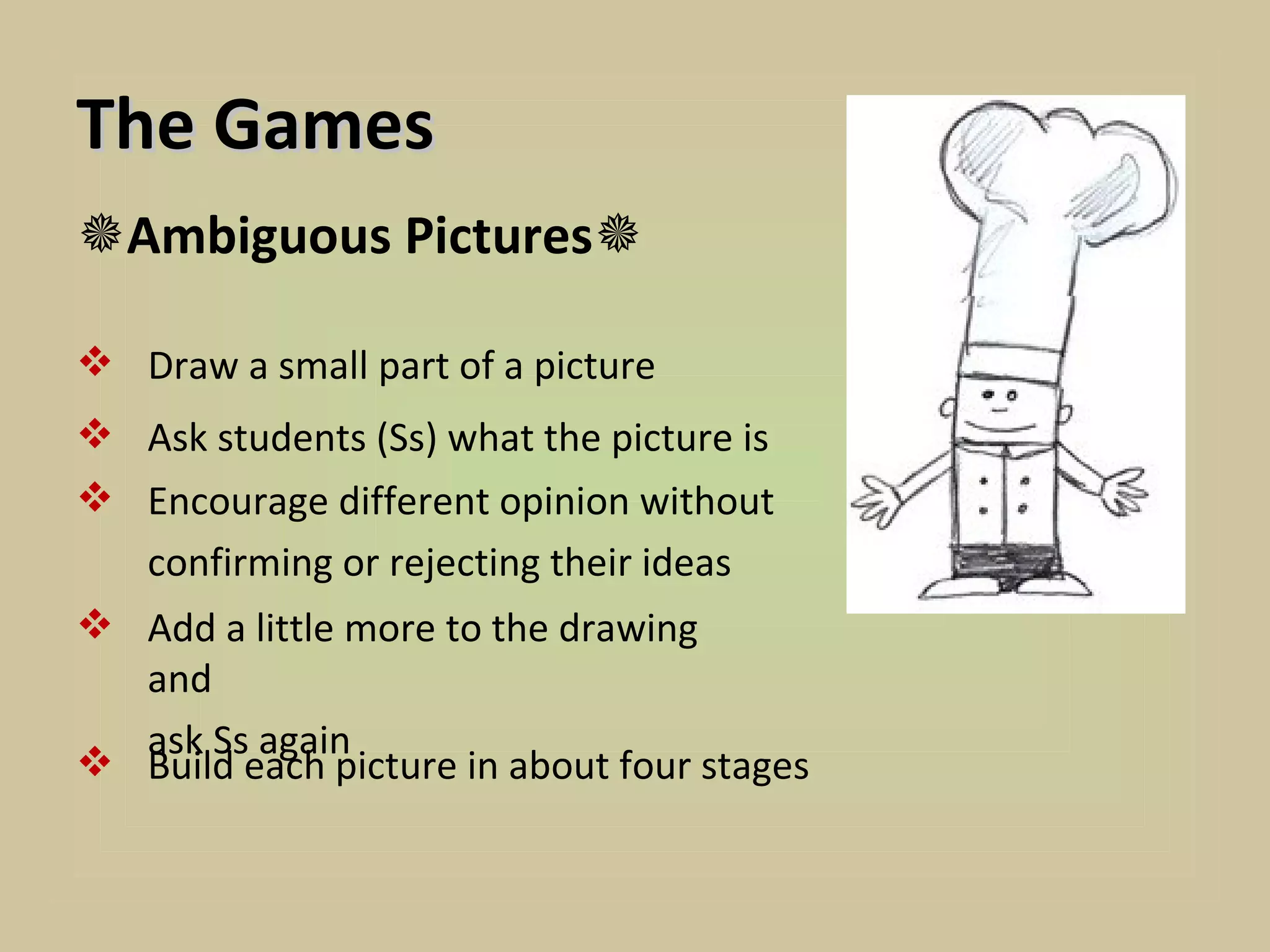
Ambiguous Pictures

 Draw a small part of a picture
 Ask students (Ss) what the picture is
 Encourage different opinion without
  confirming or rejecting their ideas
 Add a little more to the drawing
  and
  ask Ss again
 Build each picture in about four stages
A Sample Lesson Plan
    Motivating Stage


 Check what students know before teaching new
vocabulary items: occupation-related skills and abilities.

       Game: Association
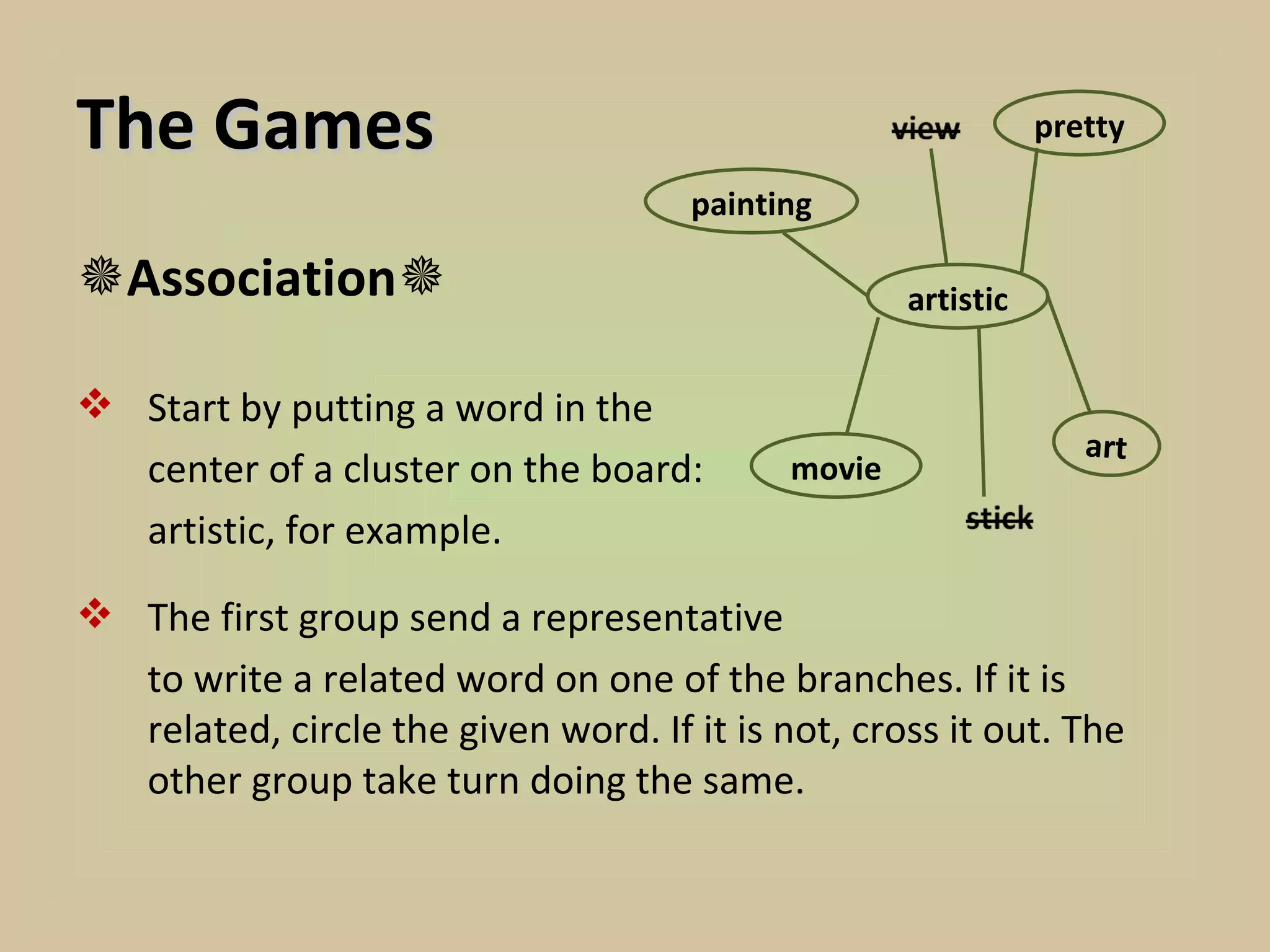
The Games                                                      pretty

                                      painting

Association                                       artistic


 Start by putting a word in the
                                                                  art
  center of a cluster on the board:         movie
  artistic, for example.

 The first group send a representative
  to write a related word on one of the branches. If it is
  related, circle the given word. If it is not, cross it out. The
  other group take turn doing the same.
A Sample Lesson Plan
   Presentation Stage


 Present new vocabulary items in context.

      Game: Matching
The Games
Matching
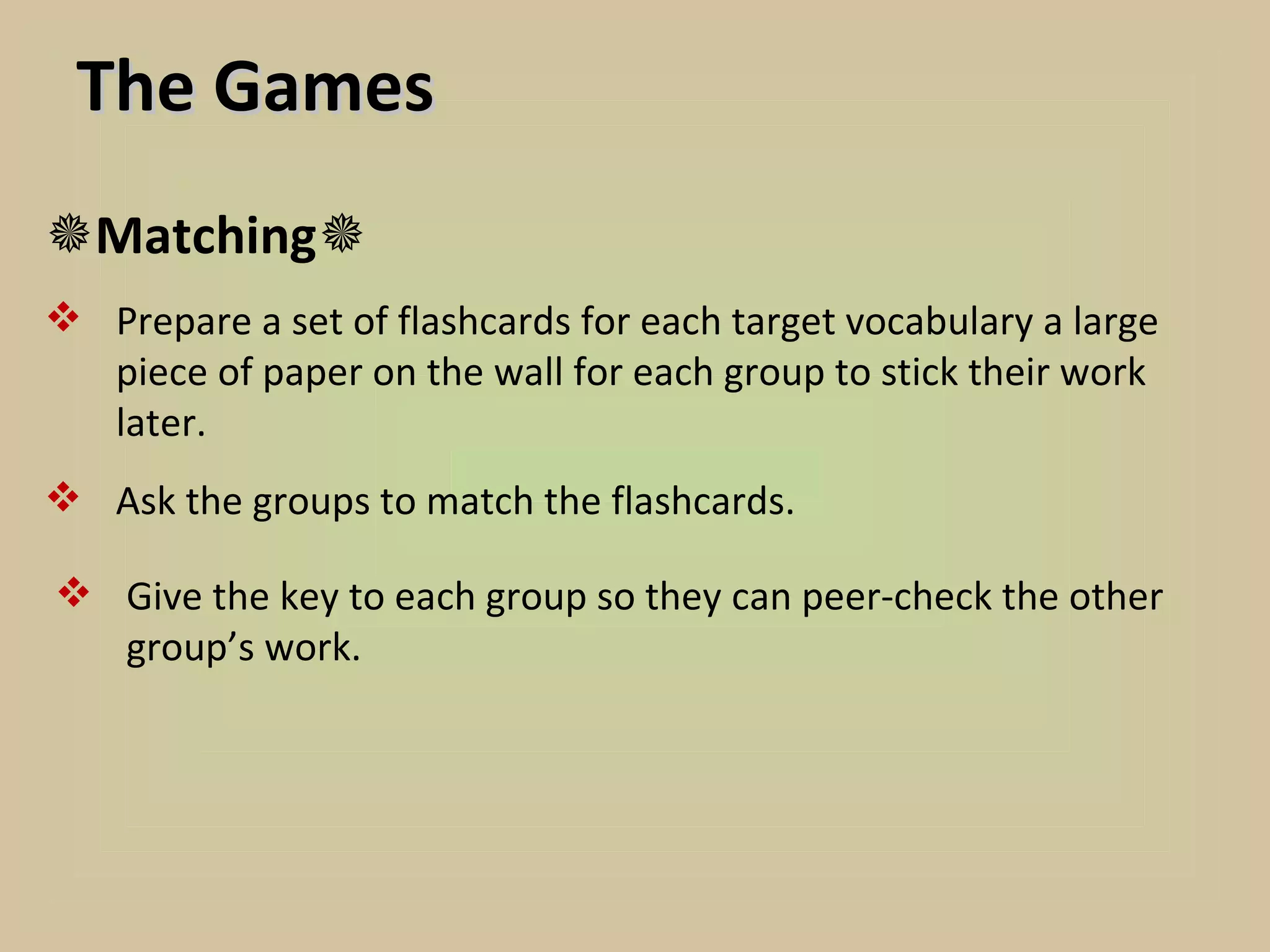
 Prepare a set of flashcards for each target vocabulary a large
  piece of paper on the wall for each group to stick their work
  later.
 Ask the groups to match the flashcards.

 Give the key to each group so they can peer-check the other
  group’s work.
A Sample Lesson Plan

   Summing Up Stage


 Review the newly learnt vocabulary focusing more on
     spelling.

      Game: Crossword
The Games
Crossword
 Ask a student to write a newly learnt word in the middle
  of the board.

 Think of a word which shares one letter with the word
  on board and give students a clue to your word. If
  somebody guesses the word, he or she writes the word
  so it crosses the first word and shares a letter.
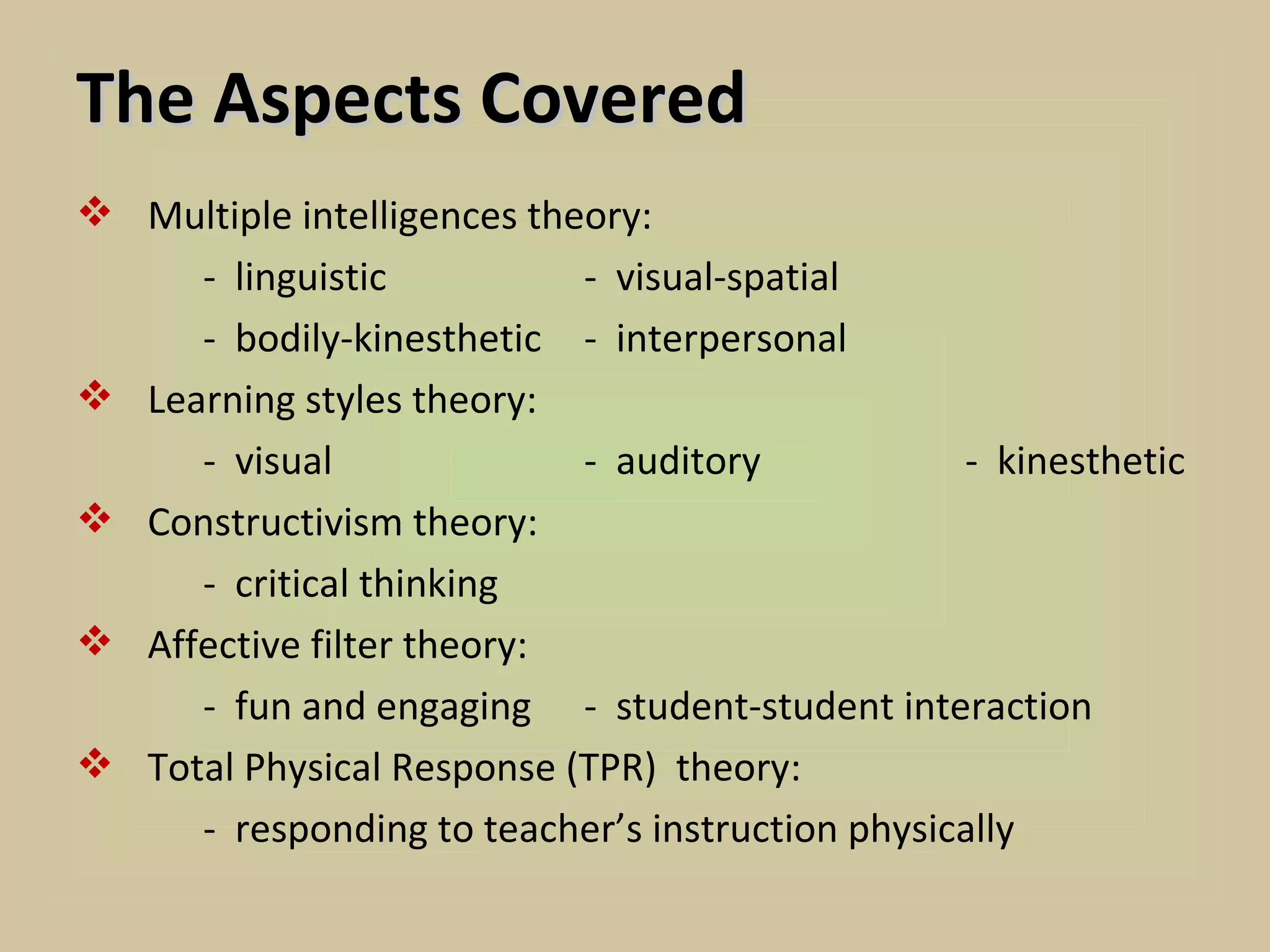
The Aspects Covered
 Multiple intelligences theory:
     - linguistic           - visual-spatial
     - bodily-kinesthetic - interpersonal
 Learning styles theory:
     - visual               - auditory           - kinesthetic
 Constructivism theory:
     - critical thinking
 Affective filter theory:
     - fun and engaging - student-student interaction
 Total Physical Response (TPR) theory:
     - responding to teacher’s instruction physically
A Sample Lesson Plan

       Assignment


 Assign students to find pictures related to each newly
     learnt word for next session review game.

      Game: Matching pictures and words


               Autonomous Learner
THANK YOU

Using Games in Teaching Vocabulary

  • 1.
    Using Games inTeaching Vocabulary Evi Sofiawati
  • 2.
    Why Teach Vocabulary? Learnersdepend on vocabulary as their first resource (Huckin & Bloch, 1993)
  • 3.
    Why Teach Vocabulary? A rich vocabulary makes the skills of listening, speaking, reading, and writing easier to perform (Nation, 1994)
  • 4.
    Why Teach Vocabulary? Learners with poor vocabulary level get frustrated easily in trying to express their thought resulting in higher affective filter
  • 5.
    The Objective of TeachingVocabulary The essential objective is for the students: to acquire, remember, and meaningfully use newly learnt words.
  • 6.
    Why Use Games? Bring in relaxation and fun for students Stephen Krashen’s hypothesis in ESL acquisition: lowering affective filter
  • 7.
    Why Use Games? Promote students' active participation in problem solving and critical thinking The learning theory: constructivism
  • 8.
    Why Use Games? Expose interpersonal skills and positive interdependence The learning theory: cooperative learning
  • 9.
    Why Use Games? Cater students of different intelligences and learning styles Howard Gardner’s theory: multiple intelligences Fleming’s theory: learning styles
  • 10.
    Why Use Games? Involve physical activities Dr. James J. Asher’s theory: Total Physical Response
  • 11.
    General Procedures  Putstudents in heterogenic groups  Explain the rules of the games beforehand in details by giving at least one example  Tell students the topic or theme of the day’s game  Give the winning team immaterial as well as inexpensive material rewards alternately
  • 12.
  • 13.
    Learners’ Background  5thand 6th graders of different schools  English course students of about 2 years of studying  Familiar with each other  6 students
  • 14.
    A Sample LessonPlan Vocabulary Teaching Objective By the end of the session (90’), students will be able to use the newly learnt vocabulary by identifying the misplaced words/phrases in a text and putting them in the right places. Topic Occupation-related skills and abilities
  • 15.
    A Sample LessonPlan Motivating Stage  Warm up the class at the beginning of the lesson by reviewing the vocabulary learnt in the previous session: kinds of occupations. Game: Ambiguous Pictures
  • 16.
    The Games Ambiguous Pictures Draw a small part of a picture  Ask students (Ss) what the picture is  Encourage different opinion without confirming or rejecting their ideas  Add a little more to the drawing and ask Ss again  Build each picture in about four stages
  • 17.
    A Sample LessonPlan Motivating Stage  Check what students know before teaching new vocabulary items: occupation-related skills and abilities. Game: Association
  • 18.
    The Games pretty painting Association artistic  Start by putting a word in the art center of a cluster on the board: movie artistic, for example.  The first group send a representative to write a related word on one of the branches. If it is related, circle the given word. If it is not, cross it out. The other group take turn doing the same.
  • 19.
    A Sample LessonPlan Presentation Stage  Present new vocabulary items in context. Game: Matching
  • 20.
    The Games Matching  Preparea set of flashcards for each target vocabulary a large piece of paper on the wall for each group to stick their work later.  Ask the groups to match the flashcards.  Give the key to each group so they can peer-check the other group’s work.
  • 21.
    A Sample LessonPlan Summing Up Stage  Review the newly learnt vocabulary focusing more on spelling. Game: Crossword
  • 22.
    The Games Crossword  Aska student to write a newly learnt word in the middle of the board.  Think of a word which shares one letter with the word on board and give students a clue to your word. If somebody guesses the word, he or she writes the word so it crosses the first word and shares a letter.
  • 23.
    The Aspects Covered Multiple intelligences theory: - linguistic - visual-spatial - bodily-kinesthetic - interpersonal  Learning styles theory: - visual - auditory - kinesthetic  Constructivism theory: - critical thinking  Affective filter theory: - fun and engaging - student-student interaction  Total Physical Response (TPR) theory: - responding to teacher’s instruction physically
  • 24.
    A Sample LessonPlan Assignment  Assign students to find pictures related to each newly learnt word for next session review game. Game: Matching pictures and words Autonomous Learner
  • 25.

Editor's Notes

  • #2 Bismillahirrahmaanirrahiim. Assalamu’alaikum warahmatullahi wabarakatuh. Good afternoon. My name is Evi Sofiawati. In this 10 minutes presentation, I would like to share with you some techniques I usually use in my teaching, using games in teaching vocabulary.
  • #3 Why teach vocabulary? As stated by Huckin & Bloch, learners depend on vocabulary as their first resource.
  • #4 Another reason to pay serious attention to the teaching of vocabulary is based on the theory stated by Nation: A rich vocabulary makes the skills of listening, speaking, reading, and writing easies to perform.
  • #5 Moreover, based on my teaching experiences, I’ve noticed that learners with poor vocabulary level get frustrated easily in trying to express their thought. This eventually results in higher affective filter.
  • #6 Basically, the essential objective of teaching vocabulary is for the students to acquire, remember, and meaningfully use newly learnt words. There are various ways to achieve this objective. In this talk, I’d like to share with you some games that will be able to help students gain this objective.
  • #7 Why use games? Games bring in relaxation and fun for students. This will lower students’ affective filter, an issue which is one of Stephen Krashen’s hypothesis in ESL acquisition.
  • #8 Games can also promote students' active participation in problem solving and critical thinking. If we look at one of the learning theory, constructivism, this is one aspect that support students’ learning process.
  • #9 Students’ interpersonal skills and positive interdependence can also be developed when we use games in the learning process. This is very closely related to the theory of cooperative learning.
  • #10 Other learning theories that I believe also related to the use of games are Howard Gardner’s multiple intelligences as well as Fleming’s theory of learning styles. This is because various kinds of games cater students of different intelligences and learning styles
  • #11 In addition, another reason for using games is because games involve physical activities which is considered beneficial in the learning process as concluded in Dr. James J Asher’s theory: Total Physical Response a.k.a TPR.
  • #12 To optimize the benefits of using games in class, we should set up certain procedures. These are some general items I usually consider prior to giving a game to my students. Students are put in heterogenic groups, to encourage cooperative learning and interpersonal skills. Explain the rules of the games beforehand in details by giving at least one example. This is to avoid confusion and dispute during the activities. Tell students the topic or theme of the day’s game. This way, students will focus on more specific vocabulary. Give the winning team immaterial as well as inexpensive material rewards alternately. Rewards will encourage students’ sense of achievement and confidence to get them more motivated in learning.
  • #13 Now, I’m going to briefly share a sample lesson plan about using games in teaching vocabulary, but before that let us take a look at the students’ background to whom this lesson plan is intended to be given to.
  • #14 Right now, I’m teaching some young learners, and the games I’m going to talk about are those I’ve planned to give to them this term. Let’s take a look at their background. These students are 5 th and 6 th graders from different schools. This means they are a bit heterogenic. They’ve been studying at the English course I’m teaching for at least 2 years. We can conclude that they have got English exposure above the average 5 th and 6 th graders. Since most of them have been in the same class for quite some time, they are familiar with each other. Thus, we can expect them to be more interactive with each other during the games. And this is a pretty small class consisting of 6 students, 3 girls and 3 boys. This condition usually makes the teaching and learning process very convenient.
  • #15 First, we’ll take a look at the vocabulary teaching objective in this lesson plan. By the end of the session (90’), students will be able to use the newly learnt vocabulary by identifying the misplaced words/phrases in a text and putting them in the right places. The topic in this lesson is occupation-related skills and abilities.
  • #16 On the motivating stage, teacher warm up the class at the beginning of the lesson by reviewing the vocabulary learnt in the previous session that is related to the day’s topic: kinds of occupations using the game, ambiguous pictures.
  • #17 Draw a small part of a picture Ask students (Ss) what the picture is Encourage different opinion without confirming or rejecting their ideas Add a little more to the drawing and ask Ss again Build each picture in about four stages
  • #18 Now, let’s move on to another activity which is still on the motivating stage. This activity is aimed to check what students know before we teach new vocabulary items which is occupation-related skills and abilities . This time, I use the association game.
  • #19 To start this game, put a word in the center of a cluster on the board: artistic, for example. The first group send a representative to write a related word on one of the branches. If it is related, circle the given word. If it is not, cross it out. The other group take turn doing the same.
  • #20 Next, on the presentation stage, we can introduce or present the new vocabulary items through a matching game.
  • #21 For this activity, the teacher needs to prepare a set of flashcards for each target vocabulary: the word, the definition and a sample sentence with the same context. Jumble them in a stack and give one stack to each group. Also prepare a large piece of paper on the wall for each group to stick their work later. Ask the groups to match each word with the definition and the sample sentence. Mention one word, and one representative of each group stick their flashcards on the provided paper on the wall. Continue this process for all the words. Give the key to each group so they can peer-check the other group’s work.
  • #22 And to sum up the day’s lesson, we can give a crossword game. I often do this in my class since most of my students find this game very enjoyable yet fruitful. Often do students know the words but are doubtful about the spelling.
  • #23 In this game, we simply ask the first student to write a newly learnt word in the middle of the board. Then the teacher thinks of a word which shares one letter with the word on board and give students a clue to your word. If somebody guesses the word, he or she writes the word so it crosses the first word and shares a letter.
  • #24 There are some aspects covered in these activities. First, regarding multiple intelligences theory, students with linguistic, visual-spatial, bodily kinesthetic, and interpersonal intelligences will benefit from this game. Second, regarding learning styles theory, these games cater visual, auditory, as well as kinesthetic learners. Next, the constructivism learning theory that deals with critical thinking is obviously involved here. And since games are usually fun and engaging and encourage student-student interaction, using games in teaching will lower students’ affective filter. In addition to those aspects, games also deal with Total Physical Response a.k.a TPR since students often have to respond to teacher’s instruction physically.
  • #25 Finally, to encourage the students to be autonomous learners, we can give an assignment to them to find pictures related to each newly learnt word for the next session. Later, we can review the day’s vocabulary using their pictures with matching pictures and words game.