
LISTENING (& FILM)
LESSON SEQUENCES
      Evi Sofiawati
Teaching Listening
Teaching Integrated Skills

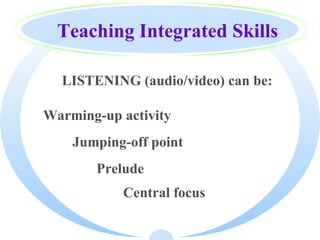
  LISTENING (audio/video) can be:

Warming-up activity
    Jumping-off point
       Prelude
           Central focus
1. Live Listening


 While listening:
  focusing on listening to the stranger’s answers
      – Speaking: asking for information
                   & clarification
      – Structure: constructing questions
      – Writing: note-taking
1. Live Listening
                    (cont.)


 Post listening:
      – Writing: writing short biographical piece
                 for a magazine profile
      – Listening & Speaking: role-playing
2. Ordering Pictures


 While listening:
  focusing on the order of the story
      – Speaking: recognizing expressions
      – Vocabulary: describing events
2. Ordering Pictures
                    (cont.)


 Post listening:
      – Listening & Speaking: role playing
      – Writing: retelling the story
      – Structure: past tenses, sequence markers
3. Listening to a Monologue


 While listening:
  focusing on the given list of words or phrases
  found in the monologue
      – Vocabulary: getting familiar with the use
                     of the given words/phrases
3. Listening to a Monologue
                    (cont.)


 Post listening:
      – Reading: using the words/phrases on the
                 list in a cloze exercise on the
                 audioscipt
      – Writing: summarizing the monologue
4. Being Observant


 While listening:
  focusing on the situations and conversations in the
  film extract
      – Vocabulary: recognizing the use of
             words/phrases in the real conversations
       – Speaking: recognizing expressions
4. Being Observant
                     (cont.)


 Post listening:
      – Speaking: describing events
      – Writing: narrative writing
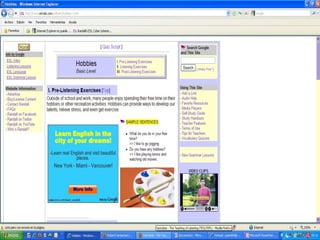
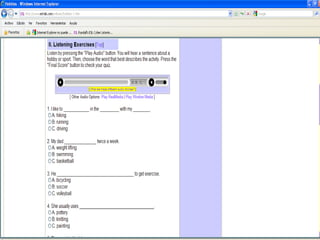
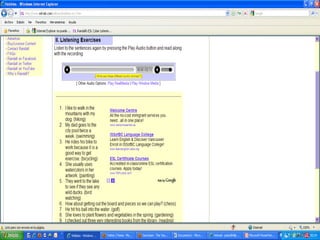
4. On the Net
                   Why?
Attract students’ attention
Encourage e-learning
Develop ourselves to be a tech-savvy teacher
Give variations in our teaching
CONCLUSION
          use listening materials
    for as many purposes as possible,
  both for practising a variety of skills
and as source materials for other activities
THANK YOU

Listening Lesson Sequences

  • 1.
    LISTENING (& FILM) LESSONSEQUENCES Evi Sofiawati
  • 2.
  • 3.
    Teaching Integrated Skills LISTENING (audio/video) can be: Warming-up activity Jumping-off point Prelude Central focus
  • 4.
    1. Live Listening While listening: focusing on listening to the stranger’s answers – Speaking: asking for information & clarification – Structure: constructing questions – Writing: note-taking
  • 5.
    1. Live Listening (cont.)  Post listening: – Writing: writing short biographical piece for a magazine profile – Listening & Speaking: role-playing
  • 6.
    2. Ordering Pictures While listening: focusing on the order of the story – Speaking: recognizing expressions – Vocabulary: describing events
  • 7.
    2. Ordering Pictures (cont.)  Post listening: – Listening & Speaking: role playing – Writing: retelling the story – Structure: past tenses, sequence markers
  • 8.
    3. Listening toa Monologue  While listening: focusing on the given list of words or phrases found in the monologue – Vocabulary: getting familiar with the use of the given words/phrases
  • 9.
    3. Listening toa Monologue (cont.)  Post listening: – Reading: using the words/phrases on the list in a cloze exercise on the audioscipt – Writing: summarizing the monologue
  • 10.
    4. Being Observant While listening: focusing on the situations and conversations in the film extract – Vocabulary: recognizing the use of words/phrases in the real conversations – Speaking: recognizing expressions
  • 11.
    4. Being Observant (cont.)  Post listening: – Speaking: describing events – Writing: narrative writing
  • 12.
    4. On theNet Why? Attract students’ attention Encourage e-learning Develop ourselves to be a tech-savvy teacher Give variations in our teaching
  • 17.
    CONCLUSION use listening materials for as many purposes as possible, both for practising a variety of skills and as source materials for other activities
  • 18.

Editor's Notes

  • #4 In most learning sequences, language skills are integrated. No skill exists in isolation. And regarding teaching listening, we can put it in a number of points in a teaching sequence. It can be the warming up activity of any lesson. It can be a jumping-off point for a speaking activity. It can also be a prelude to a piece of writing, for example. And of course when we are focusing on the listening skills, it will be the central focus in the lesson. In this talk, I am going to share with you some examples of listening sequences which are integrated with the other language skills.
  • #18 The conclusion is that we should aim to use listening materials for as many purposes as possible, both for practising a variety of skills and as source materials for other activities.