HNFE 3224:
USING & CREATING
SOCIAL INFORMATION

Rebecca Miller
millerrk@vt.edu OR hnfelibrarian@vt.edu
540-231-9669
CLASS OVERVIEW

 Touch base about research
 Evaluating social information & other web
  resources
 Professional communication & blogging

 Citations

 Q&A
RESOURCES FOR THIS COURSE
   I’ve created several resources specifically for this
    course:

     HNFE 3224 Library Course Guide
     Social Media for Nutrition and Food ePortfolio
           Basic information and resources about social media tools
            (books, journal articles, etc.)


       Additionally, this will be available on Slideshare :
        http://www.slideshare.net/millerrk
SOCIAL INFORMATION
 Information is no longer housed in just books or
  journals
 Web 2.0 = user generated content

 Information can be communicated by web
  pages, Twitter, Facebook, blogs, YouTube…and it’s
  all easily searchable by Google
SOCIAL INFORMATION PROS & CONS
   Pros:
     You can communicate with all sorts of people, in all
      sorts of locations
     It’s easy to publish and create information
     Your digital actions can define your professional
      reputation and image!
   Cons:
     You can communicate with all sorts of people, in all
      sorts of locations
     It’s easy to publish and create information
     Your digital actions can define your professional
      reputation and image!
EVALUATING WEB RESOURCES
 None of the old-timers—the professors—can really give
 us much advice on sorting through and evaluating
 resources. I think we’re kind of one of the first
 generations to have too much information, as opposed
 to too little. We’ve never had instruction really on
 navigating the Internet and picking out good
 resources. We’ve been kind of tossed into this and
 we’ve just learned through experience we have to go on
 a Web site and just raid it for information. So I would
 say that despite all that’s out there, it certainly is harder
 to find the right source and evaluate whether it’s
 good, or not, because there’s so much—you only have a
 little bit of time to spend on each source you find

 [Engineering student from Project Information Literacy study]
EFFECTIVE SEARCHING & EVALUATING

   Scenario: you are doing some research and
    stumbled across these sites:
     http://www.nutri-facts.com
     http://www.foodfacts.com/


     Are these sites authoritative?
     What are you looking at on the sites?
     Identify four reasons why you think the sites are good or bad


    We will report back and discuss in five minutes:
    http://www.online-stopwatch.com/online-countdown/
SURVEY SAYS…
Examination of these sites revealed:
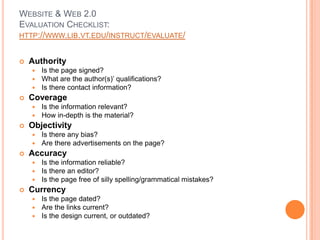
WEBSITE & WEB 2.0
EVALUATION CHECKLIST:
HTTP://WWW.LIB.VT.EDU/INSTRUCT/EVALUATE/


   Authority
       Is the page signed?
       What are the author(s)’ qualifications?
       Is there contact information?
   Coverage
       Is the information relevant?
       How in-depth is the material?
   Objectivity
       Is there any bias?
       Are there advertisements on the page?
   Accuracy
       Is the information reliable?
       Is there an editor?
       Is the page free of silly spelling/grammatical mistakes?
   Currency
       Is the page dated?
       Are the links current?
       Is the design current, or outdated?
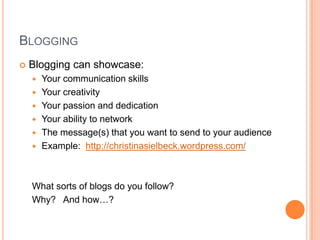
BLOGGING
   Blogging can showcase:
       Your communication skills
       Your creativity
       Your passion and dedication
       Your ability to network
       The message(s) that you want to send to your audience
       Example: http://christinasielbeck.wordpress.com/


    What sorts of blogs do you follow?
    Why? And how…?
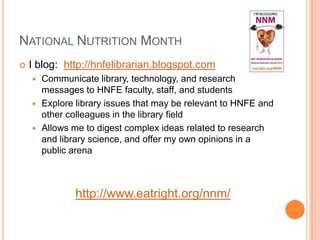
NATIONAL NUTRITION MONTH
   I blog: http://hnfelibrarian.blogspot.com
     Communicate library, technology, and research
      messages to HNFE faculty, staff, and students
     Explore library issues that may be relevant to HNFE and
      other colleagues in the library field
     Allows me to digest complex ideas related to research
      and library science, and offer my own opinions in a
      public arena


              http://www.eatright.org/nnm/
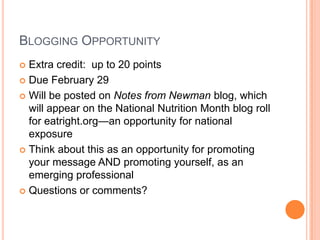
BLOGGING OPPORTUNITY
 Extra credit: up to 20 points
 Due February 29

 Will be posted on Notes from Newman blog, which
  will appear on the National Nutrition Month blog roll
  for eatright.org—an opportunity for national
  exposure
 Think about this as an opportunity for promoting
  your message AND promoting yourself, as an
  emerging professional
 Questions or comments?
LET’S EXAMINE SOME BLOGS…

   http://thepaleodiet.blogspot.com/

   http://nutritionnibbles.blogspot.com/

   http://www.foodinsight.org/blog.aspx
APA CITATION STYLE
   http://www.lib.vt.edu/find/citation/apa.html

   Trouble areas:
     Deciding what resource format you’re looking at/for
     Web resources
     Government resources
     Others?


   My favorite online guides:
       http://owl.english.purdue.edu/owl/resource/560/01/
       http://library.albany.edu/cfox
NAME THAT SOURCE!
For the next three slides, you’ll be voting on what
type of resource a particular citation represents—

Get out your cell phones* or laptops in order to
vote

Text all answers to 37607
OR go to http://PollEv.com to submit the code


*Standard texting rates apply
WHAT IS THIS?
Duncan, G. J., & Brooks-Gunn, J. (Eds.).
(1997). Consequences of growing up poor. New
York, NY: Russell Sage Foundation.

To 37607 OR http://PollEv.com

 A book—416962
 A journal article—416963

 A chapter in a book—416964

 A webpage—416965
WHAT IS THIS?
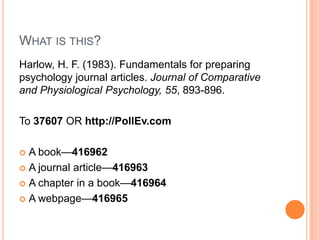
Harlow, H. F. (1983). Fundamentals for preparing
psychology journal articles. Journal of Comparative
and Physiological Psychology, 55, 893-896.

To 37607 OR http://PollEv.com

 A book—416962
 A journal article—416963

 A chapter in a book—416964

 A webpage—416965
WHAT IS THIS?
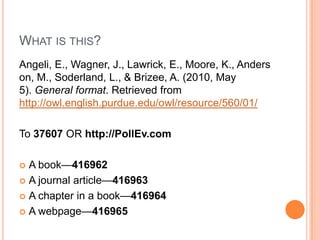
Angeli, E., Wagner, J., Lawrick, E., Moore, K., Anders
on, M., Soderland, L., & Brizee, A. (2010, May
5). General format. Retrieved from
http://owl.english.purdue.edu/owl/resource/560/01/

To 37607 OR http://PollEv.com

 A book—416962
 A journal article—416963

 A chapter in a book—416964

 A webpage—416965
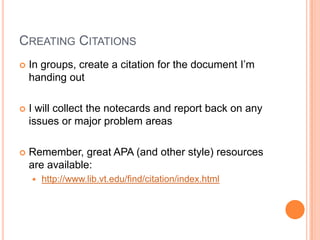
CREATING CITATIONS
   In groups, create a citation for the document I’m
    handing out

   I will collect the notecards and report back on any
    issues or major problem areas

   Remember, great APA (and other style) resources
    are available:
       http://www.lib.vt.edu/find/citation/index.html
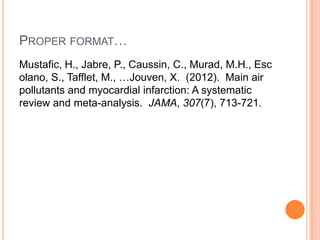
PROPER FORMAT…
Mustafic, H., Jabre, P., Caussin, C., Murad, M.H., Esc
olano, S., Tafflet, M., …Jouven, X. (2012). Main air
pollutants and myocardial infarction: A systematic
review and meta-analysis. JAMA, 307(7), 713-721.
A FEW LAST WORDS
   Review:
     Citations
     Evaluating sources
     Blogging opportunity
     Other research for this course
Questions?
Thank you!

        Rebecca Miller
     hnfelibrarian@vt.edu
     5004 Newman Library
        540-231-9669

         Office Hours:
     Atrium, Wallace Hall
   Mondays, 9:30-11:30 a.m.

http://hnfelibrarian.blogspot.com

Using & Creating Social Information

  • 1.
    HNFE 3224: USING &CREATING SOCIAL INFORMATION Rebecca Miller millerrk@vt.edu OR hnfelibrarian@vt.edu 540-231-9669
  • 2.
    CLASS OVERVIEW  Touchbase about research  Evaluating social information & other web resources  Professional communication & blogging  Citations  Q&A
  • 3.
    RESOURCES FOR THISCOURSE  I’ve created several resources specifically for this course:  HNFE 3224 Library Course Guide  Social Media for Nutrition and Food ePortfolio  Basic information and resources about social media tools (books, journal articles, etc.)  Additionally, this will be available on Slideshare : http://www.slideshare.net/millerrk
  • 4.
    SOCIAL INFORMATION  Informationis no longer housed in just books or journals  Web 2.0 = user generated content  Information can be communicated by web pages, Twitter, Facebook, blogs, YouTube…and it’s all easily searchable by Google
  • 5.
    SOCIAL INFORMATION PROS& CONS  Pros:  You can communicate with all sorts of people, in all sorts of locations  It’s easy to publish and create information  Your digital actions can define your professional reputation and image!  Cons:  You can communicate with all sorts of people, in all sorts of locations  It’s easy to publish and create information  Your digital actions can define your professional reputation and image!
  • 6.
    EVALUATING WEB RESOURCES None of the old-timers—the professors—can really give us much advice on sorting through and evaluating resources. I think we’re kind of one of the first generations to have too much information, as opposed to too little. We’ve never had instruction really on navigating the Internet and picking out good resources. We’ve been kind of tossed into this and we’ve just learned through experience we have to go on a Web site and just raid it for information. So I would say that despite all that’s out there, it certainly is harder to find the right source and evaluate whether it’s good, or not, because there’s so much—you only have a little bit of time to spend on each source you find [Engineering student from Project Information Literacy study]
  • 7.
    EFFECTIVE SEARCHING &EVALUATING  Scenario: you are doing some research and stumbled across these sites:  http://www.nutri-facts.com  http://www.foodfacts.com/  Are these sites authoritative?  What are you looking at on the sites?  Identify four reasons why you think the sites are good or bad We will report back and discuss in five minutes: http://www.online-stopwatch.com/online-countdown/
  • 8.
    SURVEY SAYS… Examination ofthese sites revealed:
  • 9.
    WEBSITE & WEB2.0 EVALUATION CHECKLIST: HTTP://WWW.LIB.VT.EDU/INSTRUCT/EVALUATE/  Authority  Is the page signed?  What are the author(s)’ qualifications?  Is there contact information?  Coverage  Is the information relevant?  How in-depth is the material?  Objectivity  Is there any bias?  Are there advertisements on the page?  Accuracy  Is the information reliable?  Is there an editor?  Is the page free of silly spelling/grammatical mistakes?  Currency  Is the page dated?  Are the links current?  Is the design current, or outdated?
  • 10.
    BLOGGING  Blogging can showcase:  Your communication skills  Your creativity  Your passion and dedication  Your ability to network  The message(s) that you want to send to your audience  Example: http://christinasielbeck.wordpress.com/ What sorts of blogs do you follow? Why? And how…?
  • 11.
    NATIONAL NUTRITION MONTH  I blog: http://hnfelibrarian.blogspot.com  Communicate library, technology, and research messages to HNFE faculty, staff, and students  Explore library issues that may be relevant to HNFE and other colleagues in the library field  Allows me to digest complex ideas related to research and library science, and offer my own opinions in a public arena http://www.eatright.org/nnm/
  • 12.
    BLOGGING OPPORTUNITY  Extracredit: up to 20 points  Due February 29  Will be posted on Notes from Newman blog, which will appear on the National Nutrition Month blog roll for eatright.org—an opportunity for national exposure  Think about this as an opportunity for promoting your message AND promoting yourself, as an emerging professional  Questions or comments?
  • 13.
    LET’S EXAMINE SOMEBLOGS…  http://thepaleodiet.blogspot.com/  http://nutritionnibbles.blogspot.com/  http://www.foodinsight.org/blog.aspx
  • 14.
    APA CITATION STYLE  http://www.lib.vt.edu/find/citation/apa.html  Trouble areas:  Deciding what resource format you’re looking at/for  Web resources  Government resources  Others?  My favorite online guides:  http://owl.english.purdue.edu/owl/resource/560/01/  http://library.albany.edu/cfox
  • 15.
    NAME THAT SOURCE! Forthe next three slides, you’ll be voting on what type of resource a particular citation represents— Get out your cell phones* or laptops in order to vote Text all answers to 37607 OR go to http://PollEv.com to submit the code *Standard texting rates apply
  • 16.
    WHAT IS THIS? Duncan,G. J., & Brooks-Gunn, J. (Eds.). (1997). Consequences of growing up poor. New York, NY: Russell Sage Foundation. To 37607 OR http://PollEv.com  A book—416962  A journal article—416963  A chapter in a book—416964  A webpage—416965
  • 17.
    WHAT IS THIS? Harlow,H. F. (1983). Fundamentals for preparing psychology journal articles. Journal of Comparative and Physiological Psychology, 55, 893-896. To 37607 OR http://PollEv.com  A book—416962  A journal article—416963  A chapter in a book—416964  A webpage—416965
  • 18.
    WHAT IS THIS? Angeli,E., Wagner, J., Lawrick, E., Moore, K., Anders on, M., Soderland, L., & Brizee, A. (2010, May 5). General format. Retrieved from http://owl.english.purdue.edu/owl/resource/560/01/ To 37607 OR http://PollEv.com  A book—416962  A journal article—416963  A chapter in a book—416964  A webpage—416965
  • 19.
    CREATING CITATIONS  In groups, create a citation for the document I’m handing out  I will collect the notecards and report back on any issues or major problem areas  Remember, great APA (and other style) resources are available:  http://www.lib.vt.edu/find/citation/index.html
  • 20.
    PROPER FORMAT… Mustafic, H.,Jabre, P., Caussin, C., Murad, M.H., Esc olano, S., Tafflet, M., …Jouven, X. (2012). Main air pollutants and myocardial infarction: A systematic review and meta-analysis. JAMA, 307(7), 713-721.
  • 21.
    A FEW LASTWORDS  Review:  Citations  Evaluating sources  Blogging opportunity  Other research for this course
  • 22.
  • 23.
    Thank you! Rebecca Miller hnfelibrarian@vt.edu 5004 Newman Library 540-231-9669 Office Hours: Atrium, Wallace Hall Mondays, 9:30-11:30 a.m. http://hnfelibrarian.blogspot.com