Rebecca K. Miller
               Carolyn Meier

Faculty Development Institute
                Virginia Tech
                  March 2012
About Us
     Rebecca K. Miller is the College Librarian for
     Science, Life Sciences, and Engineering


     Carolyn Meier is the First Year Experience Librarian
Session Overview
 The current state of e-books
 E-books in higher education
 Searching for e-books in Addison
 E-book packages at University Libraries
 Accessing University Libraries e-books
 Beyond University Libraries
E-Books: A History
 Let’s look at an infographic:
  http://thenextweb.com/shareables/2011/03/17/the-40-
  year-history-of-ebooks-illustrated/

 E-books have been around for 30 years


 The advent of devoted e-readers has changed the game
Video: The Future of the Book

      http://vimeo.com/15142335
Recent Bowker Study
 Australia, India, UK, and US are world leaders in e-
  book adoption rates—20% of respondent have
  purchased an e-book in the past 6 months
 1/3 respondents in the US and UK indicated they
  would be buying an e-book soon
 In UK and US, purchase rates are highest among 24-35
  year olds
 Genre: in UK and Australia, concentration on adult
  fiction; in India and South Korea, concentration on
  professional and academic
Libraries & E-books
 Libraries want to deliver resources to users, no matter
  where they are; e-books aid in this endeavor
 E-books also play a role in libraries’ new visions of way
  that library space can be used
 E-books are often purchased in packages
 Recent LRG report: 64% of libraries are reporting
  rising demand from patrons for e-book access (up
  from 41% last year)
Three Layers
 A recent EDUCAUSE review article (see “resources”)
 identified three layers of e-reading:

   Hardware
   Software & controls
   Content
Hardware
 What do you read e-books on?
    Computer? Dedicated e-reader? Tablet?
 Study v. “Trade” Reading
 Optimal “study” reading device:
    10 in. or larger color screen
    at least 5-8 hours of battery life
    adequate “entry” mechanism (keyboard, mouse)
    32 GB or more memory
    multitasking
   In short…a laptop!
Software & Controls
 Highlighting
 Tagging
 Full text searching
 Accessibility (visual and physical)


 Also includes:
    DRM
    Special software needed to read book (e.g. Adobe Digital
     Editions or Schubert)
Content
 Currently, less than 20% of content requested by
  faculty is available in a digital format
 The content that IS available is mainly static
  reproductions of the print textbook—not at all the
  vision of the “future” e-book
 What’s more: some content that is available for
  individual purchase is not yet available for
  institutional purchase
Students Using Textbooks
Another infographic!

http://www.mediabistro.com/ebooknewser/a-look-at-
students-using-etextbooks-infographic_b21348
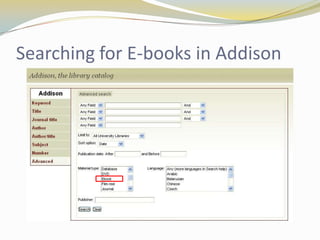
Searching for E-books in Addison
A word on Addison…
 When we receive e-book updates from these
  packages, sometimes there can be a backlog in adding
  the records to Addison (the library catalog).

 If you’re looking for a tech manual, for example, or a
  SpringerLink book, check Safari and SpringerLink
  before requesting a book via ILL
E-Book Packages at University
Libraries
   ACS Symposium Series
   APA PsycBOOKS
   Gale
   Center for Research Libraries
   EBL
   Ebooks on EBSCOhost
   ebrary
   CRC Engineering Handbooks Online
   HathiTrust Digital Library
   Knovel
   National Academies Press
   Safari Books Online
   SpringLink eBooks
   Synthesis Digital Library
   And even more…

http://www.lib.vt.edu/find/byformat/ebooks.html
A word on users & accounts
 Multi- v. single-user


 Creating an account


 “Checking out” a book
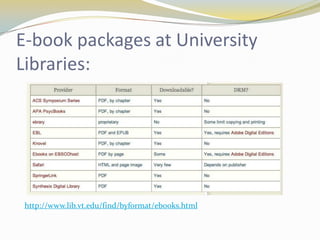
E-book packages at University
Libraries:


 http://www.lib.vt.edu/find/byformat/ebooks.html
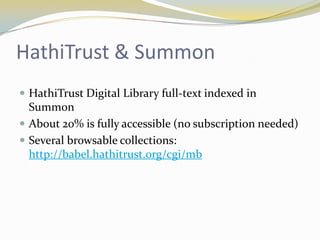
HathiTrust & Summon
 HathiTrust Digital Library full-text indexed in
  Summon
 About 20% is fully accessible (no subscription needed)
 Several browsable collections:
  http://babel.hathitrust.org/cgi/mb
Digital Rights Management
 Essentially restricts the way you can interact with a
  PDF’s content:

   Printing
   Downloading
   Viewing
   “Checkout” period
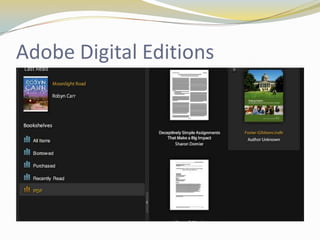
Adobe Digital Editions
 Is required by some e-book providers, like Ebsco E-
  books
 Is used to manage the e-b0oks, and recognize the
  DRM restrictions placed on this content
 Is available:
  http://www.adobe.com/products/digitaleditions/?aut
  oPrompt=true
 Our recommendation? Go ahead and install it if you
  think you may use any type of e-book soon
Adobe Digital Editions
Schubert|it
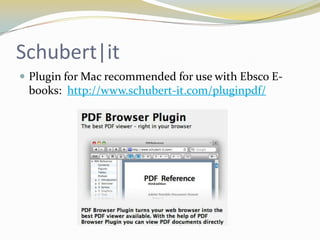
 Plugin for Mac recommended for use with Ebsco E-
 books: http://www.schubert-it.com/pluginpdf/
Beyond University Libraries:
Free, on the web

 Project Gutenberg
 National Academies Press
 Google Books
 OpenLibrary
 Some of HathiTrust
Beyond University Libraries:
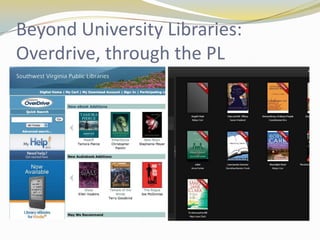
Overdrive, through the PL
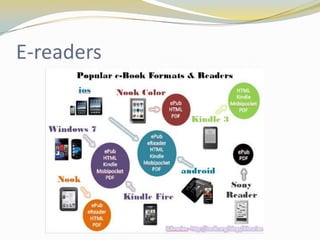
E-readers
PDFs and Documents on Kindle
 Add through USB
 Add through “free” personal document service:
  “yourname”@free.kindle.com (Kindle’s email address)
 Will not work on free Kindle applications
PDFs and Documents on Nook
 Need Adobe Digital Editions
 Drag & drop
 Will sometimes be distorted
Nook and Kindle on iPad
 The Kindle and Nook apps have some restrictions
    With Kindle, cannot use the new Lending Library or the
     free Personal Document Service

 Basically, allow you to sync with what you are reading
  on your dedicated e-reader
More on the iPad
 Reading e-books from University Libraries on an
 iPad, or other tablet, should be relatively simple.

 Simply pull up the material (PDF, html), and then read
 it as you would on another computer.

 Tablet v. dedicated e-reader
Final Thoughts
 We will only be adding more and more e-content in
  the coming years
 Most, if not all, can easily be accessed through a
  desk/laptop, but we’re still seeing how publishers work
  with tablets and dedicated e-readers
 Right now, the e-book landscape is incredibly
  diverse—no two platforms are alike!
 If you have questions, do not hesitate to contact one of
  us at University Libraries!
Resources
   EDUCAUSE. (2011). E-books: Overview. Retrieved from
    http://www.educause.edu/Resources/Browse/EBooks/30539
   McCarthy, D. (March/April 2011). E-reading: the transition in higher education. EDUCAUSE
    Review, 46(2). Retrieved from
    http://www.educause.edu/EDUCAUSE+Review/EDUCAUSEReviewMagazineVolume46/iMobilePers
    pectivesOnebooksibr/226161
   Head, A.J., and Eisenberg, M.B. (October 2011). Balancing act: how college students manage
    technology while in library during crunch time. Project Information Literacy Research Report.
    Retrieved from http://projectinfolit.org/pdfs/PIL_Fall2011_TechStudy_FullReport1.1.pdf
   Keller, M. (7 Mar., 2011). Library consortia begin to vote against HarperCollins ebook checkout policy.
    Libraryjournal.com. Retrieved from http://www.libraryjournal.com/lj/home/889582-
    264/library_consortia_begin_to_vote.html.csp
   Li, C., et al. (May 2011). Springer e-book pilot project: reader assessment subcomittee. Retrieved
    from http://www.cdlib.org/services/uxdesign/docs/2011/academic_ebook_usage_survey.pdf
   Polanka, S. (27 Mar., 2012). Bowker releases results of global ebook research. Retrieved from
    http://www.libraries.wright.edu/noshelfrequired/2012/03/27/bowker-releases-results-of-global-
    ebook-research/
   Polanka, S. (20 Mar., 2012). New LRG study. Retrieved from
    http://www.libraries.wright.edu/noshelfrequired/2012/03/20/new-lrg-study-74-of-libraries-report-
    increased-demand-for-electronic-offerings/#more-4528
Questions?
Contact us!

Rebecca K. Miller
millerrk@vt.edu
http://rebeccakatemiller.com

Carolyn Meier
cmeier@vt.edu

Finding and Using E-Books

  • 1.
    Rebecca K. Miller Carolyn Meier Faculty Development Institute Virginia Tech March 2012
  • 2.
    About Us Rebecca K. Miller is the College Librarian for Science, Life Sciences, and Engineering Carolyn Meier is the First Year Experience Librarian
  • 3.
    Session Overview  Thecurrent state of e-books  E-books in higher education  Searching for e-books in Addison  E-book packages at University Libraries  Accessing University Libraries e-books  Beyond University Libraries
  • 4.
    E-Books: A History Let’s look at an infographic: http://thenextweb.com/shareables/2011/03/17/the-40- year-history-of-ebooks-illustrated/  E-books have been around for 30 years  The advent of devoted e-readers has changed the game
  • 5.
    Video: The Futureof the Book http://vimeo.com/15142335
  • 6.
    Recent Bowker Study Australia, India, UK, and US are world leaders in e- book adoption rates—20% of respondent have purchased an e-book in the past 6 months  1/3 respondents in the US and UK indicated they would be buying an e-book soon  In UK and US, purchase rates are highest among 24-35 year olds  Genre: in UK and Australia, concentration on adult fiction; in India and South Korea, concentration on professional and academic
  • 7.
    Libraries & E-books Libraries want to deliver resources to users, no matter where they are; e-books aid in this endeavor  E-books also play a role in libraries’ new visions of way that library space can be used  E-books are often purchased in packages  Recent LRG report: 64% of libraries are reporting rising demand from patrons for e-book access (up from 41% last year)
  • 8.
    Three Layers  Arecent EDUCAUSE review article (see “resources”) identified three layers of e-reading:  Hardware  Software & controls  Content
  • 9.
    Hardware  What doyou read e-books on?  Computer? Dedicated e-reader? Tablet?  Study v. “Trade” Reading  Optimal “study” reading device:  10 in. or larger color screen  at least 5-8 hours of battery life  adequate “entry” mechanism (keyboard, mouse)  32 GB or more memory  multitasking In short…a laptop!
  • 10.
    Software & Controls Highlighting  Tagging  Full text searching  Accessibility (visual and physical)  Also includes:  DRM  Special software needed to read book (e.g. Adobe Digital Editions or Schubert)
  • 11.
    Content  Currently, lessthan 20% of content requested by faculty is available in a digital format  The content that IS available is mainly static reproductions of the print textbook—not at all the vision of the “future” e-book  What’s more: some content that is available for individual purchase is not yet available for institutional purchase
  • 12.
    Students Using Textbooks Anotherinfographic! http://www.mediabistro.com/ebooknewser/a-look-at- students-using-etextbooks-infographic_b21348
  • 13.
  • 14.
    A word onAddison…  When we receive e-book updates from these packages, sometimes there can be a backlog in adding the records to Addison (the library catalog).  If you’re looking for a tech manual, for example, or a SpringerLink book, check Safari and SpringerLink before requesting a book via ILL
  • 15.
    E-Book Packages atUniversity Libraries  ACS Symposium Series  APA PsycBOOKS  Gale  Center for Research Libraries  EBL  Ebooks on EBSCOhost  ebrary  CRC Engineering Handbooks Online  HathiTrust Digital Library  Knovel  National Academies Press  Safari Books Online  SpringLink eBooks  Synthesis Digital Library  And even more… http://www.lib.vt.edu/find/byformat/ebooks.html
  • 16.
    A word onusers & accounts  Multi- v. single-user  Creating an account  “Checking out” a book
  • 17.
    E-book packages atUniversity Libraries: http://www.lib.vt.edu/find/byformat/ebooks.html
  • 18.
    HathiTrust & Summon HathiTrust Digital Library full-text indexed in Summon  About 20% is fully accessible (no subscription needed)  Several browsable collections: http://babel.hathitrust.org/cgi/mb
  • 19.
    Digital Rights Management Essentially restricts the way you can interact with a PDF’s content:  Printing  Downloading  Viewing  “Checkout” period
  • 20.
    Adobe Digital Editions Is required by some e-book providers, like Ebsco E- books  Is used to manage the e-b0oks, and recognize the DRM restrictions placed on this content  Is available: http://www.adobe.com/products/digitaleditions/?aut oPrompt=true  Our recommendation? Go ahead and install it if you think you may use any type of e-book soon
  • 21.
  • 22.
    Schubert|it  Plugin forMac recommended for use with Ebsco E- books: http://www.schubert-it.com/pluginpdf/
  • 23.
    Beyond University Libraries: Free,on the web  Project Gutenberg  National Academies Press  Google Books  OpenLibrary  Some of HathiTrust
  • 24.
  • 25.
  • 26.
    PDFs and Documentson Kindle  Add through USB  Add through “free” personal document service: “yourname”@free.kindle.com (Kindle’s email address)  Will not work on free Kindle applications
  • 27.
    PDFs and Documentson Nook  Need Adobe Digital Editions  Drag & drop  Will sometimes be distorted
  • 28.
    Nook and Kindleon iPad  The Kindle and Nook apps have some restrictions  With Kindle, cannot use the new Lending Library or the free Personal Document Service  Basically, allow you to sync with what you are reading on your dedicated e-reader
  • 29.
    More on theiPad  Reading e-books from University Libraries on an iPad, or other tablet, should be relatively simple.  Simply pull up the material (PDF, html), and then read it as you would on another computer.  Tablet v. dedicated e-reader
  • 30.
    Final Thoughts  Wewill only be adding more and more e-content in the coming years  Most, if not all, can easily be accessed through a desk/laptop, but we’re still seeing how publishers work with tablets and dedicated e-readers  Right now, the e-book landscape is incredibly diverse—no two platforms are alike!  If you have questions, do not hesitate to contact one of us at University Libraries!
  • 31.
    Resources  EDUCAUSE. (2011). E-books: Overview. Retrieved from http://www.educause.edu/Resources/Browse/EBooks/30539  McCarthy, D. (March/April 2011). E-reading: the transition in higher education. EDUCAUSE Review, 46(2). Retrieved from http://www.educause.edu/EDUCAUSE+Review/EDUCAUSEReviewMagazineVolume46/iMobilePers pectivesOnebooksibr/226161  Head, A.J., and Eisenberg, M.B. (October 2011). Balancing act: how college students manage technology while in library during crunch time. Project Information Literacy Research Report. Retrieved from http://projectinfolit.org/pdfs/PIL_Fall2011_TechStudy_FullReport1.1.pdf  Keller, M. (7 Mar., 2011). Library consortia begin to vote against HarperCollins ebook checkout policy. Libraryjournal.com. Retrieved from http://www.libraryjournal.com/lj/home/889582- 264/library_consortia_begin_to_vote.html.csp  Li, C., et al. (May 2011). Springer e-book pilot project: reader assessment subcomittee. Retrieved from http://www.cdlib.org/services/uxdesign/docs/2011/academic_ebook_usage_survey.pdf  Polanka, S. (27 Mar., 2012). Bowker releases results of global ebook research. Retrieved from http://www.libraries.wright.edu/noshelfrequired/2012/03/27/bowker-releases-results-of-global- ebook-research/  Polanka, S. (20 Mar., 2012). New LRG study. Retrieved from http://www.libraries.wright.edu/noshelfrequired/2012/03/20/new-lrg-study-74-of-libraries-report- increased-demand-for-electronic-offerings/#more-4528
  • 32.
    Questions? Contact us! Rebecca K.Miller millerrk@vt.edu http://rebeccakatemiller.com Carolyn Meier cmeier@vt.edu

Editor's Notes

  • #14 Let’s just explore this: DEMO
  • #18 Let’s explore a few of these…DEMO