HNFE 3224:  Understanding Social InformationRebecca Millermillerrk@vt.edu OR hnfelibrarian@vt.edu540-231-9669
Class OverviewBrief demonstration of resourcesDefine and discuss “social information”Online identity managementBloggingBlogging with the HNFE Librarian (extra credit assignment!)Identification of relevant library resourcesDiscussion of APA citations and style guideEvaluating web resources (discussion & activity)Evaluating blogsMore Web 2.0 productivity tools (if time permits)
Resources for this CourseI’ve created several resources specifically for this course:HNFE 3224 Library Course GuideSocial Media for Nutrition and Food ePortfolioBasic information and resources about social media tools (books, journal articles, etc.)Additionally, this is available on Slideshare:  http://www.slideshare.net/millerrk
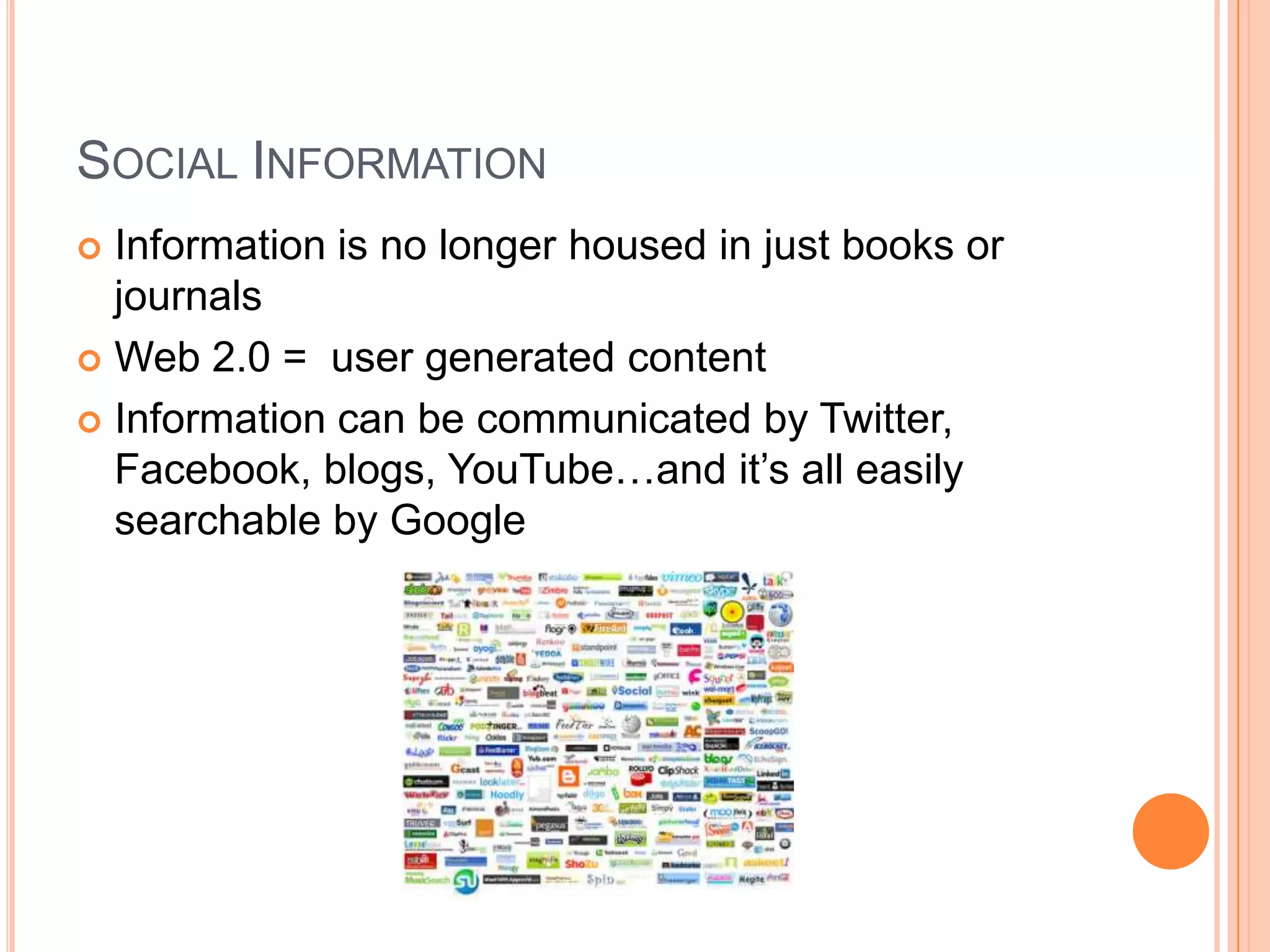
Social InformationInformation is no longer housed in just books or journalsWeb 2.0 =  user generated contentInformation can be communicated by Twitter, Facebook, blogs, YouTube…and it’s all easily searchable by Google
Social Information Pros & ConsPros:You can communicate with all sorts of people, in all sorts of locationsIt’s easy to publish and create informationYour digital actions can define your professional reputation and image!Cons:You can communicate with all sorts of people, in all sorts of locationsIt’s easy to publish and create informationYour digital actions can define your professional reputation and image!
Consuming Social InformationYou are already a “social information consumer”Do you have a social networking page?Do you ever read comments at the end of news stories?What websites do you regularly visit?  Do you read blogs and receive regular updates?	How do you think you’re a social information consumer?How do you determine what information is good information, when anyone can post or edit information?  (We’ll talk about this more later)
Creating Social InformationMost likely, you’re also already a creator of social information:Do you post updates on a social networking or blogging site?Do you ever write comments on news stories?Do you develop or update web pages?Have you been quoted in a news story	You’ve already put a lot of information “out there.”  The question is, what message are you sending?
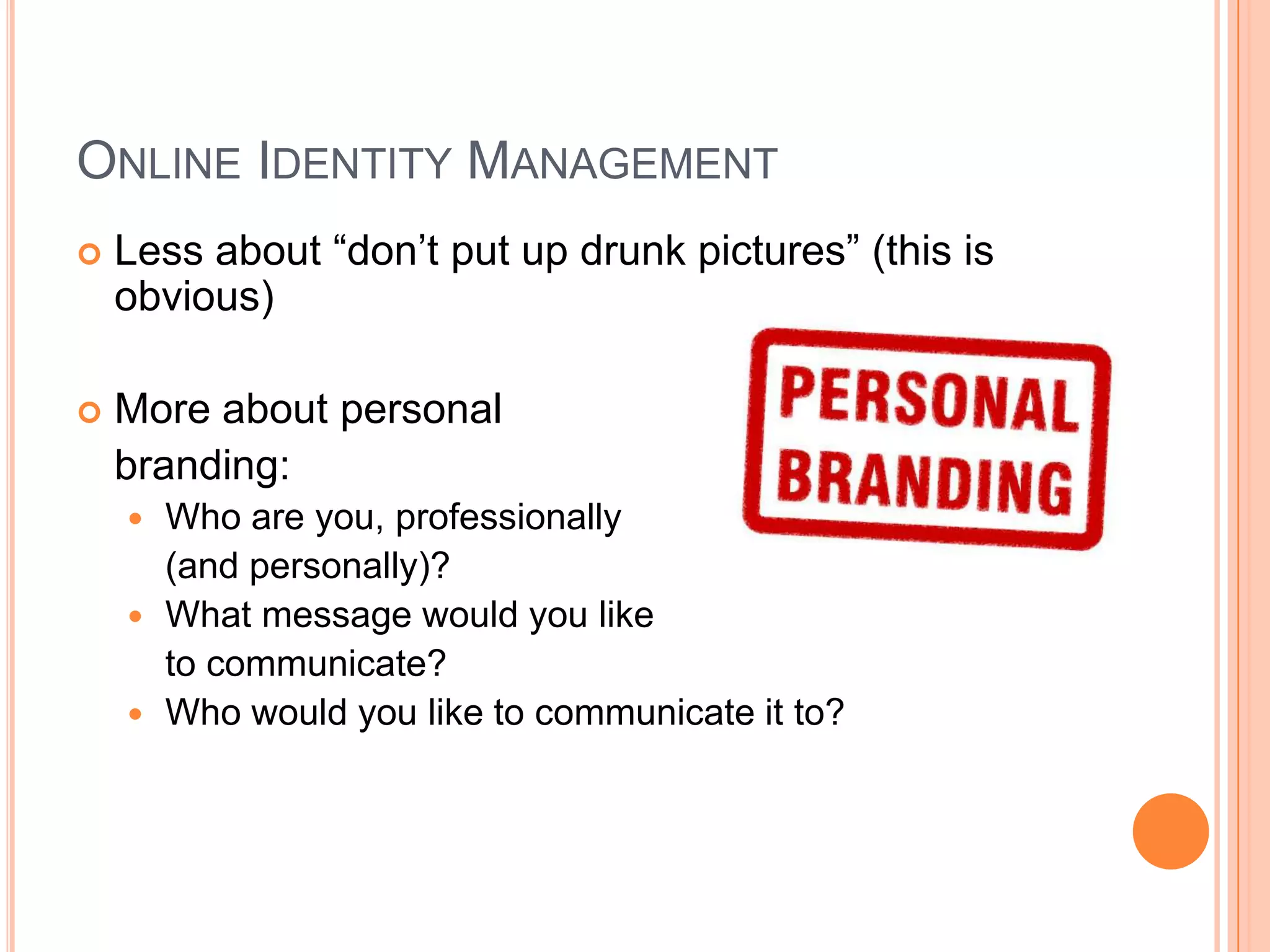
Online Identity ManagementLess about “don’t put up drunk pictures” (this is obvious) More about personal branding:Who are you, professionally (and personally)?What message would you like to communicate?Who would you like to communicate it to?
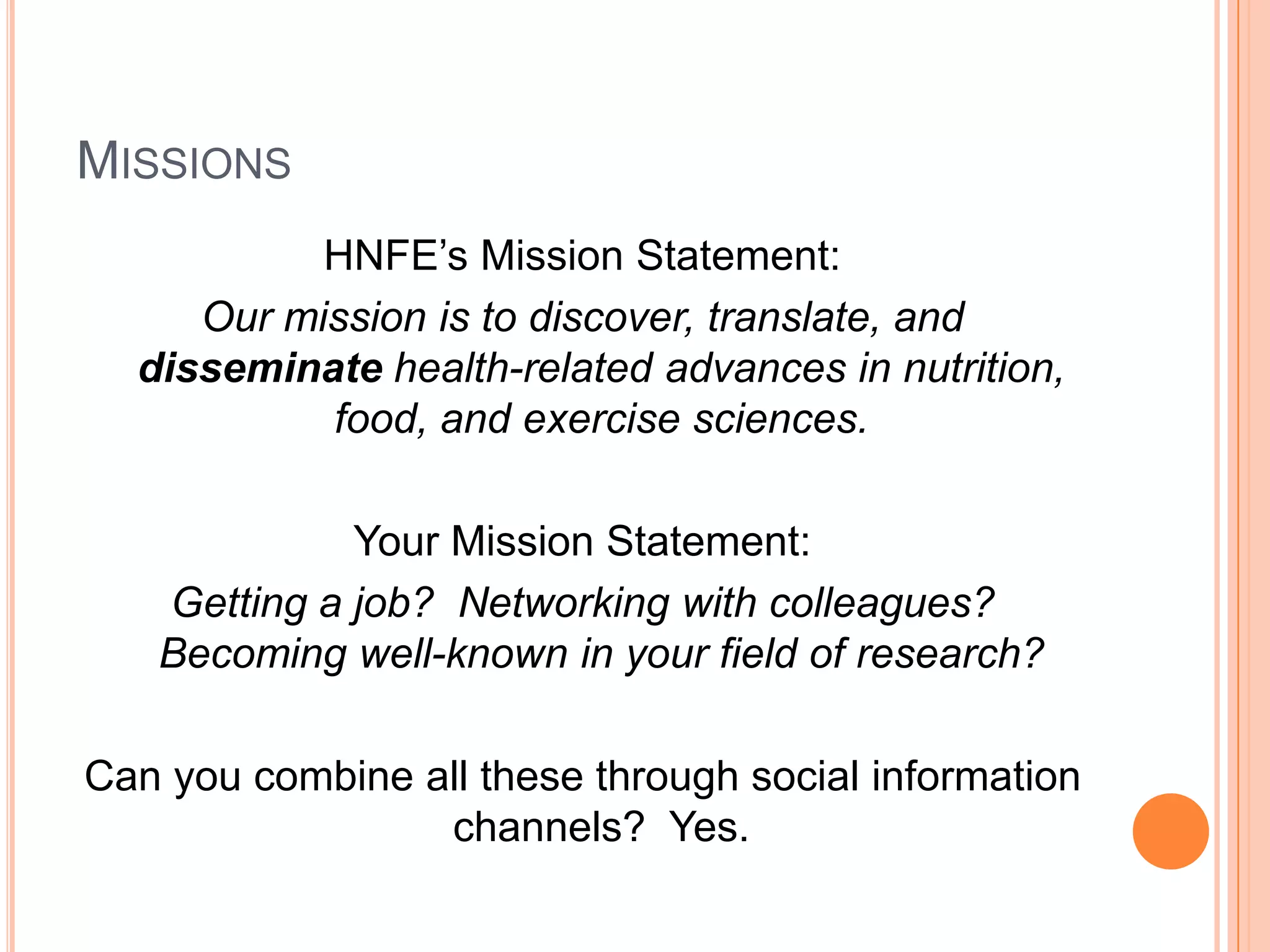
MissionsHNFE’s Mission Statement:Our mission is to discover, translate, and disseminate health-related advances in nutrition, food, and exercise sciences.Your Mission Statement:Getting a job?  Networking with colleagues?  Becoming well-known in your field of research?Can you combine all these through social information channels?  Yes.
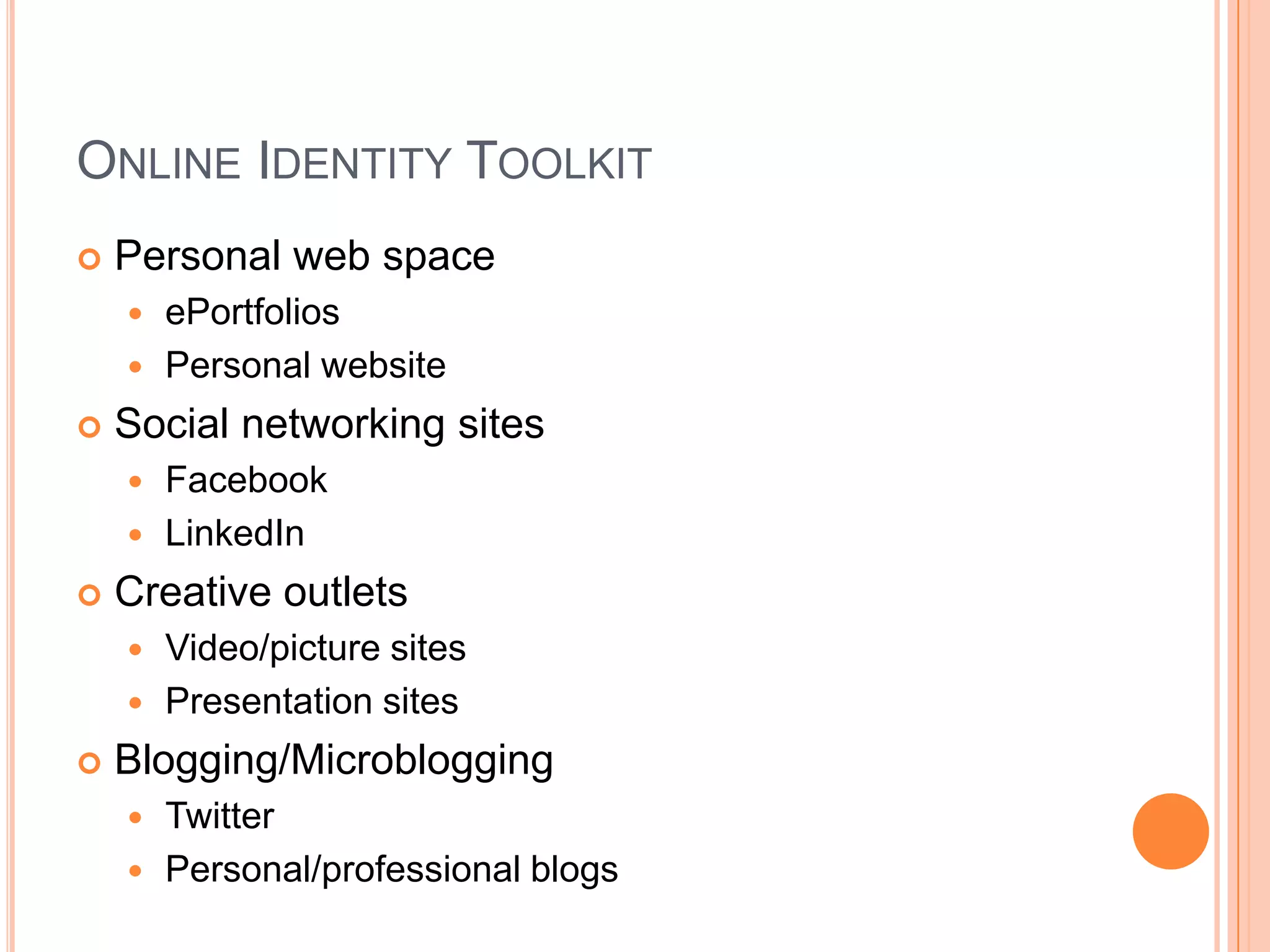
Online Identity ToolkitPersonal web spaceePortfoliosPersonal websiteSocial networking sitesFacebookLinkedInCreative outletsVideo/picture sitesPresentation sitesBlogging/MicrobloggingTwitterPersonal/professional blogs
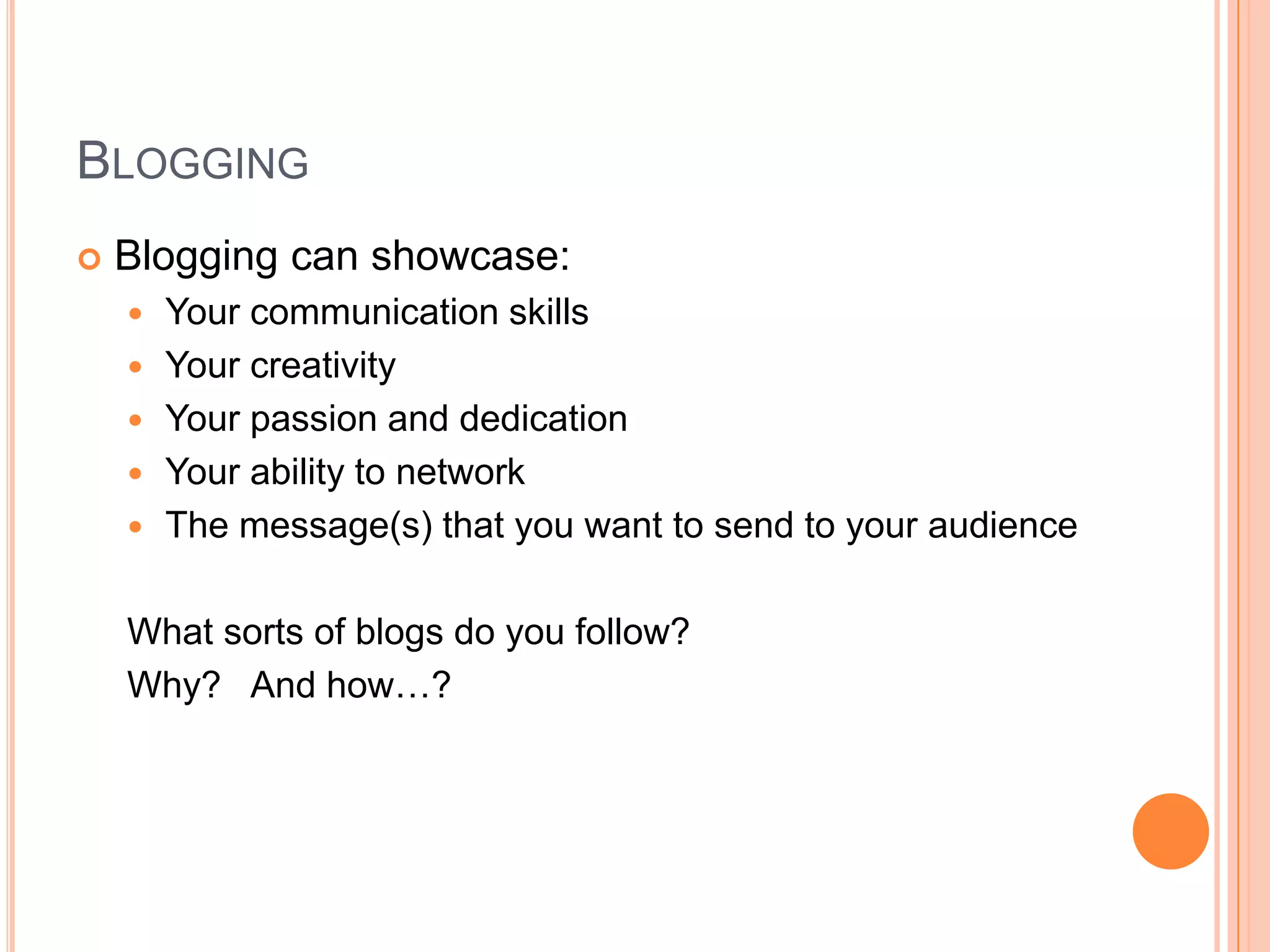
BloggingBlogging can showcase:Your communication skillsYour creativity Your passion and dedicationYour ability to networkThe message(s) that you want to send to your audienceWhat sorts of blogs do you follow?Why?   And how…?
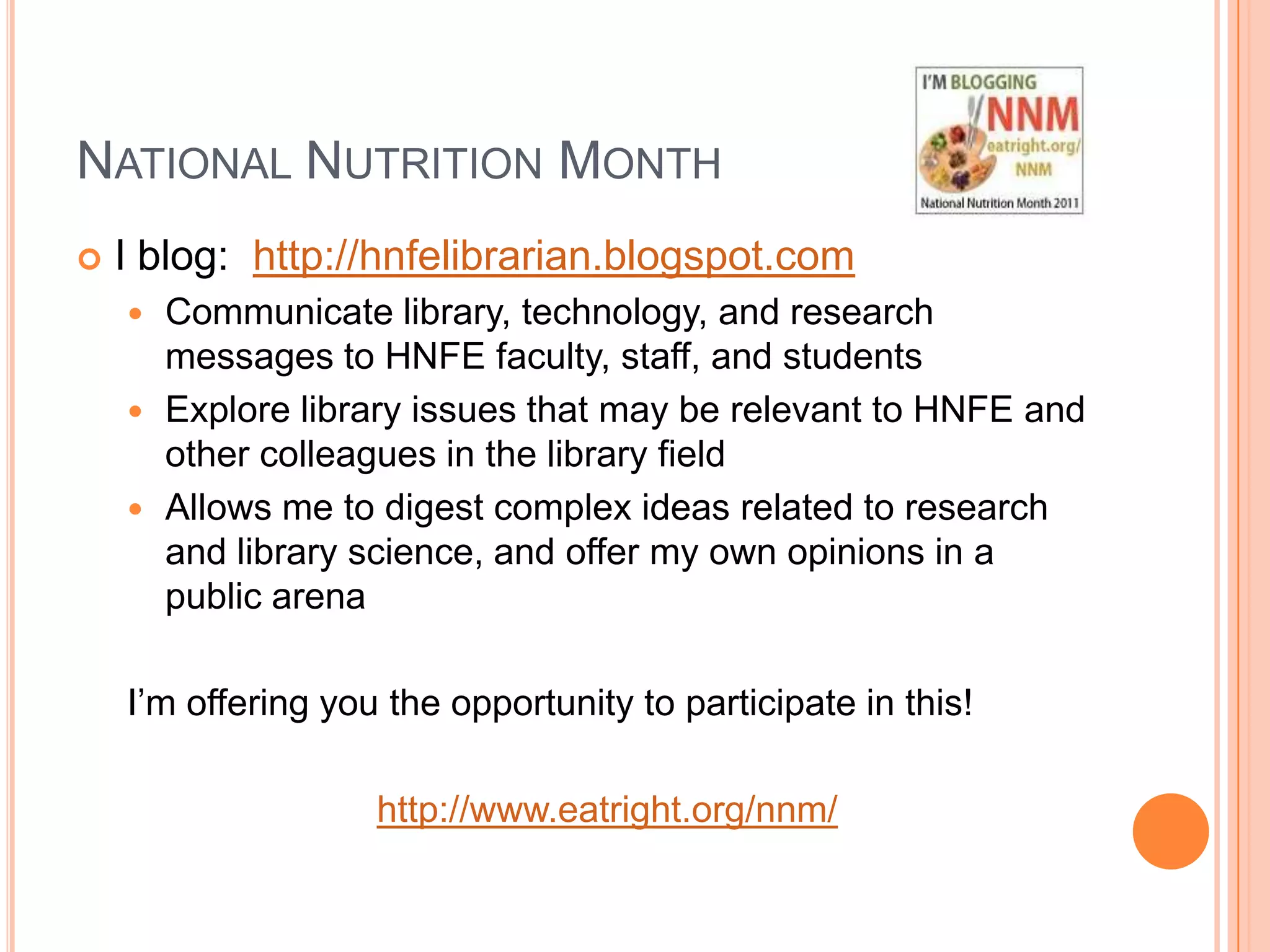
National Nutrition MonthI blog:  http://hnfelibrarian.blogspot.comCommunicate library, technology, and research messages to HNFE faculty, staff, and studentsExplore library issues that may be relevant to HNFE and other colleagues in the library fieldAllows me to digest complex ideas related to research and library science, and offer my own opinions in a public arenaI’m offering you the opportunity to participate in this! http://www.eatright.org/nnm/
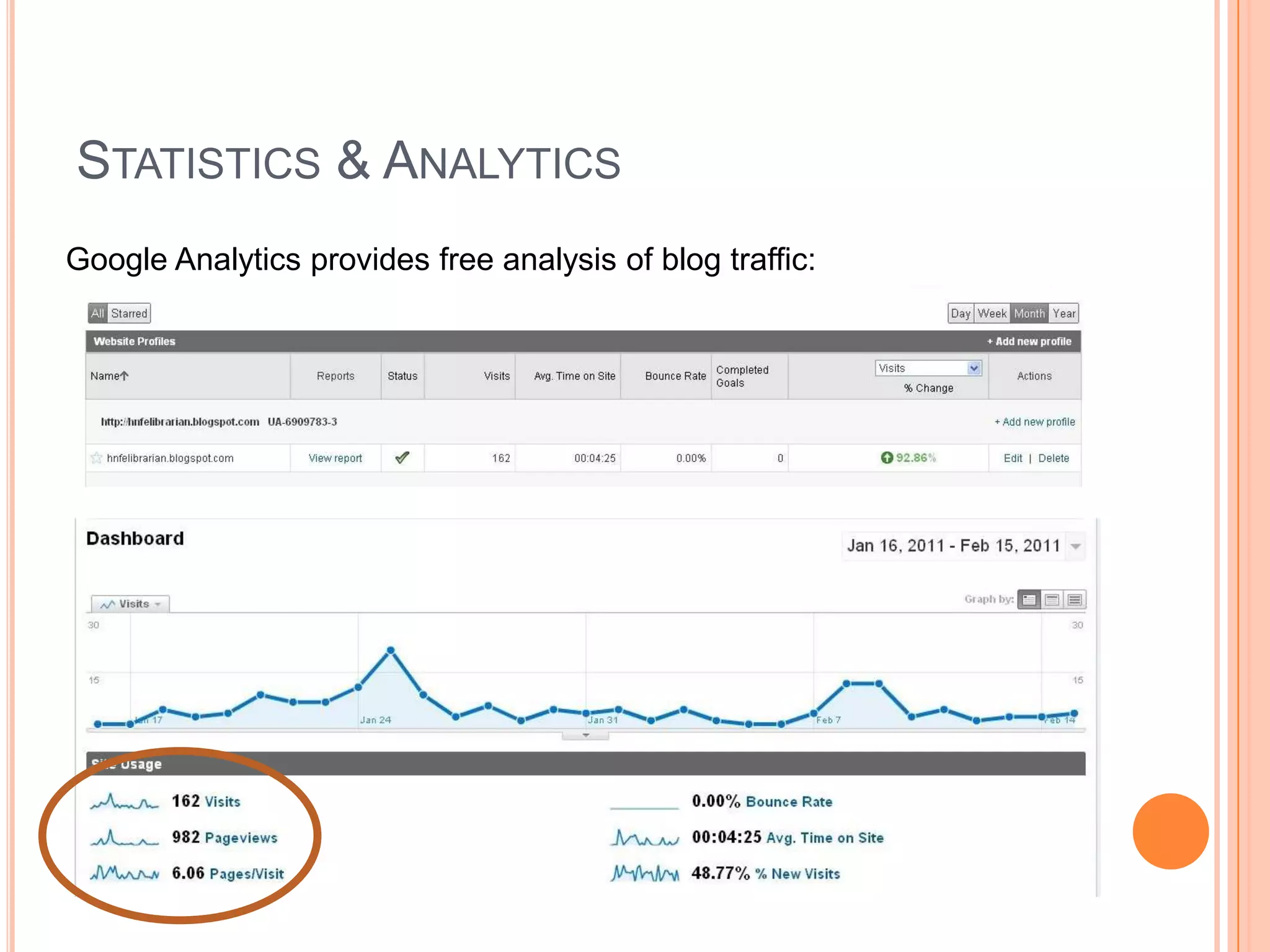
Statistics & AnalyticsGoogle Analytics provides free analysis of blog traffic:
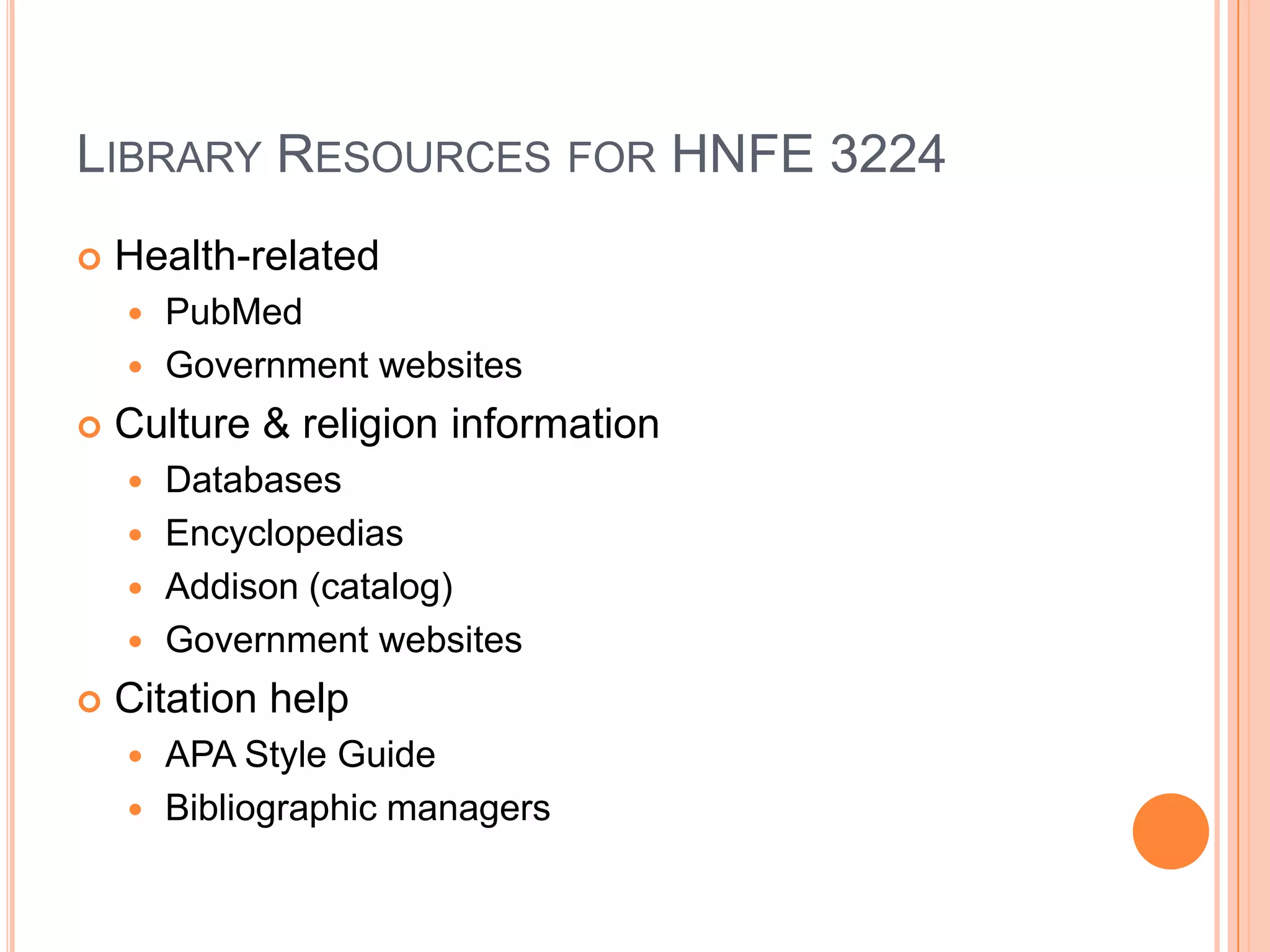
Library Resources for HNFE 3224Health-relatedPubMedGovernment websitesCulture & religion informationDatabasesEncyclopediasAddison (catalog)Government websitesCitation helpAPA Style GuideBibliographic managers
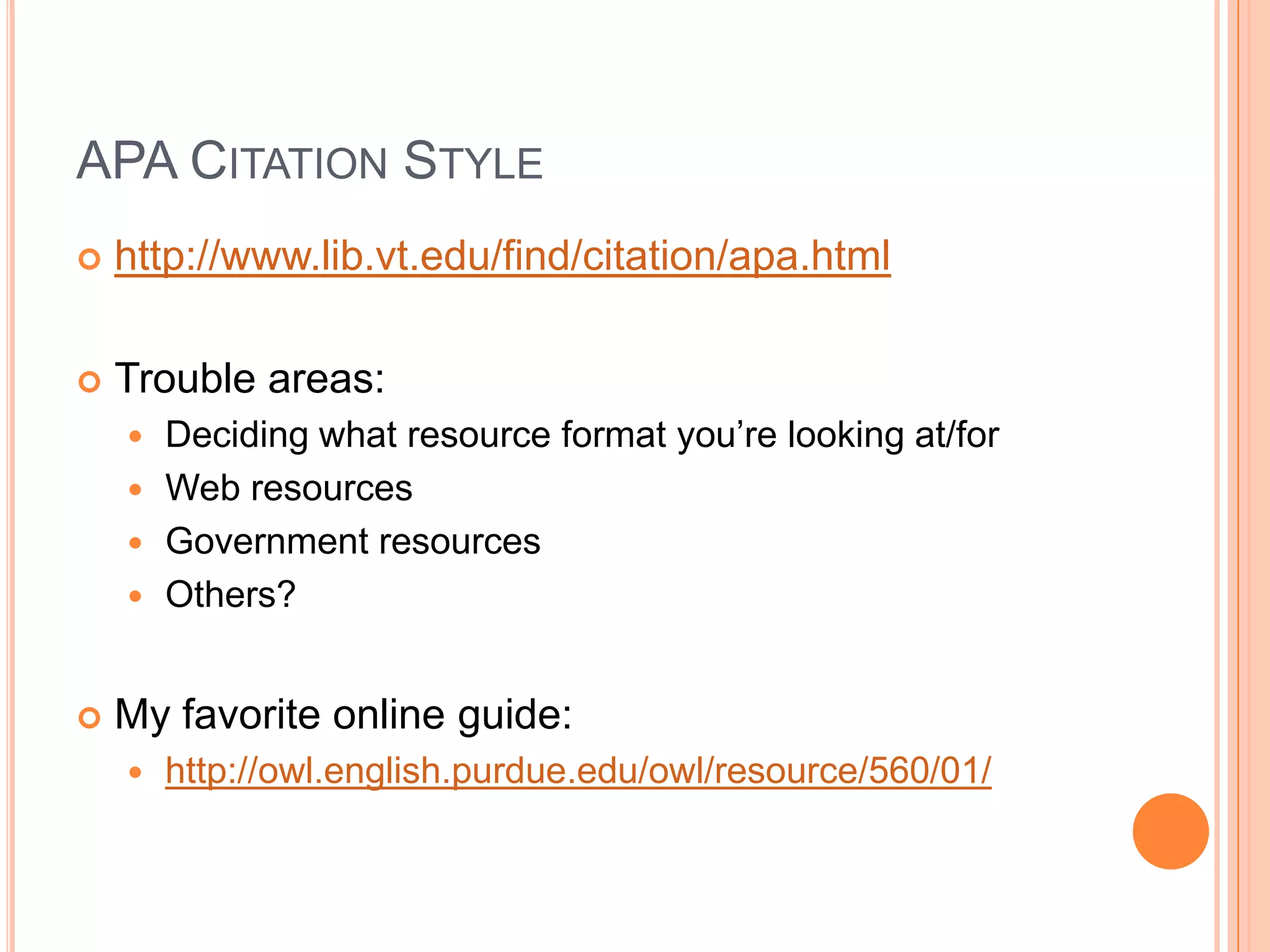
APA Citation Style http://www.lib.vt.edu/find/citation/apa.htmlTrouble areas:Deciding what resource format you’re looking at/forWeb resourcesGovernment resourcesOthers?My favorite online guide:http://owl.english.purdue.edu/owl/resource/560/01/
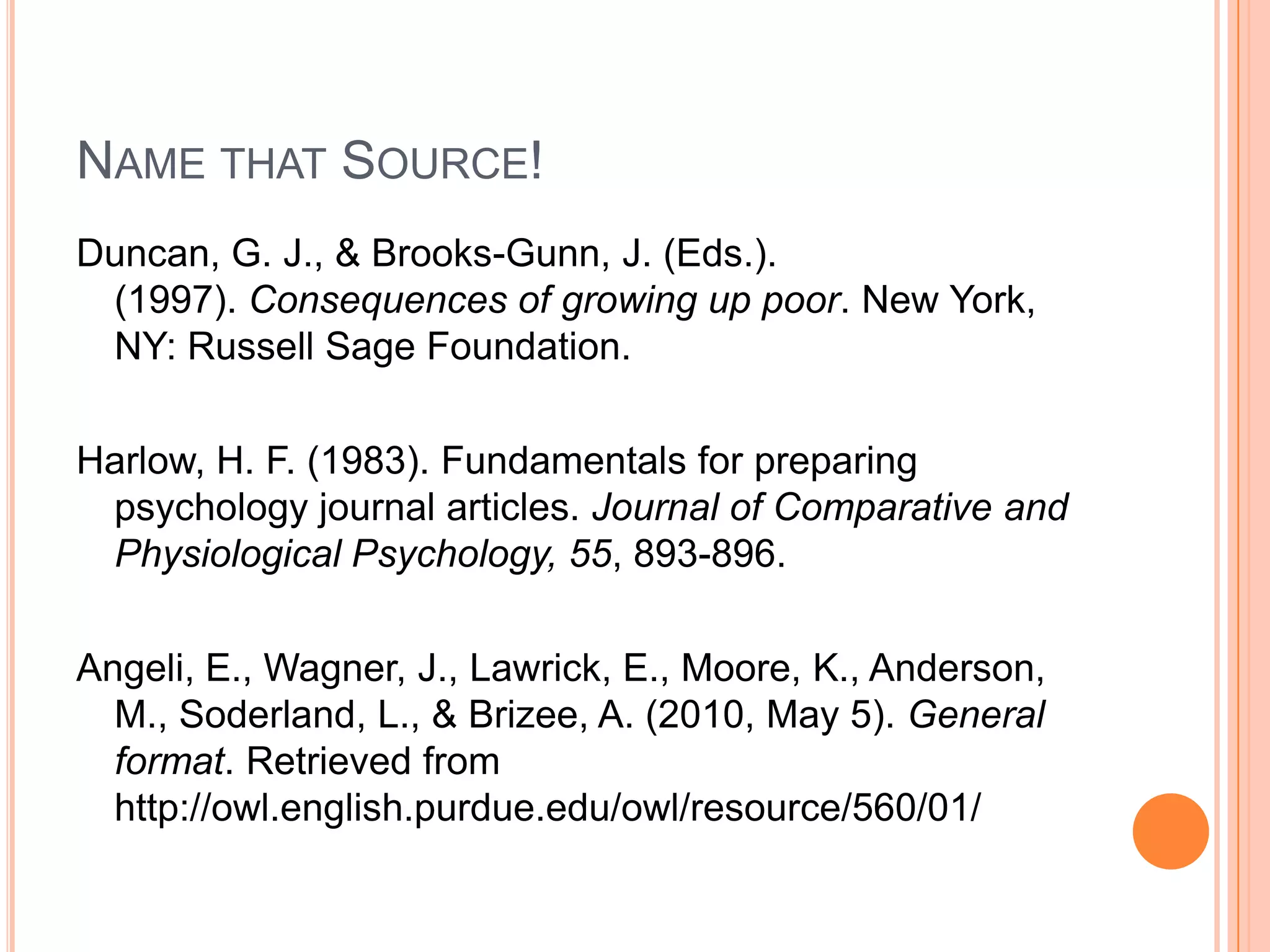
Name that Source!Duncan, G. J., & Brooks-Gunn, J. (Eds.). (1997). Consequences of growing up poor. New York, NY: Russell Sage Foundation.Harlow, H. F. (1983). Fundamentals for preparing psychology journal articles. Journal of Comparative and Physiological Psychology, 55, 893-896.Angeli, E., Wagner, J., Lawrick, E., Moore, K., Anderson, M., Soderland, L., & Brizee, A. (2010, May 5). General format. Retrieved from http://owl.english.purdue.edu/owl/resource/560/01/
Evaluating Web ResourcesRecent research (from Project Information Literacy) indicates that most students engage in a critical evaluation of resources found on the web, but rarely (fewer than 50% of students surveyed) ask instructors or librarians for help because:None of the old-timers—the professors—can really give us much advice on sorting through and evaluating resources.  I think we’re kind of one of the first generations to have too much information, as opposed to too little.  We’ve never had instruction really on navigating the Internet and picking out good resources.  We’ve been kind of tossed into this and we’ve just learned through experience we have to go on a Web site and just raid it for information.  So I would say that despite all that’s out there, it certainly is harder to find the right source and evaluate whether it’s good, or not, because there’s so much—you only have a little bit of time to spedn on each source you find  [Engineering student from study]
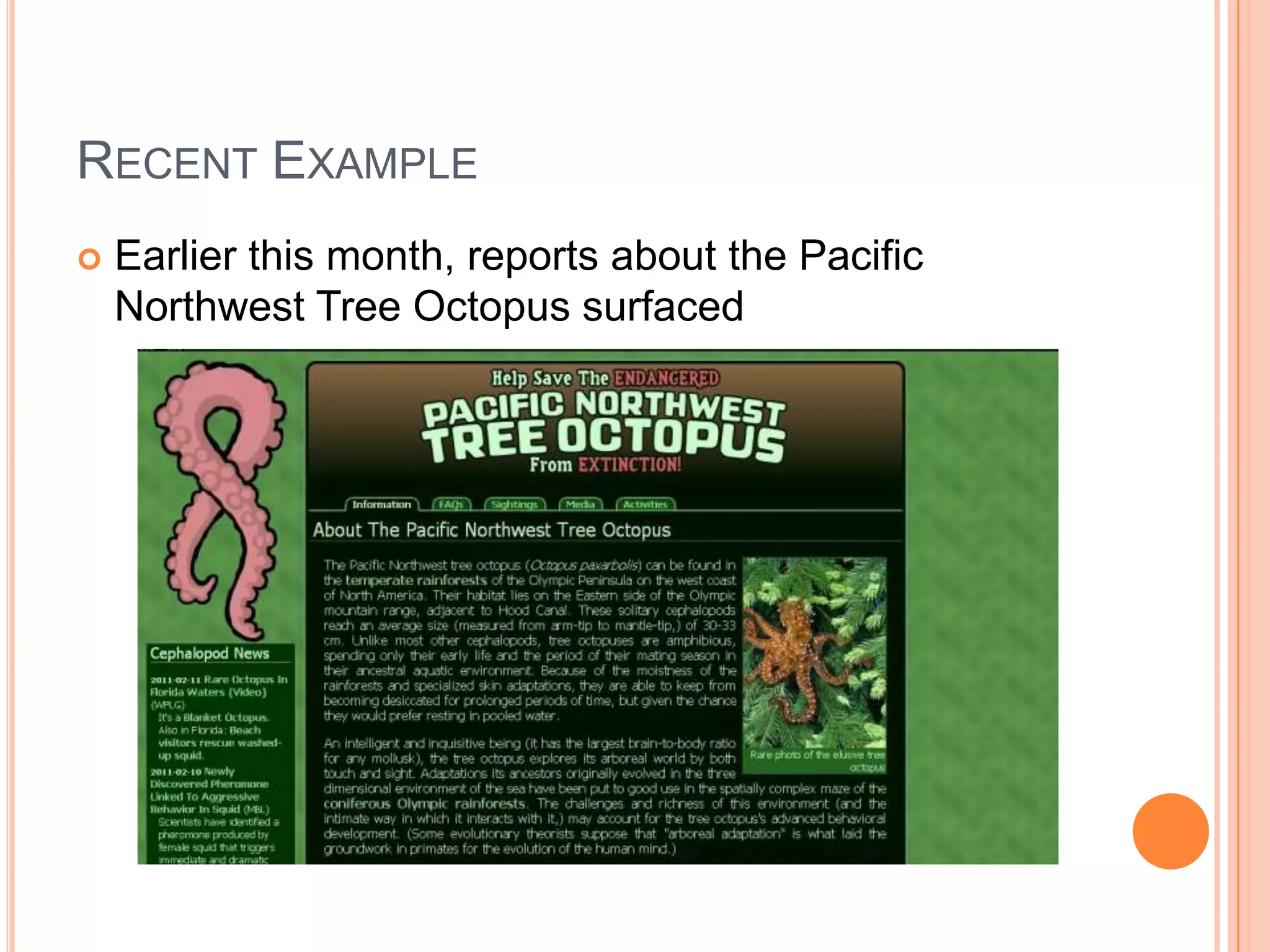
Recent ExampleEarlier this month, reports about the Pacific Northwest Tree Octopus surfaced
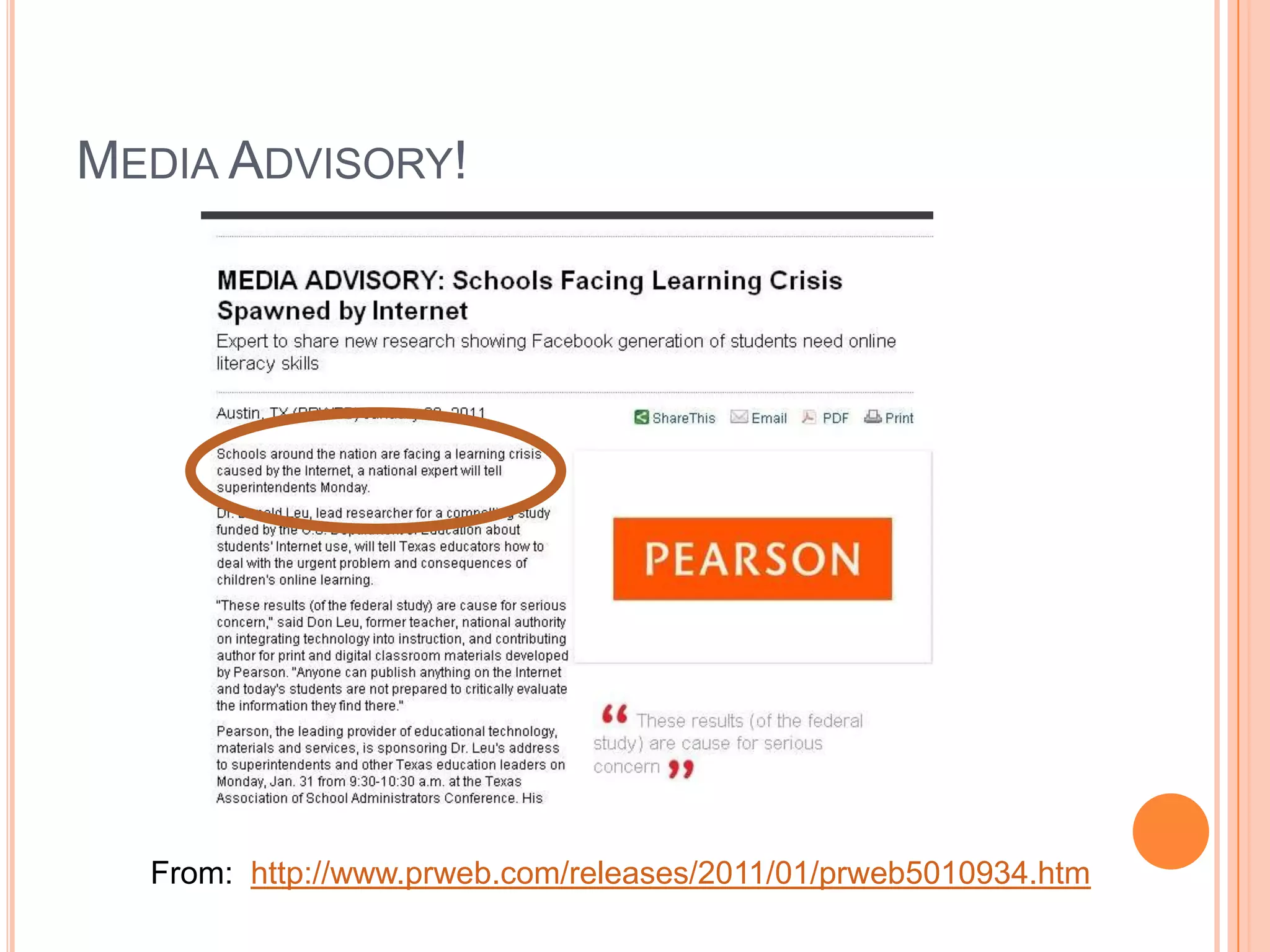
Media Advisory!From:  http://www.prweb.com/releases/2011/01/prweb5010934.htm
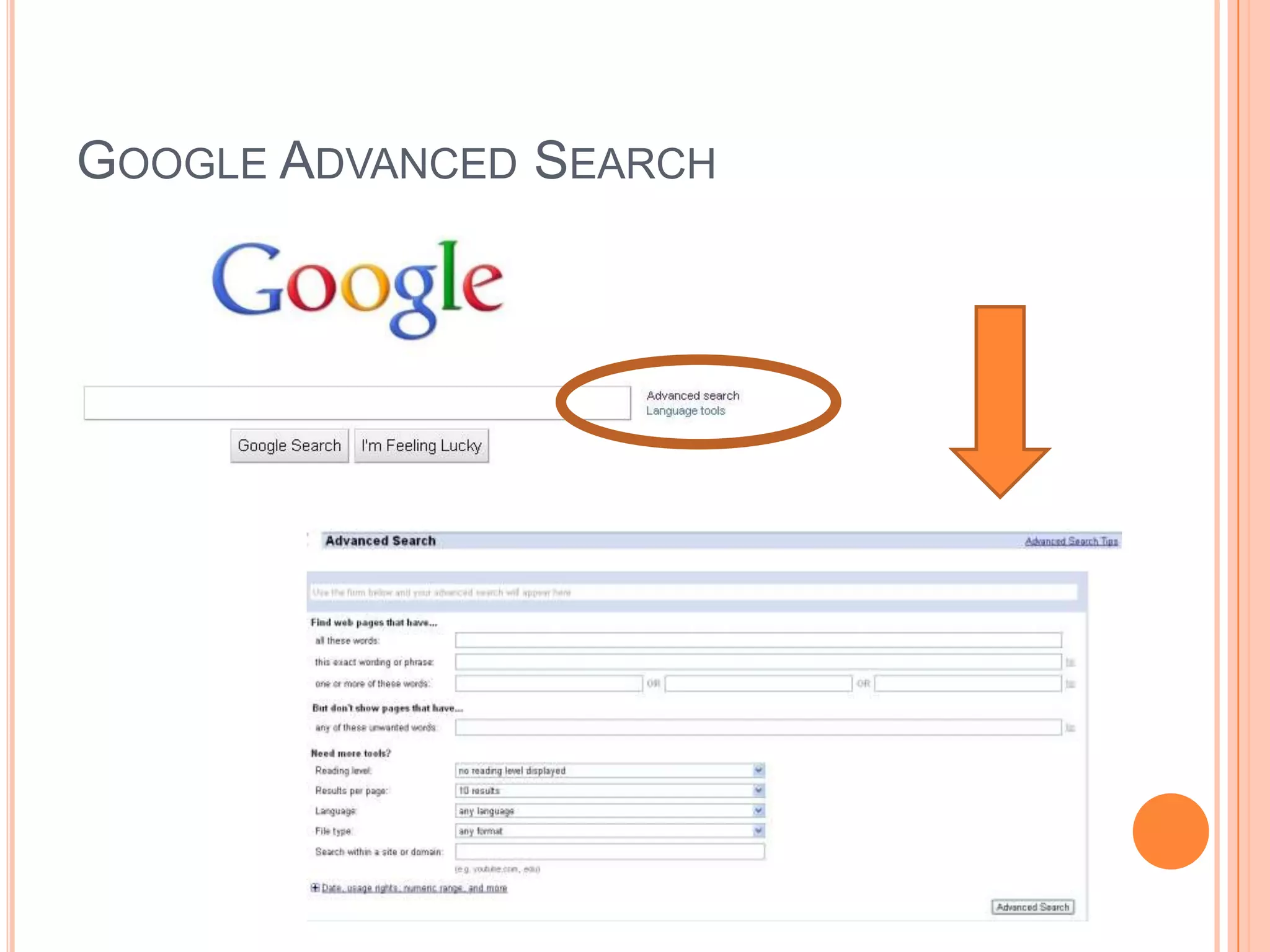
Effective Searching & EvaluatingUsing Google, and Google Scholar, efficientlyDemonstrationView next slide for screenshot of thisCritically thinking about the resources that you find there.Activity:  In groups of 3 or 4, come up with a list of evaluation criteria that you usually use when you look for resources on the Internet.  We will report back and discuss in five minutes:http://www.online-stopwatch.com/online-countdown/
Google Advanced Search
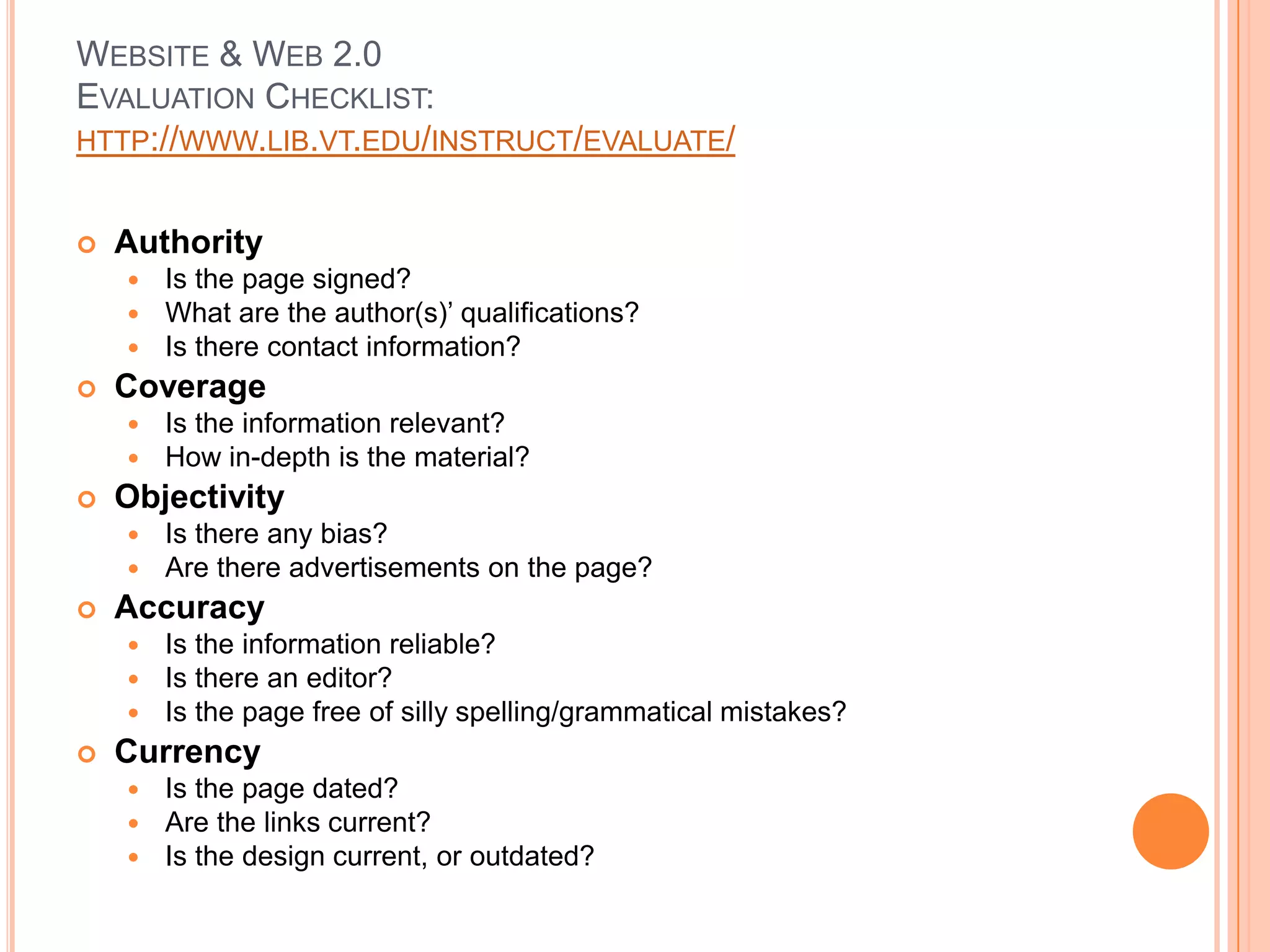
Website & Web 2.0 Evaluation Checklist:  http://www.lib.vt.edu/instruct/evaluate/AuthorityIs the page signed?What are the author(s)’ qualifications?Is there contact information?CoverageIs the information relevant?How in-depth is the material?ObjectivityIs there any bias?Are there advertisements on the page?AccuracyIs the information reliable?  Is there an editor?Is the page free of silly spelling/grammatical mistakes?CurrencyIs the page dated?Are the links current?Is the design current, or outdated?
Let’s examine some Blogs…http://thepaleodiet.blogspot.com/http://nutritionnibbles.blogspot.com/http://www.foodinsight.org/blog.aspx
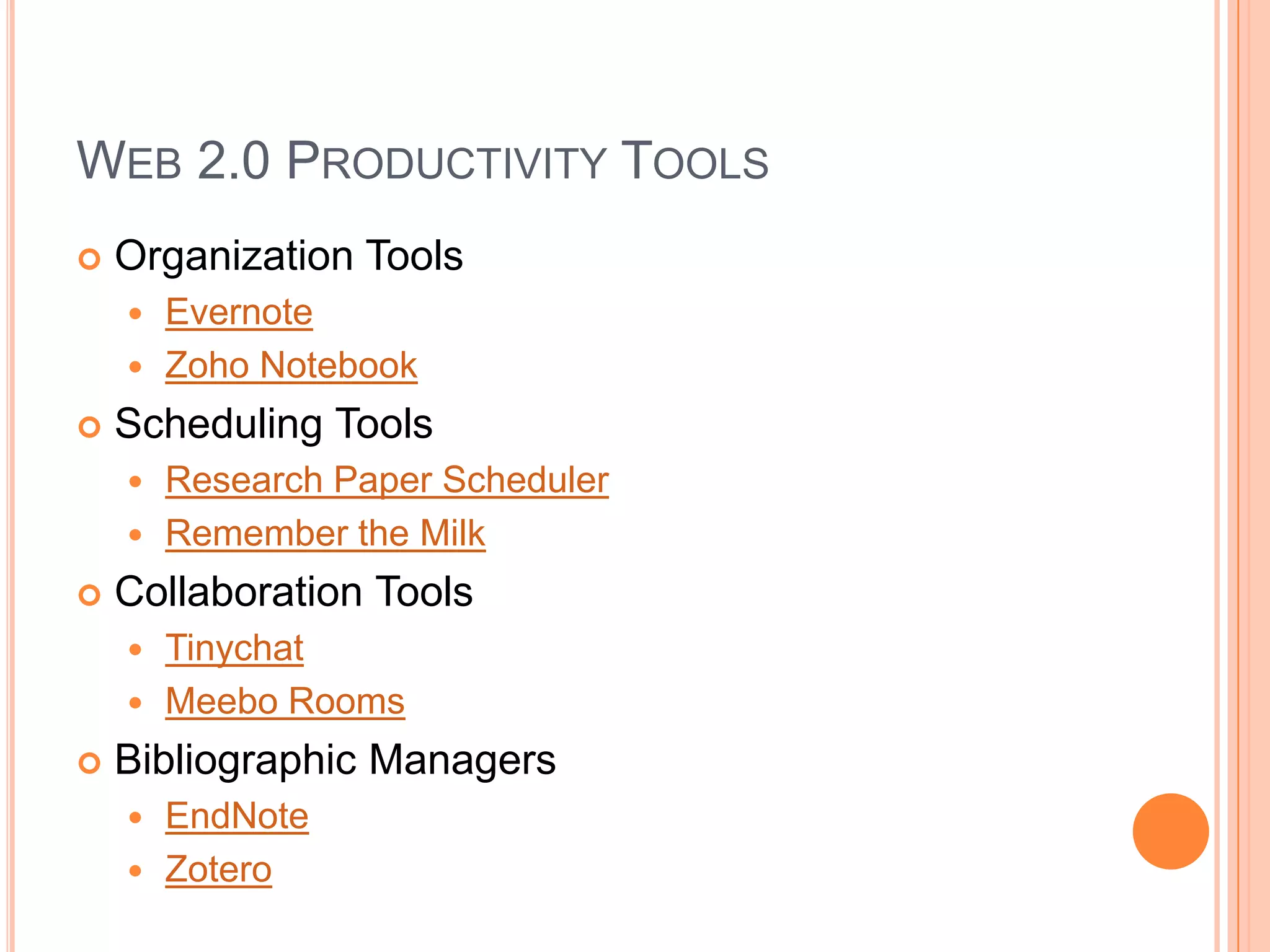
Web 2.0 Productivity ToolsOrganization ToolsEvernoteZoho NotebookScheduling ToolsResearch Paper SchedulerRemember the MilkCollaboration ToolsTinychatMeebo RoomsBibliographic ManagersEndNoteZotero
Blog With Me!Extra credit:  up to 20 pointsDue February 28Will be posted on Notes from Newman blog, which will appear on the National Nutrition Month blog roll for eatright.org—an opportunity for national exposureThink about this as an opportunity for promoting your message AND promoting yourself, as an emerging professionalQuestions or comments?
Thank you!Contact me if you have any lingering questions:Rebecca Millerhnfelibrarian@vt.edu5004 Newman Library540-231-9669Office Hours:Atrium, Wallace HallTuesdays, 2:00-3:30 p.m.Wednesdays, 9:00-10:30 a.m.http://hnfelibrarian.blogspot.com

HNFE 3224: Understanding Social Information

  • 1.
    HNFE 3224: Understanding Social InformationRebecca Millermillerrk@vt.edu OR hnfelibrarian@vt.edu540-231-9669
  • 2.
    Class OverviewBrief demonstrationof resourcesDefine and discuss “social information”Online identity managementBloggingBlogging with the HNFE Librarian (extra credit assignment!)Identification of relevant library resourcesDiscussion of APA citations and style guideEvaluating web resources (discussion & activity)Evaluating blogsMore Web 2.0 productivity tools (if time permits)
  • 3.
    Resources for thisCourseI’ve created several resources specifically for this course:HNFE 3224 Library Course GuideSocial Media for Nutrition and Food ePortfolioBasic information and resources about social media tools (books, journal articles, etc.)Additionally, this is available on Slideshare: http://www.slideshare.net/millerrk
  • 4.
    Social InformationInformation isno longer housed in just books or journalsWeb 2.0 = user generated contentInformation can be communicated by Twitter, Facebook, blogs, YouTube…and it’s all easily searchable by Google
  • 5.
    Social Information Pros& ConsPros:You can communicate with all sorts of people, in all sorts of locationsIt’s easy to publish and create informationYour digital actions can define your professional reputation and image!Cons:You can communicate with all sorts of people, in all sorts of locationsIt’s easy to publish and create informationYour digital actions can define your professional reputation and image!
  • 6.
    Consuming Social InformationYouare already a “social information consumer”Do you have a social networking page?Do you ever read comments at the end of news stories?What websites do you regularly visit? Do you read blogs and receive regular updates? How do you think you’re a social information consumer?How do you determine what information is good information, when anyone can post or edit information? (We’ll talk about this more later)
  • 7.
    Creating Social InformationMostlikely, you’re also already a creator of social information:Do you post updates on a social networking or blogging site?Do you ever write comments on news stories?Do you develop or update web pages?Have you been quoted in a news story You’ve already put a lot of information “out there.” The question is, what message are you sending?
  • 8.
    Online Identity ManagementLessabout “don’t put up drunk pictures” (this is obvious) More about personal branding:Who are you, professionally (and personally)?What message would you like to communicate?Who would you like to communicate it to?
  • 9.
    MissionsHNFE’s Mission Statement:Ourmission is to discover, translate, and disseminate health-related advances in nutrition, food, and exercise sciences.Your Mission Statement:Getting a job? Networking with colleagues? Becoming well-known in your field of research?Can you combine all these through social information channels? Yes.
  • 10.
    Online Identity ToolkitPersonalweb spaceePortfoliosPersonal websiteSocial networking sitesFacebookLinkedInCreative outletsVideo/picture sitesPresentation sitesBlogging/MicrobloggingTwitterPersonal/professional blogs
  • 11.
    BloggingBlogging can showcase:Yourcommunication skillsYour creativity Your passion and dedicationYour ability to networkThe message(s) that you want to send to your audienceWhat sorts of blogs do you follow?Why? And how…?
  • 12.
    National Nutrition MonthIblog: http://hnfelibrarian.blogspot.comCommunicate library, technology, and research messages to HNFE faculty, staff, and studentsExplore library issues that may be relevant to HNFE and other colleagues in the library fieldAllows me to digest complex ideas related to research and library science, and offer my own opinions in a public arenaI’m offering you the opportunity to participate in this! http://www.eatright.org/nnm/
  • 13.
    Statistics & AnalyticsGoogleAnalytics provides free analysis of blog traffic:
  • 14.
    Library Resources forHNFE 3224Health-relatedPubMedGovernment websitesCulture & religion informationDatabasesEncyclopediasAddison (catalog)Government websitesCitation helpAPA Style GuideBibliographic managers
  • 15.
    APA Citation Stylehttp://www.lib.vt.edu/find/citation/apa.htmlTrouble areas:Deciding what resource format you’re looking at/forWeb resourcesGovernment resourcesOthers?My favorite online guide:http://owl.english.purdue.edu/owl/resource/560/01/
  • 16.
    Name that Source!Duncan,G. J., & Brooks-Gunn, J. (Eds.). (1997). Consequences of growing up poor. New York, NY: Russell Sage Foundation.Harlow, H. F. (1983). Fundamentals for preparing psychology journal articles. Journal of Comparative and Physiological Psychology, 55, 893-896.Angeli, E., Wagner, J., Lawrick, E., Moore, K., Anderson, M., Soderland, L., & Brizee, A. (2010, May 5). General format. Retrieved from http://owl.english.purdue.edu/owl/resource/560/01/
  • 17.
    Evaluating Web ResourcesRecentresearch (from Project Information Literacy) indicates that most students engage in a critical evaluation of resources found on the web, but rarely (fewer than 50% of students surveyed) ask instructors or librarians for help because:None of the old-timers—the professors—can really give us much advice on sorting through and evaluating resources. I think we’re kind of one of the first generations to have too much information, as opposed to too little. We’ve never had instruction really on navigating the Internet and picking out good resources. We’ve been kind of tossed into this and we’ve just learned through experience we have to go on a Web site and just raid it for information. So I would say that despite all that’s out there, it certainly is harder to find the right source and evaluate whether it’s good, or not, because there’s so much—you only have a little bit of time to spedn on each source you find [Engineering student from study]
  • 18.
    Recent ExampleEarlier thismonth, reports about the Pacific Northwest Tree Octopus surfaced
  • 19.
    Media Advisory!From: http://www.prweb.com/releases/2011/01/prweb5010934.htm
  • 20.
    Effective Searching &EvaluatingUsing Google, and Google Scholar, efficientlyDemonstrationView next slide for screenshot of thisCritically thinking about the resources that you find there.Activity: In groups of 3 or 4, come up with a list of evaluation criteria that you usually use when you look for resources on the Internet. We will report back and discuss in five minutes:http://www.online-stopwatch.com/online-countdown/
  • 21.
  • 22.
    Website & Web2.0 Evaluation Checklist: http://www.lib.vt.edu/instruct/evaluate/AuthorityIs the page signed?What are the author(s)’ qualifications?Is there contact information?CoverageIs the information relevant?How in-depth is the material?ObjectivityIs there any bias?Are there advertisements on the page?AccuracyIs the information reliable? Is there an editor?Is the page free of silly spelling/grammatical mistakes?CurrencyIs the page dated?Are the links current?Is the design current, or outdated?
  • 23.
    Let’s examine someBlogs…http://thepaleodiet.blogspot.com/http://nutritionnibbles.blogspot.com/http://www.foodinsight.org/blog.aspx
  • 24.
    Web 2.0 ProductivityToolsOrganization ToolsEvernoteZoho NotebookScheduling ToolsResearch Paper SchedulerRemember the MilkCollaboration ToolsTinychatMeebo RoomsBibliographic ManagersEndNoteZotero
  • 25.
    Blog With Me!Extracredit: up to 20 pointsDue February 28Will be posted on Notes from Newman blog, which will appear on the National Nutrition Month blog roll for eatright.org—an opportunity for national exposureThink about this as an opportunity for promoting your message AND promoting yourself, as an emerging professionalQuestions or comments?
  • 26.
    Thank you!Contact meif you have any lingering questions:Rebecca Millerhnfelibrarian@vt.edu5004 Newman Library540-231-9669Office Hours:Atrium, Wallace HallTuesdays, 2:00-3:30 p.m.Wednesdays, 9:00-10:30 a.m.http://hnfelibrarian.blogspot.com