INFORMATION  LITERACY Image credit: jeltovski at morguefile.com
“ Information literacy is the key to solving problems, acting ethically, planning for the future and preparing for change.” Canadian Library Association
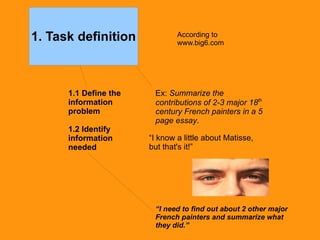
Ex:  Summarize the contributions of 2-3 major 18 th  century French painters in a 5 page essay . “ I know a little about Matisse,  but that's it!” 1.1 Define the information problem 1.2 Identify information needed “ I need to find out about 2 other major French painters and summarize what they did.” According to www.big6.com
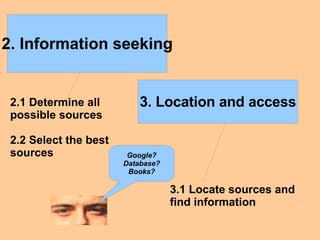
2.1 Determine all possible sources 2.2 Select the best sources 3.1 Locate sources and find information Google? Database? Books?
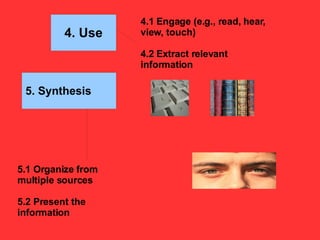
4.1 Engage (e.g., read, hear, view, touch) 4.2 Extract relevant information 5.1 Organize from multiple sources 5.2 Present the information
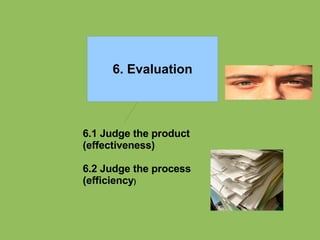
6.1 Judge the product (effectiveness) 6.2 Judge the process (efficiency )
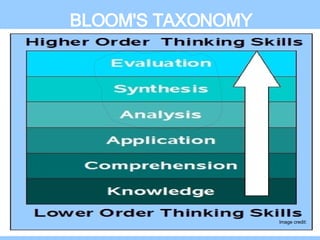
BLOOM'S TAXONOMY Image credit:
Characteristics of adult learners They want practical applications of knowledge, such as professional development. They can connect new information to past experiences.
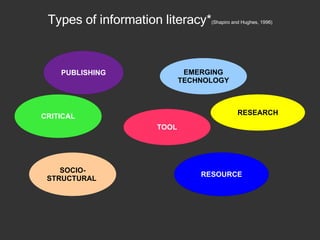
Types of information literacy* (Shapiro and Hughes, 1996) RESOURCE PUBLISHING EMERGING TECHNOLOGY SOCIO-STRUCTURAL  TOOL CRITICAL RESEARCH
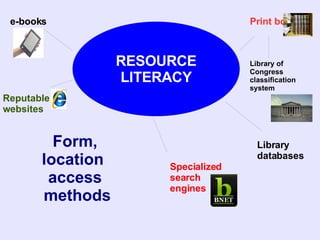
Form,  location  access  methods Library databases Print books e-books Specialized search engines Library of Congress classification system Reputable websites RESOURCE LITERACY
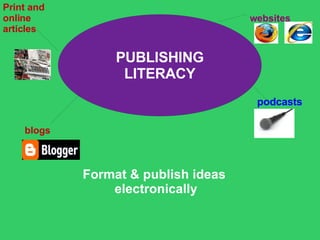
Format & publish ideas  electronically blogs podcasts websites Print and online articles PUBLISHING LITERACY
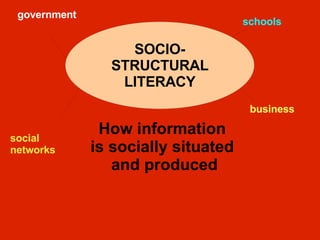
How information  is socially situated  and produced government business social networks social networks schools SOCIO-STRUCTURAL LITERACY
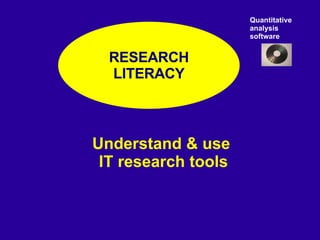
Understand & use  IT research tools   Quantitative analysis software RESEARCH LITERACY
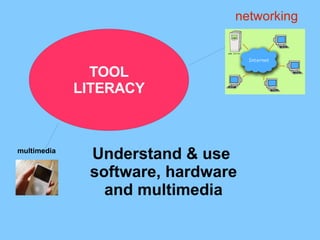
Understand & use  software, hardware  and multimedia networking multimedia TOOL LITERACY
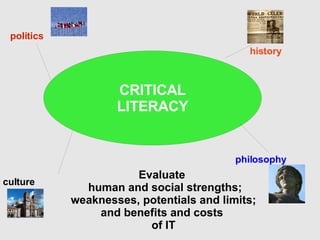
Evaluate  human and social strengths; weaknesses, potentials and limits;  and benefits and costs  of IT history politics culture philosophy CRITICAL LITERACY
Adapt to, understand, evaluate and use emerging innovations in IT EMERGING TECHNOLOGY LITERACY
My definition of information literacy: The ability to access, navigate, evaluate and synthesize information from a variety of resources  to make decisions .
Types of information literacy TRADITIONAL : Ability to read PERSONAL: Health/Career/Financial SOCIAL/POLITICAL:  Awareness of larger context on information and its impact on the world ACADEMIC:  Fi nd research; synthesize information with existing knowledge TECHNOLOGICAL —Navigate new technology
EVALUATING   WEB   RESOURCES
WHY IS EVALUATING INTERNET INFORMATION IMPORTANT?
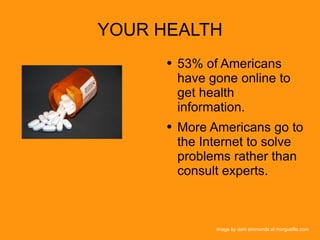
YOUR HEALTH Health  image by dani simmonds at morguefile.com 53% of Americans have gone online to get health information. More Americans go to the Internet to solve problems rather than consult experts.
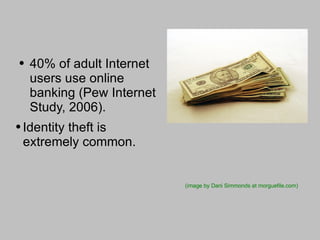
40% of adult Internet users use online banking (Pew Internet Study, 2006). Identity theft is extremely common. (image by Dani Simmonds at morguefile.com)
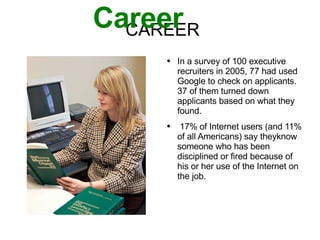
CAREER Career In a survey of 100 executive recruiters in 2005, 77 had used Google to check on applicants.  37 of them turned down applicants based on what they found. 17% of Internet users (and 11% of all Americans) say theyknow someone who has been disciplined or fired because of his or her use of the Internet on the job.
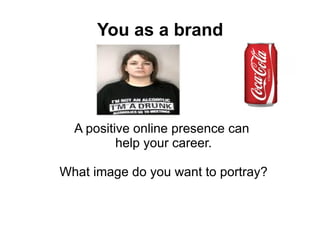
You as a brand A positive online presence can  help your career. What image do you want to portray?
How long can  your information  stay online?  (beware of Google cache!)
EVALUATION FACTORS: AUTHORITY CURRENCY OBJECTIVITY ACCURACY APPEARANCE
AUTHORITY
Authority Checklist What individual or organization is in charge  of the website content (besides the webmaster)? What are their  credentials  and how long have  they been in the field?  What kind of  publicity  have they generated?
AUTHORITY: What to look for About Us/Contact Us —should at least be on first page if not every page of site Check  Better Business Bureau  or type in company name + “scam” into Google Use  Whois.com  to see who owns the site** Sites requiring  private information  such as credit card numbers should have an “https” in their URL, not just “http” Evaluating Internet Information.  http://www.lib.vt.edu/help/instruct/evaluate/evaluating.html
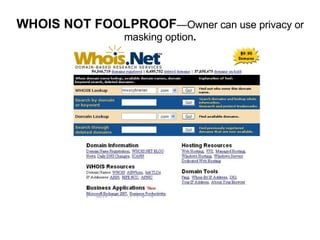
WHOIS NOT FOOLPROOF —Owner can use privacy or masking option .
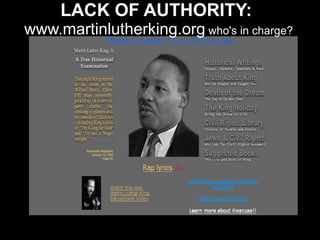
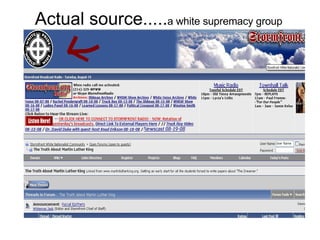
LACK OF AUTHORITY:   www.martinlutherking.org   who's in charge?
Actual source..... a white supremacy group
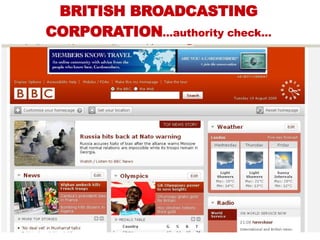
BRITISH BROADCASTING CORPORATION ...authority check...
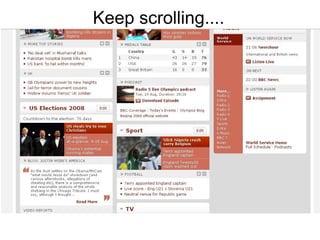
Keep scrolling....
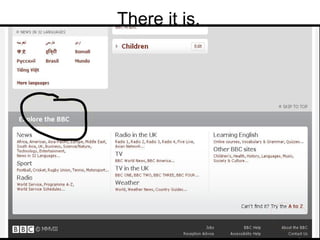
There it is.
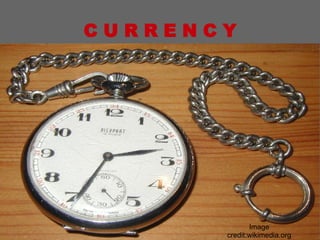
C U R R E N C Y Image credit:wikimedia.org
CURRENCY CHECKLIST HOW OFTEN DOES CONTENT CHANGE?  HOW CURRENT IS INFORMATION?  LAST SITE UPDATE ?
Currency: What to look for Site and blog updates Interactive content/user input News bulletins Discussion forums (depending on site)
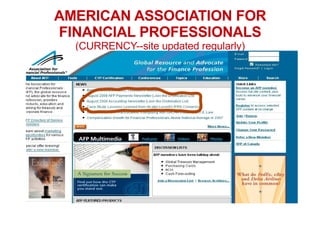
AMERICAN ASSOCIATION FOR FINANCIAL PROFESSIONALS (CURRENCY--site updated regularly)
Objectivity [insert graphic] OBJECTIVITY
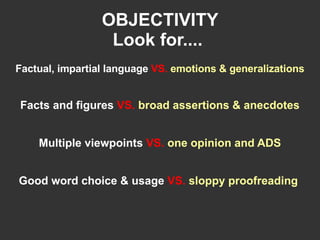
OBJECTIVITY Look for....   Factual, impartial language   VS.  emotions & generalizations Facts and figures   VS.  broad assertions & anecdotes Multiple viewpoints   VS.  one opinion and ADS Good word choice & usage   VS.  sloppy proofreading
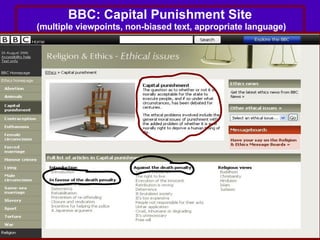
BBC: Capital Punishment Site  (multiple viewpoints, non-biased text, appropriate language)
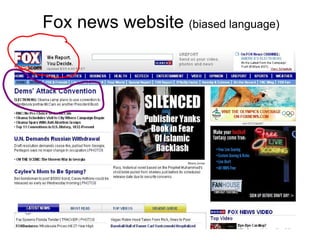
Fox news website  (biased language)
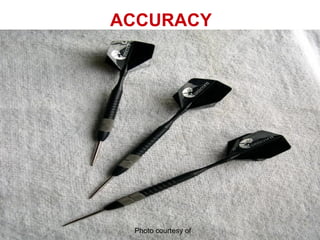
ACCURACY :  Photo courtesy of
ACCURACY CHECKLIST Can the information on the site be  confirmed  elsewhere? Is the information  edited and checked  before it goes online? Is the information  error-free ?
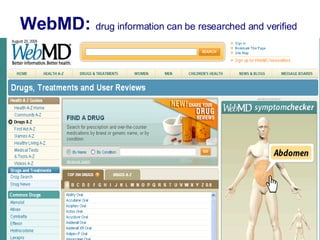
WebMD:  drug information can be researched and verified
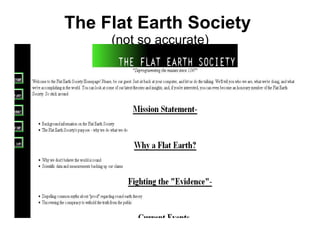
The Flat Earth Society  (not so accurate)
APPEARANCE
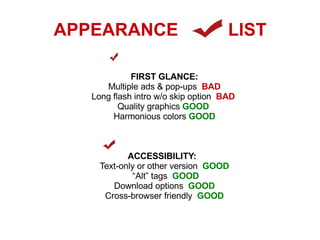
APPEARANCE  LIST FIRST GLANCE: Multiple ads & pop-ups  BAD Long flash intro w/o skip option  BAD   Quality graphics  GOOD   Harmonious colors  GOOD ACCESSIBILITY:   Text-only or other version  GOOD “ Alt” tags  GOOD   Download options  GOOD Cross-browser friendly  GOOD
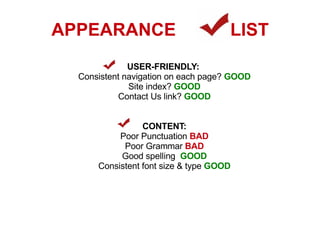
APPEARANCE  LIST USER-FRIENDLY:   Consistent navigation on each page?  GOOD Site index?  GOOD Contact Us link?  GOOD CONTENT:   Poor Punctuation  BAD Poor Grammar  BAD Good spelling  GOOD Consistent font size & type  GOOD
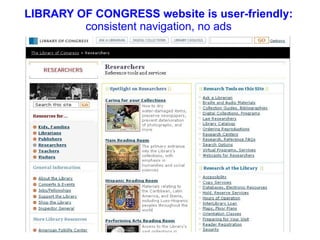
LIBRARY OF CONGRESS website is user-friendly:  consistent navigation, no ads
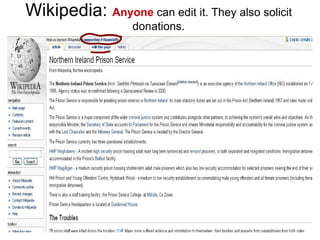
Wikipedia:  Anyone  can edit it. They also solicit donations.
SO....WHAT ABOUT   WIKIPEDIA?
WIKIPEDIA: THE GOOD ... Great info on pop culture and tech 99% of contributors =dedicated few Links to good resources
WIKIPEDIA: THE BAD  (AND THE UGLY) . ... The other 1% No expert editing Short on academic information “ Breaking Bad” photo credit: amc.com
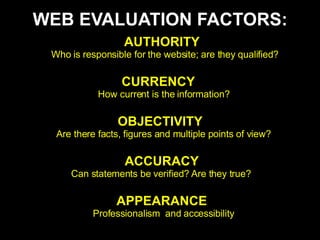
WEB EVALUATION FACTORS: AUTHORITY  Who is responsible for the website; are they qualified? CURRENCY  How current is the information? OBJECTIVITY  Are there facts, figures and multiple points of view? ACCURACY   Can statements be verified? Are they true?  APPEARANCE  Professionalism  and accessibility
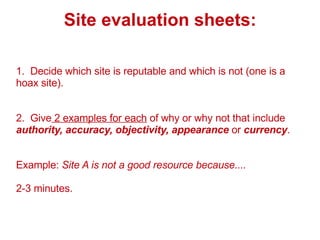
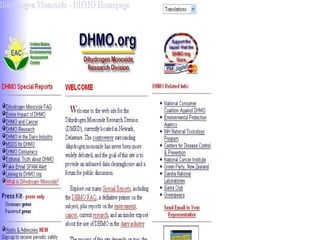
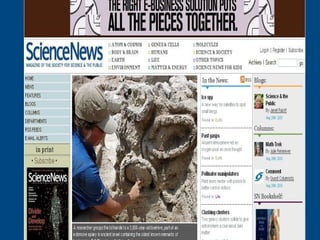
Site evaluation sheets: 1.  Decide which site is reputable and which is not (one is a hoax site). 2.  Give  2 examples for each  of why or why not that include  authority, accuracy, objectivity, appearance  or  currency . Example:  Site A is not a good resource because.... 2-3 minutes.
 
 
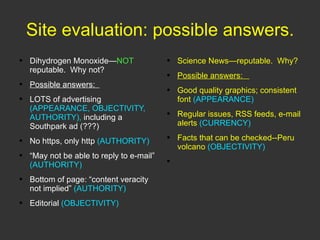
Site evaluation: possible answers. Dihydrogen Monoxide— NOT  reputable.  Why not? Possible answers:  LOTS of advertising  (APPEARANCE, OBJECTIVITY, AUTHORITY),  including a Southpark ad (???) No https, only http  (AUTHORITY) “ May not be able to reply to e-mail”  (AUTHORITY) Bottom of page: “content veracity not implied”  (AUTHORITY) Editorial  (OBJECTIVITY) Science News—reputable.  Why? Possible answers:  Good quality graphics; consistent font  (APPEARANCE) Regular issues, RSS feeds, e-mail alerts  (CURRENCY) Facts that can be checked--Peru volcano  (OBJECTIVITY)
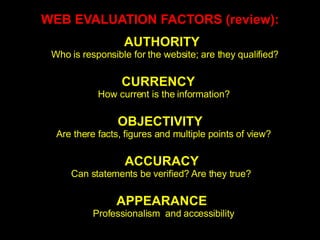
WEB EVALUATION FACTORS (review): AUTHORITY  Who is responsible for the website; are they qualified? CURRENCY  How current is the information? OBJECTIVITY  Are there facts, figures and multiple points of view? ACCURACY   Can statements be verified? Are they true?  APPEARANCE  Professionalism  and accessibility
HAPPY HUNTING! Picture courtesy of Jubsen at morguefile.com

Informationliteracy

  • 1.
    INFORMATION LITERACYImage credit: jeltovski at morguefile.com
  • 2.
    “ Information literacyis the key to solving problems, acting ethically, planning for the future and preparing for change.” Canadian Library Association
  • 3.
    Ex: Summarizethe contributions of 2-3 major 18 th century French painters in a 5 page essay . “ I know a little about Matisse, but that's it!” 1.1 Define the information problem 1.2 Identify information needed “ I need to find out about 2 other major French painters and summarize what they did.” According to www.big6.com
  • 4.
    2.1 Determine allpossible sources 2.2 Select the best sources 3.1 Locate sources and find information Google? Database? Books?
  • 5.
    4.1 Engage (e.g.,read, hear, view, touch) 4.2 Extract relevant information 5.1 Organize from multiple sources 5.2 Present the information
  • 6.
    6.1 Judge theproduct (effectiveness) 6.2 Judge the process (efficiency )
  • 7.
  • 8.
    Characteristics of adultlearners They want practical applications of knowledge, such as professional development. They can connect new information to past experiences.
  • 9.
    Types of informationliteracy* (Shapiro and Hughes, 1996) RESOURCE PUBLISHING EMERGING TECHNOLOGY SOCIO-STRUCTURAL TOOL CRITICAL RESEARCH
  • 10.
    Form, location access methods Library databases Print books e-books Specialized search engines Library of Congress classification system Reputable websites RESOURCE LITERACY
  • 11.
    Format & publishideas electronically blogs podcasts websites Print and online articles PUBLISHING LITERACY
  • 12.
    How information is socially situated and produced government business social networks social networks schools SOCIO-STRUCTURAL LITERACY
  • 13.
    Understand & use IT research tools Quantitative analysis software RESEARCH LITERACY
  • 14.
    Understand & use software, hardware and multimedia networking multimedia TOOL LITERACY
  • 15.
    Evaluate humanand social strengths; weaknesses, potentials and limits; and benefits and costs of IT history politics culture philosophy CRITICAL LITERACY
  • 16.
    Adapt to, understand,evaluate and use emerging innovations in IT EMERGING TECHNOLOGY LITERACY
  • 17.
    My definition ofinformation literacy: The ability to access, navigate, evaluate and synthesize information from a variety of resources to make decisions .
  • 18.
    Types of informationliteracy TRADITIONAL : Ability to read PERSONAL: Health/Career/Financial SOCIAL/POLITICAL: Awareness of larger context on information and its impact on the world ACADEMIC: Fi nd research; synthesize information with existing knowledge TECHNOLOGICAL —Navigate new technology
  • 19.
    EVALUATING WEB RESOURCES
  • 20.
    WHY IS EVALUATINGINTERNET INFORMATION IMPORTANT?
  • 21.
    YOUR HEALTH Health image by dani simmonds at morguefile.com 53% of Americans have gone online to get health information. More Americans go to the Internet to solve problems rather than consult experts.
  • 22.
    40% of adultInternet users use online banking (Pew Internet Study, 2006). Identity theft is extremely common. (image by Dani Simmonds at morguefile.com)
  • 23.
    CAREER Career Ina survey of 100 executive recruiters in 2005, 77 had used Google to check on applicants. 37 of them turned down applicants based on what they found. 17% of Internet users (and 11% of all Americans) say theyknow someone who has been disciplined or fired because of his or her use of the Internet on the job.
  • 24.
    You as abrand A positive online presence can help your career. What image do you want to portray?
  • 25.
    How long can your information stay online? (beware of Google cache!)
  • 26.
    EVALUATION FACTORS: AUTHORITYCURRENCY OBJECTIVITY ACCURACY APPEARANCE
  • 27.
  • 28.
    Authority Checklist Whatindividual or organization is in charge of the website content (besides the webmaster)? What are their credentials and how long have they been in the field? What kind of publicity have they generated?
  • 29.
    AUTHORITY: What tolook for About Us/Contact Us —should at least be on first page if not every page of site Check Better Business Bureau or type in company name + “scam” into Google Use Whois.com to see who owns the site** Sites requiring private information such as credit card numbers should have an “https” in their URL, not just “http” Evaluating Internet Information. http://www.lib.vt.edu/help/instruct/evaluate/evaluating.html
  • 30.
    WHOIS NOT FOOLPROOF—Owner can use privacy or masking option .
  • 31.
    LACK OF AUTHORITY: www.martinlutherking.org who's in charge?
  • 32.
    Actual source..... awhite supremacy group
  • 33.
    BRITISH BROADCASTING CORPORATION...authority check...
  • 34.
  • 35.
  • 36.
    C U RR E N C Y Image credit:wikimedia.org
  • 37.
    CURRENCY CHECKLIST HOWOFTEN DOES CONTENT CHANGE? HOW CURRENT IS INFORMATION? LAST SITE UPDATE ?
  • 38.
    Currency: What tolook for Site and blog updates Interactive content/user input News bulletins Discussion forums (depending on site)
  • 39.
    AMERICAN ASSOCIATION FORFINANCIAL PROFESSIONALS (CURRENCY--site updated regularly)
  • 40.
  • 41.
    OBJECTIVITY Look for.... Factual, impartial language VS. emotions & generalizations Facts and figures VS. broad assertions & anecdotes Multiple viewpoints VS. one opinion and ADS Good word choice & usage VS. sloppy proofreading
  • 42.
    BBC: Capital PunishmentSite (multiple viewpoints, non-biased text, appropriate language)
  • 43.
    Fox news website (biased language)
  • 44.
    ACCURACY : Photo courtesy of
  • 45.
    ACCURACY CHECKLIST Canthe information on the site be confirmed elsewhere? Is the information edited and checked before it goes online? Is the information error-free ?
  • 46.
    WebMD: druginformation can be researched and verified
  • 47.
    The Flat EarthSociety (not so accurate)
  • 48.
  • 49.
    APPEARANCE LISTFIRST GLANCE: Multiple ads & pop-ups BAD Long flash intro w/o skip option BAD Quality graphics GOOD Harmonious colors GOOD ACCESSIBILITY: Text-only or other version GOOD “ Alt” tags GOOD Download options GOOD Cross-browser friendly GOOD
  • 50.
    APPEARANCE LISTUSER-FRIENDLY: Consistent navigation on each page? GOOD Site index? GOOD Contact Us link? GOOD CONTENT: Poor Punctuation BAD Poor Grammar BAD Good spelling GOOD Consistent font size & type GOOD
  • 51.
    LIBRARY OF CONGRESSwebsite is user-friendly: consistent navigation, no ads
  • 52.
    Wikipedia: Anyone can edit it. They also solicit donations.
  • 53.
  • 54.
    WIKIPEDIA: THE GOOD... Great info on pop culture and tech 99% of contributors =dedicated few Links to good resources
  • 55.
    WIKIPEDIA: THE BAD (AND THE UGLY) . ... The other 1% No expert editing Short on academic information “ Breaking Bad” photo credit: amc.com
  • 56.
    WEB EVALUATION FACTORS:AUTHORITY Who is responsible for the website; are they qualified? CURRENCY How current is the information? OBJECTIVITY Are there facts, figures and multiple points of view? ACCURACY Can statements be verified? Are they true? APPEARANCE Professionalism and accessibility
  • 57.
    Site evaluation sheets:1. Decide which site is reputable and which is not (one is a hoax site). 2. Give 2 examples for each of why or why not that include authority, accuracy, objectivity, appearance or currency . Example: Site A is not a good resource because.... 2-3 minutes.
  • 58.
  • 59.
  • 60.
    Site evaluation: possibleanswers. Dihydrogen Monoxide— NOT reputable. Why not? Possible answers: LOTS of advertising (APPEARANCE, OBJECTIVITY, AUTHORITY), including a Southpark ad (???) No https, only http (AUTHORITY) “ May not be able to reply to e-mail” (AUTHORITY) Bottom of page: “content veracity not implied” (AUTHORITY) Editorial (OBJECTIVITY) Science News—reputable. Why? Possible answers: Good quality graphics; consistent font (APPEARANCE) Regular issues, RSS feeds, e-mail alerts (CURRENCY) Facts that can be checked--Peru volcano (OBJECTIVITY)
  • 61.
    WEB EVALUATION FACTORS(review): AUTHORITY Who is responsible for the website; are they qualified? CURRENCY How current is the information? OBJECTIVITY Are there facts, figures and multiple points of view? ACCURACY Can statements be verified? Are they true? APPEARANCE Professionalism and accessibility
  • 62.
    HAPPY HUNTING! Picturecourtesy of Jubsen at morguefile.com