Using Conventions of real media texts LO: Explore how and why I have used media conventions in my coursework
A  convention  is a “rule, method or practice established by usage”
We need to consider conventions in terms of: Representation Technical aspects (mise-en-scene, cinematography/phorgraphy, editing and sound) Narrative (story (ideology), characters, setting)
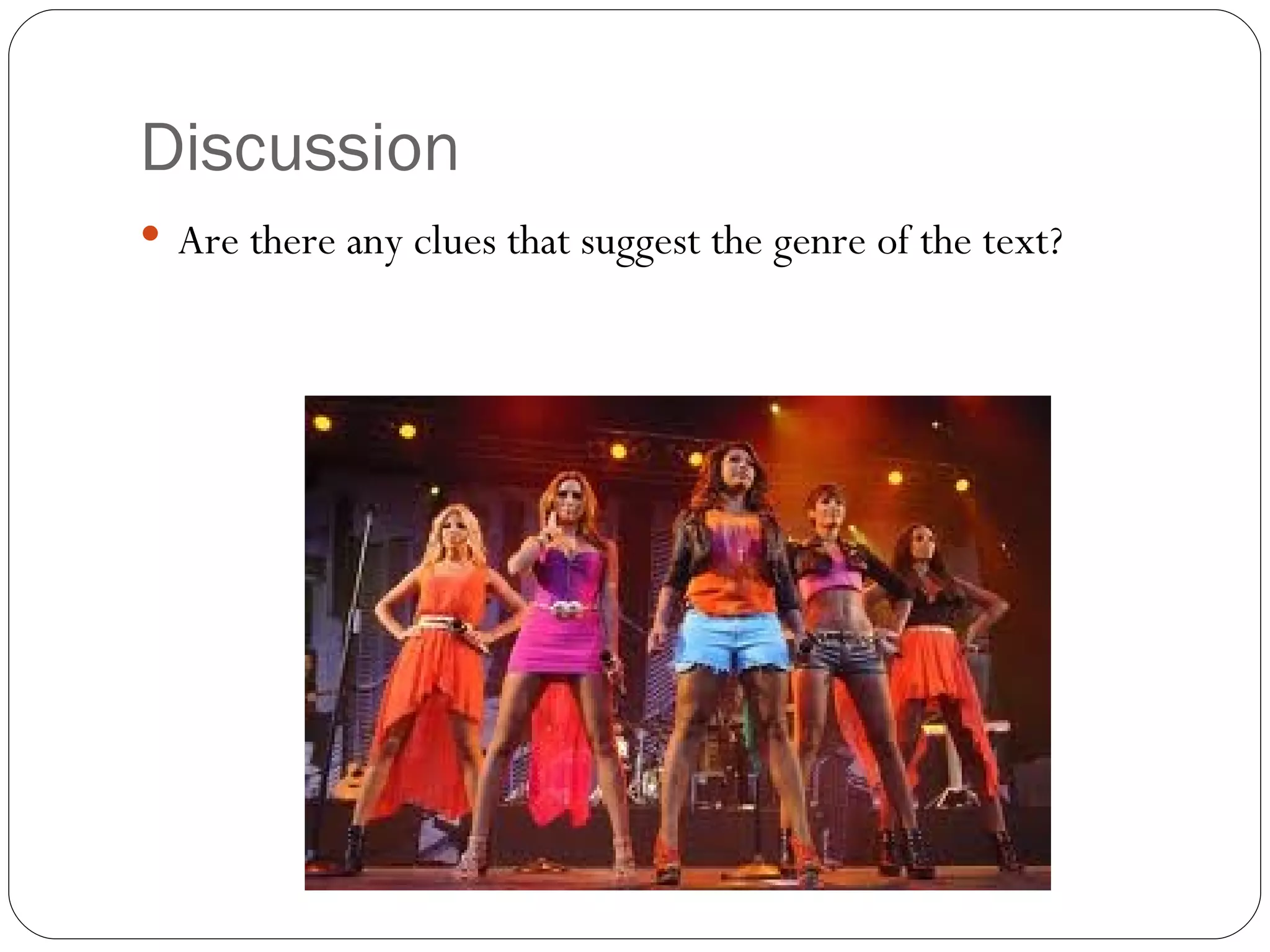
Discussion Are there any clues that suggest the genre of the text?
Discussion Are there any clues that suggest the genre of the text?  http://www.youtube.com/watch?v=SEZK7mJoPLY
What skills could you refer to in your answer? Research into “real” media texts: Organisation Analysis Use of digital technology Questionnaire
Media theory Semiotics : study of signs and symbols – are any common to the texts you have made? Feminism : typical representation of males and females in your texts Audience effect and address : hypodermic needle, uses and gratifications, Stuart Hall
Signs and Symbols Media students identify three categories of codes that may be used to convey meanings in media messages:  technical codes,  which include camera techniques, framing, depth of field, lighting and exposure  symbolic codes,  which refer to objects, setting, body language, clothing and colour;  written codes  in the form of headlines, captions,
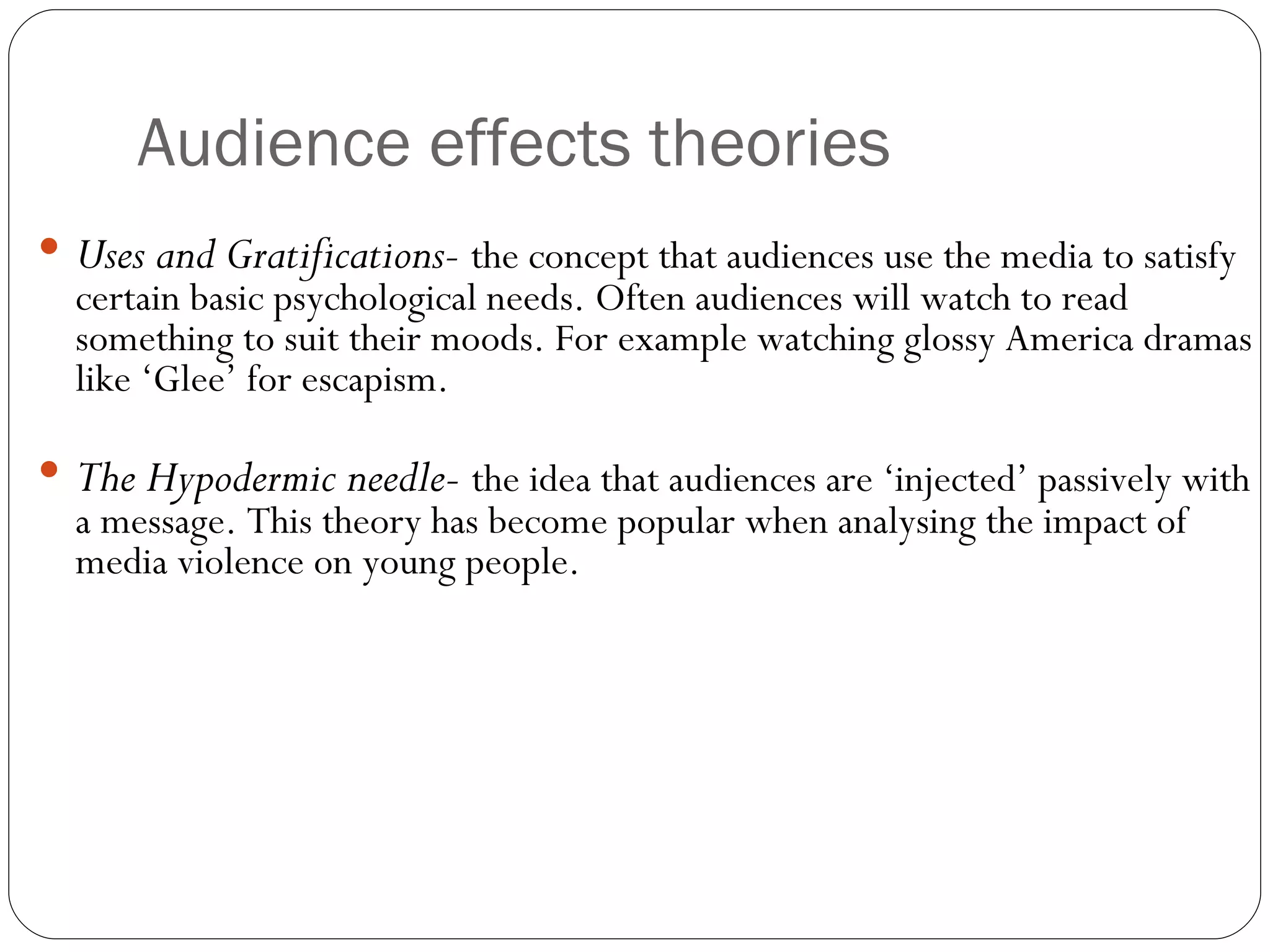
Audience effects theories Uses and Gratifications-   the concept that audiences use the media to satisfy certain basic psychological needs. Often audiences will watch to read something to suit their moods. For example watching glossy America dramas like ‘Glee’ for escapism. The Hypodermic needle-   the idea that audiences are ‘injected’ passively with a message. This theory has become popular when analysing the impact of media violence on young people.
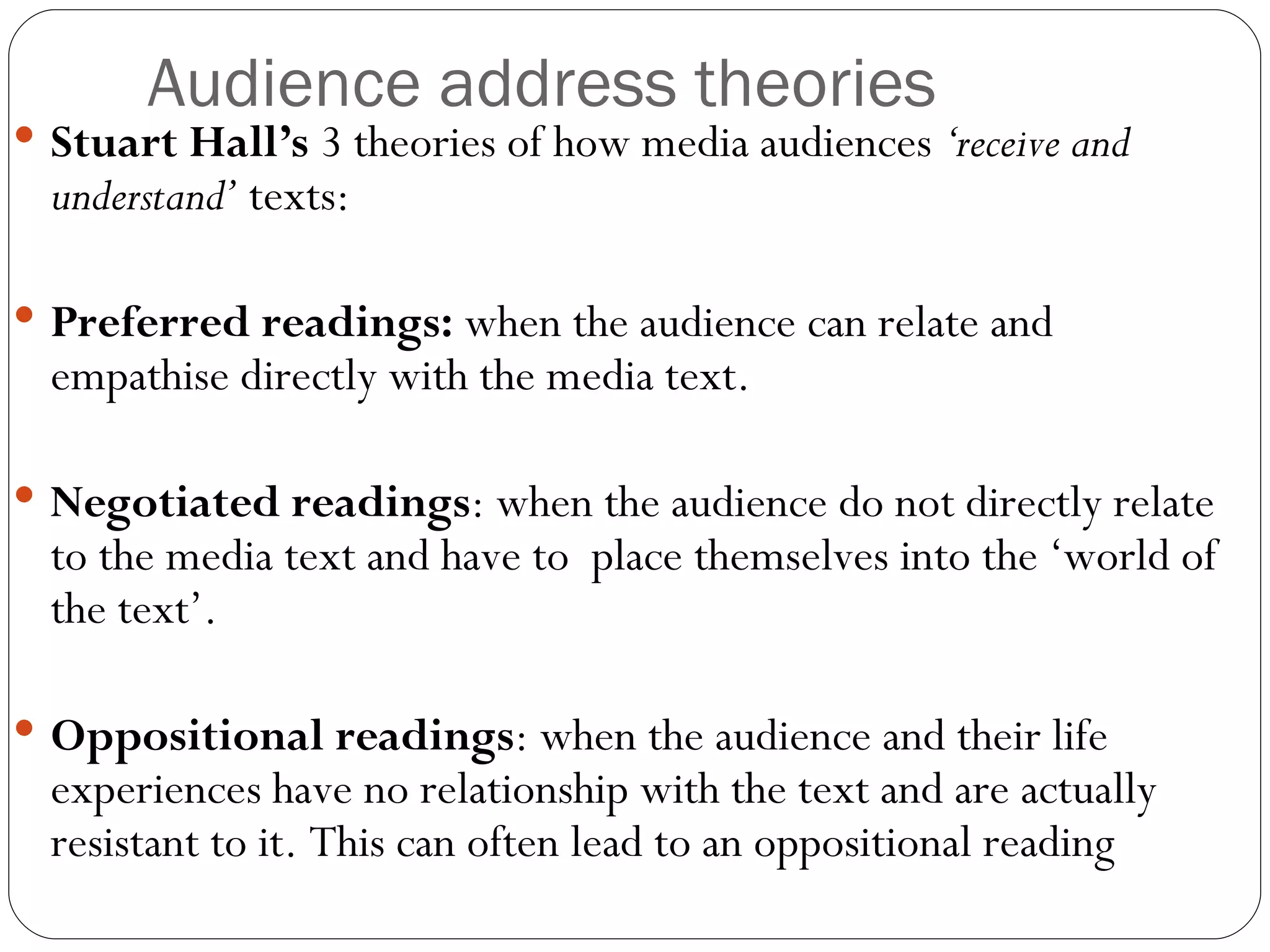
Audience address theories Stuart Hall’s  3 theories of how media audiences  ‘receive and understand’  texts: Preferred readings:  when the audience can relate and empathise directly with the media text.  Negotiated readings : when the audience do not directly relate to the media text and have to  place themselves into the ‘world of the text’.  Oppositional readings : when the audience and their life experiences have no relationship with the text and are actually resistant to it. This can often lead to an oppositional reading
Task What are the technical, symbolic and written codes in your texts? How do these relate to real media texts within the same genre? Would you say your productions utilise the hypodermic needle model or uses and gratifications theory? Why? How would you say your audience would address your work? Preferred, negotiated or oppositional

Using conventions from real media texts

  • 1.
    Using Conventions ofreal media texts LO: Explore how and why I have used media conventions in my coursework
  • 2.
    A convention is a “rule, method or practice established by usage”
  • 3.
    We need toconsider conventions in terms of: Representation Technical aspects (mise-en-scene, cinematography/phorgraphy, editing and sound) Narrative (story (ideology), characters, setting)
  • 4.
    Discussion Are thereany clues that suggest the genre of the text?
  • 5.
    Discussion Are thereany clues that suggest the genre of the text? http://www.youtube.com/watch?v=SEZK7mJoPLY
  • 6.
    What skills couldyou refer to in your answer? Research into “real” media texts: Organisation Analysis Use of digital technology Questionnaire
  • 7.
    Media theory Semiotics: study of signs and symbols – are any common to the texts you have made? Feminism : typical representation of males and females in your texts Audience effect and address : hypodermic needle, uses and gratifications, Stuart Hall
  • 8.
    Signs and SymbolsMedia students identify three categories of codes that may be used to convey meanings in media messages: technical codes, which include camera techniques, framing, depth of field, lighting and exposure symbolic codes, which refer to objects, setting, body language, clothing and colour; written codes in the form of headlines, captions,
  • 9.
    Audience effects theoriesUses and Gratifications- the concept that audiences use the media to satisfy certain basic psychological needs. Often audiences will watch to read something to suit their moods. For example watching glossy America dramas like ‘Glee’ for escapism. The Hypodermic needle- the idea that audiences are ‘injected’ passively with a message. This theory has become popular when analysing the impact of media violence on young people.
  • 10.
    Audience address theoriesStuart Hall’s 3 theories of how media audiences ‘receive and understand’ texts: Preferred readings: when the audience can relate and empathise directly with the media text. Negotiated readings : when the audience do not directly relate to the media text and have to place themselves into the ‘world of the text’. Oppositional readings : when the audience and their life experiences have no relationship with the text and are actually resistant to it. This can often lead to an oppositional reading
  • 11.
    Task What arethe technical, symbolic and written codes in your texts? How do these relate to real media texts within the same genre? Would you say your productions utilise the hypodermic needle model or uses and gratifications theory? Why? How would you say your audience would address your work? Preferred, negotiated or oppositional

Editor's Notes

  • #10 Escapism To be frightened To laugh To be educated