AS Media: Audience
Response
Media and Audience
• We may take it for granted but most of “The Media” around us are
actually quite recent inventions
• The way people communicate, inform or entertain themselves has
radically changed in the last 150 years (even 20 years!)
• Some people are concerned about the power the media has to
effect people.
Media Effects
• On a post-it note, write down an example of how the media can
affect people. Stick your note to the board at the front of the
class.
How the media affect people
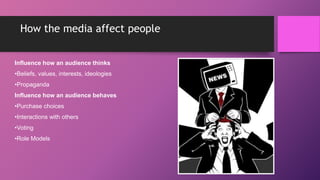
Influence how an audience thinks
•Beliefs, values, interests, ideologies
•Propaganda
Influence how an audience behaves
•Purchase choices
•Interactions with others
•Voting
•Role Models
The Media Effects Debate
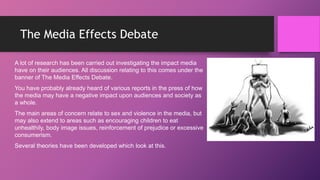
A lot of research has been carried out investigating the impact media
have on their audiences. All discussion relating to this comes under the
banner of The Media Effects Debate.
You have probably already heard of various reports in the press of how
the media may have a negative impact upon audiences and society as
a whole.
The main areas of concern relate to sex and violence in the media, but
may also extend to areas such as encouraging children to eat
unhealthily, body image issues, reinforcement of prejudice or excessive
consumerism.
Several theories have been developed which look at this.
The Hypodermic Model
http://www.youtube.com/watch?v=Qt5MjBlvGcY
The Hypodermic Model
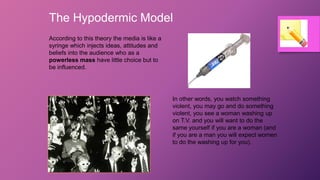
According to this theory the media is like a
syringe which injects ideas, attitudes and
beliefs into the audience who as a
powerless mass have little choice but to
be influenced.
In other words, you watch something
violent, you may go and do something
violent, you see a woman washing up
on T.V. and you will want to do the
same yourself if you are a woman (and
if you are a man you will expect women
to do the washing up for you).
Criticisms of Hyperdermic Model
•Too simplistic
•Notion of ‘Mass Audience’ acting uniformly is discredited. Audiences include a
diverse, complex and sophisticated range of users
•We may all interpret the same text differently
•Not everyone that watches a violent movie or plays a violent computer game will
become violent
•What do you think?
Considering it’s many flaws, why do you think this theory is still so pervasive?
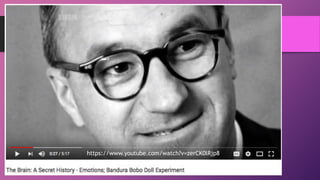
https://www.youtube.com/watch?v=zerCK0lRjp8
Media Effects: Albert Bandura
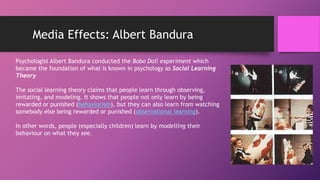
Psychologist Albert Bandura conducted the Bobo Doll experiment which
became the foundation of what is known in psychology as Social Learning
Theory
The social learning theory claims that people learn through observing,
imitating, and modeling. It shows that people not only learn by being
rewarded or punished (behaviorism), but they can also learn from watching
somebody else being rewarded or punished (observational learning).
In other words, people (especially children) learn by modelling their
behaviour on what they see.
Media Effects: Albert Bandura
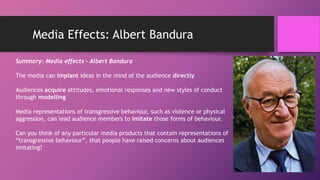
Summary: Media effects - Albert Bandura
The media can implant ideas in the mind of the audience directly
Audiences acquire attitudes, emotional responses and new styles of conduct
through modelling
Media representations of transgressive behaviour, such as violence or physical
aggression, can lead audience members to imitate those forms of behaviour.
Can you think of any particular media products that contain representations of
“transgressive behaviour”, that people have raised concerns about audiences
imitating?
The Cultivation Theory
•Difficult to prove effects of an individual text so Effects Model refined.
•Applies not to just one text but to the repeated exposure to many different media
https://www.youtube.com/watch?v=i2I7kdj45fQ&feature=youtu.be
The Cultivation Theory
•http://www.bbc.co.uk/news/magazine-20910859
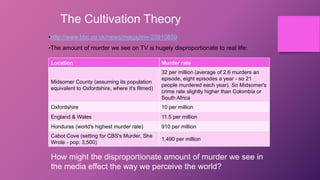
•The amount of murder we see on TV is hugely disproportionate to real life:
Location Murder rate
Midsomer County (assuming its population
equivalent to Oxfordshire, where it's filmed)
32 per million (average of 2.6 murders an
episode, eight episodes a year - so 21
people murdered each year). So Midsomer's
crime rate slightly higher than Colombia or
South Africa
Oxfordshire 10 per million
England & Wales 11.5 per million
Honduras (world's highest murder rate) 910 per million
Cabot Cove (setting for CBS's Murder, She
Wrote - pop: 3,500)
1,490 per million
How might the disproportionate amount of murder we see in
the media effect the way we perceive the world?
The Cultivation Theory
In fact, it is statistically more dangerous to be a character in a soap opera than it
is to be a real life formula one racing driver or bomb disposal expert.
This is probably not surprising. But is not just the number of murders we see but
also the type.
In real life, most murders are committed by friends or acquaintances, whereas in
fiction it is a far higher and less realistic proportion of strangers and serial killers.
Crime writer Andrew Taylor says "We all live in this terrifying world. It's quite nice
to feel afraid vicariously and then have it all tied up neatly at the end. It's a bit
like inoculation.”
It is an ever popular genre and theme for audiences and writers but it is also
easy to see how some people may have a disproportionately fearful view of the
world, known as ‘Mean World Syndrome’.
The Cultivation Theory
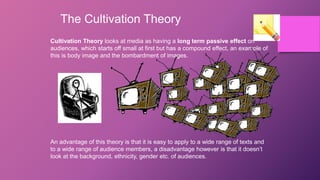
Cultivation Theory looks at media as having a long term passive effect on
audiences, which starts off small at first but has a compound effect, an example of
this is body image and the bombardment of images.
An advantage of this theory is that it is easy to apply to a wide range of texts and
to a wide range of audience members, a disadvantage however is that it doesn’t
look at the background, ethnicity, gender etc. of audiences.
The Cultivation Theory
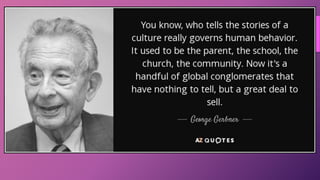
Gerbner, Gross, Morgan, & Signorielli (1986) argued that while religion or
education had previously been greater influences on social trends and mores, now
"[t]elevision is the source of the most broadly shared images and messages in
history...Television cultivates from infancy the very predispositions and
preferences that used to be acquired from other primary sources ... The repetitive
pattern of television's mass-produced messages and images forms the
mainstream of a common symbolic environment”.
Cultivation theory suggests that exposure to the media, over time, subtly
"cultivates" viewers' perceptions of reality.
This can have an impact even on light viewers of TV, because the impact on
heavy viewers has an impact on our entire culture.
Gerbner and Gross (1976) say "[t]elevision is a medium of the socialisation of
most people into standardized roles and behaviors. Its function is in a word,
enculturation" (p. 175).
Gerbner, G., & Gross, L. (1976a). Living with television: The violence profile. Journal of Communication, 26, 172-199.
Gerbner, G., Gross, L., Morgan, M., & Signorielli, N. (1986). Living with television: The dynamics of the cultivation process. In J. Bryant & D. Zillman (Eds),
Perspectives on media effects (pp. 17–40). Hilldale, NJ: Lawrence Erlbaum Associates.
The Cultivation Theory
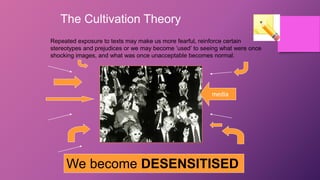
Repeated exposure to texts may make us more fearful, reinforce certain
stereotypes and prejudices or we may become ‘used’ to seeing what were once
shocking images, and what was once unacceptable becomes normal.
We become DESENSITISED
media
Media Audiences: Key Theories
Summary: Cultivation Theory – George Gerbner
Exposure to repeated patterns of representation over long periods of time can
shape and influence the way in which people perceive the world around them (i.e.
cultivating particular views and opinions)
Cultivation reinforces mainstream values (dominant ideologies).
Q:
What is the key difference between hypodermic needle theory and cultivation
theory?
Reception Theory
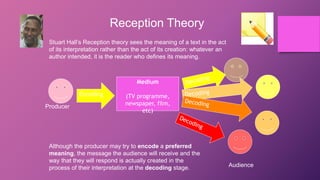
Stuart Hall’s Reception theory sees the meaning of a text in the act
of its interpretation rather than the act of its creation: whatever an
author intended, it is the reader who defines its meaning.
Medium
(TV programme,
newspaper, film,
etc)
Encoding
Producer
Audience
Although the producer may try to encode a preferred
meaning, the message the audience will receive and the
way that they will respond is actually created in the
process of their interpretation at the decoding stage.
Reception Theory
Reception theory focuses on the role of the audience in
the interpretation of the text, rather than the text itself.
It suggests that audiences play an active role in reading
texts.
Each person has the ability to interpret the same text
differently (polysemy) and that a text by itself – i.e. without
a reader – has no specific meaning.
Reception Theory
What effects the way in which an audience/user may respond to a text?
Age/Gender/Ethnicity: Different audience groups may ‘decode’ media texts differently.
It is often said that women like soap operas and men like action movies for example.
But be careful of making stating simplified generalisations as if they are fact. In other
words, who you are.
Situated Culture: The audience’s situation will also effect how they respond, e.g. ; at
home/in a cinema/alone/with friends/with family. In other words, what you are doing at
the time and in what circumstance.
Cultural Experience: Culture, upbringing and previous experiences (including other
media) will also change how an audience may respond to a text. In other words, what
have you done prior to engaging with this text.
Cultural Competence: The audience’s shared knowledge relating to their cultural
understanding of a particular media text. e.g. Young audiences are typically more
‘computer literate’ and ‘internet savvy’. Or fans of a particular genre/format (e.g. the Call
of Duty video game series). In other words, how familiar/knowledgable are you about
this kind of media text?
Different ‘Readings’
Many media texts contain many possible meanings or ways that they may
be READ by the audience. These texts are described as POLYSEMIC, or
displaying POLYSEMY.
But all media texts are made with a intended meaning or reading in mind.
The author/producer of that text will have an intended way that it should be
interpreted, but not all audience members will respond that way.
The different ways an audience may interpret a text can be discussed using
the following headings
Different ‘Readings’
Dominant hegemonic reading: The reader accepts the preferred reading intended
by the author of the text. Sharing their values or views.
Negotiated: The reader accepts SOME of the intended values of the author but
may reject or modify other elements to reflect their own interest.
Oppositional: The reader is AWARE of the intended, preferred meaning, but rejects
it entirely
Different ‘Readings’
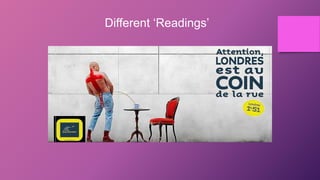
Task: In pairs analyse the following texts and answer these questions:
• Who do you think is the target audience? Why?
• What is the producer’s/author’s intended (preferred) reading?
Now, using cultural experience, situated culture and cultural experience
• Give an example of a negotiated reading and why someone might respond that
way
• Give an example of an oppositional reading and why someone might respond
that way
Different ‘Readings’
https://www.youtube.com/watch?v=vilUhBhNnQc
Different ‘Readings’
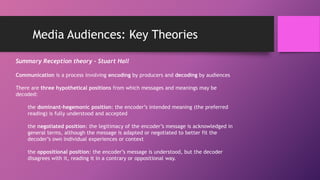
Media Audiences: Key Theories
Summary Reception theory - Stuart Hall
Communication is a process involving encoding by producers and decoding by audiences
There are three hypothetical positions from which messages and meanings may be
decoded:
the dominant-hegemonic position: the encoder’s intended meaning (the preferred
reading) is fully understood and accepted
the negotiated position: the legitimacy of the encoder’s message is acknowledged in
general terms, although the message is adapted or negotiated to better fit the
decoder’s own individual experiences or context
the oppositional position: the encoder’s message is understood, but the decoder
disagrees with it, reading it in a contrary or oppositional way.
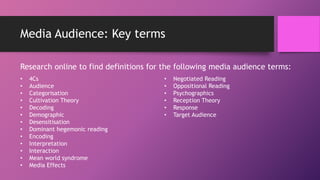
Media Audience: Key terms
Research online to find definitions for the following media audience terms:
• 4Cs
• Audience
• Categorisation
• Cultivation Theory
• Decoding
• Demographic
• Desensitisation
• Dominant hegemonic reading
• Encoding
• Interpretation
• Interaction
• Mean world syndrome
• Media Effects
• Negotiated Reading
• Oppositional Reading
• Psychographics
• Reception Theory
• Response
• Target Audience

ASY1 Media Studies Audience Response

  • 1.
  • 2.
    Media and Audience •We may take it for granted but most of “The Media” around us are actually quite recent inventions • The way people communicate, inform or entertain themselves has radically changed in the last 150 years (even 20 years!) • Some people are concerned about the power the media has to effect people.
  • 3.
    Media Effects • Ona post-it note, write down an example of how the media can affect people. Stick your note to the board at the front of the class.
  • 4.
    How the mediaaffect people Influence how an audience thinks •Beliefs, values, interests, ideologies •Propaganda Influence how an audience behaves •Purchase choices •Interactions with others •Voting •Role Models
  • 5.
    The Media EffectsDebate A lot of research has been carried out investigating the impact media have on their audiences. All discussion relating to this comes under the banner of The Media Effects Debate. You have probably already heard of various reports in the press of how the media may have a negative impact upon audiences and society as a whole. The main areas of concern relate to sex and violence in the media, but may also extend to areas such as encouraging children to eat unhealthily, body image issues, reinforcement of prejudice or excessive consumerism. Several theories have been developed which look at this.
  • 6.
  • 7.
    The Hypodermic Model Accordingto this theory the media is like a syringe which injects ideas, attitudes and beliefs into the audience who as a powerless mass have little choice but to be influenced. In other words, you watch something violent, you may go and do something violent, you see a woman washing up on T.V. and you will want to do the same yourself if you are a woman (and if you are a man you will expect women to do the washing up for you).
  • 8.
    Criticisms of HyperdermicModel •Too simplistic •Notion of ‘Mass Audience’ acting uniformly is discredited. Audiences include a diverse, complex and sophisticated range of users •We may all interpret the same text differently •Not everyone that watches a violent movie or plays a violent computer game will become violent •What do you think? Considering it’s many flaws, why do you think this theory is still so pervasive?
  • 9.
  • 10.
    Media Effects: AlbertBandura Psychologist Albert Bandura conducted the Bobo Doll experiment which became the foundation of what is known in psychology as Social Learning Theory The social learning theory claims that people learn through observing, imitating, and modeling. It shows that people not only learn by being rewarded or punished (behaviorism), but they can also learn from watching somebody else being rewarded or punished (observational learning). In other words, people (especially children) learn by modelling their behaviour on what they see.
  • 11.
    Media Effects: AlbertBandura Summary: Media effects - Albert Bandura The media can implant ideas in the mind of the audience directly Audiences acquire attitudes, emotional responses and new styles of conduct through modelling Media representations of transgressive behaviour, such as violence or physical aggression, can lead audience members to imitate those forms of behaviour. Can you think of any particular media products that contain representations of “transgressive behaviour”, that people have raised concerns about audiences imitating?
  • 12.
    The Cultivation Theory •Difficultto prove effects of an individual text so Effects Model refined. •Applies not to just one text but to the repeated exposure to many different media https://www.youtube.com/watch?v=i2I7kdj45fQ&feature=youtu.be
  • 13.
    The Cultivation Theory •http://www.bbc.co.uk/news/magazine-20910859 •Theamount of murder we see on TV is hugely disproportionate to real life: Location Murder rate Midsomer County (assuming its population equivalent to Oxfordshire, where it's filmed) 32 per million (average of 2.6 murders an episode, eight episodes a year - so 21 people murdered each year). So Midsomer's crime rate slightly higher than Colombia or South Africa Oxfordshire 10 per million England & Wales 11.5 per million Honduras (world's highest murder rate) 910 per million Cabot Cove (setting for CBS's Murder, She Wrote - pop: 3,500) 1,490 per million How might the disproportionate amount of murder we see in the media effect the way we perceive the world?
  • 14.
    The Cultivation Theory Infact, it is statistically more dangerous to be a character in a soap opera than it is to be a real life formula one racing driver or bomb disposal expert. This is probably not surprising. But is not just the number of murders we see but also the type. In real life, most murders are committed by friends or acquaintances, whereas in fiction it is a far higher and less realistic proportion of strangers and serial killers. Crime writer Andrew Taylor says "We all live in this terrifying world. It's quite nice to feel afraid vicariously and then have it all tied up neatly at the end. It's a bit like inoculation.” It is an ever popular genre and theme for audiences and writers but it is also easy to see how some people may have a disproportionately fearful view of the world, known as ‘Mean World Syndrome’.
  • 15.
    The Cultivation Theory CultivationTheory looks at media as having a long term passive effect on audiences, which starts off small at first but has a compound effect, an example of this is body image and the bombardment of images. An advantage of this theory is that it is easy to apply to a wide range of texts and to a wide range of audience members, a disadvantage however is that it doesn’t look at the background, ethnicity, gender etc. of audiences.
  • 16.
    The Cultivation Theory Gerbner,Gross, Morgan, & Signorielli (1986) argued that while religion or education had previously been greater influences on social trends and mores, now "[t]elevision is the source of the most broadly shared images and messages in history...Television cultivates from infancy the very predispositions and preferences that used to be acquired from other primary sources ... The repetitive pattern of television's mass-produced messages and images forms the mainstream of a common symbolic environment”. Cultivation theory suggests that exposure to the media, over time, subtly "cultivates" viewers' perceptions of reality. This can have an impact even on light viewers of TV, because the impact on heavy viewers has an impact on our entire culture. Gerbner and Gross (1976) say "[t]elevision is a medium of the socialisation of most people into standardized roles and behaviors. Its function is in a word, enculturation" (p. 175). Gerbner, G., & Gross, L. (1976a). Living with television: The violence profile. Journal of Communication, 26, 172-199. Gerbner, G., Gross, L., Morgan, M., & Signorielli, N. (1986). Living with television: The dynamics of the cultivation process. In J. Bryant & D. Zillman (Eds), Perspectives on media effects (pp. 17–40). Hilldale, NJ: Lawrence Erlbaum Associates.
  • 18.
    The Cultivation Theory Repeatedexposure to texts may make us more fearful, reinforce certain stereotypes and prejudices or we may become ‘used’ to seeing what were once shocking images, and what was once unacceptable becomes normal. We become DESENSITISED media
  • 19.
    Media Audiences: KeyTheories Summary: Cultivation Theory – George Gerbner Exposure to repeated patterns of representation over long periods of time can shape and influence the way in which people perceive the world around them (i.e. cultivating particular views and opinions) Cultivation reinforces mainstream values (dominant ideologies). Q: What is the key difference between hypodermic needle theory and cultivation theory?
  • 20.
    Reception Theory Stuart Hall’sReception theory sees the meaning of a text in the act of its interpretation rather than the act of its creation: whatever an author intended, it is the reader who defines its meaning. Medium (TV programme, newspaper, film, etc) Encoding Producer Audience Although the producer may try to encode a preferred meaning, the message the audience will receive and the way that they will respond is actually created in the process of their interpretation at the decoding stage.
  • 21.
    Reception Theory Reception theoryfocuses on the role of the audience in the interpretation of the text, rather than the text itself. It suggests that audiences play an active role in reading texts. Each person has the ability to interpret the same text differently (polysemy) and that a text by itself – i.e. without a reader – has no specific meaning.
  • 22.
    Reception Theory What effectsthe way in which an audience/user may respond to a text? Age/Gender/Ethnicity: Different audience groups may ‘decode’ media texts differently. It is often said that women like soap operas and men like action movies for example. But be careful of making stating simplified generalisations as if they are fact. In other words, who you are. Situated Culture: The audience’s situation will also effect how they respond, e.g. ; at home/in a cinema/alone/with friends/with family. In other words, what you are doing at the time and in what circumstance. Cultural Experience: Culture, upbringing and previous experiences (including other media) will also change how an audience may respond to a text. In other words, what have you done prior to engaging with this text. Cultural Competence: The audience’s shared knowledge relating to their cultural understanding of a particular media text. e.g. Young audiences are typically more ‘computer literate’ and ‘internet savvy’. Or fans of a particular genre/format (e.g. the Call of Duty video game series). In other words, how familiar/knowledgable are you about this kind of media text?
  • 23.
    Different ‘Readings’ Many mediatexts contain many possible meanings or ways that they may be READ by the audience. These texts are described as POLYSEMIC, or displaying POLYSEMY. But all media texts are made with a intended meaning or reading in mind. The author/producer of that text will have an intended way that it should be interpreted, but not all audience members will respond that way. The different ways an audience may interpret a text can be discussed using the following headings
  • 24.
    Different ‘Readings’ Dominant hegemonicreading: The reader accepts the preferred reading intended by the author of the text. Sharing their values or views. Negotiated: The reader accepts SOME of the intended values of the author but may reject or modify other elements to reflect their own interest. Oppositional: The reader is AWARE of the intended, preferred meaning, but rejects it entirely
  • 25.
    Different ‘Readings’ Task: Inpairs analyse the following texts and answer these questions: • Who do you think is the target audience? Why? • What is the producer’s/author’s intended (preferred) reading? Now, using cultural experience, situated culture and cultural experience • Give an example of a negotiated reading and why someone might respond that way • Give an example of an oppositional reading and why someone might respond that way
  • 26.
  • 27.
  • 28.
    Media Audiences: KeyTheories Summary Reception theory - Stuart Hall Communication is a process involving encoding by producers and decoding by audiences There are three hypothetical positions from which messages and meanings may be decoded: the dominant-hegemonic position: the encoder’s intended meaning (the preferred reading) is fully understood and accepted the negotiated position: the legitimacy of the encoder’s message is acknowledged in general terms, although the message is adapted or negotiated to better fit the decoder’s own individual experiences or context the oppositional position: the encoder’s message is understood, but the decoder disagrees with it, reading it in a contrary or oppositional way.
  • 29.
    Media Audience: Keyterms Research online to find definitions for the following media audience terms: • 4Cs • Audience • Categorisation • Cultivation Theory • Decoding • Demographic • Desensitisation • Dominant hegemonic reading • Encoding • Interpretation • Interaction • Mean world syndrome • Media Effects • Negotiated Reading • Oppositional Reading • Psychographics • Reception Theory • Response • Target Audience