Using audio and
video well in your
Moodle course
Colin Simpson
Canberra Institute of Technology
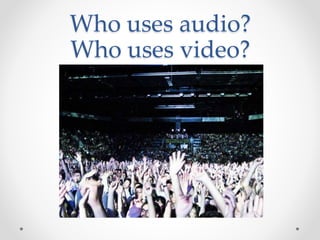
Who uses audio?
Who uses video?
Why?
• Content: explaining and demonstrating concepts by
manipulating time (time-lapse, editing, repetition) and
perspective (pov glasses)
Why?
• Dynamic: constantly moving, constantly changing.
Evolutionary instinct to pay attention. With effort, it can
also provide emotional experiences which have been
shown to create new memories very effectively
Why?
• Scaffolding: In VET certainly but arguably in all areas of
education there are foundational skills and knowledge
that need to be learnt through repetition. Language
(French), rowing, chemical titration – audio and video let
learners see and hear things the same way over and
over.
• Repetition is also valuable in assessment – for
consistency (childcare observations and physio gait
evaluation)
Why?
• Flexibility – recording lectures, guest speakers, capturing
evidence for workplace assessment, just in time
knowledge on mobile devices
• Feedback – screen-capturing marking and editing an
ESL student’s essay
• Post Literate world – are we assessing subject
knowledge or subject knowledge + essay writing ability.
How can we use
audio and video?
• Documenting workplace activity for assessment
• Student presentations in class
• How-to clips
• Screen capture – using software such as Camtasia / Camstudio
• Lectures – vodcast / broken up vs whole / streaming server
• Lectures – powerpoint slides with audio voiceover (eg Slideshare.net)
• Guest experts – pre-recorded interviews
• Guest experts – live webcam chats (Vet Virtual, Elluminate, Wimba)
• Subtitling (language and literacy classes)
• Meet the teacher
• Child observation activities (Childcare)
• Embedded YouTube / TeacherTube / Vimeo videos
• Forensics – presentation of a crime scene
• Discussion stimulator – eg. Video an excursion for a language class
• Gallery of student work
• Communication with distance students – recorded or live
• DVD games – use menus to provide choices (eg. Who wants to be a Millionaire)
• Embedding video in powerpoint presentations, in discussion boards and quizzes
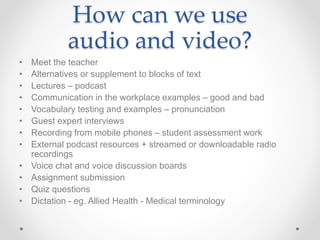
How can we use
audio and video?
• Meet the teacher
• Alternatives or supplement to blocks of text
• Lectures – podcast
• Communication in the workplace examples – good and bad
• Vocabulary testing and examples – pronunciation
• Guest expert interviews
• Recording from mobile phones – student assessment work
• External podcast resources + streamed or downloadable radio
recordings
• Voice chat and voice discussion boards
• Assignment submission
• Quiz questions
• Dictation - eg. Allied Health - Medical terminology
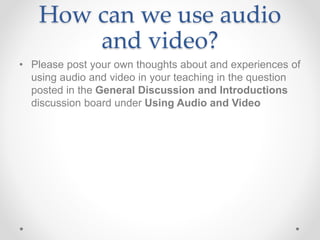
How can we use audio
and video?
• Please post your own thoughts about and experiences of
using audio and video in your teaching in the question
posted in the General Discussion and Introductions
discussion board under Using Audio and Video
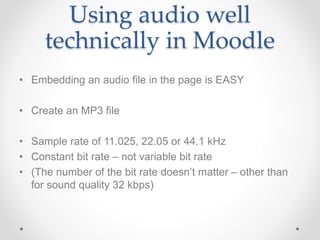
Using audio well
technically in Moodle
• Embedding an audio file in the page is EASY
• Create an MP3 file
• Sample rate of 11.025, 22.05 or 44.1 kHz
• Constant bit rate – not variable bit rate
• (The number of the bit rate doesn’t matter – other than
for sound quality 32 kbps)
Using audio well
technically in Moodle
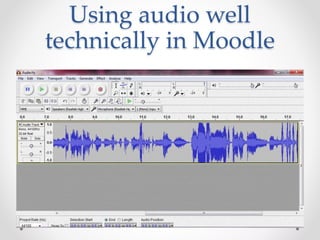
• My favourite audio software – Audacity
• http://audacity.sourceforge.net
Using audio well
technically in Moodle
Using audio well
technically in Moodle
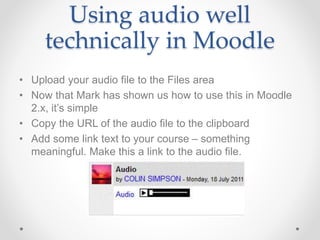
• Upload your audio file to the Files area
• Now that Mark has shown us how to use this in Moodle
2.x, it’s simple
• Copy the URL of the audio file to the clipboard
• Add some link text to your course – something
meaningful. Make this a link to the audio file.
Using audio well
technically in Moodle
• Right click the text link to download, click the player to
listen
• Where to put it?
• ANYWHERE
• Course homepage, quiz, glossary, forum, label, lesson,
book, workshop – anywhere that you can create a link.
Using audio well
technically in Moodle
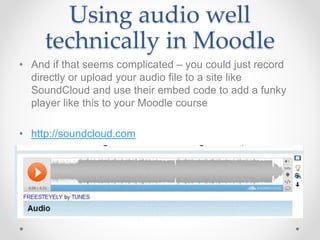
• And if that seems complicated – you could just record
directly or upload your audio file to a site like
SoundCloud and use their embed code to add a funky
player like this to your Moodle course
• http://soundcloud.com
Using audio well
technically in Moodle
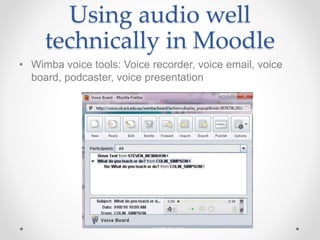
• Wimba voice tools: Voice recorder, voice email, voice
board, podcaster, voice presentation
Using audio well
technically in Moodle
• General audio tips:
• When possible, use a USB headset for recording rather
than a standard 2 x 3.5mm plug headset
• Always listen back to your recording for quality
• Keep the microphone within 3 fingers of your mouth
Using video well
technically in Moodle
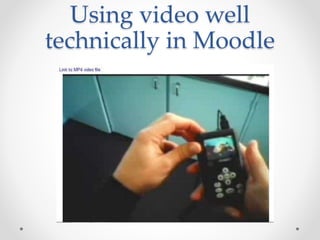
• Embedding video in your Moodle course is just as easy
as embedding audio (well, nearly)
• Once again, upload your video to the files area.
• Copy the URL to the clipboard.
• Add a text link to the file. A Flash video player will
automatically be added for MP4, MOV and FLV
Using video well
technically in Moodle
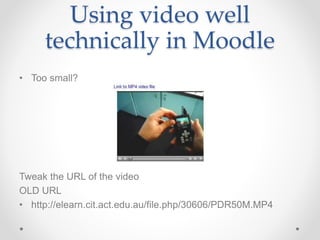
• Too small?
Tweak the URL of the video
OLD URL
• http://elearn.cit.act.edu.au/file.php/30606/PDR50M.MP4
Using video well
technically in Moodle
• New URL
• http://elearn.cit.act.edu.au/file.php/30
606/PDR50M.MP4?d=640x480
Using video well
technically in Moodle
Using video well
technically in Moodle
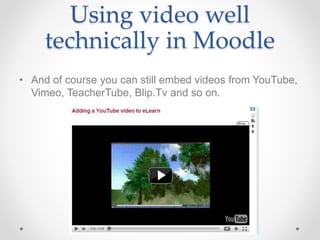
• And of course you can still embed videos from YouTube,
Vimeo, TeacherTube, Blip.Tv and so on.
Using video well
technically in Moodle
• Useful tools
• Editing – for free software, Windows Movie Maker isn’t a
bad place to start.
• Otherwise, Adobe Premiere (Pro or Elements), Sony
Vegas, iMovie or Final Cut Pro
Using video well
technically in Moodle
• Useful tools
• File Conversion:
• Super
• http://www.erightsoft.info/GetFile.php?SUPERsetup.exe
• http://www.erightsoft.com/Superdc.html
• Format Factory
• http://www.formatoz.com/
• Codec identification
• G-spot - http://www.headbands.com/gspot/
Using video well
technically in Moodle
• Useful tools
• Pretty presentations
• http://animoto.com
• Screen capture software
• Camtasia (really not free)
• Camstudio (free)
• Jing
• Fraps
Using video well
technically in Moodle
• For more information:
• POV Cameras - http://povcamera.weebly.com/
• My Delicious links -
http://www.delicious.com/colsim/video
• Great higher ed Moodle conference Oct 27/28
• http://moodleposium2011.moodlesites.com/
Questions?
• Colin Simpson
• @gamerlearner
• Colin.simpson@cit.edu.au
• Thankyou.
• Hands image – CC kmeron - Flickr

Using audio and video well in your moodle course

  • 1.
    Using audio and videowell in your Moodle course Colin Simpson Canberra Institute of Technology
  • 2.
  • 3.
    Why? • Content: explainingand demonstrating concepts by manipulating time (time-lapse, editing, repetition) and perspective (pov glasses)
  • 4.
    Why? • Dynamic: constantlymoving, constantly changing. Evolutionary instinct to pay attention. With effort, it can also provide emotional experiences which have been shown to create new memories very effectively
  • 5.
    Why? • Scaffolding: InVET certainly but arguably in all areas of education there are foundational skills and knowledge that need to be learnt through repetition. Language (French), rowing, chemical titration – audio and video let learners see and hear things the same way over and over. • Repetition is also valuable in assessment – for consistency (childcare observations and physio gait evaluation)
  • 6.
    Why? • Flexibility –recording lectures, guest speakers, capturing evidence for workplace assessment, just in time knowledge on mobile devices • Feedback – screen-capturing marking and editing an ESL student’s essay • Post Literate world – are we assessing subject knowledge or subject knowledge + essay writing ability.
  • 7.
    How can weuse audio and video? • Documenting workplace activity for assessment • Student presentations in class • How-to clips • Screen capture – using software such as Camtasia / Camstudio • Lectures – vodcast / broken up vs whole / streaming server • Lectures – powerpoint slides with audio voiceover (eg Slideshare.net) • Guest experts – pre-recorded interviews • Guest experts – live webcam chats (Vet Virtual, Elluminate, Wimba) • Subtitling (language and literacy classes) • Meet the teacher • Child observation activities (Childcare) • Embedded YouTube / TeacherTube / Vimeo videos • Forensics – presentation of a crime scene • Discussion stimulator – eg. Video an excursion for a language class • Gallery of student work • Communication with distance students – recorded or live • DVD games – use menus to provide choices (eg. Who wants to be a Millionaire) • Embedding video in powerpoint presentations, in discussion boards and quizzes
  • 8.
    How can weuse audio and video? • Meet the teacher • Alternatives or supplement to blocks of text • Lectures – podcast • Communication in the workplace examples – good and bad • Vocabulary testing and examples – pronunciation • Guest expert interviews • Recording from mobile phones – student assessment work • External podcast resources + streamed or downloadable radio recordings • Voice chat and voice discussion boards • Assignment submission • Quiz questions • Dictation - eg. Allied Health - Medical terminology
  • 9.
    How can weuse audio and video? • Please post your own thoughts about and experiences of using audio and video in your teaching in the question posted in the General Discussion and Introductions discussion board under Using Audio and Video
  • 10.
    Using audio well technicallyin Moodle • Embedding an audio file in the page is EASY • Create an MP3 file • Sample rate of 11.025, 22.05 or 44.1 kHz • Constant bit rate – not variable bit rate • (The number of the bit rate doesn’t matter – other than for sound quality 32 kbps)
  • 11.
    Using audio well technicallyin Moodle • My favourite audio software – Audacity • http://audacity.sourceforge.net
  • 12.
  • 13.
    Using audio well technicallyin Moodle • Upload your audio file to the Files area • Now that Mark has shown us how to use this in Moodle 2.x, it’s simple • Copy the URL of the audio file to the clipboard • Add some link text to your course – something meaningful. Make this a link to the audio file.
  • 14.
    Using audio well technicallyin Moodle • Right click the text link to download, click the player to listen • Where to put it? • ANYWHERE • Course homepage, quiz, glossary, forum, label, lesson, book, workshop – anywhere that you can create a link.
  • 15.
    Using audio well technicallyin Moodle • And if that seems complicated – you could just record directly or upload your audio file to a site like SoundCloud and use their embed code to add a funky player like this to your Moodle course • http://soundcloud.com
  • 16.
    Using audio well technicallyin Moodle • Wimba voice tools: Voice recorder, voice email, voice board, podcaster, voice presentation
  • 17.
    Using audio well technicallyin Moodle • General audio tips: • When possible, use a USB headset for recording rather than a standard 2 x 3.5mm plug headset • Always listen back to your recording for quality • Keep the microphone within 3 fingers of your mouth
  • 18.
    Using video well technicallyin Moodle • Embedding video in your Moodle course is just as easy as embedding audio (well, nearly) • Once again, upload your video to the files area. • Copy the URL to the clipboard. • Add a text link to the file. A Flash video player will automatically be added for MP4, MOV and FLV
  • 19.
    Using video well technicallyin Moodle • Too small? Tweak the URL of the video OLD URL • http://elearn.cit.act.edu.au/file.php/30606/PDR50M.MP4
  • 20.
    Using video well technicallyin Moodle • New URL • http://elearn.cit.act.edu.au/file.php/30 606/PDR50M.MP4?d=640x480
  • 21.
  • 22.
    Using video well technicallyin Moodle • And of course you can still embed videos from YouTube, Vimeo, TeacherTube, Blip.Tv and so on.
  • 23.
    Using video well technicallyin Moodle • Useful tools • Editing – for free software, Windows Movie Maker isn’t a bad place to start. • Otherwise, Adobe Premiere (Pro or Elements), Sony Vegas, iMovie or Final Cut Pro
  • 24.
    Using video well technicallyin Moodle • Useful tools • File Conversion: • Super • http://www.erightsoft.info/GetFile.php?SUPERsetup.exe • http://www.erightsoft.com/Superdc.html • Format Factory • http://www.formatoz.com/ • Codec identification • G-spot - http://www.headbands.com/gspot/
  • 25.
    Using video well technicallyin Moodle • Useful tools • Pretty presentations • http://animoto.com • Screen capture software • Camtasia (really not free) • Camstudio (free) • Jing • Fraps
  • 26.
    Using video well technicallyin Moodle • For more information: • POV Cameras - http://povcamera.weebly.com/ • My Delicious links - http://www.delicious.com/colsim/video • Great higher ed Moodle conference Oct 27/28 • http://moodleposium2011.moodlesites.com/
  • 27.
    Questions? • Colin Simpson •@gamerlearner • Colin.simpson@cit.edu.au • Thankyou. • Hands image – CC kmeron - Flickr