WELCOME
USES OF COMPUTER IN
NURSING PRACTICE AND
MANAGEMENT
INTRODUCTION
• In this history of civilization, no work of
science including health care information
has so comprehensively impacted on the
course of human development as health
information and management
technology(HIMT).currently the outcome
of transformation that has taken from the
mannual information technology manage
ment to a fast and accurate computerized
– HIMT of this century.
TERMINOLOGIES
• Data: It is a collection of numbers , alphabets,
or some facts.
• Program: A program is a task given to a
computer.
• Process :The computer system breaks down
each task it handles into smaller tasks called
process.
• Hardware: The physical component of a
computer system are collectively called
hardware.
• Software: Refers to the medium containing
set of instruction that instructs the hardware
how to perform particular tasks.
DEFINITION
• COMPUTER: It means
Commonly
Operated
Machine
Particularly
Used for
Training
Education
Research.
Nursing Informatics
• A field that combines nursing and
computers
• Informatics is computer science
plus information science
Cont…
• Nursing informatics:
The definition stated that nursing
informatics was the use of computer
technology in all nursing endeavors
:services, education and research.
-Scholes and Barber .
(1980)
Cont…
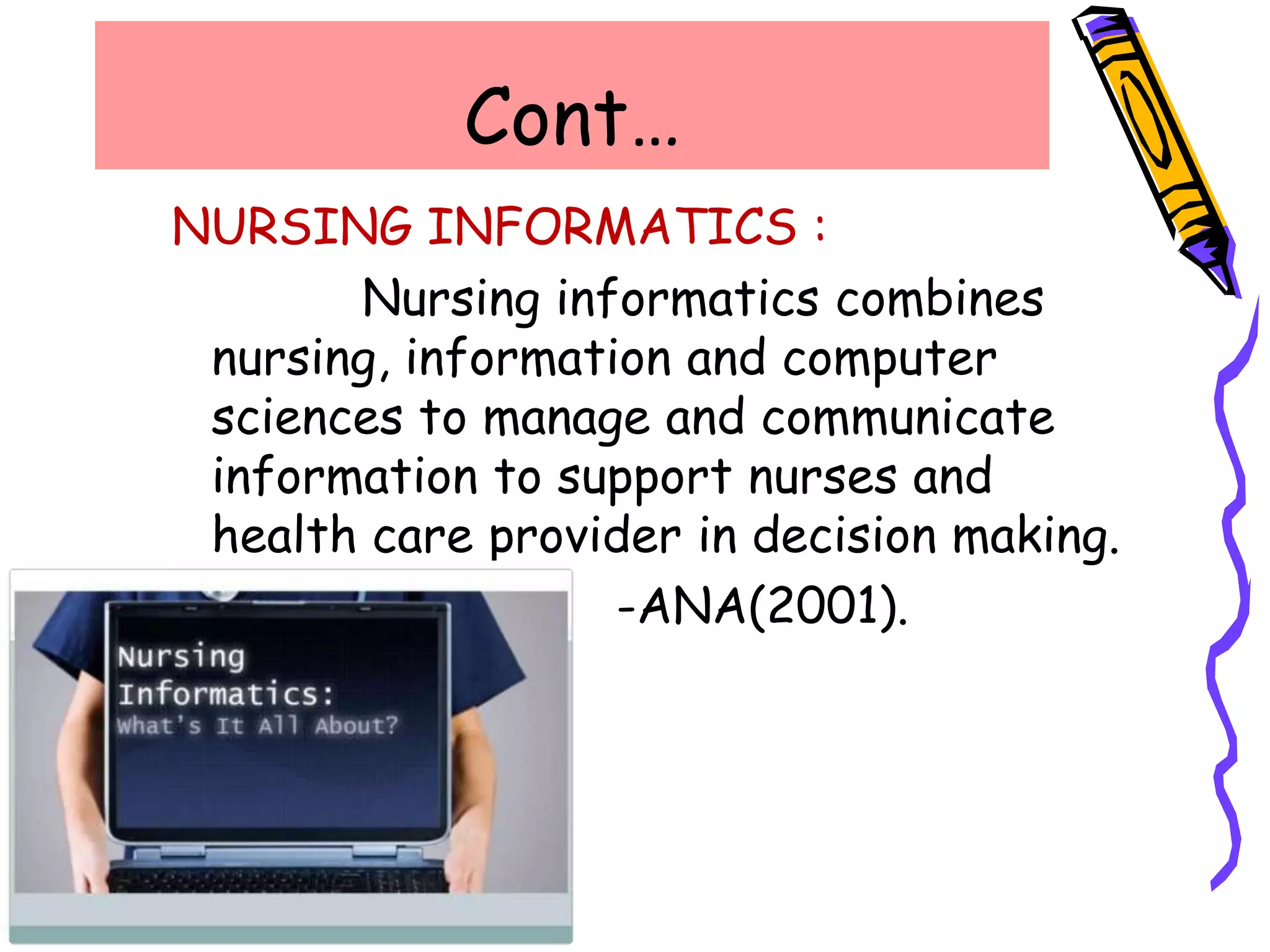
NURSING INFORMATICS :
Nursing informatics combines
nursing, information and computer
sciences to manage and communicate
information to support nurses and
health care provider in decision making.
-ANA(2001).
BASIC OPERATION OF
COMPUTER SYSTEM
1. INPUTTING
2. STORING
3. PROCESSING
4. OUTPUTTING
5. CONTROLLING
USES OF COMPUTER IN
NURSING
COMPUTER IN NURSING
EDUCATION
• Computers are used extensively in nursing
education; libraries are computerised, nursing
educationalists use computers in classroom
teaching and for academic record keeping.
COMPUTER IN NURSING
EDUCATION
• In nursing education, computers are used in
1.Teaching and learning
2. Testing
3. Student and course record management
Each of these are described next.
1.Teaching and learning
Computers enhance academic performance for
both students and faculty through facilitating
 access to literature
 computer-assisted instruction
 classroom technologies
 distance learning.
cont…
– Literature access and retrieval:
In a fraction of time, continuously updated
cumulative indexes of subjects can be
searched electronically.
• Once a list of search matches is displayed on
screen, the user can select all or certain
citations and either print them or store them on
the hard disk.
The text below lists commonly used bibliographic
systems and databases.
Acquired Immune Deficiency Syndrome
information onLINE (AIDSLINE)
CANCER LITerature (CANCER LIT)
Cumulative Index to Nursing and Allied Health
Literature (CINAHL)
Educational Resources Information Center
(ERIC)
Cont…
• Medical Literature Analysis and
Retrieval System (MEDLARS)
• Mental Measurement Yearbook
• Psychological Abstracts (PsychINFO)
Computer-Assisted Instruction (CAI)
• Many software programmes help students
and nurses learn and demonstrate learning.
• Examples of tutorials include ECG
interpretation, drug interactions, and legal
aspects of nursing.
• Completion of CAI programmes may be an
acceptable means of demonstrating
continuing education activities.
Teacher in
Srilanka
Teacher in
Africa
Teacher in
Bangalore
Teacher in
America
Teacher in
Tamilnadu
Supercourse Model: Lecture
Sharing
Teacher in
Delhi
Classroom Technology
• New educational buildings are wired to
accommodate technology. This includes electric
outlets and wireless technology for network or
Internet access.
• For nursing faculty, liquid crystal display (LCD)
panels allow computer screens to be displayed to
the entire classroom.
2.Testing
• This is the second use of computer in nursing
education.
• Surveys, including anonymous questionnaires, can be
completed online.
• For testing, large banks of potential items can be
written and the computer can generate different
exams for each student depending on the selection
criteria.
Cont…
• Students’ answers can also be scored
electronically and the exam results
analysed quickly.
• For example, the National Council
Licensure Examination (NCLEX-RN)
moved from paper and pencil tests to
computer tests.
3.Student and Course Record
Management
• Computers are useful for maintaining results of
students’ grades or attendance.
• The computer programme can calculate percentages,
sort student scores in order, and print results for
both students and faculty.
• Students are frequently asked to evaluate faculty
and courses. These data are also scanned into the
computer so that cumulative results can be
calculated and stored.
Cont…
• Many schools have now all student
records on computer. From
application through graduation, the
registrar’s office keeps track of
names, addresses, courses taken,
grades, and all other important data.
COMPUTERS IN NURSING
PRACTICE
COMPUTERS IN NURSING
PRACTICE
• Use information & communication technology to
document & evaluate patient care, advance
patient education, & enhance the accessibility
of care
• Use appropriate technology to assess & monitor
patients
• Work on an interdisciplinary team to make
ethical decisions regarding the application of
technologies & the acquisition of data
Nursing Skills
• Adapt the use of technologies to meet
patient needs
• Teach patients about health care
technologies
• Protect the safety & privacy of patients in
relation to the use of health care &
information technologies
• Use information technologies to enhance
one’s own knowledge base
Informatics & Technology in
Client Care
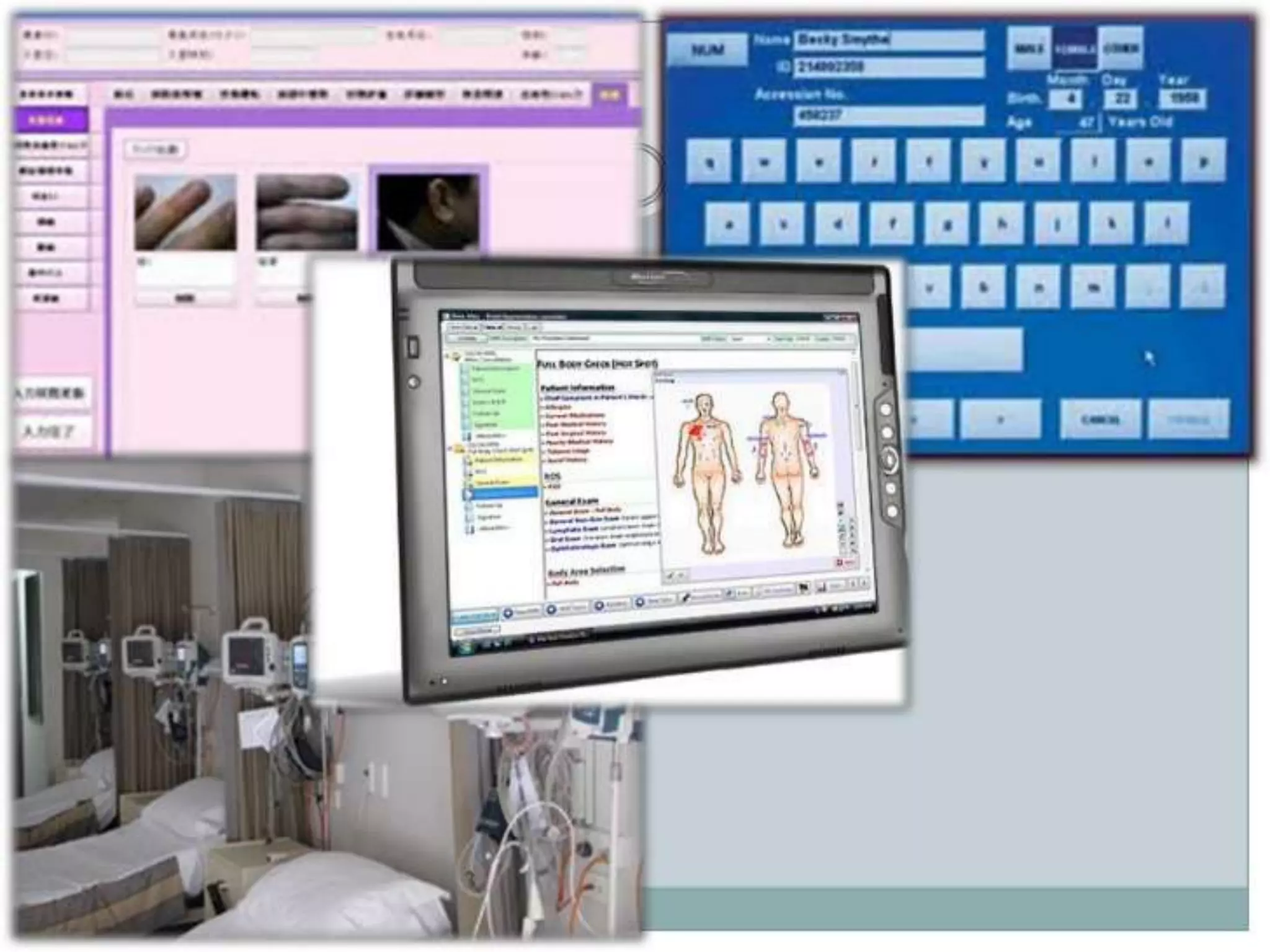
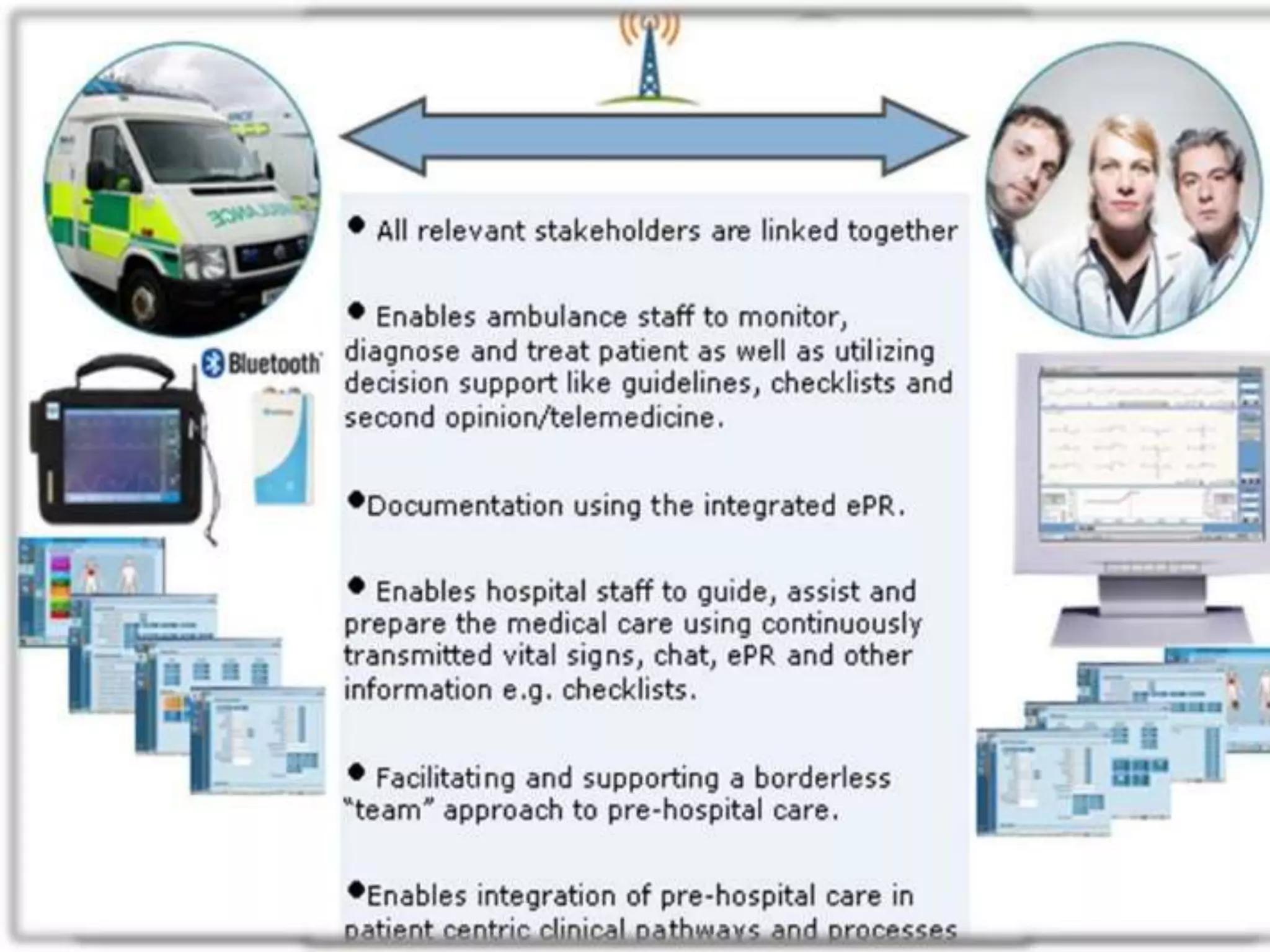
• Handheld monitors
• (e.g., pulse oximetry & peripheral blood
glucose monitors, Infusion pumps...)
• Wireless technology with automatic nurse
paging capability when client
measurements fall outside of normal
parameters
Technology & Informatics in
Client Care
• Computerized clinical decision-making
programs
• Nurse personal digital assistants
• Care-planning software programs
• Handheld clinical resource information
devices
• Intravenous pumps for medication
delivery
Current uses of Informatics
Applications in Healthcare
• Admission, discharge, & transfer
• Patient Access Record
• Financial parameters
• Physician order entry
• Ancillary department
• Documentation
Informatics Applications in
Healthcare
• Scheduling
• Pharmacy preparation
• Acuity criteria
• Specialty practice
• Decision support
• Communication
• Critical pathways
Computers in Nursing
Administration
Use of Computers in Nursing
Administration
• Human Resources
• Medical Records
• Nursing station system
• Personnel management
• Quality Assurance
Cont…
• Facilities management
• Budget and Finance
• Accreditation
Use of Computers in Nursing
Administration
• Human resourse:
 Employers must maintain a database,
for each employee
 Data’s include demographic salary, life
support certification, health requirement,
performance appraisal.
Cont…
• Medical record system:
Computerization of medical records is
utilized for
 Monthly demographic data analysis
 Hospital mortality and morbidity rate
 Monthly and annual report
 Reference
Cont…
• Nurses station system:
It is located in each ward for patient
care management
• Test requesitition
• Dietary requirement
• Drug administration schedule
• Other services
Cont…
• Personnel management: It includes
 Nursing audit
 Performance record
 Leave record
 Salary
 Promotion
 Career development
Cont…
• Facilities management:
Managing building and non nursing
services
– Control heating
– Air conditioning
– Ventilation
– Alarm system
– Readers (scanning IDcards)
– Barcodes
Cont…
• Budget and finance:
 Billing
 Salary
• Accreditation
The joint commission on
accreditation care organization
requires hospital to have online
mechanism to monitor quality
indicator.
Computers in Nursing
Research
Use of Computers in Nursing
Research
• Problem identification
• Literature Search
• Research design
• Data Collection and Analysis
• Research Dissemination
Issues Related to Computers in
Nursing
• Legal/Ethical Issues
• privacy/confidentiality
• access to data for research and other purposes
• informed consent
• License issues with telenursing
• Copy right of materials on the Web
Summary
REFERENCES
• Linda.Q.Thede. Informatics and nursing
oppourtunities & challenges. 2nd edition.
2003. Lipincott publication. Pg.no:304-308.
• NC.Jain & MS.Sakshi. Computer for nurses.
2004. AIBS publishers. India. Pg.no:1-8, 26-
28.
• AG. Chandrokar. Hospital Administration &
Planning. 2nd edition. 2009. Paras publication.
Pg.no:430-435.
REFERENCES
• GD. Mogli. Medical Records-Organisation &
Management. 2006.Newdelhi. Jaypee
Publication. Pg.no:242-246.
• http://nursestimes.com
• http://pubmed.com
CONCLUSION
Uses of computers in nursing.pdf

Uses of computers in nursing.pdf

  • 1.
  • 2.
    USES OF COMPUTERIN NURSING PRACTICE AND MANAGEMENT
  • 3.
    INTRODUCTION • In thishistory of civilization, no work of science including health care information has so comprehensively impacted on the course of human development as health information and management technology(HIMT).currently the outcome of transformation that has taken from the mannual information technology manage ment to a fast and accurate computerized – HIMT of this century.
  • 4.
    TERMINOLOGIES • Data: Itis a collection of numbers , alphabets, or some facts. • Program: A program is a task given to a computer. • Process :The computer system breaks down each task it handles into smaller tasks called process. • Hardware: The physical component of a computer system are collectively called hardware. • Software: Refers to the medium containing set of instruction that instructs the hardware how to perform particular tasks.
  • 5.
    DEFINITION • COMPUTER: Itmeans Commonly Operated Machine Particularly Used for Training Education Research.
  • 6.
    Nursing Informatics • Afield that combines nursing and computers • Informatics is computer science plus information science
  • 7.
    Cont… • Nursing informatics: Thedefinition stated that nursing informatics was the use of computer technology in all nursing endeavors :services, education and research. -Scholes and Barber . (1980)
  • 8.
    Cont… NURSING INFORMATICS : Nursinginformatics combines nursing, information and computer sciences to manage and communicate information to support nurses and health care provider in decision making. -ANA(2001).
  • 9.
    BASIC OPERATION OF COMPUTERSYSTEM 1. INPUTTING 2. STORING 3. PROCESSING 4. OUTPUTTING 5. CONTROLLING
  • 10.
    USES OF COMPUTERIN NURSING
  • 11.
    COMPUTER IN NURSING EDUCATION •Computers are used extensively in nursing education; libraries are computerised, nursing educationalists use computers in classroom teaching and for academic record keeping.
  • 12.
    COMPUTER IN NURSING EDUCATION •In nursing education, computers are used in 1.Teaching and learning 2. Testing 3. Student and course record management Each of these are described next.
  • 13.
    1.Teaching and learning Computersenhance academic performance for both students and faculty through facilitating  access to literature  computer-assisted instruction  classroom technologies  distance learning.
  • 14.
    cont… – Literature accessand retrieval: In a fraction of time, continuously updated cumulative indexes of subjects can be searched electronically. • Once a list of search matches is displayed on screen, the user can select all or certain citations and either print them or store them on the hard disk.
  • 15.
    The text belowlists commonly used bibliographic systems and databases. Acquired Immune Deficiency Syndrome information onLINE (AIDSLINE) CANCER LITerature (CANCER LIT) Cumulative Index to Nursing and Allied Health Literature (CINAHL) Educational Resources Information Center (ERIC)
  • 16.
    Cont… • Medical LiteratureAnalysis and Retrieval System (MEDLARS) • Mental Measurement Yearbook • Psychological Abstracts (PsychINFO)
  • 17.
    Computer-Assisted Instruction (CAI) •Many software programmes help students and nurses learn and demonstrate learning. • Examples of tutorials include ECG interpretation, drug interactions, and legal aspects of nursing. • Completion of CAI programmes may be an acceptable means of demonstrating continuing education activities.
  • 18.
    Teacher in Srilanka Teacher in Africa Teacherin Bangalore Teacher in America Teacher in Tamilnadu Supercourse Model: Lecture Sharing Teacher in Delhi
  • 19.
    Classroom Technology • Neweducational buildings are wired to accommodate technology. This includes electric outlets and wireless technology for network or Internet access. • For nursing faculty, liquid crystal display (LCD) panels allow computer screens to be displayed to the entire classroom.
  • 20.
    2.Testing • This isthe second use of computer in nursing education. • Surveys, including anonymous questionnaires, can be completed online. • For testing, large banks of potential items can be written and the computer can generate different exams for each student depending on the selection criteria.
  • 21.
    Cont… • Students’ answerscan also be scored electronically and the exam results analysed quickly. • For example, the National Council Licensure Examination (NCLEX-RN) moved from paper and pencil tests to computer tests.
  • 22.
    3.Student and CourseRecord Management • Computers are useful for maintaining results of students’ grades or attendance. • The computer programme can calculate percentages, sort student scores in order, and print results for both students and faculty. • Students are frequently asked to evaluate faculty and courses. These data are also scanned into the computer so that cumulative results can be calculated and stored.
  • 23.
    Cont… • Many schoolshave now all student records on computer. From application through graduation, the registrar’s office keeps track of names, addresses, courses taken, grades, and all other important data.
  • 24.
  • 25.
    COMPUTERS IN NURSING PRACTICE •Use information & communication technology to document & evaluate patient care, advance patient education, & enhance the accessibility of care • Use appropriate technology to assess & monitor patients • Work on an interdisciplinary team to make ethical decisions regarding the application of technologies & the acquisition of data
  • 26.
    Nursing Skills • Adaptthe use of technologies to meet patient needs • Teach patients about health care technologies • Protect the safety & privacy of patients in relation to the use of health care & information technologies • Use information technologies to enhance one’s own knowledge base
  • 27.
    Informatics & Technologyin Client Care • Handheld monitors • (e.g., pulse oximetry & peripheral blood glucose monitors, Infusion pumps...) • Wireless technology with automatic nurse paging capability when client measurements fall outside of normal parameters
  • 28.
    Technology & Informaticsin Client Care • Computerized clinical decision-making programs • Nurse personal digital assistants • Care-planning software programs • Handheld clinical resource information devices • Intravenous pumps for medication delivery
  • 34.
    Current uses ofInformatics Applications in Healthcare • Admission, discharge, & transfer • Patient Access Record • Financial parameters • Physician order entry • Ancillary department • Documentation
  • 35.
    Informatics Applications in Healthcare •Scheduling • Pharmacy preparation • Acuity criteria • Specialty practice • Decision support • Communication • Critical pathways
  • 36.
  • 37.
    Use of Computersin Nursing Administration • Human Resources • Medical Records • Nursing station system • Personnel management • Quality Assurance
  • 38.
    Cont… • Facilities management •Budget and Finance • Accreditation
  • 39.
    Use of Computersin Nursing Administration • Human resourse:  Employers must maintain a database, for each employee  Data’s include demographic salary, life support certification, health requirement, performance appraisal.
  • 40.
    Cont… • Medical recordsystem: Computerization of medical records is utilized for  Monthly demographic data analysis  Hospital mortality and morbidity rate  Monthly and annual report  Reference
  • 41.
    Cont… • Nurses stationsystem: It is located in each ward for patient care management • Test requesitition • Dietary requirement • Drug administration schedule • Other services
  • 42.
    Cont… • Personnel management:It includes  Nursing audit  Performance record  Leave record  Salary  Promotion  Career development
  • 43.
    Cont… • Facilities management: Managingbuilding and non nursing services – Control heating – Air conditioning – Ventilation – Alarm system – Readers (scanning IDcards) – Barcodes
  • 44.
    Cont… • Budget andfinance:  Billing  Salary • Accreditation The joint commission on accreditation care organization requires hospital to have online mechanism to monitor quality indicator.
  • 45.
  • 46.
    Use of Computersin Nursing Research • Problem identification • Literature Search • Research design • Data Collection and Analysis • Research Dissemination
  • 47.
    Issues Related toComputers in Nursing • Legal/Ethical Issues • privacy/confidentiality • access to data for research and other purposes • informed consent • License issues with telenursing • Copy right of materials on the Web
  • 48.
  • 49.
    REFERENCES • Linda.Q.Thede. Informaticsand nursing oppourtunities & challenges. 2nd edition. 2003. Lipincott publication. Pg.no:304-308. • NC.Jain & MS.Sakshi. Computer for nurses. 2004. AIBS publishers. India. Pg.no:1-8, 26- 28. • AG. Chandrokar. Hospital Administration & Planning. 2nd edition. 2009. Paras publication. Pg.no:430-435.
  • 50.
    REFERENCES • GD. Mogli.Medical Records-Organisation & Management. 2006.Newdelhi. Jaypee Publication. Pg.no:242-246. • http://nursestimes.com • http://pubmed.com
  • 51.