Nurse assists the client in performing activities of daily
living which he/she cannot perform independently due
to illness or disability.
Monika NR M.Sc.Nursing
50
Prepared by :
MonikaDevi
M.Sc. Nursing
Unit: 2
Nursing as a profession
Monika NR M.Sc.Nursing
1
2.
INTRODUCTION
The wordnurse comes from Latin word nutritious which
means to nourish to protect , to educate, to support and to
supply. Nurse not only provides care to the sick and injured
patient, but also helps in the prevention of disease and their
cure.
The nurse serve as a teacher, helps to educate public in regard
to health measures, she care for the mind as well as body
Monika NR
M.Sc. Nursing
2
3.
DEFINITION OF APROFESSION:
The services offered by a profession are
based on specialized knowledge and skills
that have been developed in scientific and
learned manner.
Monika NR M.Sc.Nursing
3
4.
Cont..
A profession isan occupation that require
extensive training and has ongoing
research, training is given in higher level
institution
Monika NR M.Sc.Nursing
4
5.
CHARACTERISTICS OF PROFESSION
It utilizes in its practice of well defined and well organized body
of special knowledge which is on the intellectual level of higher
learning.
It constantly enlarges the body of knowledge.
It applies its body of knowledge in practical services which are
vital to human and social welfare.
It attracts individuals of intellectual and personal qualities.
Monika NR M.Sc.Nursing
5
6.
Cont…
It utilizesin its practice of well defined and well organized
body of special knowledge which is on the intellectual level of
higher learning.
It constantly enlarges the body of knowledge.
It applies its body of knowledge in practical services which
are vital to human and social welfare.
It attracts individuals of intellectual and personal qualities.
Monika NR M.Sc.Nursing
6
7.
Cont..
It providea specific services
It process a code of ethics
It demand truth and loyalty it demand continuous in services
training of its member.
Member in professional autonomy in decision making and
practice.
Monika NR M.Sc.Nursing
7
8.
NURSING
DEFINITION
The uniquefunction of the nurse is to assist the individual,
sick or well in the performance of those activities
contributing to health or recovery that he would perform
unaided if he had the necessary strength, well or knowledge
and do this in such a way as to help him gain independence
as rapidly as possible. Virginia Henderson (1960)
Monika NR M.Sc.Nursing
8
9.
Cont…
“Nursing isa helping profession & as such provides services
which contribute to the health & well-being of people”.
(ANA-American Nurses Association).
The act of utilizing the environment of the patient to assist
him in his recovery. Florence nightingale (1860)
Monika NR M.Sc.Nursing
9
10.
Cont…
The term nursemay be elaborated as follow:
Noble
Useful &understanding
Responsible & resourceful
Sympathetic
Efficient
Monika NR M.Sc.Nursing
10
11.
CONCEPTS OF NURSING
There are mainly 4 concepts of nursing related to person,
environment, health, nursing.
The connections between these 4 concepts are explained in
following statement in Donaldson and Crowley: “Nursing
studies the wholesome or health of humans, recognizing that
humans are in continuous interaction with their
environment.”
Monika NR M.Sc.Nursing
11
12.
PHILOSOPHY:
A philosophyof nursing includes beliefs and values with
regard to man in general and specifically man as the
learner, teacher, nurse, client and the beliefs about health ,
illness, society, nursing, learning etc.
According to Christian philosophy : Nursing is a profession
of charity. it covers:
Monika NR M.Sc.Nursing
12
13.
Cont…
1. Spiritual: religionshould serve as the primary integrating
factor for the development of the curriculum in a school of
nursing. The principle of religion and morality are
unchanging.
2. Moral : Though understanding of moral principle,
governing man’s conduct and action leading the nurse’s to
study ‘ethics’ . Nurse has to develop right conscience.
Monika NR M.Sc.Nursing
13
14.
Cont…
3. Intellectual: toprovide a systematic development and
training of the intellect, so that it may be enlightened.
Disciplined & disposed to function. For the fulfillment of
nursing function , nursing education should give training
in:
Memory
Direction of imagination
Strengthening & expansion of capacity for association.
Cultivation and training of the intellect.
Monika NR M.Sc.Nursing
14
15.
Cont…
Imparts knowledge
Development of communication skills to express their
thoughts.
Monika NR M.Sc.Nursing
15
16.
Cont..
4. Emotional needs:nurse must be able to function as a mature,
self-dependent and responsible individual and must be able to
relate well to other people.
5. Physical: to promote the harmonious development, physical
needs also have to be met in order to preserve her body and the
essential of her health.
Monika NR M.Sc.Nursing
16
17.
Cont…
Social: Nurseis a social being , who must pass her life in
society in relation to which she has hold privileges and
obligation. Nursing is liked with social culture, in which
nursing activities are carried out.
ex.: while working/staying in India, she should know the
culture, social privileges of the Indian society.
Monika NR M.Sc.Nursing
17
18.
OBJECTIVES OF NURSING
To prepare nurses who will give expert bedside nursing care
in the hospital and home.
To provide integration of health and social aspect’s theory
and practice in generalized public health nursing
To provide an adequate, sound scientific foundation to
understand the functioning of body and mind in health and
disease
Monika NR M.Sc.Nursing
18
19.
Cont...
To preparenurses who will be able to work co operatively
with team members.
To provide opportunities through curricular and extra
curricular activities for full development of personality of
each individual student
Monika NR M.Sc.Nursing
19
20.
Cont..
To ensureopportunities for initiative and resourcefulness,
sense of responsibility for oneself.
To provide services to the individual, family, community
that promote health, prevent illness, restore health and
facilitate coping.
Monika NR M.Sc.Nursing
20
21.
NURSING PRACTICE:
Nursingis a dynamic and Supportative profession guided by
its code of ethics and it rooted in caring, a concept evident
throughout its four field of activity:
1. Practices
2. Education
3. Administration
4. Research
Monika NR M.Sc.Nursing
21
22.
CHARACTERISTICS OF NURSING
Nursing is caring
Nursing involve close personal contact with the recipient of
care
Nursing is concerned with services that take human into
account as physiological, psychological and sociological
organisms.
Nursing committed to promoting individual, families.
Monika NR M.Sc.Nursing
22
23.
Cont..
community, andnational health goals in its best manner
possible.
Nursing committed personalized services for all persons
without regard to color, creed, and social or economic status.
Nursing is an art, science of a profession. It is a call to serve
the people who are in need of care.
It is educative, it can be preventive, or therapeutic.
Monika NR M.Sc.Nursing
23
24.
Cont…
It isa science: Science is the body of knowledge based on a
no. of facts to establish certain laws & principles. Nursing is a
science because any nursing intervention done for the patient
is based on knowledge of scientific principles. Nursing is an
applied science.
Nursing is adapted to the individual needs of patient. Each
individual is considered as a unique person.
Monika NR M.Sc.Nursing
24
NATURE OF NURSING
Nursing has been called the oldest of arts and the youngest
of professions. The word nurse evolved from the Latin
word nutritious, which means nourishing. The word
nourish means to supply that which is necessary to life.
Nursing is defined by various authors at various times.
Nursing, besides being a honourable profession, is one of
the oldest arts and an essential modern occupation.
Monika NR M.Sc.Nursing
26
27.
Conti..
Handerson says“nursing is primarily assisting the
individuals (sick or well) in the performances of those
activities, contributing to health or its recovery (or to a
peaceful death) that he would perform unaided, if he had the
necessary strength, will or knowledge.
The unique contribution of nursing is to help the individual
to be independent as soon as possible.
Monika NR M.Sc.Nursing
27
28.
Cont…
Nursing hasits own body of knowledge scientifically based and
humanitarianism that promises expanded benefits to people and society.
It assists the individual or family to achieve their potential for self-
direction for health.
Nursing is not only an applied science, it is also an art, which provides
skillful care for the sick in appropriate relationship with the patient,
family, physician and with others who have related responsibilities.
Monika NR M.Sc.Nursing
28
29.
Cont…
It isconcerned equally with the prevention of illness and
the conservation of health. Skillful nursing care embraces
the whole person, body, mind and soul, his physical,
mental, social and spiritual well-being (holistic approach).
In its broadest sense, nursing covers not only the care of
the sick, the aged, the helpless and the handicapped, but
also cares for the promotion of health and prevention of
illness.
Monika NR M.Sc.Nursing
29
30.
The artsof nursing had its birth in the earliest home where
a mother cared for the well being of the rest members of
the family. It is this mother care that through the ages
developed into a skilled art and a well-organized science.
Monika NR M.Sc.Nursing
30
SCOPE OF NURSINGPRACTICE
The term “scope of practice” is used to define the
actions, procedures, etc. that are permitted by law for a
specific profession. It is restricted to what the law
permits based on specific experience and educational
qualifications.
There was a time when professional nurses had very
little choice of service because nursing was centered in
the hospital and bedside nursing. Career opportunities
are more varied now for a numbers of reasons.
Monika NR M.Sc.Nursing
32
33.
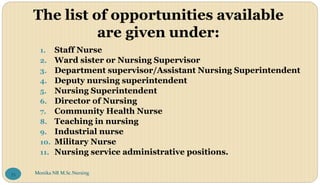
The list ofopportunities available
are given under:
1. Staff Nurse
2. Ward sister or Nursing Supervisor
3. Department supervisor/Assistant Nursing Superintendent
4. Deputy nursing superintendent
5. Nursing Superintendent
6. Director of Nursing
7. Community Health Nurse
8. Teaching in nursing
9. Industrial nurse
10. Military Nurse
11. Nursing service administrative positions.
Monika NR M.Sc.Nursing
33
34.
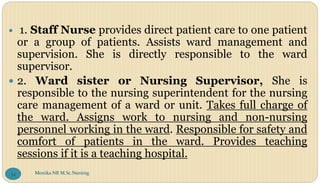
1. StaffNurse provides direct patient care to one patient
or a group of patients. Assists ward management and
supervision. She is directly responsible to the ward
supervisor.
2. Ward sister or Nursing Supervisor, She is
responsible to the nursing superintendent for the nursing
care management of a ward or unit. Takes full charge of
the ward. Assigns work to nursing and non-nursing
personnel working in the ward. Responsible for safety and
comfort of patients in the ward. Provides teaching
sessions if it is a teaching hospital.
Monika NR M.Sc.Nursing
34
35.
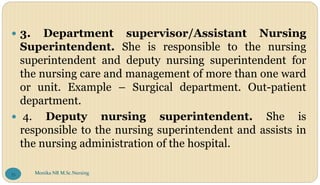
3. Departmentsupervisor/Assistant Nursing
Superintendent. She is responsible to the nursing
superintendent and deputy nursing superintendent for
the nursing care and management of more than one ward
or unit. Example – Surgical department. Out-patient
department.
4. Deputy nursing superintendent. She is
responsible to the nursing superintendent and assists in
the nursing administration of the hospital.
Monika NR M.Sc.Nursing
35
36.
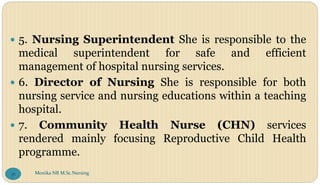
5. NursingSuperintendent She is responsible to the
medical superintendent for safe and efficient
management of hospital nursing services.
6. Director of Nursing She is responsible for both
nursing service and nursing educations within a teaching
hospital.
7. Community Health Nurse (CHN) services
rendered mainly focusing Reproductive Child Health
programme.
Monika NR M.Sc.Nursing
36
37.
8.Teaching innursing. The functions and responsibilities of
the teacher in nursing are planning, teaching and supervising
the learning experiences for the students. Positions in nursing
education are clinical instructor, tutor, senior tutor, lecturer,
and associate professor, Reader in nursing and Professor in
nursing.
Monika NR M.Sc.Nursing
37
38.
9. Industrialnurse Industrial nurses are providing
first aid, care during illness, health educations about
industrial hazards and prevention of accidents.
10. Military Nurse. Military Nursing service became a
part of the Indian Army by which means nurses became
commissioned officers who are given rank from
lieutenant to major general.
Monika NR M.Sc.Nursing
38
39.
11.Nursing serviceabroad Attractive salaries and
promising professional opportunities, which causes a major
increase for nursing service in abroad.
12.Nursing service administrative positions. At the state
level the Deputy Director of Nursing at the state health
directorate. The highest administrative position on a national
level is the Nursing Advisor to the Govt. of India.
Monika NR M.Sc.Nursing
39
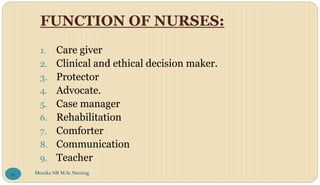
FUNCTION OF NURSES:
1.Care giver
2. Clinical and ethical decision maker.
3. Protector
4. Advocate.
5. Case manager
6. Rehabilitation
7. Comforter
8. Communication
9. Teacher
Monika NR M.Sc.Nursing
41
42.
Care giver:
Ascare giver nurse help s client to regain health through
healing process.
Nurse addresses the holistic health care needs of client.
She helps the client and families to set goals and meet
those goals.
She preserves dignity of client
She accepts client as person nor merely as mechanical
being.
Monika NR M.Sc.Nursing
42
43.
Clinical and ethicaldecision maker:
Nurse uses critical thinking skill throughout the
nursing process to provide effective care.
Nurse makes decision in collaboration with the client
and family.
She also collaborate and consults with other health
professionals.
Monika NR M.Sc.Nursing
43
44.
Protector
She providesa safe conductive environment to the
client.
She takes step to prevent injury to client.
She protects the client from every possible adverse
effect of treatment.
She asks about any allergy to medicine or food.
She provides immunization against disease.
Monika NR M.Sc.Nursing
44
45.
Advocate:
She protectsclient human and legal rights and
provides assistance in asserting those rights if the need
arise.
She advocates the client by keeping in mind the client’s
religion and culture.
Nurse defends the client right in general way by
speaking out against policies that might endanger their
well-being.
Monika NR M.Sc.Nursing
45
46.
Manager:
As amanager, nurse co-ordinate the activities of other
members of health care team.
She manage the nursing care of not only one client but
also of families and in communities.
She delegates the nursing activities.
Monika NR M.Sc.Nursing
46
47.
Communicator:
Effective communicationis an essential element of all
professional including nursing.
Nursing involves communication with client and families,
other nurses, health care professional, resources person
and the community.
As a communicator, nurse provides information to other
health team members about the planned and unplanned
nursing care.
She convey information verbally as well as through
documentation.
Nurse communicate verbally at change shift.
Monika NR M.Sc.Nursing
47
48.
Comforter:
The roleof comforter is a traditional and historical one
in nursing and has continued to be important as nurses
have assumed new roles.
She motivates clients to reach therapeutic goals.
She promotes comfort to client by staying near the
patient.
Monika NR M.Sc.Nursing
48
49.
leader
Nursing leadershipis defined as a mutual process of
interpersonal influenza through which nurse helps
client in making decision for establishing and achieving
the goals to improve the client well being. As a leader,
she influences the client to make decision regarding
health.
Monika NR M.Sc.Nursing
49
50.
Counselor:
Nurse helpsthe client to recognize and cope with
stressful, psychological or social problem.
She assist the client for developing good interpersonal
relationship.
Nurse counsels primary healthy individual with normal
adjustment difficulties.
Nurse help the persons to develop new attitude felling
and behavior.
Monika NR M.Sc.Nursing
50
51.
Rehabilitator:
Rehabilitation processby which individuals return to
maximal levels of functioning after illness, accident or
other events.
Nurse helps the clients to adapt as fully as possible who
experiences physical or emotional impairment that
change their events.
Monika NR M.Sc.Nursing
51
52.
Teacher /Educator:
Teachingrefer to the activities by which the teacher
helps the learner to learn. As a teacher
She determines that the client fully understood.
She also evaluates client’s progress in learning.
She gives health education on diet, about prevention
measures of disease.
Monika NR M.Sc.Nursing
52
53.
Researcher:
Nurse investigatesproblems in order to improve
nursing care and expand the scope of nursing practices.
She does many qualitative and quantitative researches.
Based upon these finding, they practice nursing care in
hospital as well as clinical setting.
For example: investigating various ways to resoles
client’s pain.
Monika NR M.Sc.Nursing
53
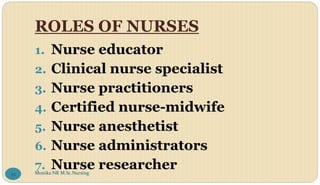
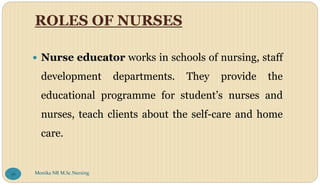
ROLES OF NURSES
Nurse educator works in schools of nursing, staff
development departments. They provide the
educational programme for student’s nurses and
nurses, teach clients about the self-care and home
care.
Monika NR M.Sc.Nursing
56
57.
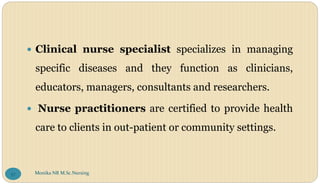
Clinical nursespecialist specializes in managing
specific diseases and they function as clinicians,
educators, managers, consultants and researchers.
Nurse practitioners are certified to provide health
care to clients in out-patient or community settings.
Monika NR M.Sc.Nursing
57
58.
Certified nurse-midwifeare certified by the
American College of Nurse-Midwives to provide
independent care for women during normal pregnancy,
labour and delivery.
Nurse anesthetist, having advance training in
anesthesiology, provides surgical anesthesia to the client
under the supervision of an anesthesiologist during
minor surgery with baccalaureate degrees or master’s
degree.
Monika NR M.Sc.Nursing
58
59.
Nurse administratorsmanage client care within the
healthcare agencies in a middle level or upper level
management position.
Nurse researcher with Doctoral degree investigate
nursing problem to improve care and to define and expand
the scope of nursing practice.
Monika NR M.Sc.Nursing
59
QUALITIES OF NURSE
MonikaNR M.Sc.Nursing
61
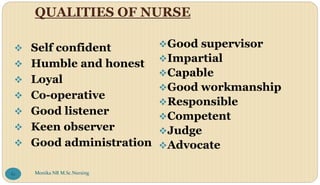
Self confident
Humble and honest
Loyal
Co-operative
Good listener
Keen observer
Good administration
Good supervisor
Impartial
Capable
Good workmanship
Responsible
Competent
Judge
Advocate
62.
QUALITIES OF NURSE
Nurseshould have the following qualities:
Self confident: a professional nurse have self confidence.
Because of this , she is able to take decisions, and provides
holistic care.
Humble and honest: With this quality, nurse develops
rapport and gain trust of the client. An honest nurse gives
explanation regarding treatment .
Monika NR M.Sc.Nursing
62
63.
Loyal: Nurseaccept the client as he is. She recognizes
the client as a person and understands empathetically
his feelings.
Co-operative: As an individual , nurse plays many
role in hospital. She works cooperatively with health
team members as with family members.
Monika NR M.Sc.Nursing
63
64.
Good listener:this is the best quality of nurse, by which
she understands client’s view. By active listening, she
identifies clients need and provides care accordingly.
Keen observer: while dealing with client a nurse observer
keenly his verbal as well as non verbal command/behavior.
Monika NR M.Sc.Nursing
64
65.
Good administration:because of this quality, a
professional nurse executes and evolutes the junior nursing
staff.
Good supervisor: A professional nurse works as
supervisor to the junior nursing staff as well other
employees while performing their duties.
Monika NR M.Sc.Nursing
65
66.
Impartial: professionalnurse treats each client without any
prejudice/ personal interest. She provides care fairly to every
client.
Capable: a nurse is competent enough and has a capability
to give care effectively.
Good workmanship: A professional nurse fulfils her
duties and responsibilities very well by coordinating with
other members of health care team.
Monika NR M.Sc.Nursing
66
67.
Responsible: aprofessional nurse is liable to her course of
action. She has a duty of care according to the laws. She is
accountable for initiating any nursing care.
Competent: competent nurse is able to provide holistic
nursing care to clients admitted with different health
problems.
Monika NR M.Sc.Nursing
67
68.
Judge: Registerednurse has ability to identify the problem
before they occur. For ex. Nurse can judge that a bed ridden
client is prone to develop pressure ulcer. So due to this
judging ability, she can prevent the occurrences of such
complications.
Advocate: A Nurse supports and speaks in favor of client
and provide information to client and family for making
informed decisions.
Monika NR M.Sc.Nursing
68
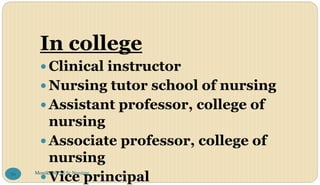
In college
Clinicalinstructor
Nursing tutor school of nursing
Assistant professor, college of
nursing
Associate professor, college of
nursing
Vice principal
Monika NR M.Sc.Nursing
70
71.
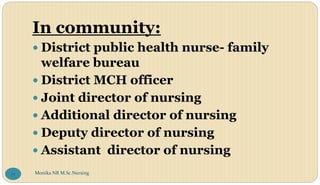
In community:
Districtpublic health nurse- family
welfare bureau
District MCH officer
Joint director of nursing
Additional director of nursing
Deputy director of nursing
Assistant director of nursing
Monika NR M.Sc.Nursing
71
NURSING AS APROFESSION
Professions are those occupation based on specialized
intellectual study and training the purpose of which is
supply skilled services with ethical components to
other, for a definite fee or salary.
Profession is a type of occupation that meet certain
that raise it to a level above that of an occupation .
Monika NR M.Sc.Nursing
73
74.
Nursing isthe protection, promotion, and optimization
of health and abilities, prevention of illness and injury,
alleviation of suffering through the diagnosis and
treatment of human response, and advocacy in the care
of individual, families, communities, and population.
Monika NR M.Sc.Nursing
74
75.
Criteria’s of aprofession.
Genevieve and Roy Bixler first
wrote about the status of nursing as a
profession in 1945. These criteria
include the following
Monika NR M.Sc.Nursing
75
76.
Occupation are principlearea of work
classified according to various feature
such as preparation, skills and
knowledge require; the nature of work
itself, supervision, motivation.
Monika NR M.Sc.Nursing
76
77.
1. The servicesprovided are vital to humanity and
the welfare of the society. Nursing is the service that
is essential to the wellbeing of the people and to the
society. Nursing promotes, maintains and restores the
health of individuals, groups and communities. Assisting
others to attain the highest level of wellness is the goal of
nursing. Caring, meaning nurturing and helping others
are the basic components of professional nursing.
Monika NR M.Sc.Nursing
77
78.
2.The services involveintellectual activities.
Individual responsibilities (accountability) are a
strong feature. Nursing has developed and refined its
own unique approach to practice. Nursing process is a
cognitive activity that requires both critical and creative
thinking and serves as the basis of providing nursing
care. Individual accountability in nursing has become the
hallmark of practice.
Monika NR M.Sc.Nursing
78
79.
Accountability is‘ is being answerable to some one for
something one has done’ Through legal opinion and court
cases, society has demonstrated that nurses are
individually responsible for their actions as well as for
those of personnel under their supervision.
Monika NR M.Sc.Nursing
79
80.
Conti..
3. Practitioners areeducated in institution of higher
learning. There are basic nursing program, baccalaureate
program, masters and Doctoral program in nursing.
4.Well-defined body of specific and unique knowledge
that undergoes continual growth through research
Monika NR M.Sc.Nursing
80
81.
5. Practitioners arerelatively independent and control
their own policies and activities. (Autonomy). Autonomy or
control over one’s practice is another controversial area for
nursing. Although many nursing actions are independent, most
nurses are employed in hospitals where authority resides in one’s
position.
6. Practitioners are motivated by service (altruism) and
considered their work an important component of their
lives. Nurses are dedicated to the ideal of service to others, which
is known as altruism
Monika NR M.Sc.Nursing
81
82.
7. There isa Code of Ethics to guide the decisions
and conduct of practitioners. The International Council
of Nurses (ICN) has established Code of Nursing Ethics
through which standards of practice are established,
promoted and refined.
Monika NR M.Sc.Nursing
82
83.
8. There isan organization (Association) that
encourages and supports high standards of
practice. Nursing has a number of professional
associations that were formed to promote the
improvement of the profession. Foremost among these,
is the TNAI (The Trained Nurses Association of India).
The purposes of TNAI are to foster high standards of
nursing practice, promote professional and educational
advancement of nurses and promote the welfare of the
nurses.
Monika NR M.Sc.Nursing
83
HISTORY OF NURSINGIN INDIA
History of nursing in India goes back through
centuries to about 1500BC. Susrutha, the father of
surgery lived during 1400BC. In charaka samhita
the writing of charaka, the importance of bathing to
purify the body is mentioned; King Asoka improved
medical care in India. Hippocrates, the father of
medicine was born about 460BC.hippocratic oath is
used in medical colleges today.
Monika NR M.Sc.Nursing
85
86.
Military nursing:
Withcoming of the British, army institutions were
developed. In 1764 the east India company helped to
start a hospital for soldiers at forest. George, madras.
Later a civilian hospital was built and the medical staff,
appointed by the east India Company, served in both
hospitals. In 1797 a lying in hospital was built and in
1854 the government sanctioned a training school for
midwives.
Monika NR M.Sc.Nursing
86
87.
In 1861,through the efforts of Miss Nightingale, reform
in military hospital led to reform the civilian hospital.
Efforts were made to provide health services for the
people of India.
Monika NR M.Sc.Nursing
87
88.
Civilian hospitals:
Nursingin the military hospital was poor quality. In 1871
a training programme for nursing was started at
government general hospital, madras. Nurse were
brought from England to be in charges and the first six
students were those who had previously received their
diploma in midwifery. Later this plan was reversed.
General training was taken first followed by a course of
midwifery.
Monika NR M.Sc.Nursing
88
89.
Provision forthe nursing care of patient in these early
hospitals was very limited. In the JJ group, nursing
was done by medical students. In 1891, Bai Kashibai
Ganpat, was the first Indian nurse to come for
training was at first for two years but become three
years afterwards. In 1893 the north India united
board of examiners for mission hospital was formed.
After the second world war several nursing school
were established.
Monika NR M.Sc.Nursing
89
90.
In Bombay,the first school of nursing was stated at JJ
hospital in 1886.
In 1926 the first nurse’s registration act was passed in
Madras. Gradually nursing councils were established in
all states.
Monika NR M.Sc.Nursing
90
91.
MISSION HOSPITAL
Missionhospital were first to begin the training of
Indian nurses. Religion prevented Hindu and Muslim
girls from joining nursing. Only Christian girls could be
trained at first. But for many years even they felt that
nursing was an inferior profession.
Monika NR M.Sc.Nursing
91
92.
Cont..
In thebeginning there was no informality of courses or
educational requirement. About 1907- 1910 the north
India united board of examination for mission hospital
was organized and set rules for admission for training
and conduct of public examination.
Monika NR M.Sc.Nursing
92
93.
DUFFERIN FUND
Untilthe late 19th century there were no women doctor and
therefore women were denied of care except in mission
hospital. This fact was brought to the attention of Queen
Victoria. At this time lady dufferin was coming to India with
her husband who was on government service. Queen
Victoria instructed lady dufferin about need for medical care
for women and children in India and asked her to take a
special interest in this problem. Lady Dufferin wrote her
friend and influential people to get financial aid.
Monika NR M.Sc.Nursing
93
94.
Thus in1885, Lady Dufferin was responsible for
starting the ‘national association for supplying medical
aid to women of India’ this is commonly called the
dufferin fund and continues to provide medical
education for women, to train nurses and midwives for
hospital and private work, and to improve medical
facilities for women.
Monika NR M.Sc.Nursing
94
95.
MODERN NURSING
Progressin science and medicine during past three
centuries increased interest for better nursing services
and training.
Florence nightingale: the era of modern nursing
commences with the work of Florence nightingale in
the Crimean war (1854-1856). She was born on 12 may
1820. She was the second daughter of wealthy English
parents. She felt that god had call her to fulfill
‘mission of mercury’.
Monika NR M.Sc.Nursing
95
96.
She thoughtof nursing or education work. She
observed the life of poor and tried to relive the sick.
Nursing appeared to her as the field in which she could
do the best.
Monika NR M.Sc.Nursing
96
97.
She studiedsanitary reforms and did consider the
nursing done in Kaiser’s war to be of a very high
standard but she gained idea from efficient method of
administration. When she was 33 year old of age, she
brought change which showed her exceptional ability
as an organizer and as an administration.
Monika NR M.Sc.Nursing
97
98.
Principles which sheestablished in her
school as St. Thomas hospital
Nurses should have practice training in hospital set-up.
Nurses should live in a home to form their moral character
and discipline.
Nursing education must be directed by a nurse.
Education is necessary for a nurse because she must know the
reason why she is to teach others.
Theory and practical must be correlated.
The school should be economical independent.
Monika NR M.Sc.Nursing
98
99.
NURSING EDUCATION
Nursingeducation in India began with very brief period
of training. The Nursing Council Act was passed in 1948
and a council of nurses was formed to ensure the quality
of nursing education in India. The Indian Nursing
Council (INC) is an autonomous body that acts as a
regulatory body for nurses and nursing education. There
are several levels of nursing education India.
Monika NR M.Sc.Nursing
99
100.
With effortsof the professor S. Radhakrishnan (the
chairman of university education commission), nursing
education in the country was integrated into the system of
higher education in all the state with graduate,
postgraduate college coming up.
Association such as the international council of nurse,
TNAI, Indian nursing council and state level registration
council promote and support the nursing profession.
State wise councils started developing from 1935 onward.
Monika NR M.Sc.Nursing
100