Questions??? Have you ever used  Google? Facebook? YouTube? Yes! Active audience!
USES  &  GRATIFICATION THEORY Phạm Lê Diệu Trang – s3311626 Đặng Thanh Thảo – s3298804
Contents Definition Historical Background 4 Key Reasons of Media Use U & G Theory in the 21 st  century Conclusion
There are three stages on how media influence the audience: Strong Supported by: Agenda-setting theory, Magic Bullet theory, Propaganda.  -> audience is passive Medium Supported by: Two-flow step theory. Weak Supported by: Uses and gratification theory. -> audience is active Definition
U&G theory states  what people do with media  NOT  what media does with people.  (Blumler & Katz 1974) -> audience plays an active role in choosing and using media in their daily lives. Definition
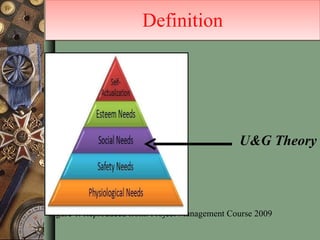
Definition U&G Theory Figure 1. Reproduced from: Project Management Course 2009
Early in the 1920s : is known as the Limited Effects Theory which is against the Mass Society theory. 1940s:  officially started with the name U&G Theory. 1960s – 1990s:  the development of U&G theory with supports from theorists.  Historical Background
Information: Finding for relevant events. Seeking advice to solve the matters and make decisions. Satisfying curiosity and general interest. Self-education. Gaining a sense of security through knowledge. 4 Key Reasons of Media Use
Personal Identity: Finding reinforcement for personal values. Finding models of behavior. Identifying with valued other (in the media). Gaining insight into one’s self. 4 Key Reasons of Media Use
Integration & Social Interaction Social empathy. Gaining a sense of belonging. Finding a basis for conversation & social interaction. Clarifying social roles. Enabling connection with family, friends and society. 4 Key Reasons of Media Use
Entertainment Free tension. Getting aesthetic enjoyment. Filling time. Emotional release. Sexual arousal. 4 Key Reasons of Media Use
The development of newer media:  The   Internet    More convenient for audience to satisfy their gratification U & G Theory in 21 st  century
Other concepts Interactivity:  multidimensional concepts: amount of choice provided to users, amount of effort users must access to access information, etc Demassification:  the control of the individual over the medium Asynchroneity:  the ability of individuals to send, receive, save or retrieve message at their convenience.  U & G Theory in 21st century
Current U & G Models   +   these other concepts   +   new media   +   evolving psychological, sociological, cultural context   =   A HIGHLY SERVICEABLE  theory for the 21 st  century  U & G Theory in 21st century
Conclusion
Blumler, J.G. & Katz, E 1974,  The uses of mass communications: Current perspectives on gratifications research,  Beverly Hills, CA. Ruggiero T 2000, ‘Uses and Gratifications Theory in the 21st century’,  Mass communication & Society  , pp.3-37. Project Management Course 2009, ‘Maslow Hierarchy of Needs,  image,  Project Management Course, viewed 26 July 2011, <http://www.abraham-maslow.com/m_motivation/Hierarchy_of_Needs.asp> References

Uses and gratification theory-presentation

  • 1.
    Questions??? Have youever used Google? Facebook? YouTube? Yes! Active audience!
  • 2.
    USES & GRATIFICATION THEORY Phạm Lê Diệu Trang – s3311626 Đặng Thanh Thảo – s3298804
  • 3.
    Contents Definition HistoricalBackground 4 Key Reasons of Media Use U & G Theory in the 21 st century Conclusion
  • 4.
    There are threestages on how media influence the audience: Strong Supported by: Agenda-setting theory, Magic Bullet theory, Propaganda. -> audience is passive Medium Supported by: Two-flow step theory. Weak Supported by: Uses and gratification theory. -> audience is active Definition
  • 5.
    U&G theory states what people do with media NOT what media does with people. (Blumler & Katz 1974) -> audience plays an active role in choosing and using media in their daily lives. Definition
  • 6.
    Definition U&G TheoryFigure 1. Reproduced from: Project Management Course 2009
  • 7.
    Early in the1920s : is known as the Limited Effects Theory which is against the Mass Society theory. 1940s: officially started with the name U&G Theory. 1960s – 1990s: the development of U&G theory with supports from theorists. Historical Background
  • 8.
    Information: Finding forrelevant events. Seeking advice to solve the matters and make decisions. Satisfying curiosity and general interest. Self-education. Gaining a sense of security through knowledge. 4 Key Reasons of Media Use
  • 9.
    Personal Identity: Findingreinforcement for personal values. Finding models of behavior. Identifying with valued other (in the media). Gaining insight into one’s self. 4 Key Reasons of Media Use
  • 10.
    Integration & SocialInteraction Social empathy. Gaining a sense of belonging. Finding a basis for conversation & social interaction. Clarifying social roles. Enabling connection with family, friends and society. 4 Key Reasons of Media Use
  • 11.
    Entertainment Free tension.Getting aesthetic enjoyment. Filling time. Emotional release. Sexual arousal. 4 Key Reasons of Media Use
  • 12.
    The development ofnewer media: The Internet  More convenient for audience to satisfy their gratification U & G Theory in 21 st century
  • 13.
    Other concepts Interactivity: multidimensional concepts: amount of choice provided to users, amount of effort users must access to access information, etc Demassification: the control of the individual over the medium Asynchroneity: the ability of individuals to send, receive, save or retrieve message at their convenience. U & G Theory in 21st century
  • 14.
    Current U &G Models + these other concepts + new media + evolving psychological, sociological, cultural context = A HIGHLY SERVICEABLE theory for the 21 st century U & G Theory in 21st century
  • 15.
  • 16.
    Blumler, J.G. &Katz, E 1974, The uses of mass communications: Current perspectives on gratifications research, Beverly Hills, CA. Ruggiero T 2000, ‘Uses and Gratifications Theory in the 21st century’, Mass communication & Society , pp.3-37. Project Management Course 2009, ‘Maslow Hierarchy of Needs, image, Project Management Course, viewed 26 July 2011, <http://www.abraham-maslow.com/m_motivation/Hierarchy_of_Needs.asp> References

Editor's Notes

  • #4 http://misschasse.com/wordpress/images/writing/UsesGratificationsTheory.pdf