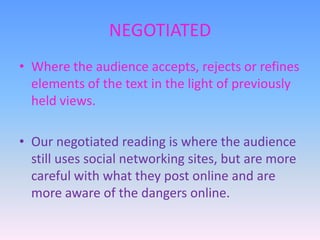
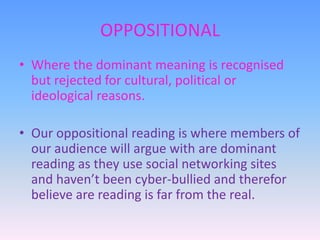
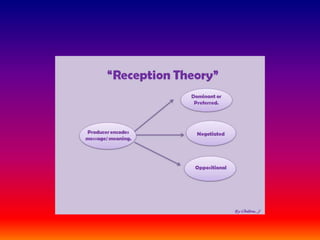
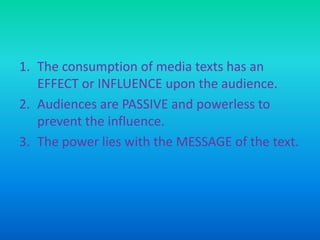
This document provides an overview of reception theory, which emphasizes how audiences receive and interpret media texts. It explains that producers encode texts with intended meanings or messages, but audiences can decode them in different ways - either correctly understanding the message, rejecting it, or misunderstanding it. The document outlines Stuart Hall's three types of audience decoding: dominant/preferred, where the audience agrees with the producer's message; negotiated, where the audience selectively accepts or refines the message; and oppositional, where the audience recognizes but rejects the dominant meaning. Examples are given of each type of decoding for a hypothetical media production on cyberbullying.



![5G Explained! A High Level Overview [Introduction]](https://cdn.slidesharecdn.com/ss_thumbnails/5gexplainedahighleveloverview-260119165306-cc137a3e-thumbnail.jpg?width=640&height=640&fit=bounds)


