Use of
Linear Algebra
in Robotics
Exploring the Invaluable Applications of
Linear Algebra in Robotics
Introduction
● Linear Algebra plays a crucial role
in various aspects of robotics.
● It provides mathematical tools to
represent, analyze, and control
robotic systems.
2
2
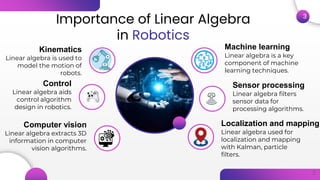
Importance of Linear Algebra
in Robotics
Kinematics
Linear algebra is used to
model the motion of
robots.
Control
Linear algebra aids
control algorithm
design in robotics.
Computer vision
Linear algebra extracts 3D
information in computer
vision algorithms.
Machine learning
Linear algebra is a key
component of machine
learning techniques.
Localization and mapping
Linear algebra used for
localization and mapping
with Kalman, particle
filters.
Sensor processing
Linear algebra filters
sensor data for
processing algorithms.
3
3
Robot Kinematics
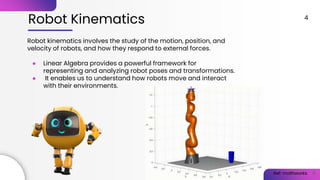
Robot kinematics involves the study of the motion, position, and
velocity of robots, and how they respond to external forces.
● Linear Algebra provides a powerful framework for
representing and analyzing robot poses and transformations.
● It enables us to understand how robots move and interact
with their environments.
Ref: mathworks 4
4
Robot Kinematics
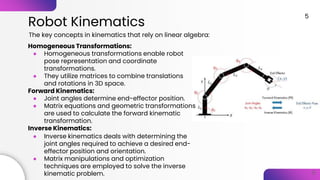
The key concepts in kinematics that rely on linear algebra:
Homogeneous Transformations:
● Homogeneous transformations enable robot
pose representation and coordinate
transformations.
● They utilize matrices to combine translations
and rotations in 3D space.
Forward Kinematics:
● Joint angles determine end-effector position.
● Matrix equations and geometric transformations
are used to calculate the forward kinematic
transformation.
Inverse Kinematics:
● Inverse kinematics deals with determining the
joint angles required to achieve a desired end-
effector position and orientation.
● Matrix manipulations and optimization
techniques are employed to solve the inverse
kinematic problem. 5
5
Applications:
Robot arm motion
planning
Path generation for mobile
robots
Workspace analysis and
optimization
Simulation and visualization
of robot movements
6
6
Robot
Control
7
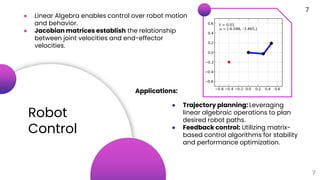
● Linear Algebra enables control over robot motion
and behavior.
● Jacobian matrices establish the relationship
between joint velocities and end-effector
velocities.
Applications:
● Trajectory planning: Leveraging
linear algebraic operations to plan
desired robot paths.
● Feedback control: Utilizing matrix-
based control algorithms for stability
and performance optimization.
7
Sensor Fusion
8
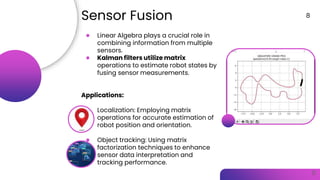
● Linear Algebra plays a crucial role in
combining information from multiple
sensors.
● Kalman filters utilize matrix
operations to estimate robot states by
fusing sensor measurements.
Applications:
● Localization: Employing matrix
operations for accurate estimation of
robot position and orientation.
● Object tracking: Using matrix
factorization techniques to enhance
sensor data interpretation and
tracking performance.
8
Computer Vision
9
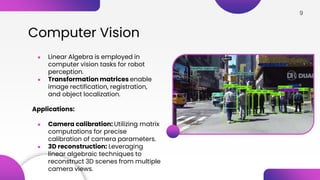
● Linear Algebra is employed in
computer vision tasks for robot
perception.
● Transformation matrices enable
image rectification, registration,
and object localization.
Applications:
● Camera calibration: Utilizing matrix
computations for precise
calibration of camera parameters.
● 3D reconstruction: Leveraging
linear algebraic techniques to
reconstruct 3D scenes from multiple
camera views.
Robot Mapping
10
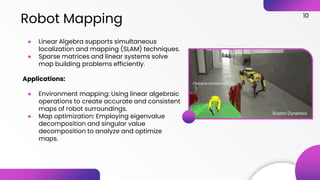
● Linear Algebra supports simultaneous
localization and mapping (SLAM) techniques.
● Sparse matrices and linear systems solve
map building problems efficiently.
Applications:
● Environment mapping: Using linear algebraic
operations to create accurate and consistent
maps of robot surroundings.
● Map optimization: Employing eigenvalue
decomposition and singular value
decomposition to analyze and optimize
maps.
10
Conclusion
● Linear Algebra plays a vital role in robotics,
enabling diverse applications.
● It empowers robot kinematics, control, sensor
fusion, computer vision, mapping, and learning.
● By understanding and utilizing linear algebraic
concepts, we can unlock new possibilities in the
field of robotics.
11
11

Use_of__Linear_Algebra__in_Robotics.pptx

  • 1.
    Use of Linear Algebra inRobotics Exploring the Invaluable Applications of Linear Algebra in Robotics
  • 2.
    Introduction ● Linear Algebraplays a crucial role in various aspects of robotics. ● It provides mathematical tools to represent, analyze, and control robotic systems. 2 2
  • 3.
    Importance of LinearAlgebra in Robotics Kinematics Linear algebra is used to model the motion of robots. Control Linear algebra aids control algorithm design in robotics. Computer vision Linear algebra extracts 3D information in computer vision algorithms. Machine learning Linear algebra is a key component of machine learning techniques. Localization and mapping Linear algebra used for localization and mapping with Kalman, particle filters. Sensor processing Linear algebra filters sensor data for processing algorithms. 3 3
  • 4.
    Robot Kinematics Robot kinematicsinvolves the study of the motion, position, and velocity of robots, and how they respond to external forces. ● Linear Algebra provides a powerful framework for representing and analyzing robot poses and transformations. ● It enables us to understand how robots move and interact with their environments. Ref: mathworks 4 4
  • 5.
    Robot Kinematics The keyconcepts in kinematics that rely on linear algebra: Homogeneous Transformations: ● Homogeneous transformations enable robot pose representation and coordinate transformations. ● They utilize matrices to combine translations and rotations in 3D space. Forward Kinematics: ● Joint angles determine end-effector position. ● Matrix equations and geometric transformations are used to calculate the forward kinematic transformation. Inverse Kinematics: ● Inverse kinematics deals with determining the joint angles required to achieve a desired end- effector position and orientation. ● Matrix manipulations and optimization techniques are employed to solve the inverse kinematic problem. 5 5
  • 6.
    Applications: Robot arm motion planning Pathgeneration for mobile robots Workspace analysis and optimization Simulation and visualization of robot movements 6 6
  • 7.
    Robot Control 7 ● Linear Algebraenables control over robot motion and behavior. ● Jacobian matrices establish the relationship between joint velocities and end-effector velocities. Applications: ● Trajectory planning: Leveraging linear algebraic operations to plan desired robot paths. ● Feedback control: Utilizing matrix- based control algorithms for stability and performance optimization. 7
  • 8.
    Sensor Fusion 8 ● LinearAlgebra plays a crucial role in combining information from multiple sensors. ● Kalman filters utilize matrix operations to estimate robot states by fusing sensor measurements. Applications: ● Localization: Employing matrix operations for accurate estimation of robot position and orientation. ● Object tracking: Using matrix factorization techniques to enhance sensor data interpretation and tracking performance. 8
  • 9.
    Computer Vision 9 ● LinearAlgebra is employed in computer vision tasks for robot perception. ● Transformation matrices enable image rectification, registration, and object localization. Applications: ● Camera calibration: Utilizing matrix computations for precise calibration of camera parameters. ● 3D reconstruction: Leveraging linear algebraic techniques to reconstruct 3D scenes from multiple camera views.
  • 10.
    Robot Mapping 10 ● LinearAlgebra supports simultaneous localization and mapping (SLAM) techniques. ● Sparse matrices and linear systems solve map building problems efficiently. Applications: ● Environment mapping: Using linear algebraic operations to create accurate and consistent maps of robot surroundings. ● Map optimization: Employing eigenvalue decomposition and singular value decomposition to analyze and optimize maps. 10
  • 11.
    Conclusion ● Linear Algebraplays a vital role in robotics, enabling diverse applications. ● It empowers robot kinematics, control, sensor fusion, computer vision, mapping, and learning. ● By understanding and utilizing linear algebraic concepts, we can unlock new possibilities in the field of robotics. 11 11