Linear Algebra:
Applications in
Computer Science
By:
-Jacob L
-Richie
Common Applications of Linear Algebra
within Computer Science:
❏ Machine learning
❏ Optimization (data / code / processing)
❏ Graphing algorithms, projections and predictive models.
❏ Search engines and result order
❏ Grouping and data organization
❏ Image processing and facial recognition
❏ IP address design schemes
❏ Cryptography
Machine Learning
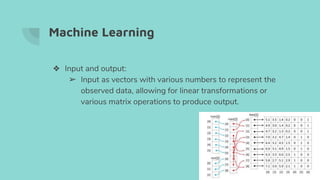
❖ Input and output:
➢ Input as vectors with various numbers to represent the
observed data, allowing for linear transformations or
various matrix operations to produce output.
Graphing Algorithms, Projections, and
Predictive Models.
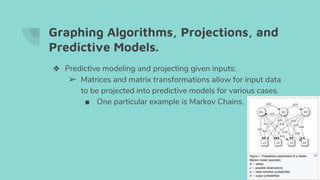
❖ Predictive modeling and projecting given inputs:
➢ Matrices and matrix transformations allow for input data
to be projected into predictive models for various cases.
■ One particular example is Markov Chains.
Search Engines, Data Retrieval and
Result Order.
❖ Google’s PageRank algorithm:
➢ Developed using eigenvectors and eigenvalues to predict
useful websites based on input from previously searched
and clicked sites.
Image Processing and Facial
Recognition
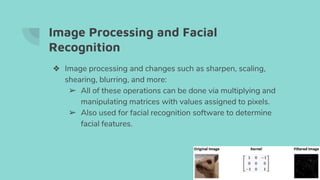
❖ Image processing and changes such as sharpen, scaling,
shearing, blurring, and more:
➢ All of these operations can be done via multiplying and
manipulating matrices with values assigned to pixels.
➢ Also used for facial recognition software to determine
facial features.
Cryptography
❖ Matrix Transformations can be used for encryptions
➢ The product of an encryption matrix and a ciphertext
matrix
❖ Hill ciphers use linear systems
➢ Decryption through solving

Linear algebra in Computer Science

  • 1.
    Linear Algebra: Applications in ComputerScience By: -Jacob L -Richie
  • 2.
    Common Applications ofLinear Algebra within Computer Science: ❏ Machine learning ❏ Optimization (data / code / processing) ❏ Graphing algorithms, projections and predictive models. ❏ Search engines and result order ❏ Grouping and data organization ❏ Image processing and facial recognition ❏ IP address design schemes ❏ Cryptography
  • 3.
    Machine Learning ❖ Inputand output: ➢ Input as vectors with various numbers to represent the observed data, allowing for linear transformations or various matrix operations to produce output.
  • 4.
    Graphing Algorithms, Projections,and Predictive Models. ❖ Predictive modeling and projecting given inputs: ➢ Matrices and matrix transformations allow for input data to be projected into predictive models for various cases. ■ One particular example is Markov Chains.
  • 5.
    Search Engines, DataRetrieval and Result Order. ❖ Google’s PageRank algorithm: ➢ Developed using eigenvectors and eigenvalues to predict useful websites based on input from previously searched and clicked sites.
  • 6.
    Image Processing andFacial Recognition ❖ Image processing and changes such as sharpen, scaling, shearing, blurring, and more: ➢ All of these operations can be done via multiplying and manipulating matrices with values assigned to pixels. ➢ Also used for facial recognition software to determine facial features.
  • 7.
    Cryptography ❖ Matrix Transformationscan be used for encryptions ➢ The product of an encryption matrix and a ciphertext matrix ❖ Hill ciphers use linear systems ➢ Decryption through solving