USE OF DMT IN GEOTECHNICAL
DESIGN WITH EMPHASIS ON
LIQUEFACTION ANALYSIS
Presented By: Muhammad Ali Rehman
Overview
 Introduction
 Data Interpretation
 DMT Correlations
 Liquefaction
 Liquefaction Assessment
 Case Study
 Conclusions
 References
 DMT
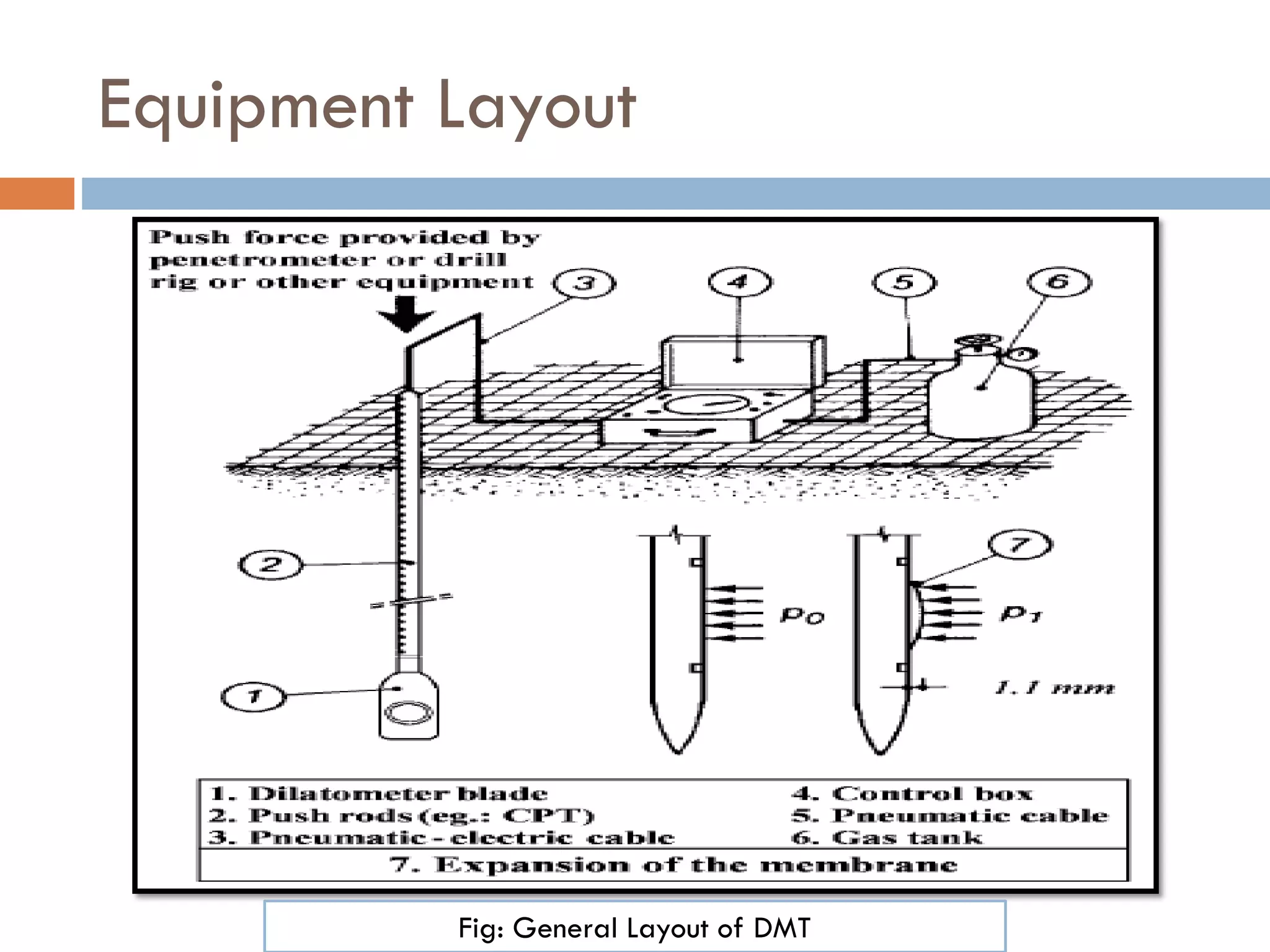
 Equipment Layout
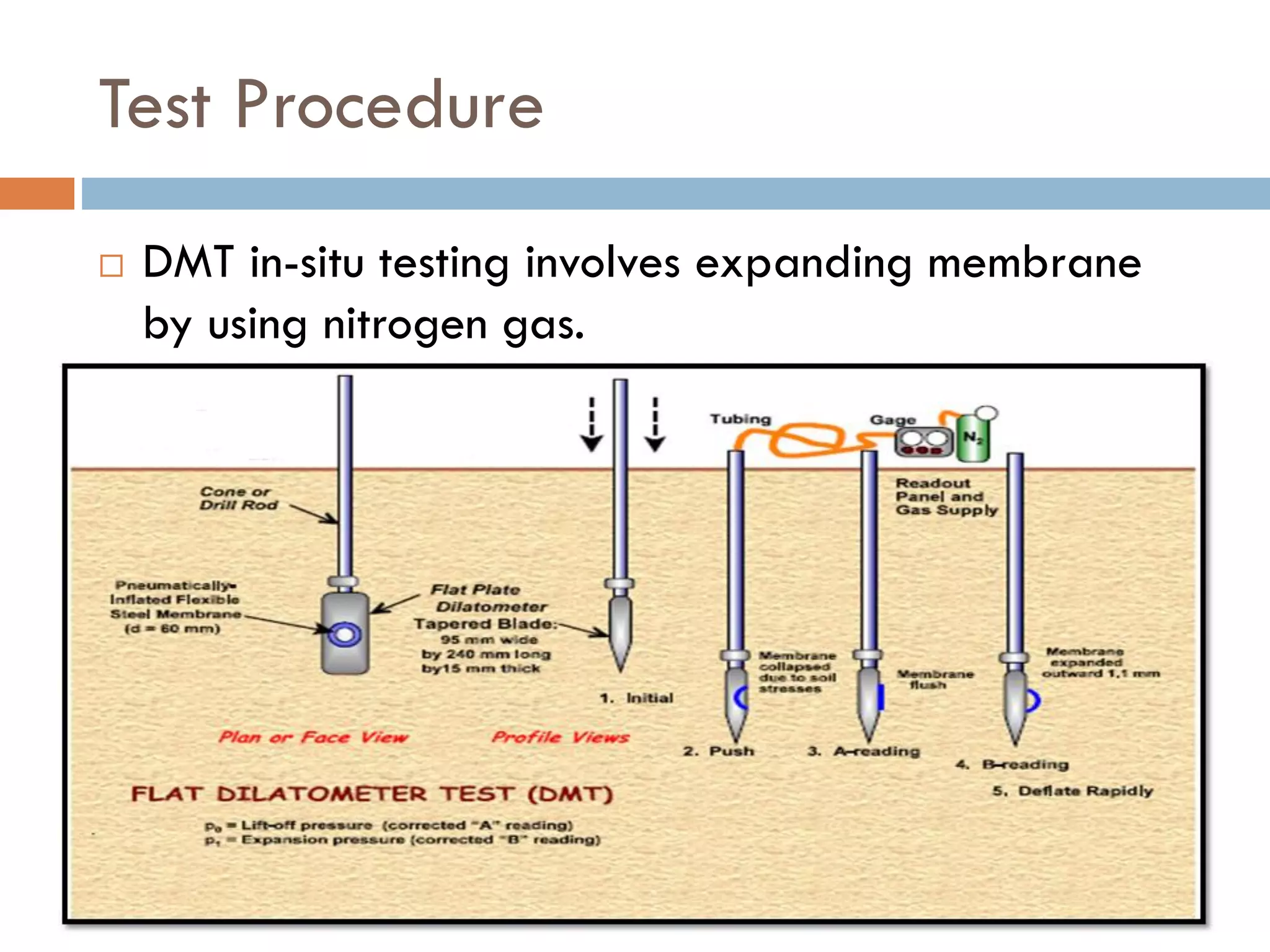
 Test Procedure
INTRODUCTION
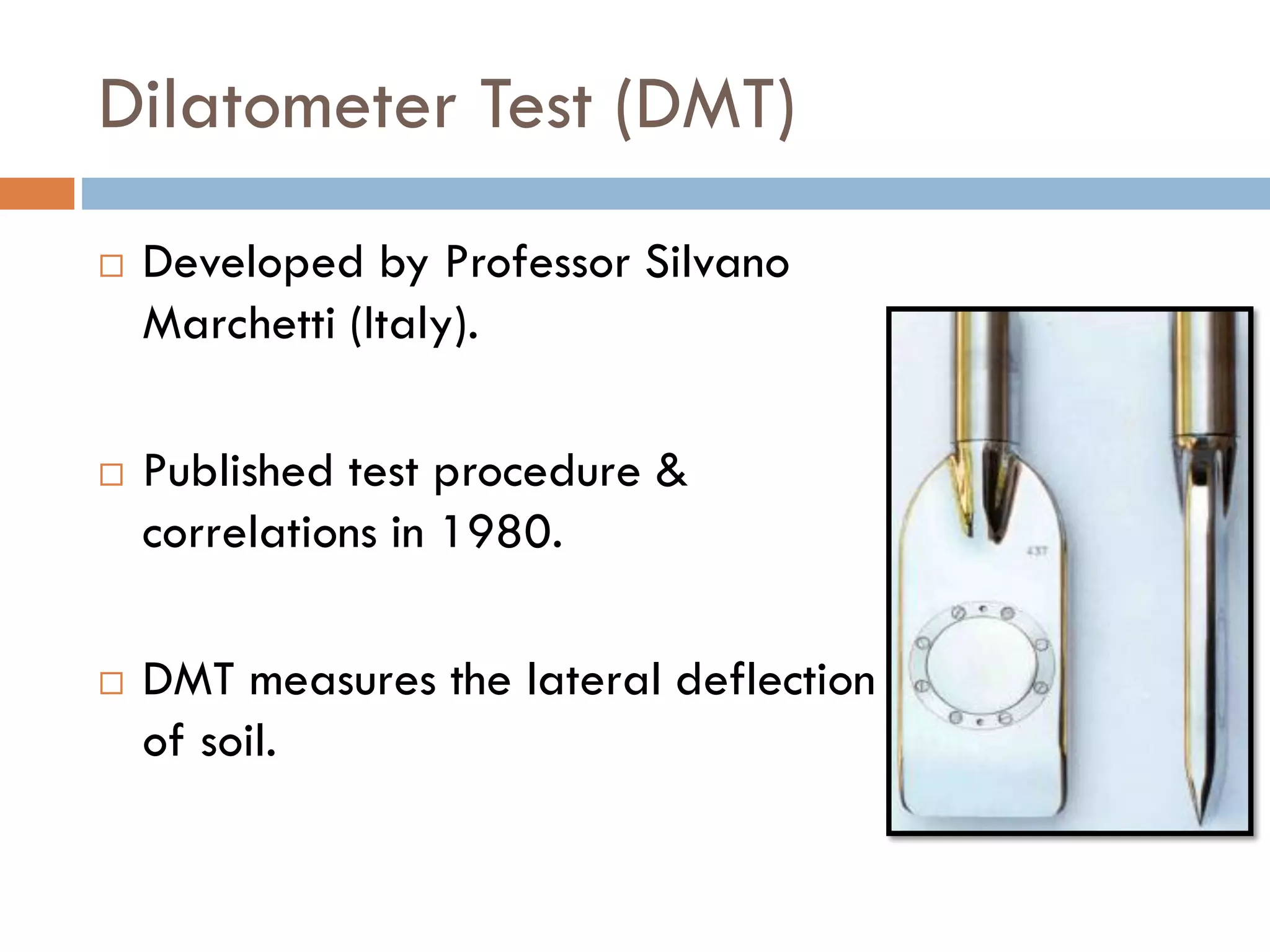
Dilatometer Test (DMT)
 Developed by Professor Silvano
Marchetti (Italy).
 Published test procedure &
correlations in 1980.
 DMT measures the lateral deflection
of soil.
Equipment Layout
Fig: General Layout of DMT
Test Procedure
 DMT in-situ testing involves expanding membrane
by using nitrogen gas.
 The primary way of using DMT results is to
interpret them in terms of common soil
parameters.
DATA INTERPRETATION
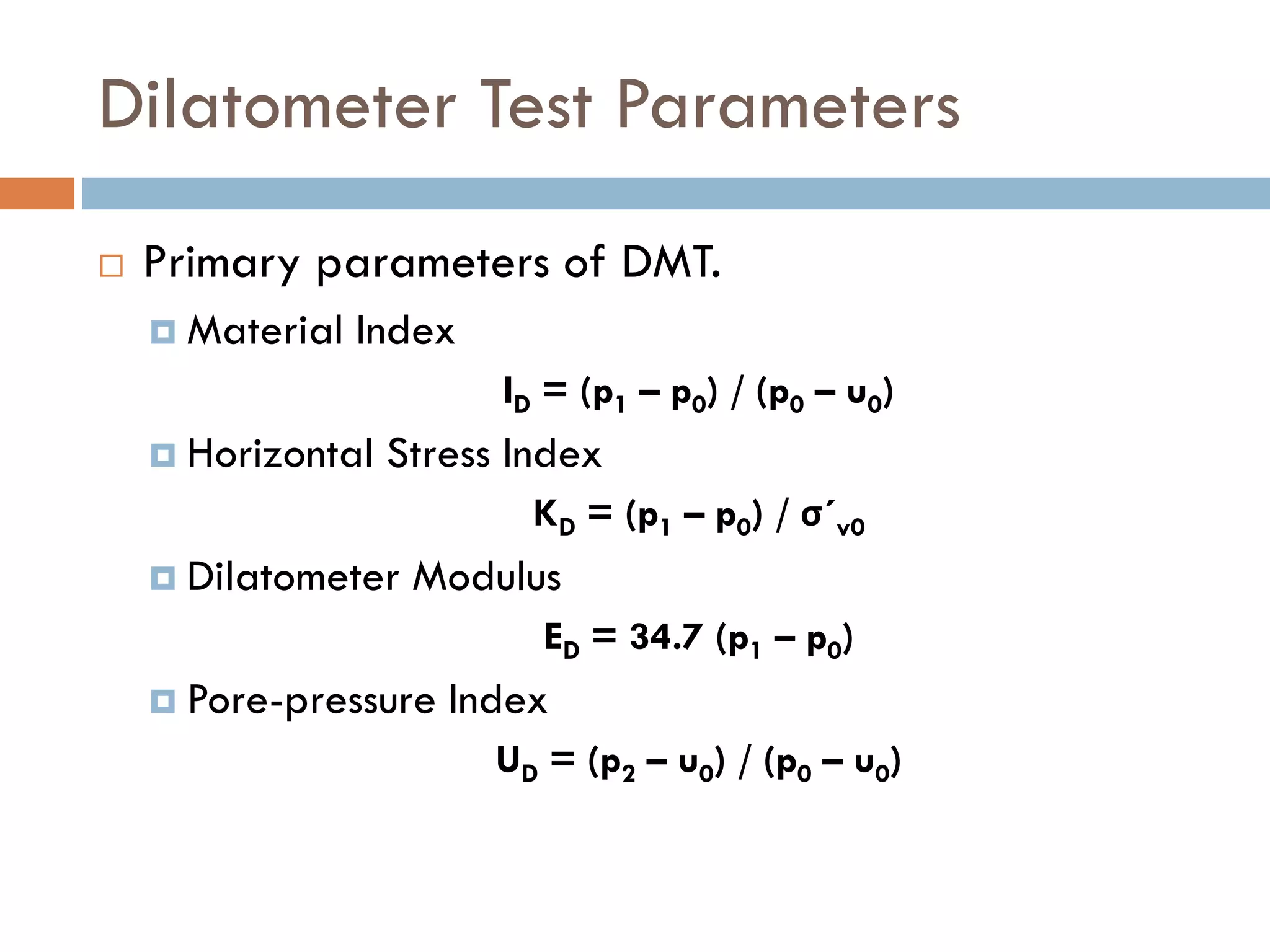
Dilatometer Test Parameters
 Primary parameters of DMT.
 Material Index
ID = (p1 – p0) / (p0 – u0)
 Horizontal Stress Index
KD = (p1 – p0) / σ´v0
 Dilatometer Modulus
ED = 34.7 (p1 – p0)
 Pore-pressure Index
UD = (p2 – u0) / (p0 – u0)
• DMT parameters, ID, KD, and ED are used in
subsequent soil analysis.
DMT CORRELATIONS
Correlations
 Soil Behavior
 Over-consolidation
 Relative Density
 Undrained Shear Strength
 Constrained Modulus
 Compression Ratio
 Settlement Prediction
 Skin friction of Driven Piles
 SPT N-value and Dilatometer Modulus
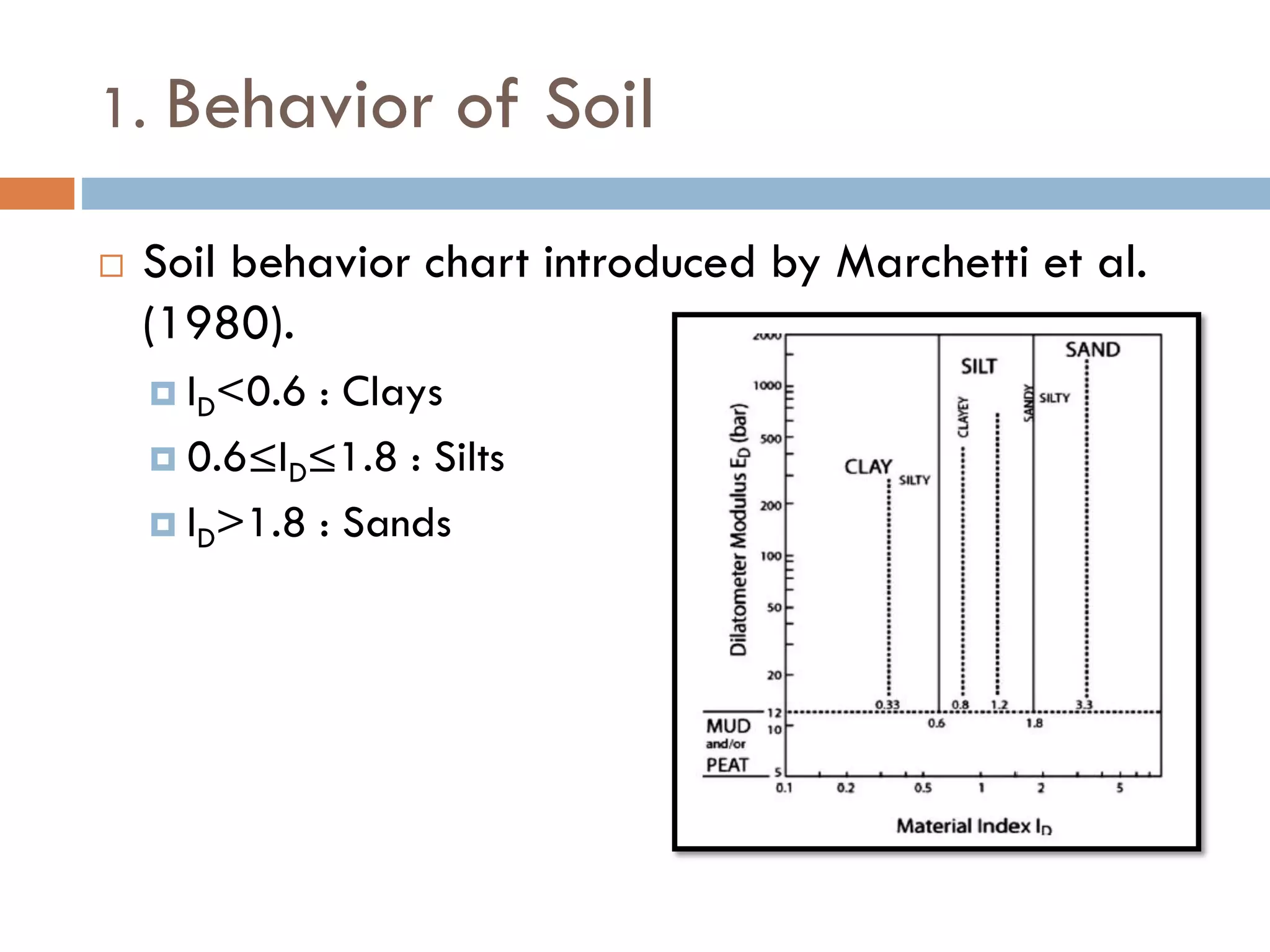
1. Behavior of Soil
 Soil behavior chart introduced by Marchetti et al.
(1980).
 ID<0.6 : Clays
 0.6≤ID≤1.8 : Silts
 ID>1.8 : Sands
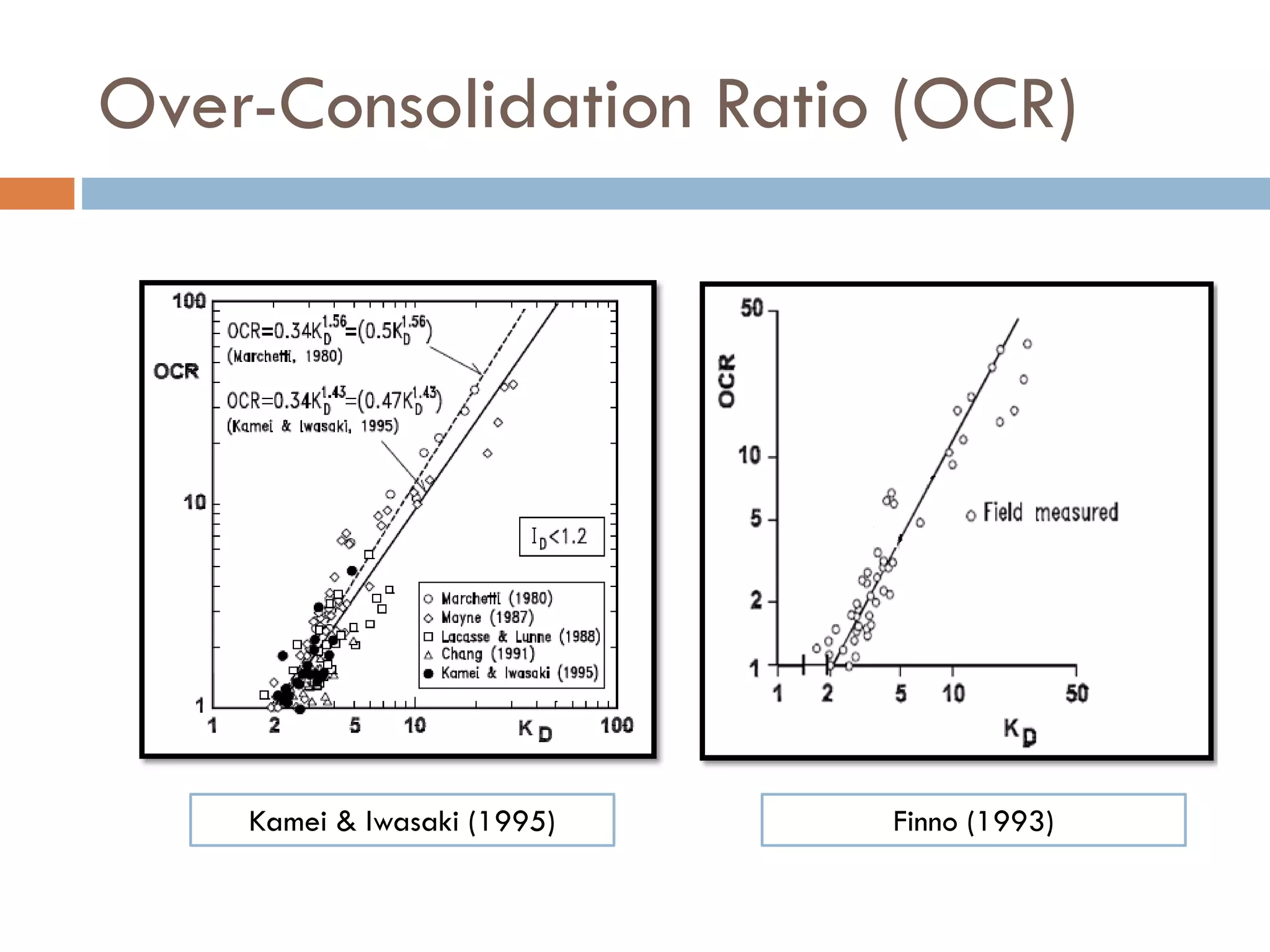
2. Over-Consolidation Ratio (OCR)
 Original correlation proposed by Marchetti et al.
(1980):
OCRDMT = (0.5 x KD)1.56
 Confirmed by a comprehensive collection of data
by Kamei & Iwasaki (1995) for clays.
 Finno (1993)
Over-Consolidation Ratio (OCR)
Kamei & Iwasaki (1995) Finno (1993)
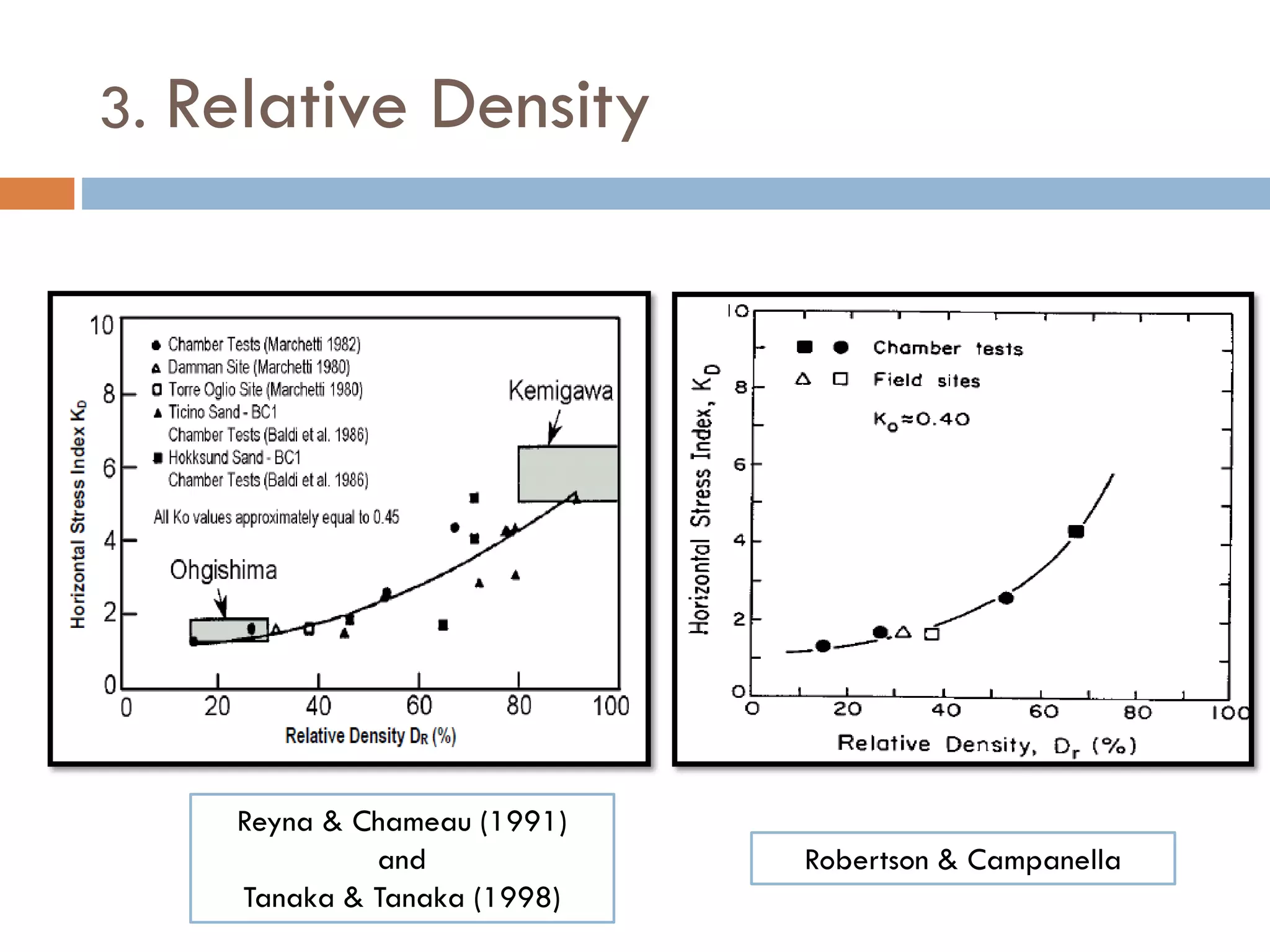
3. Relative Density
Reyna & Chameau (1991)
and
Tanaka & Tanaka (1998)
Robertson & Campanella
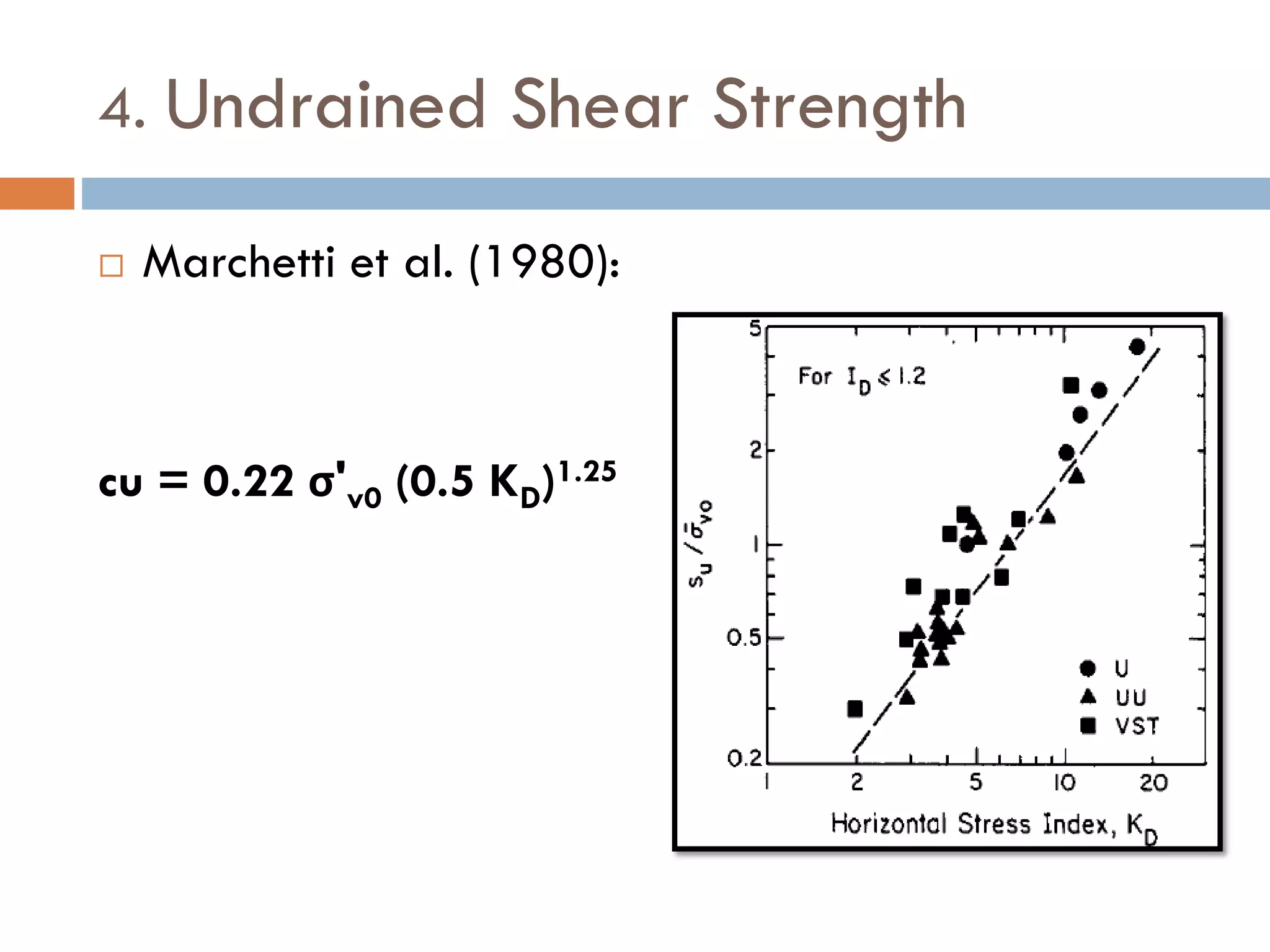
4. Undrained Shear Strength
 Marchetti et al. (1980):
cu = 0.22 σ'v0 (0.5 KD)1.25
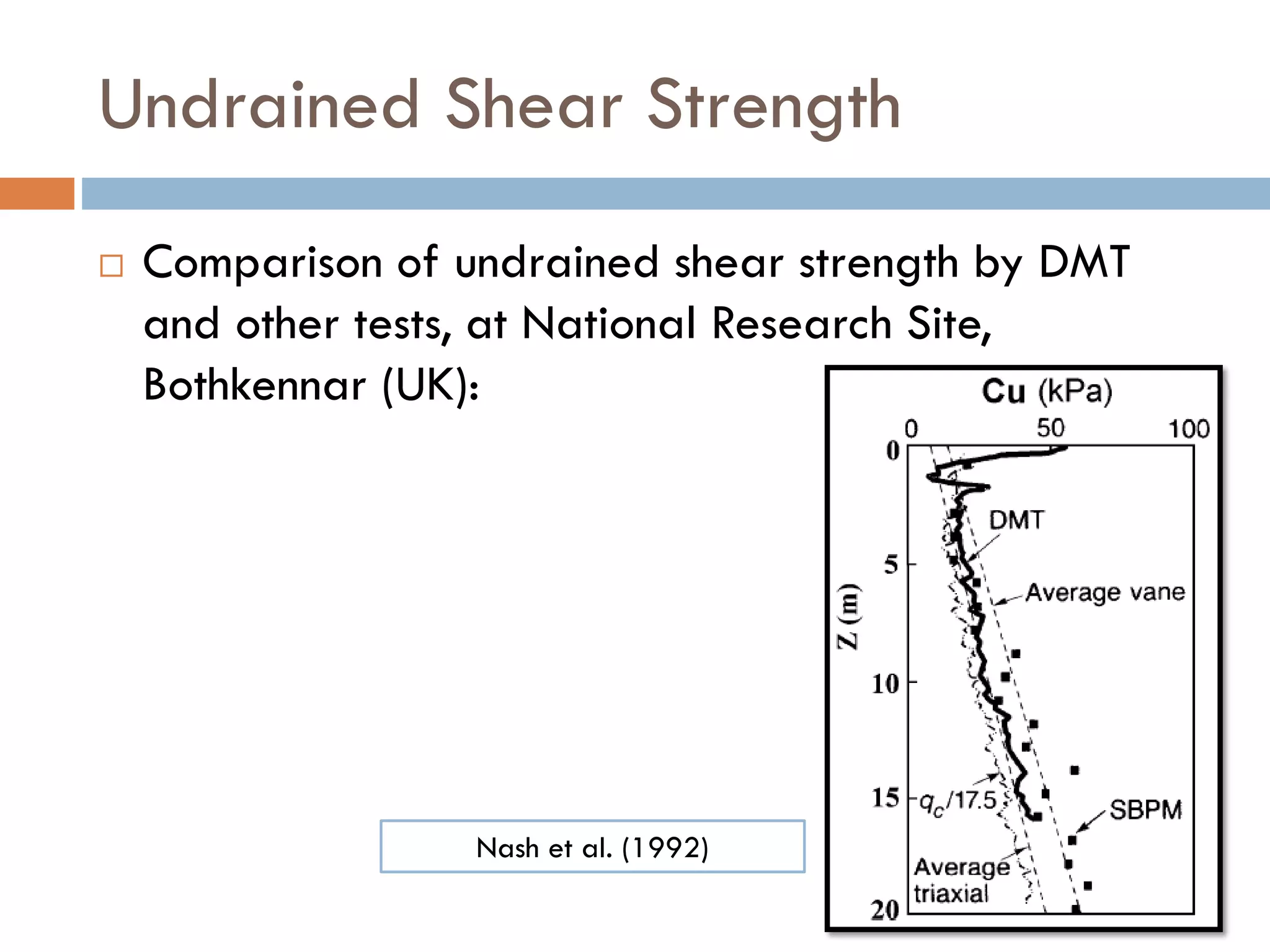
Undrained Shear Strength
 Comparison of undrained shear strength by DMT
and other tests, at National Research Site,
Bothkennar (UK):
Nash et al. (1992)
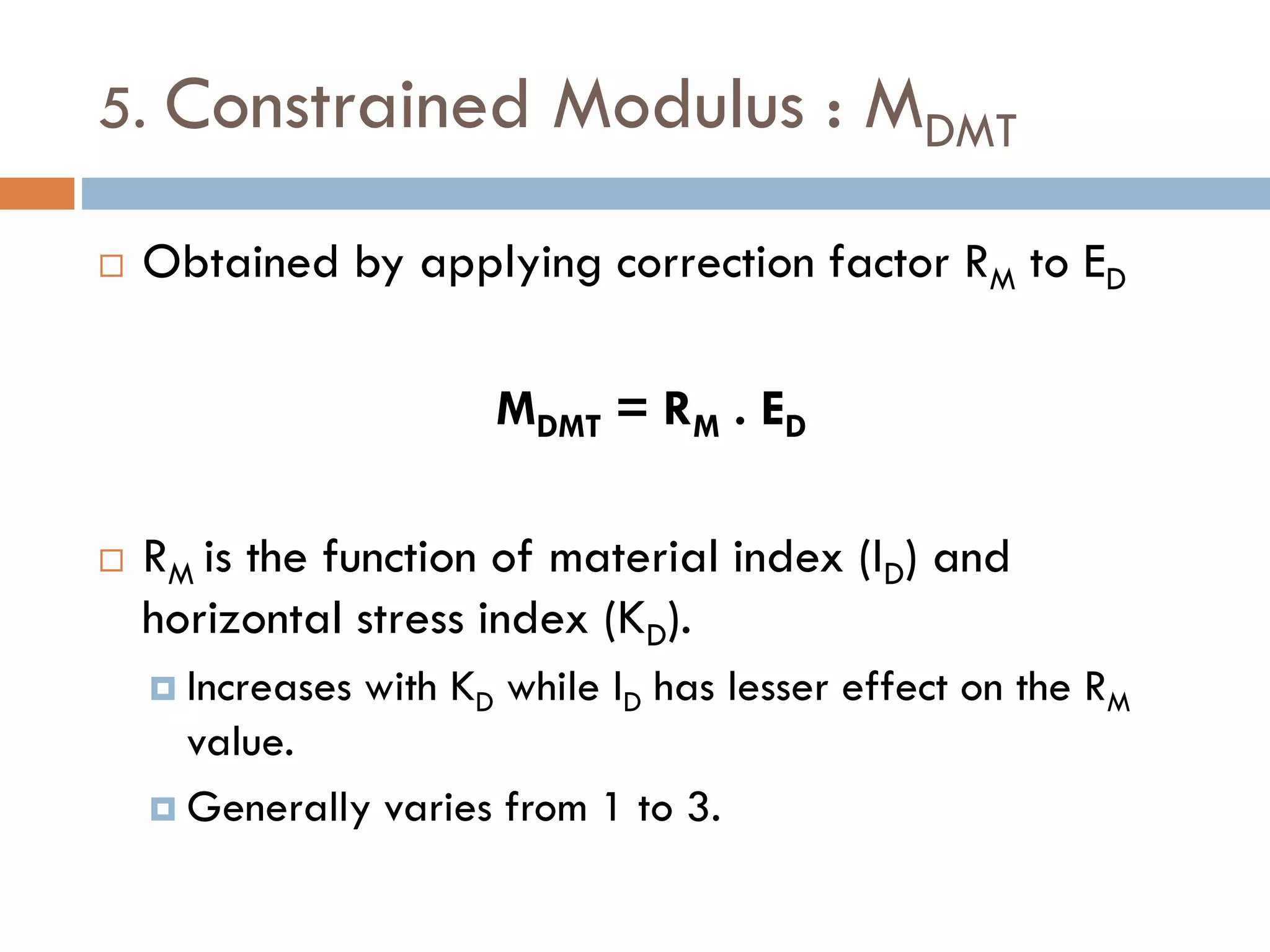
5. Constrained Modulus : MDMT
 Obtained by applying correction factor RM to ED
MDMT = RM . ED
 RM is the function of material index (ID) and
horizontal stress index (KD).
 Increases with KD while ID has lesser effect on the RM
value.
 Generally varies from 1 to 3.
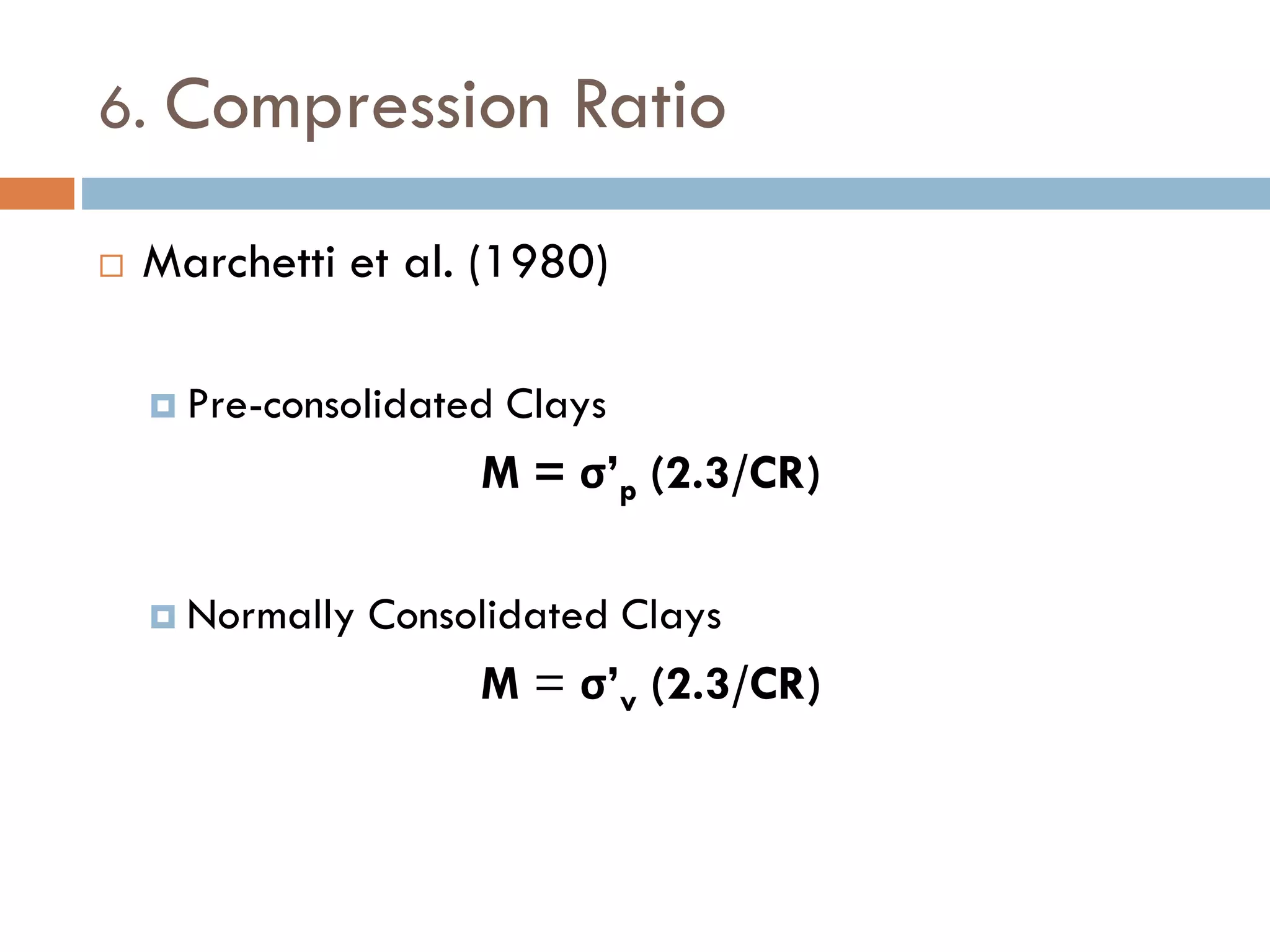
6. Compression Ratio
 Marchetti et al. (1980)
 Pre-consolidated Clays
M = σ’p (2.3/CR)
 Normally Consolidated Clays
M = σ’v (2.3/CR)
7. Settlement Prediction
 Predicting the settlement of shallow foundations
(particularly for Sands) is one of the best
applications of DMT.
 Calculated by means of expression:
S = [ Δσv/MDMT ] ΔZ
Totani, Marchetti, Monaco &
Calabrese (2001)
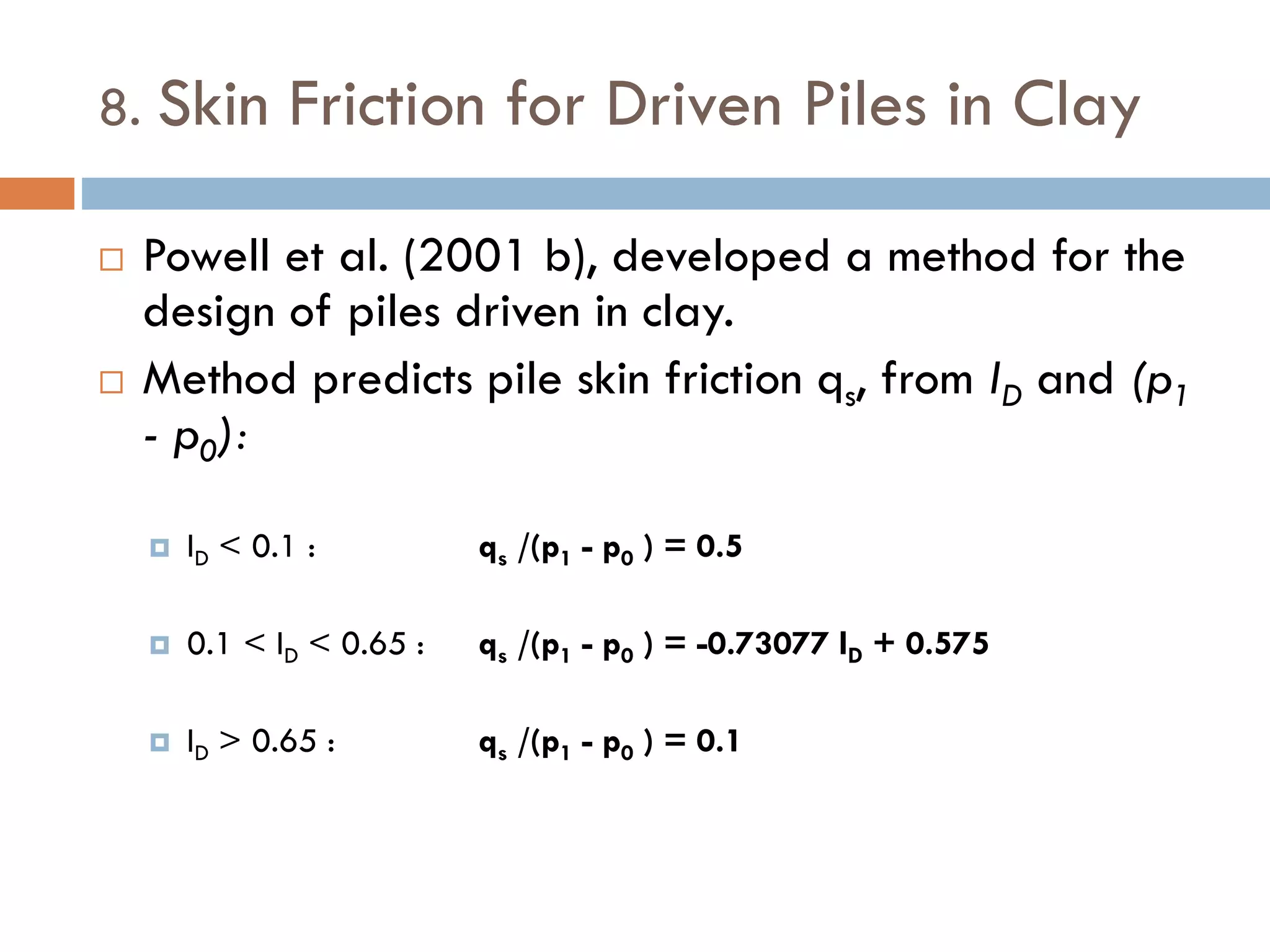
8. Skin Friction for Driven Piles in Clay
 Powell et al. (2001 b), developed a method for the
design of piles driven in clay.
 Method predicts pile skin friction qs, from ID and (p1
- p0):
 ID < 0.1 : qs /(p1 - p0 ) = 0.5
 0.1 < ID < 0.65 : qs /(p1 - p0 ) = -0.73077 ID + 0.575
 ID > 0.65 : qs /(p1 - p0 ) = 0.1
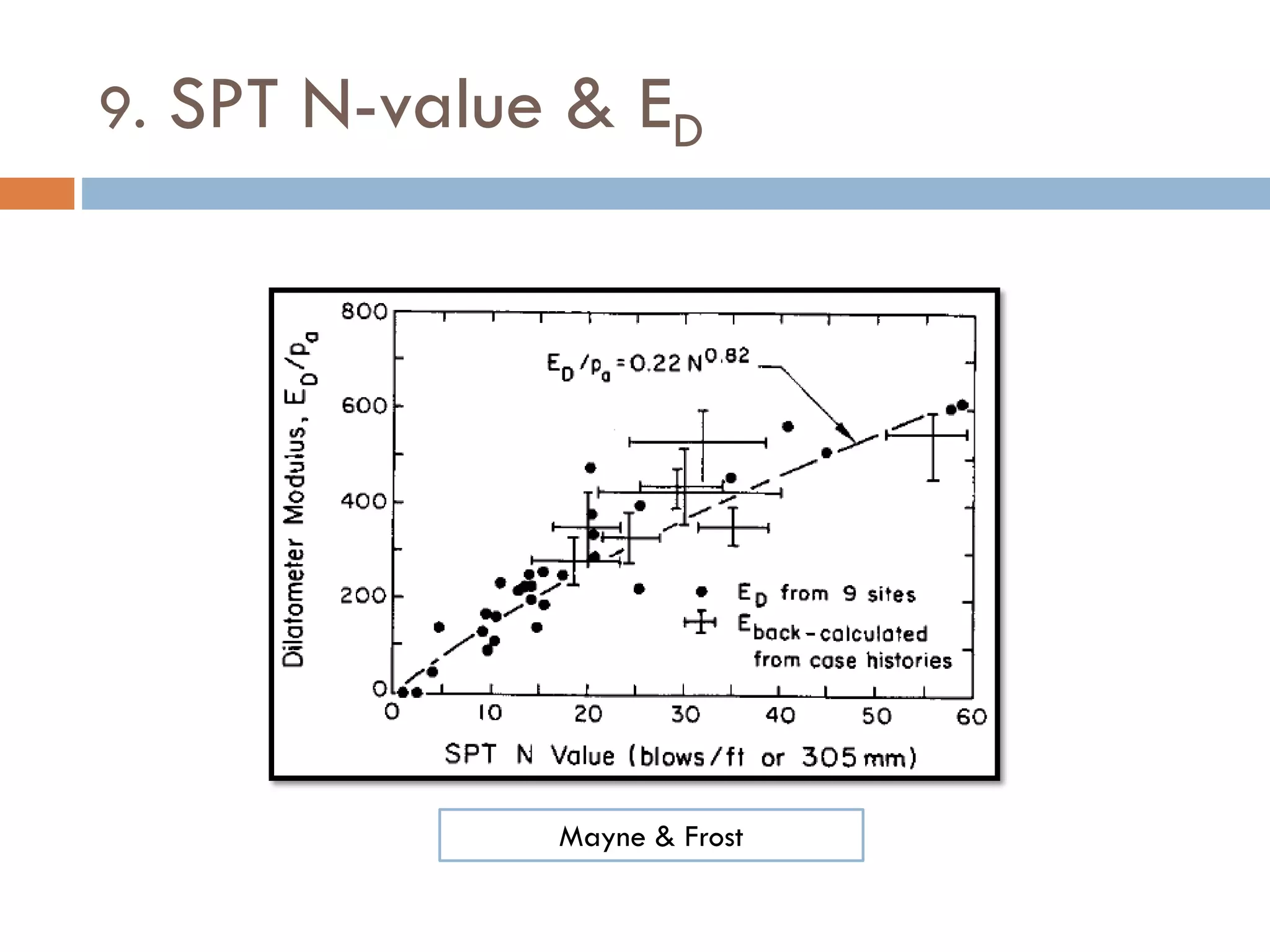
9. SPT N-value & ED
Mayne & Frost
 Introduction
 Liquefiable Soils
 Liquefaction Assessment
LIQUEFACTION
Liquefaction
 “Transformation of coarse grained soil from a solid
state into a liquid state”
 Excessive hydrostatic pressure build-up & reduction of
effective stress
 sudden shock
 cyclic loading.
 Devastating effects of structure:
 Tilting of high rise buildings
 Ground subsidence
 Surface rupture
 Collapse
Liquefiable Soils
 Loose granular soils are potentially susceptible to
liquefaction.
 Fine grained soils (such as silts and clays) are non-
liquefiable.
 Andrews & Martin (2000) suggested:
 Potentially Liquefiable: soils having, CF < 10% & LL <
32%
 Non-Liquefiable: soils having, CF > 10% & LL ≥ 32%
Liquefaction Assessment
 Glaser and Chung (1995):
 Loose granular soils densify on sampling.
 Laboratory measurements demonstrate higher cyclic strength
 In-situ testing is preferred.
 “Simplified Procedure” for liquefaction assessment,
proposed by Seed & Idriss (1971).
 To evaluate the loading to a soil caused by an earthquake (by
CSR)
 To evaluate the resistance of a soil to triggering of
liquefaction (by CRR)
Liquefaction Assessment
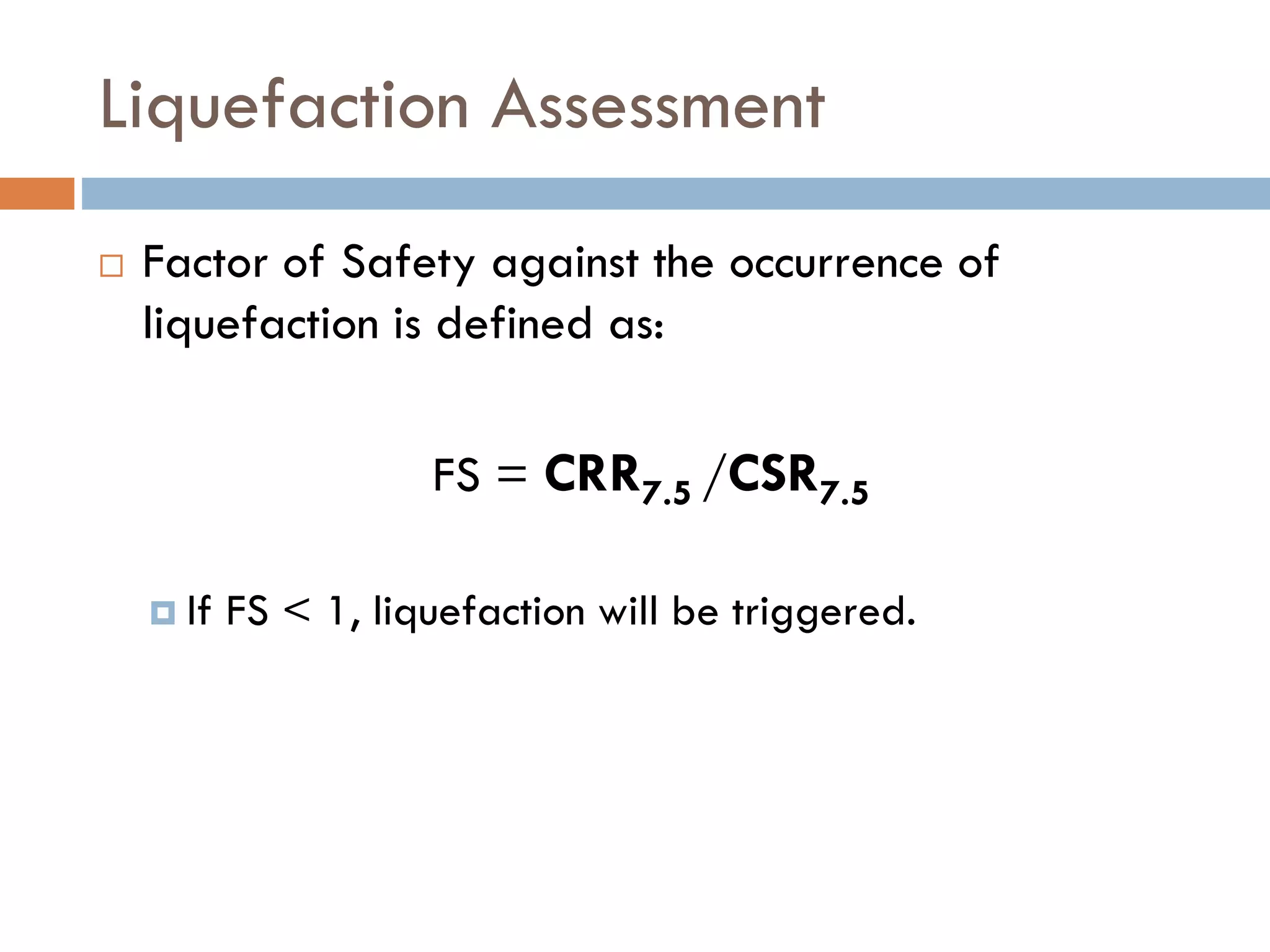
 Factor of Safety against the occurrence of
liquefaction is defined as:
FS = CRR7.5 /CSR7.5
 If FS < 1, liquefaction will be triggered.
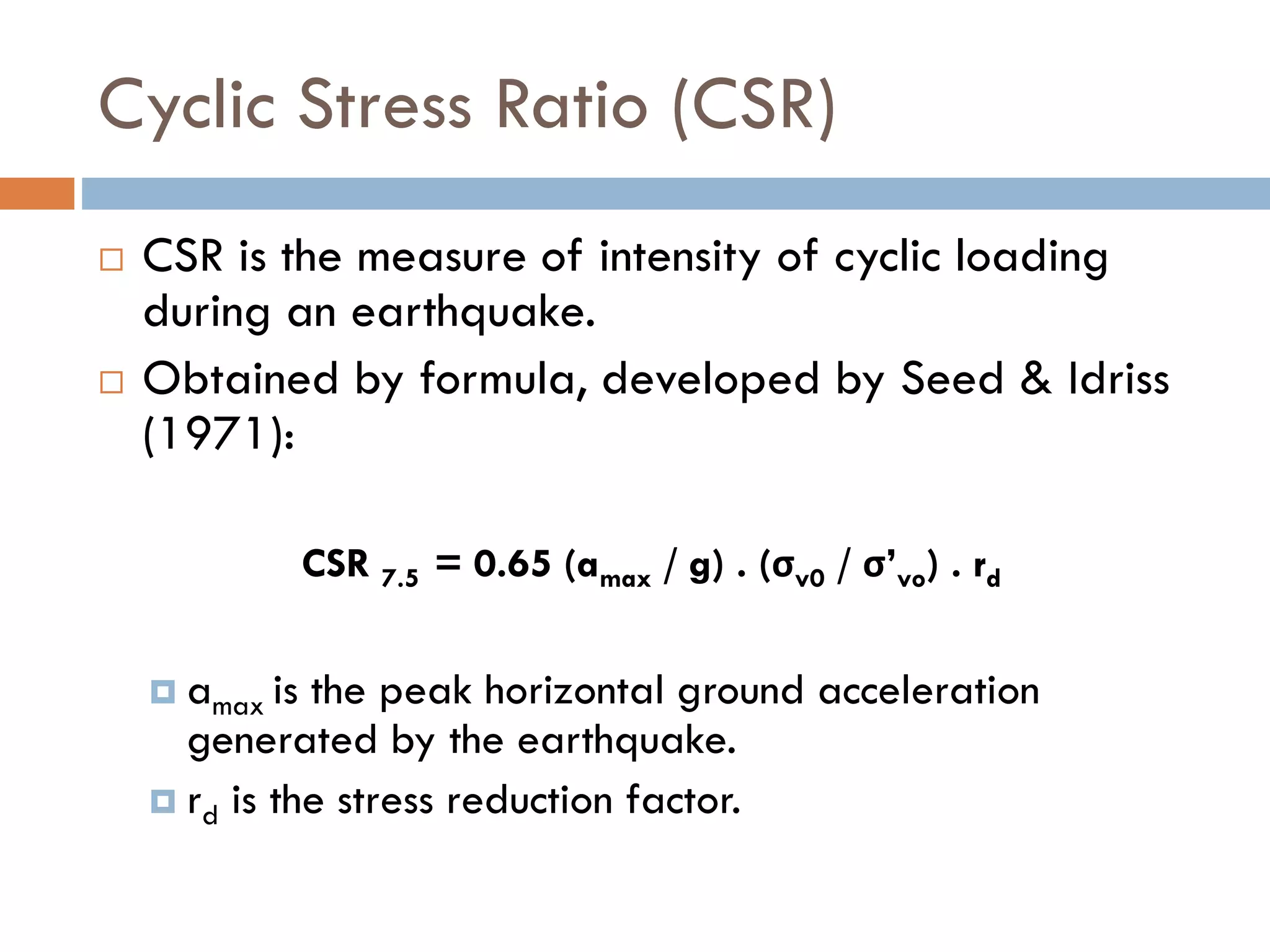
Cyclic Stress Ratio (CSR)
 CSR is the measure of intensity of cyclic loading
during an earthquake.
 Obtained by formula, developed by Seed & Idriss
(1971):
CSR 7.5 = 0.65 (amax / g) . (σv0 / σ’vo) . rd
 amax is the peak horizontal ground acceleration
generated by the earthquake.
 rd is the stress reduction factor.
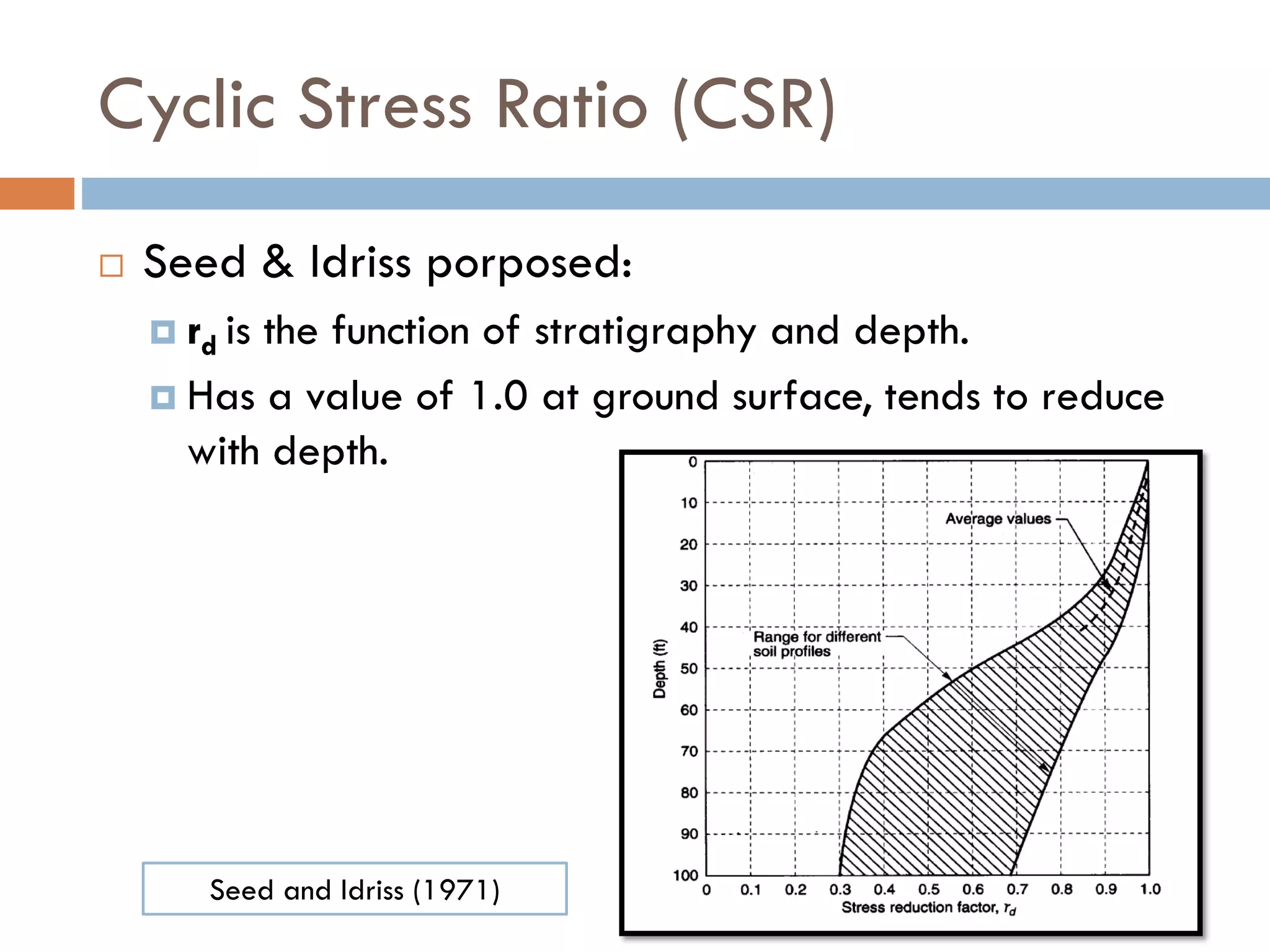
Cyclic Stress Ratio (CSR)
 Seed & Idriss porposed:
 rd is the function of stratigraphy and depth.
 Has a value of 1.0 at ground surface, tends to reduce
with depth.
Seed and Idriss (1971)
Cyclic Stress Ratio (CSR)
 Youd et al. (2001)
 rd = [1.0 – 0.00765z] (z ≤ 9.2m)
 rd = [1.174 – 0.0267z] (9.2 < z ≤ 23m)
 rd = [0.744 – 0.008z] (23 < z ≤ 30m)
 rd = 0.5 (z > 9.2m)
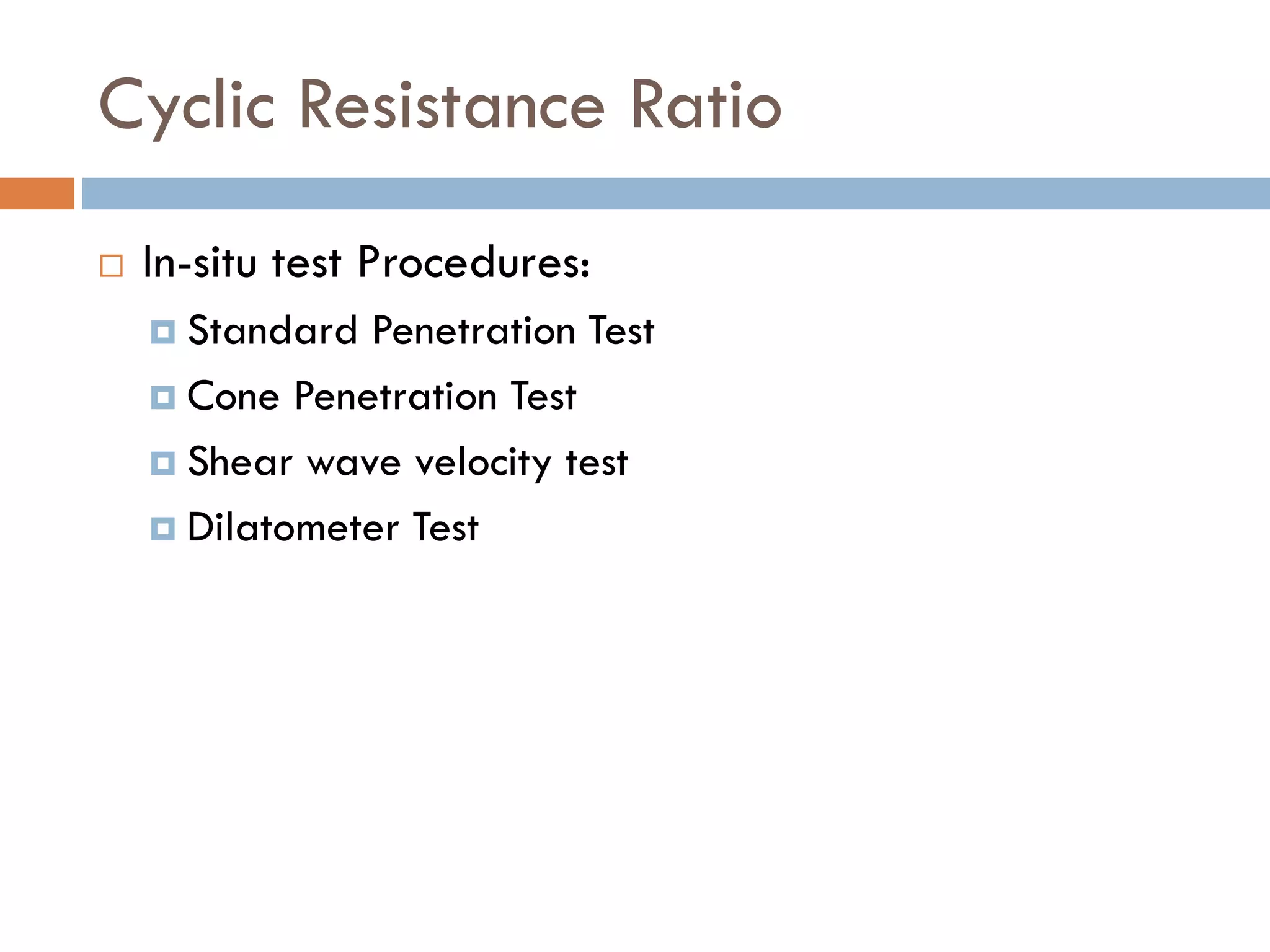
Cyclic Resistance Ratio
 In-situ test Procedures:
 Standard Penetration Test
 Cone Penetration Test
 Shear wave velocity test
 Dilatometer Test
DMT Based CRR Evaluation
 Include:
 Marchetti (1980)
 Roberstson & Campnella (1986)
 Reyna & Chameau (1991)
 Monaco et al. (2005)
 Grasso & Maugeri (2006)
 Monaco & Marchetti (2007)
 Tsai et al. (2001, 2009)
DMT Based CRR Evaluation
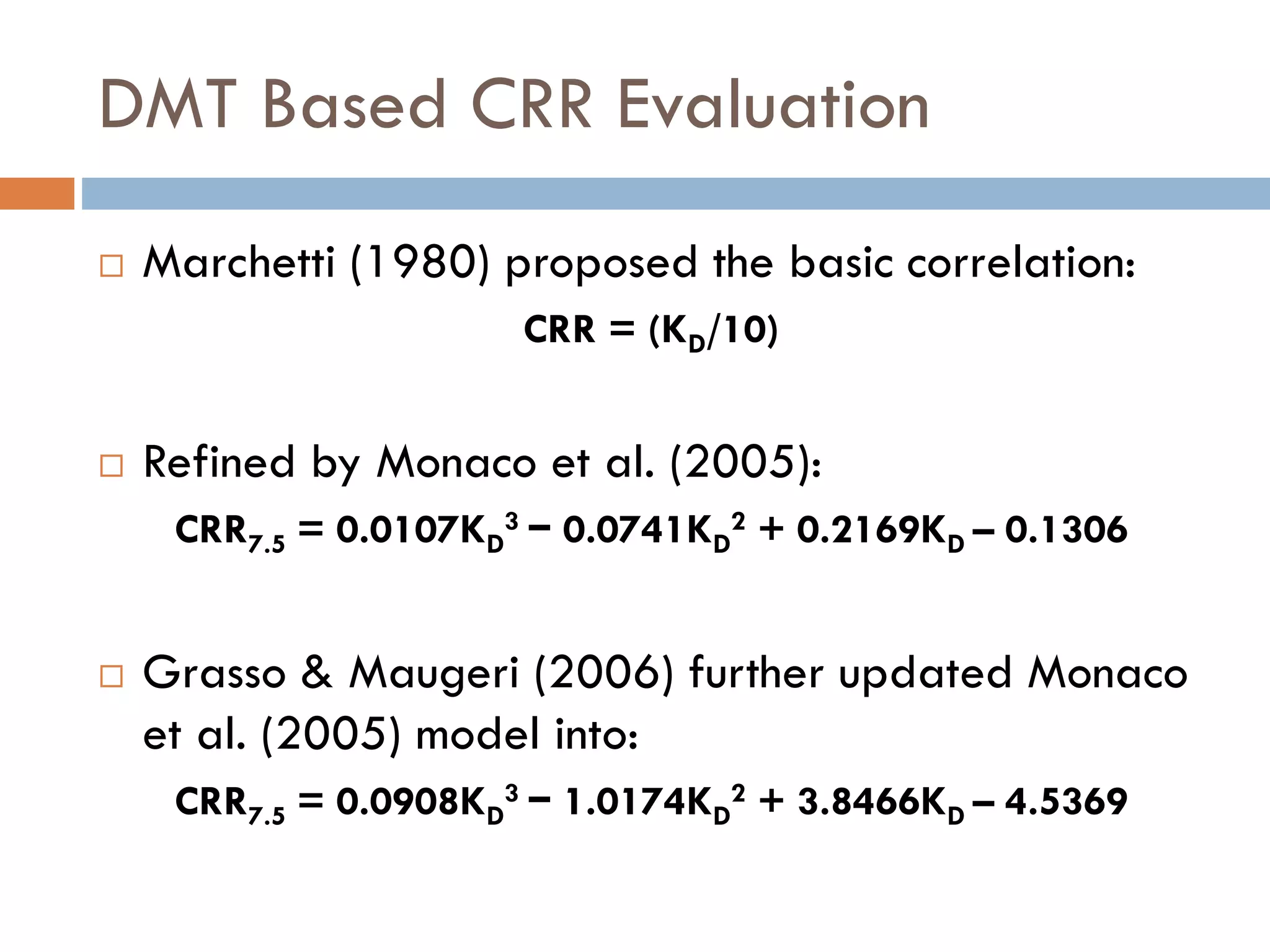
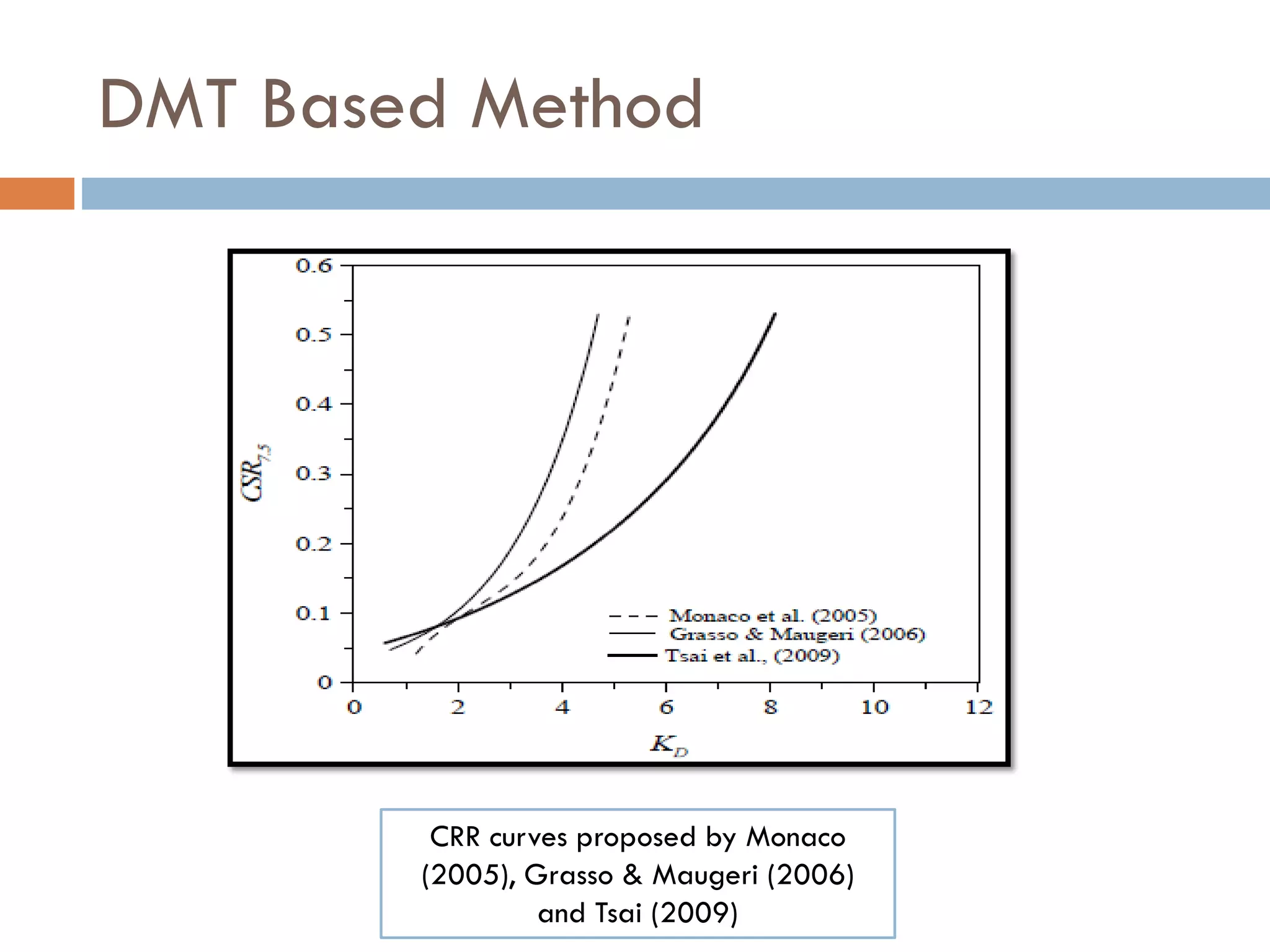
 Marchetti (1980) proposed the basic correlation:
CRR = (KD/10)
 Refined by Monaco et al. (2005):
CRR7.5 = 0.0107KD
3 − 0.0741KD
2 + 0.2169KD – 0.1306
 Grasso & Maugeri (2006) further updated Monaco
et al. (2005) model into:
CRR7.5 = 0.0908KD
3 − 1.0174KD
2 + 3.8466KD – 4.5369
DMT Based CRR Evaluation
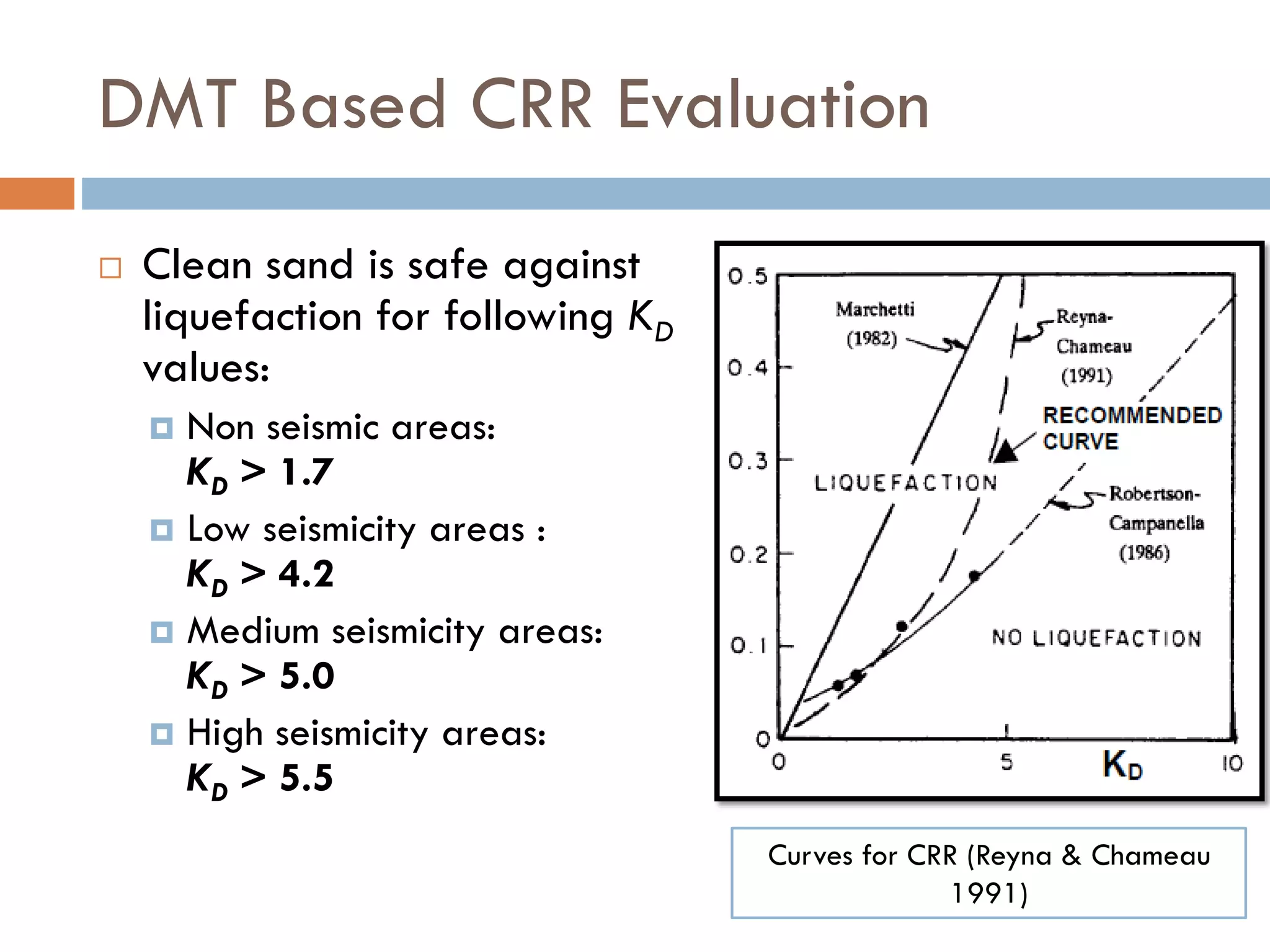
Curves for CRR (Reyna & Chameau
1991)
 Clean sand is safe against
liquefaction for following KD
values:
 Non seismic areas:
KD > 1.7
 Low seismicity areas :
KD > 4.2
 Medium seismicity areas:
KD > 5.0
 High seismicity areas:
KD > 5.5
Performance of DMT Based Liquefaction
Evaluation of Chi-Chi Earthquake, Taiwan (1999)
by Tsai et al. (2001)
Case Study
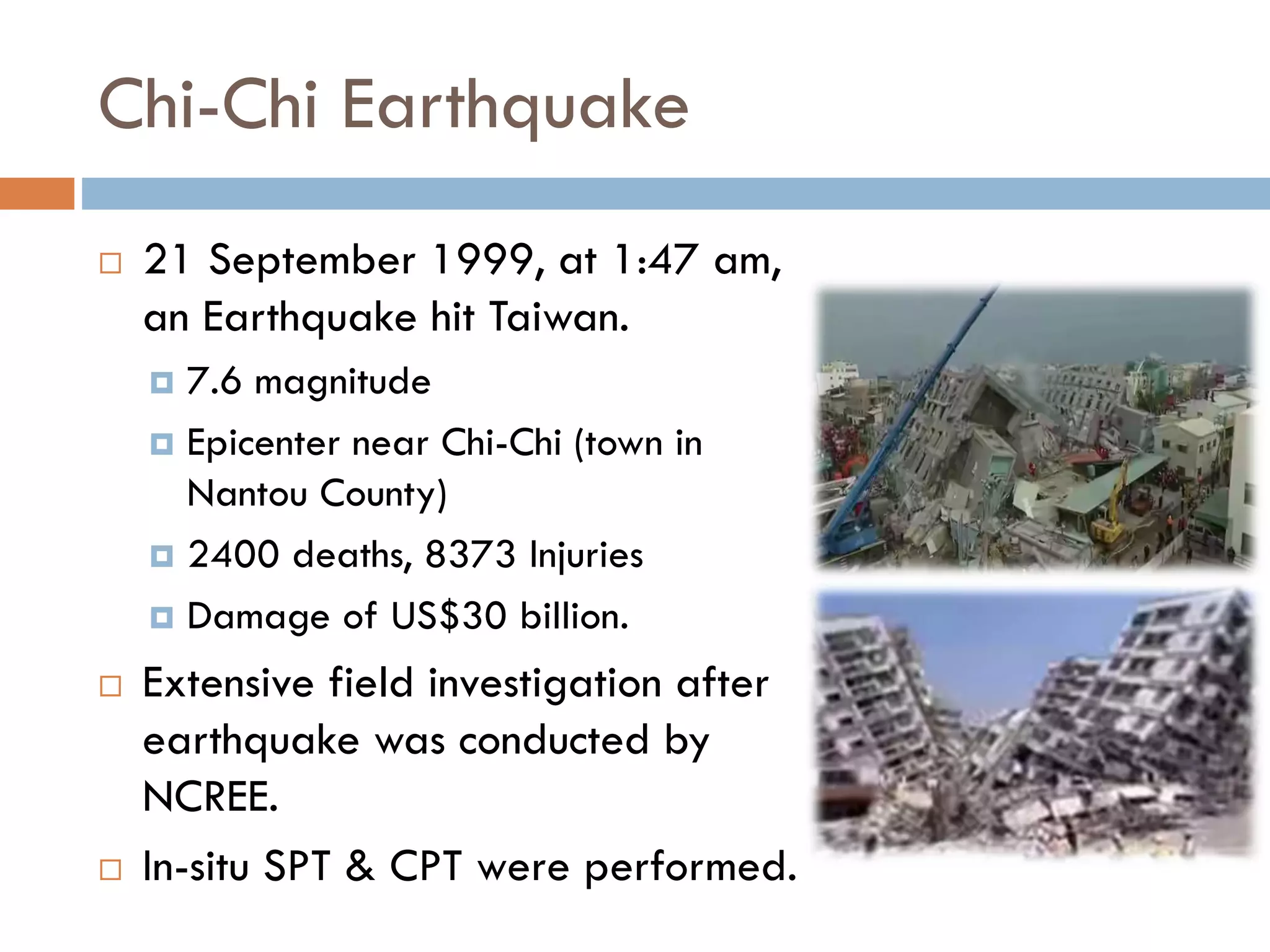
Chi-Chi Earthquake
 21 September 1999, at 1:47 am,
an Earthquake hit Taiwan.
 7.6 magnitude
 Epicenter near Chi-Chi (town in
Nantou County)
 2400 deaths, 8373 Injuries
 Damage of US$30 billion.
 Extensive field investigation after
earthquake was conducted by
NCREE.
 In-situ SPT & CPT were performed.
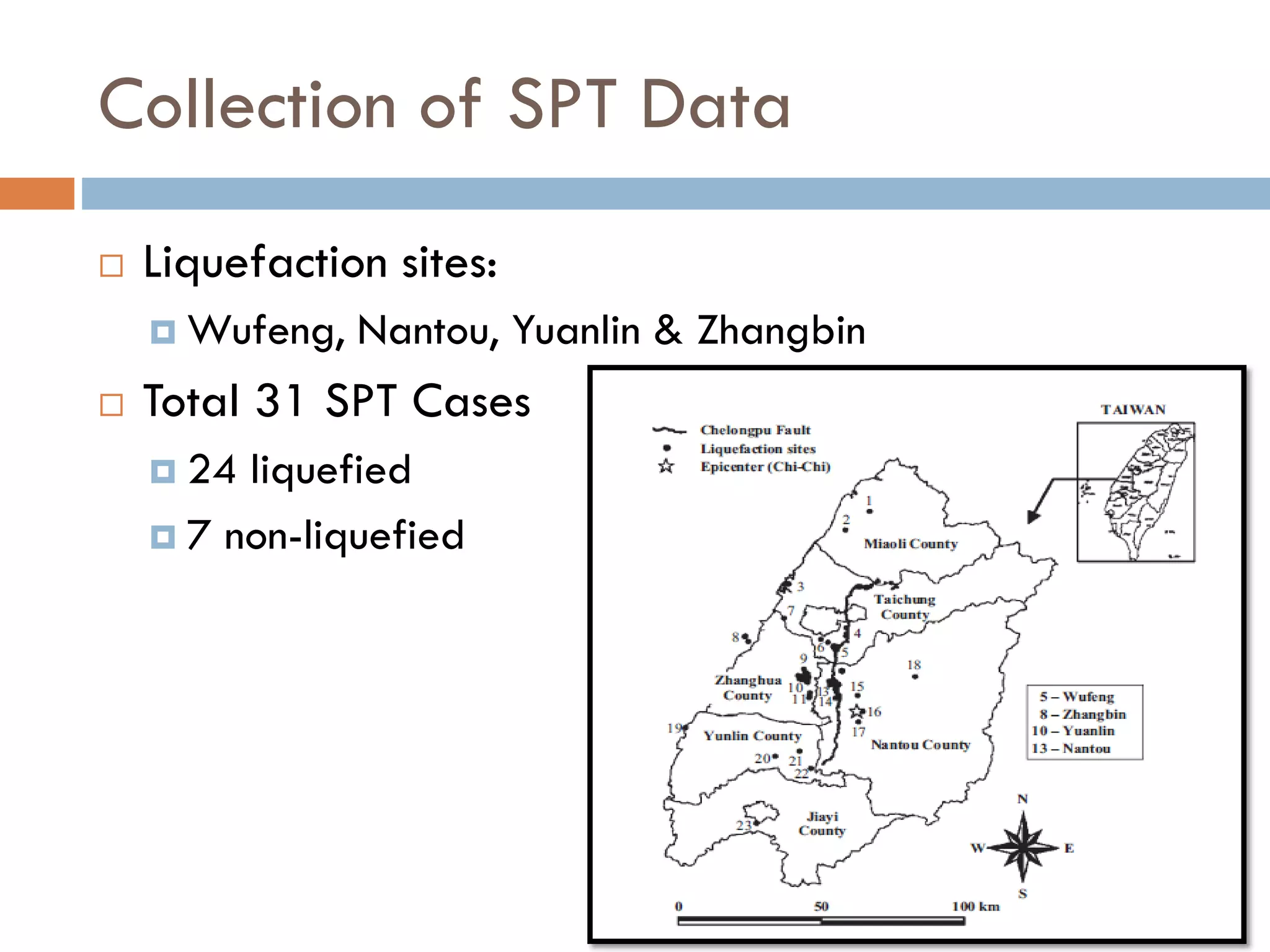
Collection of SPT Data
 Liquefaction sites:
 Wufeng, Nantou, Yuanlin & Zhangbin
 Total 31 SPT Cases
 24 liquefied
 7 non-liquefied
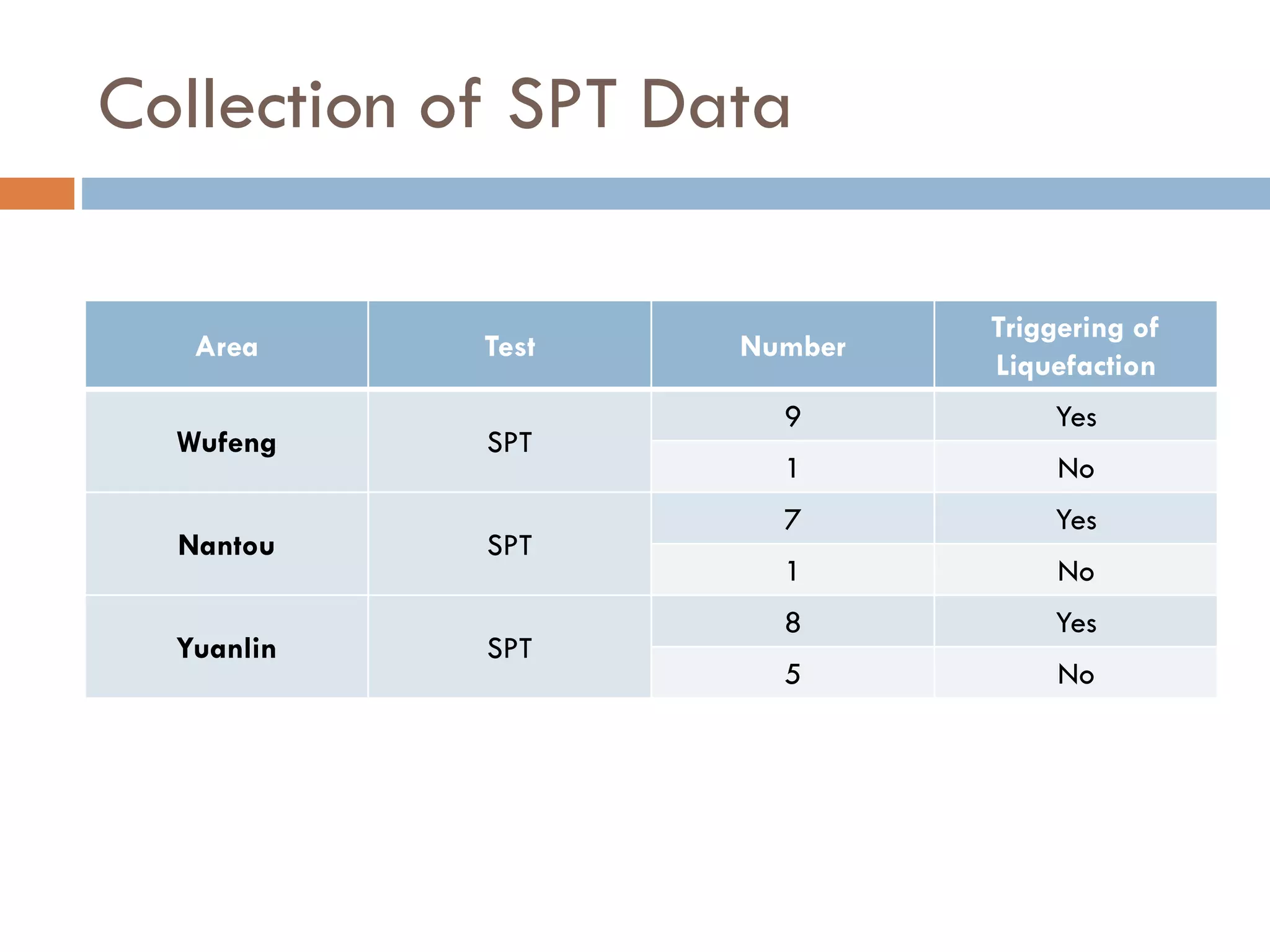
Collection of SPT Data
Area Test Number
Triggering of
Liquefaction
Wufeng SPT
9 Yes
1 No
Nantou SPT
7 Yes
1 No
Yuanlin SPT
8 Yes
5 No
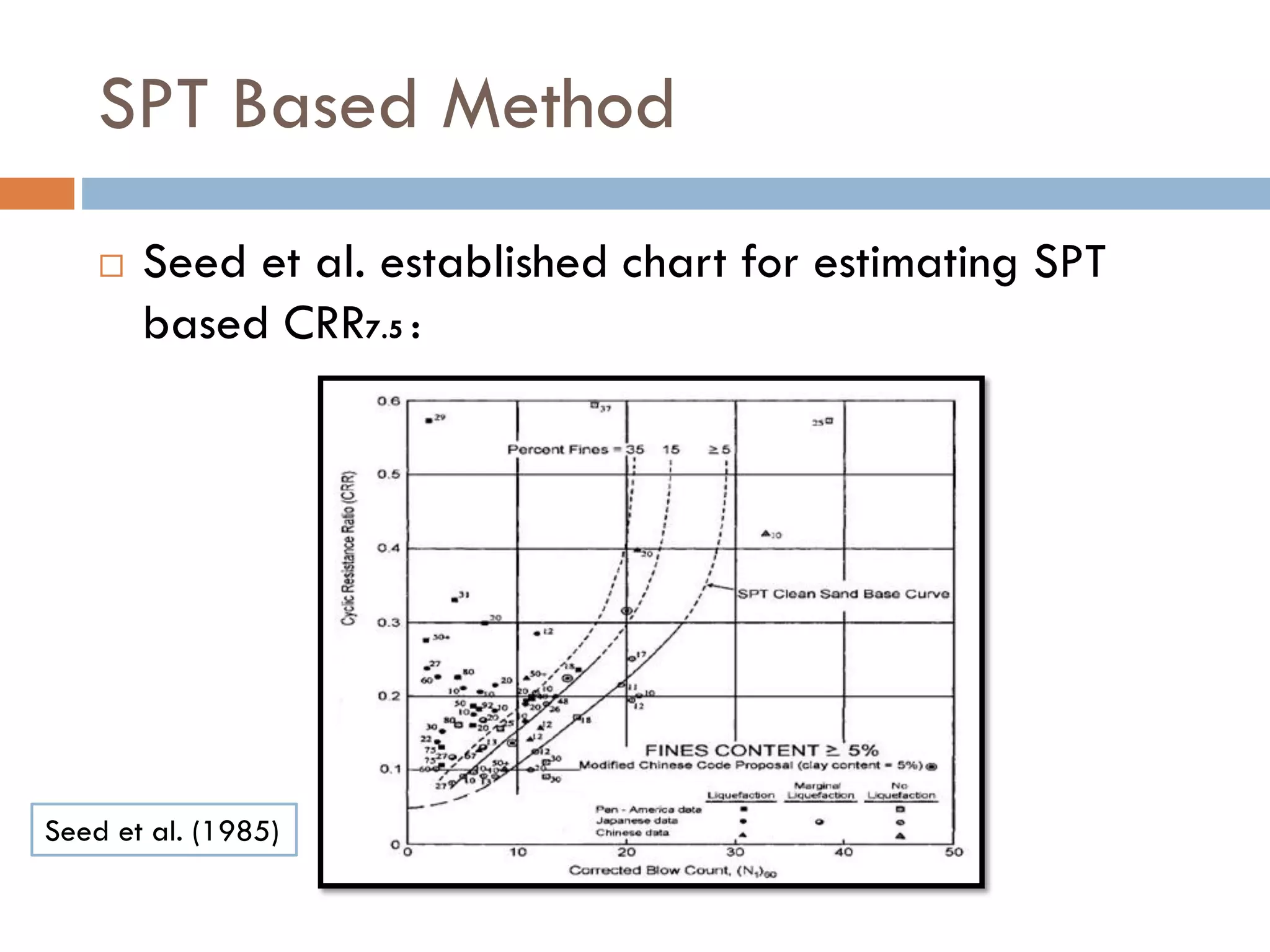
SPT Based Method
 Seed et al. established chart for estimating SPT
based CRR7.5 :
Seed et al. (1985)
SPT Based Method
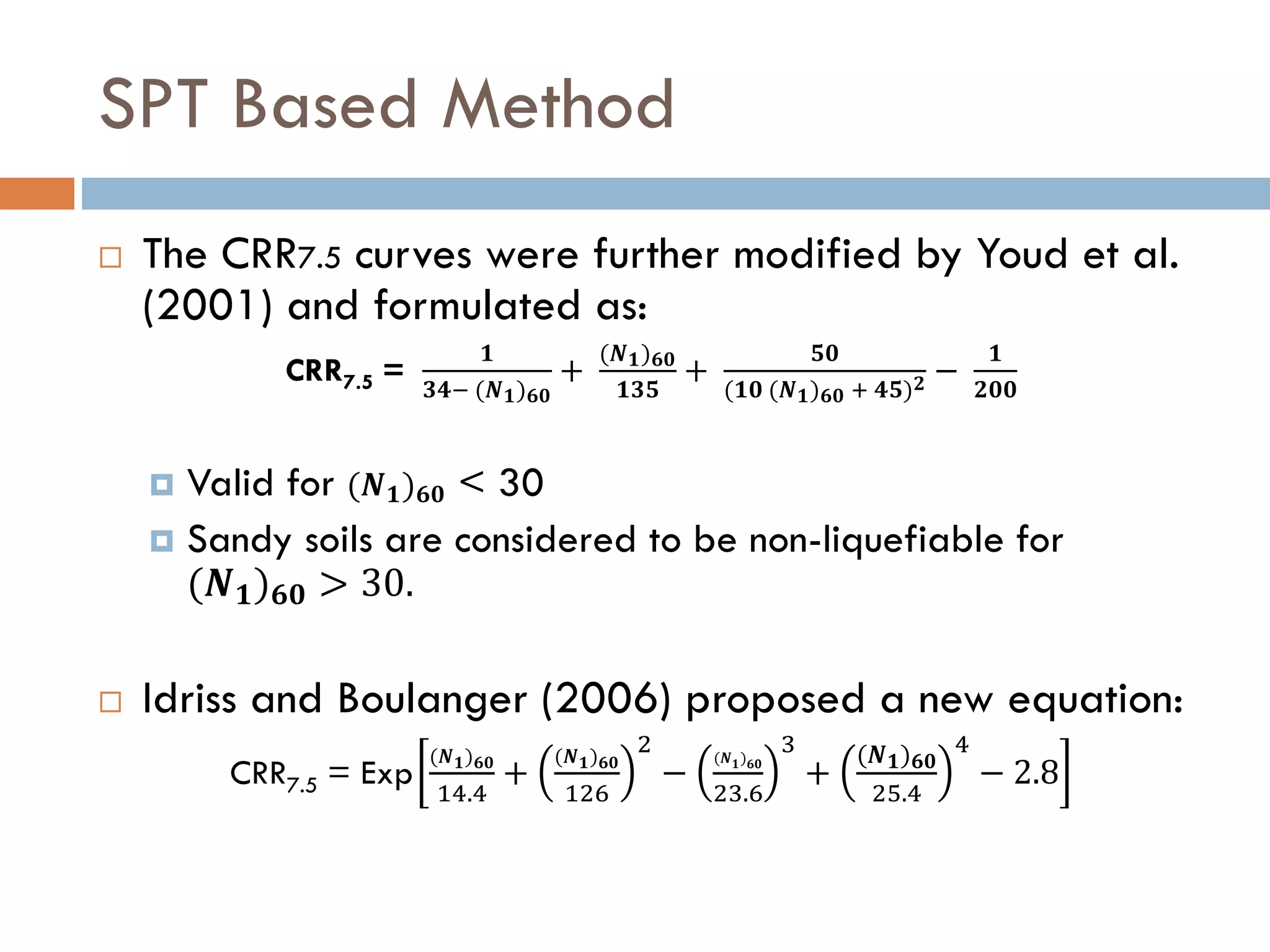
 The CRR7.5 curves were further modified by Youd et al.
(2001) and formulated as:
CRR7.5 =
𝟏
𝟑𝟒− (𝑵 𝟏) 𝟔𝟎
+
(𝑵 𝟏) 𝟔𝟎
𝟏𝟑𝟓
+
𝟓𝟎
(𝟏𝟎 (𝑵 𝟏) 𝟔𝟎 + 𝟒𝟓) 𝟐 −
𝟏
𝟐𝟎𝟎
 Valid for (𝑵 𝟏) 𝟔𝟎 < 30
 Sandy soils are considered to be non-liquefiable for
(𝑵 𝟏) 𝟔𝟎 > 30.
 Idriss and Boulanger (2006) proposed a new equation:
CRR7.5 = Exp
(𝑵 𝟏) 𝟔𝟎
14.4
+
(𝑵 𝟏) 𝟔𝟎
126
2
−
(𝑵 𝟏) 𝟔𝟎
23.6
3
+
(𝑵 𝟏) 𝟔𝟎
25.4
4
− 2.8
DMT Based Method
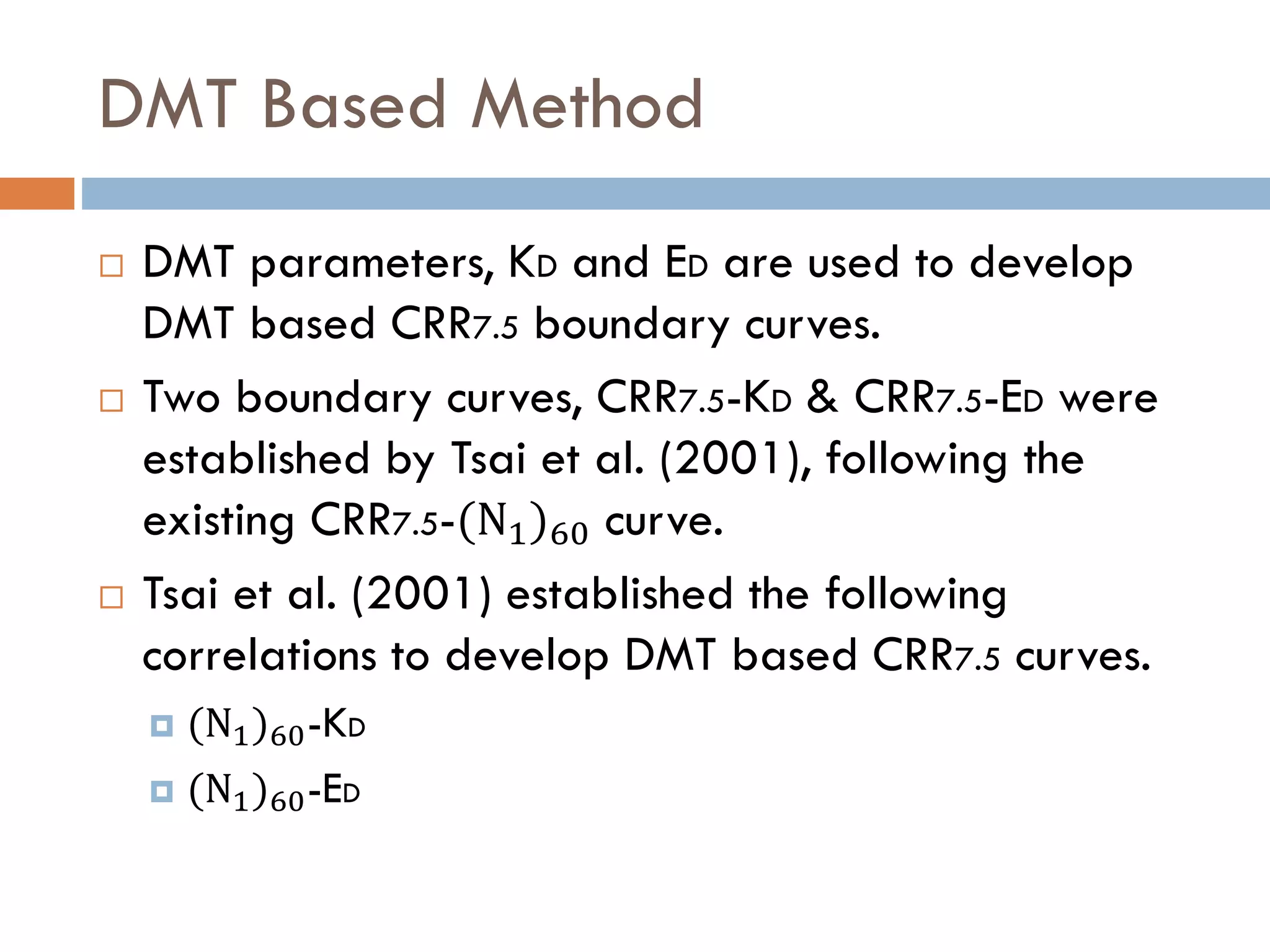
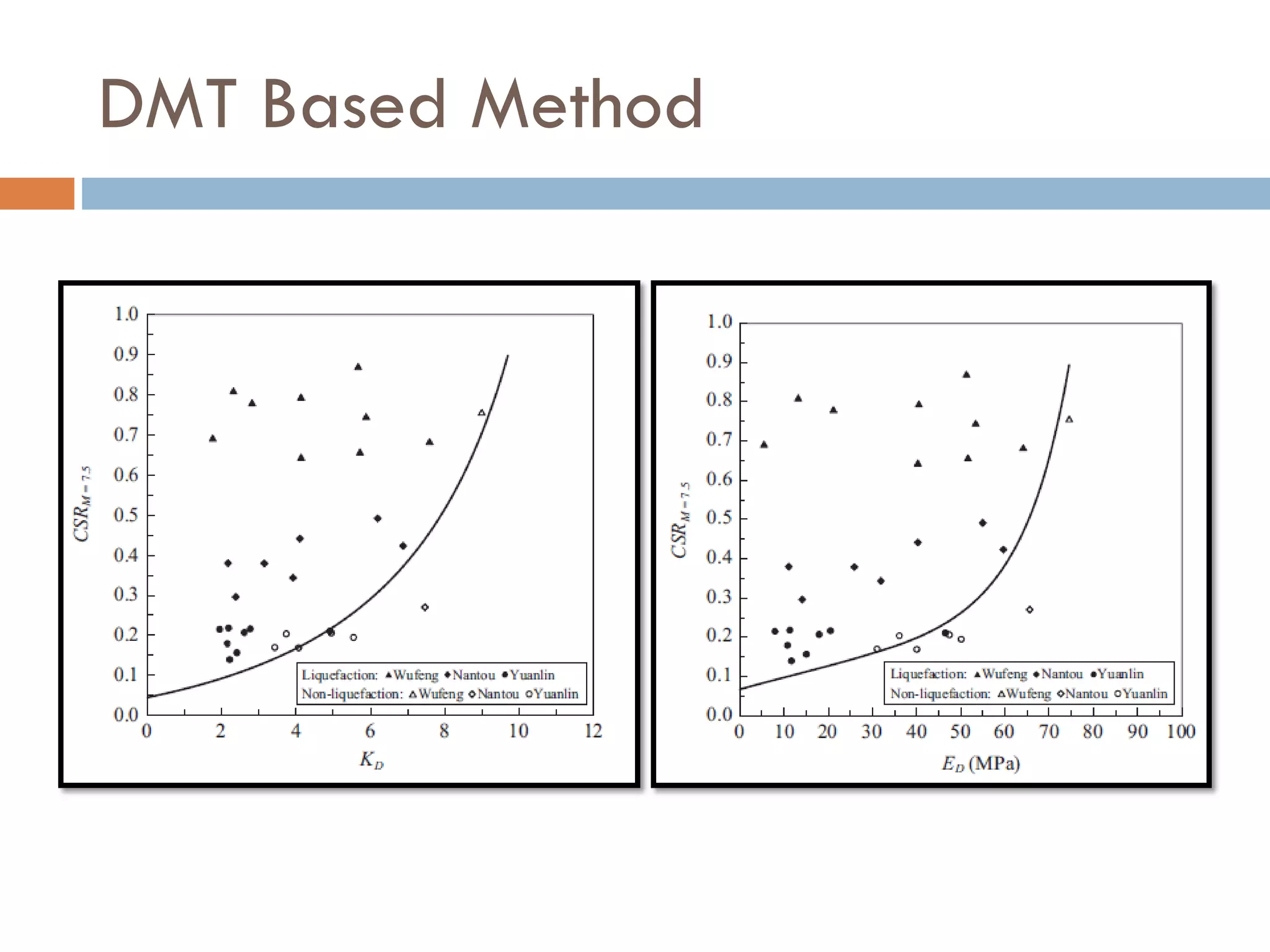
 DMT parameters, KD and ED are used to develop
DMT based CRR7.5 boundary curves.
 Two boundary curves, CRR7.5-KD & CRR7.5-ED were
established by Tsai et al. (2001), following the
existing CRR7.5-(N1)60 curve.
 Tsai et al. (2001) established the following
correlations to develop DMT based CRR7.5 curves.
 (N1)60-KD
 (N1)60-ED
DMT Based Method
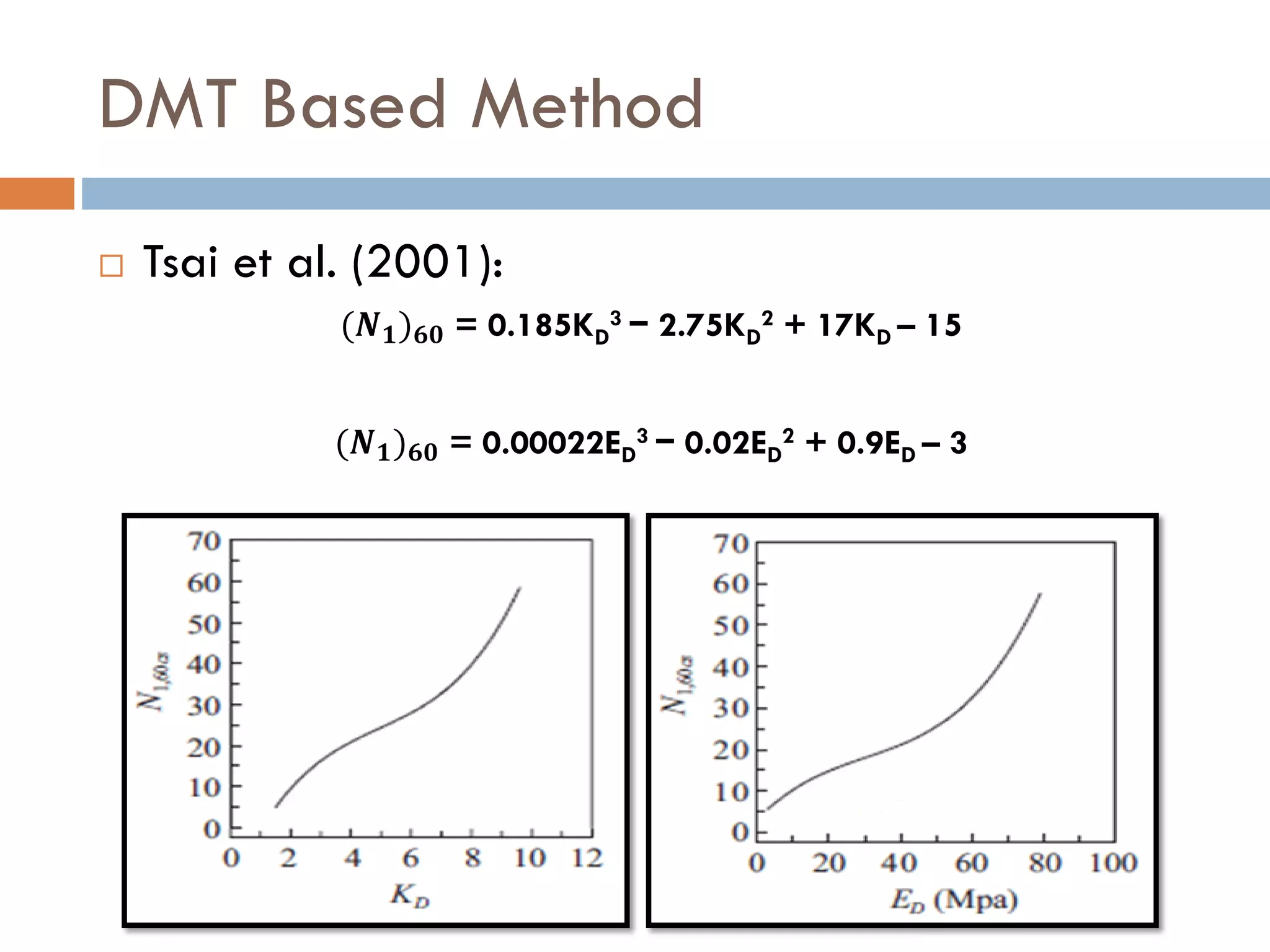
 Tsai et al. (2001):
(𝑵 𝟏) 𝟔𝟎 = 0.185KD
3 − 2.75KD
2 + 17KD – 15
(𝑵 𝟏) 𝟔𝟎 = 0.00022ED
3 − 0.02ED
2 + 0.9ED – 3
DMT Based Method
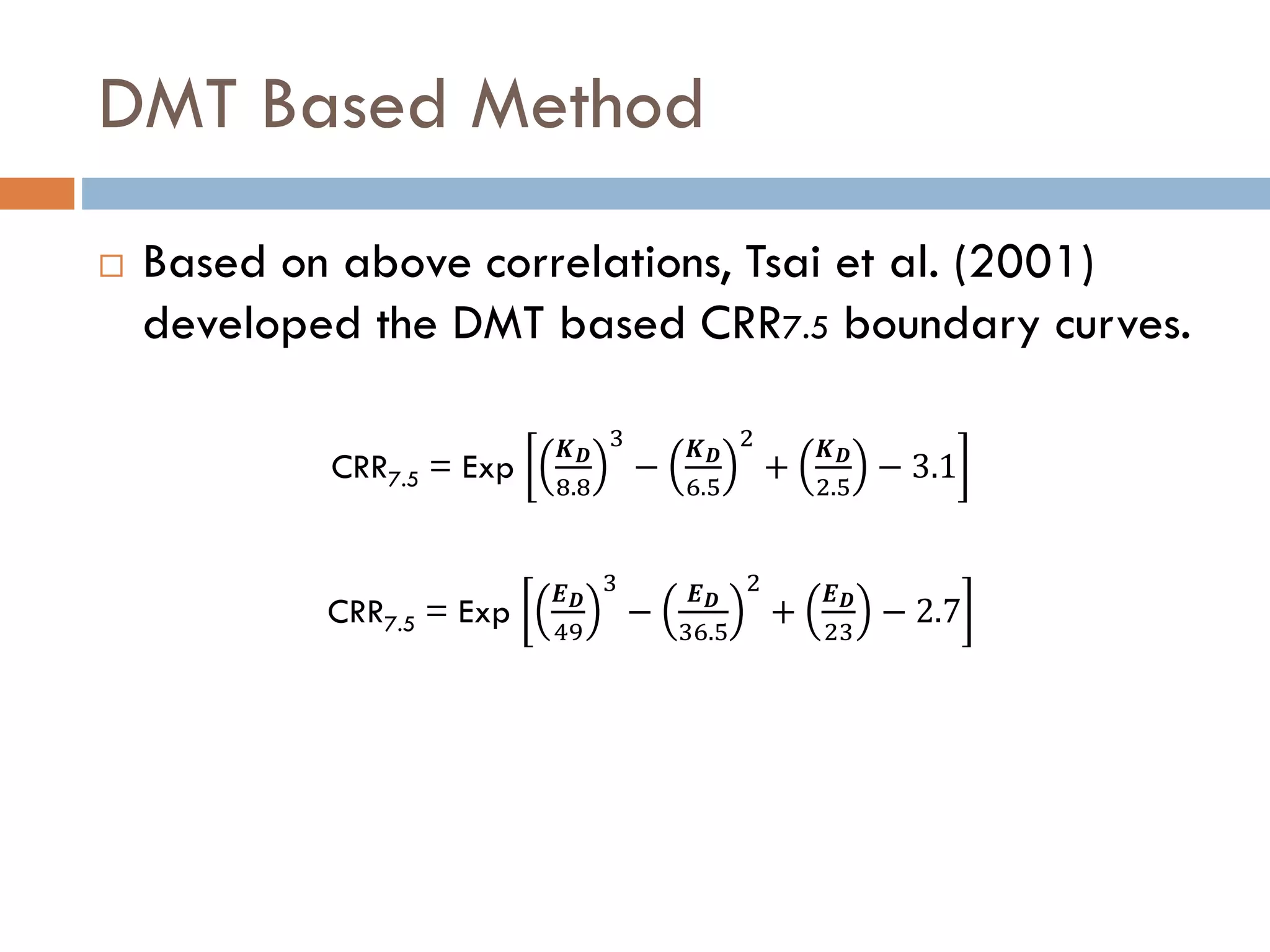
 Based on above correlations, Tsai et al. (2001)
developed the DMT based CRR7.5 boundary curves.
CRR7.5 = Exp
𝑲 𝑫
8.8
3
−
𝑲 𝑫
6.5
2
+
𝑲 𝑫
2.5
− 3.1
CRR7.5 = Exp
𝑬 𝑫
49
3
−
𝑬 𝑫
36.5
2
+
𝑬 𝑫
23
− 2.7
DMT Based Method
DMT Based Method
CRR curves proposed by Monaco
(2005), Grasso & Maugeri (2006)
and Tsai (2009)
CONCLUSION
Conclusion
 DMT is relatively quick in-situ method which estimates a
number of parameters, that can be effectively used in
geotechnical design.
 DMT is capable of taking into account the soil structure,
aging and consolidation effects, which generally influence
the liquefaction potential of soil (Tsai et al. 2001).
 Tsai et al. (2001) study shows that the accuracy of DMT
based CRR7.5 curves for Liquefaction assessment is
satisfactory.
 Liquefaction assessment is relatively fast and reliable as
compared to SPT, which takes longer time to supplement SPT
with lab testing.
Conclusion
 However, it is desirable to directly conduct DMTs in
the liquefied and non-liquefied areas of
earthquake to obtain more KD and ED data of soils
for further validating the developed DMT-based
liquefaction evaluation method although the results
of this study are preliminarily satisfactory
REFERENCES
References
 Marchetti, S. (1980). "In SituTests by Flat Dilatometer." J. Geotech. Engrg. Div.,
ASCE, 106, No.GT3, 299- 321.
 G.Totani, S. Marchetti, P. Monaco & M. Calabrese. Use of Flat DilatometerTest
in Geotechnical Design, Intl. Conf. on In-situ Measurement of Soil Properties
(2001)
 Monaco, P., Marchetti, S., Totani, G. and Calabrese, M. (2005). “Sand
liquefiability assessment by Flat DilatometerTest (DMT).” Proc. XVI ICSMGE,
Osaka, 4, 2693-2697
 Robertson, P.K., and R.G. Campanella, [1986]. “Estimating liquefaction potential
of sands using the flat plate dilatometer. Geotech.Testing J.,Vol. 9, No. 1, pp. 38–
40.
 Tsai,Tung and Lee (2001) . Performance of DMT based liquefaction evaluation
method on case history of Chi-Chi Earthquake
 Bambang Setiawan,(2011) “Assessing Liquefaction Potential of Soils Utilizing In-
situTesting” M.ScThesis
Use of DMT in Geotechnical Design with Emphasis on Liquefaction Assessment

Use of DMT in Geotechnical Design with Emphasis on Liquefaction Assessment

  • 1.
    USE OF DMTIN GEOTECHNICAL DESIGN WITH EMPHASIS ON LIQUEFACTION ANALYSIS Presented By: Muhammad Ali Rehman
  • 2.
    Overview  Introduction  DataInterpretation  DMT Correlations  Liquefaction  Liquefaction Assessment  Case Study  Conclusions  References
  • 3.
     DMT  EquipmentLayout  Test Procedure INTRODUCTION
  • 4.
    Dilatometer Test (DMT) Developed by Professor Silvano Marchetti (Italy).  Published test procedure & correlations in 1980.  DMT measures the lateral deflection of soil.
  • 5.
  • 6.
    Test Procedure  DMTin-situ testing involves expanding membrane by using nitrogen gas.
  • 7.
     The primaryway of using DMT results is to interpret them in terms of common soil parameters. DATA INTERPRETATION
  • 8.
    Dilatometer Test Parameters Primary parameters of DMT.  Material Index ID = (p1 – p0) / (p0 – u0)  Horizontal Stress Index KD = (p1 – p0) / σ´v0  Dilatometer Modulus ED = 34.7 (p1 – p0)  Pore-pressure Index UD = (p2 – u0) / (p0 – u0)
  • 9.
    • DMT parameters,ID, KD, and ED are used in subsequent soil analysis. DMT CORRELATIONS
  • 10.
    Correlations  Soil Behavior Over-consolidation  Relative Density  Undrained Shear Strength  Constrained Modulus  Compression Ratio  Settlement Prediction  Skin friction of Driven Piles  SPT N-value and Dilatometer Modulus
  • 11.
    1. Behavior ofSoil  Soil behavior chart introduced by Marchetti et al. (1980).  ID<0.6 : Clays  0.6≤ID≤1.8 : Silts  ID>1.8 : Sands
  • 12.
    2. Over-Consolidation Ratio(OCR)  Original correlation proposed by Marchetti et al. (1980): OCRDMT = (0.5 x KD)1.56  Confirmed by a comprehensive collection of data by Kamei & Iwasaki (1995) for clays.  Finno (1993)
  • 13.
    Over-Consolidation Ratio (OCR) Kamei& Iwasaki (1995) Finno (1993)
  • 14.
    3. Relative Density Reyna& Chameau (1991) and Tanaka & Tanaka (1998) Robertson & Campanella
  • 15.
    4. Undrained ShearStrength  Marchetti et al. (1980): cu = 0.22 σ'v0 (0.5 KD)1.25
  • 16.
    Undrained Shear Strength Comparison of undrained shear strength by DMT and other tests, at National Research Site, Bothkennar (UK): Nash et al. (1992)
  • 17.
    5. Constrained Modulus: MDMT  Obtained by applying correction factor RM to ED MDMT = RM . ED  RM is the function of material index (ID) and horizontal stress index (KD).  Increases with KD while ID has lesser effect on the RM value.  Generally varies from 1 to 3.
  • 18.
    6. Compression Ratio Marchetti et al. (1980)  Pre-consolidated Clays M = σ’p (2.3/CR)  Normally Consolidated Clays M = σ’v (2.3/CR)
  • 19.
    7. Settlement Prediction Predicting the settlement of shallow foundations (particularly for Sands) is one of the best applications of DMT.  Calculated by means of expression: S = [ Δσv/MDMT ] ΔZ Totani, Marchetti, Monaco & Calabrese (2001)
  • 20.
    8. Skin Frictionfor Driven Piles in Clay  Powell et al. (2001 b), developed a method for the design of piles driven in clay.  Method predicts pile skin friction qs, from ID and (p1 - p0):  ID < 0.1 : qs /(p1 - p0 ) = 0.5  0.1 < ID < 0.65 : qs /(p1 - p0 ) = -0.73077 ID + 0.575  ID > 0.65 : qs /(p1 - p0 ) = 0.1
  • 21.
    9. SPT N-value& ED Mayne & Frost
  • 22.
     Introduction  LiquefiableSoils  Liquefaction Assessment LIQUEFACTION
  • 23.
    Liquefaction  “Transformation ofcoarse grained soil from a solid state into a liquid state”  Excessive hydrostatic pressure build-up & reduction of effective stress  sudden shock  cyclic loading.  Devastating effects of structure:  Tilting of high rise buildings  Ground subsidence  Surface rupture  Collapse
  • 24.
    Liquefiable Soils  Loosegranular soils are potentially susceptible to liquefaction.  Fine grained soils (such as silts and clays) are non- liquefiable.  Andrews & Martin (2000) suggested:  Potentially Liquefiable: soils having, CF < 10% & LL < 32%  Non-Liquefiable: soils having, CF > 10% & LL ≥ 32%
  • 25.
    Liquefaction Assessment  Glaserand Chung (1995):  Loose granular soils densify on sampling.  Laboratory measurements demonstrate higher cyclic strength  In-situ testing is preferred.  “Simplified Procedure” for liquefaction assessment, proposed by Seed & Idriss (1971).  To evaluate the loading to a soil caused by an earthquake (by CSR)  To evaluate the resistance of a soil to triggering of liquefaction (by CRR)
  • 26.
    Liquefaction Assessment  Factorof Safety against the occurrence of liquefaction is defined as: FS = CRR7.5 /CSR7.5  If FS < 1, liquefaction will be triggered.
  • 27.
    Cyclic Stress Ratio(CSR)  CSR is the measure of intensity of cyclic loading during an earthquake.  Obtained by formula, developed by Seed & Idriss (1971): CSR 7.5 = 0.65 (amax / g) . (σv0 / σ’vo) . rd  amax is the peak horizontal ground acceleration generated by the earthquake.  rd is the stress reduction factor.
  • 28.
    Cyclic Stress Ratio(CSR)  Seed & Idriss porposed:  rd is the function of stratigraphy and depth.  Has a value of 1.0 at ground surface, tends to reduce with depth. Seed and Idriss (1971)
  • 29.
    Cyclic Stress Ratio(CSR)  Youd et al. (2001)  rd = [1.0 – 0.00765z] (z ≤ 9.2m)  rd = [1.174 – 0.0267z] (9.2 < z ≤ 23m)  rd = [0.744 – 0.008z] (23 < z ≤ 30m)  rd = 0.5 (z > 9.2m)
  • 30.
    Cyclic Resistance Ratio In-situ test Procedures:  Standard Penetration Test  Cone Penetration Test  Shear wave velocity test  Dilatometer Test
  • 31.
    DMT Based CRREvaluation  Include:  Marchetti (1980)  Roberstson & Campnella (1986)  Reyna & Chameau (1991)  Monaco et al. (2005)  Grasso & Maugeri (2006)  Monaco & Marchetti (2007)  Tsai et al. (2001, 2009)
  • 32.
    DMT Based CRREvaluation  Marchetti (1980) proposed the basic correlation: CRR = (KD/10)  Refined by Monaco et al. (2005): CRR7.5 = 0.0107KD 3 − 0.0741KD 2 + 0.2169KD – 0.1306  Grasso & Maugeri (2006) further updated Monaco et al. (2005) model into: CRR7.5 = 0.0908KD 3 − 1.0174KD 2 + 3.8466KD – 4.5369
  • 33.
    DMT Based CRREvaluation Curves for CRR (Reyna & Chameau 1991)  Clean sand is safe against liquefaction for following KD values:  Non seismic areas: KD > 1.7  Low seismicity areas : KD > 4.2  Medium seismicity areas: KD > 5.0  High seismicity areas: KD > 5.5
  • 34.
    Performance of DMTBased Liquefaction Evaluation of Chi-Chi Earthquake, Taiwan (1999) by Tsai et al. (2001) Case Study
  • 35.
    Chi-Chi Earthquake  21September 1999, at 1:47 am, an Earthquake hit Taiwan.  7.6 magnitude  Epicenter near Chi-Chi (town in Nantou County)  2400 deaths, 8373 Injuries  Damage of US$30 billion.  Extensive field investigation after earthquake was conducted by NCREE.  In-situ SPT & CPT were performed.
  • 36.
    Collection of SPTData  Liquefaction sites:  Wufeng, Nantou, Yuanlin & Zhangbin  Total 31 SPT Cases  24 liquefied  7 non-liquefied
  • 37.
    Collection of SPTData Area Test Number Triggering of Liquefaction Wufeng SPT 9 Yes 1 No Nantou SPT 7 Yes 1 No Yuanlin SPT 8 Yes 5 No
  • 38.
    SPT Based Method Seed et al. established chart for estimating SPT based CRR7.5 : Seed et al. (1985)
  • 39.
    SPT Based Method The CRR7.5 curves were further modified by Youd et al. (2001) and formulated as: CRR7.5 = 𝟏 𝟑𝟒− (𝑵 𝟏) 𝟔𝟎 + (𝑵 𝟏) 𝟔𝟎 𝟏𝟑𝟓 + 𝟓𝟎 (𝟏𝟎 (𝑵 𝟏) 𝟔𝟎 + 𝟒𝟓) 𝟐 − 𝟏 𝟐𝟎𝟎  Valid for (𝑵 𝟏) 𝟔𝟎 < 30  Sandy soils are considered to be non-liquefiable for (𝑵 𝟏) 𝟔𝟎 > 30.  Idriss and Boulanger (2006) proposed a new equation: CRR7.5 = Exp (𝑵 𝟏) 𝟔𝟎 14.4 + (𝑵 𝟏) 𝟔𝟎 126 2 − (𝑵 𝟏) 𝟔𝟎 23.6 3 + (𝑵 𝟏) 𝟔𝟎 25.4 4 − 2.8
  • 40.
    DMT Based Method DMT parameters, KD and ED are used to develop DMT based CRR7.5 boundary curves.  Two boundary curves, CRR7.5-KD & CRR7.5-ED were established by Tsai et al. (2001), following the existing CRR7.5-(N1)60 curve.  Tsai et al. (2001) established the following correlations to develop DMT based CRR7.5 curves.  (N1)60-KD  (N1)60-ED
  • 41.
    DMT Based Method Tsai et al. (2001): (𝑵 𝟏) 𝟔𝟎 = 0.185KD 3 − 2.75KD 2 + 17KD – 15 (𝑵 𝟏) 𝟔𝟎 = 0.00022ED 3 − 0.02ED 2 + 0.9ED – 3
  • 42.
    DMT Based Method Based on above correlations, Tsai et al. (2001) developed the DMT based CRR7.5 boundary curves. CRR7.5 = Exp 𝑲 𝑫 8.8 3 − 𝑲 𝑫 6.5 2 + 𝑲 𝑫 2.5 − 3.1 CRR7.5 = Exp 𝑬 𝑫 49 3 − 𝑬 𝑫 36.5 2 + 𝑬 𝑫 23 − 2.7
  • 43.
  • 44.
    DMT Based Method CRRcurves proposed by Monaco (2005), Grasso & Maugeri (2006) and Tsai (2009)
  • 45.
  • 46.
    Conclusion  DMT isrelatively quick in-situ method which estimates a number of parameters, that can be effectively used in geotechnical design.  DMT is capable of taking into account the soil structure, aging and consolidation effects, which generally influence the liquefaction potential of soil (Tsai et al. 2001).  Tsai et al. (2001) study shows that the accuracy of DMT based CRR7.5 curves for Liquefaction assessment is satisfactory.  Liquefaction assessment is relatively fast and reliable as compared to SPT, which takes longer time to supplement SPT with lab testing.
  • 47.
    Conclusion  However, itis desirable to directly conduct DMTs in the liquefied and non-liquefied areas of earthquake to obtain more KD and ED data of soils for further validating the developed DMT-based liquefaction evaluation method although the results of this study are preliminarily satisfactory
  • 48.
  • 49.
    References  Marchetti, S.(1980). "In SituTests by Flat Dilatometer." J. Geotech. Engrg. Div., ASCE, 106, No.GT3, 299- 321.  G.Totani, S. Marchetti, P. Monaco & M. Calabrese. Use of Flat DilatometerTest in Geotechnical Design, Intl. Conf. on In-situ Measurement of Soil Properties (2001)  Monaco, P., Marchetti, S., Totani, G. and Calabrese, M. (2005). “Sand liquefiability assessment by Flat DilatometerTest (DMT).” Proc. XVI ICSMGE, Osaka, 4, 2693-2697  Robertson, P.K., and R.G. Campanella, [1986]. “Estimating liquefaction potential of sands using the flat plate dilatometer. Geotech.Testing J.,Vol. 9, No. 1, pp. 38– 40.  Tsai,Tung and Lee (2001) . Performance of DMT based liquefaction evaluation method on case history of Chi-Chi Earthquake  Bambang Setiawan,(2011) “Assessing Liquefaction Potential of Soils Utilizing In- situTesting” M.ScThesis