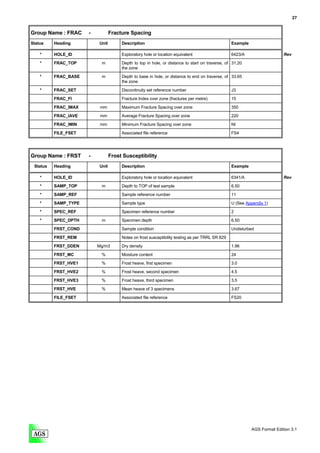
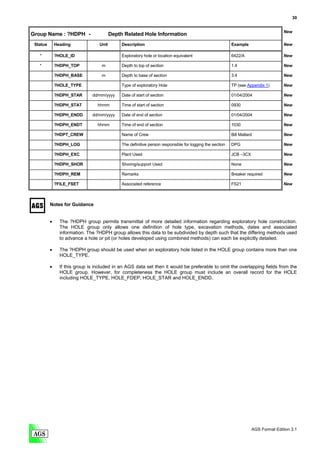
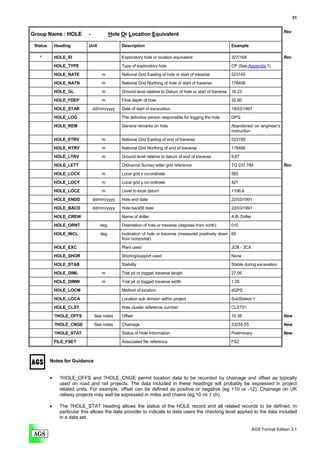
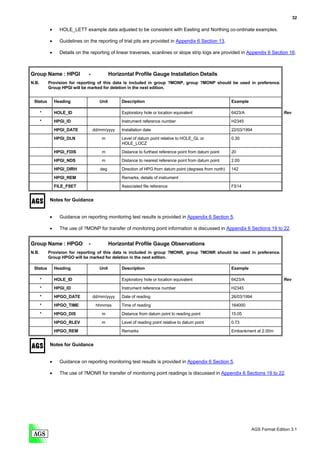
COVER


             Electronic Transfer of
                 Geotechnical
                      and
            Geoenvironmental Data

                           (Edition 3.1)
                     including addendum May 2005


                                   2004

                                Published by
        Association of Geotechnical and Geoenvironmental Specialists
i


                                                  ACKNOWLEDGEMENTS

This document has been prepared by the Association of Geotechnical and Geoenvironmental Specialists (AGS)
with the encouragement and support of the working party members. The AGS acknowledges the generous time
and resources given to the project by the individual members and their employers. Without their enthusiastic
support this ongoing project would not be possible.

Comment and feedback from the wider geotechnical industry has also been fundamental to the ongoing
evolution of the AGS Format, ensuring that the needs of the geotechnical and geoenvironmental industry and its
clients continue to be met.


Working Party Members

Jackie Bland                                                 Fugro Ltd / Geotechnics Ltd
Dominic Brightman                                            Geotechnical and Environmental Associates (GEA)
Roger Chandler                                               Key Systems Geotechnical Ltd / Keynetix Ltd
Mike Palmer                                                  Halcrow
Christopher Power                                            Mott MacDonald
Syd Pycroft                                                  Burohappold Ltd
Leonard Threadgold                                           Geotechnics Ltd
David Toll                                                   Durham University
Stephen Walthall (chairman)                                  Bechtel
Peter Whittlestone                                           Soil Mechanics (Mowlem Environmental Sciences Group)


Revised 2004
ISBN 0-9539846-2-1

©The Association of Geotechnical and Geoenvironmental Specialists, 1999 - 2004
All rights reserved.

Edition No. 3.1                     December 2004

Amendments
 Edition No.                Date of issue               Amendment
 03/92                      March 1992                  Original Issue
                                                        Rules, Appendix 1, Appendix 2 and Appendix 3
 07/94                      July 1994
                                                        amended as marked in margin.
 3                          November 1999               LIsted in Appendix 7 of Edition 3 document

 3.1                        December 2004               See Appendix 7

                                                        Addendum issued March 2005, see Appendix 7

Association of Geotechnical and Geoenvironmental Specialists
Forum Court
83 Copers Cope Road
Beckenham
Kent BR3 1NR
UNITED KINGDOM
Tel.: 020 8658 8212    Fax.: 020 8663 0949
Email: ags@geotechnical.demon.co.uk          website: http://www.ags.org.uk

Although every effort has been made to check the accuracy of the information and validity of the guidance given in this document, neither the
members of the Working Party nor the Association of Geotechnical and Geoenvironmental Specialists accept any responsibility for
misstatements contained herein or misunderstanding arising here from.


                                                                                                                     AGS Format Edition 3.1
ii


                                                FOREWORD

Foreword

The AGS Data Format subcommittee has monitored the use of the format within the industry since the launch of
AGS 3 in 1999. The committee considers that it is now appropriate to issue AGS 3.1 to include the
developments which have occurred over the last few years. In accordance with section 9 of the AGS 3
publication the majority of this document includes format additions requested by the industry.

There are no major changes from AGS 3 and therefore the committee have decided to call this Revision 1 of the
AGS 3 format (AGS 3.1) rather than AGS 4. The changes in this revision are new fields, groups and pick list
items all sitting within the AGS 3 framework.

AGS 3.1 is compliant with the rules in AGS 3 and therefore the ? remains in all new headings and groups even
though these are now in common use.

This revision brings together AGS 3, the “The AGS-M Format - for the electronic transfer of monitoring data “
published by AGS and CIRIA in 2002 and other groups and headings, which have been suggested on the AGS
website and used by the industry.

Specifying and using the AGS 3.1 format requires that data that is appropriate for these new groups or fields is
submitted in the stated format to prevent proliferation of various user defined groups and fields for the more
conventional additional data types.

The changes within this revision are listed in Appendix 7 and are summarised below:

      New groups. New groups have been added for the recording of Backfill information - ?BKFL, Depth
      Related Hole Information - ?HDPH, Monitoring Points – ?MONP (from AGS-M publication), Monitoring
      Point readings – ?MONR (from AGS-M publication), In situ Contamination testing – ?ICCT (from AGS-M
      publication), On site PID readings - ?IPID, Onsite FID readings - ?IFID, Time related remarks – ?TREM
      (from AGS-M publication).

      New fields. New fields have been added to the following groups CBRT CLSS, , CNMT, CONG, CONS,
      DPRB, DPRG, DREM, FILE, HDIA HOLE, ICBR, IDEN, IPRM, IRDX, IRES, ISPT, IVAN, PROJ, SAMP,
      SHBT and TRIX. To improve clarity of labelling for emailed data and files stored on a server, additional
      fields have also been added in PROJ to include the information traditionally transmitted on the media
      labelling (Appendix 3).

      Pick lists. A standard pick list has been supplied for the geology legend codes (GEOL_LEG) field. This
      field has always caused problems with AGS data as it is the only field that does not have a standard set of
      codes. Pick list items have also been added to six other fields (See Appendix 7 for full field details).

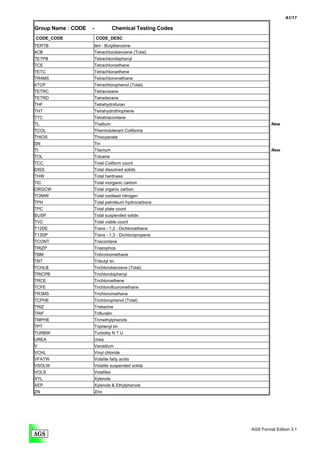
      Codes. Additional determinand codes have been added to the CODE table as suggested by the users.

      AGS Website. The AGS data format website has been updated to display all the additions in this
      document together will the appropriate guidance notes. The website also allows the visitor to view the
      field version history and an appropriate discussion thread or threads that have contributed to the changes.


A complete list of all additions, revisions and their history is available on the AGS web pages
(http://www.ags.org.uk)

It is expected that all registered users will be able to use these additional headings for projects starting after
March 2005 but this is solely up to the relevant project members to agree.


                                                                                                Steve Walthall
                                                                                       Working Party Chairman


                                                                                              AGS Format Edition 3.1
iii


                                         CONTENTS

ACKNOWLEDGEMENTS

FOREWORD

CONTENTS

1    INTRODUCTION

2    SCOPE

3    USER SUPPORT

4    PRESENTATION

5    CONCEPTS

     5.1    Base Data

     5.2    File Format

     5.3    Data Dictionary

     5.4    Groups and Fields

     5.5    Units

6    FILE SECURITY

     6.1    Labelling

     6.2    Virus Protection

7    PRELIMINARY AND FINAL DATA

8    MANAGEMENT

9    UPDATING

10   RULES

     10.1   The Rules

     10.2   Notes on the Rules

     10.3   Group Hierarchy

11   DATA DICTIONARY

     11.1   Data Sets

     11.2   Units of Measurement

     11.3   Examples

     11.4   Notes

     11.5   Key to Change Control Used


                                                    AGS Format Edition 3.1
iv


                                   CONTENTS


APPENDICES


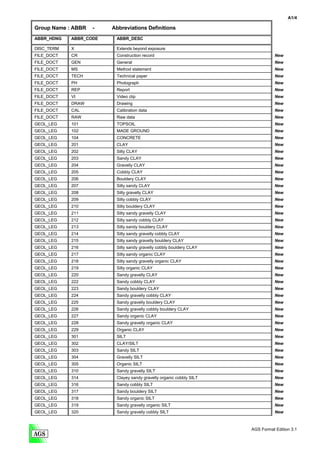
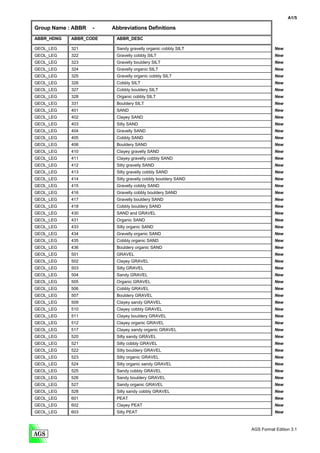
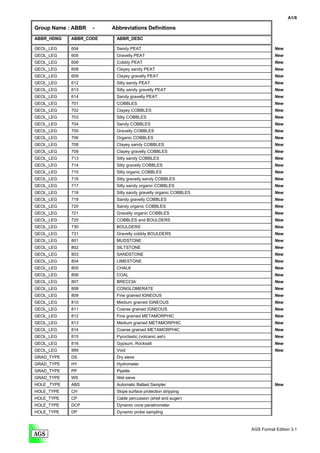
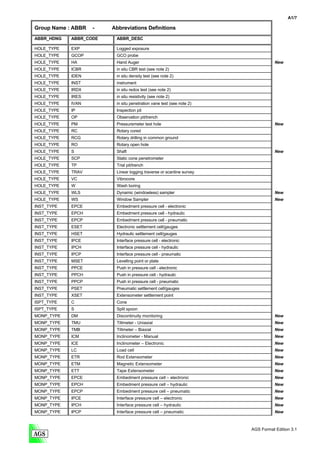
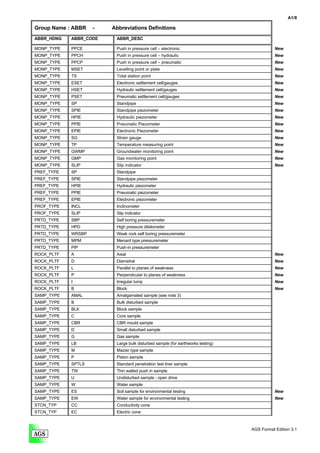
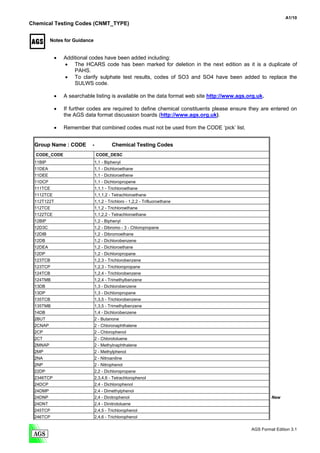
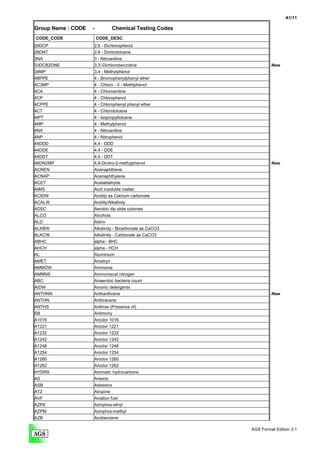
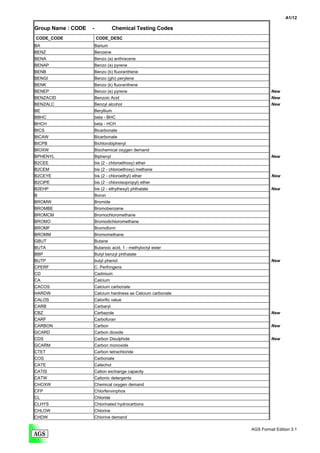
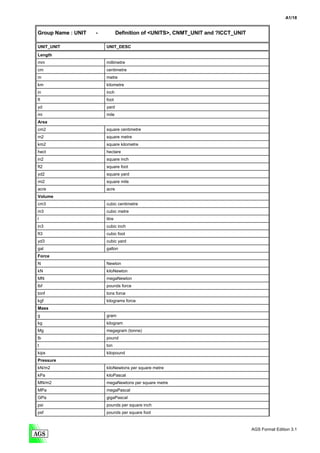
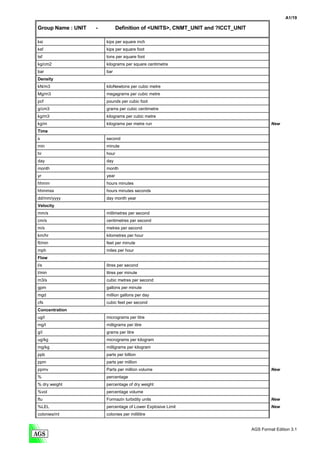
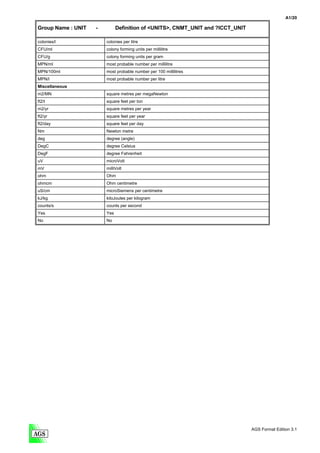
APPENDIX 1   -   Pick Lists – Groups ABBR, CODE and UNIT

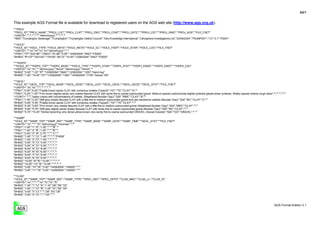
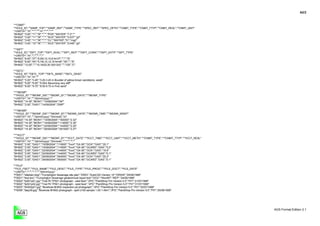
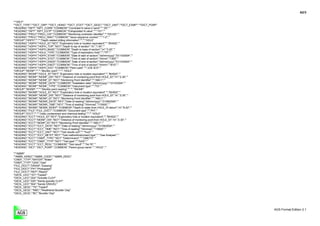
APPENDIX 2   -   Example AGS Format File

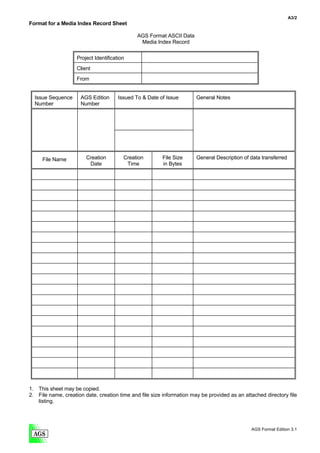
APPENDIX 3   -   Security of Media
                 Media Labelling
                 Media Index Record

APPENDIX 4   -   Examples of General and Particular Specification Clauses with
                 Associated Notes for Guidance

APPENDIX 5   -   AGS Format User Support

APPENDIX 6   -   Suggested Usage of the AGS Format

APPENDIX 7   -   Summary of Amendments Contained within AGS Edition 3.1


                                                                           AGS Format Edition 3.1
1
1   INTRODUCTION

Prior to the establishment of the AGS Format, which has now been accepted by all components of the industry
as being appropriate to data preparation, analysis, transfer and storage in electronic format, there was a
proliferation of software systems that differed both in form and purpose even though much of their content was
common. This was recognised by the Association of Geotechnical and Geoenvironmental Specialists (AGS) in
1991 and led to the setting up of a Working Party to establish an interchange format which allowed transfer of
data between systems with minimal change to the systems themselves. The outcome of this work was
embodied in the First Edition of this document. The Second and Third Editions were published in 1994 and 1999
respectively containing a series of updates and developments reflecting the ongoing needs of the industry.

Computer technology continues to advance and is now a fundamental part of the geotechnical industry. The
producers of geotechnical and geoenvironmental data have adopted database systems for the efficient
preparation and presentation of reports in printed format and the receivers for its analysis. Clearly, the transfer of
data by electronic means to the receivers systems without the need for a printed interface helps to minimise
costs, time and the potential for error. It also encourages more and better use of the data. However, much
remains to be done to encourage the use of data in the electronic format, not only in site investigation but also in
the design, bidding and construction phases of the project.

Most new systems for data recording and analysis now embody the AGS Format from inception. Once in place
each system should be capable of interfacing with any other system which recognises the same format.

Whilst providing benefit in relation to data transfer, the AGS Format allows both producers and receivers to
continue to use their own familiar forms and facilities and hence aids the implementation of quality assurance
procedures. Storage and access to the data is rendered far more efficient and the establishment of data banks
by producers, receivers and national bodies is facilitated.

This document continues the trend of updating the Format in response to industry requirements. The data format
rules laid out in the Third Edition (1999) remain unchanged; however, the data dictionary has been updated to
reflect the practicalities of data transfer and enhancements discussed on the web site. The main enhancements
included in this edition are the inclusion of the groups to transfer monitoring data, developed as part of the AGS-
M Format, and additions to the “pick lists” for standard items such as hole and sample types as well as chemical
test determinands. The “pick lists” will be the subject to ongoing additions that will be posted on the web site on
a periodic basis. Registered users of the AGS Format are automatically informed of any updates. The concept
of Additional Groups and Fields was dropped in AGS 3 leaving only Key and Common categories.


2   SCOPE

The transmission by electronic media of most of the data currently presented on forms such as Borehole
Records, Trial Pit Records, in situ Test Data and Laboratory Test Summaries, is considered a realistic objective.
However, the transmission of all data, particularly from more complex testing, is not covered by this document.

Although the ability to record the descriptive introductory elements of a report on electronic media is considered
desirable in order to provide compact storage, word processor functions such as tabulations, underlining and
fonts could not be reproduced without the use of identical word processing packages by both producer and
receiver. The format of the transmission of large bodies of text and drawings, if required, is covered by other
means. However, the AGS Format now allows reference to these documents so that reports, drawings and
photographs may also be transferred separately by electronic means.


3   USER SUPPORT

The benefits provided by Internet communications are now widely acknowledged. The AGS has therefore made
provision on its web site not only for downloading of the document, but also for discussion boards so that user
needs can be more readily identified. Similarly, any amendments can be immediately communicated to
registered users.    Further details are given in Appendix 5.        The AGS web site can be found at
http://www.ags.org.uk.


                                                                                                 AGS Format Edition 3.1
2


4     PRESENTATION

This document presents the AGS Format which should be adopted in conjunction with software used for the
preparation of geotechnical and geoenvironmental data, its analysis and storage. It explains the concepts which
have been used in preparing the format and the way in which it can be implemented in relation to future projects.
The structure of data files is defined and examples are presented.


5     CONCEPTS

5.1    Base Data

In general, the files which are used should contain basic data such as exploratory hole records and the test data
required to be reported by the relevant British Standards and other recognised documents and which would
normally be contained within a Factual Report. Any calculated or interpreted data should be derived by the
receiver, rather than being transferred within the data files.

5.2    File Format

The file format is intended to provide the widest possible level of acceptance and, in view of this, it is considered
that the data should be transmissible using American Standard Code for Information Interchange (ASCII) files.
The rules for creating Data Files are detailed in Section 10. They have been drawn up to enable the use of the
AGS Format by the simplest existing programs, in particular spreadsheets, as well as more comprehensive
database systems. An example AGS format file is given in Appendix 2.

5.3    Data Dictionary

In order to provide maximum flexibility and to allow the file formats to be more easily recognised by the
non-specialist, the Data Dictionary approach has been adopted. The Data Dictionary can be compatible with a
wide range of existing programs and should aid the structuring of future software. The Groups and Fields
constituting the Data Dictionary are given in Section 11.

5.4    Groups and Fields

In order to structure the data in a consistent and logical manner it has been divided into Data Groups within
which a series of Fields are defined. The Data Groups have been chosen to relate to specific elements of data
which are obtained, such as project information, exploratory hole details and strata details. For data of a more
complex nature it has been necessary to define two or more linked Data Groups.

Fields within each Data Group identify specific items such as stratum description, sample depth etc. They have
been defined as having the status of KEY or COMMON.

Key Fields are necessary in order to define the data unambiguously. The Common Data Fields contain the
associated data. The Data Fields and Data Groups listed are extensive and should cover the majority of
requirements. However, rules are given for the creation of other Fields and Groups, should the need arise to
transfer particular data not otherwise covered by the AGS Format. The AGS Format relies on strict adherence
to the ‘RULES’ and the creation of additional Fields or Groups should be considered as a last resort.

It must also be recognised that there is a hierarchy of Groups, as most are reliant on others to maintain
uniqueness of data. This hierarchy is defined in Section 10.3.

5.5    Units

Details of the default units to be used for each of the Data Fields are given in Section 11. These are the
preferred units for each of the data dictionary definitions and should be used wherever possible. They will be
either the appropriate SI units or the unit defined by the particular British Standard relating to that specific item of
data. A “data units” field is included within the data set in accordance with the rules. It is recommended that
these data units are used whenever possible in order to avoid potential confusion.

It is recognised that situations will occur where neither the SI unit nor the British Standard unit is being used.
Provision is made for non-standard data units to be declared in the data transfer file. Reference should be made
to Section 10.1; Rule 18 for the appropriate data format rules relating to non-standard units.

                                                                                                   AGS Format Edition 3.1
3

6     FILE SECURITY

6.1    Labelling

Clear labelling of files and media and conventions for its security and management are vital to the
implementation of a practical system. These aspects are dealt with in Appendix 3.

6.2    Virus Protection

The transfer of data between computer systems can render the data vulnerable to attack by a virus. Precluding
executable files from the data set reduces the risk of transfer of a virus. Proprietary virus scanning programs, of
which there are a number commonly available, check the files for the presence of viruses. A virus-checking
program should be used by the producer of the data to scan each data set medium prior to despatch and also by
the receiver of the file before using it.


7     PRELIMINARY AND FINAL DATA

The data files are structured in order to allow the presentation of preliminary data as well as its updating during
the course of a project, prior to issue of the final data. Preliminary data in electronic format can be useful on
major projects where design is undertaken during the period of the investigation. However, the need for this
facility needs to be very carefully considered by the receivers before including it in their Contract Specifications
since it will require the imposition of rigorous management procedures. The highlighting of changes in data is
considered to pose significant difficulties and hence preliminary data should be replaced by subsequent data
and not merely updated by it. Where the highlighting of changes is required, this should be a facility
incorporated in the receivers' software. This does not preclude submission of parts of the data on separate
disks but the producer must ensure that the data within all separate issues are compatible, and that updates are
carried through all sub-sets of the data. Each issue must be given a unique issue sequence number.


8     MANAGEMENT

In order to provide a framework, within which the data can be used, it is necessary to have specifications which
fall into the following categories: -

         National Specification
         General Specification
         Particular Specification

The National Specification is likely to include the general requirement for data in electronic format, whilst
examples of General Specification clauses and Particular Specification clauses are presented in Appendix 4.


9     UPDATING

To meet the rapidly changing needs of its users the AGS Format must continue to develop. The publication of a
First Edition in 1992, and a Second Edition in 1994, both in hard copy forms have achieved promulgation of
changes. However, the broadening of the user base has required more flexibility for updating and dissemination
of the amendments. It was therefore decided to make use of the AGS web site to publish the Third Edition and
subsequent updates. Whilst placing the Format in open access on the web site permits more frequent updates,
all changes are subject to rigorous control and notification procedures. Extensions to the Format will continue to
be necessary from time to time but any modification cannot be considered to comply with the AGS format until it
has been approved by the AGS. Further details are given in Appendix 5.

Any problems in the use of this format that may arise from time to time should be brought to the attention of the
AGS via the discussion board on the AGS website. Problems with proprietary software, however, should be
directed to the suppliers.


                                                                                                AGS Format Edition 3.1
4
10   RULES

The Rules have been the subject of much discussion and these notes seek to explain the overall framework within
which they are formulated.

A fundamental consideration has been that potential users of the Format should be able to use standard software
tools to produce the data files. The spreadsheet is the most basic tool for the task, allowing data "tables" to be
created and ASCII data files to be produced. Likewise, data files produced according to the Rules can be read
directly by spreadsheet software. Although the Rules make it possible for users to manipulate AGS data files using
spreadsheets alone, it is to be expected that more specific software will be used to automate the reading and
writing of the data files. These software systems may range from simple data entry and edit programs through to
complete database systems with data translation modules for AGS files.

Another fundamental point to bear in mind when assessing these Rules is that the resulting data file has been
designed to be easy for the computer to read. The data files do not replace the printed reports which they
accompany. However, the layout does allow data items to be readily identified should the need arise.


10.1 The Rules

The following rules must be used when creating an AGS Format file.

Rule 1
The data file shall be entirely composed of ASCII characters. The extended ASCII character set must not be used.

Rule 2
Each data file shall contain one or more data GROUPs. Each data GROUP contains related data.

Rule 3
Within each GROUP, data items are contained in data FIELDs. Each data FIELD contains a single data
VARIABLE. Each line of the AGS Format file can contain several data FIELDs.

Rule 4
The order of data FIELDs on each line within a GROUP is defined at the head of each GROUP by a set of data
HEADINGs.

Rule 5
Data HEADINGs and GROUP names must be taken from the approved Data Dictionary for data covered by these.
In cases where there is no suitable entry, a user-defined HEADING may be used in accordance with Rules 21,22
and 23.

Rule 6
The data HEADINGs fall into one of 2 categories: KEY or COMMON

KEY fields must appear in each GROUP, but may contain null data (see Rule 15).
KEY fields are necessary to uniquely define the data.

The following sub-rules apply to KEY fields and are required to ensure Data Integrity.
(See Note 3)

Rule 6a
*HOLE_ID should always be the first field except in the **PROJ GROUP, where *PROJ_ID should be the first field.
*HOLE_ID is also omitted from the **ABBR,**DICT, **CODE , **UNIT and **FILE GROUPs.

Rule 6b
There must not be more than one line of data in each GROUP with the same combination of KEY field entries.


                                                                                              AGS Format Edition 3.1
5
Rule 6c
Within each project every data entry made in the KEY fields in any GROUP must have an equivalent entry in its
PARENT GROUP.

e.g.    All HOLES referenced in any GROUP must be defined in the **HOLE GROUP.
        See GROUP HIERARCHY TABLE in Section 10.3.

Rule 7
All data VARIABLEs can contain any alphanumeric data (i.e. both text and numbers). Numerical data should be in
numerals. e.g. 10 not TEN. (See also Note 2).
Note that all numerals must be presented as a text field.

Rule 8
Data GROUP names, data field HEADINGs and data VARIABLEs must be enclosed in double quotes ("...").
e.g. for inches or seconds, (") must not appear as part of the data variable.

Rule 9
The data field HEADINGs and data VARIABLEs on each line of the data file should be separated by a comma (,).

Rule 10
Each GROUP name shall be preceded by 2 asterisks (**).

e.g.    "**HOLE"

Rule 11
HEADINGs shall be preceded by 1 asterisk (*).

e.g.    "*HOLE_ID"

Rule 12
No line of data HEADINGs or data VARIABLEs shall exceed 240 characters. The character count should include
delimiting quotes and commas.

e.g.    "*HOLE_ID","*HOLE_NATE"       = 23 characters

Rule 13
A line of data HEADINGs exceeding 240 characters can be continued on immediately following lines. A data
HEADING must not itself be split between lines. A comma must be placed at the end of a HEADINGs line that is to
be continued.

e.g.    "*HOLE_ID","*SAMP_TOP","*SAMP_REF","*SPEC_REF",
        "*CLSS_LL","*CLSS_PL","*CLSS_BDEN"

Rule 14
A line of data VARIABLEs exceeding 240 characters must be continued on immediately following lines. Data
VARIABLEs can be split between lines. A VARIABLE continuation line shall begin with the special name <CONT>
in place of the first data VARIABLE (PROJ_ID or HOLE_ID). The continued data is then placed in the correct field
order by inserting the appropriate number of Null data VARIABLEs before it. Note that each line of data in a
GROUP should contain the same number of VARIABLEs.
(See also Note 4).

e.g.    "**GEOL"
        "*HOLE_ID","*GEOL_TOP","*GEOL_BASE","*GEOL_DESC","*GEOL_LEG"
        "<UNITS>","m","m","",""
        "501","1.2","2.4","Very stiff brown CLAY with",""
        "<CONT>","","","extremely closely spaced fissures","CLAY"


                                                                                            AGS Format Edition 3.1
6
Rule 15
Null data VARIABLEs must be included as 2 consecutive double quotes ("").
(See also Note 2)

e.g.    ,"",

Rule 16
Data GROUPs can be repeated within a file with different HEADINGs.

Rule 17
The number of data HEADINGs per GROUP shall not exceed 60.

Rule 18
A UNITS line must be placed immediately after the HEADINGS line in all GROUPs except **ABBR,
**CODE,**DICT and **UNIT. An entry must be made for each data VARIABLE. Null entries ("") must be used for
data VARIABLES that are unitless, e.g. text. The line must begin with the special name <UNITS> in place of the
first data variable (PROJ_ID or HOLE_ID).
(See also Note 5)

e.g.    "**GEOL"
        "*HOLE_ID","*GEOL_TOP","*GEOL_BASE","*GEOL_DESC"
        "<UNITS>","m","m",""

Rule 18a
A line of UNITS exceeding 240 characters can be continued on immediately following lines. A UNIT must not itself
be split between lines. A comma must be placed at the end of a UNITS line that is to be continued.

e.g.    "**GEOL"
        "*HOLE_ID","*GEOL_TOP","*GEOL_BASE","*GEOL_DESC"
        "<UNITS>","m",
        "m",""

Rule 18b
Each data file shall contain the **UNIT GROUP. See Section 11 for the **UNIT GROUP defining the units used.
This GROUP uses units defined in the ‘pick’ list in Appendix 1 which contains all the standard SI units used in all
other AGS GROUPs, as well as some common non-SI equivalents. Every UNIT entered in a <UNITS> line of a
GROUP, the CNMT_UNIT field of the **CNMT GROUP and the ?ICCT_UNIT field in the ?ICCT GROUP must be
defined in the **UNIT GROUP. Both standard and non-standard UNITS must be defined in the **UNIT GROUP.

Rule 19
Each data file shall contain the **PROJ GROUP.

Rule 20
Each data file shall contain the **ABBR GROUP to define any data abbreviations where these have been used as
data entries in the data GROUPs. This applies to standard abbreviations selected from the ‘pick’ lists in Appendix
1 and user defined abbreviations.

Rule 21
Each file shall contain the **DICT GROUP to define non-standard GROUP and HEADING names where these
have been used in the data GROUPs.

Rule 22
Each non-standard GROUP name shall contain the prefix **?.
A GROUP name shall not be more than 4 characters long excluding the **? prefix and shall consist of uppercase
letters only.

e.g.    “**?TESX”


                                                                                               AGS Format Edition 3.1
7
Rule 23
Each non-standard HEADING shall contain the prefix *?.
A HEADING name shall not be more than 9 characters long excluding the *? prefix and shall consist of uppercase
letters, numbers or the underscore character only. HEADING names shall start with the GROUP name followed by
an underscore character, except for HEADINGs which duplicate a HEADING in another GROUP, in which case
this HEADING shall be used instead.

e.g.    “*?ISPT_CALN”

Rule 24
Miscellaneous computer files (e.g. digital images) may be included with a data file. Each such file should be
defined in a **FILE GROUP. File names shall not contain more than 8 characters in the main body and not more
than 3 characters in the extension.

        Correct example:               FNAME.XLS
        Incorrect example:       A LONG NAME.XYZ

Rule 25
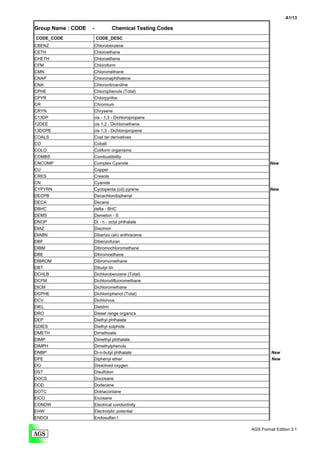
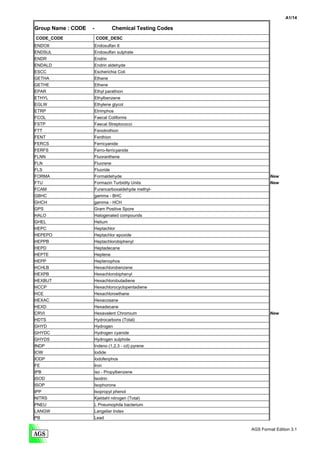
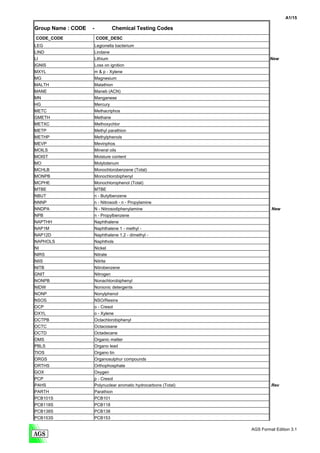
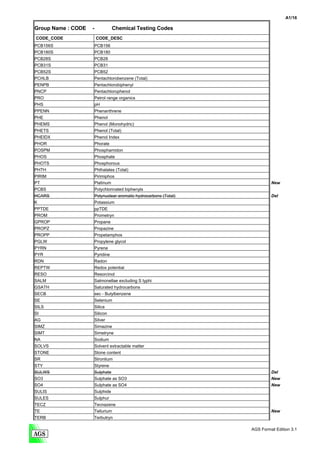
Every data file that contains a **CNMT or **?ICCT GROUP for chemical test results must also contain a **CODE
GROUP that defines the codes used for each determinand given in the CNMT_TYPE field of the **CNMT or
**?ICCT GROUP. This applies to standard codes selected from the ‘pick’ lists in Appendix 1 and user defined
codes.


10.2 Notes on the Rules

The following notes explain some points of detail in the Rules.

Note 1
ASCII 'CSV' Files

The Rules define ASCII data files of a type commonly referred to as CSV (Comma Separated Value). This type of
file is produced and read by some spreadsheet (and other) systems. The data items are separated by commas
and are surrounded by quotes (").

Note 2
Numeric and Character Data - Delimiters

The Rules permit any Data Field to contain text, since this allows characters in numeric fields and caters for those
countries which use the comma in place of the decimal point. For these reasons ALL Data Fields must be
surrounded by quotes.

Note that most spreadsheet and database systems provide a VALUE( ) function (or similar) to convert text data to
numeric data. This function can be used where calculations need to be carried out on data imported from AGS
files.

Note 3
Key and Common Fields

The Data Fields defined by the Format fall into one of two categories:

KEY Fields must be included every time a Data Group appears in a data file.
COMMON Fields are all other fields.

KEY Fields are important for maintaining data integrity. Without this the receiving software may not be able to use
the data in a meaningful way.

For the purpose of creating AGS files this means that data entered into KEY Fields must be unique in each
GROUP and that the corresponding entries are made in the PARENT GROUP. See GROUP HIERARCHY
TABLE (Section 10.3).


                                                                                                AGS Format Edition 3.1
8
Note 4
Continuation Lines

It should be noted that some spreadsheets impose a finite limit (e.g. 240) on the number of characters within a
single Data Field. The Rules define a scheme for producing continuation lines where there are long Data Fields.
Although the scheme may seem complex at first sight, it is the system automatically produced by spreadsheets if
the long data items are continued on additional rows IN THE SAME DATA COLUMN. Similarly, these Data Files
will read into spreadsheets and preserve the long data items in their correct column order, for any length of data.
The special <CONT> symbol must appear in the HOLE_ID Field, and thus <CONT> should never be used as a
HOLE_ID.

Note 5
Units

Note that a UNITS line must be included in every GROUP (except ABBR, CODE, DICT and UNIT) even where
the default units are used.

Details of the default units to be used for each of the Data Fields are given in the Data Groups below. These are
the preferred units for each of the data dictionary definitions and should be used wherever possible. They will
either be the appropriate SI units or the unit defined by the particular British Standard relating to that specific item
of data. It is recognised that situations will occur where neither the SI unit nor the British Standard unit are being
used. All entries in the <UNITS> line must be defined in the **UNIT GROUP.


10.3 Group Hierarchy

The AGS Format Data Groups are organised in a hierarchy with an inverted tree like structure. At the top of the
tree is the HOLE Group, and all other Groups lie below this. One of the Groups immediately below HOLE is
SAMP, all the laboratory testing Groups lie below SAMP. HOLE is termed the "parent" Group of SAMP. Each
Group has only one parent, but there can be many Groups below each parent. Each Group is linked to its parent
(the Group above it in the hierarchy) by Key Fields. Equally, each Group is linked to the Group(s) below it by Key
Fields. For this structure to work, and the link to be made correctly between related Groups, the data in the Key
Fields must be consistent and unique. If a Data Group is included in an AGS submission, its parent Group must
also be included, and this applies all the way up to the top of the tree. Therefore the HOLE Group must always be
present and if there is any laboratory testing the SAMP Group must be present.

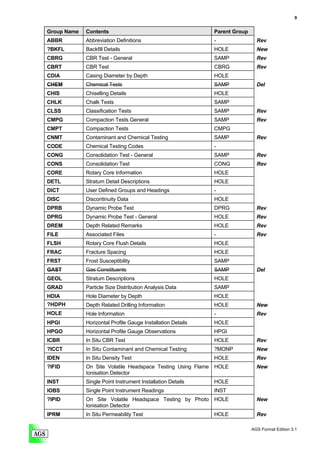
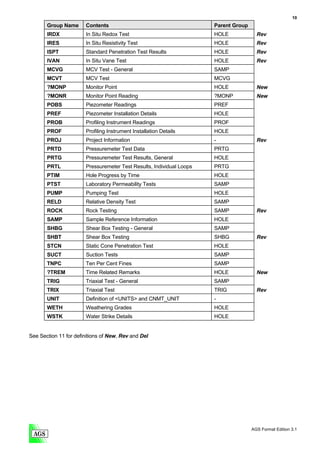
The following table defines the Group hierarchy by indicating the parent for each Group. The Key Fields that
create the link between these Groups are indicated in the Data Dictionary below.

There are six Groups that are not part of this hierarchy. The PROJ, ABBR, CODE, DICT, FILE and UNIT Groups
sit above the tree, and each have a general purpose. The PROJ, ABBR and UNIT Groups must always be
included in an AGS Format submission as they define the project, the abbreviations and the units used within the
Groups. The CODE Group must be included if the CNMT Group is used for chemical test results, as the CODE
Group defines the determinand codes used within CNMT. The DICT Group must be included if any user defined
Groups or Fields are present. The FILE Group must be included if any associated files (non-AGS format files) are
included in the submission.


                                                                                                   AGS Format Edition 3.1
9


Group Name   Contents                                        Parent Group
ABBR         Abbreviation Definitions                        -                Rev
?BKFL        Backfill Details                                HOLE             New
CBRG         CBR Test - General                              SAMP             Rev
CBRT         CBR Test                                        CBRG             Rev
CDIA         Casing Diameter by Depth                        HOLE
CHEM         Chemical Tests                                  SAMP             Del
CHIS         Chiselling Details                              HOLE
CHLK         Chalk Tests                                     SAMP
CLSS         Classification Tests                            SAMP             Rev
CMPG         Compaction Tests General                        SAMP             Rev
CMPT         Compaction Tests                                CMPG
CNMT         Contaminant and Chemical Testing                SAMP             Rev
CODE         Chemical Testing Codes                          -
CONG         Consolidation Test - General                    SAMP             Rev
CONS         Consolidation Test                              CONG             Rev
CORE         Rotary Core Information                         HOLE
DETL         Stratum Detail Descriptions                     HOLE
DICT         User Defined Groups and Headings                -
DISC         Discontinuity Data                              HOLE
DPRB         Dynamic Probe Test                              DPRG             Rev
DPRG         Dynamic Probe Test - General                    HOLE             Rev
DREM         Depth Related Remarks                           HOLE             Rev
FILE         Associated Files                                -                Rev
FLSH         Rotary Core Flush Details                       HOLE
FRAC         Fracture Spacing                                HOLE
FRST         Frost Susceptibility                            SAMP
GAST         Gas Constituents                                SAMP             Del
GEOL         Stratum Descriptions                            HOLE
GRAD         Particle Size Distribution Analysis Data        SAMP
HDIA         Hole Diameter by Depth                          HOLE
?HDPH        Depth Related Drilling Information              HOLE             New
HOLE         Hole Information                                -                Rev
HPGI         Horizontal Profile Gauge Installation Details   HOLE
HPGO         Horizontal Profile Gauge Observations           HPGI
ICBR         In Situ CBR Test                                HOLE             Rev
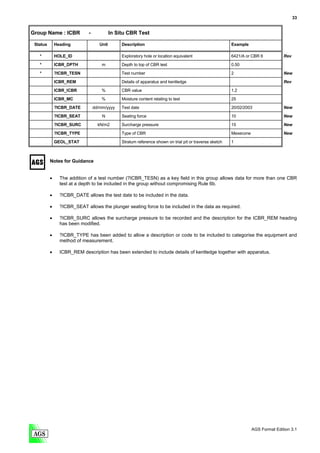
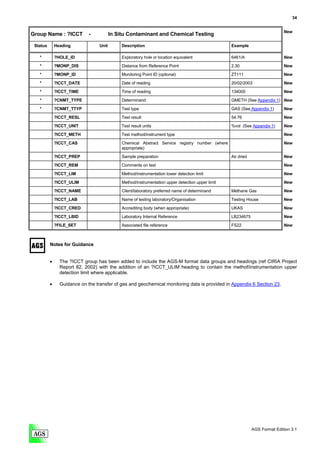
?ICCT        In Situ Contaminant and Chemical Testing        ?MONP            New
IDEN         In Situ Density Test                            HOLE             Rev
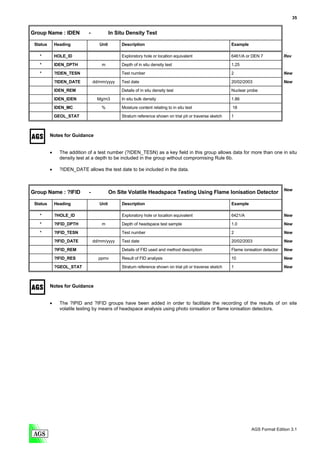
?IFID        On Site Volatile Headspace Testing Using Flame HOLE              New
             Ionisation Detector
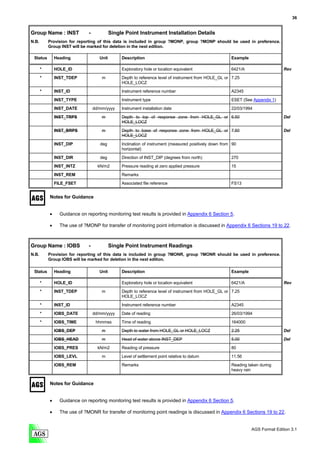
INST         Single Point Instrument Installation Details    HOLE
IOBS         Single Point Instrument Readings                INST
?IPID        On Site Volatile Headspace Testing by Photo HOLE                 New
             Ionisation Detector
IPRM         In Situ Permeability Test                       HOLE             Rev

                                                                            AGS Format Edition 3.1
10
       Group Name      Contents                                       Parent Group
       IRDX            In Situ Redox Test                             HOLE             Rev
       IRES            In Situ Resistivity Test                       HOLE             Rev
       ISPT            Standard Penetration Test Results              HOLE             Rev
       IVAN            In Situ Vane Test                              HOLE             Rev
       MCVG            MCV Test - General                             SAMP
       MCVT            MCV Test                                       MCVG
       ?MONP           Monitor Point                                  HOLE             New
       ?MONR           Monitor Point Reading                          ?MONP            New
       POBS            Piezometer Readings                            PREF
       PREF            Piezometer Installation Details                HOLE
       PROB            Profiling Instrument Readings                  PROF
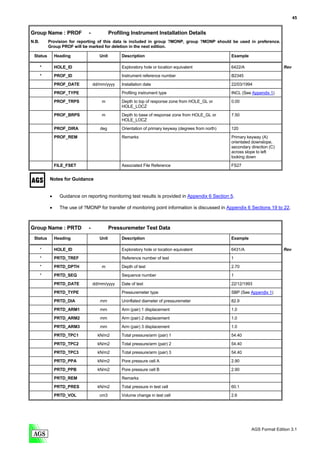
       PROF            Profiling Instrument Installation Details      HOLE
       PROJ            Project Information                            -                Rev
       PRTD            Pressuremeter Test Data                        PRTG
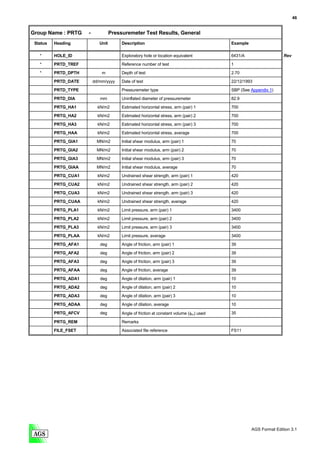
       PRTG            Pressuremeter Test Results, General            HOLE
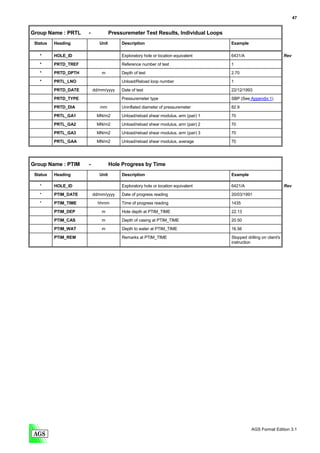
       PRTL            Pressuremeter Test Results, Individual Loops   PRTG
       PTIM            Hole Progress by Time                          HOLE
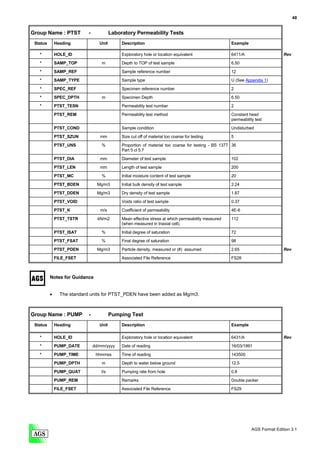
       PTST            Laboratory Permeability Tests                  SAMP
       PUMP            Pumping Test                                   HOLE
       RELD            Relative Density Test                          SAMP
       ROCK            Rock Testing                                   SAMP             Rev
       SAMP            Sample Reference Information                   HOLE
       SHBG            Shear Box Testing - General                    SAMP
       SHBT            Shear Box Testing                              SHBG             Rev
       STCN            Static Cone Penetration Test                   HOLE
       SUCT            Suction Tests                                  SAMP
       TNPC            Ten Per Cent Fines                             SAMP
       ?TREM           Time Related Remarks                           HOLE             New
       TRIG            Triaxial Test - General                        SAMP
       TRIX            Triaxial Test                                  TRIG             Rev
       UNIT            Definition of <UNITS> and CNMT_UNIT            -
       WETH            Weathering Grades                              HOLE
       WSTK            Water Strike Details                           HOLE


See Section 11 for definitions of New, Rev and Del


                                                                                     AGS Format Edition 3.1
11
11      DATA DICTIONARY

11.1    Data Sets

This Section defines the data dictionary entries for the Data Groups with their associated Key and Common Data
Fields.

The status of the individual Data Fields is shown by

        Status           Symbol
        KEY              *
        COMMON

11.2    Units of Measurement

The units of measurement shall be those given in the UNITS line. The preferred units are defined. The unit of
measurement shall not be included in the ASCII Data Field.

11.3    Examples

Typical examples are given against most of the Data Fields to indicate the type of information which may be
expected. They are not intended to be representative of any one soil or rock and hence may not be mutually
compatible.

11.4    Notes

See Appendix 1 for a list of the standard abbreviations to be used in the indicated fields. Other abbreviations may
be defined as required, see Rules 20 and 25.

11.5    Key to Change Control Used

New     New Field or Group in Edition 3.1
Rev     Revised from Edition 3
Del     Field or Group maintained for backward compatibility. Its use should be discontinued. It will be deleted in
        the next edition of the AGS Format, as the data is contained in other Groups.


                                                                                               AGS Format Edition 3.1
12


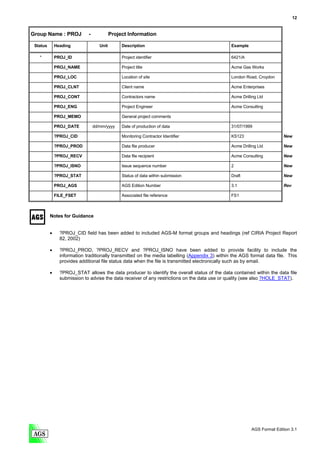
Group Name : PROJ            -             Project Information

 Status       Heading               Unit        Description                                     Example

   *          PROJ_ID                           Project identifier                              6421/A

              PROJ_NAME                         Project title                                   Acme Gas Works

              PROJ_LOC                          Location of site                                London Road, Croydon

              PROJ_CLNT                         Client name                                     Acme Enterprises

              PROJ_CONT                         Contractors name                                Acme Drilling Ltd

              PROJ_ENG                          Project Engineer                                Acme Consulting

              PROJ_MEMO                         General project comments

              PROJ_DATE          dd/mm/yyyy     Date of production of data                      31/07/1999

              ?PROJ_CID                         Monitoring Contractor Identifier                KS123                    New

              ?PROJ_PROD                        Data file producer                              Acme Drilling Ltd        New

              ?PROJ_RECV                        Data file recipient                             Acme Consulting          New

              ?PROJ_ISNO                        Issue sequence number                           2                        New

              ?PROJ_STAT                        Status of data within submission                Draft                    New

              PROJ_AGS                          AGS Edition Number                              3.1                      Rev

              FILE_FSET                         Associated file reference                       FS1


          Notes for Guidance


          •     ?PROJ_CID field has been added to included AGS-M format groups and headings (ref CIRIA Project Report
                82, 2002)

          •     ?PROJ_PROD, ?PROJ_RECV and ?PROJ_ISNO have been added to provide facility to include the
                information traditionally transmitted on the media labelling (Appendix 3) within the AGS format data file. This
                provides additional file status data when the file is transmitted electronically such as by email.

          •     ?PROJ_STAT allows the data producer to identify the overall status of the data contained within the data file
                submission to advise the data receiver of any restrictions on the data use or quality (see also ?HOLE_STAT).


                                                                                                          AGS Format Edition 3.1
13


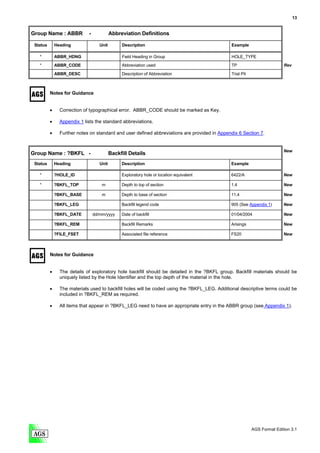
Group Name : ABBR            -             Abbreviation Definitions

 Status       Heading               Unit        Description                                   Example

   *          ABBR_HDNG                         Field Heading in Group                        HOLE_TYPE
   *          ABBR_CODE                         Abbreviation used                             TP                         Rev

              ABBR_DESC                         Description of Abbreviation                   Trial Pit


          Notes for Guidance


          •     Correction of typographical error. ABBR_CODE should be marked as Key.

          •     Appendix 1 lists the standard abbreviations.

          •     Further notes on standard and user defined abbreviations are provided in Appendix 6 Section 7.


                                                                                                                         New
Group Name : ?BKFL -                       Backfill Details
 Status       Heading               Unit        Description                                   Example

   *          ?HOLE_ID                          Exploratory hole or location equivalent       6422/A                     New

   *          ?BKFL_TOP              m          Depth to top of section                       1.4                        New

              ?BKFL_BASE             m          Depth to base of section                      11.4                       New

              ?BKFL_LEG                         Backfill legend code                          905 (See Appendix 1)       New

              ?BKFL_DATE         dd/mm/yyyy     Date of backfill                              01/04/2004                 New

              ?BKFL_REM                         Backfill Remarks                              Arisings                   New

              ?FILE_FSET                        Associated file reference                     FS20                       New


          Notes for Guidance


          •     The details of exploratory hole backfill should be detailed in the ?BKFL group. Backfill materials should be
                uniquely listed by the Hole Identifier and the top depth of the material in the hole.

          •     The materials used to backfill holes will be coded using the ?BKFL_LEG. Additional descriptive terms could be
                included in ?BKFL_REM as required.

          •     All items that appear in ?BKFL_LEG need to have an appropriate entry in the ABBR group (see Appendix 1).


                                                                                                          AGS Format Edition 3.1
14


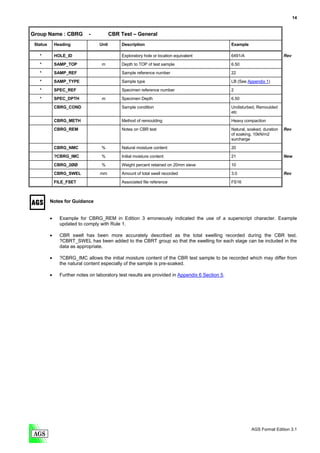
Group Name : CBRG            -           CBR Test – General
 Status       Heading             Unit       Description                                         Example

   *          HOLE_ID                        Exploratory hole or location equivalent             6491/A                      Rev

   *          SAMP_TOP              m        Depth to TOP of test sample                         6.50
   *          SAMP_REF                       Sample reference number                             22

   *          SAMP_TYPE                      Sample type                                         LB (See Appendix 1)
   *          SPEC_REF                       Specimen reference number                           2

   *          SPEC_DPTH             m        Specimen Depth                                      6.50
              CBRG_COND                      Sample condition                                    Undisturbed, Remoulded
                                                                                                 etc

              CBRG_METH                      Method of remoulding                                Heavy compaction
              CBRG_REM                       Notes on CBR test                                   Natural, soaked, duration   Rev
                                                                                                 of soaking, 10kN/m2
                                                                                                 surcharge

              CBRG_NMC             %         Natural moisture content                            20

              ?CBRG_IMC            %         Initial moisture content                            21                          New

              CBRG_2ØØ             %         Weight percent retained on 20mm sieve               10
              CBRG_SWEL            mm        Amount of total swell recorded                      3.0                         Rev
              FILE_FSET                      Associated file reference                           FS16


          Notes for Guidance


          •     Example for CBRG_REM in Edition 3 erroneously indicated the use of a superscript character. Example
                updated to comply with Rule 1.

          •     CBR swell has been more accurately described as the total swelling recorded during the CBR test.
                ?CBRT_SWEL has been added to the CBRT group so that the swelling for each stage can be included in the
                data as appropriate.

          •     ?CBRG_IMC allows the initial moisture content of the CBR test sample to be recorded which may differ from
                the natural content especially of the sample is pre-soaked.

          •     Further notes on laboratory test results are provided in Appendix 6 Section 5.


                                                                                                           AGS Format Edition 3.1
15


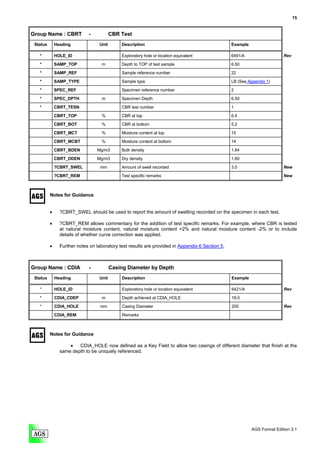
Group Name : CBRT            -           CBR Test
 Status       Heading             Unit       Description                                         Example

   *          HOLE_ID                        Exploratory hole or location equivalent             6491/A                   Rev

   *          SAMP_TOP              m        Depth to TOP of test sample                         6.50
   *          SAMP_REF                       Sample reference number                             22

   *          SAMP_TYPE                      Sample type                                         LB (See Appendix 1)
   *          SPEC_REF                       Specimen reference number                           2

   *          SPEC_DPTH             m        Specimen Depth                                      6.50
   *          CBRT_TESN                      CBR test number                                     1

              CBRT_TOP             %         CBR at top                                          6.4
              CBRT_BOT             %         CBR at bottom                                       5.2

              CBRT_MCT             %         Moisture content at top                             15
              CBRT_MCBT            %         Moisture content at bottom                          14

              CBRT_BDEN          Mg/m3       Bulk density                                        1.84
              CBRT_DDEN          Mg/m3       Dry density                                         1.60
              ?CBRT_SWEL           mm        Amount of swell recorded                            3.0                      New

              ?CBRT_REM                      Test specific remarks                                                        New


          Notes for Guidance


          •     ?CBRT_SWEL should be used to report the amount of swelling recorded on the specimen in each test.

          •     ?CBRT_REM allows commentary for the addition of test specific remarks. For example, where CBR is tested
                at natural moisture content, natural moisture content +2% and natural moisture content -2% or to include
                details of whether curve correction was applied.

          •     Further notes on laboratory test results are provided in Appendix 6 Section 5.


Group Name : CDIA            -           Casing Diameter by Depth
 Status       Heading             Unit       Description                                         Example

   *          HOLE_ID                        Exploratory hole or location equivalent             6421/A                   Rev
   *          CDIA_CDEP            m         Depth achieved at CDIA_HOLE                         18.0

   *          CDIA_HOLE            mm        Casing Diameter                                     200                      Rev

              CDIA_REM                       Remarks


          Notes for Guidance

                    •   CDIA_HOLE now defined as a Key Field to allow two casings of different diameter that finish at the
                same depth to be uniquely referenced.


                                                                                                           AGS Format Edition 3.1
16


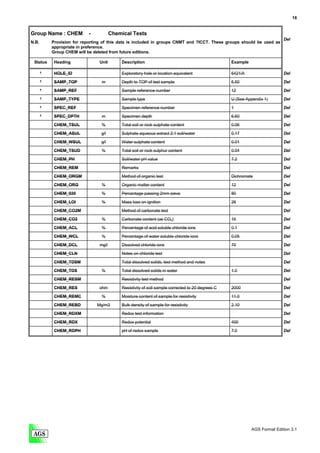
Group Name : CHEM           -           Chemical Tests
                                                                                                                            Del
N.B.       Provision for reporting of this data is included in groups CNMT and ?ICCT. These groups should be used as
           appropriate in preference.
           Group CHEM will be deleted from future editions.

 Status     Heading              Unit       Description                                            Example

       *    HOLE_ID                         Exploratory hole or location equivalent                6421/A                   Del

       *    SAMP_TOP              m         Depth to TOP of test sample                            6.50                     Del

       *    SAMP_REF                        Sample reference number                                12                       Del

       *    SAMP_TYPE                       Sample type                                            U (See Appendix 1)       Del
       *    SPEC_REF                        Specimen reference number                              1                        Del

       *    SPEC_DPTH             m         Specimen depth                                         6.60                     Del
            CHEM_TSUL             %         Total soil or rock sulphate content                    0.06                     Del

            CHEM_ASUL            g/l        Sulphate aqueous extract 2:1 soil/water                0.17                     Del
            CHEM_WSUL            g/l        Water sulphate content                                 0.01                     Del

            CHEM_TSUD             %         Total soil or rock sulphur content                     0.04                     Del
            CHEM_PH                         Soil/water pH value                                    7.2                      Del
            CHEM_REM                        Remarks                                                                         Del

            CHEM_ORGM                       Method of organic test                                 Dichromate               Del
            CHEM_ORG              %         Organic matter content                                 12                       Del

            CHEM_020              %         Percentage passing 2mm sieve                           80                       Del
            CHEM_LOI              %         Mass loss on ignition                                  26                       Del

            CHEM_CO2M                       Method of carbonate test                                                        Del
            CHEM_CO2              %         Carbonate content (as CO2)                             15                       Del
            CHEM_ACL              %         Percentage of acid soluble chloride ions               0.1                      Del
            CHEM_WCL              %         Percentage of water soluble chloride ions              0.05                     Del

            CHEM_DCL             mg/l       Dissolved chloride ions                                70                       Del
            CHEM_CLN                        Notes on chloride test                                                          Del

            CHEM_TDSM                       Total dissolved solids, test method and notes                                   Del
            CHEM_TDS              %         Total dissolved solids in water                        1.0                      Del
            CHEM_RESM                       Resistivity test method                                                         Del
            CHEM_RES            ohm         Resistivity of soil sample corrected to 20 degrees C   2000                     Del
            CHEM_REMC             %         Moisture content of sample for resistivity             11.0                     Del

            CHEM_REBD           Mg/m3       Bulk density of sample for resistivity                 2.10                     Del
            CHEM_RDXM                       Redox test information                                                          Del

            CHEM_RDX                        Redox potential                                        400                      Del

            CHEM_RDPH                       pH of redox sample                                     7.0                      Del


                                                                                                             AGS Format Edition 3.1
17


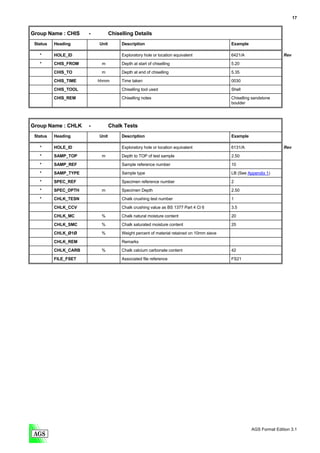
Group Name : CHIS     -          Chiselling Details
 Status   Heading         Unit        Description                                         Example

   *      HOLE_ID                     Exploratory hole or location equivalent             6421/A                   Rev
   *      CHIS_FROM        m          Depth at start of chiselling                        5.20

          CHIS_TO          m          Depth at end of chiselling                          5.35

          CHIS_TIME       hhmm        Time taken                                          0030

          CHIS_TOOL                   Chiselling tool used                                Shell
          CHIS_REM                    Chiselling notes                                    Chiselling sandstone
                                                                                          boulder


Group Name : CHLK     -          Chalk Tests
 Status   Heading         Unit        Description                                         Example

   *      HOLE_ID                     Exploratory hole or location equivalent             6131/A                   Rev
   *      SAMP_TOP         m          Depth to TOP of test sample                         2.50

   *      SAMP_REF                    Sample reference number                             10
   *      SAMP_TYPE                   Sample type                                         LB (See Appendix 1)

   *      SPEC_REF                    Specimen reference number                           2

   *      SPEC_DPTH        m          Specimen Depth                                      2.50
   *      CHLK_TESN                   Chalk crushing test number                          1

          CHLK_CCV                    Chalk crushing value as BS 1377 Part 4 Cl 6         3.5
          CHLK_MC          %          Chalk natural moisture content                      20
          CHLK_SMC         %          Chalk saturated moisture content                    25
          CHLK_Ø1Ø         %          Weight percent of material retained on 10mm sieve

          CHLK_REM                    Remarks
          CHLK_CARB        %          Chalk calcium carbonate content                     42

          FILE_FSET                   Associated file reference                           FS21


                                                                                                    AGS Format Edition 3.1
18


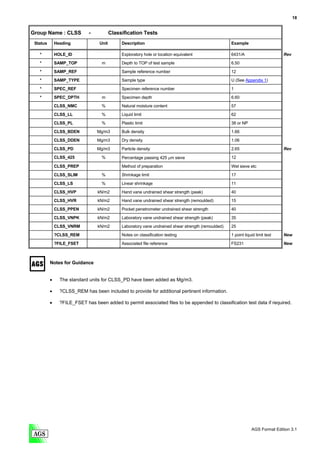
Group Name : CLSS            -           Classification Tests
 Status       Heading             Unit        Description                                            Example

   *          HOLE_ID                         Exploratory hole or location equivalent                6431/A                      Rev

   *          SAMP_TOP             m          Depth to TOP of test sample                            6.50
   *          SAMP_REF                        Sample reference number                                12

   *          SAMP_TYPE                       Sample type                                            U (See Appendix 1)
   *          SPEC_REF                        Specimen reference number                              1

   *          SPEC_DPTH            m          Specimen depth                                         6.60
              CLSS_NMC             %          Natural moisture content                               57

              CLSS_LL              %          Liquid limit                                           62
              CLSS_PL              %          Plastic limit                                          38 or NP
              CLSS_BDEN          Mg/m3        Bulk density                                           1.66

              CLSS_DDEN          Mg/m3        Dry density                                            1.06

              CLSS_PD            Mg/m3        Particle density                                       2.65                        Rev
              CLSS_425             %          Percentage passing 425 μm sieve                        12

              CLSS_PREP                       Method of preparation                                  Wet sieve etc

              CLSS_SLIM            %          Shrinkage limit                                        17

              CLSS_LS              %          Linear shrinkage                                       11

              CLSS_HVP           kN/m2        Hand vane undrained shear strength (peak)              40
              CLSS_HVR           kN/m2        Hand vane undrained shear strength (remoulded)         15
              CLSS_PPEN          kN/m2        Pocket penetrometer undrained shear strength           40
              CLSS_VNPK          kN/m2        Laboratory vane undrained shear strength (peak)        35

              CLSS_VNRM          kN/m2        Laboratory vane undrained shear strength (remoulded)   25
              ?CLSS_REM                       Notes on classification testing                        1 point liquid limit test   New

              ?FILE_FSET                      Associated file reference                              FS231                       New


          Notes for Guidance


          •     The standard units for CLSS_PD have been added as Mg/m3.

          •     ?CLSS_REM has been included to provide for additional pertinent information.

          •     ?FILE_FSET has been added to permit associated files to be appended to classification test data if required.


                                                                                                                 AGS Format Edition 3.1
19


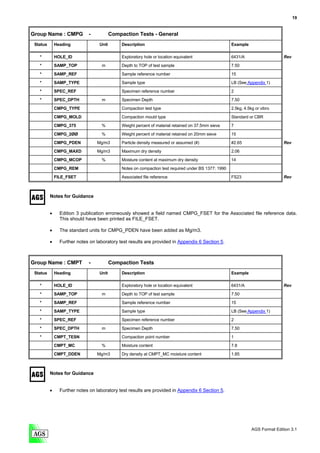
Group Name : CMPG            -           Compaction Tests - General
 Status       Heading             Unit        Description                                             Example

   *          HOLE_ID                         Exploratory hole or location equivalent                 6431/A                    Rev

   *          SAMP_TOP              m         Depth to TOP of test sample                             7.50

   *          SAMP_REF                        Sample reference number                                 15
   *          SAMP_TYPE                       Sample type                                             LB (See Appendix 1)

   *          SPEC_REF                        Specimen reference number                               2
   *          SPEC_DPTH             m         Specimen Depth                                          7.50

              CMPG_TYPE                       Compaction test type                                    2.5kg, 4.5kg or vibro
              CMPG_MOLD                       Compaction mould type                                   Standard or CBR

              CMPG_375             %          Weight percent of material retained on 37.5mm sieve     7
              CMPG_2ØØ             %          Weight percent of material retained on 20mm sieve       15

              CMPG_PDEN          Mg/m3        Particle density measured or assumed (#)                #2.65                     Rev
              CMPG_MAXD          Mg/m3        Maximum dry density                                     2.06
              CMPG_MCOP            %          Moisture content at maximum dry density                 14

              CMPG_REM                        Notes on compaction test required under BS 1377: 1990

              FILE_FSET                       Associated file reference                               FS23                      Rev


          Notes for Guidance


          •     Edition 3 publication erroneously showed a field named CMPG_FSET for the Associated file reference data.
                This should have been printed as FILE_FSET.

          •     The standard units for CMPG_PDEN have been added as Mg/m3.

          •     Further notes on laboratory test results are provided in Appendix 6 Section 5.


Group Name : CMPT            -           Compaction Tests
 Status       Heading             Unit        Description                                             Example

   *          HOLE_ID                         Exploratory hole or location equivalent                 6431/A                    Rev
   *          SAMP_TOP              m         Depth to TOP of test sample                             7.50
   *          SAMP_REF                        Sample reference number                                 15

   *          SAMP_TYPE                       Sample type                                             LB (See Appendix 1)

   *          SPEC_REF                        Specimen reference number                               2
   *          SPEC_DPTH             m         Specimen Depth                                          7.50

   *          CMPT_TESN                       Compaction point number                                 1
              CMPT_MC              %          Moisture content                                        7.8

              CMPT_DDEN          Mg/m3        Dry density at CMPT_MC moisture content                 1.85


          Notes for Guidance


          •     Further notes on laboratory test results are provided in Appendix 6 Section 5.


                                                                                                                 AGS Format Edition 3.1
20

Group Name : CNMT            -           Contaminant and Chemical Testing
NB.       in situ measurement and monitoring of contamination and chemicals shoud be recorded in Group ?ICCT

 Status       Heading             Unit       Description                                        Example

      *       HOLE_ID                        Exploratory hole or location equivalent            6431/A                     Rev
      *       SAMP_TOP             m         Depth to TOP of test sample                        6.50

      *       SAMP_REF                       Sample reference number                            12
      *       SAMP_TYPE                      Sample type                                        ES (See Appendix 1)

      *       SPEC_REF                       Specimen reference number                          4
      *       SPEC_DPTH            m         Specimen depth                                     6.90

      *       CNMT_TYPE                      Determinand                                        CL (See Appendix 1)
      *       CNMT_TTYP                      Test type                                          SOLID_WAT
                                                                                                (See Appendix 1)

              CNMT_RESL                      Test result
              CNMT_UNIT                      Test result units                                  (See Appendix 1)
              CNMT_CAS                       Chemical Abstract Service registry number (where
                                             appropriate)

              CNMT_METH                      Test method
              CNMT_PREP                      Sample preparation                                 Air dried

              CNMT_REM                       Comments on test
              CNMT_LIM                       Method lower detection limit                                                  Rev

              ?CNMT_ULIM                     Method upper detection limit                                                  New
              CNMT_NAME                      Client/laboratory preferred name of determinand    Dry weight Chloride

              CNMT_LAB                       Name of testing laboratory/Organisation            Chemical Test House
              CNMT_CRED                      Accrediting body (When appropriate)                UKAS

              ?CNMT_LBID                     Laboratory Internal Reference                      LB234675                   New
              FILE_FSET                      Associated file reference                          FS22


          Notes for Guidance


          •     Additional CNMT_TYPE codes have been added to those listed in Appendix 1 to increase the range of
                standard determinands. Further codes will be necessary to include other less common determinands. These
                should be included in the CNMT_TYPE data and appended to the CODE group in any AGS data format files
                as required and posted to the website discussion board (http://www.ags.org.uk).

          •     To more completely define the detection limits of the test method the ?CNMT_ULIM heading has been added
                to contain the upper detection limit where applicable and the existing CNMT_LIM field has been redefined to
                be the lower detection limit.

          •     ?CNMT_LBID can be used by the laboratory testing house to include their sample/test reference.

          •     Units included under the CNMT_UNIT heading should be fully defined in the UNIT group (Appendix 6
                Section 6).

          •     More details on reporting chemical testing are provided in Appendix 6 Section 15.


                                                                                                            AGS Format Edition 3.1
21


Group Name : CODE             -           Chemical Testing Codes
 Status       Heading              Unit        Description                                             Example

   *          CODE_CODE                        Code                                                    CL

              CODE_DESC                        Code Description                                        Chloride


Group Name : CONG             -           Consolidation Test - General
 Status       Heading              Unit        Description                                             Example

   *          HOLE_ID                          Exploratory hole or location equivalent                 6431/A                      Rev

   *          SAMP_TOP              m          Depth to TOP of test sample                             6.50
   *          SAMP_REF                         Sample reference number                                 12
   *          SAMP_TYPE                        Sample type                                             U (See Appendix 1)

   *          SPEC_REF                         Specimen reference number                               4

   *          SPEC_DPTH             m          Specimen depth                                          6.90
              CONG_TYPE                        Oedometer or Rowe, primary or secondary consolidation   Oed, Rowe

              CONG_COND                        Sample condition                                        Undisturbed, remoulded
                                                                                                       etc

              CONG_REM                         Test details including method statement                 Temperature 21 degrees Rev
                                                                                                       C, sample from base of
                                                                                                       U100 sample, axis vertical

              CONG_INCM           m2/MN        Coefficient of volume compressibility over CONG_INCD    0.36

              CONG_INCD           kN/m2        Defined stress range                                    100 to 200                  Rev
              CONG_DIA             mm          Test specimen diameter                                  75
              CONG_HIGT            mm          Test specimen height                                    19
              CONG_MCI              %          Initial moisture content                                21

              CONG_MCF              %          Final moisture content                                  18
              CONG_BDEN           Mg/m3        Initial bulk density                                    2.12

              CONG_DDEN           Mg/m3        Initial dry density                                     1.75
              CONG_PDEN           Mg/m3        Particle density (BS 1377) with # if assumed            #2.65                       Rev
              CONG_SATR             %          Initial degree of saturation                            98
              CONG_SPRS           kN/m2        Swelling pressure                                       100
              CONG_SATH             %          Height change of specimen on saturation as percentage +1.1
                                               of original height

              FILE_FSET                        Associated file reference                               FS9

              ?CONG_IVR                        Initial voids ratio                                     0.80                        New


          Notes for Guidance


          •     ?CONG_IVR should be used to report the initial voids ratio at the start of testing.

          •     The standard units for CONG _PDEN have been added as Mg/m3 and the example for CONG_INCD modified.

          •     Further notes on laboratory test results are provided in Appendix 6 Section 5.


                                                                                                                    AGS Format Edition 3.1
22


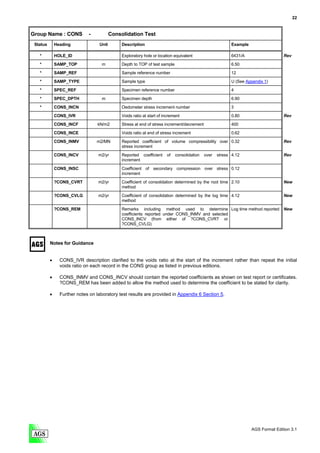
Group Name : CONS            -           Consolidation Test
 Status       Heading             Unit        Description                                                 Example

   *          HOLE_ID                         Exploratory hole or location equivalent                     6431/A                   Rev

   *          SAMP_TOP              m         Depth to TOP of test sample                                 6.50
   *          SAMP_REF                        Sample reference number                                     12

   *          SAMP_TYPE                       Sample type                                                 U (See Appendix 1)
   *          SPEC_REF                        Specimen reference number                                   4

   *          SPEC_DPTH             m         Specimen depth                                              6.90
   *          CONS_INCN                       Oedometer stress increment number                           3

              CONS_IVR                        Voids ratio at start of increment                           0.80                     Rev
              CONS_INCF          kN/m2        Stress at end of stress increment/decrement                 400

              CONS_INCE                       Voids ratio at end of stress increment                      0.62
              CONS_INMV          m2/MN        Reported coefficient of volume compressibility over 0.32                             Rev
                                              stress increment

              CONS_INCV           m2/yr       Reported coefficient     of   consolidation   over   stress 4.12                     Rev
                                              increment

              CONS_INSC                       Coefficient of secondary compression over stress 0.12
                                              increment
              ?CONS_CVRT          m2/yr       Coefficient of consolidation determined by the root time 2.10                        New
                                              method
              ?CONS_CVLG          m2/yr       Coefficient of consolidation determined by the log time 4.12                         New
                                              method

              ?CONS_REM                       Remarks including method used to determine Log time method reported                  New
                                              coefficients reported under CONS_INMV and selected
                                              CONS_INCV (from either of ?CONS_CVRT or
                                              ?CONS_CVLG)


          Notes for Guidance


          •     CONS_IVR description clarified to the voids ratio at the start of the increment rather than repeat the initial
                voids ratio on each record in the CONS group as listed in previous editions.

          •     CONS_INMV and CONS_INCV should contain the reported coefficients as shown on test report or certificates.
                ?CONS_REM has been added to allow the method used to determine the coefficient to be stated for clarity.

          •     Further notes on laboratory test results are provided in Appendix 6 Section 5.


                                                                                                                    AGS Format Edition 3.1
23


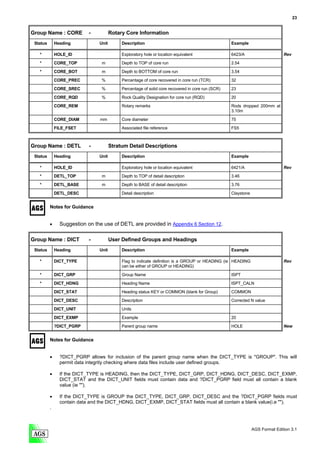
Group Name : CORE           -          Rotary Core Information
 Status       Heading           Unit        Description                                            Example

   *          HOLE_ID                       Exploratory hole or location equivalent                6423/A                     Rev

   *          CORE_TOP           m          Depth to TOP of core run                               2.54
   *          CORE_BOT           m          Depth to BOTTOM of core run                            3.54

              CORE_PREC          %          Percentage of core recovered in core run (TCR)         32
              CORE_SREC          %          Percentage of solid core recovered in core run (SCR)   23

              CORE_RQD           %          Rock Quality Designation for core run (RQD)            20
              CORE_REM                      Rotary remarks                                         Rods dropped 200mm at
                                                                                                   3.10m
              CORE_DIAM         mm          Core diameter                                          75
              FILE_FSET                     Associated file reference                              FS5


Group Name : DETL           -          Stratum Detail Descriptions
 Status       Heading           Unit        Description                                            Example

   *          HOLE_ID                       Exploratory hole or location equivalent                6421/A                     Rev
   *          DETL_TOP           m          Depth to TOP of detail description                     3.46

   *          DETL_BASE          m          Depth to BASE of detail description                    3.76

              DETL_DESC                     Detail description                                     Claystone


          Notes for Guidance


          •     Suggestion on the use of DETL are provided in Appendix 6 Section 12.

Group Name : DICT           -          User Defined Groups and Headings
 Status       Heading           Unit        Description                                            Example

   *          DICT_TYPE                     Flag to indicate definition is a GROUP or HEADING (ie HEADING                     Rev
                                            can be either of GROUP or HEADING)

   *          DICT_GRP                      Group Name                                             ISPT
   *          DICT_HDNG                     Heading Name                                           ISPT_CALN
              DICT_STAT                     Heading status KEY or COMMON (blank for Group)         COMMON

              DICT_DESC                     Description                                            Corrected N value

              DICT_UNIT                     Units

              DICT_EXMP                     Example                                                20
              ?DICT_PGRP                    Parent group name                                      HOLE                       New


          Notes for Guidance


          •     ?DICT_PGRP allows for inclusion of the parent group name when the DICT_TYPE is "GROUP". This will
                permit data integrity checking where data files include user defined groups.

          •     If the DICT_TYPE is HEADING, then the DICT_TYPE, DICT_GRP, DICT_HDNG, DICT_DESC, DICT_EXMP,
                DICT_STAT and the DICT_UNIT fields must contain data and ?DICT_PGRP field must all contain a blank
                value (ie "").

          •     If the DICT_TYPE is GROUP the DICT_TYPE, DICT_GRP, DICT_DESC and the ?DICT_PGRP fields must
                contain data and the DICT_HDNG, DICT_EXMP, DICT_STAT fields must all contain a blank value(i.e "").
          .


                                                                                                               AGS Format Edition 3.1
24

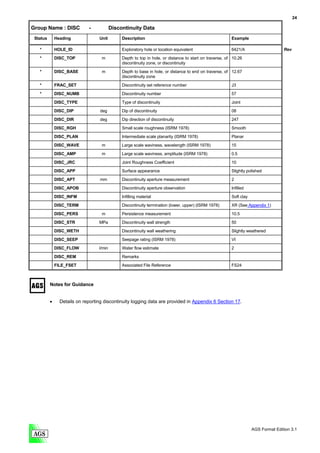
Group Name : DISC            -            Discontinuity Data
 Status       Heading             Unit         Description                                               Example

   *          HOLE_ID                          Exploratory hole or location equivalent                   6421/A                     Rev

   *          DISC_TOP             m           Depth to top in hole, or distance to start on traverse, of 10.26
                                               discontinuity zone, or discontinuity

   *          DISC_BASE            m           Depth to base in hole, or distance to end on traverse, of 12.67
                                               discontinuity zone

   *          FRAC_SET                         Discontinuity set reference number                        J3

   *          DISC_NUMB                        Discontinuity number                                      57

              DISC_TYPE                        Type of discontinuity                                     Joint
              DISC_DIP             deg         Dip of discontinuity                                      08

              DISC_DIR             deg         Dip direction of discontinuity                            247
              DISC_RGH                         Small scale roughness (ISRM 1978)                         Smooth

              DISC_PLAN                        Intermediate scale planarity (ISRM 1978)                  Planar
              DISC_WAVE            m           Large scale waviness, wavelength (ISRM 1978)              15

              DISC_AMP             m           Large scale waviness, amplitude (ISRM 1978)               0.5
              DISC_JRC                         Joint Roughness Coefficient                               10
              DISC_APP                         Surface appearance                                        Slightly polished

              DISC_APT             mm          Discontinuity aperture measurement                        2
              DISC_APOB                        Discontinuity aperture observation                        Infilled

              DISC_INFM                        Infilling material                                        Soft clay
              DISC_TERM                        Discontinuity termination (lower, upper) (ISRM 1978)      XR (See Appendix 1)

              DISC_PERS            m           Persistence measurement                                   10.5
              DISC_STR            MPa          Discontinuity wall strength                               50
              DISC_WETH                        Discontinuity wall weathering                             Slightly weathered
              DISC_SEEP                        Seepage rating (ISRM 1978)                                VI

              DISC_FLOW           l/min        Water flow estimate                                       2
              DISC_REM                         Remarks
              FILE_FSET                        Associated File Reference                                 FS24


          Notes for Guidance


          •     Details on reporting discontinuity logging data are provided in Appendix 6 Section 17.


                                                                                                                     AGS Format Edition 3.1
25


Group Name : DPRB            -           Dynamic Probe Test
NB.       The type of probe should be recorded in the Group DPRG

 Status       Heading             Unit       Description                                      Example

      *       HOLE_ID                        Exploratory hole or location equivalent          6451/A                      Rev

      *       DPRB_DPTH            m         Depth to start of dynamic probe increment        2.50

              DPRB_TYPE                      Dynamic probe type                               Macintosh

              DPRB_BLOW                      Dynamic probe blows for increment DPRB_INC       7
              DPRB_TORQ           Nm         Maximum torque required to rotate rods           75

              DPRB_DEL           hhmm        Duration of delay before increment started       0000                        Rev
              DPRB_INC            mm         Dynamic probe increment                          100

              DPRB_REM                       Notes on events during increment


          Notes for Guidance


          •     Edition 3 publication erroneously showed an incorrect example for DPRB_DEL.

          •     Guidance on including probe results in DPRG and DPRB groups is provided in Appendix 6 Section 5.


Group Name : DPRG            -           Dynamic Probe Test - General

 Status       Heading             Unit        Description                                     Example

      *       HOLE_ID                         Exploratory hole or location equivalent         6451/A                      Rev

              DPRG_TYPE                       Dynamic probe type                              DPH
              DPRG_TEST                       Test method                                     BS 1377 Part 9: 3.2
              DPRG_MASS            kg         Hammer mass                                     50
              DPRG_DROP           mm          Standard drop                                   500
              DPRG_CONE           mm          Cone base diameter                              43                          Rev
              DPRG_ROD            mm          Rod diameter                                    35

              DPRG_DAMP                       Type of anvil damper                            None
              DPRG_TIP             m          Depth of cone if left in ground                 8.00
              DPRG_REM                        General remarks                                 Hole     backfilled    on
                                                                                              completion

              ?DPRG_ANG           Deg         Cone angle                                      90                          New
              ?DPRG_RMSS          kg/m        Rod Mass                                        9                           New

              FILE_FSET                       Associated File Reference                       FS25


          Notes for Guidance


          •     Correction of typographical error. DPRG_CONE was incorrectly published as DRPG_CONE in Edition 3
                publication.

          •     The cone angle and rod mass (per unit length) have been included to provide additional test data for defining
                non-standard equipment such as the Macintosh Probe.

          •     Guidance on including probe results in DPRG and DPRB groups is provided in Appendix 6 Section 5.


                                                                                                          AGS Format Edition 3.1
26


Group Name : DREM            -             Depth Related Remarks

 Status       Heading               Unit        Description                                 Example

   *          HOLE_ID                           Exploratory hole or location equivalent     6421/A                   Rev

   *          DREM_DPTH              m          Depth of DREM_REM                           12.50
              ?DREM_BDEP             m          Base depth                                  13.80                    New

              DREM_REM                          Depth related remark                        Driving boulder ahead of Rev
                                                                                            casing


          Notes for Guidance


          •     ?DREM_BDEP can be used to include a base depth for remarks allowing the data provider to omit depths from
                DREM_REM heading (example updated to reflect this).

          •     Suggestions on the use of DREM are included in Appendix 6 Section 12.


Group Name : FILE            -             Associated Files

 Status       Heading               Unit        Description                                 Example

   *          FILE_FSET                         File set reference number                   FS128
   *          FILE_NAME                         File name                                   BH1COR08.JPG
              FILE_DESC                         Description of content                      BH1 Core photo box 8

              FILE_TYPE                         File type                                   JPG

              FILE_PROG                         Parent program and version number           Paintshop Pro v 5.0
              ?FILE_DOCT                        Document type                               PH (See Appendix 1)      New
              FILE_DATE          dd/mm/yyyy     File date                                   31/07/1999


          Notes for Guidance


          •     ?FILE_DOCT has been added to include the AGS-M format data groups and headings (ref CIRIA Project
                Report 82, 2002).

          •     Further details on including associated files in an AGS format data submission is provided in Appendix 6
                Section 9.


Group Name : FLSH           -              Rotary Core Flush Details
 Status       Heading               Unit        Description                                Example

   *          HOLE_ID                           Exploratory hole or location equivalent    6421/A                    Rev

   *          FLSH_FROM              m          Depth to top of flush zone                 10.00
   *          FLSH_TO                m          Depth to bottom of flush zone              20.00

              FLSH_TYPE                         Type of flush                              Water

              FLSH_RETN              %          Flush return                               50

              FLSH_COL                          Colour of flush return                     White


                                                                                                      AGS Format Edition 3.1
27


Group Name : FRAC     -          Fracture Spacing
Status    Heading         Unit        Description                                                Example

    *     HOLE_ID                     Exploratory hole or location equivalent                    6423/A                   Rev

    *     FRAC_TOP         m          Depth to top in hole, or distance to start on traverse, of 31.20
                                      the zone
    *     FRAC_BASE        m          Depth to base in hole, or distance to end on traverse, of 33.65
                                      the zone
    *     FRAC_SET                    Discontinuity set reference number                         J3
          FRAC_FI                     Fracture Index over zone (fractures per metre)             15

          FRAC_IMAX        mm         Maximum Fracture Spacing over zone                         350
          FRAC_IAVE        mm         Average Fracture Spacing over zone                         220

          FRAC_IMIN        mm         Minimum Fracture Spacing over zone                         NI
          FILE_FSET                   Associated file reference                                  FS4


Group Name : FRST     -          Frost Susceptibility
 Status   Heading         Unit        Description                                                Example

    *     HOLE_ID                     Exploratory hole or location equivalent                    6341/A                   Rev

    *     SAMP_TOP         m          Depth to TOP of test sample                                6.50
    *     SAMP_REF                    Sample reference number                                    11

    *     SAMP_TYPE                   Sample type                                                U (See Appendix 1)
    *     SPEC_REF                    Specimen reference number                                  2

    *     SPEC_DPTH        m          Specimen depth                                             6.50
          FRST_COND                   Sample condition                                           Undisturbed
          FRST_REM                    Notes on frost susceptibility testing as per TRRL SR 829
          FRST_DDEN       Mg/m3       Dry density                                                1.96

          FRST_MC          %          Moisture content                                           24
          FRST_HVE1        %          Frost heave, first specimen                                3.0

          FRST_HVE2        %          Frost heave, second specimen                               4.5

          FRST_HVE3        %          Frost heave, third specimen                                3.5
          FRST_HVE         %          Mean heave of 3 specimens                                  3.67

          FILE_FSET                   Associated file reference                                  FS20


                                                                                                           AGS Format Edition 3.1
28

                                                                                                                             Del
Group Name : GAST            -             Gas Constituents
N.B.       Provision for reporting of this data is included in groups CNMT and ?ICCT. These groups should be used as
           appropriate in preference.
           Group GAST will be deleted from future editions

 Status        Heading              Unit       Description                                        Example

       *    HOLE_ID                            Exploratory hole or location equivalent            6151/A                     Del
       *    SAMP_TOP                 m         Depth to TOP of test sample                        6.50                       Del

       *    SAMP_REF                           Sample reference number                            6                          Del

       *    SAMP_TYPE                          Sample type                                        G (See Appendix 1)         Del

       *    SPEC_REF                           Specimen reference number                          ii)                        Del
       *    SPEC_DPTH                m         Specimen Depth                                     8.50                       Del

       *    GAST_DATE            dd/mm/yyyy    Date of sampling                                   26/03/1991                 Del
       *    GAST_TIME             hhmmss       Time of sampling                                   092800                     Del

            GAST_REM                           Remarks                                                                       Del
            GAST_TEMP              DegC        Temperature of gas at time of sampling             8                          Del

            GAST_OX                % vol       Oxygen                                             0.16                       Del
            GAST_NIT               % vol       Nitrogen                                           2.4                        Del
            GAST_CARD              % vol       Carbon Dioxide                                     33.6                       Del

            GAST_METH              % vol       Methane                                            63.8                       Del
            GAST_HYDS              % vol       Hydrogen Sulphide                                  0.00002                    Del

            GAST_ETHA              % vol       Ethane                                             0.005                      Del
            GAST_PROP              % vol       Propane                                            0.002                      Del

            GAST_HYD               % vol       Hydrogen                                           0.05                       Del
            GAST_HEL               % vol       Helium                                             0.0000005                  Del
            GAST_HIGA              % vol       Higher Alkanes                                     0.1                        Del
            GAST_CARM              % vol       Carbon Monoxide                                    0.001                      Del

            GAST_ETHE              % vol       Ethene                                             0.018                      Del
            GAST_ACET              % vol       Acetaldehyde                                       0.005                      Del
            GAST_ISOB              % vol       Isobutane                                          0.002                      Del
            GAST_NBUT              % vol       n - butane                                         0.001                      Del

            GAST_SATH              % vol       Saturated Hydrocarbons other than Methane, Ethane, 0.005                      Del
                                               Propane, Butane

            GAST_UNSH              % vol       Unsaturated Hydrocarbons other than Ethene         0.009                      Del
            GAST_HALO              % vol       Halogenated Compounds                              0.00002                    Del
            GAST_ORGS              % vol       Organosulphur Compounds                            0.00001                    Del

            GAST_ALCO              % vol       Alcohols                                           0.00001                    Del

            GAST_HYDC              % vol       Hydrogen Cyanide                                   0.00001                    Del
            GAST_DIES              % vol       Diethyl Sulphide                                   0.0000005                  Del
            GAST_RAD               Bq/m3       Radon                                              200                        Del

            GAST_OTHR              % vol       Other Types                                        0.023                      Del

            GAST_OTH                           Definition of GAST_OTHR                                                       Del


                                                                                                              AGS Format Edition 3.1
29


Group Name : GEOL            -           Stratum Descriptions
 Status       Heading             Unit        Description                                               Example

      *       HOLE_ID                         Exploratory hole or location equivalent                   6421/A                    Rev

      *       GEOL_TOP             m          Depth to the TOP of stratum                               16.21
      *       GEOL_BASE            m          Depth to the BASE of description                          17.25

              GEOL_DESC                       General description of stratum                            Stiff grey silty CLAY
              GEOL_LEG                        Legend code                                               200 (See Rule 20 and Rev
                                                                                                        Appendix 1)

              GEOL_GEOL                       Geology code                                              LC (See Rule 20)
              GEOL_GEO2                       Second Geology code                                       SAND (See Rule 20)

              GEOL_STAT                       Stratum reference shown on trial pit or traverse sketch   1
              FILE_FSET                       Associated file reference                                 FS4


          Notes for Guidance


          •     Notes on defining geology codes GEOL_GEOL, GEOL_GEO2 and GEOL_STAT are included in Appendix 6
                Section 8.


Group Name : GRAD            -           Particle Size Distribution Analysis Data
 Status       Heading             Unit        Description                                               Example

      *       HOLE_ID                         Exploratory hole or location equivalent                   6431/A                    Rev

      *       SAMP_TOP             m          Depth to TOP of test sample                               6.50
      *       SAMP_REF                        Sample reference number                                   12

      *       SAMP_TYPE                       Sample type                                               U (See Appendix 1)
      *       SPEC_REF                        Specimen reference number                                 2
      *       SPEC_DPTH            m          Specimen Depth                                            6.60
      *       GRAD_SIZE           mm          Sieve or particle size                                    3.35

              GRAD_PERP            %          Percentage passing/finer                                  25
              GRAD_TYPE                       Grading analysis test type                                WS (See Appendix 1)


Group Name : HDIA            -           Hole Diameter by Depth
NB.       Casing information should be recorded in the CDIA group
 Status       Heading             Unit        Description                                               Example

      *       HOLE_ID                         Exploratory hole or location equivalent                   6421/A                    Rev

      *       HDIA_HDEP            m          Depth achieved at HDIA_HOLE                               18.0
              HDIA_HOLE           mm          Borehole diameter                                         200
              HDIA_CASG           mm          Casing diameter                                           200                       Del
                                              (included for backward compatibility only)
              HDIA_CDEP            m          Depth to which HDIA_CASG taken                            18.0                      Del
                                              (included for backward compatibility only)
              ?HDIA_REM                       Remarks                                                   Cased to full depth       New


          Notes for Guidance


          •     ?HDIA_REM has been added to allow additional data regarding hole construction to be included in the data file
                if required.


                                                                                                                   AGS Format Edition 3.1
30


                                                                                                                                    New
Group Name : ?HDPH -                     Depth Related Hole Information
 Status       Heading             Unit        Description                                                 Example                   New

   *          ?HOLE_ID                        Exploratory hole or location equivalent                     6422/A                    New

   *          ?HDPH_TOP            m          Depth to top of section                                     1.4                       New

              ?HDPH_BASE           m          Depth to base of section                                    3.4                       New

              ?HOLE_TYPE                      Type of exploratory Hole                                    TP (see Appendix 1)       New

              ?HDPH_STAR       dd/mm/yyyy     Date of start of section                                    01/04/2004                New

              ?HDPH_STAT          hhmm        Time of start of section                                    0930                      New

              ?HDPH_ENDD       dd/mm/yyyy     Date of end of section                                      01/04/2004                New

              ?HDPH_ENDT          hhmm        Time of end of section                                      1030                      New

              ?HDPT_CREW                      Name of Crew                                                Bill Mallard              New

              ?HDPH_LOG                       The definitive person responsible for logging the section   DPG                       New

              ?HDPH_EXC                       Plant Used                                                  JCB –3CX                  New

              ?HDPH_SHOR                      Shoring/support Used                                        None                      New

              ?HDPH_REM                       Remarks                                                     Breaker required          New

              ?FILE_FSET                      Associated reference                                        FS21                      New


          Notes for Guidance


          •     The ?HDPH group permits transmittal of more detailed information regarding exploratory hole construction.
                The HOLE group only allows one definition of hole type, excavation methods, dates and associated
                information. The ?HDPH group allows this data to be subdivided by depth such that the differing methods used
                to advance a hole or pit (or holes developed using combined methods) can each be explicitly detailed.

          •     The ?HDPH group should be used when an exploratory hole listed in the HOLE group contains more than one
                HOLE_TYPE.

          •     If this group is included in an AGS data set then it would be preferable to omit the overlapping fields from the
                HOLE group. However, for completeness the HOLE group must include an overall record for the HOLE
                including HOLE_TYPE, HOLE_FDEP, HOLE_STAR and HOLE_ENDD.


                                                                                                                     AGS Format Edition 3.1
31


                                                                                                                                            Rev
Group Name : HOLE             -            Hole Or Location Equivalent

 Status       Heading         Unit              Description                                                   Example

   *          HOLE_ID                           Exploratory hole or location equivalent                       327/16A                       Rev

              HOLE_TYPE                         Type of exploratory hole                                      CP (See Appendix 1)
              HOLE_NATE               m         National Grid Easting of hole or start of traverse            523145

              HOLE_NATN               m         National Grid Northing of hole or start of traverse           178456
              HOLE_GL                 m         Ground level relative to Datum of hole or start of traverse   16.23

              HOLE_FDEP               m         Final depth of hole                                           32.60
              HOLE_STAR           dd/mm/yyyy    Date of start of excavation                                   18/03/1991

              HOLE_LOG                          The definitive person responsible for logging the hole        DPG
              HOLE_REM                          General remarks on hole                                       Abandoned on engineer's
                                                                                                              instruction
              HOLE_ETRV               m         National Grid Easting of end of traverse                      523195
              HOLE_NTRV               m         National Grid Northing of end of traverse                     178486
              HOLE_LTRV               m         Ground level relative to datum of end of traverse             9.67

              HOLE_LETT                         Ordnance Survey letter grid reference                         TQ 231 784                    Rev

              HOLE_LOCX               m         Local grid x co-ordinate                                      565

              HOLE_LOCY               m         Local grid y co-ordinate                                      421
              HOLE_LOCZ               m         Level to local datum                                          +106.6
              HOLE_ENDD           dd/mm/yyyy    Hole end date                                                 22/03/1991
              HOLE_BACD           dd/mm/yyyy    Hole backfill date                                            22/03/1991

              HOLE_CREW                         Name of driller                                               A.B. Driller
              HOLE_ORNT              deg        Orientation of hole or traverse (degrees from north)          010

              HOLE_INCL              deg        Inclination of hole or traverse (measured positively down 65
                                                from horizontal)

              HOLE_EXC                          Plant used                                                    JCB - 3CX
              HOLE_SHOR                         Shoring/support used                                          None

              HOLE_STAB                         Stability                                                     Stable during excavation
              HOLE_DIML               m         Trial pit or logged traverse length                           27.56
              HOLE_DIMW               m         Trial pit or logged traverse width                            1.35

              HOLE_LOCM                         Method of location                                            dGPS
              HOLE_LOCA                         Location sub division within project                          SubStation 1
              HOLE_CLST                         Hole cluster reference number                                 CLST01
              ?HOLE_OFFS          See notes     Offset                                                        10.35                         New

              ?HOLE_CNGE          See notes     Chainage                                                      23255.55                      New

              ?HOLE_STAT                        Status of Hole Information                                    Preliminary                   New

              FILE_FSET                         Associated file reference                                     FS2


          Notes for Guidance


          •     ?HOLE_OFFS and ?HOLE_CNGE permit location data to be recorded by chainage and offset as typically
                used on road and rail projects. The data included in these headings will probably be expressed in project
                related units. For example, offset can be defined as positive or negative (eg +10 or -12). Chainage on UK
                railway projects may well be expressed in miles and chains (eg 10 mi 1 ch)

          •     The ?HOLE_STAT heading allows the status of the HOLE record and all related records to be defined. In
                particular this allows the data provider to indicate to data users the checking level applied to the data included
                in a data set.

                                                                                                                             AGS Format Edition 3.1
32

           •     HOLE_LETT example data adjusted to be consistent with Easting and Northing co-ordinate examples.

           •     Guidelines on the reporting of trial pits are provided in Appendix 6 Section 13.

           •     Details on the reporting of linear traverses, scanlines or slope strip logs are provided in Appendix 6 Section 16.


Group Name : HPGI              -             Horizontal Profile Gauge Installation Details
N.B.       Provision for reporting of this data is included in group ?MONP, group ?MONP should be used in preference.
           Group HPGI will be marked for deletion in the next edition.


 Status        Heading                Unit        Description                                              Example

       *       HOLE_ID                            Exploratory hole or location equivalent                  6423/A                   Rev

       *       HPGI_ID                            Instrument reference number                              H2345

               HPGI_DATE           dd/mm/yyyy     Installation date                                        22/03/1994
               HPGI_DLN                m          Level of datum point relative to HOLE_GL or              0.30
                                                  HOLE_LOCZ
               HPGI_FDIS               m          Distance to furthest reference point from datum point    20
               HPGI_NDS                m          Distance to nearest reference point from datum point     2.00
               HPGI_DIRH              deg         Direction of HPG from datum point (degrees from north)   142

               HPGI_REM                           Remarks, details of instrument

               FILE_FSET                          Associated file reference                                FS14


           Notes for Guidance


           •     Guidance on reporting monitoring test results is provided in Appendix 6 Section 5.

           •     The use of ?MONP for transfer of monitoring point information is discussed in Appendix 6 Sections 19 to 22.


Group Name : HPGO              -             Horizontal Profile Gauge Observations
N.B.       Provision for reporting of this data is included in group ?MONR, group ?MONR should be used in preference.
           Group HPGO will be marked for deletion in the next edition.

 Status        Heading                Unit        Description                                              Example

       *       HOLE_ID                            Exploratory hole or location equivalent                  6423/A                   Rev
       *       HPGI_ID                            Instrument reference number                              H2345
       *       HPGO_DATE           dd/mm/yyyy     Date of reading                                          26/03/1994
       *       HPGO_TIME            hhmmss        Time of reading                                          164000

       *       HPGO_DIS                m          Distance from datum point to reading point               15.05
               HPGO_RLEV               m          Level of reading point relative to datum point           0.73

               HPGO_REM                           Remarks                                                  Embankment at 2.00m


           Notes for Guidance


           •     Guidance on reporting monitoring test results is provided in Appendix 6 Section 5.

           •     The use of ?MONR for transfer of monitoring point readings is discussed in Appendix 6 Sections 19 to 22.


                                                                                                                     AGS Format Edition 3.1
33


Group Name : ICBR            -             In Situ CBR Test

 Status       Heading               Unit        Description                                               Example

   *          HOLE_ID                           Exploratory hole or location equivalent                   6421/A or CBR 6           Rev

   *          ICBR_DPTH              m          Depth to top of CBR test                                  0.50
   *          ?ICBR_TESN                        Test number                                               2                         New

              ICBR_REM                          Details of apparatus and kentledge                                                  Rev
              ICBR_ICBR              %          CBR value                                                 1.2

              ICBR_MC                %          Moisture content relating to test                         25
              ?ICBR_DATE         dd/mm/yyyy     Test date                                                 20/02/2003                New

              ?ICBR_SEAT             N          Seating force                                             10                        New
              ?ICBR_SURC           kN/m2        Surcharge pressure                                        15                        New
              ?ICBR_TYPE                        Type of CBR                                               Mexecone                  New

              GEOL_STAT                         Stratum reference shown on trial pit or traverse sketch   1


          Notes for Guidance


          •     The addition of a test number (?ICBR_TESN) as a key field in this group allows data for more than one CBR
                test at a depth to be included in the group without compromising Rule 6b.

          •     ?ICBR_DATE allows the test date to be included in the data.

          •     ?ICBR_SEAT allows the plunger seating force to be included in the data as required.

          •     ?ICBR_SURC allows the surcharge pressure to be recorded and the description for the ICBR_REM heading
                has been modified.

          •     ?ICBR_TYPE has been added to allow a description or code to be included to categorise the equipment and
                method of measurement.

          •     ICBR_REM description has been extended to include details of kentledge together with apparatus.


                                                                                                                     AGS Format Edition 3.1
34


                                                                                                                              New
Group Name : ?ICCT           -           In Situ Contaminant and Chemical Testing

 Status       Heading             Unit        Description                                          Example

   *          ?HOLE_ID                        Exploratory hole or location equivalent              6461/A                     New

   *          ?MONP_DIS                       Distance from Reference Point                        2.30                       New
   *          ?MONP_ID                        Monitoring Point ID (optional)                       ZT111                      New

   *          ?ICCT_DATE                      Date of reading                                      20/02/2003                 New
   *          ?ICCT_TIME                      Time of reading                                      134000                     New

   *          ?CNMT_TYPE                      Determinand                                          GMETH (See Appendix 1) New
   *          ?CNMT_TTYP                      Test type                                            GAS (See Appendix 1)       New

              ?ICCT_RESL                      Test result                                          54.76                      New
              ?ICCT_UNIT                      Test result units                                    %vol (See Appendix 1)      New

              ?ICCT_METH                      Test method/instrument type                                                     New
              ?ICCT_CAS                       Chemical Abstract Service registry number (where                                New
                                              appropriate)

              ?ICCT_PREP                      Sample preparation                                   Air dried                  New

              ?ICCT_REM                       Comments on test                                                                New

              ?ICCT_LIM                       Method/instrumentation lower detection limit                                    New

              ?ICCT_ULIM                      Method/instrumentation upper detection upper limit                              New
              ?ICCT_NAME                      Client/laboratory preferred name of determinand      Methane Gas                New
              ?ICCT_LAB                       Name of testing laboratory/Organisation              Testing House              New
              ?ICCT_CRED                      Accrediting body (when appropriate)                  UKAS                       New

              ?ICCT_LBID                      Laboratory Internal Reference                        LB234675                   New
              ?FILE_SET                       Associated file reference                            FS22                       New


          Notes for Guidance


          •     The ?ICCT group has been added to include the AGS-M format data groups and headings (ref CIRIA Project
                Report 82, 2002) with the addition of an ?ICCT_ULIM heading to contain the methof/instrumentation upper
                detection limit where applicable.

          •     Guidance on the transfer of gas and geochemical monitoring data is provided in Appendix 6 Section 23.


                                                                                                               AGS Format Edition 3.1
35


Group Name : IDEN            -             In Situ Density Test

 Status       Heading               Unit        Description                                               Example

   *          HOLE_ID                           Exploratory hole or location equivalent                   6461/A or DEN 7             Rev

   *          IDEN_DPTH              m          Depth of in situ density test                             1.25
   *          ?IDEN_TESN                        Test number                                               2                           New

              ?IDEN_DATE         dd/mm/yyyy     Test date                                                 20/02/2003                  New
              IDEN_REM                          Details of in situ density test                           Nuclear probe

              IDEN_IDEN            Mg/m3        In situ bulk density                                      1.86
              IDEN_MC                %          Moisture content relating to in situ test                 18

              GEOL_STAT                         Stratum reference shown on trial pit or traverse sketch   1


          Notes for Guidance


          •     The addition of a test number (?IDEN_TESN) as a key field in this group allows data for more than one in situ
                density test at a depth to be included in the group without compromising Rule 6b.

          •     ?IDEN_DATE allows the test date to be included in the data.


                                                                                                                                      New
Group Name : ?IFID           -             On Site Volatile Headspace Testing Using Flame Ionisation Detector

 Status       Heading               Unit        Description                                               Example

   *          ?HOLE_ID                          Exploratory hole or location equivalent                   6421/A                      New

   *          ?IFID_DPTH             m          Depth of headspace test sample                            1.0                         New
   *          ?IFID_TESN                        Test number                                               2                           New
              ?IFID_DATE         dd/mm/yyyy     Test date                                                 20/02/2003                  New
              ?IFID_REM                         Details of FID used and method description                Flame ionisation detector   New
              ?IFID_RES            ppmv         Result of FID analysis                                    10                          New
              ?GEOL_STAT                        Stratum reference shown on trial pit or traverse sketch   1                           New


          Notes for Guidance


          •     The ?IPID and ?IFID groups have been added in order to facilitate the recording of the results of on site
                volatile testing by means of headspace analysis using photo ionisation or flame ionisation detectors.


                                                                                                                    AGS Format Edition 3.1
36


Group Name : INST             -             Single Point Instrument Installation Details
N.B.       Provision for reporting of this data is included in group ?MONP, group ?MONP should be used in preference.
           Group INST will be marked for deletion in the next edition.

 Status        Heading               Unit        Description                                             Example

       *       HOLE_ID                           Exploratory hole or location equivalent                 6421/A                   Rev

       *       INST_TDEP              m          Depth to reference level of instrument from HOLE_GL or 7.25
                                                 HOLE_LOCZ
       *       INST_ID                           Instrument reference number                             A2345

               INST_TYPE                         Instrument type                                         ESET (See Appendix 1)
               INST_DATE          dd/mm/yyyy     Instrument installation date                            22/03/1994

               INST_TRPS              m          Depth to top of response zone from HOLE_GL or 6.50                               Del
                                                 HOLE_LOCZ

               INST_BRPS              m          Depth to base of response zone from HOLE_GL or 7.50                              Del
                                                 HOLE_LOCZ

               INST_DIP              deg         Inclination of instrument (measured positively down from 90
                                                 horizontal)
               INST_DIR              deg         Direction of INST_DIP (degrees from north)              270

               INST_INTZ            kN/m2        Pressure reading at zero applied pressure               15
               INST_REM                          Remarks

               FILE_FSET                         Associated file reference                               FS13


           Notes for Guidance


           •     Guidance on reporting monitoring test results is provided in Appendix 6 Section 5.

           •     The use of ?MONP for transfer of monitoring point information is discussed in Appendix 6 Sections 19 to 22.


Group Name : IOBS             -             Single Point Instrument Readings
N.B.       Provision for reporting of this data is included in group ?MONR, group ?MONR should be used in preference.
           Group IOBS will be marked for deletion in the next edition.

 Status        Heading               Unit        Description                                             Example

       *       HOLE_ID                           Exploratory hole or location equivalent                 6421/A                   Rev
       *       INST_TDEP              m          Depth to reference level of instrument from HOLE_GL or 7.25
                                                 HOLE_LOCZ

       *       INST_ID                           Instrument reference number                             A2345
       *       IOBS_DATE          dd/mm/yyyy     Date of reading                                         26/03/1994

       *       IOBS_TIME           hhmmss        Time of reading                                         164000
               IOBS_DEP               m          Depth to water from HOLE_GL or HOLE_LOCZ                2.25                     Del
               IOBS_HEAD              m          Head of water above INST_DEP                            5.00                     Del

               IOBS_PRES            kN/m2        Reading of pressure                                     80

               IOBS_LEVL              m          Level of settlement point relative to datum             11.56

               IOBS_REM                          Remarks                                                 Reading taken during
                                                                                                         heavy rain


           Notes for Guidance


           •     Guidance on reporting monitoring test results is provided in Appendix 6 Section 5.

           •     The use of ?MONR for transfer of monitoring point readings is discussed in Appendix 6 Sections 19 to 22.


                                                                                                                   AGS Format Edition 3.1
37


                                                                                                                                       New
Group Name : ?IPID           -             On Site Volatile Headspace Testing by Photo Ionisation Detector

 Status       Heading               Unit        Description                                               Example

   *          ?HOLE_ID                          Exploratory hole or location equivalent                   6421/A                       New
   *          ?IPID_DPTH             m          Depth of headspace test sample                            1.0                          New

   *          ?IPID_TESN                        Test number                                               3                            New

              ?IPID_DATE         dd/mm/yyyy     Test date                                                 20/02/2003                   New

              ?IPID_REM                         Details of PID used and method description                Carried out on temporary     New
                                                                                                          samples using photo
                                                                                                          ionisation detector fitted
                                                                                                          with 10.6 eV lamp

              ?IPID_RES            ppmv         Result of PID analysis                                    10                           New

              ?GEOL_STAT                        Stratum reference shown on trial pit or traverse sketch   1                            New


          Notes for Guidance


          •     The ?IPID and ?IFID groups have been added in order to facilitate the recording of the results of on site
                volatile testing by means of headspace analysis using photo ionisation or flame ionisation detectors.


Group Name : IPRM           -              In Situ Permeability Test

 Status       Heading               Unit        Description                                               Example

   *          HOLE_ID                           Exploratory hole or location equivalent                   6471/A                       Rev

   *          IPRM_TOP               m          Depth to top of test zone                                 12.20
   *          IPRM_BASE              m          Depth to base of test zone                                12.95
   *          IPRM_STG                          Stage number of multistage packer test                    1
   *          ?IPRM_TESN                        Test number                                               2                            New

              IPRM_TYPE                         Type of test                                              Rising, Falling, Constant
                                                                                                          Head

              IPRM_PRWL              m          Depth to water in borehole or piezometer immediately 10.60
                                                prior to test

              IPRM_SWAL              m          Depth to water at start of test                           5.40
              IPRM_TDIA              m          Diameter of test zone                                     0.150

              IPRM_SDIA              m          Diameter of standpipe or casing                           0.019
              IPRM_IPRM             m/s         Permeability                                              5E-9
              IPRM_REM                          Test remarks
              IPRM_FLOW              l/s        Average flow during packer test stage                     2.3

              IPRM_AWL               m          Depth to assumed standing water level                     10.0

              IPRM_HEAD              m          Applied total head of water during test stage at centre of 20.5
                                                packer test zone

              ?IPRM_DATE         dd/mm/yyyy     Test date                                                 20/02/2003                   New
              FILE_FSET                         Associated File Reference                                 FS26


          Notes for Guidance


          •     The addition of a test number (?IPRM_TESN) as a key field in this group allows data for more than one
                permeability test at a depth to be included in the group without compromising Rule 6b.

          •     ?IPRM_DATE allows the test date to be included.


                                                                                                                     AGS Format Edition 3.1
38


Group Name : IRDX            -             In Situ Redox Test

 Status       Heading               Unit        Description                                               Example

   *          HOLE_ID                           Exploratory hole or location equivalent                   6421/A or RDX 2          Rev

   *          IRDX_DPTH              m          Depth of redox test                                       1.0
   *          ?IRDX_TESN                        Test number                                               2                        New

              ?IRDX_DATE         dd/mm/yyyy     Test date                                                 20/02/2003               New

              IRDX_REM                          Details of redox test and probe type

              IRDX_PH                           pH                                                        7.0
              IRDX_IRDX             mV          Redox potential                                           400

              GEOL_STAT                         Stratum reference shown on trial pit or traverse sketch   1


          Notes for Guidance


          •     The addition of a test number (?IRDX_TESN) as a key field in this group allows data for more than one redox
                test at a depth to be included in the group without compromising Rule 6b.

          •     ?IRDX_DATE allows the test date to be included in the data.


Group Name : IRES            -             In Situ Resistivity Test

 Status       Heading               Unit        Description                                               Example

   *          HOLE_ID                           Exploratory hole or location equivalent                   6421/A or RES/12         Rev
   *          IRES_DPTH              m          Depth range to which in situ resistivity test relates     0 to 10


   *          ?IRES_TESN                        Test number                                               2                        New
              IRES_TYPE                         Type of resistivity test
              ?IRES_DATE         dd/mm/yyyy     Test date                                                 20/02/2003               New
              IRES_IRES           ohm cm        Result                                                    2000

              IRES_REM                          Details of test eg. electrode spacing and configuration
              GEOL_STAT                         Stratum reference shown on trial pit or traverse sketch   1


          Notes for Guidance


          •     The addition of a test number (?IRES_TESN) as a key field in this group allows data for more than one
                resistivity test at a depth to be included in the group without compromising Rule 6b.

          •     ?IRES_DATE allows the test date to be included in the data.


                                                                                                                    AGS Format Edition 3.1
39


Group Name : ISPT            -           Standard Penetration Test Results

 Status       Heading             Unit        Description                                          Example

   *          HOLE_ID                         Exploratory hole or location equivalent              6421/A                    Rev

   *          ISPT_TOP             m          Depth to top of test                                 13.50
              ISPT_SEAT                       Number of blows for seating drive                    14

              ISPT_MAIN                       Number of blows for main test drive                  35
              ISPT_NPEN           mm          Total penetration for seating drive and test drive   450                       Rev

              ISPT_NVAL                       SPT 'N' value                                        35
              ISPT_REP                        SPT reported result                                  6,8/8,9,9,9 N=35

              ISPT_CAS             m          Casing depth at time of test                         12.00
              ISPT_WAT             m          Depth to water at time of test                       2.50
              ISPT_TYPE                       Type of SPT test                                     S (See Appendix 1)

              ?ISPT_SWP           mm          Self-weight penetration                              25                        New

              ISPT_REM                        Remarks relating to the test                         Borehole topped up with   Rev
                                                                                                   water prior to test
              ISPT_INC1                       Number of blows for 1st Increment (Seating)          6
              ISPT_INC2                       Number of blows for 2nd Increment (Seating)          8

              ISPT_INC3                       Number of blows for 1st Increment (Test)             8
              ISPT_INC4                       Number of blows for 2nd Increment (Test)             9

              ISPT_INC5                       Number of blows for 3rd Increment (Test)             9
              ISPT_INC6                       Number of blows for 4th Increment (Test)             9

              ISPT_PEN1           mm          Penetration for 1st Increment (Seating Drive)        75
              ISPT_PEN2           mm          Penetration for 2nd Increment (Seating Drive)        75
              ISPT_PEN3           mm          Penetration for 1st Increment (Test)                 75
              ISPT_PEN4           mm          Penetration for 2nd Increment (Test)                 75

              ISPT_PEN5           mm          Penetration for 3rd Increment (Test)                 75
              ISPT_PEN6           mm          Penetration for 4th Increment (Test)                 75


          Notes for Guidance


          •     Description of ISPT_NPEN has been clarified. It should represent the total test depth comprising both the
                seating drive and the main test drive.

          •     ?ISPT_SWP has been added to allow the self-weight penetration of the SPT tool to be included by the data
                provider. This value can then be included in any evaluation of the test data.

          •     Guidelines for reporting SPT results are provided in Appendix 6 Section 14.


                                                                                                             AGS Format Edition 3.1
40


Group Name : IVAN            -             In Situ Vane Test
 Status       Heading               Unit        Description                                               Example

   *          HOLE_ID                           Exploratory hole or location equivalent                   6421/A or VAN 15         Rev

   *          IVAN_DPTH              m          Depth of vane test                                        13.50
   *          IVAN_TESN                         Vane test number                                          2

              IVAN_REM                          Details of vane test, vane size, vane type
              IVAN_IVAN            kN/m2        Vane test result                                          60

              IVAN_IVAR            kN/m2        Vane test remoulded result                                45
              IVAN_IPEN            kN/m2        Hand penetrometer result                                  23

              ?IVAN_DATE         dd/mm/yyyy     Test Date                                                 20/02/2003               New
              GEOL_STAT                         Stratum reference shown on trial pit or traverse sketch   1


          Notes for Guidance


          •     ?IVAN_DATE allows the test date to be included in the data.


Group Name : MCVG            -             MCV Test - General
 Status       Heading               Unit        Description                                               Example

   *          HOLE_ID                           Exploratory hole or location equivalent                   6481/A                   Rev
   *          SAMP_TOP               m          Depth to TOP of test sample                               6.50
   *          SAMP_REF                          Sample reference number                                   18
   *          SAMP_TYPE                         Sample type                                               LB (See Appendix 1)
   *          SPEC_REF                          Specimen reference number                                 2

   *          SPEC_DPTH              m          Specimen Depth                                            6.50
              MCVG_REM                          Notes on MCV test as BS 1377 Part 4 Cl. 5.4, and 5.5.
                                                Test report items a) and c)
              MCVG_2ØØ               %          Weight percent of material retained on 20mm sieve         15
              MCVG_NMC               %          Natural moisture content                                  21

              MCVG_PRCL                         MCV precalibrated value as BS 1377 Part 4 and whether >10
                                                higher or lower.
              FILE_FSET                         Associated file reference                                 FS15


          Notes for Guidance


          •     Further notes on laboratory test results are provided in Appendix 6 Section 5.


                                                                                                                    AGS Format Edition 3.1
41


Group Name : MCVT            -             MCV Test
 Status       Heading               Unit        Description                                             Example

   *          HOLE_ID                           Exploratory hole or location equivalent                 6481/A                     Rev

   *          SAMP_TOP               m          Depth to TOP of test sample                             6.50
   *          SAMP_REF                          Sample reference number                                 18

   *          SAMP_TYPE                         Sample type                                             LB (See Appendix 1)
   *          SPEC_REF                          Specimen reference number                               2

   *          SPEC_DPTH              m          Specimen Depth                                          6.50
   *          MCVT_TESN                         MCV test number                                         1

              MCVT_MC                %          Moisture content                                        17
              MCVT_RELK                         MCV value at MCVT_MC moisture content                   12.3
              MCVT_BDEN            Mg/m3        Bulk density related to the MCVT_RELK MCV               2.0


          Notes for Guidance


          •     Further notes on laboratory test results are provided in Appendix 6 Section 5.

                                                                                                                                   New
Group Name : ?MONP -                       Monitor Point

 Status       Heading               Unit        Description                                             Example

   *          ?HOLE_ID                          Exploratory hole or location equivalent                 6422/A                     New
   *          ?MONP_DIS              m          Distance of monitoring point from HOLE_ID               2.30                       New

   *          ?MONP_ID                          Monitoring Point Identifier                             ZT102                      New

              ?MONP_DATE         dd/mm/yyyy     Installation date                                       01/02/2003                 New

              ?MONP_TYPE                        Instrument type                                         TS (See Appendix 1)        New

              ?MONP_TRZ              m          Distance to start of response zone from HOLE_ID datum   5.50                       New

              ?MONP_BRZ              m          Distance to end of response zone from HOLE_ID datum     7.50                       New

              ?MONP_BRGA            deg         Bearing of monitoring axis A (compass bearing)          090                        New

              ?MONP_BRGB            deg         Bearing of monitoring axis B (compass bearing)          180                        New

              ?MONP_BRGC            deg         Bearing of monitoring axis C (compass bearing)          NA                         New

              ?MONP_INCA            deg         Inclination of instrument axis A (measured positively                              New
                                                down from horizontal)

              ?MONP_INCB            deg         Inclination of instrument axis B (measured positively                              New
                                                down from horizontal)

              ?MONP_INCC            deg         Inclination of instrument axis C (measured positively                              New
                                                down from horizontal)

              ?MONP_RSCA                        Reading sign convention in direction A                  Displacement to East +ve   New

              ?MONP_RSCB                        Reading sign convention in direction B                  Displacement   to   South New
                                                                                                        +ve

              ?MONP_RSCC                        Reading sign convention in direction C                  Displacement up +ve        New

              ?MONP_REM                         Remarks                                                 Behind wall                New

              ?FILE_FSET                        Associated file reference                               FS27                       New


          Notes for Guidance


          •     The ?MONP group has been added to include the AGS-M format data groups and headings (ref CIRIA Project
                Report 82, 2002)


                                                                                                                  AGS Format Edition 3.1
42
                                                                                                                               New
Group Name : ?MONR -                    Monitor Point Reading

 Status       Heading            Unit        Description                                              Example

   *          ?HOLE_ID                       Exploratory hole or location equivalent                  6422/A                   New

   *          ?MONP_DIS           m          Distance of monitoring point from HOLE_ID                2.30                     New

   *          ?MONP_ID                       Monitoring Point Identifier                              ZT102                    New

   *          ?MONR_DATE      dd/mm/yyyy     Date of reading                                          20/02/2003               New

   *          ?MONR_TIME       hhmmss        Time of reading                                          134000                   New

              ?MONR_DSTA          m          Distance A from HOLE_ID (slip indicator top rod)         2.73                     New

              ?MONR_DSTB          m          Distance B from HOLE_ID (slip indicator top rod)         11.56                    New

              ?MONR_DSPA         mm          Displacement in direction A                              24                       New

              ?MONR_DSPB         mm          Displacement in direction B                              12.7                     New

              ?MONR_DSPC         mm          Displacement in direction C                              -10.842                  New

              ?MONR_PRES        kN/m2        Pressure                                                 20.64                    New

              ?MONR_ANGA         deg         Rotation/Tilt in direction A                             0.023                    New

              ?MONR_ANGB         deg         Rotation/Tilt in direction B                             -0.284                   New

              ?MONR_ANGC         deg         Rotation in direction C                                  2.42                     New

              ?MONR_STRA          %          Strain in direction A                                    -1.87                    New

              ?MONR_STRB          %          Strain in direction B                                    1.09                     New

              ?MONR_STRC          %          Strain in direction C                                    1.23                     New

              ?MONR_FORC         kN          Force                                                    62.8                     New

              ?MONR_TEMP        DegC         Temperature                                              21.2                     New

              ?MONR_WDEP          m          Depth to water from HOLE_ID datum                        6.42                     New

              ?MONR_EAST          m          Absolute position (Easting)                              523145                   New

              ?MONR_NRTH          m          Absolute position (Northing)                             178963                   New

              ?MONR_LEV           m          Absolute position (Level)                                10.2                     New

              ?MONR_WHD           m          Head of water above tip                                  2.1                      New

              ?MONR_GAUG          m          Gauge length                                             0.50                     New

              ?MONR_FLOW          l/s        Flow                                                     20.1                     New

              ?MONR_REM                      Details for instrument reference, probe logger, serial                            New
                                             numbers
              ?FILE_FSET                     Associated file reference                                FS28                     New


          Notes for Guidance


          •     The ?MONR group has been added to include the AGS-M format data groups and headings (ref CIRIA Project
                Report 82, 2002)


                                                                                                                AGS Format Edition 3.1
43


Group Name : POBS             -             Piezometer Readings
N.B.       Provision for reporting of this data is included in group ?MONR, group ?MONR should be used in preference.
           Group POBS will be marked for deletion in the next edition.

 Status        Heading               Unit        Description                                          Example

       *       HOLE_ID                           Exploratory hole or location equivalent              6421/A                   Rev

       *       PREF_TDEP              m          Depth to reference level of piezometer tip           7.25
       *       POBS_DATE          dd/mm/yyyy     Date of piezometer reading                           26/03/1991

       *       POBS_TIME           hhmmss        Time of piezometer reading                           164000
               POBS_DEP               m          Depth to water below ground surface                  6.40

               POBS_HEAD              m          Head of water above piezometer tip                   0.85
               POBS_REM                          Remarks                                              Reading taken during
                                                                                                      heavy rain


           Notes for Guidance


           •     Guidance on reporting monitoring test results is provided in Appendix 6 Section 5.

           •     The use of ?MONR for transfer of monitoring point readings is discussed in Appendix 6 Sections 19 to 22.


Group Name : PREF             -             Piezometer Installation Details
N.B.       Provision for reporting of this data is included in group ?MONP, group ?MONP should be used in preference.
           Group PREF will be marked for deletion in the next edition.


 Status        Heading               Unit        Description                                          Example

       *       HOLE_ID                           Exploratory hole or location equivalent              6421/A                   Rev
       *       PREF_TDEP              m          Depth to reference level of piezometer tip           7.25
               PREF_DATE          dd/mm/yyyy     Piezometer installation date                         22/03/1991
               PREF_TYPE                         Piezometer type                                      PPIE (See Appendix 1)
               PREF_TRPS              m          Depth to top of response zone                        6.50

               PREF_BRPS              m          Depth to base of response zone                       7.50
               PREF_REM                          Details of type and depths of grouting and readout
                                                 arrangements/locations

               FILE_FSET                         Associated file reference                            FS6


           Notes for Guidance


           •     Guidance on reporting monitoring test results is provided in Appendix 6 Section 5.

           •     The use of ?MONP for transfer of monitoring point information is discussed in Appendix 6 Sections 19 to 22.


                                                                                                                AGS Format Edition 3.1
44


Group Name : PROB             -             Profiling Instrument Readings
N.B.       Provision for reporting of this data is included in group ?MONR, group ?MONR should be used in preference.
           Group PROB will be marked for deletion in the next edition.

 Status        Heading               Unit        Description                                              Example

       *       HOLE_ID                           Exploratory hole or location equivalent                  6422/A                   Rev
       *       PROF_ID                           Instrument reference number                              B2345

       *       PROB_DATE          dd/mm/yyyy     Date of reading                                          26/03/1994
       *       PROB_TIME           hhmmss        Time of reading                                          164000

       *       PROB_DEP               m          Depth of reading from HOLE_GL or HOLE_LOCZ               6.50
               PROB_GAUG                         Rod or inclinometer gauge length                         0.50

               PROB_TDEP              m          Depth to top of slip obstruction from HOLE_GL or         3.20
                                                 HOLE_LOCZ for slip indicator

               PROB_BDEP              m          Depth to base of slip obstruction from HOLE_GL or        4.00
                                                 HOLE_LOCZ for slip indicator

               PROB_A                mm          Primary keyway displacement direction A                  3

               PROB_B                mm          Displacement direction B                                 -3
               PROB_C                mm          Displacement direction C                                 2

               PROB_D                mm          Displacement direction D                                 -2

               PROB_REM                          Details for instrument reference, probe logger, serial
                                                 numbers


           Notes for Guidance


           •     Guidance on reporting monitoring test results is provided in Appendix 6 Section 5.

           •     The use of ?MONR for transfer of monitoring point readings is discussed in Appendix 6 Sections 19 to 22.


                                                                                                                    AGS Format Edition 3.1
45


Group Name : PROF             -             Profiling Instrument Installation Details
N.B.       Provision for reporting of this data is included in group ?MONP, group ?MONP should be used in preference.
           Group PROF will be marked for deletion in the next edition.

 Status        Heading               Unit        Description                                          Example

       *       HOLE_ID                           Exploratory hole or location equivalent              6422/A                    Rev
       *       PROF_ID                           Instrument reference number                          B2345

               PROF_DATE          dd/mm/yyyy     Installation date                                    22/03/1994
               PROF_TYPE                         Profiling instrument type                            INCL (See Appendix 1)

               PROF_TRPS              m          Depth to top of response zone from HOLE_GL or        0.00
                                                 HOLE_LOCZ
               PROF_BRPS              m          Depth to base of response zone from HOLE_GL or       7.50
                                                 HOLE_LOCZ
               PROF_DIRA             deg         Orientation of primary keyway (degrees from north)   120
               PROF_REM                          Remarks                                              Primary keyway (A)
                                                                                                      orientated downslope,
                                                                                                      secondary direction (C)
                                                                                                      across slope to left
                                                                                                      looking down
               FILE_FSET                         Associated File Reference                            FS27


           Notes for Guidance


           •     Guidance on reporting monitoring test results is provided in Appendix 6 Section 5.

           •     The use of ?MONP for transfer of monitoring point information is discussed in Appendix 6 Sections 19 to 22.


Group Name : PRTD             -             Pressuremeter Test Data
 Status        Heading               Unit        Description                                          Example

       *       HOLE_ID                           Exploratory hole or location equivalent              6431/A                    Rev
       *       PRTD_TREF                         Reference number of test                             1
       *       PRTD_DPTH              m          Depth of test                                        2.70
       *       PRTD_SEQ                          Sequence number                                      1

               PRTD_DATE          dd/mm/yyyy     Date of test                                         22/12/1993

               PRTD_TYPE                         Pressuremeter type                                   SBP (See Appendix 1)
               PRTD_DIA              mm          Uninflated diameter of pressuremeter                 82.9

               PRTD_ARM1             mm          Arm (pair) 1 displacement                            1.0
               PRTD_ARM2             mm          Arm (pair) 2 displacement                            1.0
               PRTD_ARM3             mm          Arm (pair) 3 displacement                            1.0
               PRTD_TPC1            kN/m2        Total pressure/arm (pair) 1                          54.40

               PRTD_TPC2            kN/m2        Total pressure/arm (pair) 2                          54.40
               PRTD_TPC3            kN/m2        Total pressure/arm (pair) 3                          54.40
               PRTD_PPA             kN/m2        Pore pressure cell A                                 2.90
               PRTD_PPB             kN/m2        Pore pressure cell B                                 2.90

               PRTD_REM                          Remarks

               PRTD_PRES            kN/m2        Total pressure in test cell                          60.1
               PRTD_VOL              cm3         Volume change in test cell                           2.6


                                                                                                                AGS Format Edition 3.1
46


Group Name : PRTG     -             Pressuremeter Test Results, General
 Status   Heading            Unit        Description                                       Example

   *      HOLE_ID                        Exploratory hole or location equivalent           6431/A                   Rev
   *      PRTD_TREF                      Reference number of test                          1

   *      PRTD_DPTH           m          Depth of test                                     2.70
          PRTD_DATE       dd/mm/yyyy     Date of test                                      22/12/1993

          PRTD_TYPE                      Pressuremeter type                                SBP (See Appendix 1)

          PRTD_DIA           mm          Uninflated diameter of pressuremeter              82.9

          PRTG_HA1          kN/m2        Estimated horizontal stress, arm (pair) 1         700
          PRTG_HA2          kN/m2        Estimated horizontal stress, arm (pair) 2         700

          PRTG_HA3          kN/m2        Estimated horizontal stress, arm (pair) 3         700
          PRTG_HAA          kN/m2        Estimated horizontal stress, average              700

          PRTG_GIA1        MN/m2         Initial shear modulus, arm (pair) 1               70
          PRTG_GIA2        MN/m2         Initial shear modulus, arm (pair) 2               70

          PRTG_GIA3        MN/m2         Initial shear modulus, arm (pair) 3               70
          PRTG_GIAA        MN/m2         Initial shear modulus, average                    70
          PRTG_CUA1         kN/m2        Undrained shear strength, arm (pair) 1            420

          PRTG_CUA2         kN/m2        Undrained shear strength, arm (pair) 2            420
          PRTG_CUA3         kN/m2        Undrained shear strength, arm (pair) 3            420

          PRTG_CUAA         kN/m2        Undrained shear strength, average                 420
          PRTG_PLA1         kN/m2        Limit pressure, arm (pair) 1                      3400

          PRTG_PLA2         kN/m2        Limit pressure, arm (pair) 2                      3400
          PRTG_PLA3         kN/m2        Limit pressure, arm (pair) 3                      3400
          PRTG_PLAA         kN/m2        Limit pressure, average                           3400
          PRTG_AFA1          deg         Angle of friction, arm (pair) 1                   39

          PRTG_AFA2          deg         Angle of friction, arm (pair) 2                   39
          PRTG_AFA3          deg         Angle of friction, arm (pair) 3                   39
          PRTG_AFAA          deg         Angle of friction, average                        39
          PRTG_ADA1          deg         Angle of dilation, arm (pair) 1                   10

          PRTG_ADA2          deg         Angle of dilation, arm (pair) 2                   10

          PRTG_ADA3          deg         Angle of dilation, arm (pair) 3                   10
          PRTG_ADAA          deg         Angle of dilation, average                        10

          PRTG_AFCV          deg         Angle of friction at constant volume (φcv) used   35

          PRTG_REM                       Remarks
          FILE_FSET                      Associated file reference                         FS11


                                                                                                     AGS Format Edition 3.1
47


Group Name : PRTL     -             Pressuremeter Test Results, Individual Loops
 Status   Heading            Unit        Description                                 Example

   *      HOLE_ID                        Exploratory hole or location equivalent     6431/A                         Rev
   *      PRTD_TREF                      Reference number of test                    1

   *      PRTD_DPTH           m          Depth of test                               2.70
   *      PRTL_LNO                       Unload/Reload loop number                   1

          PRTD_DATE       dd/mm/yyyy     Date of test                                22/12/1993

          PRTD_TYPE                      Pressuremeter type                          SBP (See Appendix 1)

          PRTD_DIA           mm          Uninflated diameter of pressuremeter        82.9
          PRTL_GA1         MN/m2         Unload/reload shear modulus, arm (pair) 1   70

          PRTL_GA2         MN/m2         Unload/reload shear modulus, arm (pair) 2   70
          PRTL_GA3         MN/m2         Unload/reload shear modulus, arm (pair) 3   70

          PRTL_GAA         MN/m2         Unload/reload shear modulus, average        70


Group Name : PTIM     -             Hole Progress by Time
 Status   Heading            Unit        Description                                 Example

   *      HOLE_ID                        Exploratory hole or location equivalent     6421/A                         Rev
   *      PTIM_DATE       dd/mm/yyyy     Date of progress reading                    20/03/1991
   *      PTIM_TIME         hhmm         Time of progress reading                    1435
          PTIM_DEP            m          Hole depth at PTIM_TIME                     22.13
          PTIM_CAS            m          Depth of casing at PTIM_TIME                20.50
          PTIM_WAT            m          Depth to water at PTIM_TIME                 16.56

          PTIM_REM                       Remarks at PTIM_TIME                        Stopped drilling on client's
                                                                                     instruction


                                                                                                AGS Format Edition 3.1
48


Group Name : PTST           -             Laboratory Permeability Tests
 Status       Heading              Unit        Description                                            Example

   *          HOLE_ID                          Exploratory hole or location equivalent                6411/A                    Rev

   *          SAMP_TOP              m          Depth to TOP of test sample                            6.50
   *          SAMP_REF                         Sample reference number                                12

   *          SAMP_TYPE                        Sample type                                            U (See Appendix 1)
   *          SPEC_REF                         Specimen reference number                              2

   *          SPEC_DPTH             m          Specimen Depth                                         6.50
   *          PTST_TESN                        Permeability test number                               2

              PTST_REM                         Permeability test method                               Constant head
                                                                                                      permeability test
              PTST_COND                        Sample condition                                       Undisturbed

              PTST_SZUN            mm          Size cut off of material too coarse for testing        5
              PTST_UNS              %          Proportion of material too coarse for testing - BS 1377 36
                                               Part 5 cl 5.7

              PTST_DIA             mm          Diameter of test sample                                102
              PTST_LEN             mm          Length of test sample                                  200

              PTST_MC               %          Initial moisture content of test sample                20

              PTST_BDEN           Mg/m3        Initial bulk density of test sample                    2.24
              PTST_DDEN           Mg/m3        Dry density of test sample                             1.87

              PTST_VOID                        Voids ratio of test sample                             0.37
              PTST_K               m/s         Coefficient of permeability                            4E-6
              PTST_TSTR           kN/m2        Mean effective stress at which permeability measured   112
                                               (when measured in triaxial cell).

              PTST_ISAT             %          Initial degree of saturation                           72

              PTST_FSAT             %          Final degree of saturation                             98
              PTST_PDEN           Mg/m3        Particle density, measured or (#) assumed              2.65                      Rev
              FILE_FSET                        Associated File Reference                              FS28


          Notes for Guidance


          •     The standard units for PTST_PDEN have been added as Mg/m3.


Group Name : PUMP           -             Pumping Test
 Status       Heading              Unit        Description                                            Example

   *          HOLE_ID                          Exploratory hole or location equivalent                6431/A                    Rev
   *          PUMP_DATE         dd/mm/yyyy     Date of reading                                        16/03/1991
   *          PUMP_TIME          hhmmss        Time of reading                                        143500
              PUMP_DPTH             m          Depth to water below ground                            12.5

              PUMP_QUAT             l/s        Pumping rate from hole                                 0.8

              PUMP_REM                         Remarks                                                Double packer
              FILE_FSET                        Associated File Reference                              FS29


                                                                                                                 AGS Format Edition 3.1
49


Group Name: RELD      -           Relative Density Test
 Status   Heading          Unit        Description                                              Example

   *      HOLE_ID                      Exploratory hole or location equivalent                  6431/A                   Rev
   *      SAMP_TOP          m          Depth to TOP of test sample                              8.50

   *      SAMP_REF                     Sample reference number                                  16
   *      SAMP_TYPE                    Sample type                                              LB (See Appendix 1)

   *      SPEC_REF                     Specimen reference number                                2

   *      SPEC_DPTH         m          Specimen depth                                           8.50

          RELD_REM                     Method of test
          RELD_DMAX       Mg/m3        Maximum dry density as BS 1377 part 4 cl 4               2.15

          RELD_375          %          Weight percent of sample retained on 37.5mm sieve        7.0
          RELD_Ø63          %          Weight percent of sample retained on 6.3mm sieve         10

          RELD_Ø2Ø          %          Weight percent of sample retained on 2mm sieve           5.0
          RELD_DMIN       Mg/m3        Minimum dry density as BS 1377 part 4 cl 4               1.65


Group Name : ROCK     -           Rock Testing
 Status   Heading          Unit        Description                                              Example

   *      HOLE_ID                      Exploratory hole or location equivalent                  6423/A                   Rev
   *      SAMP_TOP          m          Depth to TOP of test sample                              2.54
   *      SAMP_REF                     Sample reference number                                  12
   *      SAMP_TYPE                    Sample type                                              C (See Appendix 1)
   *      SPEC_REF                     Specimen reference number                                2

   *      SPEC_DPTH         m          Specimen depth                                           2.54
          ROCK_PLS        MN/m2        Uncorrected point load (Is)                              2.3
          ROCK_PLSI       MN/m2        Size corrected point load index (Is 50)                  2.5
          ROCK_PLTF                    Point load test type (A, D, L or P)                      A+L (See Appendix 1)     Rev

          ROCK_UCS        MN/m2        Uniaxial compressive strength (size corrected)           16.8
          ROCK_REM                     Remarks
          ROCK_PREM                    Details additional to ROCK_PLTF
          ROCK_UREM                    Notes on uniaxial compressive strength test, including   ISRM 76mm diameter
                                       sample dimensions                                        205mm high
          ROCK_E          MN/m2        Elastic modulus                                          220
          ROCK_MU                      Poisson's ratio                                          0.3

          ROCK_BRAZ       MN/m2        Tensile strength by the Brazilian method                 50

          ROCK_BREM                    Notes on Brazilian tensile strength test including sample ISRM 76mm diameter
                                       dimensions                                                32mm thick

          ROCK_PORO         %          Rock porosity                                            17

          ROCK_PORE                    Notes on type of porosity test                           ISRM Calliper method
          ROCK_MC           %          Natural moisture content                                 18

          ROCK_BDEN       Mg/m3        Rock bulk density                                        2.22
          ROCK_DDEN       Mg/m3        Rock dry density                                         1.88
          ROCK_PDEN       Mg/m3        Aggregate particle density                               2.53

          ROCK_DREM                    Aggregate particle density test method and notes         BS812 Gas jar method.
                                                                                                Saturated, surface
                                                                                                dried10mm aggregate


                                                                                                          AGS Format Edition 3.1
50

Group Name : ROCK            -           Rock Testing
 Status       Heading             Unit       Description                                            Example

              ROCK_WTAB            %         Aggregate water absorption                             2.6

              ROCK_WREM                      Aggregate water absorption test method and notes       BS812 Gas jar method
                                                                                                    10mm aggregate

              ROCK_SDI             %         Slake durability Index                                 23.2

              ROCK_SREM                      Slake durability test method and notes                 ISRM 2nd cycle Tap water
                                                                                                    at 20 deg C

              ROCK_SOUN            %         Aggregate Soundness Test                               95

              ROCK_MREM                      Aggregate soundness test method and notes              BS 812 Magnesium
                                                                                                    sulphate 10-14mm
                                                                                                    aggregate 5 cycles %
                                                                                                    retained

              ROCK_ACV             %         Aggregate Crushing Value                               16.5
              ROCK_CREM                      Aggregate Crushing Value test method and notes         BS812 10-14mm
                                                                                                    aggregate
              ROCK_AIV             %         Aggregate Impact Value                                 15
              ROCK_IREM                      Aggregate Impact Value test method and notes           BS812 10-14mm
                                                                                                    aggregate, saturated 15
                                                                                                    blows

              ROCK_LOSA            %         Aggregate Los Angeles abrasion                         15

              ROCK_LREM                      Aggregate Los Angeles abrasion test method and notes   ASTM C131 9.5-19mm
                                                                                                    aggregate 500 revolutions

              ROCK_AAV                       Aggregate Abrasion Value                               8.32
              ROCK_PSV                       Aggregate Polished Stone Value                         67

              ROCK_FI              %         Aggregate Flakiness Index                              9
              ROCK_EI              %         Aggregate Elongation Index                             12
              ROCK_DESC                      Specimen description                                   Mudstone
              ROCK_SHOR                      Shore hardness                                         29.7
              ROCK_PWAV            m/s       P-wave velocity                                        3000
              ROCK_SWAV            m/s       S-wave velocity                                        1800
              ROCK_EMOD           GPa        Dynamic Elastic Modulus                                20

              ROCK_SG             GPa        Shear modulus derived from ROCK_SWAV                   8
              ROCK_SWEL          kN/m2       Rock swelling index                                    50
              FILE_FSET                      Associated file reference                              FS10


          Notes for Guidance


          •     A pick list has been included to standardise the coding of point load tests ROCK_PLTF. The codes used are
                derived form the ISRM Suggested Method (ISRM, 1985). Typically a test will include combined codes to
                represent the sample type/orientation and the direction of the test with respect to bedding. For example a piece
                of core tested across the diameter and along the bedding direction will be coded as A+L

                Reference: ISRM : 1985 : Suggested method for determining point load strength. Int J Rock Mech Min Sci &
                Geomech Abstr, Vol 22, No 2, pp 51-60

          •     The Rock testing data group ROCK is the subject of on-going discussion. Please refer to the data format
                website discussion boards http:www.ags.org.uk for more information. This group will be updated in the next
                edition of the AGS Data Format.


                                                                                                               AGS Format Edition 3.1
51


Group Name : SAMP           -              Sample Reference Information
 Status       Heading              Unit        Description                                               Example

   *          HOLE_ID                          Exploratory hole or location equivalent                   6421/A                    Rev

   *          SAMP_TOP              m          Depth to TOP of sample                                    24.55
   *          SAMP_REF                         Sample reference number                                   24

   *          SAMP_TYPE                        Sample type                                               U (See Appendix 1)
              SAMP_DIA             mm          Sample diameter                                           100

              SAMP_BASE             m          Depth to BASE of sample                                   25.00
              SAMP_DESC                        Sample description                                        Stiff brown very silty
                                                                                                         CLAY
              SAMP_UBLO                        Number of blows required to drive sampler                 35
              SAMP_REM                         Sample remarks                                            60% recovery

              SAMP_DATE         dd/mm/yyyy     Date sample taken                                         26/03/1991
              SAMP_TIME          hhmmss        Time sample taken                                         092800

              SAMP_BAR             kPa         Barometric Pressure at time of sampling                   99.1
              SAMP_WDEP             m          Depth to water below ground surface at time of sampling   4.50
              SAMP_TEMP           DegC         Sample temperature at time of sampling                    8

              SAMP_PRES            kPa         Gas pressure (above barometric)                           0.2
              SAMP_FLOW            l/min       Gas flow                                                  0.2

              ?SAMP_PREP                       Details of sample preparation                             Preservative added        New
              GEOL_STAT                        Stratum reference shown on trial pit or traverse sketch   1

              FILE_FSET                        Associated file reference                                 FS3


          Notes for Guidance


          •     New environmental SAMP_TYPE codes have been added in order to provide a standard for environmental
                samples. Additional SAMP_TYPE codes may be defined for more detailed environmental sampling protocols
                linked to a contract specification and/or method of measurement.

          •     ?SAMP_PREP has been added to allow details of the sample preparation to be included. This would typically
                be used to detail the precautions taken with samples for further chemical or environmental testing.

          •     Details on using amalgamated samples to present laboratory testing results are provided in Appendix 6
                Section 11.


                                                                                                                    AGS Format Edition 3.1
52


Group Name : SHBG            -           Shear Box Testing - General
 Status       Heading             Unit        Description                                             Example

   *          HOLE_ID                         Exploratory hole or location equivalent                 6331/A                   Rev

   *          SAMP_TOP              m         Depth to TOP of test sample                             6.50
   *          SAMP_REF                        Sample reference number                                 12

   *          SAMP_TYPE                       Sample type                                             U (See Appendix 1)
   *          SPEC_REF                        Specimen reference number                               2

   *          SPEC_DPTH             m         Specimen Depth                                          6.50
              SHBG_TYPE                       Test type e.g. small shear box, large shear box, ring   Small shear box
                                              shear
              SHBG_REM                        Test notes e.g. undisturbed, pre-existing shear,        Undisturbed
                                              recompacted, rock joint, cut plane

              SHBG_PCOH          kN/m2        Peak cohesion intercept                                 5

              SHBG_PHI             deg        Peak angle of friction                                  26.5
              SHBG_RCOH          kN/m2        Residual cohesion intercept                             1

              SHBG_RPHI            deg        Residual angle of friction                              13.0
              FILE_FSET                       Associated file reference                               FS18


          Notes for Guidance


          •     Further notes on laboratory test results are provided in Appendix 6 Section 5.


                                                                                                                AGS Format Edition 3.1
53


Group Name : SHBT             -           Shear Box Testing
 Status       Heading              Unit       Description                                          Example

   *          HOLE_ID                         Exploratory hole or location equivalent              6331/A                   Rev

   *          SAMP_TOP              m         Depth to TOP of test sample                          6.50
   *          SAMP_REF                        Sample reference number                              12

   *          SAMP_TYPE                       Sample type                                          U (See Appendix 1)
   *          SPEC_REF                        Specimen reference number                            2

   *          SPEC_DPTH             m         Specimen Depth                                       6.50
   *          SHBT_TESN                       Shear box stage number                               1

              SHBT_MC               %         Specimen initial moisture content                    20                       Del
              SHBT_BDEN           Mg/m3       Bulk density                                         1.96
              SHBT_DDEN           Mg/m3       Dry density                                          1.63

              SHBT_NORM           kN/m2       Shear box normal stress                              100

              SHBT_DISP           mm/min      Displacement rate                                    0.1                      Rev
              SHBT_PEAK           kN/m2       Shear box peak shear stress                          65.5

              SHBT_RES            kN/m2       Shear box residual shear stress                      47.2                     Rev
              SHBT_PDIS            mm         Displacement at peak shear strength                  2.35

              SHBT_RDIS            mm         Displacement at residual shear strength              12.41

              SHBT_PDEN           Mg/m3       Particle density. measured or, (#) assumed           2.65
              SHBT_IVR                        Initial voids ratio                                  0.5

              SHBT_MCI              %         Initial moisture content                             20
              SHBT_MCF              %         Final moisture content                               18
              ?SHBT_REM                       Remarks on test stage                                Reached end of travel    New


          Notes for Guidance


          •     Correction of typographical error. Example units of SHBT_RES should be kN/m2.

          •     SHBT_MC is marked for deletion as it is a repetition of SHBT_MCI which should be used in preference.

          •     SHBT_DISP example units updated to more conventional mm/min.

          •     ?SHBT_REM has been added to allow remarks to be associated with a test stage if appropriate.

          •     Further details on laboratory test results are provided in Appendix 6 Section 5.


                                                                                                             AGS Format Edition 3.1
54


Group Name : STCN            -           Static Cone Penetration Test
 Status       Heading             Unit        Description                                    Example

   *          HOLE_ID                         Exploratory hole or location equivalent        6421/A                    Rev

   *          STCN_DPTH             m         Depth of result for static cone test           12.10
              STCN_TYP                        Cone test type                                 PC (See Appendix 1)

              STCN_REF                        Cone identification reference                  PQ47
              STCN_FORC            kN         Axial force (Qc)                                                         Del

              STCN_FRIC            kN         Frictional force on sleeve (Qs)                                          Del
              STCN_RES           MN/m2        Cone resistance                                20

              STCN_FRES          kN/m2        Local unit side friction resistance            1000
              STCN_PWP1          kN/m2        Porewater pressure                             15.0
              STCN_PWP2          kN/m2        Second porewater pressure                      15.0

              STCN_PWP3          kN/m2        Third porewater pressure                       15.0

              STCN_CON           uS/cm        Conductivity                                   0.01
              STCN_TEMP           DegC        Temperature                                    10

              STCN_PH                         pH reading                                     7.2
              STCN_SLP1            deg        Slope Indicator no. 1                          4.1

              STCN_SLP2            deg        Slope Indicator no. 2                          6.3

              STCN_REDX            mV         Redox potential reading                        13.3
              STCN_FFD              %         Fluorescence intensity                         96.3

              STCN_PMT           counts/s     Photo-multiplier tube reading                  26
              STCN_PID             uV         Photo ionization detector reading              3650
              STCN_FID             uV         Flame ionization detector reading              151260
              FILE_FSET                       Associated file reference                      FS12


          Notes for Guidance


          •     The cone penetration data group STCN is the subject of on-going discussion. Please refer to the data format
                website discussion boards http:www.ags.org.uk for more information. This group will be updated in the next
                edition of the AGS Data Format.


Group Name : SUCT            -           Suction Tests
 Status       Heading             Unit        Description                                    Example


   *          HOLE_ID                         Exploratory hole or location equivalent        6431/A                    Rev
   *          SAMP_TOP              m         Depth to TOP of test sample                    6.50

   *          SAMP_REF                        Sample reference number                        12
   *          SAMP_TYPE                       Sample type                                    U (See Appendix 1)
   *          SPEC_REF                        Specimen reference number                      1
   *          SPEC_DPTH             m         Specimen depth                                 6.60
              SUCT_METH                       Test method                                    Chandler

              SUCT_VAL           kN/m2        Suction value                                  50


                                                                                                        AGS Format Edition 3.1
55


Group Name : TNPC            -             Ten Per Cent Fines
 Status       Heading               Unit        Description                                  Example

   *          HOLE_ID                           Exploratory hole or location equivalent      6321/A                   Rev

   *          SAMP_TOP               m          Depth to TOP of test sample                  6.50
   *          SAMP_REF                          Sample reference number                      25

   *          SAMP_TYPE                         Sample type                                  B (See Appendix 1)
   *          SPEC_REF                          Specimen reference number                    2

   *          SPEC_DPTH              m          Specimen Depth                               6.50
              TNPC_TESN                         Ten per cent fines test number               1

              TNPC_REM                          Notes on testing as per BS 812
              TNPC_DRY              kN          10% fines values on dry aggregate            70
              TNPC_WET              kN          10% fines value on wet aggregate             60

              FILE_FSET                         Associated file reference                    FS19


                                                                                                                      New
Group Name : ?TREM -                       Time Related Remarks
 Status       Heading               Unit        Description                                  Example

   *          ?HOLE_ID                          Exploratory hole or location equivalent      G12                      New

   *          ?TREM_DATE         dd/mm/yyyy     Date of remark                               16/05/2001               New
   *          ?TREM_TIME          hhmmss        Time of remark                               120000                   New

              ?TREM_REM                         Time related remark                          Completion of concrete   New
                                                                                             pour for slab G12
              ?FILE_FSET                        Associated File Reference                    FS28                     New


          Notes for Guidance


          •     The ?TREM group has been added to include the AGS-M format data groups and headings (ref CIRIA Project
                Report 82, 2002).

          •     The ?HOLE_ID heading has been added to the group to comply with Rule 6a. ?HOLE_ID could be used to
                refer to any site location including exploratory hole locations.

          •     The use of ?TREM for include time based observations and incidents is discussed in Appendix 6 Section 24.


                                                                                                       AGS Format Edition 3.1
56


Group Name : TRIG            -           Triaxial Test - General
 Status       Heading             Unit        Description                                                    Example

   *          HOLE_ID                         Exploratory hole or location equivalent                        6431/A                   Rev

   *          SAMP_TOP              m         Depth to TOP of test sample                                    6.50
   *          SAMP_REF                        Sample reference number                                        12

   *          SAMP_TYPE                       Sample type                                                    U (See Appendix 1)
   *          SPEC_REF                        Specimen reference number                                      3

   *          SPEC_DPTH             m         Specimen depth                                                 6.80
              TRIG_TYPE                       Test type                                                      UU (See Appendix 1)

              TRIG_COND                       Sample condition                                               Undisturbed
              TRIG_REM                        Test method, additional information, failure criteria.
              TRIG_CU            kN/m2        Value of undrained shear strength                              75

              TRIG_COH           kN/m2        Cohesion intercept associated with TRIG_PHI                    2

              TRIG_PHI             deg        Angle of friction for effective shear strength triaxial test   32
              FILE_FSET                       Associated file reference                                      FS7


          Notes for Guidance


          •     Further notes on laboratory test results are provided in Appendix 6 Section 5.


                                                                                                                       AGS Format Edition 3.1
57


Group Name : TRIX            -           Triaxial Test
 Status       Heading             Unit        Description                                        Example

   *          HOLE_ID                         Exploratory hole or location equivalent            6431/A                      Rev

   *          SAMP_TOP              m         Depth to TOP of test sample                        6.50
   *          SAMP_REF                        Sample reference number                            12

   *          SAMP_TYPE                       Sample type                                        U (See Appendix 1)
   *          SPEC_REF                        Specimen reference number                          3

   *          SPEC_DPTH             m         Specimen depth                                     6.80
   *          TRIX_TESN                       Triaxial test/stage number                         1

              TRIX_SDIA            mm         Specimen diameter                                  38
              TRIX_MC              %          Specimen initial moisture content                  15
              TRIX_CELL          kN/m2        Total cell pressure                                100

              TRIX_DEVF          kN/m2        Deviator stress at failure                         360

              TRIX_SLEN            mm         Sample length                                      76
              TRIX_BDEN          Mg/m3        Initial bulk density                               2.12

              TRIX_DDEN          Mg/m3        Initial dry density                                1.84
              TRIX_PWPF          kN/m2        Porewater pressure at failure                      60

              TRIX_PWPI          kN/m2        Porewater pressure at start of shear stage         50

              ?TRIX_CU           kN/m2        Value of Undrained Shear Strength                  180                         New
              TRIX_STRN            %          Strain at failure                                  9

              TRIX_MODE                       Mode of failure                                    Brittle, plastic


          Notes for Guidance


          •     Individual stage undrained shear strength values should be included as ?TRIX_CU. TRIG_CU can only include
                a single value per sample. In a multi-stage test or a set of 3 specimens TRIG_CU would therefore need to be
                interpreted from the stage values. Interpretation is usually beyond the remit of the geotechnical testing
                laboratory.

          •     Further notes on laboratory test results are provided in Appendix 6 Section 5.


Group Name : UNIT            -           Definition of <UNITS> and CNMT_UNIT
 Status       Heading             Unit        Description                                        Example

   *          UNIT_UNIT                       Unit Used                                          ohmcm

              UNIT_DESC                       Description                                        Ohm centimetres


          Notes for Guidance


          •     Further notes on reporting units within an AGS format data file are provided in Appendix 6 Section 6.


                                                                                                              AGS Format Edition 3.1
58


Group Name : WETH     -             Weathering Grades
 Status   Heading            Unit        Description                                    Example

   *      HOLE_ID                        Exploratory hole or location equivalent        6421/A                      Rev

   *      WETH_TOP            m          Depth to TOP of weathering subdivision         3.50
   *      WETH_BASE           m          Depth to BASE of weathering subdivision        3.95

          WETH_GRAD                      Material weathering grade                      IV
          WETH_REM                       Remarks, weathering system used                Geoguide 3


Group Name : WSTK     -             Water Strike Details
 Status   Heading            Unit        Description                                    Example

   *      HOLE_ID                        Exploratory hole or location equivalent        6421/A                      Rev

   *      WSTK_DEP            m          Depth to water strike                          17.20

   *      WSTK_NMIN          min         Minutes after strike                           20
          WSTK_CAS            m          Casing depth at time of water strike           15.70

          WSTK_DATE       dd/mm/yyyy     Date of water strike                           19/03/1991
          WSTK_TIME         hhmm         Time of water strike                           1640

          WSTK_POST           m          Depth to water after WSTK_NMIN minutes         10.23

          WSTK_FLOW                      Flow rate remarks                              Steady flow of water into
                                                                                        hole

          WSTK_SEAL           m          Depth at which water strike sealed by casing   19.10


                                                                                                   AGS Format Edition 3.1
A1


     APPENDIX 1

        Pick Lists

Groups ABBR, CODE and UNIT


                             AGS Format Edition 3.1
A1/1
Introduction

Codes or abbreviations are used in a number of the AGS Format Groups in order to ensure consistency in
terminology and for brevity. This Appendix defines a series of ‘pick’ lists of the standard codes and
abbreviations and the Group and Field in which each is to be used.

The CNMT and ?ICCT Groups are used for all chemical test results. The codes used in the CNMT_TYPE Field of
the CNMT Group or the ?ICCT_TYPE of the ?ICCT Group define the determinand tested. The standard codes are
given in the CODE Group ‘pick’ list below. For all other Groups the standard abbreviations are given in the ABBR
Group ‘pick’ list below.

Whilst these lists are extensive, they are not intended to be exhaustive and it may be necessary to use some
additional codes on a specific project.

All the abbreviations and codes used in any Group within an AGS Format submission must be defined in the ABBR
and CODE Groups included in the submission. This applies to both standard codes given in the following ‘pick’
lists, and user defined, project specific codes.

The units used to report test results must be stated in the <UNITS> line of each Group and for chemical testing
must be given in the CNMT_UNIT field of the CNMT Group or ?ICCT_UNIT field of the ?ICCT Group. The
abbreviations to be used for standard units are given in the UNIT ‘pick’ list below. All units used in an AGS Format
submission must be defined in a UNIT group. This applies to both standard units given in the following ‘pick’ list
and user defined units.


                                                                                                AGS Format Edition 3.1
A1/2


This page left intentionally blank


                                     AGS Format Edition 3.1
A1/3
Abbreviations Definitions


        Notes for Guidance


              •   See Appendix 6, Section 7 for general guidelines on abbreviations.

              •   Combined abbreviations may be used as appropriate from the ABBR ‘pick’ list; e.g. IP+CP+RC

              •   See Appendix 6, Section 11 on the use of amalgamated samples.

              •   See Appendix 6, Section 18 on the use of in-situ testing abbreviations.

              •   Additional codes for HOLE_TYPE and ROCK_PLTF have been added to standardise the more
                  common definitions.

              •   Codes have been added for ?MONP_TYPE and additional items added for HOLE_TYPE have
                  been added to include the AGS-M format abbreviations (ref CIRIA Project Report 82, 2002)

              •   New codes have been added for GEOL_LEG to aid standardisation.


  Group Name : ABBR        -        Abbreviations Definitions
  ABBR_HDNG       ABBR_CODE           ABBR_DESC

  BKFL_LEG        901                 Sand backfill                                                    New
  BKFL_LEG        902                 Gravel backfill                                                  New
  BKFL_LEG        903                 Bentonite                                                        New
  BKFL_LEG        904                 Grout                                                            New
  BKFL_LEG        905                 Arisings                                                         New
  BKFL_LEG        906                 Concrete                                                         New
  CNMT_TTYP       GAS                 Gas
  CNMT_TTYP       LIQUID              Liquid
  CNMT_TTYP       SOLID               Solid
  CNMT_TTYP       SOLID_11WAT         Solid (1:1 Soil/Water extract)                                   New
  CNMT_TTYP       SOLID_21WAT         Solid (2:1 Soil/Water extract)
  CNMT_TTYP       SOLID_ACID          Solid (Acid extract)
  CNMT_TTYP       SOLID_AVAIL         Solid (Available)
  CNMT_TTYP       SOLID_DRY           Solid (Dry weight)
  CNMT_TTYP       SOLID_EDTA          Solid (EDTA extract)
  CNMT_TTYP       SOLID_FREE          Solid (Free)
  CNMT_TTYP       SOLID_PRES          Solid (Presence of)
  CNMT_TTYP       SOLID_TOT           Solid(Total)
  CNMT_TTYP       SOLID_WAT           Solid (Water extract)
  CNMT_TTYP       WATER               Water
  CNMT_TTYP       WATER_ACIDHY        Water (Acid hydrolysable)
  CNMT_TTYP       WATER_DISS          Water (Dissolved)
  CNMT_TTYP       WATER_ELEM          Water(Elemental)
  CNMT_TTYP       WATER_FREE          Water (Free)
  CNMT_TTYP       WATER_ORG           Water (Organic)
  CNMT_TTYP       WATER_PRES          Water (Presence of)
  CNMT_TTYP       WATER_SOLRE         Water (Soluble reactive)
  CNMT_TTYP       WATER_TOT           Water (Total)
  CNMT_TTYP       LEACHATE            Leachate
  CNMT_TTYP       LEACHATE_TOT        Leachate (Total)
  CNMT_TTYP       LEACHATE_FREE       Leachate (Free)
  CNMT_TTYP       LEACHATE_DISS       Leachate (Dissolved)                                             New
  DISC_TERM       D                   Terminates against another discontinuity
  DISC_TERM       R                   Terminates within rock


                                                                                            AGS Format Edition 3.1
A1/4

Group Name : ABBR   -   Abbreviations Definitions
ABBR_HDNG   ABBR_CODE    ABBR_DESC

DISC_TERM   X            Extends beyond exposure
FILE_DOCT   CR           Construction record                                    New
FILE_DOCT   GEN          General                                                New
FILE_DOCT   MS           Method statement                                       New
FILE_DOCT   TECH         Technical paper                                        New
FILE_DOCT   PH           Photograph                                             New
FILE_DOCT   REP          Report                                                 New
FILE_DOCT   VI           Video clip                                             New
FILE_DOCT   DRAW         Drawing                                                New
FILE_DOCT   CAL          Calibration data                                       New
FILE_DOCT   RAW          Raw data                                               New
GEOL_LEG    101          TOPSOIL                                                New
GEOL_LEG    102          MADE GROUND                                            New
GEOL_LEG    104          CONCRETE                                               New
GEOL_LEG    201          CLAY                                                   New
GEOL_LEG    202          Silty CLAY                                             New
GEOL_LEG    203          Sandy CLAY                                             New
GEOL_LEG    204          Gravelly CLAY                                          New
GEOL_LEG    205          Cobbly CLAY                                            New
GEOL_LEG    206          Bouldery CLAY                                          New
GEOL_LEG    207          Silty sandy CLAY                                       New
GEOL_LEG    208          Silty gravelly CLAY                                    New
GEOL_LEG    209          Silty cobbly CLAY                                      New
GEOL_LEG    210          Silty bouldery CLAY                                    New
GEOL_LEG    211          Silty sandy gravelly CLAY                              New
GEOL_LEG    212          Silty sandy cobbly CLAY                                New
GEOL_LEG    213          Silty sandy bouldery CLAY                              New
GEOL_LEG    214          Silty sandy gravelly cobbly CLAY                       New
GEOL_LEG    215          Silty sandy gravelly bouldery CLAY                     New
GEOL_LEG    216          Silty sandy gravelly cobbly bouldery CLAY              New
GEOL_LEG    217          Silty sandy organic CLAY                               New
GEOL_LEG    218          Silty sandy gravelly organic CLAY                      New
GEOL_LEG    219          Silty organic CLAY                                     New
GEOL_LEG    220          Sandy gravelly CLAY                                    New
GEOL_LEG    222          Sandy cobbly CLAY                                      New
GEOL_LEG    223          Sandy bouldery CLAY                                    New
GEOL_LEG    224          Sandy gravelly cobbly CLAY                             New
GEOL_LEG    225          Sandy gravelly bouldery CLAY                           New
GEOL_LEG    226          Sandy gravelly cobbly bouldery CLAY                    New
GEOL_LEG    227          Sandy organic CLAY                                     New
GEOL_LEG    228          Sandy gravelly organic CLAY                            New
GEOL_LEG    229          Organic CLAY                                           New
GEOL_LEG    301          SILT                                                   New
GEOL_LEG    302          CLAY/SILT                                              New
GEOL_LEG    303          Sandy SILT                                             New
GEOL_LEG    304          Gravelly SILT                                          New
GEOL_LEG    305          Organic SILT                                           New
GEOL_LEG    310          Sandy gravelly SILT                                    New
GEOL_LEG    314          Clayey sandy gravelly organic cobbly SILT              New
GEOL_LEG    316          Sandy cobbly SILT                                      New
GEOL_LEG    317          Sandy bouldery SILT                                    New
GEOL_LEG    318          Sandy organic SILT                                     New
GEOL_LEG    319          Sandy gravelly organic SILT                            New
GEOL_LEG    320          Sandy gravelly cobbly SILT                             New


                                                                     AGS Format Edition 3.1
A1/5

Group Name : ABBR   -   Abbreviations Definitions
ABBR_HDNG   ABBR_CODE    ABBR_DESC

GEOL_LEG    321          Sandy gravelly organic cobbly SILT               New
GEOL_LEG    322          Gravelly cobbly SILT                             New
GEOL_LEG    323          Gravelly bouldery SILT                           New
GEOL_LEG    324          Gravelly organic SILT                            New
GEOL_LEG    325          Gravelly organic cobbly SILT                     New
GEOL_LEG    326          Cobbly SILT                                      New
GEOL_LEG    327          Cobbly bouldery SILT                             New
GEOL_LEG    328          Organic cobbly SILT                              New
GEOL_LEG    331          Bouldery SILT                                    New
GEOL_LEG    401          SAND                                             New
GEOL_LEG    402          Clayey SAND                                      New
GEOL_LEG    403          Silty SAND                                       New
GEOL_LEG    404          Gravelly SAND                                    New
GEOL_LEG    405          Cobbly SAND                                      New
GEOL_LEG    406          Bouldery SAND                                    New
GEOL_LEG    410          Clayey gravelly SAND                             New
GEOL_LEG    411          Clayey gravelly cobbly SAND                      New
GEOL_LEG    412          Silty gravelly SAND                              New
GEOL_LEG    413          Silty gravelly cobbly SAND                       New
GEOL_LEG    414          Silty gravelly cobbly bouldery SAND              New
GEOL_LEG    415          Gravelly cobbly SAND                             New
GEOL_LEG    416          Gravelly cobbly bouldery SAND                    New
GEOL_LEG    417          Gravelly bouldery SAND                           New
GEOL_LEG    418          Cobbly bouldery SAND                             New
GEOL_LEG    430          SAND and GRAVEL                                  New
GEOL_LEG    431          Organic SAND                                     New
GEOL_LEG    433          Silty organic SAND                               New
GEOL_LEG    434          Gravelly organic SAND                            New
GEOL_LEG    435          Cobbly organic SAND                              New
GEOL_LEG    436          Bouldery organic SAND                            New
GEOL_LEG    501          GRAVEL                                           New
GEOL_LEG    502          Clayey GRAVEL                                    New
GEOL_LEG    503          Silty GRAVEL                                     New
GEOL_LEG    504          Sandy GRAVEL                                     New
GEOL_LEG    505          Organic GRAVEL                                   New
GEOL_LEG    506          Cobbly GRAVEL                                    New
GEOL_LEG    507          Bouldery GRAVEL                                  New
GEOL_LEG    509          Clayey sandy GRAVEL                              New
GEOL_LEG    510          Clayey cobbly GRAVEL                             New
GEOL_LEG    511          Clayey bouldery GRAVEL                           New
GEOL_LEG    512          Clayey organic GRAVEL                            New
GEOL_LEG    517          Clayey sandy organic GRAVEL                      New
GEOL_LEG    520          Silty sandy GRAVEL                               New
GEOL_LEG    521          Silty cobbly GRAVEL                              New
GEOL_LEG    522          Silty bouldery GRAVEL                            New
GEOL_LEG    523          Silty organic GRAVEL                             New
GEOL_LEG    524          Silty organic sandy GRAVEL                       New
GEOL_LEG    525          Sandy cobbly GRAVEL                              New
GEOL_LEG    526          Sandy bouldery GRAVEL                            New
GEOL_LEG    527          Sandy organic GRAVEL                             New
GEOL_LEG    528          Silty sandy cobbly GRAVEL                        New
GEOL_LEG    601          PEAT                                             New
GEOL_LEG    602          Clayey PEAT                                      New
GEOL_LEG    603          Silty PEAT                                       New


                                                               AGS Format Edition 3.1
A1/6

Group Name : ABBR   -    Abbreviations Definitions
ABBR_HDNG    ABBR_CODE    ABBR_DESC

GEOL_LEG     604          Sandy PEAT                                        New
GEOL_LEG     605          Gravelly PEAT                                     New
GEOL_LEG     606          Cobbly PEAT                                       New
GEOL_LEG     608          Clayey sandy PEAT                                 New
GEOL_LEG     609          Clayey gravelly PEAT                              New
GEOL_LEG     612          Silty sandy PEAT                                  New
GEOL_LEG     613          Silty sandy gravelly PEAT                         New
GEOL_LEG     614          Sandy gravelly PEAT                               New
GEOL_LEG     701          COBBLES                                           New
GEOL_LEG     702          Clayey COBBLES                                    New
GEOL_LEG     703          Silty COBBLES                                     New
GEOL_LEG     704          Sandy COBBLES                                     New
GEOL_LEG     705          Gravelly COBBLES                                  New
GEOL_LEG     706          Organic COBBLES                                   New
GEOL_LEG     708          Clayey sandy COBBLES                              New
GEOL_LEG     709          Clayey gravelly COBBLES                           New
GEOL_LEG     713          Silty sandy COBBLES                               New
GEOL_LEG     714          Silty gravelly COBBLES                            New
GEOL_LEG     715          Silty organic COBBLES                             New
GEOL_LEG     716          Silty gravelly sandy COBBLES                      New
GEOL_LEG     717          Silty sandy organic COBBLES                       New
GEOL_LEG     718          Silty sandy gravelly organic COBBLES              New
GEOL_LEG     719          Sandy gravelly COBBLES                            New
GEOL_LEG     720          Sandy organic COBBLES                             New
GEOL_LEG     721          Gravelly organic COBBLES                          New
GEOL_LEG     725          COBBLES and BOULDERS                              New
GEOL_LEG     730          BOULDERS                                          New
GEOL_LEG     731          Gravelly cobbly BOULDERS                          New
GEOL_LEG     801          MUDSTONE                                          New
GEOL_LEG     802          SILTSTONE                                         New
GEOL_LEG     803          SANDSTONE                                         New
GEOL_LEG     804          LIMESTONE                                         New
GEOL_LEG     805          CHALK                                             New
GEOL_LEG     806          COAL                                              New
GEOL_LEG     807          BRECCIA                                           New
GEOL_LEG     808          CONGLOMERATE                                      New
GEOL_LEG     809          Fine grained IGNEOUS                              New
GEOL_LEG     810          Medium grained IGNEOUS                            New
GEOL_LEG     811          Coarse grained IGNEOUS                            New
GEOL_LEG     812          Fine grained METAMORPHIC                          New
GEOL_LEG     813          Medium grained METAMORPHIC                        New
GEOL_LEG     814          Coarse grained METAMORPHIC                        New
GEOL_LEG     815          Pyroclastic (volcanic ash)                        New
GEOL_LEG     816          Gypsum, Rocksalt                                  New
GEOL_LEG     999          Void                                              New
GRAD_TYPE    DS           Dry sieve
GRAD_TYPE    HY           Hydrometer
GRAD_TYPE    PP           Pipette
GRAD_TYPE    WS           Wet sieve
HOLE _TYPE   ABS          Automatic Ballast Sampler                         New
HOLE_TYPE    CH           Slope surface protection stripping
HOLE_TYPE    CP           Cable percussion (shell and auger)
HOLE_TYPE    DCP          Dynamic cone penetrometer
HOLE_TYPE    DP           Dynamic probe sampling


                                                                 AGS Format Edition 3.1
A1/7

Group Name : ABBR   -   Abbreviations Definitions
ABBR_HDNG   ABBR_CODE    ABBR_DESC

HOLE_TYPE   EXP          Logged exposure
HOLE_TYPE   GCOP         GCO probe
HOLE_TYPE   HA           Hand Auger                                              New
HOLE_TYPE   ICBR         in situ CBR test (see note 2)
HOLE_TYPE   IDEN         in situ density test (see note 2)
HOLE_TYPE   INST         instrument
HOLE_TYPE   IRDX         in situ redox test (see note 2)
HOLE_TYPE   IRES         in situ resistivity (see note 2)
HOLE_TYPE   IVAN         in situ penetration vane test (see note 2)
HOLE_TYPE   IP           Inspection pit
HOLE_TYPE   OP           Observation pit/trench
HOLE_TYPE   PM           Pressuremeter test hole                                 New
HOLE_TYPE   RC           Rotary cored
HOLE_TYPE   RCG          Rotary drilling in common ground
HOLE_TYPE   RO           Rotary open hole
HOLE_TYPE   S            Shaft                                                   New
HOLE_TYPE   SCP          Static cone penetrometer
HOLE_TYPE   TP           Trial pit/trench
HOLE_TYPE   TRAV         Linear logging traverse or scanline survey
HOLE_TYPE   VC           Vibrocore
HOLE_TYPE   W            Wash boring
HOLE_TYPE   WLS          Dynamic (windowless) sampler                            New
HOLE_TYPE   WS           Window Sampler                                          New
INST_TYPE   EPCE         Embedment pressure cell - electronic
INST_TYPE   EPCH         Embedment pressure cell - hydraulic
INST_TYPE   EPCP         Embedment pressure cell - pneumatic
INST_TYPE   ESET         Electronic settlement cell/gauges
INST_TYPE   HSET         Hydraulic settlement cell/gauges
INST_TYPE   IPCE         Interface pressure cell - electronic
INST_TYPE   IPCH         Interface pressure cell - hydraulic
INST_TYPE   IPCP         Interface pressure cell - pneumatic
INST_TYPE   MSET         Levelling point or plate
INST_TYPE   PPCE         Push in pressure cell - electronic
INST_TYPE   PPCH         Push in pressure cell - hydraulic
INST_TYPE   PPCP         Push in pressure cell - pneumatic
INST_TYPE   PSET         Pneumatic settlement cell/gauges
INST_TYPE   XSET         Extensometer settlement point
ISPT_TYPE   C            Cone
ISPT_TYPE   S            Split spoon
MONP_TYPE   DM           Discontinuity monitoring                                New
MONP_TYPE   TMU          Tiltmeter - Uniaxial                                    New
MONP_TYPE   TMB          Tiltmeter – Biaxial                                     New
MONP_TYPE   ICM          Inclinometer - Manual                                   New
MONP_TYPE   ICE          Inclinometer – Electronic                               New
MONP_TYPE   LC           Load cell                                               New
MONP_TYPE   ETR          Rod Extensometer                                        New
MONP_TYPE   ETM          Magnetic Extensometer                                   New
MONP_TYPE   ETT          Tape Extensometer                                       New
MONP_TYPE   EPCE         Embedment pressure cell – electronic                    New
MONP_TYPE   EPCH         Embedment pressure cell – hydraulic                     New
MONP_TYPE   EPCP         Embedment pressure cell – pneumatic                     New
MONP_TYPE   IPCE         Interface pressure cell – electronic                    New
MONP_TYPE   IPCH         Interface pressure cell – hydraulic                     New
MONP_TYPE   IPCP         Interface pressure cell – pneumatic                     New


                                                                      AGS Format Edition 3.1
A1/8

Group Name : ABBR   -   Abbreviations Definitions
ABBR_HDNG   ABBR_CODE    ABBR_DESC

MONP_TYPE   PPCE         Push in pressure cell – electronic                                New
MONP_TYPE   PPCH         Push in pressure cell – hydraulic                                 New
MONP_TYPE   PPCP         Push in pressure cell – pneumatic                                 New
MONP_TYPE   MSET         Levelling point or plate                                          New
MONP_TYPE   TS           Total station point                                               New
MONP_TYPE   ESET         Electronic settlement cell/gauges                                 New
MONP_TYPE   HSET         Hydraulic settlement cell/gauges                                  New
MONP_TYPE   PSET         Pneumatic settlement cell/gauges                                  New
MONP_TYPE   SP           Standpipe                                                         New
MONP_TYPE   SPIE         Standpipe piezometer                                              New
MONP_TYPE   HPIE         Hydraulic piezometer                                              New
MONP_TYPE   PPIE         Pneumatic Piezometer                                              New
MONP_TYPE   EPIE         Electronic Piezometer                                             New
MONP_TYPE   SG           Strain gauge                                                      New
MONP_TYPE   TP           Temperature measuring point                                       New
MONP_TYPE   GWMP         Groundwater monitoring point                                      New
MONP_TYPE   GMP          Gas monitoring point                                              New
MONP_TYPE   SLIP         Slip indicator                                                    New
PREF_TYPE   SP           Standpipe
PREF_TYPE   SPIE         Standpipe piezometer
PREF_TYPE   HPIE         Hydraulic piezometer
PREF_TYPE   PPIE         Pneumatic piezometer
PREF_TYPE   EPIE         Electronic piezometer
PROF_TYPE   INCL         Inclinometer
PROF_TYPE   SLIP         Slip indicator
PRTD_TYPE   SBP          Self boring pressuremeter
PRTD_TYPE   HPD          High pressure dilatometer
PRTD_TYPE   WRSBP        Weak rock self boring pressuremeter
PRTD_TYPE   MPM          Menard type pressuremeter
PRTD_TYPE   PIP          Push-in pressuremeter
ROCK_PLTF   A            Axial                                                             New
ROCK_PLTF   D            Diametral                                                         New
ROCK_PLTF   L            Parallel to planes of weakness                                    New
ROCK_PLTF   P            Perpendicular to planes of weakness                               New
ROCK_PLTF   I            Irregular lump                                                    New
ROCK_PLTF   B            Block                                                             New
SAMP_TYPE   AMAL         Amalgamated sample (see note 3)
SAMP_TYPE   B            Bulk disturbed sample
SAMP_TYPE   BLK          Block sample
SAMP_TYPE   C            Core sample
SAMP_TYPE   CBR          CBR mould sample
SAMP_TYPE   D            Small disturbed sample
SAMP_TYPE   G            Gas sample
SAMP_TYPE   LB           Large bulk disturbed sample (for earthworks testing)
SAMP_TYPE   M            Mazier type sample
SAMP_TYPE   P            Piston sample
SAMP_TYPE   SPTLS        Standard penetration test liner sample
SAMP_TYPE   TW           Thin walled push in sample
SAMP_TYPE   U            Undisturbed sample - open drive
SAMP_TYPE   W            Water sample
SAMP_TYPE   ES           Soil sample for environmental testing                             New
SAMP_TYPE   EW           Water sample for environmental testing                            New
STCN_TYP    CC           Conductivity cone
STCN_TYP    EC           Electric cone


                                                                                AGS Format Edition 3.1
A1/9

Group Name : ABBR   -   Abbreviations Definitions
ABBR_HDNG   ABBR_CODE    ABBR_DESC

STCN_TYP    FFD          Fuel fluorescence cone
STCN_TYP    MC           Mechanical cone
STCN_TYP    PC           Piezo cone
STCN_TYP    TC           Temperature cone
TRIG_TYPE   CD           Consolidated drained (single stage)
TRIG_TYPE   CDM          Consolidated drained (multi-stage)
TRIG_TYPE   CU           Consolidated undrained with pwp measurement (single stage)
TRIG_TYPE   CUM          Consolidated undrained with pwp measurement (multi-stage)
TRIG_TYPE   UU           Unconsolidated quick undrained (single stage)
TRIG_TYPE   UUM          Unconsolidated quick undrained (multi-stage)


                                                                                      AGS Format Edition 3.1
A1/10
Chemical Testing Codes (CNMT_TYPE)


         Notes for Guidance


           •   Additional codes have been added including:
               • The HCARS code has been marked for deletion in the next edition as it is a duplicate of
                   PAHS.
               • To clarify sulphate test results, codes of SO3 and SO4 have been added to replace the
                   SULWS code.

           •   A searchable listing is available on the data format web site http://www.ags.org.uk.

           •   If further codes are required to define chemical constituents please ensure they are entered on
               the AGS data format discussion boards (http://www.ags.org.uk).

           •   Remember that combined codes must not be used from the CODE ‘pick’ list.


 Group Name : CODE         -             Chemical Testing Codes
  CODE_CODE                    CODE_DESC
 11BIP                         1,1 - Biphenyl
 11DEA                         1,1 - Dichloroethane
 11DEE                         1,1 - Dichloroethene
 11DCP                         1,1 - Dichloropropene
 111TCE                        1,1,1 - Trichloroethane
 1112TCE                       1,1,1,2 - Tetrachloroethane
 112T122T                      1,1,2 - Trichloro - 1,2,2 - Trifluoroethane
 112TCE                        1,1,2 - Trichloroethane
 1122TCE                       1,1,2,2 - Tetrachloroethane
 12BIP                         1,2 - Biphenyl
 12D3C                         1,2 - Dibromo - 3 - Chloropropane
 12DIB                         1,2 - Dibromoethane
 12DB                          1,2 - Dichlorobenzene
 12DEA                         1,2 - Dichloroethane
 12DP                          1,2 - Dichloropropane
 123TCB                        1,2,3 - Trichlorobenzene
 123TCP                        1,2,3 - Trichloropropane
 124TCB                        1,2,4 - Trichlorobenzene
 124TMB                        1,2,4 - Trimethylbenzene
 13DB                          1,3 - Dichlorobenzene
 13DP                          1,3 - Dichloropropane
 135TCB                        1,3,5 - Trichlorobenzene
 135TMB                        1,3,5 - Trimethylbenzene
 14DB                          1,4 - Dichlorobenzene
 2BUT                          2 - Butanone
 2CNAP                         2 - Chloronaphthalene
 2CP                           2 - Chlorophenol
 2CT                           2 - Chlorotoluene
 2MNAP                        2 - Methylnaphthalene
 2MP                          2 - Methylphenol
 2NA                           2 - Nitroaniline
 2NP                           2 - Nitrophenol
 22DP                          2,2 - Dichloropropane
 2346TCP                       2,3,4,6 - Tetrachlorophenol
 24DCP                         2,4 - Dichlorophenol
 24DMP                         2,4 - Dimethylphenol
 24DNP                         2,4 - Dinitrophenol                                                    New
 24DNT                         2,4 - Dinitrotoluene
 245TCP                        2,4,5 - Trichlorophenol
 246TCP                        2,4,6 - Trichlorophenol

                                                                                             AGS Format Edition 3.1
A1/11

Group Name : CODE   -              Chemical Testing Codes
CODE_CODE               CODE_DESC
26DCP                   2,6 - Dichlorophenol
26DNT                   2,6 - Dinitrotoluene
3NA                     3 - Nitroaniline
33DCBZDNE               3,3'-Dichlorobenzidine                       New
34MP                    3,4 - Methylphenol
4BPPE               4 - Bromophenylphenyl ether
4C3MP                   4 - Chloro - 3 - Methlphenol
4CA                     4 - Chloroaniline
4CP                     4 - Chlorophenol
4CPPE               4 - Chlorophenyl phenyl ether
4CT                     4 - Chlorotoluene
4IPT                    4 - Isopropyltoluene
4MP                     4 - Methylphenol
4NA                     4 - Nitroaniline
4NP                     4 - Nitrophenol
44DDD                   4,4 - DDD
44DDE                   4,4 - DDE
44DDT                   4,4 - DDT
46DN2MP                 4,6-Dinitro-2-methylphenol                   New
ACNEN                   Acenaphthene
ACNAP                   Acenaphthylene
ACET                    Acetaldehyde
AIMS                    Acid insoluble matter
ACIDW                   Acidity as Calcium carbonate
ACALW                   Acidity/Alkalinity
ADSC                    Aerobic dip slide colonies
ALCO                    Alcohols
ALD                     Aldrin
ALKBW                   Alkalinity - Bicarbonate as CaCO3
ALKCW                   Alkalinity - Carbonate as CaCO3
ABHC                    alpha - BHC
AHCH                    alpha - HCH
AL                      Aluminium
AMET                    Ametryn
AMMOW                   Ammonia
AMMNS                   Ammoniacal nitrogen
ABC                     Anaerobic bacteria count
AIDW                    Anionic detergents
ANTHNN                  Anthanthrene                                 New
ANTHN                   Anthracene
ANTHS                   Anthrax (Presence of)
SB                      Antimony
A1016                   Aroclor 1016
A1221                   Aroclor 1221
A1232                   Aroclor 1232
A1242                   Aroclor 1242
A1248                   Aroclor 1248
A1254                   Aroclor 1254
A1260                   Aroclor 1260
A1262                   Aroclor 1262
HYDRS                   Aromatic hydrocarbons
AS                      Arsenic
ASB                     Asbestos
ATZ                     Atrazine
AVF                     Aviation fuel
AZPE                    Azinphos-ethyl
AZPM                    Azinphos-methyl
AZB                     Azobenzene

                                                            AGS Format Edition 3.1
A1/12

Group Name : CODE   -              Chemical Testing Codes
CODE_CODE               CODE_DESC
BA                      Barium
BENZ                    Benzene
BENA                Benzo (a) anthracene
BENAP               Benzo (a) pyrene
BENB                    Benzo (b) fluoranthene
BENGI                   Benzo (ghi) perylene
BENK                    Benzo (k) fluoranthene
BENEP               Benzo (e) pyrene                                     New
BENZACID                Benzoic Acid                                     New
BENZALC                 Benzyl alcohol                                   New
BE                      Beryllium
BBHC                    beta - BHC
BHCH                    beta - HCH
BICS                    Bicarbonate
BICAW                   Bicarbonate
BICPB                   Bichlorobiphenyl
BIOXW                   Biochemical oxygen demand
BPHENYL                 Biphenyl                                         New
B2CEE               bis (2 - chloroethoxy) ether
B2CEM                   bis (2 - chloroethoxy) methane
B2CEYE                  bis (2 - chloroethyl) ether                      New
B2CIPE                  bis (2 - chloroisopropyl) ether
B2EHP                   bis (2 - ethylhexyl) phthalate                   New
B                       Boron
BROMW                   Bromide
BROMBE                  Bromobenzene
BROMCM                  Bromochloromethane
BROMO                   Bromodichloromethane
BROMF                   Bromoform
BROMM                   Bromomethane
GBUT                    Butane
BUTA                    Butanoic acid, 1 - methyloctyl ester
BBP                     Butyl benzyl phthalate
BUTP                    butyl phenol                                     New
CPERF                   C. Perfringens
CD                      Cadmium
CA                      Calcium
CACOS                   Calcium carbonate
HARDW                   Calcium hardness as Calcium carbonate
CALOS                   Calorific value
CARB                    Carbaryl
CBZ                     Carbazole                                        New
CARF                    Carbofuran
CARBON                  Carbon                                           New
GCARD                   Carbon dioxide
CDS                     Carbon Disulphide                                New
GCARM                   Carbon monoxide
CTET                    Carbon tetrachloride
COS                     Carbonate
CATE                    Catechol
CATIS                   Cation exchange capacity
CATW                    Cationic detergents
CHOXW                   Chemical oxygen demand
CFP                     Chlorfenvinphos
CL                      Chloride
CLHYS                   Chlorinated hydrocarbons
CHLOW                   Chlorine
CHDW                    Chlorine demand

                                                                AGS Format Edition 3.1
A1/13

Group Name : CODE   -              Chemical Testing Codes
CODE_CODE               CODE_DESC
CBENZ                   Chlorobenzene
CETH                    Chloroethane
CHETH                   Chloroethene
CFM                     Chloroform
CMN                     Chloromethane
CNAP                    Chloronaphthalene
CNA                     Chloronitroaniline
CPHE                    Chlorophenols (Total)
CPYR                    Chlorpyrifos
CR                      Chromium
CRYN                    Chrysene
C13DP                   cis - 1,3 - Dichloropropane
12DEE                   cis 1,2 - Dichloroethene
13DCPE                  cis 1,3 - Dichloropropene
COALS                   Coal tar derivatives
CO                      Cobalt
COLO                    Coliform organisms
COMBS                   Combustibility
CNCOMP                  Complex Cyanide                             New
CU                      Copper
CRES                    Cresols
CN                      Cyanide
CYPYRN                  Cyclopenta (cd) pyrene                      New
DECPB                   Decachlorobiphenyl
DECA                    Decane
DBHC                    delta - BHC
DEMS                    Demeton - S
DNOP                    Di - n - octyl phthalate
DIAZ                    Diazinon
DIABN                   Dibenzo (ah) anthracene
DBF                     Dibenzofuran
DIBM                    Dibromochloromethane
DBE                     Dibromoethane
DIBROM                  Dibromomethane
DBT                     Dibutyl tin
DCHLB                   Dichlorobenzene (Total)
DCFM                    Dichlorodifluoromethane
DICM                    Dichloromethane
DCPHE                   Dichlorophenol (Total)
DCV                     Dichlorvos
DIEL                    Dieldrin
DRO                     Diesel range organics
DEP                     Diethyl phthalate
GDIES                   Diethyl sulphide
DMETH                   Dimethoate
DIMP                    Dimethyl phthalate
DIMPH                   Dimethylphenols
DNBP                    Di-n-butyl phthalate                         New
DPE                     Diphenyl ether                               New
DO                      Dissolved oxygen
DST                     Disulfoton
DOCS                    Docosane
DOD                     Dodecane
DOTC                    Dotriacontane
EICO                    Eicosane
CONDW                   Electrical conductivity
EHW                     Electrolytic potential
ENDOI                   Endosulfan I

                                                            AGS Format Edition 3.1
A1/14

Group Name : CODE   -              Chemical Testing Codes
CODE_CODE               CODE_DESC
ENDOII                  Endosulfan II
ENDSUL                  Endosulfan sulphate
ENDR                    Endrin
ENDALD                  Endrin aldehyde
ESCC                    Escherichia Coli
GETHA                   Ethane
GETHE                   Ethene
EPAR                    Ethyl parathion
ETHYL                   Ethylbenzene
EGLW                    Ethylene glycol
ETRP                    Etrimphos
FCOL                    Faecal Coliforms
FSTP                    Faecal Streptococci
FTT                     Fenotrothion
FENT                    Fenthion
FERCS                   Ferricyanide
FERFS                   Ferro-ferricyanide
FLNN                    Fluoranthene
FLN                     Fluorene
FLS                     Fluoride
FORMA                   Formaldehyde                                New
FTU                     Formazin Turbidity Units                    New
FCAM                    Furancarboxaldehyde methyl-
GBHC                    gamma - BHC
GHCH                    gamma - HCH
GPS                     Gram Positive Spore
HALO                    Halogenated compounds
GHEL                    Helium
HEPC                    Heptachlor
HEPEPO                  Heptachlor epoxide
HEPPB                   Heptachlorobiphenyl
HEPD                    Heptadecane
HEPTE                   Heptene
HEPP                    Heptenophos
HCHLB                   Hexachlorobenzene
HEXPB                   Hexachlorobiphenyl
HEXBUT                  Hexachlorobutadiene
HCCP                    Hexachlorocyclopentadiene
HCE                     Hexachloroethane
HEXAC                   Hexacosane
HEXD                    Hexadecane
CRVI                    Hexavalent Chromium                         New
HDTS                    Hydrocarbons (Total)
GHYD                    Hydrogen
GHYDC                   Hydrogen cyanide
GHYDS                   Hydrogen sulphide
INDP                    Indeno (1,2,3 - cd) pyrene
IOW                     Iodide
IODP                    Iodofenphos
FE                      Iron
IPB                     iso - Propylbenzene
ISOD                    Isodrin
ISOP                    Isophorone
IPP                     Isopropyl phenol
NITRS                   Kjeldahl nitrogen (Total)
PNEU                    L Pneumophila bacterium
LANGW                   Langelier Index
PB                      Lead

                                                            AGS Format Edition 3.1
A1/15

Group Name : CODE   -              Chemical Testing Codes
CODE_CODE               CODE_DESC
LEG                     Legionella bacterium
LIND                    Lindane
LI                      Lithium                                             New
IGNIS                   Loss on ignition
MXYL                    m & p - Xylene
MG                      Magnesium
MALTH                   Malathion
MANE                    Maneb (ACN)
MN                      Manganese
HG                      Mercury
METC                    Methacriphos
GMETH                   Methane
METXC                   Methoxychlor
METP                    Methyl parathion
METHP                   Methylphenols
MEVP                    Mevinphos
MOILS                   Mineral oils
MOIST                   Moisture content
MO                      Molybdenum
MCHLB                   Monochlorobenzene (Total)
MONPB                   Monochlorobiphenyl
MCPHE                   Monochlorophenol (Total)
MTBE                    MTBE
NBUT                    n - Butylbenzene
NNNP                    n - Nitrosodi - n - Propylamine
NNDPA                   N - Nitrosodiphenylamine                             New
NPB                     n - Propylbenzene
NAPTHH                  Naphthalene
NAP1M               Naphthalene 1 - methyl -
NAP12D                  Naphthalene 1,2 - dimethyl -
NAPHOLS                 Naphthols
NI                      Nickel
NIRS                    Nitrate
NIIS                    Nitrite
NITB                    Nitrobenzene
GNIT                    Nitrogen
NONPB                   Nonachlorobiphenyl
NIDW                    Nonionic detergents
NONP                    Nonylphenol
NSOS                    NSO/Resins
OCP                     o - Cresol
OXYL                    o - Xylene
OCTPB                   Octachlorobiphenyl
OCTC                    Octacosane
OCTD                    Octadecane
OMS                     Organic matter
PBLS                Organo lead
TIOS                    Organo tin
ORGS                    Organosulphur compounds
ORTHS                   Orthophosphate
GOX                     Oxygen
PCP                     p - Cresol
PAHS                    Polynuclear aromatic hydrocarbons (Total)            Rev
PARTH                   Parathion
PCB101S                 PCB101
PCB118S                 PCB118
PCB138S                 PCB138
PCB153S                 PCB153

                                                                    AGS Format Edition 3.1
A1/16

Group Name : CODE   -              Chemical Testing Codes
CODE_CODE               CODE_DESC
PCB156S                 PCB156
PCB180S                 PCB180
PCB28S                  PCB28
PCB31S                  PCB31
PCB52S                  PCB52
PCHLB                   Pentachlorobenzene (Total)
PENPB                   Pentachlorobiphenyl
PNCP                    Pentachlorophenol
PRO                     Petrol range organics
PHS                     pH
PPENN                   Phenanthrene
PHE                     Phenol
PHEMS                   Phenol (Monohydric)
PHETS                   Phenol (Total)
PHEIDX                  Phenol Index
PHOR                    Phorate
POSPM                   Phosphamidon
PHOS                    Phosphate
PHOTS                   Phosphorous
PHTH                    Phthalates (Total)
PIRIM                   Pirimiphos
PT                      Platinum                                             New
PCBS                    Polychlorinated biphenyls
HCARS                   Polynuclear aromatic hydrocarbons (Total)            Del
K                       Potassium
PPTDE                   ppTDE
PROM                    Prometryn
GPROP                   Propane
PROPZ                   Propazine
PROPP                   Propetamphos
PGLW                    Propylene glycol
PYRN                    Pyrene
PYR                     Pyridine
RDN                     Radon
REPTW                   Redox potential
RESO                    Resorcinol
SALM                    Salmonellae excluding S typhi
GSATH                   Saturated hydrocarbons
SECB                    sec - Butylbenzene
SE                      Selenium
SILS                    Silica
SI                      Silicon
AG                      Silver
SIMZ                    Simazine
SIMT                    Simetryne
NA                      Sodium
SOLVS                   Solvent extractable matter
STONE                   Stone content
SR                      Strontium
STY                     Styrene
SULWS                   Sulphate                                             Del
SO3                     Sulphate as SO3                                      New
SO4                     Sulphate as SO4                                      New
SULIS                   Sulphide
SULES                   Sulphur
TECZ                    Tecnazene
TE                      Tellurium                                            New
TERB                    Terbutryn

                                                                    AGS Format Edition 3.1
A1/17

Group Name : CODE   -               Chemical Testing Codes
CODE_CODE               CODE_DESC
TERTB                   tert - Butylbenzene
4CB                     Tetrachlorobenzene (Total)
TETPB                   Tetrachlorobiphenyl
TCE                     Tetrachloroethane
TETC                    Tetrachloroethene
TR4MS                   Tetrachloromethane
4TCP                    Tetrachlorophenol (Total)
TETRC                   Tetracosane
TETRD                   Tetradecane
THF                     Tetrahydrofuran
THT                     Tetrahydrothiophene
TTC                     Tetratriacontane
TL                      Thallium                                      New
TCOL                    Thermotolerant Coliforms
THIOS                   Thiocyanate
SN                      Tin
TI                      Titanium                                      New
TOL                     Toluene
TCC                     Total Coliform count
DISS                    Total dissolved solids
THW                     Total hardness
TIC                     Total inorganic carbon
ORGCW                   Total organic carbon
TONIW                   Total oxidised nitrogen
TPH                     Total petroleum hydrocarbons
TPC                     Total plate count
SUSP                    Total suspended solids
TVC                     Total viable count
T12DE                   Trans - 1,2 - Dichloroethene
T13DP                   Trans - 1,3 - Dichloropropene
TCONT                   Triacontane
TRIZP                   Triazophos
TBM                     Tribromomethane
TBT                     Tributyl tin
TCHLB                   Trichlorobenzene (Total)
TRICPB                  Trichlorobiphenyl
TRCE                    Trichloroethene
TCFE                    Trichlorofluoromethane
TR3MS                   Trichloromethane
TCPHE                   Trichlorophenol (Total)
TRIZ                    Trietazine
TRIF                    Trifluralin
TMPHE                   Trimethylphenols
TPT                     Triphenyl tin
TURBW                   Turbidity N T U
UREA                    Urea
V                       Vanadium
VCHL                    Vinyl chloride
VFATW                   Volatile fatty acids
VSOLW                   Volatile suspended solids
VOLS                    Volatiles
XYL                     Xylenols
XEP                     Xylenols & Ethylphenols
ZN                      Zinc


                                                             AGS Format Edition 3.1
A1/18


Group Name : UNIT   -           Definition of <UNITS>, CNMT_UNIT and ?ICCT_UNIT

UNIT_UNIT               UNIT_DESC
Length
mm                      millimetre
cm                      centimetre
m                       metre
km                      kilometre
in                      inch
ft                      foot
yd                      yard
mi                      mile
Area
cm2                     square centimetre
m2                      square metre
km2                     square kilometre
hect                    hectare
in2                     square inch
ft2                     square foot
yd2                     square yard
mi2                     square mile
acre                    acre
Volume
cm3                     cubic centimetre
m3                      cubic metre
l                       litre
in3                     cubic inch
ft3                     cubic foot
yd3                     cubic yard
gal                     gallon
Force
N                       Newton
kN                      kiloNewton
MN                      megaNewton
lbf                     pounds force
tonf                    tons force
kgf                     kilograms force
Mass
g                       gram
kg                      kilogram
Mg                      megagram (tonne)
lb                      pound
t                       ton
kips                    kilopound
Pressure
kN/m2                   kiloNewtons per square metre
kPa                     kiloPascal
MN/m2                   megaNewtons per square metre
MPa                     megaPascal
GPa                     gigaPascal
psi                     pounds per square inch
psf                     pounds per square foot


                                                                                  AGS Format Edition 3.1
A1/19

Group Name : UNIT   -          Definition of <UNITS>, CNMT_UNIT and ?ICCT_UNIT

ksi                     kips per square inch
ksf                     kips per square foot
tsf                     tons per square foot
kg/cm2                  kilograms per square centimetre
bar                     bar
Density
kN/m3                   kiloNewtons per cubic metre
Mg/m3                   megagrams per cubic metre
pcf                     pounds per cubic foot
g/cm3                   grams per cubic centimetre
kg/m3                   kilograms per cubic metre
kg/m                    kilograms per metre run                                           New
Time
s                       second
min                     minute
hr                      hour
day                     day
month                   month
yr                      year
hhmm                    hours minutes
hhmmss                  hours minutes seconds
dd/mm/yyyy              day month year
Velocity
mm/s                    millimetres per second
cm/s                    centimetres per second
m/s                     metres per second
km/hr                   kilometres per hour
ft/min                  feet per minute
mph                     miles per hour
Flow
l/s                     litres per second
l/min                   litres per minute
m3/s                    cubic metres per second
gpm                     gallons per minute
mgd                     million gallons per day
cfs                     cubic feet per second
Concentration
ug/l                    micrograms per litre
mg/l                    milligrams per litre
g/l                     grams per litre
ug/kg                   micrograms per kilogram
mg/kg                   milligrams per kilogram
ppb                     parts per billion
ppm                     parts per million
ppmv                    Parts per million volume                                          New
%                       percentage
% dry weight            percentage of dry weight
%vol                    percentage volume
ftu                     Formazin turbidity units                                          New
%LEL                    percentage of Lower Explosive Limit                               New
colonies/ml             colonies per millilitre


                                                                                 AGS Format Edition 3.1
A1/20

Group Name : UNIT   -         Definition of <UNITS>, CNMT_UNIT and ?ICCT_UNIT

colonies/l              colonies per litre
CFU/ml                  colony forming units per millilitre
CFU/g                   colony forming units per gram
MPN/ml                  most probable number per millilitre
MPN/100ml               most probable number per 100 millilitres
MPN/l                   most probable number per litre
Miscellaneous
m2/MN                   square metres per megaNewton
ft2/t                   square feet per ton
m2/yr                   square metres per year
ft2/yr                  square feet per year
ft2/day                 square feet per day
Nm                      Newton metre
deg                     degree (angle)
DegC                    degree Celsius
DegF                    degree Fahrenheit
uV                      microVolt
mV                      milliVolt
ohm                     Ohm
ohmcm                   Ohm centimetre
uS/cm                   microSiemens per centimetre
kJ/kg                   kiloJoules per kilogram
counts/s                counts per second
Yes                     Yes
No                      No


                                                                                AGS Format Edition 3.1
A2


    APPENDIX 2
Example AGS Format File


                          AGS Format Edition 3.1
A2/1


This example AGS Format file is available for download to registered users on the AGS web site (http://www.ags.org.uk).
"**PROJ"
"*PROJ_ID","*PROJ_NAME","*PROJ_LOC","*PROJ_CLNT","*PROJ_ENG","*PROJ_CONT","*PROJ_DATE","*?PROJ_CID","*?PROJ_ISNO","*PROJ_AGS","*FILE_FSET"
"<UNITS>","","","","","","dd/mm/yyyy","","","",""
"7845","Trumpington Sewerage","Trumpington","Trumpington District Council","Geo-Knowledge International","Lithosphere Investigations Ltd","23/09/2004","TRUMP001","1.0","3.1","FS001"

"**HOLE"
"*HOLE_ID","*HOLE_TYPE","*HOLE_NATE","*HOLE_NATN","*HOLE_GL","*HOLE_FDEP","*HOLE_STAR","*HOLE_LOG","*FILE_FSET"
"<UNITS>","","m","m","m","m","dd/mm/yyyy","",""
"TP501","TP","523196","178231","61.86","3.25","12/09/2004","ANO","FS002"
"BH502","IP+CP","523142","178183","58.72","15.45","13/09/2004","ANO","FS003"

"**?HDPH"
"*?HOLE_ID","*?HDPH_TOP","*?HDPH_BASE","*?HOLE_TYPE","*?HDPH_STAR","*?HDPH_STAT","*?HDPH_ENDD","*?HDPH_ENDT","*?HDPH_EXC"
"<UNITS>","m","m","","dd/mm/yyyy","hhmm","dd/mm/yyyy","hhmm",""
"BH502","0.00","1.20","IP","13/09/2004","0945","13/09/2004","1200","Hand dug"
"BH502","1.20","15.45","CP","13/09/2004","1300","14/09/2004","1730","Dando 150"

"**GEOL"
"*HOLE_ID","*GEOL_TOP","*GEOL_BASE","*GEOL_DESC","*GEOL_LEG","*GEOL_GEOL","*GEOL_GEO2","*GEOL_STAT","*FILE_FSET"
"<UNITS>","m","m","","","","","",""
"TP501","0.00","0.25","Friable brown sandy CLAY with numerous rootlets (Topsoil)","101","TS","CLAY","A",""
"TP501","0.25","1.55","Firm brown slightly sandy very closely fissured CLAY with some fine to coarse subrounded gravel. Medium spaced subhorizontal slightly polished gleyed shear surfaces. Widely spaced vertical rough desic","","","","",""
"<CONT>","","","cation cracks with concentrations of rootlets. (Weathered Boulder Clay)","220","WBC","CLAY","B",""
"TP501","1.55","3.25","Stiff grey closely fissured CLAY with a little fine to medium subrounded gravel and rare sandstone cobbles (Boulder Clay)","204","BC","CLAY","C",""
"BH502","0.00","0.30","Friable brown sandy CLAY with numerous rootlets (Topsoil)","101","TS","CLAY","",""
"BH502","0.30","2.60","Firm brown very closely fissured CLAY with a little fine to medium subrounded gravel (Weathered Boulder Clay)","204","WBC","CLAY","",""
"BH502","2.60","5.75","Stiff grey slightly sandy closely fissured CLAY with some fine to coarse subrounded gravel (Boulder Clay)","220","BC","CLAY","",""
"BH502","5.75","15.45","Dense becoming very dense yellow brown very sandy fine to coarse subrounded GRAVEL (Glacial Gravels)","504","GG","GRAVEL","",""

"**SAMP"
"*HOLE_ID","*SAMP_TOP","*SAMP_REF","*SAMP_TYPE","*SAMP_BASE","*SAMP_DATE","*SAMP_TIME","*GEOL_STAT","*FILE_FSET"
"<UNITS>","m","","","m","dd/mm/yyyy","hhmmss","",""
"TP501","1.00","1","D","1.00","","","B",""
"TP501","1.00","2","B","1.30","","","B",""
"TP501","2.50","3","B","2.75","","","C",""
"BH502","1.00","1","U","1.45","","","","FS058"
"BH502","1.50","2","D","1.50","","","",""
"BH502","3.00","3","U","3.45","","","",""
"BH502","3.50","4","D","3.50","","","",""
"BH502","6.00","5","D","6.45","","","",""
"BH502","6.00","6","B","6.50","","","",""
"BH502","9.00","7","D","9.45","","","",""
"BH502","9.00","8","B","9.50","","","",""
"BH502","10.00","9","B","10.50","","","",""
"BH502","12.00","12","B","12.50","","","",""
"BH502","3.00","10","W","3.00","14/09/2004","140000","",""
"BH502","3.00","11","W","3.00","14/09/2004","163000","",""

"**CLSS"
"*HOLE_ID","*SAMP_TOP","*SAMP_REF","*SAMP_TYPE","*SPEC_REF","*SPEC_DPTH","*CLSS_NMC","*CLSS_LL","*CLSS_PL"
"<UNITS>","m","","","","m","%","%","%"
"BH502","1.00","1","U","A","1.10","28","56","22"
"BH502","1.00","1","U","B","1.25","31","62","24"
"BH502","3.00","3","U","","","28","53","28"
"BH502","3.50","4","D","","","24","",""


                                                                                                                                                                                                                                    AGS Format Edition 3.1
A2/2


"**CNMT"
"*HOLE_ID","*SAMP_TOP","*SAMP_REF","*SAMP_TYPE","*SPEC_REF","*SPEC_DPTH","*CNMT_TYPE","*CNMT_TTYP","*CNMT_RESL","*CNMT_UNIT"
"<UNITS>","m","","","","m","","","",""
"BH502","3.00","11","W","","","PHS","WATER","7.2",""
"BH502","3.00","11","W","","","SO3","WATER","0.037","g/l"
"BH502","3.00","11","W","","","CL","WATER","51","mg/l"
"BH502","3.00","10","W","","","SO3","WATER","0.040","g/l"

"**ISPT"
"*HOLE_ID","*ISPT_TOP","*ISPT_NVAL","*ISPT_REP","*?ISPT_CORN","*?ISPT_EXTP","*ISPT_TYPE"
"<UNITS>","m","","","","",""
"BH502","6.00","37","8,9/9,10,10,8 N=37","","","S"
"BH502","9.00","45","5,7/8,10,12,15 N=45","30","","S"
"BH502","12.00","","15,18/20,30 (50/120)","","125","C"

"**DETL"
"*HOLE_ID","*DETL_TOP","*DETL_BASE","*DETL_DESC"
"<UNITS>","m","m",""
"BH502","3.20","3.45","3.20-3.45 m Boulder of yellow brown sandstone, weak"
"BH502","5.00","5.00","5.00m Becoming very stiff"
"BH502","8.50","9.70","8.50-9.70 m Fine sand"

"**?MONP"
"*?HOLE_ID","*?MONP_DIS","*?MONP_ID","*?MONP_DATE","*?MONP_TYPE"
"<UNITS>","m","","dd/mm/yyyy",""
"BH502","14.30","MON1","14/09/2004","SP"
"BH502","2.50","GAS1","14/09/2004","GMP"

"**?MONR"
"*?HOLE_ID","*?MONP_DIS","*?MONP_ID","*?MONR_DATE","*?MONR_TIME","*?MONR_WDEP"
"<UNITS>","m","","dd/mm/yyyy","hhmmss","m"
"BH502","14.30","MON1","14/09/2004","183000","2.32"
"BH502","14.30","MON1","15/09/2004","114500","2.30"
"BH502","14.30","MON1","22/09/2004","143500","2.25"
"BH502","14.30","MON1","29/09/2004","091500","2.27"

"**?ICCT"
"*?HOLE_ID","*?MONP_DIS","*?MONP_ID","*?ICCT_DATE","*?ICCT_TIME","*?ICCT_UNIT","*?ICCT_METH","*?CNMT_TYPE","*?CNMT_TTYP","*?ICCT_RESL"
"<UNITS>","m","","dd/mm/yyyy","hhmmss","","","","",""
"BH502","2.50","GAS1","15/09/2004","115500","%vol","GA 90","GOX","GAS","20.1"
"BH502","2.50","GAS1","15/09/2004","115500","%vol","GA 90","GCARD","GAS","0.2"
"BH502","2.50","GAS1","22/09/2004","144000","%vol","GA 90","GOX","GAS","19.9"
"BH502","2.50","GAS1","22/09/2004","144000","%vol","GA 90","GCARD","GAS","0.1"
"BH502","2.50","GAS1","29/09/2004","093000","%vol","GA 90","GOX","GAS","20.2"
"BH502","2.50","GAS1","29/09/2004","093000","%vol","GA 90","GCARD","GAS","0.1"

"**FILE"
"*FILE_FSET","*FILE_NAME","*FILE_DESC","*FILE_TYPE","*FILE_PROG","*?FILE_DOCT","*FILE_DATE"
"<UNITS>","","","","","","dd/mm/yyyy"
"FS001","siteplan.dwg","Trumpington Sewerage site plan","DWG","AutoCAD Version 14","DRAW","24/08/1999"
"FS001","text.doc","Trumpington Sewerage geotechnical report text","DOC","Word97","REP","24/08/1999"
"FS002","tp501p01.jpg","Trial Pit TP501 photograph - east face","JPG","PaintShop Pro Version 5.0","PH","21/07/1999"
"FS002","tp501p02.jpg","Trial Pit TP501 photograph - west face","JPG","PaintShop Pro Version 5.0","PH","21/07/1999"
"FS003","bh502p01.jpg","Borehole BH502 inspection pit photograph","JPG","PaintShop Pro Version 5.0","PH","22/07/1999"
"FS058","labp39.jpg","Borehole BH502 photograph - split U100 sample 1.00-1.45m","JPG","PaintShop Pro Version 5.0","PH","20/08/1999"


                                                                                                                                         AGS Format Edition 3.1
A2/3


"**DICT"
"*DICT_TYPE","*DICT_GRP","*DICT_HDNG","*DICT_STAT","*DICT_DESC","*DICT_UNIT","*DICT_EXMP",”*?DICT_PGRP”
"HEADING","ISPT","ISPT_CORN","COMMON","Corrected N value in sand","","20",””
"HEADING","ISPT","ISPT_EXTP","COMMON","Extrapolated N value","","151",””
"HEADING","PROJ","PROJ_CID","COMMON","Monitoring contractor identifier","","KS123",””
"HEADING","PROJ","PROJ_ISNO","COMMON","Issue sequence number","","1.0",””
"GROUP","HDPH","","","Depth related drilling information","","",”HOLE”
"HEADING","HDPH","HOLE_ID","KEY","Exploratory hole or location equivalent","","BH502",””
"HEADING","HDPH","HDPH_TOP","KEY","Depth to top of section","m","1.40",””
"HEADING","HDPH","HDPH_BASE","COMMON","Depth to base of section","m","3.20",””
"HEADING","HDPH","HOLE_TYPE","COMMON","Type of exploratory Hole","","TP",””
"HEADING","HDPH","HDPH_STAR","COMMON","Date of start of section","dd/mm/yyyy","01/10/2004",””
"HEADING","HDPH","HDPH_STAT","COMMON","Time of start of section","hhmm","1300",””
"HEADING","HDPH","HDPH_ENDD","COMMON","Date of end of section","dd/mm/yyyy","01/10/2004",””
"HEADING","HDPH","HDPH_ENDT","COMMON","Time of end of section","hhmm","1810",””
"HEADING","HDPH","HDPH_EXC","COMMON","Plant used","","JCB 3CX",””
"GROUP","MONP","","","Monitor point","","",”HOLE”
"HEADING","MONP","HOLE_ID","KEY","Exploratory hole or location equivalent","","BH502",””
"HEADING","MONP","MONP_DIS","KEY","Distance of monitoring point from HOLE_ID","m","2.30",””
"HEADING","MONP","MONP_ID","KEY","Monitoring Point Identifier","","ABC1",””
"HEADING","MONP","MONP_DATE","COMMON","Installation date","dd/mm/yyyy","13/12/2004",””
"HEADING","MONP","MONP_TYPE","COMMON","Instrument type","","TS",””
"GROUP","MONR","","","Monitor point reading","","",”?MONP”
"HEADING","MONR","HOLE_ID","KEY","Exploratory hole or location equivalent","","BH502",””
"HEADING","MONR","MONP_DIS","KEY","Distance of monitoring point from HOLE_ID","m","2.30",””
"HEADING","MONR","MONP_ID","KEY","Monitoring Point Identifier","","ABC1",””
"HEADING","MONR","MONR_DATE","KEY","Date of reading","dd/mm/yyyy","31/08/2004",””
"HEADING","MONR","MONR_TIME","KEY","Time of reading","hhmmss","115500",””
"HEADING","MONR","MONR_WDEP","COMMON","Depth to water from HOLE_ID datum","m","6.42",””
"HEADING","FILE","FILE_DOCT","COMMON","Document type","","PH",””
"GROUP","ICCT","","","Insitu contaminant and chemical testing","","",”HOLE”
"HEADING","ICCT","HOLE_ID","KEY","Exploratory hole or location equivalent","","BH502",””
"HEADING","ICCT","MONP_DIS","KEY","Distance of monitoring point from HOLE_ID","m","2.30",””
"HEADING","ICCT","MONP_ID","KEY","Monitoring Point Identifier","","ABC1",””
"HEADING","ICCT","ICCT_DATE","KEY","Date of reading","dd/mm/yyyy","31/08/2004",””
"HEADING","ICCT","ICCT_TIME","KEY","Time of reading","hhmmss","115500",””
"HEADING","ICCT","ICCT_UNIT","KEY","Test results unit","","%vol",””
"HEADING","ICCT","ICCT_METH","KEY","Test method/instrument type","","Gas Analyser",””
"HEADING","ICCT","CNMT_TYPE","KEY","Determinand","","GMETH",””
"HEADING","ICCT","CNMT_TTYP","KEY","Test type","","GAS",””
"HEADING","ICCT","ICCT_RESL","COMMON","Test result","","54.76",””
“HEADING”,”DICT”,”DICT_PGRP”,”COMMON”,”Parent group name”,””,”HOLE”,””

"**ABBR"
"*ABBR_HDNG","*ABBR_CODE","*ABBR_DESC"
"CNMT_TTYP","WATER","Water"
"CNMT_TTYP","GAS","Gas"
"FILE_DOCT","DRAW","Drawing"
"FILE_DOCT","PH","Photograph"
"FILE_DOCT","REP","Report"
"GEOL_LEG","101","Topsoil"
"GEOL_LEG","204","Gravelly CLAY"
"GEOL_LEG","220","Sandy gravelly CLAY"
"GEOL_LEG","504","Sandy GRAVEL"
"GEOL_GEOL","TS","Topsoil"
"GEOL_GEOL","WBC","Weathered Boulder Clay"
"GEOL_GEOL","BC","Boulder Clay"


                                                                                                          AGS Format Edition 3.1
A2/4


"GEOL_GEOL","GG","Glacial Gravels"
"GEOL_GEO2","CLAY","Clay"
"GEOL_GEO2","GRAVEL","Gravel"
"HOLE_TYPE","CP","Cable percussion (shell and auger)"
"HOLE_TYPE","IP","Inspection pit"
"HOLE_TYPE","TP","Trial pit/trench"
"ISPT_TYPE","C","Cone"
"ISPT_TYPE","S","Split spoon"
"MONP_TYPE","SP","Standpipe"
"MONP_TYPE","GMP","Gas monitoring point"
"SAMP_TYPE","B","Bulk disturbed sample"
"SAMP_TYPE","D","Small disturbed sample"
"SAMP_TYPE","U","Undisturbed sample - open drive"
"SAMP_TYPE","W","Water sample"

"**CODE"
"*CODE_CODE","*CODE_DESC"
"PHS","pH"
"SO3","Sulphate as SO3"
"CL","Chloride"
"GOX","Oxygen"
"GCARD","Carbon dioxide"

"**UNIT"
"*UNIT_UNIT","*UNIT_DESC"
"m","metre"
"dd/mm/yyyy","day month year"
"hhmm","hours minutes"
"hhmmss","hours minutes seconds"
"%","percentage"
"g/l","grams per litre"
"mg/l","milligrams per litre"
“%vol”,”percentage volume”


                                                        AGS Format Edition 3.1
A3


  APPENDIX 3

 Security of Media

 Media Labelling

Media Index Record


                     AGS Format Edition 3.1
A3/1
SECURITY OF MEDIA, MEDIA LABELLING, MEDIA INDEX RECORD
Backup copies of media

The Producer will make two identical copies of each media disk containing AGS Format data.

The first copy will remain the property of the Producer and will be kept by him until the expiry of the contract
maintenance period.

The second copy will be given to the Receiver who will be responsible for its long term retention. The Receiver will
make a backup copy of the disk for security purposes immediately on receipt.

Media labelling

All media will be securely labelled and clearly marked with

                  The title 'AGS Format Data'
                  The project identification (PROJ_ID)
                  The date of issue to the Receiver
                  The name of the Producer
                  The name of the Receiver
                  The AGS Edition number
                  The unique issue sequence number

Media index record

The Producer will maintain an index detailing for each issue of data.

                  The heading 'AGS Format Data'
                  The title 'Media Index Record'
                  The project identification (PROJ_ID)
                  The unique issue sequence number
                  The date of issue to the Receiver
                  The name of the Producer
                  The AGS Edition number
                  The name of the Receivers representative to whom the media was given
                  A general description of the data transferred and/or a file listing for associated files

In addition the index will detail for each AGS Format data set, including all associated files.

                  The file name including the extension
                  The date of file creation
                  The time of file creation
                  The file size in bytes
                  A general description of the data contained in each file and/or a file listing for associated files

An index sheet should be prepared each time a data set is issued. The Producer should retain one copy of the
index sheet and give a copy to the Receiver when the data set is handed over. An example of the form of index to
be adopted is included.

The data files shall be checked for viruses before issue.

Where data is transferred via email or similar the media labelling shall be provided in a covering message.
Provision is also made for these details to also be included in the PROJ group of the data submission.


                                                                                                      AGS Format Edition 3.1
A3/2
Format for a Media Index Record Sheet

                                              AGS Format ASCII Data
                                               Media Index Record

                    Project Identification
                    Client
                    From


  Issue Sequence     AGS Edition       Issued To & Date of Issue       General Notes
  Number             Number


     File Name          Creation         Creation        File Size     General Description of data transferred
                         Date             Time           in Bytes


1. This sheet may be copied.
2. File name, creation date, creation time and file size information may be provided as an attached directory file
   listing.


                                                                                              AGS Format Edition 3.1
A4


                 APPENDIX 4

Examples of General and Particular Specification
  Clauses with Associated Notes for Guidance


                                                   AGS Format Edition 3.1
A4/1
Introduction

In order to assist in the drafting of ground investigation specifications, examples of the type of clauses and
associated notes for guidance for implementing digital data are given in this Appendix. Not all of these clauses are
likely to be required in all contracts but the intention is to provide the appropriate clauses for most scales of ground
investigation.

General

1     Unless otherwise required in the Contract, the Contractor is to provide field and laboratory data in digital
      form, as well as in paper form.

2        The definitive copy of the field and laboratory data shall be the paper copy.

Format

3     The format of the digital data files shall comply with the Association of Geotechnical and Geoenvironmental
      Specialists (AGS) publication `Electronic transfer of geotechnical and geoenvironmental data' Edition 3.1.

4        Any new groups or fields shall only be created with the Engineer's approval.

Security

5        All disks, or other agreed transmission media, shall be securely labelled and clearly marked with:

                 The title `AGS Format Data'
                 The project identification (PROJ_ID)
                 The date of issue to the Engineer
                 The name of the Contractor
                 The name of the Engineer
                 The unique issue sequence number

      If more than one disk, or other agreed transmission medium, is required, then each shall be clearly labelled
      to indicate the order in which the Engineer should read the data. The split of the data into separate files
      shall be decided by the Contractor. The unique sequence number shall run sequentially from the start of the
      contract. Where more than one disk is required for a particular issue of digital data, this fact shall be clearly
      identified on the labels in that issue.

6        Until the completion of the maintenance period, the Contractor shall keep an index detailing:

                 The heading `AGS Format Data'
                 The title `Media Index Record'
                 The project identification (PROJ_ID)
                 The unique issue sequence number
                 The date of Issue to the Engineer
                 The name of the Contractor issuing the transmission media
                 The name of the Engineer to whom the transmission media was issued
                 A general description of the data transferred and/or a file listing for associated files.

         For each AGS Format data set, including all associated files, the index will detail:

                 The file name including the extension
                 The date the file was created
                 The time the file was created
                 The file size in bytes
                 A general description of the data contained in each file and/or a file listing for associated files.

      The Contractor shall retain one copy of the index sheet and shall issue to the Engineer a copy of the
      completed index sheet with the disk(s), or other agreed transmission medium.

7     All data files shall be checked for viruses before issue using a recent proprietary anti-virus program.


                                                                                                     AGS Format Edition 3.1
A4/2

Preliminary Data

8    The Contractor shall issue digital copies of all preliminary data whenever required by the Engineer.

9    The preliminary data may be subject to update as necessary in the light of laboratory testing and the further
     examination of samples and cores. When available, laboratory data shall be input.

10   In addition to the labelling given in Clause 5, the disks shall be labelled `PRELIM' and a unique sequence
     number given to the disk for each issue of digital data to the Engineer.

11     A list of data items not included in the digital data but included in the paper copy shall be provided.

12   All preliminary data in digital form shall be able to be presented in the same form as it is to be used for the
     Factual Report. The digital data must be produced from the same source/program as that used to produce
     the factual report.

Factual Report

13   In addition to the labelling given in Clause 5 of this specification, the disk(s), or other agreed transmission
     media, submitted with the Factual Report shall be labelled `FINAL'.

14   The digital data provided by the Contractor with the Factual Report is required to be complete and a total
     replacement of any previous preliminary data.

15   In addition to the paper copies of the Factual Report, the Contractor shall provide a Report with a digital copy
     of those field and laboratory data and associated files specified in the Contract to be in digital form. This
     report shall consist of a disk(s), or other agreed transmission medium, containing the digital data and
     associated files, paper copies of any data or drawings not included in digital form. The file format for
     associated files shall be agreed in advance between the Contractor and the Engineer. The paper copies
     shall be firmly bound within stiff covers.

Dummy Set of Data

16   Prior to the start of work on the Contract the Contractor shall submit to the Engineer a dummy set of data in
     the required format for the approval of the Engineer.

Submitting Data

17   Updated disks, or other agreed media, shall be provided as required by the Engineer as work proceeds.
     The Contractor shall make two identical copies of each disk, whether preliminary or final. The first copy shall
     be retained by the Contractor until the expiry of the contract maintenance period. The second copy will be
     issued to the Engineer.


Units of Measurement

18   The preferred units of measurement shall be those given in the AGS publication `Electronic transfer of
     geotechnical and geoenvironmental data' unless other units of measurement for digital data are given in the
     Contract. The units of measurement must be given in the AGS Format files, and must be the same as those
     used in the paper version of the report.


                                                                                                  AGS Format Edition 3.1
A4/3
Notes for guidance on the use of the specification for digital data

The numbering of these notes corresponds to the relevant clause number of the specification for digital data.

General

NG 1         A copy of the digital data may in some circumstances accompany every issue of the paper copies and
             the data shall be subject to the same timing and submission requirements. However, the Engineer
             may, depending on the contract, prefer to receive digital data only after a significant amount of data
             has been collected.

NG 2             The paper copy is definitive.

Format

NG 3         The acceptable media for the transmission of data should be given on a site specific basis. The data
             dictionary defining the data groups and headings is given in the AGS publication `Electronic transfer
             of geotechnical and geoenvironmental data'.

NG 4         The Engineer is responsible for contacting the AGS to ensure that any digital data proposed to be
             used, and which are not included in the AGS publication mentioned in NG 3, have not already been
             assigned a heading. By following this procedure, new standard headings can be issued.

Security

NG 5         It is critical that disks, or other agreed transmission media, are properly labelled to ensure easy
             identification.

NG 6         The index is also critical to the proper management of disks, or other agreed transmission media.
             The AGS publication mentioned in NG 3 gives an example of the form of index which can be adopted.

NG 7         The virus scanning software shall be capable of scanning the included associated files, for example
             for macro viruses.

Preliminary Data

NG 8         Only the preliminary data or Factual Report may be required in digital form for some contracts. The
             timing of submission of the digital data may also require specifying.

NG 9         The Engineer and the Contractor must be aware of the problems posed by the presence of small sets
             of data in a series of files and the potential for, and the presence of, errors in the data sets. These
             become very important if the data is being transferred to a database where incoming data is added to
             existing data. The organisation of the data prior to issue is the responsibility of the Contractor. The
             Contractor's system must ensure that data originating from different sources within the Contractor's
             organisation is compatible.

NG 10        The sequential numbering of data issues must be rigorously adhered to so that no data versions are
             issued out of sequence. When errors or inconsistencies are noted in the data, by either the Engineer
             or Contractor, they should be corrected by the Contractor and a corrected data set issued. When a
             change or addition is made to data within an issue, a complete data group should be reissued, not just
             the changed fields. This may not require complete replacement of the whole data set which includes
             other previous issues.

NG 11        The requirement for identification of data items, which are not included in the preliminary data set
             ensures that no information is left out when each digital data record is issued.

Factual Report

NG 15        The requirements given for the Report containing the digital data are to ensure that the bound volume
             is as complete as the full paper copy. The requirement for data items, which are not included in the
             digital data, to be given ensures that no information is left out when the digital data is issued.

Dummy Set of Data


                                                                                                AGS Format Edition 3.1
A4/4
NG 16      This requirement ensures that the Contractor is using the standard headings and that the digital data
           can be accurately transferred.

Submitting Data

NG 17      The second copy will be given to the Engineer who should, immediately on receipt, make a backup
           copy for security purposes.

           The Engineer is likely to be receiving information from a number of sources within the Contractor's
           organisation, e.g. field data and laboratory data. The Contractor's data management system must
           ensure that all issues are compatible and numbered in the correct sequential order. The Engineer
           must be prepared to manage the data as it arrives. Any file transmitted during the Contract may
           contain all or part of the data available at that time. It may contain borehole log data, laboratory
           data or both.

Units of Measurement

NG 18      It is necessary for the Engineer to be certain exactly what the units of measurement are for the data
           being received. It is recognised that units may be specified elsewhere in the contract. All units must
           be specified for the digital data in order to ensure an understanding of transferred data.


                                                                                             AGS Format Edition 3.1
A5


      APPENDIX 5
AGS Format User Support


                          AGS Format Edition 3.1
A5/1
1       Introduction

The AGS web site is designed to support users of the AGS Format. It contains the latest publication in Acrobat
PDF together with the data dictionary and latest ‘pick’ list codes in CSV format. The site also contains a
discussion board where users can discuss questions with the AGS Format committee members and other users.
The web site address is http://www.ags.org.uk.

2       Web Site Format Login

Before you can download the AGS publication or submit questions to the discussion board you must request a
login name to access the restricted areas of the web site. Site logins are free of charge and can be requested
on line in 5 to 10 minutes. When the on site form is completed you will be emailed an activation code for your
account and instructions on how to log on.

3       Discussion board

The discussion board is an area of the web site that has been designed for the support of AGS Format users. If
you are in any doubt on the use of a particular aspect of the Format then you are advised to consult the
discussion board for questions and discussions on the particular subject.

If you are unable to find the information you require on a current discussion thread then you can place a new
question on the discussion board. The discussion board is monitored by the AGS and you should receive an
answer to your questions within a couple of days.

Full instructions on how to use the discussion board are available on the web site.

4       ‘Pick’ List Codes

The latest version of the ‘pick’ list codes can be viewed and downloaded from the web site. Users should check
this list before defining a non-standard ‘pick’ list code. If the required ‘pick’ list item is not on the web site list
then you may submit it to the on-line suggestion box. All suggestions will be considered and commented on by
the AGS Format Working Party. Appropriate codes will be added to the web site list and an update notification
emailed to all registered users of the AGS Format.

5       Downloading This Publication

Registered users of the AGS Web site can download this document in PDF file format free of charge. The
document is distributed as shareware and can be read without charge.

6       AGS Format Registration

If your company uses the AGS Format to transmit data electronically we request that you register your use of the
AGS Format for a small fee. A list of registered companies is available on the web site. Registration forms and
information on current charges can be downloaded from the web site.

If you receive AGS Format data we ask you to ensure that your data producer is registered to use the AGS
Format.

7       Update Notification

Registered users of the Format will receive AGS Format news and updates by email.


                                                                                                  AGS Format Edition 3.1
A5/2
8       Registration Benefits

Registered users of the format will also;

        Be sent the current ‘pick’ lists and data dictionary in CSV file format
        Be able to use the AGS Data Logo on their reports
        Be able to download the example AGS file from the web site
        Be included on the list of registered users
        Make suggestions for future additions of the AGS Format

9       Suggestions for Future Additions

Registered users of the format will be able to suggest additions to the format's data dictionary via an on-line
suggestion box. All suggestions will be considered and commented on by the AGS committee and all
appropriate suggestions will be included in the next release of the format.


                                                                                            AGS Format Edition 3.1
A6


         APPENDIX 6

Suggested Usage of the AGS Format


                                    AGS Format Edition 3.1
A6/1
Introduction

This Appendix is intended to help both new and experienced users of the AGS Format. It presents some
general issues; provides guidance on avoiding common problems; explains how to use the Format to report less
frequently used data and introduces features that are new to Version 3.

If you have a specific problem in using the AGS Format which is not addressed in this Appendix, then refer to
the Discussion Forum on the AGS web site (see Appendix 5) to see if your query has already been answered, or
ask a question of the AGS Format committee.

Key to symbols

            The indicated text provides general information that is relevant to users of the AGS Format.


            The indicated text describes an AGS recommended procedure.


            The indicated text describes a typical usage of the AGS Format. The AGS would welcome
            suggestions from users of other ways that this aspect of the AGS Format can be carried out.
            Suggestions should be made in the Discussion Forum on the AGS web site.


                                                                                             AGS Format Edition 3.1
A6/2


This page is left intentionally blank


                                        AGS Format Edition 3.1
A6/3
                                                      Contents


1    Data format, data integrity and data correctness checks

2    Using a spreadsheet to create or edit AGS Format data

3    Using a relational database to create or edit AGS Format data

4    Backward and forward compatibility

5    The use of linked pairs of Groups

6    Reporting test units

7    Standard abbreviation ‘pick’ lists and user defined abbreviations

8    Geology and Legend Codes

9    Associated files

10   Geophysical data

11   Amalgamated samples

12   The use of DREM and DETL

13   Reporting trial pits

14   Reporting SPT tests

15   Reporting chemical test results

16   Reporting linear traverse, scanline or slope strip logs

17   Reporting discontinuity logging data

18   Reporting in situ tests not carried out in a borehole or trial pit

19   Transfer of monitoring data

20   Reference points, monitoring points and key fields

21   Instrument orientations and sign conventions

22   ?MONP and ?MONR Examples

23   In situ gas and geochemical monitoring

24   Time related remarks

25   User defined Headings and Groups

26   Text formatting, fonts and special characters

27   Declaration of AGS Format data files


                                                                          AGS Format Edition 3.1
A6/4


This page is left intentionally blank


                                        AGS Format Edition 3.1
A6/5


1          Data format, data integrity and data correctness checks

The AGS Format is designed for the transfer of geotechnical data between a Provider and a Receiver. The data
will be produced by a software program and received into another program. It is tempting for both the Provider
and Receiver to assume that because the data has been output from a computer program it must be correct.
This is a dangerous assumption. The onus is on the Provider to produce correct data, but the Receiver should
also satisfy himself that it is correct, before using it. There is a series of checks that both Provider and Receiver
should carry out on each data set issued or received.

a)         Data format checks

      Does the data format comply 100% with the format defined by the AGS Rules set out in this document?

      i)       The best way to check the data format is to use one of the commercially available AGS data format
               checking programs. The available programs are listed on the software page of the AGS web site at
               http://www.ags.org.uk. A data format checking program should allow you to check the following:

               • Is the PROJ Group present in the data file.

               • Is the total line length correct.

               • Are <CONT> continuation lines handled correctly.

               • Are there missing or extra commas or quotation marks.

               • Are the Group and Heading names correct.

               • Is the <UNITS> line present.

               • The program may also check other aspects of the data format.

               •   The program will not be able to check that the columns of data line up correctly under the
                   correct Heading or Units, so the file should be imported into a spreadsheet to check this (see (ii)
                   below).

      ii)      If an AGS Format checking program is not available then a partial check may be carried out by
               importing each data file into a spreadsheet.

               • Import the AGS File into the spreadsheet using the Comma Separated Value (CSV) import filter.

               • If the Headings continue onto a second line, they will not line up over the correct column. Cut
                 and paste them to the correct columns.

               • If the Units continue onto a second line they will not line up over the correct column. Cut and
                 paste them to the correct columns.

               • Check that all the columns of data line up correctly under the correct column Heading, if not,
                 there are some missing commas or other problems in the data set.

               • Check that the Units are appropriate for the Heading that they are under. If not there may be
                 some missing commas or the wrong Units may have been given.

               • Make sure that no quotation marks appear in the data.           If they do this will often highlight
                 mismatched quotation marks.

               • Check that the <CONT> continuation lines follow on correctly. Look particularly at long stratum
                 descriptions in the GEOL Group.

               • Beware, if you are subsequently going to import the AGS file into a specialist program that
                 expects strict AGS Format files, then do not edit or save the AGS file from your spreadsheet if it
                 does not produce strict AGS Format CSV files (see Section 2 below).


                                                                                                  AGS Format Edition 3.1
A6/6
     iii)       The data files can be imported into a word processor or text editor and checked by eye.

            • Switch off word wrapping, or set the line length to greater than 240 characters. Use a non-
              proportional font.

            • Checking by eye is extremely tedious and it is not easy to spot formatting errors. However, it is
              sometimes necessary to resort to this, when methods (i) and (ii) fail to show up format problems
              which may prevent the data from being read correctly.

b)      Data integrity checks

     The AGS Format defines a hierarchy of the data Groups, with the HOLE Group at the top and all the other
     data Groups below this in an inverted tree-like structure. Each Group is linked to the one above it and the
     one(s) below it by Key Fields. For this structure to work correctly the data in the Key Fields must be
     consistent. If the Key Field data is not consistent, or is missing, then the integrity of the data set breaks
     down and data may be 'lost' or unrecognisable to the Receiver's software.

     i) Data integrity checks could be carried out by eye on a small data set.

            • Import each group into a spreadsheet. If the Headings or Units continue onto a second line cut
              and paste them to the correct columns and print it out.

            • Carry out the checks and cross-checks described below in (ii).

            • It is not practical to carry out this process by eye on a data set with anything more than a dozen
              or so holes.

     ii)    For medium to large size data sets an integrity check can only be sensibly and rigorously carried
            out by one of the commercially available geotechnical relational database programs that has in-built
            data integrity checking procedures. The available programs are listed on the software page of the
            AGS web site at http://www.ags.org.uk. The program should check for the following integrity
            problems:

            • Each line of data in every Group must have a combination of data in the Key Fields that is not
              repeated in any other lines of data in that Group. This unique combination of Key Field data
              must exist wherever there is a related item in any Group lower down in the hierarchy. As one
              progresses down the hierarchy additional Key Fields are required to ensure this uniqueness at
              each level. This is illustrated in more detail below.

            • The borehole, trial pit and reference point numbers given in the HOLE Group must be unique. If
              there are two boreholes numbered BH1 in the data set, for example due to a re-drill at an
              adjacent location, then this is a data integrity error and must be changed. One of the boreholes
              must be re-numbered BH1A.

            • The borehole, trial pit and reference point numbers must be consistent throughout the data set.
              For example, borehole BH1A must always be written exactly in this way. Variants such as
              Borehole 1A, BH1a, BH1, BH-1A, BH1(A), BH 1A, 1A etc are not acceptable. The program will
              check every data Group below HOLE in the hierarchy and every line of data in every Group must
              have a borehole number which is in HOLE. If the borehole number is not in HOLE or is
              formatted differently from the version in HOLE or is missing then this is an integrity error and
              must be corrected.


                                                                                              AGS Format Edition 3.1
A6/7

• For every sample in the data set, and for every test on every sample, there must be a unique,
  unambiguous and consistent combination of borehole number, sample top depth, sample
  reference number and sample type. For example, the first four samples in the following table
  are uniquely defined, but the fifth sample is ambiguous, and does not satisfy data integrity, and
  must be corrected.

         HOLE_ID                  SAMP_TOP                 SAMP_REF                 SAMP_TYPE
         BH1A                     9.50                     10                       D
         BH1A                     10.00                    10                       D
         BH1A                     10.00                    11                       D
         BH1A                     10.00                    11                       W
         BH1A                     10.00                    11

   It is good practice to give a sample top depth, sample reference number and sample type to
   every sample. It is also preferable to have unique sample reference numbers in each borehole
   as this then provides a cross check against sample labelling errors. Data integrity can also be
   obtained where every sample is given a unique reference number.

• The combination of HOLE_ID, SAMP_TOP, SAMP_REF and SAMP_TYPE given in the SAMP
  Group for a sample, must be repeated exactly in all the Groups below SAMP in the hierarchy, for
  all tests on that sample. There must not be any laboratory test results in any Group that have a
  combination of HOLE_ID, SAMP_TOP, SAMP_REF and SAMP_TYPE that does not appear in
  the SAMP Group.

• The SPEC_REF and SPEC_DPTH fields in all the laboratory testing Groups below SAMP in the
  hierarchy are intended to be used when two or more sub-samples are taken from a sample, and
  tested independently. If this is done, then each sub-sample tested must have a unique
  combination of SPEC_REF and SPEC_DPTH, and this combination must be identical for all
  tests carried out on that sub-sample.

• If the same test type is repeated on the same sample more than once, then each test result must
  be given a different SPEC_REF.

• If a sample has only one specimen prepared from it, and one test of a given type carried out,
  then the SPEC_REF and SPEC_DPTH fields may be left blank (ie. a null "" character should be
  placed in them).

• All the Groups that relate to in situ testing and monitoring have either a depth or date plus time
  Key Fields. The combination of HOLE_ID and the depth or date plus time must be unique for
  each test result.

• Laboratory and in situ testing Groups that are linked in pairs of a General Group and a Detail
  Group (see Section 5 below) have a point number, stage number or increment number in the
  Detail Group, and this must be unique for each point, stage or increment of the test.

• For every monitoring point in the data set, and for every reading on every monitoring point, there
  must be a unique, unambiguous and consistent combination of reference point ID and distance
  from the monitoring point to the reference point. For example, the first four monitoring points in
  the following table are uniquely defined, but the fifth sample is ambiguous, and does not satisfy
  data integrity, and must be corrected. ?MONP_DIS must always be given. If the monitoring point
  is at the reference point, then ?MONP_DIS is zero and must be given as 0 to avoid ambiguity.

             ?HOLE_ID                        ?MONP_DIS                        ?MONP_ID
               H1A                               0
               H1A                             10.00                              Top
               H1A                             10.01
               H1A                             10.02
               H1A
               H1A                               10.00                            Side


                                                                                AGS Format Edition 3.1
A6/8

            • If there are two of more monitoring points at the same distance from the reference point, and it is
              not possible to make the combination of ?HOLE_ID and ?MONP_DIS unique, then a ?MONP_ID
              must be added (as in the example above) to make the combination of ?HOLE_ID, ?MONP_DIS
              and ?MONP_ID unique.

            • For all readings given in ?MONR and ?ICCT a date and time must be given. The combination of
              ?HOLE_ID, ?MONP_DIS, ?MONP_ID, ?MONR_DATE and ?MONR_TIME given in ?MONR
              must be unique for every reading. Similarly, the combination of ?HOLE_ID, ?MONP_DIS,
              ??MONP_ID, ?ICCT_DATE and ?ICCT_TIME given in ?ICCT must be unique for every result.


     iii)      The golden rules for data integrity are:

            • Within each Group the Key Fields must contain sufficient information that uniquely identifies that
              item of data within that Group. There must be no duplicates and no ambiguities.

            • The data in the Key Fields must be identical in the Groups both above and below each Group in
              the hierarchy, to ensure that the data can be linked together correctly.

            • As you move down the hierarchy of Groups to increasing levels of detail, more Key Fields are
              needed at each level to ensure that the data is uniquely identified.

c)      Data correctness checks

     Perhaps the most difficult check to carry out is to determine if the data given in the AGS file is correct.
     This check can only be automated to a certain degree, and relies largely on careful checking by eye, and
     on the experience of the checker to spot rogue results. The following checks should be carried out. Some
     of these checks apply only to the AGS data set, but others are of a more general nature, and apply
     equally to the paper version of the report.

     i) AGS Format checks

            • Is the data set complete? Have all the investigations and tests carried out been fully reported.

            • Does the data given in the AGS file agree 100% with the data given in the paper report?

            • Are the <UNITS> correct? The data Provider's software may add the <UNITS> fields
              automatically, without the intervention of the person who has typed in the data, and errors can
              result.

            • Are the <UNITS> the same as the preferred units given in this document? Different units may be
              used, but the Receiver should ensure that the receiving software correctly identifies the units.

     ii)       General checks on the AGS file and the paper report

            • Is the data factually correct? Are there any systematic errors that effect all the results of a
              particular test type, and are there any rogue results that effect just a few of the results? These
              problems are often only spotted once someone starts to use the results, and analyse them in
              detail. It is prudent to do some quick depth plots of data during the checking process to look for
              rogue or anomalous results. Some of the geotechnical database programs allow the user to set
              minimum and maximum values for each test result, and any values falling outside this range are
              flagged as anomalous.

            • Have the calculations of test results been carried out correctly.

            • Have the interpretations within the 'factual' data been carried out correctly. Such as, have the
              correct geological stratum names been assigned to each stratum.


                                                                                              AGS Format Edition 3.1
A6/9


2         Using a spreadsheet to create or edit AGS Format data

a)        Data integrity problems

      The AGS Format has been designed so that it can be created and viewed in a spreadsheet. This can
      work quite satisfactorily for small investigations where it is practical to carryout the checks described in
      Section 1 above by eye. However, with medium to large investigations it is impractical to carry out these
      checks with sufficient rigor and in particular, experience has shown that it becomes impossible to maintain
      data integrity within a large data set. Inconsistent borehole and sample numbering becomes almost
      inevitable when many spreadsheets are created by a number of different people.

b)        CSV file format problems

      When the AGS Format was first conceived in 1992, most of the spreadsheet programs on the market
      were able to output files in CSV (Comma Separated Value) format, with each variable on a line separated
      from the next by a comma. If all the values (text, number or date) were forced to be in text format they
      would each be surrounded by inverted commas. This became the basis of the AGS Format. However,
      with the march of software progress, spreadsheet programs have become more "intelligent", and a
      number of the current spreadsheets output CSV format files that only put inverted commas around text
      fields that contain commas in the text. All other text, number or date fields are not surrounded by inverted
      commas. If a text field includes an inverted comma in the text, the inverted comma may be bracketed by
      two inverted commas. Any of these variants of the CSV format would not satisfy the AGS Format Rules.
      Also, leading or trailing zeros may be truncated from numbers, and the date format may be altered. As a
      result of these inconsistencies, spreadsheet generated or edited CSV files may not be handled correctly
      by programs designed to receive strict AGS Format files.

      To check whether your spreadsheet is capable of producing AGS Format data files run the following test:

      •     Open a new blank spreadsheet. Select the whole spreadsheet, and set all the cells to text format.

      •     Type in the following three lines of data:

               a                           b                          c                          d
               1                           2.00                       0.03
                                           a,a                        b"b                        01/11/1999

      •      Save the spreadsheet in CSV format.

      •      Open the CSV file in a text editor, such as Notepad, using a non-proportional font, with all formatting
             and word-wrapping switched off. You should see the following file:

             "a","b","c","d"
             "1","2.00","0.03",""
             "","a,a","b"b","01/11/1999"

      •      If you see anything else, your spreadsheet has failed the test.

      Excel95, Excel97 and Excel XP fail this test and can not be used by themselves to create or edit AGS
      Format files. However, Excel add-ins are available that overcome this problem and are referenced on the
      software page of the AGS web site at http://www.ags.org.uk.


3         Using a relational database to create or edit AGS Format data

For medium to large projects it is essential to use a dedicated geotechnical relational database to generate the
AGS data set to ensure data integrity. Such a program should be able to handle all the geotechnical data for a
project, from borehole logs, in situ tests, monitoring test results to laboratory test results. The program should
have 'persistent referential integrity' built in to it, which can not be overridden or circumvented and this will
ensure that the borehole and sample numbers are consistent throughout the database. The available
geotechnical relational database programs that utilise the AGS Format are referenced on the software page of
the AGS web site at www.ags.org.uk


                                                                                                AGS Format Edition 3.1
A6/10
The golden rules for producing high quality, correct AGS Format data are:

• All the data is entered into one dedicated program which has in-built rules for enforcing data integrity.

• Each item of data is only entered once. For example, the sample details are only input when the borehole log
  is being typed in. When the laboratory test results are being input, the sample details are called up from the
  program and do not have to be entered again.

• All the pages for the paper report (the borehole logs, the laboratory test summary tables etc) are produced
  directly from the same database and by the same program at the same time as the AGS Format data files are
  produced.

• The program has some in-built procedures for checking for gross errors and rogue results.

• The checking of the data is thorough, is done on the paper version of the data and includes the plotting out of
  the data to spot rogue results.

• A person with appropriate experience who is able to spot rogue results, errors and inconsistencies should
  review the data.

• The AGS Format data files are run through a format-checking program before being issued.

• Use of a spreadsheet program alone cannot satisfy the above requirements. Only a dedicated geotechnical
  relational database program (or a spreadsheet with sophisticated macros that emulate the behaviour of a
  relational database) can be expected to produce high quality AGS Format data for medium to large size
  projects. However, a database program cannot perform miracles; it requires correct data to be input, by
  competent people, who carry out thorough checking before issuing any output.


4       Backward and forward compatibility

Software designed to read Version 3 of the AGS Format should also be able to read data in Version 2 of the
AGS Format. Version 3 software may not be able to fully read data in Version 1 of the AGS Format, as there
were some significant structural changes in the AGS Format between Versions 1 and 2. Software designed for
Version 2 of the AGS Format will not be able to fully read a Version 3 data file.

A number of Group Headings in Version 3 of the AGS Format have been marked as "Deleted". These Headings
should not be used, and have been retained solely to ensure backward compatibility with old data sets held in
Version 2 of the AGS Format. Provision has been made in Version 3 for all "Deleted" Headings. They are either
replaced by alternative Headings, or Headings in other existing Groups, or new Groups. Deleted Headings may
be removed from future versions of the AGS Format and only referenced in a ‘previous versions’ section to
provide information for those developing conversion routines.

The AGS Format will continue to develop in response to user's requirements. The AGS Format drafting
committee intends to maintain backward compatibility to the immediately previous version, but can not
guarantee full backward compatibility to earlier versions. Wherever possible the committee will give advance
warning of significant format changes intended to be implemented in the next version. For example, in the
current Version 3, it is announced that the CHEM and GAST Groups will be discontinued in the future Version 4,
and that their use should be phased out, and replaced by the CNMT Group.

The availability of format conversion programs, to convert old data sets to the current version of the AGS
Format, will be announced on the AGS web site at http://www.ags.org.uk.


                                                                                                AGS Format Edition 3.1
A6/11


5        The use of linked pairs of Groups

a)   The AGS Format uses pairs of Groups to report some test results where the test can be divided into
     general information, and detailed data. The paired Groups are:

     •    CBRG and CBRT for CBR tests.
     •    CMPG and CMPT for compaction tests.
     •    CONG and CONS for consolidation tests.
     •    DPRG and DPRB for dynamic probe tests.
     •    MCVG and MCVT for MCV tests.
     •    PRTG and PRTL for pressuremeter tests.
     •    SHBG and SHBT for shear box tests.
     •    TRIG and TRIX for triaxial tests.

     For each of these pairs, the first Group of the pair, with the 'G' suffix, is used to present the general
     information for the test and the overall test results. The second Group of the pair is used to present the
     detailed data for each stage of the test. The second Group includes a Key Field for stage number (or
     increment or point or loop number or depth etc). The first Group will always only have one line of data for
     each test, whereas the second Group will have several lines of data for each test. When reporting the
     results of these tests it is normal practice to include both Groups in order to report the test fully. However,
     if the detailed data is not required or not available, then the general Group may be reported on its own by
     agreement between the Provider and the Receiver (except for DPRG which gives only the dynamic probe
     equipment and no results). The detailed Group must not be provided without the general Group.

     These paired Groups are handled readily by dedicated geotechnical relational database programs.
     However, they are not easily created or viewed using spreadsheets. If spreadsheets are being used, then
     care must be taken to ensure data integrity and the correct splitting and merging of the data when creating
     and viewing the AGS Format files.

     If user defined Headings are added to these paired Groups, you should ensure that the Heading is added
     to the correct Group.

b)   One exception to the paired Groups is the GRAD Group for particle size distribution analysis data. For
     this test the general information and detailed data have been combined into one group. If user defined
     Headings are added to this group for general items, such as percentage clay fraction, then this data must
     be repeated in the data set for every point on the grading curve. It is therefore, better practice to put such
     user defined general fields into another Group, for example into the CLSS Group.

c)   A similar paired Group approach is adopted for monitoring test results, where a general Group is used to
     report the monitoring installation information and a detailed Group is used to report the monitoring test
     results. The paired Groups of this type are:

     •    HPGI and HPGO for horizontal profile gauge installations and readings.
     •    INST and IOBS for single point instrumentation installations and readings.
     •    PREF and POBS for piezometer installations and readings.
     •    PROF and PROB for profiling instrument installations and readings.

     The first Group of the pair will always have only one line of data for each instrument, whereas the second
     Group of the pair will have many lines of data for the readings taken in that instrument. It is usual practice
     to present both Groups of the pair. However, if the instrument has been installed but no readings are
     available, then only the first Group need be presented. The second Group for readings must not be
     presented without the corresponding first Group for installation details.

     For all of these instruments it is possible to have more than one instrument in a borehole, therefore Key
     Fields are required in both Groups of the pair to indicate which instrument is being referred to. These Key
     Fields are:

     •    The instrument reference number for horizontal profile gauges.
     •    The instrument depth and reference number for single point instruments.
     •    The piezometer tip depth for piezometers.
     •    The instrument reference number for profiling instruments.


                                                                                                AGS Format Edition 3.1
A6/12
      These Key Fields must be reported for all installations and all readings otherwise data integrity is not
      satisfied.

      The individual readings are identified by reading date and time and these must be recorded and reported.
      In addition for profiling instruments and horizontal profile gauges, each reading requires a depth or
      distance to identify it.


6         Reporting test units

A <UNITS> line must be included in every data Group except ABBR, CODE, DICT and UNIT. If you are creating
or viewing an AGS Format file in a spreadsheet this line of information will be visible below the column Headings
and should be carefully checked. Further checks are also required for the CNMT Group which handles test units
in a different way from all other Groups.

a)        All data Groups apart from CNMT and ?ICCT

      •    Import the AGS file into a spreadsheet using the Comma Separated Value (CSV) import filter.

      •    If the <UNITS> continues onto a second line, you must first cut and paste the second line into the
           correct columns.

      •    Are the units lined up under the correct column Heading?

      •    Are the units the same as defined in the AGS Format? This is desirable, but it is not essential. For
           example the testing may have been carried out overseas, or to a different standard method and
           therefore different units may have been used. The same units must be used as given in the paper
           version of the report.

      •    Are the units correct for the data that is given beneath? Experience has shown that this is a common
           error.

      •    The units given in the <UNITS> line must be defined in the UNIT Group. Standard units are given in
           the ‘pick’ list in Appendix 1. Where standard units are used the format must comply exactly with that
           given in the ‘pick’ list in Appendix 1.

      •    If you are creating or viewing data in a dedicated geotechnical relational database program, the units
           embedded in the AGS data file may not be displayed by the program in all views of the data. The
           program may assume that the units stated in the AGS Format have been used and display these
           units, rather than those in the AGS file. Similarly, when creating an AGS format file, the program may
           automatically generate the <UNITS> information, assuming the AGS default values, irrespective of the
           units actually used. There is therefore potential for significant systematic errors, which will only be
           avoided by careful checking by the data Provider and Receiver.

      •    Authors of dedicated geotechnical relational database programs should ensure that their software
           requires the data Provider to input the units, or confirm the default units, for each parameter. The
           program should also display the units as embedded in the received AGS file.

b)        The CNMT and ?ICCT Groups

      The procedure for checking the test units for chemical test results reported in the CNMT or ?ICCT Groups
      are different to that used for all other data Groups. The following points should be recognised:

      •    The <UNITS> line in the CNMT Group gives only the units of the SAMP_TOP and SPEC_DPTH fields
           (preferred units are "m"). The <UNITS> line in the ?ICCT Group gives only the units of the
           ?MONP_DIS, ?ICCT_DATE and ?ICCT_TIME fields (preferred units are "m", "dd/mm/yyyy" and
           "hhmmss" respectively).

      •    The <UNITS> line does not give the units of the test results and is left blank for CNMT_RESL or
           ?ICCT_RESL (ie a null "" is given). The units of the test results are given in the CNMT_UNIT or
           ?ICCT_UNIT field of the CNMT or ?ICCT Group for every test result. It is necessary to check the units
           for every test result, not just the <UNITS> line.


                                                                                              AGS Format Edition 3.1
A6/13
      •     The units used for a particular test should follow the appropriate testing standard that has been
            specified and should be agreed between the data Provider and Receiver. The AGS Format does not
            specify preferred units for the tests reported in the CNMT or ?ICCT Groups.

      •    The units used in the AGS Format submission should be the same as those used in the paper report.

      •    For each test type the same units should be used throughout an AGS Format submission. The units
           given in CNMT_UNIT or ?ICCT_UNIT for a given test type should not be different on different
           samples.

      •    If several partial data submissions are made, then the units for a given test type should remain the
           same.

      •    The units given in CNMT_UNIT or ?ICCT_UNIT must be defined in the UNIT Group. Standard units
           are given in the ‘pick’ list in Appendix 1. Where standard units are used the format must comply
           exactly with that given in the ‘pick’ list in Appendix 1.

c)        The UNIT Group

     All units used in an AGS Format submission must be defined in the UNIT Group; this includes standard
     units given in the ‘pick’ list in Appendix 1, and user defined units. The following guidelines should be
     followed for all units:

      •    Where standard units are used, the format must be exactly as given in the ‘pick’ list in Appendix 1.
           This is required so that computer software can be programmed to automatically recognise the units.

      •    User defined units must be composed of only standard ASCII characters. No non-ASCII or extended
           ASCII characters shall be used. For example, do not use the Greek mu symbol for 1/1000000, but
           instead use the abbreviation "u",   e.g. ug/kg.

      •     Do not use any superscripted characters. For example do not use kN/m2 but instead use kN/m2.

      •     The units are case sensitive, therefore ensure that you exactly match the case of the standard units
            and that you have the correct case for any user defined units. For example, the standard unit is
            kN/m2 and therefore KN/m2 or kn/m2 are not acceptable.

      •     Before creating new user defined units, consult the Discussion Forum of the AGS web site at
            http://www.ags.org.uk to see if anybody else has already suggested an appropriate style of
            presentation for the unit. If not, add details to the Discussion Forum of what you propose to do. The
            AGS Format committee will consider all suggestions posted in the Discussion Forum when preparing
            the next revision of the AGS Format. See Appendix 5 for further details.


7         Standard abbreviation ‘pick’ lists and user defined abbreviations

All abbreviations used within the AGS Format data files of a submission must be defined in the ABBR and
CODE Groups, including the standard abbreviations given in the ‘pick’ lists in Appendix 1. Chemical test codes
are defined in the CODE Group, and all other abbreviations are defined in the ABBR Group.

a)        User defined abbreviations in the ABBR Group

      The ‘pick’ lists in Appendix 1 define a set of standard abbreviations, and indicate which Headings they
      should be used in. The data Group definitions indicate the Headings for which ‘pick’ lists of abbreviations
      are available. Headings which are indicated to have ‘pick’ lists available can also contain text items which
      are not taken from the relevant ‘pick’ list. If an abbreviation is used, then it must come from the ‘pick’ list,
      or a user defined abbreviation must be created. If a standard abbreviation exists for an item, then the
      abbreviation should be used not a full text equivalent.


                                                                                                 AGS Format Edition 3.1
A6/14
     User defined abbreviations must be given in the ABBR Group and should follow these guidelines:

     •    User defined abbreviations should not duplicate an item for which a standard abbreviation is already
          given in the ‘pick’ lists.

     •    The abbreviation given in ABBR_CODE must not duplicate a code already given in the ‘pick’ lists for
          the same Heading. For example in the ‘pick’ lists "W" is given as an abbreviation for "Wash boring" in
          HOLE_TYPE and for "Water sample" in SAMP_TYPE. "W" must not be used as a user defined
          abbreviation in either of these Headings but could be used for other Headings, for example, as an
          abbreviation for "Well" in PREF_TYPE.

     •    ABBR_CODE should be considered as not case sensitive. Therefore "Cp" and "cp" are the same as
          the existing code "CP" and should not be used as a user defined abbreviation within HOLE_TYPE
          where "CP" is already defined in the ‘pick’ lists.

     •    ABBR_CODE should be restricted to the letters A to Z and the numbers 0 to 9 and should not contain
          spaces.

     •    The abbreviations should be agreed between the Provider and Receiver.

     •    All abbreviations must be defined in the ABBR Group including the standard abbreviations given in the
          ‘pick’ lists in Appendix 1, for example:

          "**ABBR"
          "*ABBR_HDNG", "*ABBR_CODE", "*ABBR_DESC"
          "SAMP_TYPE", "M", "Mazier type sample"
          "SAMP_TYPE", "VS", "Vial sample"
          "SAMP_TYPE", "W", "Water sample"
          "HOLE_TYPE","OWCP","Overwater cable percussion boring"
          "MONP_TYPE","TS","Total station point"
          "MONP_TYPE","LC","Load cell"

     • Before creating new abbreviations, consult the Discussion Forum of the AGS web site at
       http://www.ags.org.uk to see if anybody else has already suggested an appropriate abbreviation. If
       not, add details to the Discussion Forum of what you propose to do. The AGS Format committee will
       consider all suggestions posted in the Discussion Forum when preparing the next revision of the AGS
       Format. See Appendix 5 for further details.

b)       User defined chemical codes in the CODE Group

     User defined chemical codes must be given in the CODE Group and should follow these guidelines:

     •    User defined chemical codes must not duplicate a standard code which is already given in the ‘pick’
          lists.

     •    CODE_CODE should be considered as not case sensitive. Therefore "Tol" and "tol" are the same as
          the existing code "TOL" and should not be used.

     •    CODE_CODE must be restricted to the letters A to Z and the numbers 0 to 9 and must not contain
          spaces.

     •    The codes should be agreed between the Provider and Receiver.

     •    All codes must be defined in the CODE Group including the standard codes given in Appendix 1, for
          example:

          "**CODE"
          "*CODE_CODE","*CODE_DESC”
          "BIOXW","Biochemical oxygen demand"


                                                                                            AGS Format Edition 3.1
A6/15

       • Before creating new codes, consult the Discussion Forum of the AGS web site at www.ags.org.uk to
         see if anybody else has already suggested an appropriate code. If not, add details to the Discussion
         Forum of what you propose to do. The AGS Format committee will consider all suggestions posted in
         the Discussion Forum when preparing the next revision of the AGS Format. See Appendix 5 for
         further details.

8       Geology Codes

      The code Headings within the GEOL Group may be used as follows, although alternative
      applications are possible.

a)    The geology code GEOL_GEOL may be used as an abbreviation for the Geological Name of each
      geological unit, for example:

              RA as an abbreviation for Recent Alluvium
              LC as an abbreviation for London Clay

      User defined abbreviations or standard national abbreviations may be used. For example, in the United
      Kingdom the computer code given in the British Geological Survey lexicon of named rock units may be
      used (see the BGS web site at http://www.bgs.ac.uk).

b)    The second geology code GEOL_GEO2 may be used as an abbreviation for the material type of each
      stratum, for example:

              SC for Sandy CLAY
              C for CLAY

c)    The stratum code GEOL_STAT may be used as the reference letter or number of each stratum on a trial
      pit log. Its sole purpose is to link the stratum shown on the face sketch of the trial pit to the stratum
      description given elsewhere on the log. It is therefore not used on borehole logs and it is not used on
      simple trial pit logs which are presented in borehole log format, without a face sketch. GEOL_STAT is
      usually just the numbers 1, 2, 3 etc or the letters A, B, C etc.

      GEOL_STAT also appears in the SAMP Group and several of the in situ testing Groups so that it is
      possible to indicate which stratum on a trial pit face a sample was taken from, or an in situ test carried out
      in.

d)    The way that GEOL_GEOL, GEOL_GEO2 and GEOL_STAT are used should be agreed between the
      Provider and the Receiver.

e)    All GEOL_GEOL and GEOL_GEO2 codes must be defined in the ABBR Group (see Section 7 above), for
      example:

                "**ABBR"
                "*ABBR_HDNG","*ABBR_CODE","*ABBR_DESC"
                "GEOL_GEOL","RA","Recent Alluvium"
                "GEOL_GEOL","LC","London Clay"
                "GEOL_GEO2","SC","Sandy CLAY"
                "GEOL_GEO2","C","CLAY"


9       Associated files

Data may be included in an AGS compatible submission for items that are not covered by the AGS Format by
including the data in an associated file and referencing it in the AGS Format. The associated files may be in any
file format that is acceptable to the Provider and Receiver. It is preferable that associated files are not
compressed, however, large files that will not fit on to a single disk may be compressed using the ZIP file format.
Zipped files must indicate the original file format plus the zipped file format. Compressed files should only be
used in agreement between the Provider and Receiver. The AGS Format files in a submission should not be
compressed.

All associated files must have an up to 8 character file name and a 3 character file type extension. Long file
names must not be used.

                                                                                                AGS Format Edition 3.1
A6/16
The referencing procedure is in two parts:

a)    The associated data files are collected together into data sets. Each data set must have a unique
      reference number and this reference number is given in the FILE_FSET field of the relevant Group as
      follows:

      • General data files that refer to the whole site should be collected together in a file set that is referenced
        in the FILE_FSET field of the PROJ Group. Such data files may include the report text as a word
        processor file, the site plan as a CAD file, a set of general site photographs as JPG files or the
        investigation Bill of Quantities as a spreadsheet file. For example:

         "**PROJ"
         "*PROJ_ID","*PROJ_NAME","*PROJ_LOC","*PROJ_DATE","*PROJ_AGS","*FILE_FSET"
         "<UNITS>","","","dd/mm/yyyy","",""
         "7845","Trumpington Sewerage","Trumpington","28/05/1999","3","FS1"

      • Data files that refer to specific boreholes or trial pits should be collected together in a file set that is
        referenced in the FILE_FSET field of the HOLE Group. Such data files may include a set of borehole
        geophysics files in LAS format, the trial pit photographs as JPG files, or a detailed location plan as a
        CAD file. It is recommended that core photograph files are collected together as part of the
        FILE_FSET in the HOLE Group, rather than being placed in the CORE Group, as each core box
        generally contains more than one core run.

         "**HOLE"
         "*HOLE_ID","*HOLE_TYPE","*HOLE_NATE","*HOLE_NATN","*HOLE_GL", "*FILE_FSET"
         "<UNITS>","","m","m","m",""
         "BH1","CP+RC","532154","176163","78.4","FS2"
         "TP2","TP","532246","176047","64.9","FS3"
         "H1","INST","532154","176163","78.4","FS2M"
         "BH10","CP","532246","176047","64.9","FS3M"

      • Data files that refer to specific samples should be collected together in a file set that is referenced in
        the FILE_FSET field of the SAMP Group. Such data files may include close up fabric photographs of a
        split piston sample as JPG files, or the text of a separate report on the petrographic analysis of an
        aggregate bulk sample as a word processor document.

         "**SAMP"
         "*HOLE_ID","*SAMP_TOP","*SAMP_REF","*SAMP_TYPE","*FILE_FSET"
         "<UNITS>", "m","","",""
         "BH1","2.50","5","P","FS205"
         "TP2","3.50","3","B","FS314"

      • Data files that refer to specific tests should be collected together in a file set that is referenced in the
        FILE_FSET field of the relevant test results Group. Such data may include close up photographs of a
        shear box sample after failure as a JPG file referenced in the SHBG Group, or a spreadsheet file of the
        detailed results and calculations of an in situ permeability test referenced in the IPRM Group. Where
        Groups occur as linked pairs (see Section 5) the file set should be referenced in the general Group of
        the pair.

      • Data files that refer to specific monitoring points should be collected together in a file set that is
        referenced in the ?FILE_FSET field of ?MONP. Such data may include calibration files for the
        instrument or a detailed specification of the instrument type.
        "**?MONP"
        "*?HOLE_ID","*?MONP_DIS","*?MONP_TYPE","*?FILE_FSET"
        "<UNITS>."m","",""
        "H1","0","TS","FS21M"
        "BH10","12.50","SP","FS204M"


                                                                                                 AGS Format Edition 3.1
A6/17
b)    The contents of each file set are described in the FILE Group. The File Name within each File Set must
      be unique, so that the combination of the Key Fields of FILE_FSET and FILE_NAME is unique.

      "**FILE"
      "*FILE_FSET","*FILE_NAME","*FILE_DESC","*FILE_TYPE","*FILE_PROG", "FILE_DATE", "?FILE_DOCT"
      "<UNITS>","","","","","dd/mm/yyyy"
      "FS1","trumptxt.doc","Factual report text","DOC","Word 97","27/05/1999","REP"
      "FS1","trumpsi.zip","Site plan","DWG+ZIP","AutoCAD ver 14 + PKZip ver 2.04g","24/05/1999","DRAW"
      "FS1","trump011.jpg","Photo of site looking North","JPG","Paintshop Pro ver 5","02/05/1999","PH"
      "FS1","trump021.jpg","Photo of site looking South","JPG","Paintshop Pro ver 5","02/05/1999","PH"
      "FS1","trumpboq.xls","Final BOQ","XLS","Excel 97","27/05/1999","PH"
      "FS2","bh1geoph.zip","BH1 geophysics","LAS+ZIP","GLog ver 3 + PKZip ver 2.04g","02/05/1999","DATA"
      "FS2","bh1p01.jpg","BH1 core photo box 1","JPG","Paintshop Pro ver 5","09/05/1999","PH"
      "FS2","bh1p02.jpg","BH1 core photo box 2","JPG","Paintshop Pro ver 5","09/05/1999","PH"
      "FS2","bh1plan.dwg","BH1 location plan","DWG","AutoCAD ver 14","06/05/1999","DRAW"
      "FS3","tp2p01.jpg","TP2 photo north face","JPG","Paintshop Pro ver 5","02/05/1999","PH"
      "FS2M","h1p01.jpg","H1 location photograph","JPG","Paintshop Pro ver 5","09/05/2001","PH"
      "FS3N","bh10plan.dwg","BH10 location plan","DWG","AutoCAD ver 14","06/05/2001","DRAW"
      "FS205","bh1p26.jpg","BH1 sample P5 split piston","JPG","Paintshop Pro ver 5","09/05/1999","PH"
      "FS314","tp2pet1.doc","TP2 sample B3 petrographic report text","DOC","Word 97","21/05/1999","REP"
      "FS21M","h1.xls","Tiltmeter H1 calibration file","XLS","Excel 2000","09/05/2001","CAL"
      "FS204M","bh10inst.doc","BH10 pneumatic piezometer installation details","DOC","Word 97","21/05/2001","CR"


10      Geophysical data

The AGS Format does not cater for geophysical data (other than resistivity) as there are already well established
international standards for the digital exchange of geophysical data.

a)      The most widely used standards are:

      • LAS (Log ASCII Standard). Originated by the Canadian Well Logging Society for the interchange of
        geophysical wireline logs in a simple ASCII format on floppy disc.

      • LIS (Log Information Standard) and DLIS (Digital Log Interchange Standard). LIS was originated by
        Schlumberger for the interchange of geophysical wireline logs. It has been largely superseded by
        DLIS developed by the American Petroleum Institute, but now maintained by the Petrotechnical Open
        Software Corporation. DLIS is also known as POSC RP66. These are more complete and complex
        formats than LAS, and were designed for magnetic tape use.

      • SEGY (Society of Exploration Geophysicists Y Format) for the exchange of seismic data. This is a
        tape based format.

      • Refer to the AGS web site at http://www.ags.org.uk for internet links to further information on these
        interchange formats. Of the above, LAS is the only one that is suitable for a submission on floppy disc,
        the others require magnetic tape.

b)    To include associated geophysical data files in any of the above formats in an AGS Format compatible
      submission:

      • For borehole wireline geophysical logs reference the data set of geophysical files under the
        FILE_FSET Heading of the relevant borehole in the HOLE Group. Detail all the files contained within
        the data set in the FILE Group (see Section 9 above).

      • For surface geophysical data sets (seismic, gravity etc) give a unique HOLE_ID in the HOLE Group for
        each data run, profile or point and then reference the data set of files under the FILE_FSET Heading of
        the HOLE Group. If the data set covers a linear run or profile then give the start and end co-ordinates
        of the line using the HOLE_NATE, HOLE_NATN, HOLE_ETRV and HOLE_NTRV Headings. The
        ground levels of the start and end of the line should be given using the HOLE_GL and HOLE_LTRV
        Headings. Detail all the files contained within the data set in the FILE Group (see Section 9 above).

      • For in situ resistivity profile data use the IRES Group of the AGS Format.


                                                                                                  AGS Format Edition 3.1
A6/18

11      Amalgamated samples

It may be necessary to amalgamate two or more samples for laboratory testing. The samples may come from
the same, or different, boreholes or trial pits. The procedure for reporting tests on these samples is given below:

      • All the original samples (before amalgamation) must be detailed in the SAMP Group with their original
        borehole/trial pit numbers, depth, sample type and sample number.

      • Then select one of the group of samples to be amalgamated as the "Primary sample" and put a
        duplicate entry for it into the SAMP Group, but change the sample type to AMAL. In the SAMP_REM
        field list all the samples that have been amalgamated to create this one combined sample. Include in
        the list the sample used as the "Primary sample". The format of the SAMP_REM list should be as
        follows:

         HOLE_ID , SAMP_REF , SAMP_TYPE , SAMP_TOP units of SAMP_TOP +
         HOLE_ID , SAMP_REF , SAMP_TYPE , SAMP_TOP units of SAMP_TOP etc

         For example:

         "**SAMP"
         "*HOLE_ID","*SAMP_TOP","*SAMP_REF","*SAMP_TYPE","*SAMP_REM"
         "<UNITS>", "m","","",""
         "TP1","2.50","1","B",""
         "TP2","3.50","3","B",""
         "TP2","4.50","5","B",""
         "TP2","3.50","3","AMAL","TP1,1,B,2.50m+TP2,3,B,3.50m+TP2,5,B,4.50m"

      • All amalgamated samples must be defined in SAMP before test results can be given elsewhere.

      • In reporting test results on the amalgamated sample in other Groups, use the "Primary sample" details
        with the sample type as AMAL.


12      The use of DREM and DETL

The Groups DREM and DETL both include detailed information for inclusion on the borehole or trial pit log.
Guidance on the use of these two Groups is given below, but alternative usages are possible.

a)      Group DETL may be used for adding geological details to the geological description of a stratum.

      • A geological description in DETL_DESC should be considered as a supplement to the main stratum
        description given in GEOL_DESC of the GEOL Group.

      • Detailed descriptions should be given a top and bottom depth if the feature has thickness.               For
        example, "19.30 to 19.60m Sandstone boulder".

      • Detailed descriptions should be given a single depth (which is repeated in both the DETL_TOP and
        DETL_BASE fields), only if it has no significant thickness, or if it marks the top of a gradational change
        in the nature of the stratum. For example, "27.65m Marl parting" or "35.65m Becoming very sandy".

      • If the change in the stratum is not gradational it is generally preferable to give depth ranges. For
        example, "6.50 to 8.70m Sandy", is generally preferable to "Sandy below 6.50m".

      • The depth or depth range of the detailed feature may be repeated within the description if it is to be
        printed on the log.

      • Since the detailed descriptions are a supplement to the main description, detailed description depth
        ranges should not cross main stratum boundaries.


                                                                                               AGS Format Edition 3.1
A6/19
b)    Group DREM may be used for all remarks and notes that are related to a specific depth in the borehole or
      trial pit, that are not geological.

      • DREM is used for reporting incidents during drilling (such as "Fishing for broken U100 3.00 to 3.70m"),
        drilling records that don't readily fit in any other groups (such as "Pushing boulder ahead of casing 7.80
        to 8.15m"), observations that are not strictly geological (such as "Strong petrol smell at 5.00m").


13      Reporting trial pits

Simple trial pits where the geology is treated as horizontal, continuous layers can be reported in a borehole type
log, which is a one dimensional record of the ground conditions, the only dimension being depth. These logs
readily convert into the AGS Format.

For more complex trial pits where the geology is not in horizontal, continuous layers, the log will normally include
a (two dimensional) sketch of the faces to show the disposition of the strata, and the location of the samples and
in situ tests. The stratum descriptions will be referenced to the sketch. Such trial pit logs require some
compromises to convert them to a one dimensional borehole log in order to report them in the AGS Format. The
following procedure may be used, but alternative methods are possible.

      • On the face sketch give each stratum a stratum code number or letter. This is used to link the sketch to
        the stratum description, and is recorded as GEOL_STAT.

      • In your log production software produce a (one dimensional) borehole style log. The stratum code
        GEOL_STAT should be prominently displayed at the start of, or adjacent to, each stratum description.
        The strata should be presented in the same vertical sequence that they are seen in the trial pit faces.
        The stratum boundary depths on this log should be "approximate average depths" for each stratum
        boundary, as seen in the trial pit faces. This may be difficult to achieve where the strata boundaries are
        complex. However, every stratum must be included in the depth log, with some nominal thickness, and
        there must be no gaps in the log. Where strata are very limited in extent they could be included as a
        detail in the DETL Group, rather than as a separate stratum in the GEOL Group.

      • Samples are recorded in the SAMP Group as normal, but also include the stratum code in
        GEOL_STAT of the SAMP Group to indicate which stratum the sample has been taken from. If you
        also wish to indicate which face of the trial pit the sample was taken from, then include this as a remark
        in SAMP_REM.

      • In situ CBR, density, redox, resistivity and vane tests can be carried out in a trial pit, rather than at the
        ground surface. The tests should be recorded in the relevant Group as normal, but also include the
        stratum code in GEOL_STAT of the Group to indicate which stratum the test was carried out in. If
        required, the trial pit face number should be given in the REM field of the Group.

      • If the face sketch has been produced on computer software, then this could be included in the AGS file
        as an associated file (see Section 9 above), and referenced in the FILE_FSET field of the HOLE Group
        for the trial pit.


14      Reporting SPT tests

The following guidelines may be applied to the reporting of SPT tests in the ISPT Group, but alternative usages
are possible.

      • When full test penetration of 450mm has been achieved the N value should be reported in the
        ISPT_NVAL field as a number. That is, report 35, do not report N=35.

      • When full test penetration has not been achieved, then leave the ISPT_NVAL field empty.

      • In the ISPT_REP field put the test result as reported on the paper borehole log. This may be in a
        format specific to the Provider. For example, an N Value of 35 may be reported on the log as: 35,
        N=35, [35] or 3,5/9,7,9,10=35 etc. An incomplete test may be reported on the log as: 50/160mm,
        50/160, (50) or 8,10/15,12,23 for 10mm etc.


                                                                                                 AGS Format Edition 3.1
A6/20
       • The ISPT_INC1, ISPT_INC2, ISPT_PEN1 and ISPT_PEN2 fields should only be used for reporting the
         seating drive. If the seating drive is terminated during the first increment (as BS1377 permits in certain
         circumstances), then ISPT_INC2 and ISPT_PEN2 are left blank. The first increment of the main test
         drive is always reported in ISPT_INC3 and ISPT_PEN3.

       • In some countries the test procedure requires three increments of 150mm each, rather than six
         increments of 75mm each. If this procedure is adopted, then report the increments in ISPT_INC1,
         ISPT_INC3 and ISPT_INC5, and the corresponding ISPT_PEN fields.


15      Reporting chemical test results

Routine chemical testing for geotechnical purposes (in accordance with BS1377) and chemical tests carried out
for geo-environmental purposes, to standards other than BS1377, are reported using the CNMT Group. The
CNMT Group has a structure that is different from all the other Groups in the AGS Format. The reported tests
are identified by a code which is defined in the ‘pick’ lists in Appendix 1. The codes used must be defined in the
CODE Group, as described in Section 7 above, even if standard codes defined in Appendix 1 are being used.

There has been a change in the way that the codes are used between Version 2 and Version 3 of the AGS
Format. In Version 2 the codes were often a combination of determinand and test type; therefore, there were
several different codes for sulphate tests carried out on soil or water samples, and by different test methods. In
Version 3 the codes used in CNMT_TYPE and defined in CODE_CODE solely indicate the determinand. In
addition to the CNMT_TYPE code, a test type code must be used in CNMT_TTYP and defined in ABBR_CODE,
which distinguishes between the different types of sulphate test. CNMT_TYPE and CNMT_TTYP are both KEY
fields and must be included for every test result. Further information may optionally be given on the test method
and sample preparation method in CNMT_METH and CNMT_PREP. Examples of the use of these four fields
are given below:

                                                                                 Version 2
                                 Version 3
                                                                                 equivalent
  CNMT_TYPE           CNMT_TTYP          CNMT_METH          CNMT_PREP           CNMT_TYPE
 SO3                 WATER                                 Filtered            SULAW
 SO3                 SOLID_21WAT        2:1 soil/water     Air dried           SULWS
                                        extract
 SO3                 SOLID_TOT          BS1377 Acid        Oven dried          SULTS
                                        extract

The results of the chemical tests are given in the CNMT_RESL field, and the units of each result must be stated
in the CNMT_UNIT field. The abbreviations for the units must be defined in the UNIT Group (see Section 6
above).

The AGS wishes to promote the wider adoption of CAS numbers (Chemical Abstracts Service registry numbers),
which uniquely identify many chemical compounds. The separation of determinand code and test type code in
Version 3 of the AGS Format is compatible with the approach of the CAS number system. However, CAS
numbers are not available for all the determinands listed in Appendix 1, and therefore CAS numbers may be
used to supplement the CNMT_TYPE codes, but not replace them. CAS numbers may be included in the
CNMT_CAS field. References to further information on CAS numbers are given on the AGS web site at
http://www.ags.org.uk.


16      Reporting linear traverse, scanline or slope strip logs

The AGS Format can handle the reporting of logs of linear traverses (eg of a quarry face or foundation
excavation), or scanline logs (eg for a detailed rock discontinuity survey) or a slope strip log (where the surface
protection is stripped off a cutting face to log the underlying geology). Geological logging, discontinuity logging,
sampling and in situ testing can all be included using the following guidelines.

a)     The location and orientation of the traverse is recorded in the HOLE Group. The traverse should be given
       a unique reference number in HOLE_ID. The HOLE_TYPE is TRAV (for a traverse or scanline) or CH (for
       a surface slope protection strip). The co-ordinates of the start of the traverse are given in HOLE_NATE,
       HOLE_NATN and the co-ordinates for the end are given in HOLE_ETRV and HOLE_NTRV. The level of
       the start of the traverse is given in HOLE_GL and the level of the end is given in HOLE_LTRV. The


                                                                                                AGS Format Edition 3.1
A6/21
      compass bearing of the traverse is given in HOLE_ORNT and the inclination of the traverse line from the
      horizontal is given in HOLE_INCL (eg 0 deg for a horizontal scanline, or 90 deg for a vertical slope strip).

b)    Strata boundaries, weathering divisions, discontinuities, samples and in situ test locations are measured
      along the length of the traverse from the start for a subhorizontal traverse and down the traverse from the
      top for a subvertical traverse. These measurements are then entered as depths in the appropriate AGS
      fields (eg GEOL_TOP, GEOL_BASE, WETH_TOP, WETH_BASE, DISC_TOP, DISC_BASE,
      SAMP_TOP, IVAN_DPTH etc).


17      Reporting discontinuity logging data

Discontinuity logging may be carried out as part of a scanline survey of a rock face, or as a detailed fracture log
of borehole core.

a)      The logging may take one of three forms, the first two being the commonest:

      • The recording of the nature of individual discontinuities. All discontinuity descriptions are given in the
        DISC Group. The FRAC Group is not used. The spacing between individual discontinuities may be
        assessed from their depths.

      • The recording of the typical nature of sets of discontinuities. The typical description for a discontinuity
        set is given in the DISC Group and the typical spacing is given in the FRAC Group. Individual
        discontinuities are not described.

      • The recording of the nature of individual discontinuities, with each discontinuity assigned to a
        discontinuity set. The individual discontinuity descriptions are given in the DISC Group and the typical
        spacing of a discontinuity set is given in the FRAC Group.

b)    If individual discontinuities have been logged along a scanline or in a borehole, then the reporting
      procedure is as follows:

      • The nature of the individual discontinuities is recorded in the DISC Group.

      • The location of each discontinuity is given in DISC_TOP, either as depth in a borehole, or as distance
        from the start of the traverse along a scanline. The DISC_BASE field is left empty.

      • Each discontinuity is numbered sequentially in DISC_NUMB from the top of the borehole, or from the
        start of the traverse.

      • If each discontinuity has been assigned to a discontinuity set, then the set reference number should be
        given in FRAC_SET (see Section 17c below). The use of FRAC_SET is optional when individual
        discontinuities are logged.

      • The orientation and nature of each discontinuity is reported using the remaining fields in DISC. The
        descriptive scheme is derived from the ISRM (1978) Suggested methods for the quantitative
        description of discontinuities in rock masses. International Journal of Rock Mechanics and Mining
        Science. Volume 15. No 6 pp 319-368.

      • For borehole logs the surface nature of the discontinuity is described using a combination of
        DISC_RGH, DISC_PLAN, DISC_JRC, DISC_APP, DISC_STR and DISC_WETH. It is generally not
        reliable to measure the aperture of a discontinuity in borehole core as the effect of drilling disturbance
        is unknown. However, the thickness of any discontinuity infill should be given in DISC_APT, and the
        nature of the infill given in DISC_INFM. Discontinuity dip can be given in DISC_DIP for vertical
        boreholes, and inclined boreholes with orientated core. Discontinuity dip direction can only be given in
        DISC_DIR if the core is orientated. In an inclined borehole with unorientated core only relative
        discontinuity dip can be given with respect to the core axis.

      • For scanline logs all the above details of discontinuity orientation and nature can be given, together
        with the large scale waviness, true discontinuity aperture, discontinuity termination (using the terms
        given in the ‘pick’ list in Appendix 1), and water seepage observations.

      • The format of the DISC Group is applicable to most descriptive schemes, other than ISRM (1978).
        Alternative schemes may be used on agreement between the Provider and Receiver.

                                                                                               AGS Format Edition 3.1
A6/22

c)    If sets or zones of discontinuities have been logged along a scanline or in a borehole, then the reporting
      procedure is as follows:

      • The discontinuity sets or zones are recorded in a combination of the DISC and FRAC Groups. The
        DISC Group is used to record either the typical orientation and nature of each set or zone of
        discontinuities, or the individual discontinuities. The FRAC Group is used to record the spacing of the
        discontinuities in each set or zone.

      • The start and end of each set or zone of discontinuities of similar nature is given in DISC_TOP and
        DISC_BASE, either as depth in a borehole, or as distance from the start of the traverse along a
        scanline. The start and end of each set or zone of discontinuities with a similar spacing is given in
        FRAC_TOP and FRAC_BASE. Normally the "nature" and "spacing" zones will coincide, and therefore
        DISC_TOP and DISC_BASE will be the same as FRAC_TOP and FRAC_BASE.

      • DISC_NUMB is left blank when logging discontinuity sets or zones.

      • Each discontinuity set or zone must be given a unique set reference number in FRAC_SET. For
        example, joint sets may be numbered J1, J2, J3 etc, bedding discontinuities as B1, B2 etc. The use of
        FRAC_SET provides the link between the DISC and FRAC Groups.

      • The typical orientation and nature of each discontinuity set or zone is reported using the remaining
        fields in DISC.

      • The spacing of the discontinuities within each discontinuity set or zone is reported in the FRAC Group,
        giving the minimum, average (typical), and maximum spacing in mm of the fractures in that set or zone,
        using the FRAC_IMIN, FRAC_IAVE and FRAC_IMAX fields. Alternatively, the average (typical)
        number of fractures per metre can be given in FRAC_FI.


18        Reporting in situ tests not carried out in a borehole or trial pit

In situ tests are mostly carried out in boreholes or trial pits, but this is not always the case, and some tests can
be carried out on their own, from the surface, without a borehole or trial pit.

a)        The tests that can be carried out from the surface are:

      •    In situ CBR test reported in Group ICBR
      •    In situ density test reported in Group IDEN
      •    In situ redox test reported in Group IRDX
      •    In situ resistivity test reported in Group IRES
      •    In situ vane test reported in Group IVAN

      Static cone and dynamic probe tests are treated in the same way as boreholes.

b)        Where these tests are carried out from the surface the following reporting procedure should be used:

      • Each test should be given its own unique HOLE_ID.

      • In the HOLE Group the HOLE_ID of each test is given, together with its co-ordinates and ground level.
        Under the HOLE_TYPE Heading the abbreviation given in the ‘pick’ list in Appendix 1 should be used.
        For example:

           "**HOLE"
           "*HOLE_ID", "*HOLE_TYPE", "*HOLE_NATE", "HOLE_NATN", "*HOLE_GL"
           "<UNITS>","","m","m","m"
           "ID124","IDEN","521356","176478","34.6"
           "ID125","IDEN","521364","176459","38.3"
           "IC063","ICBR","521357","176477","34.5"


                                                                                                AGS Format Edition 3.1
A6/23

         • The test results are reported in the appropriate Group as normal, but using the unique HOLE_ID
           defined in the HOLE Group. For example:

           "**IDEN"
           "*HOLE_ID", "*IDEN_DPTH", "*IDEN_IDEN", "*IDEN_MC", "*IDEN_REM"
           "<UNITS>", "m", "Mg/m3", "%", ""
           "ID124","0.00","1.75","17","Sand replacement. Test at ground level"
           "ID125","0.00","1.73","15","Sand replacement. Test at ground level"


19        Transfer of monitoring data

The addition of the groups originally defined in AGS-M (ref CIRIA Project Report 82, 2002) permit the transfer of
sufficient information to allow the receiver to recreate the factual engineering plots that are included in the paper
version of the instrumentation monitoring report. Most of these plots will show the variation with time of a
physical parameter or a geochemical determinand. The raw instrument readings that the data provider has taken
in the field, or the calibration factors that have been applied to the raw readings, are not transferred as part of
the AGS Format. Similarly, interpreted information which has been derived from the factual data is not
transferred by the AGS Format. However, the Format is flexible and data outside the scope of the Format may
be transferred as associated files which are referenced in the AGS data, if this is agreed between the data
provider and receiver (Appendix 4).

The following types of monitoring data are defined, and may be transferred using the AGS Format or as
associated files as indicated below:

     •    General information about the project. Given in the PROJ Group.

     •    Location of each instrument reference point. Given in the HOLE Group.

     •    Details of each monitoring point. Given in the ?MONP Group.

     •    The readings (after the application of any calibrations or corrections) of physical parameters from each
          monitoring point. Given in the ?MONR Group.

     •    The results of in situ measurements of geochemical determinands (after the application of any
          calibrations or corrections) from each monitoring point. Given in the ?ICCT Group.

     •    The raw instrument readings (prior to the application of any calibrations or corrections) of physical
          parameters or geochemical determinands from each monitoring point. These are not given in the AGS
          Format, but may be included in an attached file referenced from the FILE_FSET in either ?MONR or
          ?ICCT with the associated calibrated result.

     •    Calibration information or initial base readings for the instrument which are used to obtain the corrected
          readings. These are not given in the AGS Format, but may be included in an attached file referenced
          from the ?FILE_FSET in ?MONP or HOLE, depending on the instrument type. For instruments where
          there are single entries in ?MONP the data is referenced from ?MONP eg a single earth pressure cell.
          For installations where multiple monitoring points are defined in ?MONP, each with their own calibration,
          the data is referenced in ?MONP, eg a series of tiltmeters up a bridge abutment. For installations where
          multiple monitoring points are defined in ?MONP, but they combine to act as one instrument, then the
          data is referenced in HOLE eg a manually read borehole inclinometer.

     •    Calibration information for a readout unit or measurement gauge which is used to read many
          installations across the project. This is not given in the AGS Format, but may be included in an attached
          file referenced from the FILE_FSET in PROJ.


                                                                                                 AGS Format Edition 3.1
A6/24


20       Reference points, monitoring points and key fields

The AGS Format makes the distinction between reference points and monitoring points as follows:

     •   The monitoring point is the precise location at which a reading is taken. It may be a single instrument
         such as a precise levelling point, or it may be an individual location within a long instrument, such as a
         particular depth within a borehole inclinometer at which readings are taken.

     •   The reference point is the general location of the instrument that has been surveyed in with coordinates
         and a level. For example, in the case of an instrument installed in a borehole, the reference point would
         be the top of the borehole. For a set of tiltmeters installed up a bridge pier, the reference point may be
         the base of the pier. For a precise levelling point the reference point and the monitoring point locations
         are likely to be the same.

Each reference point can have one or more monitoring points. But each monitoring point must have only one
reference point.

The monitoring points are related to their respective reference point by an off-set distance. For an instrument in
a borehole the off-set distance is the depth down the borehole to the monitoring point (or points). For a set of
tiltmeters installed up a bridge pier the off-set distance is the distance up the pier to the tiltmeter from the
reference point at the pier base. For a precise levelling point, where the reference point and the monitoring point
are the same, the off-set distance is zero.

The position of any monitoring point should ideally be uniquely defined by a combination of its reference point
and off-set distance; these are the main Key Fields which uniquely identify the instrument, and are used in the to
make the link between the instrument details and its associated readings. If it is not possible to uniquely identify
an instrument by these two Key Fields alone, then the ?MONP_ID Key Field may be added to produce a unique
combination of the three Key Fields.

The reference point name is given in HOLE_ID, and the location of the reference point is defined by its nominal
co-ordinates and level given in the HOLE_NATE, HOLE_NATN and HOLE_GL fields in the HOLE Group. The
HOLE_ID is repeated in the ?MONP, ?MONR and ?ICCT Groups. If the reference point moves (for example a
borehole installed in an active landslip) the nominal co-ordinates and level given in HOLE should not be
changed. To record the movement create a monitoring point at the top of the borehole and record the relative
movement or absolute position with time using the appropriate fields in ?MONR.

The off-set distance between the reference point and the monitoring point is given in ?MONP_DIS in the ?MONP
Group, and is repeated in the ?MONR and ?ICCT Groups with the readings. ?MONP_DIS is a Key Field and
must always be included. If the off-set distance is zero, then ?MONP_DIS must be given as 0.

?MONP_ID may be the instrument serial number, or some other reference, and is optional if the instrument can
be uniquely identified by a combination of its reference point and off-set distance alone. If the instrument can not
be uniquely identified without ?MONP_ID then it must be included in the ?MONP, ?MONR and ?ICCT Groups.


21       Instrument orientations and sign conventions

Where a reference point relates to a line of monitoring points, the orientation of the line is given in the
HOLE Group. For example:

     •   An inclinometer installed in a vertical borehole: the inclination given in HOLE_INCL is 90, the orientation
         given in HOLE_ORNT is NA (not applicable).

     •   An extensometer installed at an angle of 45 degrees upwards on a bearing to the east in the roof of a
         tunnel: the inclination in HOLE_INCL is -45 (down is +ve, up is -ve for HOLE_INCL), and the orientation
         given in HOLE_ORNT is 090 (bearings are given as three digits).

     •   A set of strain gauges installed along a horizontal excavation prop orientated north-south: HOLE_INCL
         is 0 and HOLE_ORNT is 180.


                                                                                                   AGS Format Edition 3.1
A6/25
The orientation of the reading axis of a monitoring point is given in the ?MONP Group. If the monitoring point has
more than one reading axis, the orientation of each axis is given in ?MONP. For example:

     •   A horizontally mounted tiltmeter on the east-west wall of a building: the bearing of the measuring axis
         given in ?MONP_BRGA is 090 and the inclination of the axis given in ?MONP_INCA is 0.

     •   A strain rosette with two reading axes, glued on to the vertical side of an east-west trending excavation
         prop: the bearing of the horizontal measuring axis is 090 (given in ?MONP_BRGA), and of the vertical
         axis is NA (not applicable, given in ?MONP_BRGB). The inclination of the horizontal axis is 0 (given in
         ?MONP_INCA) and of the vertical axis is 90 (given in ?MONP_INCB).

The AGS Format does not define any sign conventions for instrument readings reported in ?MONR. The sign
conventions for each measuring point must be defined in ?MONP. For some instruments a sign convention is
not relevant, if the reading can only ever be positive. For monitoring points with more than one axis, the sign
convention must be given for each axis. The sign convention is defined in words and must be unambiguous. The
sign convention, orientation and inclination of the reading axis must be mutually compatible. For example:

     •   A horizontally mounted tiltmeter on the east-west wall of a building: with a reading axis bearing 090 and
         an inclination of 0, the sign convention (given in ?MONP_RSCA) may be "Clockwise tilt down to the east
         is +ve".

     •   A precise levelling point installed on the side of a building with a reading axis bearing of NA, and an
         inclination of 90, the sign convention (given in ?MONP_RSCA) may be "Displacement up is +ve".

Instruments for in situ geochemical measurements are omni-directional and the measured values can only be
+ve, therefore the bearing, inclination and reading sign convention in ?MONP are not applicable (NA).


22       ?MONP and ?MONR Examples

The following examples illustrate how to report the installation details and readings of physical parameters for
common instruments using the ?MONP and ?MONR Groups. General concepts are not repeated in subsequent
examples. Detailed, worked examples for most common instrument types are given on the AGS web site at
http://www.ags.org.uk.

a) Total station survey point on a building

     •   The reference point and the monitoring point locations are the same.

     •   The reference point ID is given in HOLE_ID.

     •   The off-set of the monitoring point from the reference point is zero and is given as 0 in ?MONP_DIS.

     •   The combination of HOLE_ID and ?MONP_DIS uniquely define the survey point, so no ?MONP_ID is
         required, and may be left blank.

     •   The co-ordinates and level of the reference point given in HOLE (in HOLE_NATE, HOLE_NATN and
         HOLE_GL) may be the initial precise readings on the point, or may be rounded readings.

     •   The co-ordinates and level of the reference point may additionally, or alternatively, be given to a local
         grid and datum in HOLE using HOLE_LOCX, HOLE_LOCY and HOLE_LOCZ.

     •   The orientation and inclination of the reference point in HOLE_ORNT and HOLE_INCL are not relevant,
         and are given as NA (Not applicable).

     •   Photographs of the reference point may be given as an associated file and referenced in FILE_FSET in
         HOLE.

     •   The date that the survey point was installed is given in ?MONP_DATE.

     •   The HOLE_TYPE is INST to indicate Instrument.

     •   The type of instrument is given using the pick list code TS for Total station survey point in
         ?MONP_TYPE.
                                                                                                  AGS Format Edition 3.1
A6/26

    •   If the readings are reported as Easting, Northing and Level then the bearings and inclinations of the
        measurement axes are:
        ?MONP_BRGA = 090 (ie Eastings)
        ?MONP_BRGB = 000 (ie Northings)
        ?MONP_BRGC = NA (ie Level, bearing is Not Applicable)
        ?MONP_INCA = 0 (ie Eastings, horizontal axis)
        ?MONP_INCB = 0 (ie Northings, horizontal axis)
        ?MONP_INCC = 90 (ie Level, vertical axis)

    •   If absolute readings of Easting, Northing and Level are being reported, then there are no sign
        conventions and ?MONP_RSCA, ?MONP_RSCB and ?MONP_RSCC are NA (Not applicable).

    •   Absolute readings of Easting, Northing and Level are reported in ?MONR_EAST, ?MONR_NRTH and
        ?MONR_LEV.

    •   If relative displacements from an initial base reading are being reported, then the sign conventions for
        displacements in each axis must be given, for example:
        ?MONP_RSCA = Displacement to East +ve.
        ?MONP_RSCB = Displacement to South +ve
        ?MONP_RSCC = Displacement up +ve.

    •   Relative displacements would be reported in ?MONR_DSPA, ?MONR_DSPB and ?MONR_DSPC.

    •   The date and time of every set of readings must be given in ?MONR_DATE and ?MONR_TIME. The
        date is always given in the format dd/mm/yyyy eg 05/12/2001, the following formats are not acceptable
        5/12/2001, 05/12/01, 5 Dec 2001 or 12/05/2001. The time is always given to the 24 hour clock in the
        format hhmmss eg 104500, the following formats are not acceptable 1045, 10:45:00, 1045am.

b) Bi-axial tiltmeter on a building

    •   If the tiltmeter is installed on its own near ground level, then the reference point and monitoring point
        locations will be the same, and ?MONP_DIS will be zero. Inclination and orientation of the reference line
        (HOLE_INCL and HOLE_ORNT) are not relevant.

    •   The HOLE_TYPE is INST to indicate Instrument.

    •   The instrument type given in ?MONP_TYPE is TMB.

    •   The serial number of the tiltmeter can be given in ?MONP_ID, but it is not required to uniquely define the
        instrument, and so may be left blank.

    •   The calibration details of the instrument can be given as an associated file and referenced in
        FILE_FSET in ?MONP.

    •   If one axis of the tiltmeter is horizontal, aligned east-west, and the second axis is horizontal, aligned
        north-south, the bearing, inclination and sign conventions given in ?MONP may be as follows:
        ?MONP_BRGA = 090
        ?MONP_BRGB = 180
        ?MONP_INCA = 0
        ?MONP_INCB = 0
        ?MONP_RSCA = Clockwise rotation down to the east is +ve
        ?MONP_RSCB = Anticlockwise rotation down to the south is +ve

    •   The readings will be reported using ?MONR_ANGA and ?MONR_ANGB.


                                                                                                  AGS Format Edition 3.1
A6/27
c) Manually read inclinometer in a borehole

   •    The reference point is the top of the borehole. The reference point ID is the borehole number. There are
        multiple monitoring points, one at each depth down the inclinometer at which readings are taken. Each
        monitoring point is identified by its depth below ground level, given in ?MONP_DIS. ?MONP_ID is not
        relevant and is left blank.

   •    The HOLE_TYPE given in HOLE is CP for cable percussion borehole.

   •    The co-ordinates and ground level of the top of the borehole are given in HOLE.

   •    The instrument type given in ?MONP_TYPE is ICM for inclinometer - manual.

   •    The inclination and orientation of the borehole are given in HOLE. If the borehole is vertical HOLE_INCL
        is 90 and HOLE_ORNT is NA.

   •    Each depth at which readings are taken in the inclinometer is considered to be a separate monitoring
        point and must be defined in ?MONP, even though the orientations, inclinations and reading sign
        conventions will be the same for every point. The nominal bearings of the keyways are given in
        ?MONP_BRGA and ?MONP_BRGB. ?MONP_BRGC is not applicable. The inclination of the measuring
        direction for both keyways is horizontal (ie 0), as the resultant horizontal displacements are reported.
        The reading sign convention for the two keyway directions must be stated. An example partial data set
        for ?MONP would be as follows:


    ?HOLE_ID     ?MONP_DIS     ?MONP_BRGA      ?MONP_BRG     ?MONP_INCA     ?MONP_INCB     ?MONP_RSC      ?MONP_RSC
                                                   A                                            A              B
       BH10          6.00           100           190              0             0         Towards east     Towards
                                                                                               +ve           south
                                                                                                              +ve
       BH10          7.00           100            190             0             0         Towards east     Towards
                                                                                               +ve           south
                                                                                                              +ve
       BH10          8.00           100            190             0             0         Towards east     Towards
                                                                                               +ve           south
                                                                                                              +ve

   •    The readings, given as displacements in mm from the base reading at each depth, are reported in
        ?MONR_DSPA and ?MONR_DSPB, observing the sign conventions given in ?MONP.

   •    A set of base readings will be taken for each inclinometer installation which define the initial shape of the
        tube in the ground and which are then used in the calculation procedure to determine the incremental
        displacement for each subsequent set of readings. These base readings may be considered as
        calibration data for the installation and are therefore not reported in the AGS Format. If they are required
        they may be given as an attached file and referenced in the FILE_FSET of the HOLE Group.

   •    The raw instrument readings of the angle of the measuring torpedo in the keyways at each depth are not
        reported in the AGS Format. Similarly, the intermediate calculated readings of absolute shape of the
        inclinometer installation at each reading date are not reported. The only results reported are the final
        relative displacements after application of the calibration factors and subtraction of the base readings.

   •    If spiral twist is measured it provides additional detail on the configuration of the installation, and is
        required by the data receiver to fully understand the incremental displacement data ie although the
        keyways may be nominally aligned at 100/190 degrees at the surface, they may be rotated to 150/240
        degrees at 50m depth. Spiral twist information is therefore part of the instrument definition, and is not
        calibration data. It is reported in ?MONP by giving the precise, rather than the nominal, keyway bearing
        at each measurement depth in ?MONP_BRGA and ?MONP_BRGB.


                                                                                                 AGS Format Edition 3.1
A6/28
d) Piezometer in a borehole

   •   The reference point is the top of the borehole, and the reference ID is the borehole number.

   •   The off-set from the reference point given in ?MONP_DIS is the depth below ground level to the
       piezometer tip; this allows multiple piezometers in a borehole to be uniquely identified.
   •   The combination of HOLE_ID and ?MONP_DIS uniquely define the piezometer, so no ?MONP_ID is
       required, and may be left blank.

   •   The top and bottom of the piezometer response zone (sand filter pocket) are given as depths below
       ground level in ?MONP_TRZ and ?MONP_BRZ.

   •   The HOLE_TYPE is CP for cable percussion borehole.

   •   The instrument type is given as SPIE for a standpipe piezometer in ?MONP_TYPE.

   •   The orientation and inclination of the borehole are given in HOLE_ORNT and HOLE_INCL.

   •   Bearing and inclination of the piezometer are not relevant as the instrument is omnidirectional, so
       ?MONP_BRGA and ?MONP_INCA may be left blank or given as NA.

   •   The reading sign convention is only relevant with piezometers that can measure negative heads, in
       which case ?MONP_RSCA would be "Positive head is +ve".

   •   The readings are reported as either depth to water from reference point datum (ie depth below ground
       level) in ?MONR_WDEP or as head of water above tip level in ?MONR_WHD.

e) Slip indicator in a borehole

   •   The readings are reported in ?MONR using fields ?MONR_DSTA and ?MONR_DSTB. The depth below
       ground level that the top of the bottom rod gets stopped is reported in ?MONR_DSTB, and the depth
       below ground level that the bottom of the top rod gets stopped is reported in ?MONR_DSTA.

   •   The length of the top rod used is reported in ?MONR_GAUG; so the results of using several top rods of
       different lengths can be reported.

   •   The monitoring point is defined as at the base of the slip indicator tube, and is given as the depth of the
       installation in ?MONP_DIS. The combination of HOLE_ID and ?MONP_DIS uniquely define the survey
       point, so no ?MONP_ID is required, and may be left blank.

f) Set of strain gauges on an excavation prop

   •   The reference point is located at the end of the prop, and the set of strain gauges may all be given the
       same HOLE_ID.

   •   The strain rosettes on the side and top of the prop are both at the same distance from the reference
       point, given in ?MONP_DIS.

   •   The combination of HOLE_ID and ?MONP_DIS does not uniquely identify each strain rosette, therefore
       each rosette must additionally be given a monitoring point identifier in ?MONP_ID to make the
       combination of HOLE_ID, ?MONP_DIS and ?MONP_ID unique. The ?MONP_ID may simply be "Top"
       and "Side", or "A" and "B", or some project specific referencing system.

   •   The strain measurements are reported after they have been resolved to the measurement axes defined
       in ?MONP_BRGA, ?MONP_BRGB, ?MONP_BRGC, ?MONP_INCA, ?MONP_INCB and ?MONP_INCC,
       and are reported using the sign conventions defined in ?MONP_RSCA, ?MONP_RSCB and
       ?MONP_RSCC. The raw readings from each strain arm in each rosette are not reported in AGS.


                                                                                               AGS Format Edition 3.1
A6/29
g) Set of crack monitoring pins manually measured by a Demec gauge

     •   A set of three or four pins are installed to straddle a crack. The distance between pairs of pins is
         manually measured by a Demec gauge and this data is used to calculate the displacement across the
         crack, and the shear displacement along the crack. The orientation of these two axes of displacement
         are defined in ?MONP. For a horizontal crack in a north-south trending, vertical wall the ?MONP entries
         would be as follows:
         ?MONP_BRGA = NA
         ?MONP_BRGB = 180
         ?MONP_INCA = 90
         ?MONP_INCB = 0
         ?MONP_RSCA = Crack opening +ve
         ?MONP_RSCB = Right lateral shear +ve

     •   The displacement and shear displacement would be reported in ?MONR_DSPA and ?MONR_DSPB.

     •   The readings of distance between pairs of pins is raw data and is not reported in AGS. If this information
         is required it may be included as an attached file referenced in the FILE_FSET of ?MONR.


23       In situ gas and geochemical monitoring

If samples of soil, water or gas are taken in the field for subsequent geochemical analysis in the laboratory, then
the sampling and testing may be fully reported using the HOLE, SAMP and CNMT Groups. However, if testing is
carried out in situ and no samples are taken, then the results are reported as follows:

     •   The location of the reference point is defined using the various Headings in the HOLE Group.

     •   The details of the monitoring point installation are given in ?MONP. This applies to both fixed
         installations and readings taken with a handheld instrument.

     •   The results of physical readings such as flow, temperature and pressure, are given in ?MONR.

     •   The results of chemical readings are given in ?ICCT. The ?ICCT Group uses the same concepts and
         pick list items for reporting chemical test results as does the CNMT Group, however, instead of sample
         details it includes date and time Headings, and links to the monitoring point definitions given in ?MONP.

Examples

a) Gas monitoring well

A series of gas monitoring wells at a landfill site are periodically monitored for gas flow, pressure and
composition using a handheld readout unit. Barometric pressure is also recorded.

     •   Each well is given a borehole number in HOLE_ID. The reference point is ground level. The monitoring
         point is the base of the response zone of the well screen, and therefore ?MONP_DIS and ?MONP_BRZ
         are the same. ?MONP_TRZ gives the top of the response zone of the well screen. The instrument
         ?MONP_TYPE is GMP for gas monitoring point. If the installation is also used for groundwater
         monitoring then the instrument ?MONP_TYPE is GMP+GWMP.

     •   The installation is omni-directional therefore bearing and inclination are not relevant in ?MONP. The
         parameters being measured can only be +ve, and therefore the reading sign convention in ?MONP is
         also not relevant.

     •   Each set of readings is given a consistent pair of date and time values ie the time reading is nominal,
         rather than precise to the second. ?MONR_TIME and ?ICCT_TIME (as well as ?MONR_DATE and
         ?ICCT_DATE) must be identical for a group of readings in a single installation which are to be
         considered as a set.

     •   The gas pressure and flow from the installation are recorded in ?MONR_PRES and ?MONR_FLOW
         respectively.


                                                                                                 AGS Format Edition 3.1
A6/30
     •   The gas composition is recorded using the relevant ?ICCT Headings. The pick list codes for
         ?CNMT_TYPE and ?CNMT_TTYP are given in Appendix 1. An example partial set of readings is given
         below:
?HOLE_ID   ?MONP_DIS     ?ICCT_DATE    ?ICCT_TIME    ?CNMT_TYPE     ?CNMT_TTYP     ?ICCT_RESL    ?ICCT_UNIT     ?ICCT_METH
  GW02       10.50        21/06/2001      143500       GMETH           GAS            64.23         %vol           Handheld
                                                                                                                 infrared gas
                                                                                                                   analyzer

 GW02         10.50       21/06/2001      143500         GOX            GAS            33.82         %vol          Handheld
                                                                                                                 infrared gas
                                                                                                                   analyzer

 GW02         10.50       21/06/2001      143500        GCARD           GAS            0.12          %vol          Handheld
                                                                                                                 infrared gas
                                                                                                                   analyzer


     •   If barometric pressure is recorded at the site each day that readings are taken, then a monitoring point is
         defined for the barometer with its own HOLE_ID. The readings are reported in ?MONR_PRES.

b) Water gauging station at a tunnel outlet

An automatic data logger is used to record every 12 hours the water flowing out of a tunnel drainage system.
The flow rate is determined by an instrumented float on a v-notch weir and the pH and conductivity are
measured by electrical probes.

     •   The reference point is the weir, and its location is defined in HOLE. The reference point and monitoring
         point are the same, therefore ?MONP_DIS is zero.

     •   HOLE_TYPE is INST, and ?MONP_TYPE is GWMP.

     •   In ?MONP the bearing, inclination and reading sign convention are not relevant.

     •   The flow over the weir is reported in ?MONR_FLOW, expressed as l/s.

     •   The pH and conductivity are reported in ?ICCT with ?CNMT_TYPE of PHS and CONDW respectively,
         and with ?CNMT_TTYP of WATER.

     •   The raw electrical output from the transducers is not reported. Similarly, the float level on the weir is not
         reported, nor are the calibration or conversions factors by which the electrical outputs are converted to
         the reported readings.


24       Time related remarks

If there is a notable occurance that effects a particular exploratory location or measurements then it is best
reported as a remark in the appropriate group/heading, for example HOLE_REM or DREM, or associated with
the particular data that is affected.

If an incident affects a particular instrument or a particular data reading in a single instrument then it is best
reported as a remark in ?MONR_REM on the date and time at which it occurred or was noted, and associated
with the particular reading that is affected eg 'Installation vandalised. Cover damaged'.

If there is an event on the site that is of a more general nature that may affect the results on a number of
instruments then this can be reported in ?TREM as a time related remark. ?TREM can be used to report a site
diary of key events eg 'Heavy rain for 2 days, site flooded'. To associate these remarks to site locations other
than exploratory holes, additional HOLE_IDs will need to be defined.


                                                                                                   AGS Format Edition 3.1
A6/31


25     User defined Headings and Groups

The AGS Format contains Groups and Headings covering all the common investigation techniques and tests.
However, if you find that you have carried out some work that is not covered by the Format it is possible to
customise the Format to include your additional requirements.

a)     Any additions you make should use these guidelines:

      • If the AGS Format already includes the Headings you want to use, but you would prefer them to be in a
        different Group, for example, because your laboratory test results spreadsheet includes both index test
        results and chemical test results. Do not change the AGS Format to fit your software. Instead, change
        your software, or write a conversion routine to output the data in correct AGS Format.

      • If you need to add some additional Headings, try to put them into an existing AGS Group, rather than
        create a new Group for them.

      • If your new Headings do not readily fit into an existing Group, then you may create a new Group.
        Follow the same structure as the majority of the existing Groups in the AGS Format. Do not use the
        structure of the CNMT Group, which is different from all the other AGS Groups, and requires specific
        program code in the Receivers software to handle it.

      • If you are adding Groups to handle a test that has both an overall test result, and detailed data for
        multiple points within the test, use a linked pair of groups (see Section 5 above).

      • Any new Headings or Groups created should be specifically agreed between the Provider and
        Receiver.

      • Do not create a new Group which only has PROJ_ID as the Key Field. Instead, add new Headings to
        the PROJ Group.

      • Do not create a new Group which only has HOLE_ID as the Key Field. Instead, add new Headings to
        the HOLE Group.

      • Do not create a new Group which only has HOLE_ID, SAMP_TOP, SAMP_REF and SAMP_TYPE as
        the Key Fields. Instead, add new Headings to the SAMP Group.

      • Do not create a new Group which only has ?HOLE_ID, ?MONP_DIS and ?MONP_ID as the Key
        Fields. Instead, add new Headings to ?MONP Group.

      • Do not create a new Group which only has ?HOLE_ID, ?MONP_DIS, ?MONP_ID, ?MONR_DATE and
        ?MONR_TIME as the Key Fields. Instead, add new Headings to ?MONR Group.

      • Do not create a new Group for in situ chemical test results. Instead add new Headings to ?ICCT.

      • If the new Group you propose to create has the same Key Fields as an existing Group, consider
        whether it is possible to add new Headings to the existing Group, rather than creating a new Group.

b)    When creating a new Group, the most important aspect is to get the right Key Fields for the Group. Most
      new Groups should fit into one of the following four formats:

      • In situ test results should have Key Fields of HOLE_ID and a depth field.

      • Laboratory test results should have Key Fields of HOLE_ID, SAMP_TOP, SAMP_REF, SAMP_TYPE,
        SPEC_REF and SPEC_DPTH.

      • In linked pairs of Groups for laboratory test results the general Group should have Key Fields of
        HOLE_ID, SAMP_TOP, SAMP_REF, SAMP_TYPE, SPEC_REF and SPEC_DPTH. In the Group for
        the detailed test results the Key Fields should be HOLE_ID, SAMP_TOP, SAMP_REF, SAMP_TYPE,
        SPEC_REF, SPEC_DPTH plus test stage number.


                                                                                            AGS Format Edition 3.1
A6/32
     • In linked pairs of Groups for monitoring readings, the Group for the instrument installation information
       should have Key Fields of HOLE_ID, instrument depth and/or reference number. In the Group for the
       detailed monitoring readings the Key Fields should be HOLE_ID, instrument depth and/or reference
       number plus date and time.

     • If your new Group does not satisfy one of the above patterns of Key Fields, then review your database
       structure very carefully, it should probably be changed.

c)   Before adding a new Heading or Group consult the Discussion Forum of the AGS web site at
     http://www.ags.org.uk, to see if anybody else has already suggested a solution to your requirements. If
     not, then add details to the Discussion Forum of what you propose to do. The AGS Format committee will
     consider all suggestions posted in the Discussion Forum when preparing the next revision of the AGS
     Format.

     See Appendix 5 for further details on the AGS web site.

d)    To add a new Heading to an existing Group.

     • Define the new Heading in the DICT Group. Indicate whether the new field is a KEY field or a
       COMMON field. For example, to add a new field for corrected SPT N value to the ISPT group, create
       the following line in the DICT Group.

        "**DICT"
        "*DICT_TYPE", "*DICT_GRP", "*DICT_HDNG","*DICT_STAT", "*DICT_DESC",                     "*DICT_UNIT",
        "*DICT_EXMP",”?DICT_PGRP”
        "HEADING","ISPT","ISPT_CORN","COMMON","Corrected N value"," ","20",””

     • Add the new Heading to the existing Group, together with its data. The new Heading contains the
       prefix *?

        "**ISPT"
        "*HOLE_ID", "*ISPT_TOP", "*ISPT_SEAT",             "*ISPT_MAIN",     *ISPT_NPEN",      "*ISPT_NVAL",
        "*?ISPT_CORN"
        "<UNITS>","m","","","mm","",""
        "BH1A","2.00","10","14","450","14","14"
        "BH1A","3.00","13","21","450","21","18"
        "BH1A","4.00","8","18","450","18","16.5"
        "BH1A","4.00","16","32","450","32","23.5"

e)   To add a new Group and Headings.

     • Define the new Group and its new Headings in the DICT Group. For example, to define a new Group
       for plate loading test results.

        "**DICT"
        "*DICT_TYPE", "*DICT_GRP", "*DICT_HDNG", "*DICT_STAT","*DICT_DESC", "*DICT_UNIT",
        "*DICT_EXMP",”?DICT_PGRP”
        "GROUP","PLTT","","","Plate loading test results","","",”HOLE”
        "HEADING","PLTT","HOLE_ID","KEY","Test location number","","PLT01",””
        "HEADING","PLTT","PLTT_DPTH","KEY","Test depth","m","2.55",””
        "HEADING","PLTT","PLTT_DIAM","COMMON","Plate diameter","m","0.95",””
        "HEADING","PLTT","PLTT_INTE","COMMON","Initial loading modulus","MN/m2","55.6",””
        "HEADING","PLTT","PLTT_UNRE","COMMON","Unload/reload modulus","MN/m2","127.4",””
        "HEADING","PLTT","PLTT_REM","COMMON","Notes","","Maintained load test.",””


                                                                                           AGS Format Edition 3.1
A6/33

     • Create the new Group. The Group name contains the prefix **? and add the new Headings with the
       corresponding data. Each new Heading contains the prefix *?

          "**?PLTT"
          "*?HOLE_ID", "*?PLTT_DPTH", "*?PLTT_DIAM", "*?PLTT_INTE", *?PLTT_UNRE", "*?PLTT_REM"
          "<UNITS>","m","m","MN/m2","MN/m2",""
          "PLT15","0.50","0.95","4.76","11.8","Maintained load test"
          "PLT15","1.60","0.95","62.6","178","Maintained load test"
          "PLT15","3.40","0.95","137","279","Maintained load test"


26       Text formatting, fonts and special characters

a)       Text formatting

     The AGS Format is designed to transfer only the geotechnical and geoenvironmental data. It is not
     intended to transfer any formatting of the data. If your data includes any formatting it will either be lost, or
     could cause problems to the Receiver. To minimise such problems use the following guidelines.

     • When entering data into your software, do not add any formatting in the data. Let your software control
       formatting of the output.

     • Do not use Tabs to horizontally position your data.

     • Do not use multiple spaces to horizontally position your data.

     • Do not use multiple carriage returns to vertically position your data.

     • Do not embed columns or tables in your data.

     • Ensure that your software does not output any formatting or format control codes when creating an
       AGS Format file.

b)       Fonts

     The AGS Format does not transfer any font information. Use the following guidelines:

     •     When entering data into your software do not add any font information, let your software control fonts
           within its in-built output formatting.

     •     Do not use bold, italic or underline in your data.

     •     Do not use superscripted or subscripted numbers. For example, use MN/m3 and CaCO3.

     •     When entering data in Scientific Notation, do not use 10 to the power something, but use the
           exponent format eg 6.1E-6.

     •     Ensure that your software does not output any font information or font control codes when creating an
           AGS Format file.

c)       Special characters

     Rule 1 of the AGS Format Rules states that the extended ASCII character set must not be used. The
     extended character set includes characters such as accented letters, Greek letters and symbols. The way
     that extended characters are displayed in your software may depend on the language setting of your
     operating system, the code page set up, the font you are using and your printer set up. The results can
     be unpredictable, with either the wrong character being displayed, or no character being shown. The
     Rules therefore require you to avoid the extended ASCII character set. Some suggestions follow:

     •     When typing an angle, do not use the degree symbol, but use "deg" instead; eg 45 deg.

     •     When entering units do not use the superscripted 2 or 3, but use a normal 2 or 3 instead; eg kN/m2.


                                                                                                AGS Format Edition 3.1
A6/34
      •     When entering units do not use the Greek mu symbol for 1/1000000, but instead use the abbreviation
            "u"; e.g. ug/kg.

      •     Do not use accented letters.

      •     Do not use the special mathematical or copyright symbols, but replace them with composites made
            from the standard keyboard symbols, or with words.

            E.g.   Greater than or equal to: >=
                   Plus or minus: +/-
                   Approximately: approx
                   Copyright: (c)
                   Trade Mark: (TM)
                   Registered TradeMark: (R)

      •     Do not use any characters or symbols that are not on your keyboard or that require you to use an
           "Insert symbol" option in your software.


27        Declaration of AGS Format data files

The AGS wishes to encourage data Providers to declare on their paper reports when the data contained within
the report is also available in AGS Format. This will become of considerable benefit to third party Receivers,
who are not the primary Receivers that commissioned the report. To this end the AGS provides the following
AGS Format logo to Registered Users of the Format.


The logo should be used as follows:

      •    The logo should be included in a prominent position on the front cover, or inside front cover, of the
           Factual Report to indicate that the data contained within the report has also been provided to the
           primary Receiver in AGS Format.

      •    The logo should also be included on every log within the report, as logs are frequently separated from
           the main text of the report.

      •    The logo is only to be used by Registered Users of the Format. A list of Registered Users is given on
           the AGS web site at http://www.ags.org.uk.


                                                                                             AGS Format Edition 3.1
A7


                APPENDIX 7

Summary of Amendments Contained within AGS 3.1


                                                 AGS Format Edition 3.1
A7/1
The main additions within this revision of the AGS Format are

      New groups. New groups have been added for the recording of:
         • Backfill information - ?BKFL
         • Depth Related Drilling Information - ?HDPH
         • In situ Contamination testing – ?ICCT
         • In situ FID readings -?IFID
         • In situ PID readings - ?IPID
         • Monitor Points – ?MONP
         • Monitor Point readings – ?MONR
         • Time related remarks – ?TREM

      ?MONP, ?MONR, ?ICCT and ?TREM have been appended from the AGS-M documentation (ref CIRIA
      Project Report 82, 2002).

      New fields. New fields have been added to the following groups:
         • PROJ                            • HOLE
         • CBRG                            • ICBR
         • CBRT                            • IPRM
         • CLSS                            • IDEN
         • CNMT                            • IPRM
         • CONG                            • IRDX
         • CONS                            • IRES
         • DICT                            • ISPT
         • DPRG                            • IVAN
         • DREM                            • SAMP
         • FILE                            • SHBT
         • HDIA                            • TRIX


      Additional fields have also been added in PROJ to include the information traditionally transmitted on the
      media labelling (Appendix 3) within the AGS format data file when transmitted by email.

      Pick lists. A standard pick list has been supplied for the geology legend codes (GEOL_LEG) field. This
      field has historically caused problems as it is often coded but has not had a standard set of codes before
      now. Additions have also been made to the pick list items for the following fields:
           • ?BKFL_LEG
           • CNMT_TTYP
           • ?FILE_DOCT
           • HOLE_TYPE
           • ?MONP_TYPE
           • ROCK_PLTF
           • SAMP_TYPE

      New unit definitions have also been added.

      Codes. Additional determinand codes (CNMT_TYPE) have been added to the code table (Appendix 1)

      Notes for Guidance. Additional notes for guidance have been added amoungst the group details in the
      main text to describe the application of the new headings and link to other sections of the document that
      provide further information. Appendix 6 has also been updated to reflect field changes.

      AGS Website. The AGS data format website (http://www.ags.org.uk) has been updated to display all
      the additions in this document together will the appropriate guidance notes. The website also allows the
      visitor to view the field version history and an appropriate discussion threads that have contributed to the
      changes.


                                                                                              AGS Format Edition 3.1
A7/2


Corrections made post initial publication, May 2005

   •   ?ICCT - removed key field markings against ?ICCT_UNIT and ?ICCT_METH and added ?ICCT_ULIM
       to maintain compatibility with CNMT group, page 34.

   •   ?IFID - added ?IFID_TESN as key field and added ?GEOL_STAT to maintain consistency with other in
       situ test data groups, page 35.

   •   ?IPID - added ?IPID_TESN as key field and added ?GEOL_STAT to maintain consistency with other in
       situ test data groups, page 37.

   •   ppmv - parts per million volume used in example of ?IFID_RES added to UNITS listing in Appendix 1.

   •   Change to description of HOLE_ID throughout document marked as Rev.

   •   Revised examples for ?BKFL_LEG, ?CBRT_REM, ?CLSS_REM, CONG_REM and ?TRIX_CU.

   •   Added missing Del flags to deleted fields in INST and STCN.

   •   Removed reference to a 'SPEC_TYPE' field in Appendix 6 discussion on user defined abbreviations
       (Section 7).

   •   Removed duplicate entries for HCARS and PAHS from CODE listing in Appendix 1.

   •   Amended Appendix footers to AGS Edition 3.1

   •   Corrected spelling errors on ABBR table.


                                                                                         AGS Format Edition 3.1

A G S3 1a May2005

  • 1.
    COVER Electronic Transfer of Geotechnical and Geoenvironmental Data (Edition 3.1) including addendum May 2005 2004 Published by Association of Geotechnical and Geoenvironmental Specialists
  • 3.
    i ACKNOWLEDGEMENTS This document has been prepared by the Association of Geotechnical and Geoenvironmental Specialists (AGS) with the encouragement and support of the working party members. The AGS acknowledges the generous time and resources given to the project by the individual members and their employers. Without their enthusiastic support this ongoing project would not be possible. Comment and feedback from the wider geotechnical industry has also been fundamental to the ongoing evolution of the AGS Format, ensuring that the needs of the geotechnical and geoenvironmental industry and its clients continue to be met. Working Party Members Jackie Bland Fugro Ltd / Geotechnics Ltd Dominic Brightman Geotechnical and Environmental Associates (GEA) Roger Chandler Key Systems Geotechnical Ltd / Keynetix Ltd Mike Palmer Halcrow Christopher Power Mott MacDonald Syd Pycroft Burohappold Ltd Leonard Threadgold Geotechnics Ltd David Toll Durham University Stephen Walthall (chairman) Bechtel Peter Whittlestone Soil Mechanics (Mowlem Environmental Sciences Group) Revised 2004 ISBN 0-9539846-2-1 ©The Association of Geotechnical and Geoenvironmental Specialists, 1999 - 2004 All rights reserved. Edition No. 3.1 December 2004 Amendments Edition No. Date of issue Amendment 03/92 March 1992 Original Issue Rules, Appendix 1, Appendix 2 and Appendix 3 07/94 July 1994 amended as marked in margin. 3 November 1999 LIsted in Appendix 7 of Edition 3 document 3.1 December 2004 See Appendix 7 Addendum issued March 2005, see Appendix 7 Association of Geotechnical and Geoenvironmental Specialists Forum Court 83 Copers Cope Road Beckenham Kent BR3 1NR UNITED KINGDOM Tel.: 020 8658 8212 Fax.: 020 8663 0949 Email: ags@geotechnical.demon.co.uk website: http://www.ags.org.uk Although every effort has been made to check the accuracy of the information and validity of the guidance given in this document, neither the members of the Working Party nor the Association of Geotechnical and Geoenvironmental Specialists accept any responsibility for misstatements contained herein or misunderstanding arising here from. AGS Format Edition 3.1
  • 5.
    ii FOREWORD Foreword The AGS Data Format subcommittee has monitored the use of the format within the industry since the launch of AGS 3 in 1999. The committee considers that it is now appropriate to issue AGS 3.1 to include the developments which have occurred over the last few years. In accordance with section 9 of the AGS 3 publication the majority of this document includes format additions requested by the industry. There are no major changes from AGS 3 and therefore the committee have decided to call this Revision 1 of the AGS 3 format (AGS 3.1) rather than AGS 4. The changes in this revision are new fields, groups and pick list items all sitting within the AGS 3 framework. AGS 3.1 is compliant with the rules in AGS 3 and therefore the ? remains in all new headings and groups even though these are now in common use. This revision brings together AGS 3, the “The AGS-M Format - for the electronic transfer of monitoring data “ published by AGS and CIRIA in 2002 and other groups and headings, which have been suggested on the AGS website and used by the industry. Specifying and using the AGS 3.1 format requires that data that is appropriate for these new groups or fields is submitted in the stated format to prevent proliferation of various user defined groups and fields for the more conventional additional data types. The changes within this revision are listed in Appendix 7 and are summarised below: New groups. New groups have been added for the recording of Backfill information - ?BKFL, Depth Related Hole Information - ?HDPH, Monitoring Points – ?MONP (from AGS-M publication), Monitoring Point readings – ?MONR (from AGS-M publication), In situ Contamination testing – ?ICCT (from AGS-M publication), On site PID readings - ?IPID, Onsite FID readings - ?IFID, Time related remarks – ?TREM (from AGS-M publication). New fields. New fields have been added to the following groups CBRT CLSS, , CNMT, CONG, CONS, DPRB, DPRG, DREM, FILE, HDIA HOLE, ICBR, IDEN, IPRM, IRDX, IRES, ISPT, IVAN, PROJ, SAMP, SHBT and TRIX. To improve clarity of labelling for emailed data and files stored on a server, additional fields have also been added in PROJ to include the information traditionally transmitted on the media labelling (Appendix 3). Pick lists. A standard pick list has been supplied for the geology legend codes (GEOL_LEG) field. This field has always caused problems with AGS data as it is the only field that does not have a standard set of codes. Pick list items have also been added to six other fields (See Appendix 7 for full field details). Codes. Additional determinand codes have been added to the CODE table as suggested by the users. AGS Website. The AGS data format website has been updated to display all the additions in this document together will the appropriate guidance notes. The website also allows the visitor to view the field version history and an appropriate discussion thread or threads that have contributed to the changes. A complete list of all additions, revisions and their history is available on the AGS web pages (http://www.ags.org.uk) It is expected that all registered users will be able to use these additional headings for projects starting after March 2005 but this is solely up to the relevant project members to agree. Steve Walthall Working Party Chairman AGS Format Edition 3.1
  • 7.
    iii CONTENTS ACKNOWLEDGEMENTS FOREWORD CONTENTS 1 INTRODUCTION 2 SCOPE 3 USER SUPPORT 4 PRESENTATION 5 CONCEPTS 5.1 Base Data 5.2 File Format 5.3 Data Dictionary 5.4 Groups and Fields 5.5 Units 6 FILE SECURITY 6.1 Labelling 6.2 Virus Protection 7 PRELIMINARY AND FINAL DATA 8 MANAGEMENT 9 UPDATING 10 RULES 10.1 The Rules 10.2 Notes on the Rules 10.3 Group Hierarchy 11 DATA DICTIONARY 11.1 Data Sets 11.2 Units of Measurement 11.3 Examples 11.4 Notes 11.5 Key to Change Control Used AGS Format Edition 3.1
  • 9.
    iv CONTENTS APPENDICES APPENDIX 1 - Pick Lists – Groups ABBR, CODE and UNIT APPENDIX 2 - Example AGS Format File APPENDIX 3 - Security of Media Media Labelling Media Index Record APPENDIX 4 - Examples of General and Particular Specification Clauses with Associated Notes for Guidance APPENDIX 5 - AGS Format User Support APPENDIX 6 - Suggested Usage of the AGS Format APPENDIX 7 - Summary of Amendments Contained within AGS Edition 3.1 AGS Format Edition 3.1
  • 11.
    1 1 INTRODUCTION Prior to the establishment of the AGS Format, which has now been accepted by all components of the industry as being appropriate to data preparation, analysis, transfer and storage in electronic format, there was a proliferation of software systems that differed both in form and purpose even though much of their content was common. This was recognised by the Association of Geotechnical and Geoenvironmental Specialists (AGS) in 1991 and led to the setting up of a Working Party to establish an interchange format which allowed transfer of data between systems with minimal change to the systems themselves. The outcome of this work was embodied in the First Edition of this document. The Second and Third Editions were published in 1994 and 1999 respectively containing a series of updates and developments reflecting the ongoing needs of the industry. Computer technology continues to advance and is now a fundamental part of the geotechnical industry. The producers of geotechnical and geoenvironmental data have adopted database systems for the efficient preparation and presentation of reports in printed format and the receivers for its analysis. Clearly, the transfer of data by electronic means to the receivers systems without the need for a printed interface helps to minimise costs, time and the potential for error. It also encourages more and better use of the data. However, much remains to be done to encourage the use of data in the electronic format, not only in site investigation but also in the design, bidding and construction phases of the project. Most new systems for data recording and analysis now embody the AGS Format from inception. Once in place each system should be capable of interfacing with any other system which recognises the same format. Whilst providing benefit in relation to data transfer, the AGS Format allows both producers and receivers to continue to use their own familiar forms and facilities and hence aids the implementation of quality assurance procedures. Storage and access to the data is rendered far more efficient and the establishment of data banks by producers, receivers and national bodies is facilitated. This document continues the trend of updating the Format in response to industry requirements. The data format rules laid out in the Third Edition (1999) remain unchanged; however, the data dictionary has been updated to reflect the practicalities of data transfer and enhancements discussed on the web site. The main enhancements included in this edition are the inclusion of the groups to transfer monitoring data, developed as part of the AGS- M Format, and additions to the “pick lists” for standard items such as hole and sample types as well as chemical test determinands. The “pick lists” will be the subject to ongoing additions that will be posted on the web site on a periodic basis. Registered users of the AGS Format are automatically informed of any updates. The concept of Additional Groups and Fields was dropped in AGS 3 leaving only Key and Common categories. 2 SCOPE The transmission by electronic media of most of the data currently presented on forms such as Borehole Records, Trial Pit Records, in situ Test Data and Laboratory Test Summaries, is considered a realistic objective. However, the transmission of all data, particularly from more complex testing, is not covered by this document. Although the ability to record the descriptive introductory elements of a report on electronic media is considered desirable in order to provide compact storage, word processor functions such as tabulations, underlining and fonts could not be reproduced without the use of identical word processing packages by both producer and receiver. The format of the transmission of large bodies of text and drawings, if required, is covered by other means. However, the AGS Format now allows reference to these documents so that reports, drawings and photographs may also be transferred separately by electronic means. 3 USER SUPPORT The benefits provided by Internet communications are now widely acknowledged. The AGS has therefore made provision on its web site not only for downloading of the document, but also for discussion boards so that user needs can be more readily identified. Similarly, any amendments can be immediately communicated to registered users. Further details are given in Appendix 5. The AGS web site can be found at http://www.ags.org.uk. AGS Format Edition 3.1
  • 12.
    2 4 PRESENTATION This document presents the AGS Format which should be adopted in conjunction with software used for the preparation of geotechnical and geoenvironmental data, its analysis and storage. It explains the concepts which have been used in preparing the format and the way in which it can be implemented in relation to future projects. The structure of data files is defined and examples are presented. 5 CONCEPTS 5.1 Base Data In general, the files which are used should contain basic data such as exploratory hole records and the test data required to be reported by the relevant British Standards and other recognised documents and which would normally be contained within a Factual Report. Any calculated or interpreted data should be derived by the receiver, rather than being transferred within the data files. 5.2 File Format The file format is intended to provide the widest possible level of acceptance and, in view of this, it is considered that the data should be transmissible using American Standard Code for Information Interchange (ASCII) files. The rules for creating Data Files are detailed in Section 10. They have been drawn up to enable the use of the AGS Format by the simplest existing programs, in particular spreadsheets, as well as more comprehensive database systems. An example AGS format file is given in Appendix 2. 5.3 Data Dictionary In order to provide maximum flexibility and to allow the file formats to be more easily recognised by the non-specialist, the Data Dictionary approach has been adopted. The Data Dictionary can be compatible with a wide range of existing programs and should aid the structuring of future software. The Groups and Fields constituting the Data Dictionary are given in Section 11. 5.4 Groups and Fields In order to structure the data in a consistent and logical manner it has been divided into Data Groups within which a series of Fields are defined. The Data Groups have been chosen to relate to specific elements of data which are obtained, such as project information, exploratory hole details and strata details. For data of a more complex nature it has been necessary to define two or more linked Data Groups. Fields within each Data Group identify specific items such as stratum description, sample depth etc. They have been defined as having the status of KEY or COMMON. Key Fields are necessary in order to define the data unambiguously. The Common Data Fields contain the associated data. The Data Fields and Data Groups listed are extensive and should cover the majority of requirements. However, rules are given for the creation of other Fields and Groups, should the need arise to transfer particular data not otherwise covered by the AGS Format. The AGS Format relies on strict adherence to the ‘RULES’ and the creation of additional Fields or Groups should be considered as a last resort. It must also be recognised that there is a hierarchy of Groups, as most are reliant on others to maintain uniqueness of data. This hierarchy is defined in Section 10.3. 5.5 Units Details of the default units to be used for each of the Data Fields are given in Section 11. These are the preferred units for each of the data dictionary definitions and should be used wherever possible. They will be either the appropriate SI units or the unit defined by the particular British Standard relating to that specific item of data. A “data units” field is included within the data set in accordance with the rules. It is recommended that these data units are used whenever possible in order to avoid potential confusion. It is recognised that situations will occur where neither the SI unit nor the British Standard unit is being used. Provision is made for non-standard data units to be declared in the data transfer file. Reference should be made to Section 10.1; Rule 18 for the appropriate data format rules relating to non-standard units. AGS Format Edition 3.1
  • 13.
    3 6 FILE SECURITY 6.1 Labelling Clear labelling of files and media and conventions for its security and management are vital to the implementation of a practical system. These aspects are dealt with in Appendix 3. 6.2 Virus Protection The transfer of data between computer systems can render the data vulnerable to attack by a virus. Precluding executable files from the data set reduces the risk of transfer of a virus. Proprietary virus scanning programs, of which there are a number commonly available, check the files for the presence of viruses. A virus-checking program should be used by the producer of the data to scan each data set medium prior to despatch and also by the receiver of the file before using it. 7 PRELIMINARY AND FINAL DATA The data files are structured in order to allow the presentation of preliminary data as well as its updating during the course of a project, prior to issue of the final data. Preliminary data in electronic format can be useful on major projects where design is undertaken during the period of the investigation. However, the need for this facility needs to be very carefully considered by the receivers before including it in their Contract Specifications since it will require the imposition of rigorous management procedures. The highlighting of changes in data is considered to pose significant difficulties and hence preliminary data should be replaced by subsequent data and not merely updated by it. Where the highlighting of changes is required, this should be a facility incorporated in the receivers' software. This does not preclude submission of parts of the data on separate disks but the producer must ensure that the data within all separate issues are compatible, and that updates are carried through all sub-sets of the data. Each issue must be given a unique issue sequence number. 8 MANAGEMENT In order to provide a framework, within which the data can be used, it is necessary to have specifications which fall into the following categories: - National Specification General Specification Particular Specification The National Specification is likely to include the general requirement for data in electronic format, whilst examples of General Specification clauses and Particular Specification clauses are presented in Appendix 4. 9 UPDATING To meet the rapidly changing needs of its users the AGS Format must continue to develop. The publication of a First Edition in 1992, and a Second Edition in 1994, both in hard copy forms have achieved promulgation of changes. However, the broadening of the user base has required more flexibility for updating and dissemination of the amendments. It was therefore decided to make use of the AGS web site to publish the Third Edition and subsequent updates. Whilst placing the Format in open access on the web site permits more frequent updates, all changes are subject to rigorous control and notification procedures. Extensions to the Format will continue to be necessary from time to time but any modification cannot be considered to comply with the AGS format until it has been approved by the AGS. Further details are given in Appendix 5. Any problems in the use of this format that may arise from time to time should be brought to the attention of the AGS via the discussion board on the AGS website. Problems with proprietary software, however, should be directed to the suppliers. AGS Format Edition 3.1
  • 14.
    4 10 RULES The Rules have been the subject of much discussion and these notes seek to explain the overall framework within which they are formulated. A fundamental consideration has been that potential users of the Format should be able to use standard software tools to produce the data files. The spreadsheet is the most basic tool for the task, allowing data "tables" to be created and ASCII data files to be produced. Likewise, data files produced according to the Rules can be read directly by spreadsheet software. Although the Rules make it possible for users to manipulate AGS data files using spreadsheets alone, it is to be expected that more specific software will be used to automate the reading and writing of the data files. These software systems may range from simple data entry and edit programs through to complete database systems with data translation modules for AGS files. Another fundamental point to bear in mind when assessing these Rules is that the resulting data file has been designed to be easy for the computer to read. The data files do not replace the printed reports which they accompany. However, the layout does allow data items to be readily identified should the need arise. 10.1 The Rules The following rules must be used when creating an AGS Format file. Rule 1 The data file shall be entirely composed of ASCII characters. The extended ASCII character set must not be used. Rule 2 Each data file shall contain one or more data GROUPs. Each data GROUP contains related data. Rule 3 Within each GROUP, data items are contained in data FIELDs. Each data FIELD contains a single data VARIABLE. Each line of the AGS Format file can contain several data FIELDs. Rule 4 The order of data FIELDs on each line within a GROUP is defined at the head of each GROUP by a set of data HEADINGs. Rule 5 Data HEADINGs and GROUP names must be taken from the approved Data Dictionary for data covered by these. In cases where there is no suitable entry, a user-defined HEADING may be used in accordance with Rules 21,22 and 23. Rule 6 The data HEADINGs fall into one of 2 categories: KEY or COMMON KEY fields must appear in each GROUP, but may contain null data (see Rule 15). KEY fields are necessary to uniquely define the data. The following sub-rules apply to KEY fields and are required to ensure Data Integrity. (See Note 3) Rule 6a *HOLE_ID should always be the first field except in the **PROJ GROUP, where *PROJ_ID should be the first field. *HOLE_ID is also omitted from the **ABBR,**DICT, **CODE , **UNIT and **FILE GROUPs. Rule 6b There must not be more than one line of data in each GROUP with the same combination of KEY field entries. AGS Format Edition 3.1
  • 15.
    5 Rule 6c Within eachproject every data entry made in the KEY fields in any GROUP must have an equivalent entry in its PARENT GROUP. e.g. All HOLES referenced in any GROUP must be defined in the **HOLE GROUP. See GROUP HIERARCHY TABLE in Section 10.3. Rule 7 All data VARIABLEs can contain any alphanumeric data (i.e. both text and numbers). Numerical data should be in numerals. e.g. 10 not TEN. (See also Note 2). Note that all numerals must be presented as a text field. Rule 8 Data GROUP names, data field HEADINGs and data VARIABLEs must be enclosed in double quotes ("..."). e.g. for inches or seconds, (") must not appear as part of the data variable. Rule 9 The data field HEADINGs and data VARIABLEs on each line of the data file should be separated by a comma (,). Rule 10 Each GROUP name shall be preceded by 2 asterisks (**). e.g. "**HOLE" Rule 11 HEADINGs shall be preceded by 1 asterisk (*). e.g. "*HOLE_ID" Rule 12 No line of data HEADINGs or data VARIABLEs shall exceed 240 characters. The character count should include delimiting quotes and commas. e.g. "*HOLE_ID","*HOLE_NATE" = 23 characters Rule 13 A line of data HEADINGs exceeding 240 characters can be continued on immediately following lines. A data HEADING must not itself be split between lines. A comma must be placed at the end of a HEADINGs line that is to be continued. e.g. "*HOLE_ID","*SAMP_TOP","*SAMP_REF","*SPEC_REF", "*CLSS_LL","*CLSS_PL","*CLSS_BDEN" Rule 14 A line of data VARIABLEs exceeding 240 characters must be continued on immediately following lines. Data VARIABLEs can be split between lines. A VARIABLE continuation line shall begin with the special name <CONT> in place of the first data VARIABLE (PROJ_ID or HOLE_ID). The continued data is then placed in the correct field order by inserting the appropriate number of Null data VARIABLEs before it. Note that each line of data in a GROUP should contain the same number of VARIABLEs. (See also Note 4). e.g. "**GEOL" "*HOLE_ID","*GEOL_TOP","*GEOL_BASE","*GEOL_DESC","*GEOL_LEG" "<UNITS>","m","m","","" "501","1.2","2.4","Very stiff brown CLAY with","" "<CONT>","","","extremely closely spaced fissures","CLAY" AGS Format Edition 3.1
  • 16.
    6 Rule 15 Null dataVARIABLEs must be included as 2 consecutive double quotes (""). (See also Note 2) e.g. ,"", Rule 16 Data GROUPs can be repeated within a file with different HEADINGs. Rule 17 The number of data HEADINGs per GROUP shall not exceed 60. Rule 18 A UNITS line must be placed immediately after the HEADINGS line in all GROUPs except **ABBR, **CODE,**DICT and **UNIT. An entry must be made for each data VARIABLE. Null entries ("") must be used for data VARIABLES that are unitless, e.g. text. The line must begin with the special name <UNITS> in place of the first data variable (PROJ_ID or HOLE_ID). (See also Note 5) e.g. "**GEOL" "*HOLE_ID","*GEOL_TOP","*GEOL_BASE","*GEOL_DESC" "<UNITS>","m","m","" Rule 18a A line of UNITS exceeding 240 characters can be continued on immediately following lines. A UNIT must not itself be split between lines. A comma must be placed at the end of a UNITS line that is to be continued. e.g. "**GEOL" "*HOLE_ID","*GEOL_TOP","*GEOL_BASE","*GEOL_DESC" "<UNITS>","m", "m","" Rule 18b Each data file shall contain the **UNIT GROUP. See Section 11 for the **UNIT GROUP defining the units used. This GROUP uses units defined in the ‘pick’ list in Appendix 1 which contains all the standard SI units used in all other AGS GROUPs, as well as some common non-SI equivalents. Every UNIT entered in a <UNITS> line of a GROUP, the CNMT_UNIT field of the **CNMT GROUP and the ?ICCT_UNIT field in the ?ICCT GROUP must be defined in the **UNIT GROUP. Both standard and non-standard UNITS must be defined in the **UNIT GROUP. Rule 19 Each data file shall contain the **PROJ GROUP. Rule 20 Each data file shall contain the **ABBR GROUP to define any data abbreviations where these have been used as data entries in the data GROUPs. This applies to standard abbreviations selected from the ‘pick’ lists in Appendix 1 and user defined abbreviations. Rule 21 Each file shall contain the **DICT GROUP to define non-standard GROUP and HEADING names where these have been used in the data GROUPs. Rule 22 Each non-standard GROUP name shall contain the prefix **?. A GROUP name shall not be more than 4 characters long excluding the **? prefix and shall consist of uppercase letters only. e.g. “**?TESX” AGS Format Edition 3.1
  • 17.
    7 Rule 23 Each non-standardHEADING shall contain the prefix *?. A HEADING name shall not be more than 9 characters long excluding the *? prefix and shall consist of uppercase letters, numbers or the underscore character only. HEADING names shall start with the GROUP name followed by an underscore character, except for HEADINGs which duplicate a HEADING in another GROUP, in which case this HEADING shall be used instead. e.g. “*?ISPT_CALN” Rule 24 Miscellaneous computer files (e.g. digital images) may be included with a data file. Each such file should be defined in a **FILE GROUP. File names shall not contain more than 8 characters in the main body and not more than 3 characters in the extension. Correct example: FNAME.XLS Incorrect example: A LONG NAME.XYZ Rule 25 Every data file that contains a **CNMT or **?ICCT GROUP for chemical test results must also contain a **CODE GROUP that defines the codes used for each determinand given in the CNMT_TYPE field of the **CNMT or **?ICCT GROUP. This applies to standard codes selected from the ‘pick’ lists in Appendix 1 and user defined codes. 10.2 Notes on the Rules The following notes explain some points of detail in the Rules. Note 1 ASCII 'CSV' Files The Rules define ASCII data files of a type commonly referred to as CSV (Comma Separated Value). This type of file is produced and read by some spreadsheet (and other) systems. The data items are separated by commas and are surrounded by quotes ("). Note 2 Numeric and Character Data - Delimiters The Rules permit any Data Field to contain text, since this allows characters in numeric fields and caters for those countries which use the comma in place of the decimal point. For these reasons ALL Data Fields must be surrounded by quotes. Note that most spreadsheet and database systems provide a VALUE( ) function (or similar) to convert text data to numeric data. This function can be used where calculations need to be carried out on data imported from AGS files. Note 3 Key and Common Fields The Data Fields defined by the Format fall into one of two categories: KEY Fields must be included every time a Data Group appears in a data file. COMMON Fields are all other fields. KEY Fields are important for maintaining data integrity. Without this the receiving software may not be able to use the data in a meaningful way. For the purpose of creating AGS files this means that data entered into KEY Fields must be unique in each GROUP and that the corresponding entries are made in the PARENT GROUP. See GROUP HIERARCHY TABLE (Section 10.3). AGS Format Edition 3.1
  • 18.
    8 Note 4 Continuation Lines Itshould be noted that some spreadsheets impose a finite limit (e.g. 240) on the number of characters within a single Data Field. The Rules define a scheme for producing continuation lines where there are long Data Fields. Although the scheme may seem complex at first sight, it is the system automatically produced by spreadsheets if the long data items are continued on additional rows IN THE SAME DATA COLUMN. Similarly, these Data Files will read into spreadsheets and preserve the long data items in their correct column order, for any length of data. The special <CONT> symbol must appear in the HOLE_ID Field, and thus <CONT> should never be used as a HOLE_ID. Note 5 Units Note that a UNITS line must be included in every GROUP (except ABBR, CODE, DICT and UNIT) even where the default units are used. Details of the default units to be used for each of the Data Fields are given in the Data Groups below. These are the preferred units for each of the data dictionary definitions and should be used wherever possible. They will either be the appropriate SI units or the unit defined by the particular British Standard relating to that specific item of data. It is recognised that situations will occur where neither the SI unit nor the British Standard unit are being used. All entries in the <UNITS> line must be defined in the **UNIT GROUP. 10.3 Group Hierarchy The AGS Format Data Groups are organised in a hierarchy with an inverted tree like structure. At the top of the tree is the HOLE Group, and all other Groups lie below this. One of the Groups immediately below HOLE is SAMP, all the laboratory testing Groups lie below SAMP. HOLE is termed the "parent" Group of SAMP. Each Group has only one parent, but there can be many Groups below each parent. Each Group is linked to its parent (the Group above it in the hierarchy) by Key Fields. Equally, each Group is linked to the Group(s) below it by Key Fields. For this structure to work, and the link to be made correctly between related Groups, the data in the Key Fields must be consistent and unique. If a Data Group is included in an AGS submission, its parent Group must also be included, and this applies all the way up to the top of the tree. Therefore the HOLE Group must always be present and if there is any laboratory testing the SAMP Group must be present. The following table defines the Group hierarchy by indicating the parent for each Group. The Key Fields that create the link between these Groups are indicated in the Data Dictionary below. There are six Groups that are not part of this hierarchy. The PROJ, ABBR, CODE, DICT, FILE and UNIT Groups sit above the tree, and each have a general purpose. The PROJ, ABBR and UNIT Groups must always be included in an AGS Format submission as they define the project, the abbreviations and the units used within the Groups. The CODE Group must be included if the CNMT Group is used for chemical test results, as the CODE Group defines the determinand codes used within CNMT. The DICT Group must be included if any user defined Groups or Fields are present. The FILE Group must be included if any associated files (non-AGS format files) are included in the submission. AGS Format Edition 3.1
  • 19.
    9 Group Name Contents Parent Group ABBR Abbreviation Definitions - Rev ?BKFL Backfill Details HOLE New CBRG CBR Test - General SAMP Rev CBRT CBR Test CBRG Rev CDIA Casing Diameter by Depth HOLE CHEM Chemical Tests SAMP Del CHIS Chiselling Details HOLE CHLK Chalk Tests SAMP CLSS Classification Tests SAMP Rev CMPG Compaction Tests General SAMP Rev CMPT Compaction Tests CMPG CNMT Contaminant and Chemical Testing SAMP Rev CODE Chemical Testing Codes - CONG Consolidation Test - General SAMP Rev CONS Consolidation Test CONG Rev CORE Rotary Core Information HOLE DETL Stratum Detail Descriptions HOLE DICT User Defined Groups and Headings - DISC Discontinuity Data HOLE DPRB Dynamic Probe Test DPRG Rev DPRG Dynamic Probe Test - General HOLE Rev DREM Depth Related Remarks HOLE Rev FILE Associated Files - Rev FLSH Rotary Core Flush Details HOLE FRAC Fracture Spacing HOLE FRST Frost Susceptibility SAMP GAST Gas Constituents SAMP Del GEOL Stratum Descriptions HOLE GRAD Particle Size Distribution Analysis Data SAMP HDIA Hole Diameter by Depth HOLE ?HDPH Depth Related Drilling Information HOLE New HOLE Hole Information - Rev HPGI Horizontal Profile Gauge Installation Details HOLE HPGO Horizontal Profile Gauge Observations HPGI ICBR In Situ CBR Test HOLE Rev ?ICCT In Situ Contaminant and Chemical Testing ?MONP New IDEN In Situ Density Test HOLE Rev ?IFID On Site Volatile Headspace Testing Using Flame HOLE New Ionisation Detector INST Single Point Instrument Installation Details HOLE IOBS Single Point Instrument Readings INST ?IPID On Site Volatile Headspace Testing by Photo HOLE New Ionisation Detector IPRM In Situ Permeability Test HOLE Rev AGS Format Edition 3.1
  • 20.
    10 Group Name Contents Parent Group IRDX In Situ Redox Test HOLE Rev IRES In Situ Resistivity Test HOLE Rev ISPT Standard Penetration Test Results HOLE Rev IVAN In Situ Vane Test HOLE Rev MCVG MCV Test - General SAMP MCVT MCV Test MCVG ?MONP Monitor Point HOLE New ?MONR Monitor Point Reading ?MONP New POBS Piezometer Readings PREF PREF Piezometer Installation Details HOLE PROB Profiling Instrument Readings PROF PROF Profiling Instrument Installation Details HOLE PROJ Project Information - Rev PRTD Pressuremeter Test Data PRTG PRTG Pressuremeter Test Results, General HOLE PRTL Pressuremeter Test Results, Individual Loops PRTG PTIM Hole Progress by Time HOLE PTST Laboratory Permeability Tests SAMP PUMP Pumping Test HOLE RELD Relative Density Test SAMP ROCK Rock Testing SAMP Rev SAMP Sample Reference Information HOLE SHBG Shear Box Testing - General SAMP SHBT Shear Box Testing SHBG Rev STCN Static Cone Penetration Test HOLE SUCT Suction Tests SAMP TNPC Ten Per Cent Fines SAMP ?TREM Time Related Remarks HOLE New TRIG Triaxial Test - General SAMP TRIX Triaxial Test TRIG Rev UNIT Definition of <UNITS> and CNMT_UNIT - WETH Weathering Grades HOLE WSTK Water Strike Details HOLE See Section 11 for definitions of New, Rev and Del AGS Format Edition 3.1
  • 21.
    11 11 DATA DICTIONARY 11.1 Data Sets This Section defines the data dictionary entries for the Data Groups with their associated Key and Common Data Fields. The status of the individual Data Fields is shown by Status Symbol KEY * COMMON 11.2 Units of Measurement The units of measurement shall be those given in the UNITS line. The preferred units are defined. The unit of measurement shall not be included in the ASCII Data Field. 11.3 Examples Typical examples are given against most of the Data Fields to indicate the type of information which may be expected. They are not intended to be representative of any one soil or rock and hence may not be mutually compatible. 11.4 Notes See Appendix 1 for a list of the standard abbreviations to be used in the indicated fields. Other abbreviations may be defined as required, see Rules 20 and 25. 11.5 Key to Change Control Used New New Field or Group in Edition 3.1 Rev Revised from Edition 3 Del Field or Group maintained for backward compatibility. Its use should be discontinued. It will be deleted in the next edition of the AGS Format, as the data is contained in other Groups. AGS Format Edition 3.1
  • 22.
    12 Group Name :PROJ - Project Information Status Heading Unit Description Example * PROJ_ID Project identifier 6421/A PROJ_NAME Project title Acme Gas Works PROJ_LOC Location of site London Road, Croydon PROJ_CLNT Client name Acme Enterprises PROJ_CONT Contractors name Acme Drilling Ltd PROJ_ENG Project Engineer Acme Consulting PROJ_MEMO General project comments PROJ_DATE dd/mm/yyyy Date of production of data 31/07/1999 ?PROJ_CID Monitoring Contractor Identifier KS123 New ?PROJ_PROD Data file producer Acme Drilling Ltd New ?PROJ_RECV Data file recipient Acme Consulting New ?PROJ_ISNO Issue sequence number 2 New ?PROJ_STAT Status of data within submission Draft New PROJ_AGS AGS Edition Number 3.1 Rev FILE_FSET Associated file reference FS1 Notes for Guidance • ?PROJ_CID field has been added to included AGS-M format groups and headings (ref CIRIA Project Report 82, 2002) • ?PROJ_PROD, ?PROJ_RECV and ?PROJ_ISNO have been added to provide facility to include the information traditionally transmitted on the media labelling (Appendix 3) within the AGS format data file. This provides additional file status data when the file is transmitted electronically such as by email. • ?PROJ_STAT allows the data producer to identify the overall status of the data contained within the data file submission to advise the data receiver of any restrictions on the data use or quality (see also ?HOLE_STAT). AGS Format Edition 3.1
  • 23.
    13 Group Name :ABBR - Abbreviation Definitions Status Heading Unit Description Example * ABBR_HDNG Field Heading in Group HOLE_TYPE * ABBR_CODE Abbreviation used TP Rev ABBR_DESC Description of Abbreviation Trial Pit Notes for Guidance • Correction of typographical error. ABBR_CODE should be marked as Key. • Appendix 1 lists the standard abbreviations. • Further notes on standard and user defined abbreviations are provided in Appendix 6 Section 7. New Group Name : ?BKFL - Backfill Details Status Heading Unit Description Example * ?HOLE_ID Exploratory hole or location equivalent 6422/A New * ?BKFL_TOP m Depth to top of section 1.4 New ?BKFL_BASE m Depth to base of section 11.4 New ?BKFL_LEG Backfill legend code 905 (See Appendix 1) New ?BKFL_DATE dd/mm/yyyy Date of backfill 01/04/2004 New ?BKFL_REM Backfill Remarks Arisings New ?FILE_FSET Associated file reference FS20 New Notes for Guidance • The details of exploratory hole backfill should be detailed in the ?BKFL group. Backfill materials should be uniquely listed by the Hole Identifier and the top depth of the material in the hole. • The materials used to backfill holes will be coded using the ?BKFL_LEG. Additional descriptive terms could be included in ?BKFL_REM as required. • All items that appear in ?BKFL_LEG need to have an appropriate entry in the ABBR group (see Appendix 1). AGS Format Edition 3.1
  • 24.
    14 Group Name :CBRG - CBR Test – General Status Heading Unit Description Example * HOLE_ID Exploratory hole or location equivalent 6491/A Rev * SAMP_TOP m Depth to TOP of test sample 6.50 * SAMP_REF Sample reference number 22 * SAMP_TYPE Sample type LB (See Appendix 1) * SPEC_REF Specimen reference number 2 * SPEC_DPTH m Specimen Depth 6.50 CBRG_COND Sample condition Undisturbed, Remoulded etc CBRG_METH Method of remoulding Heavy compaction CBRG_REM Notes on CBR test Natural, soaked, duration Rev of soaking, 10kN/m2 surcharge CBRG_NMC % Natural moisture content 20 ?CBRG_IMC % Initial moisture content 21 New CBRG_2ØØ % Weight percent retained on 20mm sieve 10 CBRG_SWEL mm Amount of total swell recorded 3.0 Rev FILE_FSET Associated file reference FS16 Notes for Guidance • Example for CBRG_REM in Edition 3 erroneously indicated the use of a superscript character. Example updated to comply with Rule 1. • CBR swell has been more accurately described as the total swelling recorded during the CBR test. ?CBRT_SWEL has been added to the CBRT group so that the swelling for each stage can be included in the data as appropriate. • ?CBRG_IMC allows the initial moisture content of the CBR test sample to be recorded which may differ from the natural content especially of the sample is pre-soaked. • Further notes on laboratory test results are provided in Appendix 6 Section 5. AGS Format Edition 3.1
  • 25.
    15 Group Name :CBRT - CBR Test Status Heading Unit Description Example * HOLE_ID Exploratory hole or location equivalent 6491/A Rev * SAMP_TOP m Depth to TOP of test sample 6.50 * SAMP_REF Sample reference number 22 * SAMP_TYPE Sample type LB (See Appendix 1) * SPEC_REF Specimen reference number 2 * SPEC_DPTH m Specimen Depth 6.50 * CBRT_TESN CBR test number 1 CBRT_TOP % CBR at top 6.4 CBRT_BOT % CBR at bottom 5.2 CBRT_MCT % Moisture content at top 15 CBRT_MCBT % Moisture content at bottom 14 CBRT_BDEN Mg/m3 Bulk density 1.84 CBRT_DDEN Mg/m3 Dry density 1.60 ?CBRT_SWEL mm Amount of swell recorded 3.0 New ?CBRT_REM Test specific remarks New Notes for Guidance • ?CBRT_SWEL should be used to report the amount of swelling recorded on the specimen in each test. • ?CBRT_REM allows commentary for the addition of test specific remarks. For example, where CBR is tested at natural moisture content, natural moisture content +2% and natural moisture content -2% or to include details of whether curve correction was applied. • Further notes on laboratory test results are provided in Appendix 6 Section 5. Group Name : CDIA - Casing Diameter by Depth Status Heading Unit Description Example * HOLE_ID Exploratory hole or location equivalent 6421/A Rev * CDIA_CDEP m Depth achieved at CDIA_HOLE 18.0 * CDIA_HOLE mm Casing Diameter 200 Rev CDIA_REM Remarks Notes for Guidance • CDIA_HOLE now defined as a Key Field to allow two casings of different diameter that finish at the same depth to be uniquely referenced. AGS Format Edition 3.1
  • 26.
    16 Group Name :CHEM - Chemical Tests Del N.B. Provision for reporting of this data is included in groups CNMT and ?ICCT. These groups should be used as appropriate in preference. Group CHEM will be deleted from future editions. Status Heading Unit Description Example * HOLE_ID Exploratory hole or location equivalent 6421/A Del * SAMP_TOP m Depth to TOP of test sample 6.50 Del * SAMP_REF Sample reference number 12 Del * SAMP_TYPE Sample type U (See Appendix 1) Del * SPEC_REF Specimen reference number 1 Del * SPEC_DPTH m Specimen depth 6.60 Del CHEM_TSUL % Total soil or rock sulphate content 0.06 Del CHEM_ASUL g/l Sulphate aqueous extract 2:1 soil/water 0.17 Del CHEM_WSUL g/l Water sulphate content 0.01 Del CHEM_TSUD % Total soil or rock sulphur content 0.04 Del CHEM_PH Soil/water pH value 7.2 Del CHEM_REM Remarks Del CHEM_ORGM Method of organic test Dichromate Del CHEM_ORG % Organic matter content 12 Del CHEM_020 % Percentage passing 2mm sieve 80 Del CHEM_LOI % Mass loss on ignition 26 Del CHEM_CO2M Method of carbonate test Del CHEM_CO2 % Carbonate content (as CO2) 15 Del CHEM_ACL % Percentage of acid soluble chloride ions 0.1 Del CHEM_WCL % Percentage of water soluble chloride ions 0.05 Del CHEM_DCL mg/l Dissolved chloride ions 70 Del CHEM_CLN Notes on chloride test Del CHEM_TDSM Total dissolved solids, test method and notes Del CHEM_TDS % Total dissolved solids in water 1.0 Del CHEM_RESM Resistivity test method Del CHEM_RES ohm Resistivity of soil sample corrected to 20 degrees C 2000 Del CHEM_REMC % Moisture content of sample for resistivity 11.0 Del CHEM_REBD Mg/m3 Bulk density of sample for resistivity 2.10 Del CHEM_RDXM Redox test information Del CHEM_RDX Redox potential 400 Del CHEM_RDPH pH of redox sample 7.0 Del AGS Format Edition 3.1
  • 27.
    17 Group Name :CHIS - Chiselling Details Status Heading Unit Description Example * HOLE_ID Exploratory hole or location equivalent 6421/A Rev * CHIS_FROM m Depth at start of chiselling 5.20 CHIS_TO m Depth at end of chiselling 5.35 CHIS_TIME hhmm Time taken 0030 CHIS_TOOL Chiselling tool used Shell CHIS_REM Chiselling notes Chiselling sandstone boulder Group Name : CHLK - Chalk Tests Status Heading Unit Description Example * HOLE_ID Exploratory hole or location equivalent 6131/A Rev * SAMP_TOP m Depth to TOP of test sample 2.50 * SAMP_REF Sample reference number 10 * SAMP_TYPE Sample type LB (See Appendix 1) * SPEC_REF Specimen reference number 2 * SPEC_DPTH m Specimen Depth 2.50 * CHLK_TESN Chalk crushing test number 1 CHLK_CCV Chalk crushing value as BS 1377 Part 4 Cl 6 3.5 CHLK_MC % Chalk natural moisture content 20 CHLK_SMC % Chalk saturated moisture content 25 CHLK_Ø1Ø % Weight percent of material retained on 10mm sieve CHLK_REM Remarks CHLK_CARB % Chalk calcium carbonate content 42 FILE_FSET Associated file reference FS21 AGS Format Edition 3.1
  • 28.
    18 Group Name :CLSS - Classification Tests Status Heading Unit Description Example * HOLE_ID Exploratory hole or location equivalent 6431/A Rev * SAMP_TOP m Depth to TOP of test sample 6.50 * SAMP_REF Sample reference number 12 * SAMP_TYPE Sample type U (See Appendix 1) * SPEC_REF Specimen reference number 1 * SPEC_DPTH m Specimen depth 6.60 CLSS_NMC % Natural moisture content 57 CLSS_LL % Liquid limit 62 CLSS_PL % Plastic limit 38 or NP CLSS_BDEN Mg/m3 Bulk density 1.66 CLSS_DDEN Mg/m3 Dry density 1.06 CLSS_PD Mg/m3 Particle density 2.65 Rev CLSS_425 % Percentage passing 425 μm sieve 12 CLSS_PREP Method of preparation Wet sieve etc CLSS_SLIM % Shrinkage limit 17 CLSS_LS % Linear shrinkage 11 CLSS_HVP kN/m2 Hand vane undrained shear strength (peak) 40 CLSS_HVR kN/m2 Hand vane undrained shear strength (remoulded) 15 CLSS_PPEN kN/m2 Pocket penetrometer undrained shear strength 40 CLSS_VNPK kN/m2 Laboratory vane undrained shear strength (peak) 35 CLSS_VNRM kN/m2 Laboratory vane undrained shear strength (remoulded) 25 ?CLSS_REM Notes on classification testing 1 point liquid limit test New ?FILE_FSET Associated file reference FS231 New Notes for Guidance • The standard units for CLSS_PD have been added as Mg/m3. • ?CLSS_REM has been included to provide for additional pertinent information. • ?FILE_FSET has been added to permit associated files to be appended to classification test data if required. AGS Format Edition 3.1
  • 29.
    19 Group Name :CMPG - Compaction Tests - General Status Heading Unit Description Example * HOLE_ID Exploratory hole or location equivalent 6431/A Rev * SAMP_TOP m Depth to TOP of test sample 7.50 * SAMP_REF Sample reference number 15 * SAMP_TYPE Sample type LB (See Appendix 1) * SPEC_REF Specimen reference number 2 * SPEC_DPTH m Specimen Depth 7.50 CMPG_TYPE Compaction test type 2.5kg, 4.5kg or vibro CMPG_MOLD Compaction mould type Standard or CBR CMPG_375 % Weight percent of material retained on 37.5mm sieve 7 CMPG_2ØØ % Weight percent of material retained on 20mm sieve 15 CMPG_PDEN Mg/m3 Particle density measured or assumed (#) #2.65 Rev CMPG_MAXD Mg/m3 Maximum dry density 2.06 CMPG_MCOP % Moisture content at maximum dry density 14 CMPG_REM Notes on compaction test required under BS 1377: 1990 FILE_FSET Associated file reference FS23 Rev Notes for Guidance • Edition 3 publication erroneously showed a field named CMPG_FSET for the Associated file reference data. This should have been printed as FILE_FSET. • The standard units for CMPG_PDEN have been added as Mg/m3. • Further notes on laboratory test results are provided in Appendix 6 Section 5. Group Name : CMPT - Compaction Tests Status Heading Unit Description Example * HOLE_ID Exploratory hole or location equivalent 6431/A Rev * SAMP_TOP m Depth to TOP of test sample 7.50 * SAMP_REF Sample reference number 15 * SAMP_TYPE Sample type LB (See Appendix 1) * SPEC_REF Specimen reference number 2 * SPEC_DPTH m Specimen Depth 7.50 * CMPT_TESN Compaction point number 1 CMPT_MC % Moisture content 7.8 CMPT_DDEN Mg/m3 Dry density at CMPT_MC moisture content 1.85 Notes for Guidance • Further notes on laboratory test results are provided in Appendix 6 Section 5. AGS Format Edition 3.1
  • 30.
    20 Group Name :CNMT - Contaminant and Chemical Testing NB. in situ measurement and monitoring of contamination and chemicals shoud be recorded in Group ?ICCT Status Heading Unit Description Example * HOLE_ID Exploratory hole or location equivalent 6431/A Rev * SAMP_TOP m Depth to TOP of test sample 6.50 * SAMP_REF Sample reference number 12 * SAMP_TYPE Sample type ES (See Appendix 1) * SPEC_REF Specimen reference number 4 * SPEC_DPTH m Specimen depth 6.90 * CNMT_TYPE Determinand CL (See Appendix 1) * CNMT_TTYP Test type SOLID_WAT (See Appendix 1) CNMT_RESL Test result CNMT_UNIT Test result units (See Appendix 1) CNMT_CAS Chemical Abstract Service registry number (where appropriate) CNMT_METH Test method CNMT_PREP Sample preparation Air dried CNMT_REM Comments on test CNMT_LIM Method lower detection limit Rev ?CNMT_ULIM Method upper detection limit New CNMT_NAME Client/laboratory preferred name of determinand Dry weight Chloride CNMT_LAB Name of testing laboratory/Organisation Chemical Test House CNMT_CRED Accrediting body (When appropriate) UKAS ?CNMT_LBID Laboratory Internal Reference LB234675 New FILE_FSET Associated file reference FS22 Notes for Guidance • Additional CNMT_TYPE codes have been added to those listed in Appendix 1 to increase the range of standard determinands. Further codes will be necessary to include other less common determinands. These should be included in the CNMT_TYPE data and appended to the CODE group in any AGS data format files as required and posted to the website discussion board (http://www.ags.org.uk). • To more completely define the detection limits of the test method the ?CNMT_ULIM heading has been added to contain the upper detection limit where applicable and the existing CNMT_LIM field has been redefined to be the lower detection limit. • ?CNMT_LBID can be used by the laboratory testing house to include their sample/test reference. • Units included under the CNMT_UNIT heading should be fully defined in the UNIT group (Appendix 6 Section 6). • More details on reporting chemical testing are provided in Appendix 6 Section 15. AGS Format Edition 3.1
  • 31.
    21 Group Name :CODE - Chemical Testing Codes Status Heading Unit Description Example * CODE_CODE Code CL CODE_DESC Code Description Chloride Group Name : CONG - Consolidation Test - General Status Heading Unit Description Example * HOLE_ID Exploratory hole or location equivalent 6431/A Rev * SAMP_TOP m Depth to TOP of test sample 6.50 * SAMP_REF Sample reference number 12 * SAMP_TYPE Sample type U (See Appendix 1) * SPEC_REF Specimen reference number 4 * SPEC_DPTH m Specimen depth 6.90 CONG_TYPE Oedometer or Rowe, primary or secondary consolidation Oed, Rowe CONG_COND Sample condition Undisturbed, remoulded etc CONG_REM Test details including method statement Temperature 21 degrees Rev C, sample from base of U100 sample, axis vertical CONG_INCM m2/MN Coefficient of volume compressibility over CONG_INCD 0.36 CONG_INCD kN/m2 Defined stress range 100 to 200 Rev CONG_DIA mm Test specimen diameter 75 CONG_HIGT mm Test specimen height 19 CONG_MCI % Initial moisture content 21 CONG_MCF % Final moisture content 18 CONG_BDEN Mg/m3 Initial bulk density 2.12 CONG_DDEN Mg/m3 Initial dry density 1.75 CONG_PDEN Mg/m3 Particle density (BS 1377) with # if assumed #2.65 Rev CONG_SATR % Initial degree of saturation 98 CONG_SPRS kN/m2 Swelling pressure 100 CONG_SATH % Height change of specimen on saturation as percentage +1.1 of original height FILE_FSET Associated file reference FS9 ?CONG_IVR Initial voids ratio 0.80 New Notes for Guidance • ?CONG_IVR should be used to report the initial voids ratio at the start of testing. • The standard units for CONG _PDEN have been added as Mg/m3 and the example for CONG_INCD modified. • Further notes on laboratory test results are provided in Appendix 6 Section 5. AGS Format Edition 3.1
  • 32.
    22 Group Name :CONS - Consolidation Test Status Heading Unit Description Example * HOLE_ID Exploratory hole or location equivalent 6431/A Rev * SAMP_TOP m Depth to TOP of test sample 6.50 * SAMP_REF Sample reference number 12 * SAMP_TYPE Sample type U (See Appendix 1) * SPEC_REF Specimen reference number 4 * SPEC_DPTH m Specimen depth 6.90 * CONS_INCN Oedometer stress increment number 3 CONS_IVR Voids ratio at start of increment 0.80 Rev CONS_INCF kN/m2 Stress at end of stress increment/decrement 400 CONS_INCE Voids ratio at end of stress increment 0.62 CONS_INMV m2/MN Reported coefficient of volume compressibility over 0.32 Rev stress increment CONS_INCV m2/yr Reported coefficient of consolidation over stress 4.12 Rev increment CONS_INSC Coefficient of secondary compression over stress 0.12 increment ?CONS_CVRT m2/yr Coefficient of consolidation determined by the root time 2.10 New method ?CONS_CVLG m2/yr Coefficient of consolidation determined by the log time 4.12 New method ?CONS_REM Remarks including method used to determine Log time method reported New coefficients reported under CONS_INMV and selected CONS_INCV (from either of ?CONS_CVRT or ?CONS_CVLG) Notes for Guidance • CONS_IVR description clarified to the voids ratio at the start of the increment rather than repeat the initial voids ratio on each record in the CONS group as listed in previous editions. • CONS_INMV and CONS_INCV should contain the reported coefficients as shown on test report or certificates. ?CONS_REM has been added to allow the method used to determine the coefficient to be stated for clarity. • Further notes on laboratory test results are provided in Appendix 6 Section 5. AGS Format Edition 3.1
  • 33.
    23 Group Name :CORE - Rotary Core Information Status Heading Unit Description Example * HOLE_ID Exploratory hole or location equivalent 6423/A Rev * CORE_TOP m Depth to TOP of core run 2.54 * CORE_BOT m Depth to BOTTOM of core run 3.54 CORE_PREC % Percentage of core recovered in core run (TCR) 32 CORE_SREC % Percentage of solid core recovered in core run (SCR) 23 CORE_RQD % Rock Quality Designation for core run (RQD) 20 CORE_REM Rotary remarks Rods dropped 200mm at 3.10m CORE_DIAM mm Core diameter 75 FILE_FSET Associated file reference FS5 Group Name : DETL - Stratum Detail Descriptions Status Heading Unit Description Example * HOLE_ID Exploratory hole or location equivalent 6421/A Rev * DETL_TOP m Depth to TOP of detail description 3.46 * DETL_BASE m Depth to BASE of detail description 3.76 DETL_DESC Detail description Claystone Notes for Guidance • Suggestion on the use of DETL are provided in Appendix 6 Section 12. Group Name : DICT - User Defined Groups and Headings Status Heading Unit Description Example * DICT_TYPE Flag to indicate definition is a GROUP or HEADING (ie HEADING Rev can be either of GROUP or HEADING) * DICT_GRP Group Name ISPT * DICT_HDNG Heading Name ISPT_CALN DICT_STAT Heading status KEY or COMMON (blank for Group) COMMON DICT_DESC Description Corrected N value DICT_UNIT Units DICT_EXMP Example 20 ?DICT_PGRP Parent group name HOLE New Notes for Guidance • ?DICT_PGRP allows for inclusion of the parent group name when the DICT_TYPE is "GROUP". This will permit data integrity checking where data files include user defined groups. • If the DICT_TYPE is HEADING, then the DICT_TYPE, DICT_GRP, DICT_HDNG, DICT_DESC, DICT_EXMP, DICT_STAT and the DICT_UNIT fields must contain data and ?DICT_PGRP field must all contain a blank value (ie ""). • If the DICT_TYPE is GROUP the DICT_TYPE, DICT_GRP, DICT_DESC and the ?DICT_PGRP fields must contain data and the DICT_HDNG, DICT_EXMP, DICT_STAT fields must all contain a blank value(i.e ""). . AGS Format Edition 3.1
  • 34.
    24 Group Name :DISC - Discontinuity Data Status Heading Unit Description Example * HOLE_ID Exploratory hole or location equivalent 6421/A Rev * DISC_TOP m Depth to top in hole, or distance to start on traverse, of 10.26 discontinuity zone, or discontinuity * DISC_BASE m Depth to base in hole, or distance to end on traverse, of 12.67 discontinuity zone * FRAC_SET Discontinuity set reference number J3 * DISC_NUMB Discontinuity number 57 DISC_TYPE Type of discontinuity Joint DISC_DIP deg Dip of discontinuity 08 DISC_DIR deg Dip direction of discontinuity 247 DISC_RGH Small scale roughness (ISRM 1978) Smooth DISC_PLAN Intermediate scale planarity (ISRM 1978) Planar DISC_WAVE m Large scale waviness, wavelength (ISRM 1978) 15 DISC_AMP m Large scale waviness, amplitude (ISRM 1978) 0.5 DISC_JRC Joint Roughness Coefficient 10 DISC_APP Surface appearance Slightly polished DISC_APT mm Discontinuity aperture measurement 2 DISC_APOB Discontinuity aperture observation Infilled DISC_INFM Infilling material Soft clay DISC_TERM Discontinuity termination (lower, upper) (ISRM 1978) XR (See Appendix 1) DISC_PERS m Persistence measurement 10.5 DISC_STR MPa Discontinuity wall strength 50 DISC_WETH Discontinuity wall weathering Slightly weathered DISC_SEEP Seepage rating (ISRM 1978) VI DISC_FLOW l/min Water flow estimate 2 DISC_REM Remarks FILE_FSET Associated File Reference FS24 Notes for Guidance • Details on reporting discontinuity logging data are provided in Appendix 6 Section 17. AGS Format Edition 3.1
  • 35.
    25 Group Name :DPRB - Dynamic Probe Test NB. The type of probe should be recorded in the Group DPRG Status Heading Unit Description Example * HOLE_ID Exploratory hole or location equivalent 6451/A Rev * DPRB_DPTH m Depth to start of dynamic probe increment 2.50 DPRB_TYPE Dynamic probe type Macintosh DPRB_BLOW Dynamic probe blows for increment DPRB_INC 7 DPRB_TORQ Nm Maximum torque required to rotate rods 75 DPRB_DEL hhmm Duration of delay before increment started 0000 Rev DPRB_INC mm Dynamic probe increment 100 DPRB_REM Notes on events during increment Notes for Guidance • Edition 3 publication erroneously showed an incorrect example for DPRB_DEL. • Guidance on including probe results in DPRG and DPRB groups is provided in Appendix 6 Section 5. Group Name : DPRG - Dynamic Probe Test - General Status Heading Unit Description Example * HOLE_ID Exploratory hole or location equivalent 6451/A Rev DPRG_TYPE Dynamic probe type DPH DPRG_TEST Test method BS 1377 Part 9: 3.2 DPRG_MASS kg Hammer mass 50 DPRG_DROP mm Standard drop 500 DPRG_CONE mm Cone base diameter 43 Rev DPRG_ROD mm Rod diameter 35 DPRG_DAMP Type of anvil damper None DPRG_TIP m Depth of cone if left in ground 8.00 DPRG_REM General remarks Hole backfilled on completion ?DPRG_ANG Deg Cone angle 90 New ?DPRG_RMSS kg/m Rod Mass 9 New FILE_FSET Associated File Reference FS25 Notes for Guidance • Correction of typographical error. DPRG_CONE was incorrectly published as DRPG_CONE in Edition 3 publication. • The cone angle and rod mass (per unit length) have been included to provide additional test data for defining non-standard equipment such as the Macintosh Probe. • Guidance on including probe results in DPRG and DPRB groups is provided in Appendix 6 Section 5. AGS Format Edition 3.1
  • 36.
    26 Group Name :DREM - Depth Related Remarks Status Heading Unit Description Example * HOLE_ID Exploratory hole or location equivalent 6421/A Rev * DREM_DPTH m Depth of DREM_REM 12.50 ?DREM_BDEP m Base depth 13.80 New DREM_REM Depth related remark Driving boulder ahead of Rev casing Notes for Guidance • ?DREM_BDEP can be used to include a base depth for remarks allowing the data provider to omit depths from DREM_REM heading (example updated to reflect this). • Suggestions on the use of DREM are included in Appendix 6 Section 12. Group Name : FILE - Associated Files Status Heading Unit Description Example * FILE_FSET File set reference number FS128 * FILE_NAME File name BH1COR08.JPG FILE_DESC Description of content BH1 Core photo box 8 FILE_TYPE File type JPG FILE_PROG Parent program and version number Paintshop Pro v 5.0 ?FILE_DOCT Document type PH (See Appendix 1) New FILE_DATE dd/mm/yyyy File date 31/07/1999 Notes for Guidance • ?FILE_DOCT has been added to include the AGS-M format data groups and headings (ref CIRIA Project Report 82, 2002). • Further details on including associated files in an AGS format data submission is provided in Appendix 6 Section 9. Group Name : FLSH - Rotary Core Flush Details Status Heading Unit Description Example * HOLE_ID Exploratory hole or location equivalent 6421/A Rev * FLSH_FROM m Depth to top of flush zone 10.00 * FLSH_TO m Depth to bottom of flush zone 20.00 FLSH_TYPE Type of flush Water FLSH_RETN % Flush return 50 FLSH_COL Colour of flush return White AGS Format Edition 3.1
  • 37.
    27 Group Name :FRAC - Fracture Spacing Status Heading Unit Description Example * HOLE_ID Exploratory hole or location equivalent 6423/A Rev * FRAC_TOP m Depth to top in hole, or distance to start on traverse, of 31.20 the zone * FRAC_BASE m Depth to base in hole, or distance to end on traverse, of 33.65 the zone * FRAC_SET Discontinuity set reference number J3 FRAC_FI Fracture Index over zone (fractures per metre) 15 FRAC_IMAX mm Maximum Fracture Spacing over zone 350 FRAC_IAVE mm Average Fracture Spacing over zone 220 FRAC_IMIN mm Minimum Fracture Spacing over zone NI FILE_FSET Associated file reference FS4 Group Name : FRST - Frost Susceptibility Status Heading Unit Description Example * HOLE_ID Exploratory hole or location equivalent 6341/A Rev * SAMP_TOP m Depth to TOP of test sample 6.50 * SAMP_REF Sample reference number 11 * SAMP_TYPE Sample type U (See Appendix 1) * SPEC_REF Specimen reference number 2 * SPEC_DPTH m Specimen depth 6.50 FRST_COND Sample condition Undisturbed FRST_REM Notes on frost susceptibility testing as per TRRL SR 829 FRST_DDEN Mg/m3 Dry density 1.96 FRST_MC % Moisture content 24 FRST_HVE1 % Frost heave, first specimen 3.0 FRST_HVE2 % Frost heave, second specimen 4.5 FRST_HVE3 % Frost heave, third specimen 3.5 FRST_HVE % Mean heave of 3 specimens 3.67 FILE_FSET Associated file reference FS20 AGS Format Edition 3.1
  • 38.
    28 Del Group Name : GAST - Gas Constituents N.B. Provision for reporting of this data is included in groups CNMT and ?ICCT. These groups should be used as appropriate in preference. Group GAST will be deleted from future editions Status Heading Unit Description Example * HOLE_ID Exploratory hole or location equivalent 6151/A Del * SAMP_TOP m Depth to TOP of test sample 6.50 Del * SAMP_REF Sample reference number 6 Del * SAMP_TYPE Sample type G (See Appendix 1) Del * SPEC_REF Specimen reference number ii) Del * SPEC_DPTH m Specimen Depth 8.50 Del * GAST_DATE dd/mm/yyyy Date of sampling 26/03/1991 Del * GAST_TIME hhmmss Time of sampling 092800 Del GAST_REM Remarks Del GAST_TEMP DegC Temperature of gas at time of sampling 8 Del GAST_OX % vol Oxygen 0.16 Del GAST_NIT % vol Nitrogen 2.4 Del GAST_CARD % vol Carbon Dioxide 33.6 Del GAST_METH % vol Methane 63.8 Del GAST_HYDS % vol Hydrogen Sulphide 0.00002 Del GAST_ETHA % vol Ethane 0.005 Del GAST_PROP % vol Propane 0.002 Del GAST_HYD % vol Hydrogen 0.05 Del GAST_HEL % vol Helium 0.0000005 Del GAST_HIGA % vol Higher Alkanes 0.1 Del GAST_CARM % vol Carbon Monoxide 0.001 Del GAST_ETHE % vol Ethene 0.018 Del GAST_ACET % vol Acetaldehyde 0.005 Del GAST_ISOB % vol Isobutane 0.002 Del GAST_NBUT % vol n - butane 0.001 Del GAST_SATH % vol Saturated Hydrocarbons other than Methane, Ethane, 0.005 Del Propane, Butane GAST_UNSH % vol Unsaturated Hydrocarbons other than Ethene 0.009 Del GAST_HALO % vol Halogenated Compounds 0.00002 Del GAST_ORGS % vol Organosulphur Compounds 0.00001 Del GAST_ALCO % vol Alcohols 0.00001 Del GAST_HYDC % vol Hydrogen Cyanide 0.00001 Del GAST_DIES % vol Diethyl Sulphide 0.0000005 Del GAST_RAD Bq/m3 Radon 200 Del GAST_OTHR % vol Other Types 0.023 Del GAST_OTH Definition of GAST_OTHR Del AGS Format Edition 3.1
  • 39.
    29 Group Name :GEOL - Stratum Descriptions Status Heading Unit Description Example * HOLE_ID Exploratory hole or location equivalent 6421/A Rev * GEOL_TOP m Depth to the TOP of stratum 16.21 * GEOL_BASE m Depth to the BASE of description 17.25 GEOL_DESC General description of stratum Stiff grey silty CLAY GEOL_LEG Legend code 200 (See Rule 20 and Rev Appendix 1) GEOL_GEOL Geology code LC (See Rule 20) GEOL_GEO2 Second Geology code SAND (See Rule 20) GEOL_STAT Stratum reference shown on trial pit or traverse sketch 1 FILE_FSET Associated file reference FS4 Notes for Guidance • Notes on defining geology codes GEOL_GEOL, GEOL_GEO2 and GEOL_STAT are included in Appendix 6 Section 8. Group Name : GRAD - Particle Size Distribution Analysis Data Status Heading Unit Description Example * HOLE_ID Exploratory hole or location equivalent 6431/A Rev * SAMP_TOP m Depth to TOP of test sample 6.50 * SAMP_REF Sample reference number 12 * SAMP_TYPE Sample type U (See Appendix 1) * SPEC_REF Specimen reference number 2 * SPEC_DPTH m Specimen Depth 6.60 * GRAD_SIZE mm Sieve or particle size 3.35 GRAD_PERP % Percentage passing/finer 25 GRAD_TYPE Grading analysis test type WS (See Appendix 1) Group Name : HDIA - Hole Diameter by Depth NB. Casing information should be recorded in the CDIA group Status Heading Unit Description Example * HOLE_ID Exploratory hole or location equivalent 6421/A Rev * HDIA_HDEP m Depth achieved at HDIA_HOLE 18.0 HDIA_HOLE mm Borehole diameter 200 HDIA_CASG mm Casing diameter 200 Del (included for backward compatibility only) HDIA_CDEP m Depth to which HDIA_CASG taken 18.0 Del (included for backward compatibility only) ?HDIA_REM Remarks Cased to full depth New Notes for Guidance • ?HDIA_REM has been added to allow additional data regarding hole construction to be included in the data file if required. AGS Format Edition 3.1
  • 40.
    30 New Group Name : ?HDPH - Depth Related Hole Information Status Heading Unit Description Example New * ?HOLE_ID Exploratory hole or location equivalent 6422/A New * ?HDPH_TOP m Depth to top of section 1.4 New ?HDPH_BASE m Depth to base of section 3.4 New ?HOLE_TYPE Type of exploratory Hole TP (see Appendix 1) New ?HDPH_STAR dd/mm/yyyy Date of start of section 01/04/2004 New ?HDPH_STAT hhmm Time of start of section 0930 New ?HDPH_ENDD dd/mm/yyyy Date of end of section 01/04/2004 New ?HDPH_ENDT hhmm Time of end of section 1030 New ?HDPT_CREW Name of Crew Bill Mallard New ?HDPH_LOG The definitive person responsible for logging the section DPG New ?HDPH_EXC Plant Used JCB –3CX New ?HDPH_SHOR Shoring/support Used None New ?HDPH_REM Remarks Breaker required New ?FILE_FSET Associated reference FS21 New Notes for Guidance • The ?HDPH group permits transmittal of more detailed information regarding exploratory hole construction. The HOLE group only allows one definition of hole type, excavation methods, dates and associated information. The ?HDPH group allows this data to be subdivided by depth such that the differing methods used to advance a hole or pit (or holes developed using combined methods) can each be explicitly detailed. • The ?HDPH group should be used when an exploratory hole listed in the HOLE group contains more than one HOLE_TYPE. • If this group is included in an AGS data set then it would be preferable to omit the overlapping fields from the HOLE group. However, for completeness the HOLE group must include an overall record for the HOLE including HOLE_TYPE, HOLE_FDEP, HOLE_STAR and HOLE_ENDD. AGS Format Edition 3.1
  • 41.
    31 Rev Group Name : HOLE - Hole Or Location Equivalent Status Heading Unit Description Example * HOLE_ID Exploratory hole or location equivalent 327/16A Rev HOLE_TYPE Type of exploratory hole CP (See Appendix 1) HOLE_NATE m National Grid Easting of hole or start of traverse 523145 HOLE_NATN m National Grid Northing of hole or start of traverse 178456 HOLE_GL m Ground level relative to Datum of hole or start of traverse 16.23 HOLE_FDEP m Final depth of hole 32.60 HOLE_STAR dd/mm/yyyy Date of start of excavation 18/03/1991 HOLE_LOG The definitive person responsible for logging the hole DPG HOLE_REM General remarks on hole Abandoned on engineer's instruction HOLE_ETRV m National Grid Easting of end of traverse 523195 HOLE_NTRV m National Grid Northing of end of traverse 178486 HOLE_LTRV m Ground level relative to datum of end of traverse 9.67 HOLE_LETT Ordnance Survey letter grid reference TQ 231 784 Rev HOLE_LOCX m Local grid x co-ordinate 565 HOLE_LOCY m Local grid y co-ordinate 421 HOLE_LOCZ m Level to local datum +106.6 HOLE_ENDD dd/mm/yyyy Hole end date 22/03/1991 HOLE_BACD dd/mm/yyyy Hole backfill date 22/03/1991 HOLE_CREW Name of driller A.B. Driller HOLE_ORNT deg Orientation of hole or traverse (degrees from north) 010 HOLE_INCL deg Inclination of hole or traverse (measured positively down 65 from horizontal) HOLE_EXC Plant used JCB - 3CX HOLE_SHOR Shoring/support used None HOLE_STAB Stability Stable during excavation HOLE_DIML m Trial pit or logged traverse length 27.56 HOLE_DIMW m Trial pit or logged traverse width 1.35 HOLE_LOCM Method of location dGPS HOLE_LOCA Location sub division within project SubStation 1 HOLE_CLST Hole cluster reference number CLST01 ?HOLE_OFFS See notes Offset 10.35 New ?HOLE_CNGE See notes Chainage 23255.55 New ?HOLE_STAT Status of Hole Information Preliminary New FILE_FSET Associated file reference FS2 Notes for Guidance • ?HOLE_OFFS and ?HOLE_CNGE permit location data to be recorded by chainage and offset as typically used on road and rail projects. The data included in these headings will probably be expressed in project related units. For example, offset can be defined as positive or negative (eg +10 or -12). Chainage on UK railway projects may well be expressed in miles and chains (eg 10 mi 1 ch) • The ?HOLE_STAT heading allows the status of the HOLE record and all related records to be defined. In particular this allows the data provider to indicate to data users the checking level applied to the data included in a data set. AGS Format Edition 3.1
  • 42.
    32 • HOLE_LETT example data adjusted to be consistent with Easting and Northing co-ordinate examples. • Guidelines on the reporting of trial pits are provided in Appendix 6 Section 13. • Details on the reporting of linear traverses, scanlines or slope strip logs are provided in Appendix 6 Section 16. Group Name : HPGI - Horizontal Profile Gauge Installation Details N.B. Provision for reporting of this data is included in group ?MONP, group ?MONP should be used in preference. Group HPGI will be marked for deletion in the next edition. Status Heading Unit Description Example * HOLE_ID Exploratory hole or location equivalent 6423/A Rev * HPGI_ID Instrument reference number H2345 HPGI_DATE dd/mm/yyyy Installation date 22/03/1994 HPGI_DLN m Level of datum point relative to HOLE_GL or 0.30 HOLE_LOCZ HPGI_FDIS m Distance to furthest reference point from datum point 20 HPGI_NDS m Distance to nearest reference point from datum point 2.00 HPGI_DIRH deg Direction of HPG from datum point (degrees from north) 142 HPGI_REM Remarks, details of instrument FILE_FSET Associated file reference FS14 Notes for Guidance • Guidance on reporting monitoring test results is provided in Appendix 6 Section 5. • The use of ?MONP for transfer of monitoring point information is discussed in Appendix 6 Sections 19 to 22. Group Name : HPGO - Horizontal Profile Gauge Observations N.B. Provision for reporting of this data is included in group ?MONR, group ?MONR should be used in preference. Group HPGO will be marked for deletion in the next edition. Status Heading Unit Description Example * HOLE_ID Exploratory hole or location equivalent 6423/A Rev * HPGI_ID Instrument reference number H2345 * HPGO_DATE dd/mm/yyyy Date of reading 26/03/1994 * HPGO_TIME hhmmss Time of reading 164000 * HPGO_DIS m Distance from datum point to reading point 15.05 HPGO_RLEV m Level of reading point relative to datum point 0.73 HPGO_REM Remarks Embankment at 2.00m Notes for Guidance • Guidance on reporting monitoring test results is provided in Appendix 6 Section 5. • The use of ?MONR for transfer of monitoring point readings is discussed in Appendix 6 Sections 19 to 22. AGS Format Edition 3.1
  • 43.
    33 Group Name :ICBR - In Situ CBR Test Status Heading Unit Description Example * HOLE_ID Exploratory hole or location equivalent 6421/A or CBR 6 Rev * ICBR_DPTH m Depth to top of CBR test 0.50 * ?ICBR_TESN Test number 2 New ICBR_REM Details of apparatus and kentledge Rev ICBR_ICBR % CBR value 1.2 ICBR_MC % Moisture content relating to test 25 ?ICBR_DATE dd/mm/yyyy Test date 20/02/2003 New ?ICBR_SEAT N Seating force 10 New ?ICBR_SURC kN/m2 Surcharge pressure 15 New ?ICBR_TYPE Type of CBR Mexecone New GEOL_STAT Stratum reference shown on trial pit or traverse sketch 1 Notes for Guidance • The addition of a test number (?ICBR_TESN) as a key field in this group allows data for more than one CBR test at a depth to be included in the group without compromising Rule 6b. • ?ICBR_DATE allows the test date to be included in the data. • ?ICBR_SEAT allows the plunger seating force to be included in the data as required. • ?ICBR_SURC allows the surcharge pressure to be recorded and the description for the ICBR_REM heading has been modified. • ?ICBR_TYPE has been added to allow a description or code to be included to categorise the equipment and method of measurement. • ICBR_REM description has been extended to include details of kentledge together with apparatus. AGS Format Edition 3.1
  • 44.
    34 New Group Name : ?ICCT - In Situ Contaminant and Chemical Testing Status Heading Unit Description Example * ?HOLE_ID Exploratory hole or location equivalent 6461/A New * ?MONP_DIS Distance from Reference Point 2.30 New * ?MONP_ID Monitoring Point ID (optional) ZT111 New * ?ICCT_DATE Date of reading 20/02/2003 New * ?ICCT_TIME Time of reading 134000 New * ?CNMT_TYPE Determinand GMETH (See Appendix 1) New * ?CNMT_TTYP Test type GAS (See Appendix 1) New ?ICCT_RESL Test result 54.76 New ?ICCT_UNIT Test result units %vol (See Appendix 1) New ?ICCT_METH Test method/instrument type New ?ICCT_CAS Chemical Abstract Service registry number (where New appropriate) ?ICCT_PREP Sample preparation Air dried New ?ICCT_REM Comments on test New ?ICCT_LIM Method/instrumentation lower detection limit New ?ICCT_ULIM Method/instrumentation upper detection upper limit New ?ICCT_NAME Client/laboratory preferred name of determinand Methane Gas New ?ICCT_LAB Name of testing laboratory/Organisation Testing House New ?ICCT_CRED Accrediting body (when appropriate) UKAS New ?ICCT_LBID Laboratory Internal Reference LB234675 New ?FILE_SET Associated file reference FS22 New Notes for Guidance • The ?ICCT group has been added to include the AGS-M format data groups and headings (ref CIRIA Project Report 82, 2002) with the addition of an ?ICCT_ULIM heading to contain the methof/instrumentation upper detection limit where applicable. • Guidance on the transfer of gas and geochemical monitoring data is provided in Appendix 6 Section 23. AGS Format Edition 3.1
  • 45.
    35 Group Name :IDEN - In Situ Density Test Status Heading Unit Description Example * HOLE_ID Exploratory hole or location equivalent 6461/A or DEN 7 Rev * IDEN_DPTH m Depth of in situ density test 1.25 * ?IDEN_TESN Test number 2 New ?IDEN_DATE dd/mm/yyyy Test date 20/02/2003 New IDEN_REM Details of in situ density test Nuclear probe IDEN_IDEN Mg/m3 In situ bulk density 1.86 IDEN_MC % Moisture content relating to in situ test 18 GEOL_STAT Stratum reference shown on trial pit or traverse sketch 1 Notes for Guidance • The addition of a test number (?IDEN_TESN) as a key field in this group allows data for more than one in situ density test at a depth to be included in the group without compromising Rule 6b. • ?IDEN_DATE allows the test date to be included in the data. New Group Name : ?IFID - On Site Volatile Headspace Testing Using Flame Ionisation Detector Status Heading Unit Description Example * ?HOLE_ID Exploratory hole or location equivalent 6421/A New * ?IFID_DPTH m Depth of headspace test sample 1.0 New * ?IFID_TESN Test number 2 New ?IFID_DATE dd/mm/yyyy Test date 20/02/2003 New ?IFID_REM Details of FID used and method description Flame ionisation detector New ?IFID_RES ppmv Result of FID analysis 10 New ?GEOL_STAT Stratum reference shown on trial pit or traverse sketch 1 New Notes for Guidance • The ?IPID and ?IFID groups have been added in order to facilitate the recording of the results of on site volatile testing by means of headspace analysis using photo ionisation or flame ionisation detectors. AGS Format Edition 3.1
  • 46.
    36 Group Name :INST - Single Point Instrument Installation Details N.B. Provision for reporting of this data is included in group ?MONP, group ?MONP should be used in preference. Group INST will be marked for deletion in the next edition. Status Heading Unit Description Example * HOLE_ID Exploratory hole or location equivalent 6421/A Rev * INST_TDEP m Depth to reference level of instrument from HOLE_GL or 7.25 HOLE_LOCZ * INST_ID Instrument reference number A2345 INST_TYPE Instrument type ESET (See Appendix 1) INST_DATE dd/mm/yyyy Instrument installation date 22/03/1994 INST_TRPS m Depth to top of response zone from HOLE_GL or 6.50 Del HOLE_LOCZ INST_BRPS m Depth to base of response zone from HOLE_GL or 7.50 Del HOLE_LOCZ INST_DIP deg Inclination of instrument (measured positively down from 90 horizontal) INST_DIR deg Direction of INST_DIP (degrees from north) 270 INST_INTZ kN/m2 Pressure reading at zero applied pressure 15 INST_REM Remarks FILE_FSET Associated file reference FS13 Notes for Guidance • Guidance on reporting monitoring test results is provided in Appendix 6 Section 5. • The use of ?MONP for transfer of monitoring point information is discussed in Appendix 6 Sections 19 to 22. Group Name : IOBS - Single Point Instrument Readings N.B. Provision for reporting of this data is included in group ?MONR, group ?MONR should be used in preference. Group IOBS will be marked for deletion in the next edition. Status Heading Unit Description Example * HOLE_ID Exploratory hole or location equivalent 6421/A Rev * INST_TDEP m Depth to reference level of instrument from HOLE_GL or 7.25 HOLE_LOCZ * INST_ID Instrument reference number A2345 * IOBS_DATE dd/mm/yyyy Date of reading 26/03/1994 * IOBS_TIME hhmmss Time of reading 164000 IOBS_DEP m Depth to water from HOLE_GL or HOLE_LOCZ 2.25 Del IOBS_HEAD m Head of water above INST_DEP 5.00 Del IOBS_PRES kN/m2 Reading of pressure 80 IOBS_LEVL m Level of settlement point relative to datum 11.56 IOBS_REM Remarks Reading taken during heavy rain Notes for Guidance • Guidance on reporting monitoring test results is provided in Appendix 6 Section 5. • The use of ?MONR for transfer of monitoring point readings is discussed in Appendix 6 Sections 19 to 22. AGS Format Edition 3.1
  • 47.
    37 New Group Name : ?IPID - On Site Volatile Headspace Testing by Photo Ionisation Detector Status Heading Unit Description Example * ?HOLE_ID Exploratory hole or location equivalent 6421/A New * ?IPID_DPTH m Depth of headspace test sample 1.0 New * ?IPID_TESN Test number 3 New ?IPID_DATE dd/mm/yyyy Test date 20/02/2003 New ?IPID_REM Details of PID used and method description Carried out on temporary New samples using photo ionisation detector fitted with 10.6 eV lamp ?IPID_RES ppmv Result of PID analysis 10 New ?GEOL_STAT Stratum reference shown on trial pit or traverse sketch 1 New Notes for Guidance • The ?IPID and ?IFID groups have been added in order to facilitate the recording of the results of on site volatile testing by means of headspace analysis using photo ionisation or flame ionisation detectors. Group Name : IPRM - In Situ Permeability Test Status Heading Unit Description Example * HOLE_ID Exploratory hole or location equivalent 6471/A Rev * IPRM_TOP m Depth to top of test zone 12.20 * IPRM_BASE m Depth to base of test zone 12.95 * IPRM_STG Stage number of multistage packer test 1 * ?IPRM_TESN Test number 2 New IPRM_TYPE Type of test Rising, Falling, Constant Head IPRM_PRWL m Depth to water in borehole or piezometer immediately 10.60 prior to test IPRM_SWAL m Depth to water at start of test 5.40 IPRM_TDIA m Diameter of test zone 0.150 IPRM_SDIA m Diameter of standpipe or casing 0.019 IPRM_IPRM m/s Permeability 5E-9 IPRM_REM Test remarks IPRM_FLOW l/s Average flow during packer test stage 2.3 IPRM_AWL m Depth to assumed standing water level 10.0 IPRM_HEAD m Applied total head of water during test stage at centre of 20.5 packer test zone ?IPRM_DATE dd/mm/yyyy Test date 20/02/2003 New FILE_FSET Associated File Reference FS26 Notes for Guidance • The addition of a test number (?IPRM_TESN) as a key field in this group allows data for more than one permeability test at a depth to be included in the group without compromising Rule 6b. • ?IPRM_DATE allows the test date to be included. AGS Format Edition 3.1
  • 48.
    38 Group Name :IRDX - In Situ Redox Test Status Heading Unit Description Example * HOLE_ID Exploratory hole or location equivalent 6421/A or RDX 2 Rev * IRDX_DPTH m Depth of redox test 1.0 * ?IRDX_TESN Test number 2 New ?IRDX_DATE dd/mm/yyyy Test date 20/02/2003 New IRDX_REM Details of redox test and probe type IRDX_PH pH 7.0 IRDX_IRDX mV Redox potential 400 GEOL_STAT Stratum reference shown on trial pit or traverse sketch 1 Notes for Guidance • The addition of a test number (?IRDX_TESN) as a key field in this group allows data for more than one redox test at a depth to be included in the group without compromising Rule 6b. • ?IRDX_DATE allows the test date to be included in the data. Group Name : IRES - In Situ Resistivity Test Status Heading Unit Description Example * HOLE_ID Exploratory hole or location equivalent 6421/A or RES/12 Rev * IRES_DPTH m Depth range to which in situ resistivity test relates 0 to 10 * ?IRES_TESN Test number 2 New IRES_TYPE Type of resistivity test ?IRES_DATE dd/mm/yyyy Test date 20/02/2003 New IRES_IRES ohm cm Result 2000 IRES_REM Details of test eg. electrode spacing and configuration GEOL_STAT Stratum reference shown on trial pit or traverse sketch 1 Notes for Guidance • The addition of a test number (?IRES_TESN) as a key field in this group allows data for more than one resistivity test at a depth to be included in the group without compromising Rule 6b. • ?IRES_DATE allows the test date to be included in the data. AGS Format Edition 3.1
  • 49.
    39 Group Name :ISPT - Standard Penetration Test Results Status Heading Unit Description Example * HOLE_ID Exploratory hole or location equivalent 6421/A Rev * ISPT_TOP m Depth to top of test 13.50 ISPT_SEAT Number of blows for seating drive 14 ISPT_MAIN Number of blows for main test drive 35 ISPT_NPEN mm Total penetration for seating drive and test drive 450 Rev ISPT_NVAL SPT 'N' value 35 ISPT_REP SPT reported result 6,8/8,9,9,9 N=35 ISPT_CAS m Casing depth at time of test 12.00 ISPT_WAT m Depth to water at time of test 2.50 ISPT_TYPE Type of SPT test S (See Appendix 1) ?ISPT_SWP mm Self-weight penetration 25 New ISPT_REM Remarks relating to the test Borehole topped up with Rev water prior to test ISPT_INC1 Number of blows for 1st Increment (Seating) 6 ISPT_INC2 Number of blows for 2nd Increment (Seating) 8 ISPT_INC3 Number of blows for 1st Increment (Test) 8 ISPT_INC4 Number of blows for 2nd Increment (Test) 9 ISPT_INC5 Number of blows for 3rd Increment (Test) 9 ISPT_INC6 Number of blows for 4th Increment (Test) 9 ISPT_PEN1 mm Penetration for 1st Increment (Seating Drive) 75 ISPT_PEN2 mm Penetration for 2nd Increment (Seating Drive) 75 ISPT_PEN3 mm Penetration for 1st Increment (Test) 75 ISPT_PEN4 mm Penetration for 2nd Increment (Test) 75 ISPT_PEN5 mm Penetration for 3rd Increment (Test) 75 ISPT_PEN6 mm Penetration for 4th Increment (Test) 75 Notes for Guidance • Description of ISPT_NPEN has been clarified. It should represent the total test depth comprising both the seating drive and the main test drive. • ?ISPT_SWP has been added to allow the self-weight penetration of the SPT tool to be included by the data provider. This value can then be included in any evaluation of the test data. • Guidelines for reporting SPT results are provided in Appendix 6 Section 14. AGS Format Edition 3.1
  • 50.
    40 Group Name :IVAN - In Situ Vane Test Status Heading Unit Description Example * HOLE_ID Exploratory hole or location equivalent 6421/A or VAN 15 Rev * IVAN_DPTH m Depth of vane test 13.50 * IVAN_TESN Vane test number 2 IVAN_REM Details of vane test, vane size, vane type IVAN_IVAN kN/m2 Vane test result 60 IVAN_IVAR kN/m2 Vane test remoulded result 45 IVAN_IPEN kN/m2 Hand penetrometer result 23 ?IVAN_DATE dd/mm/yyyy Test Date 20/02/2003 New GEOL_STAT Stratum reference shown on trial pit or traverse sketch 1 Notes for Guidance • ?IVAN_DATE allows the test date to be included in the data. Group Name : MCVG - MCV Test - General Status Heading Unit Description Example * HOLE_ID Exploratory hole or location equivalent 6481/A Rev * SAMP_TOP m Depth to TOP of test sample 6.50 * SAMP_REF Sample reference number 18 * SAMP_TYPE Sample type LB (See Appendix 1) * SPEC_REF Specimen reference number 2 * SPEC_DPTH m Specimen Depth 6.50 MCVG_REM Notes on MCV test as BS 1377 Part 4 Cl. 5.4, and 5.5. Test report items a) and c) MCVG_2ØØ % Weight percent of material retained on 20mm sieve 15 MCVG_NMC % Natural moisture content 21 MCVG_PRCL MCV precalibrated value as BS 1377 Part 4 and whether >10 higher or lower. FILE_FSET Associated file reference FS15 Notes for Guidance • Further notes on laboratory test results are provided in Appendix 6 Section 5. AGS Format Edition 3.1
  • 51.
    41 Group Name :MCVT - MCV Test Status Heading Unit Description Example * HOLE_ID Exploratory hole or location equivalent 6481/A Rev * SAMP_TOP m Depth to TOP of test sample 6.50 * SAMP_REF Sample reference number 18 * SAMP_TYPE Sample type LB (See Appendix 1) * SPEC_REF Specimen reference number 2 * SPEC_DPTH m Specimen Depth 6.50 * MCVT_TESN MCV test number 1 MCVT_MC % Moisture content 17 MCVT_RELK MCV value at MCVT_MC moisture content 12.3 MCVT_BDEN Mg/m3 Bulk density related to the MCVT_RELK MCV 2.0 Notes for Guidance • Further notes on laboratory test results are provided in Appendix 6 Section 5. New Group Name : ?MONP - Monitor Point Status Heading Unit Description Example * ?HOLE_ID Exploratory hole or location equivalent 6422/A New * ?MONP_DIS m Distance of monitoring point from HOLE_ID 2.30 New * ?MONP_ID Monitoring Point Identifier ZT102 New ?MONP_DATE dd/mm/yyyy Installation date 01/02/2003 New ?MONP_TYPE Instrument type TS (See Appendix 1) New ?MONP_TRZ m Distance to start of response zone from HOLE_ID datum 5.50 New ?MONP_BRZ m Distance to end of response zone from HOLE_ID datum 7.50 New ?MONP_BRGA deg Bearing of monitoring axis A (compass bearing) 090 New ?MONP_BRGB deg Bearing of monitoring axis B (compass bearing) 180 New ?MONP_BRGC deg Bearing of monitoring axis C (compass bearing) NA New ?MONP_INCA deg Inclination of instrument axis A (measured positively New down from horizontal) ?MONP_INCB deg Inclination of instrument axis B (measured positively New down from horizontal) ?MONP_INCC deg Inclination of instrument axis C (measured positively New down from horizontal) ?MONP_RSCA Reading sign convention in direction A Displacement to East +ve New ?MONP_RSCB Reading sign convention in direction B Displacement to South New +ve ?MONP_RSCC Reading sign convention in direction C Displacement up +ve New ?MONP_REM Remarks Behind wall New ?FILE_FSET Associated file reference FS27 New Notes for Guidance • The ?MONP group has been added to include the AGS-M format data groups and headings (ref CIRIA Project Report 82, 2002) AGS Format Edition 3.1
  • 52.
    42 New Group Name : ?MONR - Monitor Point Reading Status Heading Unit Description Example * ?HOLE_ID Exploratory hole or location equivalent 6422/A New * ?MONP_DIS m Distance of monitoring point from HOLE_ID 2.30 New * ?MONP_ID Monitoring Point Identifier ZT102 New * ?MONR_DATE dd/mm/yyyy Date of reading 20/02/2003 New * ?MONR_TIME hhmmss Time of reading 134000 New ?MONR_DSTA m Distance A from HOLE_ID (slip indicator top rod) 2.73 New ?MONR_DSTB m Distance B from HOLE_ID (slip indicator top rod) 11.56 New ?MONR_DSPA mm Displacement in direction A 24 New ?MONR_DSPB mm Displacement in direction B 12.7 New ?MONR_DSPC mm Displacement in direction C -10.842 New ?MONR_PRES kN/m2 Pressure 20.64 New ?MONR_ANGA deg Rotation/Tilt in direction A 0.023 New ?MONR_ANGB deg Rotation/Tilt in direction B -0.284 New ?MONR_ANGC deg Rotation in direction C 2.42 New ?MONR_STRA % Strain in direction A -1.87 New ?MONR_STRB % Strain in direction B 1.09 New ?MONR_STRC % Strain in direction C 1.23 New ?MONR_FORC kN Force 62.8 New ?MONR_TEMP DegC Temperature 21.2 New ?MONR_WDEP m Depth to water from HOLE_ID datum 6.42 New ?MONR_EAST m Absolute position (Easting) 523145 New ?MONR_NRTH m Absolute position (Northing) 178963 New ?MONR_LEV m Absolute position (Level) 10.2 New ?MONR_WHD m Head of water above tip 2.1 New ?MONR_GAUG m Gauge length 0.50 New ?MONR_FLOW l/s Flow 20.1 New ?MONR_REM Details for instrument reference, probe logger, serial New numbers ?FILE_FSET Associated file reference FS28 New Notes for Guidance • The ?MONR group has been added to include the AGS-M format data groups and headings (ref CIRIA Project Report 82, 2002) AGS Format Edition 3.1
  • 53.
    43 Group Name :POBS - Piezometer Readings N.B. Provision for reporting of this data is included in group ?MONR, group ?MONR should be used in preference. Group POBS will be marked for deletion in the next edition. Status Heading Unit Description Example * HOLE_ID Exploratory hole or location equivalent 6421/A Rev * PREF_TDEP m Depth to reference level of piezometer tip 7.25 * POBS_DATE dd/mm/yyyy Date of piezometer reading 26/03/1991 * POBS_TIME hhmmss Time of piezometer reading 164000 POBS_DEP m Depth to water below ground surface 6.40 POBS_HEAD m Head of water above piezometer tip 0.85 POBS_REM Remarks Reading taken during heavy rain Notes for Guidance • Guidance on reporting monitoring test results is provided in Appendix 6 Section 5. • The use of ?MONR for transfer of monitoring point readings is discussed in Appendix 6 Sections 19 to 22. Group Name : PREF - Piezometer Installation Details N.B. Provision for reporting of this data is included in group ?MONP, group ?MONP should be used in preference. Group PREF will be marked for deletion in the next edition. Status Heading Unit Description Example * HOLE_ID Exploratory hole or location equivalent 6421/A Rev * PREF_TDEP m Depth to reference level of piezometer tip 7.25 PREF_DATE dd/mm/yyyy Piezometer installation date 22/03/1991 PREF_TYPE Piezometer type PPIE (See Appendix 1) PREF_TRPS m Depth to top of response zone 6.50 PREF_BRPS m Depth to base of response zone 7.50 PREF_REM Details of type and depths of grouting and readout arrangements/locations FILE_FSET Associated file reference FS6 Notes for Guidance • Guidance on reporting monitoring test results is provided in Appendix 6 Section 5. • The use of ?MONP for transfer of monitoring point information is discussed in Appendix 6 Sections 19 to 22. AGS Format Edition 3.1
  • 54.
    44 Group Name :PROB - Profiling Instrument Readings N.B. Provision for reporting of this data is included in group ?MONR, group ?MONR should be used in preference. Group PROB will be marked for deletion in the next edition. Status Heading Unit Description Example * HOLE_ID Exploratory hole or location equivalent 6422/A Rev * PROF_ID Instrument reference number B2345 * PROB_DATE dd/mm/yyyy Date of reading 26/03/1994 * PROB_TIME hhmmss Time of reading 164000 * PROB_DEP m Depth of reading from HOLE_GL or HOLE_LOCZ 6.50 PROB_GAUG Rod or inclinometer gauge length 0.50 PROB_TDEP m Depth to top of slip obstruction from HOLE_GL or 3.20 HOLE_LOCZ for slip indicator PROB_BDEP m Depth to base of slip obstruction from HOLE_GL or 4.00 HOLE_LOCZ for slip indicator PROB_A mm Primary keyway displacement direction A 3 PROB_B mm Displacement direction B -3 PROB_C mm Displacement direction C 2 PROB_D mm Displacement direction D -2 PROB_REM Details for instrument reference, probe logger, serial numbers Notes for Guidance • Guidance on reporting monitoring test results is provided in Appendix 6 Section 5. • The use of ?MONR for transfer of monitoring point readings is discussed in Appendix 6 Sections 19 to 22. AGS Format Edition 3.1
  • 55.
    45 Group Name :PROF - Profiling Instrument Installation Details N.B. Provision for reporting of this data is included in group ?MONP, group ?MONP should be used in preference. Group PROF will be marked for deletion in the next edition. Status Heading Unit Description Example * HOLE_ID Exploratory hole or location equivalent 6422/A Rev * PROF_ID Instrument reference number B2345 PROF_DATE dd/mm/yyyy Installation date 22/03/1994 PROF_TYPE Profiling instrument type INCL (See Appendix 1) PROF_TRPS m Depth to top of response zone from HOLE_GL or 0.00 HOLE_LOCZ PROF_BRPS m Depth to base of response zone from HOLE_GL or 7.50 HOLE_LOCZ PROF_DIRA deg Orientation of primary keyway (degrees from north) 120 PROF_REM Remarks Primary keyway (A) orientated downslope, secondary direction (C) across slope to left looking down FILE_FSET Associated File Reference FS27 Notes for Guidance • Guidance on reporting monitoring test results is provided in Appendix 6 Section 5. • The use of ?MONP for transfer of monitoring point information is discussed in Appendix 6 Sections 19 to 22. Group Name : PRTD - Pressuremeter Test Data Status Heading Unit Description Example * HOLE_ID Exploratory hole or location equivalent 6431/A Rev * PRTD_TREF Reference number of test 1 * PRTD_DPTH m Depth of test 2.70 * PRTD_SEQ Sequence number 1 PRTD_DATE dd/mm/yyyy Date of test 22/12/1993 PRTD_TYPE Pressuremeter type SBP (See Appendix 1) PRTD_DIA mm Uninflated diameter of pressuremeter 82.9 PRTD_ARM1 mm Arm (pair) 1 displacement 1.0 PRTD_ARM2 mm Arm (pair) 2 displacement 1.0 PRTD_ARM3 mm Arm (pair) 3 displacement 1.0 PRTD_TPC1 kN/m2 Total pressure/arm (pair) 1 54.40 PRTD_TPC2 kN/m2 Total pressure/arm (pair) 2 54.40 PRTD_TPC3 kN/m2 Total pressure/arm (pair) 3 54.40 PRTD_PPA kN/m2 Pore pressure cell A 2.90 PRTD_PPB kN/m2 Pore pressure cell B 2.90 PRTD_REM Remarks PRTD_PRES kN/m2 Total pressure in test cell 60.1 PRTD_VOL cm3 Volume change in test cell 2.6 AGS Format Edition 3.1
  • 56.
    46 Group Name :PRTG - Pressuremeter Test Results, General Status Heading Unit Description Example * HOLE_ID Exploratory hole or location equivalent 6431/A Rev * PRTD_TREF Reference number of test 1 * PRTD_DPTH m Depth of test 2.70 PRTD_DATE dd/mm/yyyy Date of test 22/12/1993 PRTD_TYPE Pressuremeter type SBP (See Appendix 1) PRTD_DIA mm Uninflated diameter of pressuremeter 82.9 PRTG_HA1 kN/m2 Estimated horizontal stress, arm (pair) 1 700 PRTG_HA2 kN/m2 Estimated horizontal stress, arm (pair) 2 700 PRTG_HA3 kN/m2 Estimated horizontal stress, arm (pair) 3 700 PRTG_HAA kN/m2 Estimated horizontal stress, average 700 PRTG_GIA1 MN/m2 Initial shear modulus, arm (pair) 1 70 PRTG_GIA2 MN/m2 Initial shear modulus, arm (pair) 2 70 PRTG_GIA3 MN/m2 Initial shear modulus, arm (pair) 3 70 PRTG_GIAA MN/m2 Initial shear modulus, average 70 PRTG_CUA1 kN/m2 Undrained shear strength, arm (pair) 1 420 PRTG_CUA2 kN/m2 Undrained shear strength, arm (pair) 2 420 PRTG_CUA3 kN/m2 Undrained shear strength, arm (pair) 3 420 PRTG_CUAA kN/m2 Undrained shear strength, average 420 PRTG_PLA1 kN/m2 Limit pressure, arm (pair) 1 3400 PRTG_PLA2 kN/m2 Limit pressure, arm (pair) 2 3400 PRTG_PLA3 kN/m2 Limit pressure, arm (pair) 3 3400 PRTG_PLAA kN/m2 Limit pressure, average 3400 PRTG_AFA1 deg Angle of friction, arm (pair) 1 39 PRTG_AFA2 deg Angle of friction, arm (pair) 2 39 PRTG_AFA3 deg Angle of friction, arm (pair) 3 39 PRTG_AFAA deg Angle of friction, average 39 PRTG_ADA1 deg Angle of dilation, arm (pair) 1 10 PRTG_ADA2 deg Angle of dilation, arm (pair) 2 10 PRTG_ADA3 deg Angle of dilation, arm (pair) 3 10 PRTG_ADAA deg Angle of dilation, average 10 PRTG_AFCV deg Angle of friction at constant volume (φcv) used 35 PRTG_REM Remarks FILE_FSET Associated file reference FS11 AGS Format Edition 3.1
  • 57.
    47 Group Name :PRTL - Pressuremeter Test Results, Individual Loops Status Heading Unit Description Example * HOLE_ID Exploratory hole or location equivalent 6431/A Rev * PRTD_TREF Reference number of test 1 * PRTD_DPTH m Depth of test 2.70 * PRTL_LNO Unload/Reload loop number 1 PRTD_DATE dd/mm/yyyy Date of test 22/12/1993 PRTD_TYPE Pressuremeter type SBP (See Appendix 1) PRTD_DIA mm Uninflated diameter of pressuremeter 82.9 PRTL_GA1 MN/m2 Unload/reload shear modulus, arm (pair) 1 70 PRTL_GA2 MN/m2 Unload/reload shear modulus, arm (pair) 2 70 PRTL_GA3 MN/m2 Unload/reload shear modulus, arm (pair) 3 70 PRTL_GAA MN/m2 Unload/reload shear modulus, average 70 Group Name : PTIM - Hole Progress by Time Status Heading Unit Description Example * HOLE_ID Exploratory hole or location equivalent 6421/A Rev * PTIM_DATE dd/mm/yyyy Date of progress reading 20/03/1991 * PTIM_TIME hhmm Time of progress reading 1435 PTIM_DEP m Hole depth at PTIM_TIME 22.13 PTIM_CAS m Depth of casing at PTIM_TIME 20.50 PTIM_WAT m Depth to water at PTIM_TIME 16.56 PTIM_REM Remarks at PTIM_TIME Stopped drilling on client's instruction AGS Format Edition 3.1
  • 58.
    48 Group Name :PTST - Laboratory Permeability Tests Status Heading Unit Description Example * HOLE_ID Exploratory hole or location equivalent 6411/A Rev * SAMP_TOP m Depth to TOP of test sample 6.50 * SAMP_REF Sample reference number 12 * SAMP_TYPE Sample type U (See Appendix 1) * SPEC_REF Specimen reference number 2 * SPEC_DPTH m Specimen Depth 6.50 * PTST_TESN Permeability test number 2 PTST_REM Permeability test method Constant head permeability test PTST_COND Sample condition Undisturbed PTST_SZUN mm Size cut off of material too coarse for testing 5 PTST_UNS % Proportion of material too coarse for testing - BS 1377 36 Part 5 cl 5.7 PTST_DIA mm Diameter of test sample 102 PTST_LEN mm Length of test sample 200 PTST_MC % Initial moisture content of test sample 20 PTST_BDEN Mg/m3 Initial bulk density of test sample 2.24 PTST_DDEN Mg/m3 Dry density of test sample 1.87 PTST_VOID Voids ratio of test sample 0.37 PTST_K m/s Coefficient of permeability 4E-6 PTST_TSTR kN/m2 Mean effective stress at which permeability measured 112 (when measured in triaxial cell). PTST_ISAT % Initial degree of saturation 72 PTST_FSAT % Final degree of saturation 98 PTST_PDEN Mg/m3 Particle density, measured or (#) assumed 2.65 Rev FILE_FSET Associated File Reference FS28 Notes for Guidance • The standard units for PTST_PDEN have been added as Mg/m3. Group Name : PUMP - Pumping Test Status Heading Unit Description Example * HOLE_ID Exploratory hole or location equivalent 6431/A Rev * PUMP_DATE dd/mm/yyyy Date of reading 16/03/1991 * PUMP_TIME hhmmss Time of reading 143500 PUMP_DPTH m Depth to water below ground 12.5 PUMP_QUAT l/s Pumping rate from hole 0.8 PUMP_REM Remarks Double packer FILE_FSET Associated File Reference FS29 AGS Format Edition 3.1
  • 59.
    49 Group Name: RELD - Relative Density Test Status Heading Unit Description Example * HOLE_ID Exploratory hole or location equivalent 6431/A Rev * SAMP_TOP m Depth to TOP of test sample 8.50 * SAMP_REF Sample reference number 16 * SAMP_TYPE Sample type LB (See Appendix 1) * SPEC_REF Specimen reference number 2 * SPEC_DPTH m Specimen depth 8.50 RELD_REM Method of test RELD_DMAX Mg/m3 Maximum dry density as BS 1377 part 4 cl 4 2.15 RELD_375 % Weight percent of sample retained on 37.5mm sieve 7.0 RELD_Ø63 % Weight percent of sample retained on 6.3mm sieve 10 RELD_Ø2Ø % Weight percent of sample retained on 2mm sieve 5.0 RELD_DMIN Mg/m3 Minimum dry density as BS 1377 part 4 cl 4 1.65 Group Name : ROCK - Rock Testing Status Heading Unit Description Example * HOLE_ID Exploratory hole or location equivalent 6423/A Rev * SAMP_TOP m Depth to TOP of test sample 2.54 * SAMP_REF Sample reference number 12 * SAMP_TYPE Sample type C (See Appendix 1) * SPEC_REF Specimen reference number 2 * SPEC_DPTH m Specimen depth 2.54 ROCK_PLS MN/m2 Uncorrected point load (Is) 2.3 ROCK_PLSI MN/m2 Size corrected point load index (Is 50) 2.5 ROCK_PLTF Point load test type (A, D, L or P) A+L (See Appendix 1) Rev ROCK_UCS MN/m2 Uniaxial compressive strength (size corrected) 16.8 ROCK_REM Remarks ROCK_PREM Details additional to ROCK_PLTF ROCK_UREM Notes on uniaxial compressive strength test, including ISRM 76mm diameter sample dimensions 205mm high ROCK_E MN/m2 Elastic modulus 220 ROCK_MU Poisson's ratio 0.3 ROCK_BRAZ MN/m2 Tensile strength by the Brazilian method 50 ROCK_BREM Notes on Brazilian tensile strength test including sample ISRM 76mm diameter dimensions 32mm thick ROCK_PORO % Rock porosity 17 ROCK_PORE Notes on type of porosity test ISRM Calliper method ROCK_MC % Natural moisture content 18 ROCK_BDEN Mg/m3 Rock bulk density 2.22 ROCK_DDEN Mg/m3 Rock dry density 1.88 ROCK_PDEN Mg/m3 Aggregate particle density 2.53 ROCK_DREM Aggregate particle density test method and notes BS812 Gas jar method. Saturated, surface dried10mm aggregate AGS Format Edition 3.1
  • 60.
    50 Group Name :ROCK - Rock Testing Status Heading Unit Description Example ROCK_WTAB % Aggregate water absorption 2.6 ROCK_WREM Aggregate water absorption test method and notes BS812 Gas jar method 10mm aggregate ROCK_SDI % Slake durability Index 23.2 ROCK_SREM Slake durability test method and notes ISRM 2nd cycle Tap water at 20 deg C ROCK_SOUN % Aggregate Soundness Test 95 ROCK_MREM Aggregate soundness test method and notes BS 812 Magnesium sulphate 10-14mm aggregate 5 cycles % retained ROCK_ACV % Aggregate Crushing Value 16.5 ROCK_CREM Aggregate Crushing Value test method and notes BS812 10-14mm aggregate ROCK_AIV % Aggregate Impact Value 15 ROCK_IREM Aggregate Impact Value test method and notes BS812 10-14mm aggregate, saturated 15 blows ROCK_LOSA % Aggregate Los Angeles abrasion 15 ROCK_LREM Aggregate Los Angeles abrasion test method and notes ASTM C131 9.5-19mm aggregate 500 revolutions ROCK_AAV Aggregate Abrasion Value 8.32 ROCK_PSV Aggregate Polished Stone Value 67 ROCK_FI % Aggregate Flakiness Index 9 ROCK_EI % Aggregate Elongation Index 12 ROCK_DESC Specimen description Mudstone ROCK_SHOR Shore hardness 29.7 ROCK_PWAV m/s P-wave velocity 3000 ROCK_SWAV m/s S-wave velocity 1800 ROCK_EMOD GPa Dynamic Elastic Modulus 20 ROCK_SG GPa Shear modulus derived from ROCK_SWAV 8 ROCK_SWEL kN/m2 Rock swelling index 50 FILE_FSET Associated file reference FS10 Notes for Guidance • A pick list has been included to standardise the coding of point load tests ROCK_PLTF. The codes used are derived form the ISRM Suggested Method (ISRM, 1985). Typically a test will include combined codes to represent the sample type/orientation and the direction of the test with respect to bedding. For example a piece of core tested across the diameter and along the bedding direction will be coded as A+L Reference: ISRM : 1985 : Suggested method for determining point load strength. Int J Rock Mech Min Sci & Geomech Abstr, Vol 22, No 2, pp 51-60 • The Rock testing data group ROCK is the subject of on-going discussion. Please refer to the data format website discussion boards http:www.ags.org.uk for more information. This group will be updated in the next edition of the AGS Data Format. AGS Format Edition 3.1
  • 61.
    51 Group Name :SAMP - Sample Reference Information Status Heading Unit Description Example * HOLE_ID Exploratory hole or location equivalent 6421/A Rev * SAMP_TOP m Depth to TOP of sample 24.55 * SAMP_REF Sample reference number 24 * SAMP_TYPE Sample type U (See Appendix 1) SAMP_DIA mm Sample diameter 100 SAMP_BASE m Depth to BASE of sample 25.00 SAMP_DESC Sample description Stiff brown very silty CLAY SAMP_UBLO Number of blows required to drive sampler 35 SAMP_REM Sample remarks 60% recovery SAMP_DATE dd/mm/yyyy Date sample taken 26/03/1991 SAMP_TIME hhmmss Time sample taken 092800 SAMP_BAR kPa Barometric Pressure at time of sampling 99.1 SAMP_WDEP m Depth to water below ground surface at time of sampling 4.50 SAMP_TEMP DegC Sample temperature at time of sampling 8 SAMP_PRES kPa Gas pressure (above barometric) 0.2 SAMP_FLOW l/min Gas flow 0.2 ?SAMP_PREP Details of sample preparation Preservative added New GEOL_STAT Stratum reference shown on trial pit or traverse sketch 1 FILE_FSET Associated file reference FS3 Notes for Guidance • New environmental SAMP_TYPE codes have been added in order to provide a standard for environmental samples. Additional SAMP_TYPE codes may be defined for more detailed environmental sampling protocols linked to a contract specification and/or method of measurement. • ?SAMP_PREP has been added to allow details of the sample preparation to be included. This would typically be used to detail the precautions taken with samples for further chemical or environmental testing. • Details on using amalgamated samples to present laboratory testing results are provided in Appendix 6 Section 11. AGS Format Edition 3.1
  • 62.
    52 Group Name :SHBG - Shear Box Testing - General Status Heading Unit Description Example * HOLE_ID Exploratory hole or location equivalent 6331/A Rev * SAMP_TOP m Depth to TOP of test sample 6.50 * SAMP_REF Sample reference number 12 * SAMP_TYPE Sample type U (See Appendix 1) * SPEC_REF Specimen reference number 2 * SPEC_DPTH m Specimen Depth 6.50 SHBG_TYPE Test type e.g. small shear box, large shear box, ring Small shear box shear SHBG_REM Test notes e.g. undisturbed, pre-existing shear, Undisturbed recompacted, rock joint, cut plane SHBG_PCOH kN/m2 Peak cohesion intercept 5 SHBG_PHI deg Peak angle of friction 26.5 SHBG_RCOH kN/m2 Residual cohesion intercept 1 SHBG_RPHI deg Residual angle of friction 13.0 FILE_FSET Associated file reference FS18 Notes for Guidance • Further notes on laboratory test results are provided in Appendix 6 Section 5. AGS Format Edition 3.1
  • 63.
    53 Group Name :SHBT - Shear Box Testing Status Heading Unit Description Example * HOLE_ID Exploratory hole or location equivalent 6331/A Rev * SAMP_TOP m Depth to TOP of test sample 6.50 * SAMP_REF Sample reference number 12 * SAMP_TYPE Sample type U (See Appendix 1) * SPEC_REF Specimen reference number 2 * SPEC_DPTH m Specimen Depth 6.50 * SHBT_TESN Shear box stage number 1 SHBT_MC % Specimen initial moisture content 20 Del SHBT_BDEN Mg/m3 Bulk density 1.96 SHBT_DDEN Mg/m3 Dry density 1.63 SHBT_NORM kN/m2 Shear box normal stress 100 SHBT_DISP mm/min Displacement rate 0.1 Rev SHBT_PEAK kN/m2 Shear box peak shear stress 65.5 SHBT_RES kN/m2 Shear box residual shear stress 47.2 Rev SHBT_PDIS mm Displacement at peak shear strength 2.35 SHBT_RDIS mm Displacement at residual shear strength 12.41 SHBT_PDEN Mg/m3 Particle density. measured or, (#) assumed 2.65 SHBT_IVR Initial voids ratio 0.5 SHBT_MCI % Initial moisture content 20 SHBT_MCF % Final moisture content 18 ?SHBT_REM Remarks on test stage Reached end of travel New Notes for Guidance • Correction of typographical error. Example units of SHBT_RES should be kN/m2. • SHBT_MC is marked for deletion as it is a repetition of SHBT_MCI which should be used in preference. • SHBT_DISP example units updated to more conventional mm/min. • ?SHBT_REM has been added to allow remarks to be associated with a test stage if appropriate. • Further details on laboratory test results are provided in Appendix 6 Section 5. AGS Format Edition 3.1
  • 64.
    54 Group Name :STCN - Static Cone Penetration Test Status Heading Unit Description Example * HOLE_ID Exploratory hole or location equivalent 6421/A Rev * STCN_DPTH m Depth of result for static cone test 12.10 STCN_TYP Cone test type PC (See Appendix 1) STCN_REF Cone identification reference PQ47 STCN_FORC kN Axial force (Qc) Del STCN_FRIC kN Frictional force on sleeve (Qs) Del STCN_RES MN/m2 Cone resistance 20 STCN_FRES kN/m2 Local unit side friction resistance 1000 STCN_PWP1 kN/m2 Porewater pressure 15.0 STCN_PWP2 kN/m2 Second porewater pressure 15.0 STCN_PWP3 kN/m2 Third porewater pressure 15.0 STCN_CON uS/cm Conductivity 0.01 STCN_TEMP DegC Temperature 10 STCN_PH pH reading 7.2 STCN_SLP1 deg Slope Indicator no. 1 4.1 STCN_SLP2 deg Slope Indicator no. 2 6.3 STCN_REDX mV Redox potential reading 13.3 STCN_FFD % Fluorescence intensity 96.3 STCN_PMT counts/s Photo-multiplier tube reading 26 STCN_PID uV Photo ionization detector reading 3650 STCN_FID uV Flame ionization detector reading 151260 FILE_FSET Associated file reference FS12 Notes for Guidance • The cone penetration data group STCN is the subject of on-going discussion. Please refer to the data format website discussion boards http:www.ags.org.uk for more information. This group will be updated in the next edition of the AGS Data Format. Group Name : SUCT - Suction Tests Status Heading Unit Description Example * HOLE_ID Exploratory hole or location equivalent 6431/A Rev * SAMP_TOP m Depth to TOP of test sample 6.50 * SAMP_REF Sample reference number 12 * SAMP_TYPE Sample type U (See Appendix 1) * SPEC_REF Specimen reference number 1 * SPEC_DPTH m Specimen depth 6.60 SUCT_METH Test method Chandler SUCT_VAL kN/m2 Suction value 50 AGS Format Edition 3.1
  • 65.
    55 Group Name :TNPC - Ten Per Cent Fines Status Heading Unit Description Example * HOLE_ID Exploratory hole or location equivalent 6321/A Rev * SAMP_TOP m Depth to TOP of test sample 6.50 * SAMP_REF Sample reference number 25 * SAMP_TYPE Sample type B (See Appendix 1) * SPEC_REF Specimen reference number 2 * SPEC_DPTH m Specimen Depth 6.50 TNPC_TESN Ten per cent fines test number 1 TNPC_REM Notes on testing as per BS 812 TNPC_DRY kN 10% fines values on dry aggregate 70 TNPC_WET kN 10% fines value on wet aggregate 60 FILE_FSET Associated file reference FS19 New Group Name : ?TREM - Time Related Remarks Status Heading Unit Description Example * ?HOLE_ID Exploratory hole or location equivalent G12 New * ?TREM_DATE dd/mm/yyyy Date of remark 16/05/2001 New * ?TREM_TIME hhmmss Time of remark 120000 New ?TREM_REM Time related remark Completion of concrete New pour for slab G12 ?FILE_FSET Associated File Reference FS28 New Notes for Guidance • The ?TREM group has been added to include the AGS-M format data groups and headings (ref CIRIA Project Report 82, 2002). • The ?HOLE_ID heading has been added to the group to comply with Rule 6a. ?HOLE_ID could be used to refer to any site location including exploratory hole locations. • The use of ?TREM for include time based observations and incidents is discussed in Appendix 6 Section 24. AGS Format Edition 3.1
  • 66.
    56 Group Name :TRIG - Triaxial Test - General Status Heading Unit Description Example * HOLE_ID Exploratory hole or location equivalent 6431/A Rev * SAMP_TOP m Depth to TOP of test sample 6.50 * SAMP_REF Sample reference number 12 * SAMP_TYPE Sample type U (See Appendix 1) * SPEC_REF Specimen reference number 3 * SPEC_DPTH m Specimen depth 6.80 TRIG_TYPE Test type UU (See Appendix 1) TRIG_COND Sample condition Undisturbed TRIG_REM Test method, additional information, failure criteria. TRIG_CU kN/m2 Value of undrained shear strength 75 TRIG_COH kN/m2 Cohesion intercept associated with TRIG_PHI 2 TRIG_PHI deg Angle of friction for effective shear strength triaxial test 32 FILE_FSET Associated file reference FS7 Notes for Guidance • Further notes on laboratory test results are provided in Appendix 6 Section 5. AGS Format Edition 3.1
  • 67.
    57 Group Name :TRIX - Triaxial Test Status Heading Unit Description Example * HOLE_ID Exploratory hole or location equivalent 6431/A Rev * SAMP_TOP m Depth to TOP of test sample 6.50 * SAMP_REF Sample reference number 12 * SAMP_TYPE Sample type U (See Appendix 1) * SPEC_REF Specimen reference number 3 * SPEC_DPTH m Specimen depth 6.80 * TRIX_TESN Triaxial test/stage number 1 TRIX_SDIA mm Specimen diameter 38 TRIX_MC % Specimen initial moisture content 15 TRIX_CELL kN/m2 Total cell pressure 100 TRIX_DEVF kN/m2 Deviator stress at failure 360 TRIX_SLEN mm Sample length 76 TRIX_BDEN Mg/m3 Initial bulk density 2.12 TRIX_DDEN Mg/m3 Initial dry density 1.84 TRIX_PWPF kN/m2 Porewater pressure at failure 60 TRIX_PWPI kN/m2 Porewater pressure at start of shear stage 50 ?TRIX_CU kN/m2 Value of Undrained Shear Strength 180 New TRIX_STRN % Strain at failure 9 TRIX_MODE Mode of failure Brittle, plastic Notes for Guidance • Individual stage undrained shear strength values should be included as ?TRIX_CU. TRIG_CU can only include a single value per sample. In a multi-stage test or a set of 3 specimens TRIG_CU would therefore need to be interpreted from the stage values. Interpretation is usually beyond the remit of the geotechnical testing laboratory. • Further notes on laboratory test results are provided in Appendix 6 Section 5. Group Name : UNIT - Definition of <UNITS> and CNMT_UNIT Status Heading Unit Description Example * UNIT_UNIT Unit Used ohmcm UNIT_DESC Description Ohm centimetres Notes for Guidance • Further notes on reporting units within an AGS format data file are provided in Appendix 6 Section 6. AGS Format Edition 3.1
  • 68.
    58 Group Name :WETH - Weathering Grades Status Heading Unit Description Example * HOLE_ID Exploratory hole or location equivalent 6421/A Rev * WETH_TOP m Depth to TOP of weathering subdivision 3.50 * WETH_BASE m Depth to BASE of weathering subdivision 3.95 WETH_GRAD Material weathering grade IV WETH_REM Remarks, weathering system used Geoguide 3 Group Name : WSTK - Water Strike Details Status Heading Unit Description Example * HOLE_ID Exploratory hole or location equivalent 6421/A Rev * WSTK_DEP m Depth to water strike 17.20 * WSTK_NMIN min Minutes after strike 20 WSTK_CAS m Casing depth at time of water strike 15.70 WSTK_DATE dd/mm/yyyy Date of water strike 19/03/1991 WSTK_TIME hhmm Time of water strike 1640 WSTK_POST m Depth to water after WSTK_NMIN minutes 10.23 WSTK_FLOW Flow rate remarks Steady flow of water into hole WSTK_SEAL m Depth at which water strike sealed by casing 19.10 AGS Format Edition 3.1
  • 69.
    A1 APPENDIX 1 Pick Lists Groups ABBR, CODE and UNIT AGS Format Edition 3.1
  • 71.
    A1/1 Introduction Codes or abbreviationsare used in a number of the AGS Format Groups in order to ensure consistency in terminology and for brevity. This Appendix defines a series of ‘pick’ lists of the standard codes and abbreviations and the Group and Field in which each is to be used. The CNMT and ?ICCT Groups are used for all chemical test results. The codes used in the CNMT_TYPE Field of the CNMT Group or the ?ICCT_TYPE of the ?ICCT Group define the determinand tested. The standard codes are given in the CODE Group ‘pick’ list below. For all other Groups the standard abbreviations are given in the ABBR Group ‘pick’ list below. Whilst these lists are extensive, they are not intended to be exhaustive and it may be necessary to use some additional codes on a specific project. All the abbreviations and codes used in any Group within an AGS Format submission must be defined in the ABBR and CODE Groups included in the submission. This applies to both standard codes given in the following ‘pick’ lists, and user defined, project specific codes. The units used to report test results must be stated in the <UNITS> line of each Group and for chemical testing must be given in the CNMT_UNIT field of the CNMT Group or ?ICCT_UNIT field of the ?ICCT Group. The abbreviations to be used for standard units are given in the UNIT ‘pick’ list below. All units used in an AGS Format submission must be defined in a UNIT group. This applies to both standard units given in the following ‘pick’ list and user defined units. AGS Format Edition 3.1
  • 72.
    A1/2 This page leftintentionally blank AGS Format Edition 3.1
  • 73.
    A1/3 Abbreviations Definitions Notes for Guidance • See Appendix 6, Section 7 for general guidelines on abbreviations. • Combined abbreviations may be used as appropriate from the ABBR ‘pick’ list; e.g. IP+CP+RC • See Appendix 6, Section 11 on the use of amalgamated samples. • See Appendix 6, Section 18 on the use of in-situ testing abbreviations. • Additional codes for HOLE_TYPE and ROCK_PLTF have been added to standardise the more common definitions. • Codes have been added for ?MONP_TYPE and additional items added for HOLE_TYPE have been added to include the AGS-M format abbreviations (ref CIRIA Project Report 82, 2002) • New codes have been added for GEOL_LEG to aid standardisation. Group Name : ABBR - Abbreviations Definitions ABBR_HDNG ABBR_CODE ABBR_DESC BKFL_LEG 901 Sand backfill New BKFL_LEG 902 Gravel backfill New BKFL_LEG 903 Bentonite New BKFL_LEG 904 Grout New BKFL_LEG 905 Arisings New BKFL_LEG 906 Concrete New CNMT_TTYP GAS Gas CNMT_TTYP LIQUID Liquid CNMT_TTYP SOLID Solid CNMT_TTYP SOLID_11WAT Solid (1:1 Soil/Water extract) New CNMT_TTYP SOLID_21WAT Solid (2:1 Soil/Water extract) CNMT_TTYP SOLID_ACID Solid (Acid extract) CNMT_TTYP SOLID_AVAIL Solid (Available) CNMT_TTYP SOLID_DRY Solid (Dry weight) CNMT_TTYP SOLID_EDTA Solid (EDTA extract) CNMT_TTYP SOLID_FREE Solid (Free) CNMT_TTYP SOLID_PRES Solid (Presence of) CNMT_TTYP SOLID_TOT Solid(Total) CNMT_TTYP SOLID_WAT Solid (Water extract) CNMT_TTYP WATER Water CNMT_TTYP WATER_ACIDHY Water (Acid hydrolysable) CNMT_TTYP WATER_DISS Water (Dissolved) CNMT_TTYP WATER_ELEM Water(Elemental) CNMT_TTYP WATER_FREE Water (Free) CNMT_TTYP WATER_ORG Water (Organic) CNMT_TTYP WATER_PRES Water (Presence of) CNMT_TTYP WATER_SOLRE Water (Soluble reactive) CNMT_TTYP WATER_TOT Water (Total) CNMT_TTYP LEACHATE Leachate CNMT_TTYP LEACHATE_TOT Leachate (Total) CNMT_TTYP LEACHATE_FREE Leachate (Free) CNMT_TTYP LEACHATE_DISS Leachate (Dissolved) New DISC_TERM D Terminates against another discontinuity DISC_TERM R Terminates within rock AGS Format Edition 3.1
  • 74.
    A1/4 Group Name :ABBR - Abbreviations Definitions ABBR_HDNG ABBR_CODE ABBR_DESC DISC_TERM X Extends beyond exposure FILE_DOCT CR Construction record New FILE_DOCT GEN General New FILE_DOCT MS Method statement New FILE_DOCT TECH Technical paper New FILE_DOCT PH Photograph New FILE_DOCT REP Report New FILE_DOCT VI Video clip New FILE_DOCT DRAW Drawing New FILE_DOCT CAL Calibration data New FILE_DOCT RAW Raw data New GEOL_LEG 101 TOPSOIL New GEOL_LEG 102 MADE GROUND New GEOL_LEG 104 CONCRETE New GEOL_LEG 201 CLAY New GEOL_LEG 202 Silty CLAY New GEOL_LEG 203 Sandy CLAY New GEOL_LEG 204 Gravelly CLAY New GEOL_LEG 205 Cobbly CLAY New GEOL_LEG 206 Bouldery CLAY New GEOL_LEG 207 Silty sandy CLAY New GEOL_LEG 208 Silty gravelly CLAY New GEOL_LEG 209 Silty cobbly CLAY New GEOL_LEG 210 Silty bouldery CLAY New GEOL_LEG 211 Silty sandy gravelly CLAY New GEOL_LEG 212 Silty sandy cobbly CLAY New GEOL_LEG 213 Silty sandy bouldery CLAY New GEOL_LEG 214 Silty sandy gravelly cobbly CLAY New GEOL_LEG 215 Silty sandy gravelly bouldery CLAY New GEOL_LEG 216 Silty sandy gravelly cobbly bouldery CLAY New GEOL_LEG 217 Silty sandy organic CLAY New GEOL_LEG 218 Silty sandy gravelly organic CLAY New GEOL_LEG 219 Silty organic CLAY New GEOL_LEG 220 Sandy gravelly CLAY New GEOL_LEG 222 Sandy cobbly CLAY New GEOL_LEG 223 Sandy bouldery CLAY New GEOL_LEG 224 Sandy gravelly cobbly CLAY New GEOL_LEG 225 Sandy gravelly bouldery CLAY New GEOL_LEG 226 Sandy gravelly cobbly bouldery CLAY New GEOL_LEG 227 Sandy organic CLAY New GEOL_LEG 228 Sandy gravelly organic CLAY New GEOL_LEG 229 Organic CLAY New GEOL_LEG 301 SILT New GEOL_LEG 302 CLAY/SILT New GEOL_LEG 303 Sandy SILT New GEOL_LEG 304 Gravelly SILT New GEOL_LEG 305 Organic SILT New GEOL_LEG 310 Sandy gravelly SILT New GEOL_LEG 314 Clayey sandy gravelly organic cobbly SILT New GEOL_LEG 316 Sandy cobbly SILT New GEOL_LEG 317 Sandy bouldery SILT New GEOL_LEG 318 Sandy organic SILT New GEOL_LEG 319 Sandy gravelly organic SILT New GEOL_LEG 320 Sandy gravelly cobbly SILT New AGS Format Edition 3.1
  • 75.
    A1/5 Group Name :ABBR - Abbreviations Definitions ABBR_HDNG ABBR_CODE ABBR_DESC GEOL_LEG 321 Sandy gravelly organic cobbly SILT New GEOL_LEG 322 Gravelly cobbly SILT New GEOL_LEG 323 Gravelly bouldery SILT New GEOL_LEG 324 Gravelly organic SILT New GEOL_LEG 325 Gravelly organic cobbly SILT New GEOL_LEG 326 Cobbly SILT New GEOL_LEG 327 Cobbly bouldery SILT New GEOL_LEG 328 Organic cobbly SILT New GEOL_LEG 331 Bouldery SILT New GEOL_LEG 401 SAND New GEOL_LEG 402 Clayey SAND New GEOL_LEG 403 Silty SAND New GEOL_LEG 404 Gravelly SAND New GEOL_LEG 405 Cobbly SAND New GEOL_LEG 406 Bouldery SAND New GEOL_LEG 410 Clayey gravelly SAND New GEOL_LEG 411 Clayey gravelly cobbly SAND New GEOL_LEG 412 Silty gravelly SAND New GEOL_LEG 413 Silty gravelly cobbly SAND New GEOL_LEG 414 Silty gravelly cobbly bouldery SAND New GEOL_LEG 415 Gravelly cobbly SAND New GEOL_LEG 416 Gravelly cobbly bouldery SAND New GEOL_LEG 417 Gravelly bouldery SAND New GEOL_LEG 418 Cobbly bouldery SAND New GEOL_LEG 430 SAND and GRAVEL New GEOL_LEG 431 Organic SAND New GEOL_LEG 433 Silty organic SAND New GEOL_LEG 434 Gravelly organic SAND New GEOL_LEG 435 Cobbly organic SAND New GEOL_LEG 436 Bouldery organic SAND New GEOL_LEG 501 GRAVEL New GEOL_LEG 502 Clayey GRAVEL New GEOL_LEG 503 Silty GRAVEL New GEOL_LEG 504 Sandy GRAVEL New GEOL_LEG 505 Organic GRAVEL New GEOL_LEG 506 Cobbly GRAVEL New GEOL_LEG 507 Bouldery GRAVEL New GEOL_LEG 509 Clayey sandy GRAVEL New GEOL_LEG 510 Clayey cobbly GRAVEL New GEOL_LEG 511 Clayey bouldery GRAVEL New GEOL_LEG 512 Clayey organic GRAVEL New GEOL_LEG 517 Clayey sandy organic GRAVEL New GEOL_LEG 520 Silty sandy GRAVEL New GEOL_LEG 521 Silty cobbly GRAVEL New GEOL_LEG 522 Silty bouldery GRAVEL New GEOL_LEG 523 Silty organic GRAVEL New GEOL_LEG 524 Silty organic sandy GRAVEL New GEOL_LEG 525 Sandy cobbly GRAVEL New GEOL_LEG 526 Sandy bouldery GRAVEL New GEOL_LEG 527 Sandy organic GRAVEL New GEOL_LEG 528 Silty sandy cobbly GRAVEL New GEOL_LEG 601 PEAT New GEOL_LEG 602 Clayey PEAT New GEOL_LEG 603 Silty PEAT New AGS Format Edition 3.1
  • 76.
    A1/6 Group Name :ABBR - Abbreviations Definitions ABBR_HDNG ABBR_CODE ABBR_DESC GEOL_LEG 604 Sandy PEAT New GEOL_LEG 605 Gravelly PEAT New GEOL_LEG 606 Cobbly PEAT New GEOL_LEG 608 Clayey sandy PEAT New GEOL_LEG 609 Clayey gravelly PEAT New GEOL_LEG 612 Silty sandy PEAT New GEOL_LEG 613 Silty sandy gravelly PEAT New GEOL_LEG 614 Sandy gravelly PEAT New GEOL_LEG 701 COBBLES New GEOL_LEG 702 Clayey COBBLES New GEOL_LEG 703 Silty COBBLES New GEOL_LEG 704 Sandy COBBLES New GEOL_LEG 705 Gravelly COBBLES New GEOL_LEG 706 Organic COBBLES New GEOL_LEG 708 Clayey sandy COBBLES New GEOL_LEG 709 Clayey gravelly COBBLES New GEOL_LEG 713 Silty sandy COBBLES New GEOL_LEG 714 Silty gravelly COBBLES New GEOL_LEG 715 Silty organic COBBLES New GEOL_LEG 716 Silty gravelly sandy COBBLES New GEOL_LEG 717 Silty sandy organic COBBLES New GEOL_LEG 718 Silty sandy gravelly organic COBBLES New GEOL_LEG 719 Sandy gravelly COBBLES New GEOL_LEG 720 Sandy organic COBBLES New GEOL_LEG 721 Gravelly organic COBBLES New GEOL_LEG 725 COBBLES and BOULDERS New GEOL_LEG 730 BOULDERS New GEOL_LEG 731 Gravelly cobbly BOULDERS New GEOL_LEG 801 MUDSTONE New GEOL_LEG 802 SILTSTONE New GEOL_LEG 803 SANDSTONE New GEOL_LEG 804 LIMESTONE New GEOL_LEG 805 CHALK New GEOL_LEG 806 COAL New GEOL_LEG 807 BRECCIA New GEOL_LEG 808 CONGLOMERATE New GEOL_LEG 809 Fine grained IGNEOUS New GEOL_LEG 810 Medium grained IGNEOUS New GEOL_LEG 811 Coarse grained IGNEOUS New GEOL_LEG 812 Fine grained METAMORPHIC New GEOL_LEG 813 Medium grained METAMORPHIC New GEOL_LEG 814 Coarse grained METAMORPHIC New GEOL_LEG 815 Pyroclastic (volcanic ash) New GEOL_LEG 816 Gypsum, Rocksalt New GEOL_LEG 999 Void New GRAD_TYPE DS Dry sieve GRAD_TYPE HY Hydrometer GRAD_TYPE PP Pipette GRAD_TYPE WS Wet sieve HOLE _TYPE ABS Automatic Ballast Sampler New HOLE_TYPE CH Slope surface protection stripping HOLE_TYPE CP Cable percussion (shell and auger) HOLE_TYPE DCP Dynamic cone penetrometer HOLE_TYPE DP Dynamic probe sampling AGS Format Edition 3.1
  • 77.
    A1/7 Group Name :ABBR - Abbreviations Definitions ABBR_HDNG ABBR_CODE ABBR_DESC HOLE_TYPE EXP Logged exposure HOLE_TYPE GCOP GCO probe HOLE_TYPE HA Hand Auger New HOLE_TYPE ICBR in situ CBR test (see note 2) HOLE_TYPE IDEN in situ density test (see note 2) HOLE_TYPE INST instrument HOLE_TYPE IRDX in situ redox test (see note 2) HOLE_TYPE IRES in situ resistivity (see note 2) HOLE_TYPE IVAN in situ penetration vane test (see note 2) HOLE_TYPE IP Inspection pit HOLE_TYPE OP Observation pit/trench HOLE_TYPE PM Pressuremeter test hole New HOLE_TYPE RC Rotary cored HOLE_TYPE RCG Rotary drilling in common ground HOLE_TYPE RO Rotary open hole HOLE_TYPE S Shaft New HOLE_TYPE SCP Static cone penetrometer HOLE_TYPE TP Trial pit/trench HOLE_TYPE TRAV Linear logging traverse or scanline survey HOLE_TYPE VC Vibrocore HOLE_TYPE W Wash boring HOLE_TYPE WLS Dynamic (windowless) sampler New HOLE_TYPE WS Window Sampler New INST_TYPE EPCE Embedment pressure cell - electronic INST_TYPE EPCH Embedment pressure cell - hydraulic INST_TYPE EPCP Embedment pressure cell - pneumatic INST_TYPE ESET Electronic settlement cell/gauges INST_TYPE HSET Hydraulic settlement cell/gauges INST_TYPE IPCE Interface pressure cell - electronic INST_TYPE IPCH Interface pressure cell - hydraulic INST_TYPE IPCP Interface pressure cell - pneumatic INST_TYPE MSET Levelling point or plate INST_TYPE PPCE Push in pressure cell - electronic INST_TYPE PPCH Push in pressure cell - hydraulic INST_TYPE PPCP Push in pressure cell - pneumatic INST_TYPE PSET Pneumatic settlement cell/gauges INST_TYPE XSET Extensometer settlement point ISPT_TYPE C Cone ISPT_TYPE S Split spoon MONP_TYPE DM Discontinuity monitoring New MONP_TYPE TMU Tiltmeter - Uniaxial New MONP_TYPE TMB Tiltmeter – Biaxial New MONP_TYPE ICM Inclinometer - Manual New MONP_TYPE ICE Inclinometer – Electronic New MONP_TYPE LC Load cell New MONP_TYPE ETR Rod Extensometer New MONP_TYPE ETM Magnetic Extensometer New MONP_TYPE ETT Tape Extensometer New MONP_TYPE EPCE Embedment pressure cell – electronic New MONP_TYPE EPCH Embedment pressure cell – hydraulic New MONP_TYPE EPCP Embedment pressure cell – pneumatic New MONP_TYPE IPCE Interface pressure cell – electronic New MONP_TYPE IPCH Interface pressure cell – hydraulic New MONP_TYPE IPCP Interface pressure cell – pneumatic New AGS Format Edition 3.1
  • 78.
    A1/8 Group Name :ABBR - Abbreviations Definitions ABBR_HDNG ABBR_CODE ABBR_DESC MONP_TYPE PPCE Push in pressure cell – electronic New MONP_TYPE PPCH Push in pressure cell – hydraulic New MONP_TYPE PPCP Push in pressure cell – pneumatic New MONP_TYPE MSET Levelling point or plate New MONP_TYPE TS Total station point New MONP_TYPE ESET Electronic settlement cell/gauges New MONP_TYPE HSET Hydraulic settlement cell/gauges New MONP_TYPE PSET Pneumatic settlement cell/gauges New MONP_TYPE SP Standpipe New MONP_TYPE SPIE Standpipe piezometer New MONP_TYPE HPIE Hydraulic piezometer New MONP_TYPE PPIE Pneumatic Piezometer New MONP_TYPE EPIE Electronic Piezometer New MONP_TYPE SG Strain gauge New MONP_TYPE TP Temperature measuring point New MONP_TYPE GWMP Groundwater monitoring point New MONP_TYPE GMP Gas monitoring point New MONP_TYPE SLIP Slip indicator New PREF_TYPE SP Standpipe PREF_TYPE SPIE Standpipe piezometer PREF_TYPE HPIE Hydraulic piezometer PREF_TYPE PPIE Pneumatic piezometer PREF_TYPE EPIE Electronic piezometer PROF_TYPE INCL Inclinometer PROF_TYPE SLIP Slip indicator PRTD_TYPE SBP Self boring pressuremeter PRTD_TYPE HPD High pressure dilatometer PRTD_TYPE WRSBP Weak rock self boring pressuremeter PRTD_TYPE MPM Menard type pressuremeter PRTD_TYPE PIP Push-in pressuremeter ROCK_PLTF A Axial New ROCK_PLTF D Diametral New ROCK_PLTF L Parallel to planes of weakness New ROCK_PLTF P Perpendicular to planes of weakness New ROCK_PLTF I Irregular lump New ROCK_PLTF B Block New SAMP_TYPE AMAL Amalgamated sample (see note 3) SAMP_TYPE B Bulk disturbed sample SAMP_TYPE BLK Block sample SAMP_TYPE C Core sample SAMP_TYPE CBR CBR mould sample SAMP_TYPE D Small disturbed sample SAMP_TYPE G Gas sample SAMP_TYPE LB Large bulk disturbed sample (for earthworks testing) SAMP_TYPE M Mazier type sample SAMP_TYPE P Piston sample SAMP_TYPE SPTLS Standard penetration test liner sample SAMP_TYPE TW Thin walled push in sample SAMP_TYPE U Undisturbed sample - open drive SAMP_TYPE W Water sample SAMP_TYPE ES Soil sample for environmental testing New SAMP_TYPE EW Water sample for environmental testing New STCN_TYP CC Conductivity cone STCN_TYP EC Electric cone AGS Format Edition 3.1
  • 79.
    A1/9 Group Name :ABBR - Abbreviations Definitions ABBR_HDNG ABBR_CODE ABBR_DESC STCN_TYP FFD Fuel fluorescence cone STCN_TYP MC Mechanical cone STCN_TYP PC Piezo cone STCN_TYP TC Temperature cone TRIG_TYPE CD Consolidated drained (single stage) TRIG_TYPE CDM Consolidated drained (multi-stage) TRIG_TYPE CU Consolidated undrained with pwp measurement (single stage) TRIG_TYPE CUM Consolidated undrained with pwp measurement (multi-stage) TRIG_TYPE UU Unconsolidated quick undrained (single stage) TRIG_TYPE UUM Unconsolidated quick undrained (multi-stage) AGS Format Edition 3.1
  • 80.
    A1/10 Chemical Testing Codes(CNMT_TYPE) Notes for Guidance • Additional codes have been added including: • The HCARS code has been marked for deletion in the next edition as it is a duplicate of PAHS. • To clarify sulphate test results, codes of SO3 and SO4 have been added to replace the SULWS code. • A searchable listing is available on the data format web site http://www.ags.org.uk. • If further codes are required to define chemical constituents please ensure they are entered on the AGS data format discussion boards (http://www.ags.org.uk). • Remember that combined codes must not be used from the CODE ‘pick’ list. Group Name : CODE - Chemical Testing Codes CODE_CODE CODE_DESC 11BIP 1,1 - Biphenyl 11DEA 1,1 - Dichloroethane 11DEE 1,1 - Dichloroethene 11DCP 1,1 - Dichloropropene 111TCE 1,1,1 - Trichloroethane 1112TCE 1,1,1,2 - Tetrachloroethane 112T122T 1,1,2 - Trichloro - 1,2,2 - Trifluoroethane 112TCE 1,1,2 - Trichloroethane 1122TCE 1,1,2,2 - Tetrachloroethane 12BIP 1,2 - Biphenyl 12D3C 1,2 - Dibromo - 3 - Chloropropane 12DIB 1,2 - Dibromoethane 12DB 1,2 - Dichlorobenzene 12DEA 1,2 - Dichloroethane 12DP 1,2 - Dichloropropane 123TCB 1,2,3 - Trichlorobenzene 123TCP 1,2,3 - Trichloropropane 124TCB 1,2,4 - Trichlorobenzene 124TMB 1,2,4 - Trimethylbenzene 13DB 1,3 - Dichlorobenzene 13DP 1,3 - Dichloropropane 135TCB 1,3,5 - Trichlorobenzene 135TMB 1,3,5 - Trimethylbenzene 14DB 1,4 - Dichlorobenzene 2BUT 2 - Butanone 2CNAP 2 - Chloronaphthalene 2CP 2 - Chlorophenol 2CT 2 - Chlorotoluene 2MNAP 2 - Methylnaphthalene 2MP 2 - Methylphenol 2NA 2 - Nitroaniline 2NP 2 - Nitrophenol 22DP 2,2 - Dichloropropane 2346TCP 2,3,4,6 - Tetrachlorophenol 24DCP 2,4 - Dichlorophenol 24DMP 2,4 - Dimethylphenol 24DNP 2,4 - Dinitrophenol New 24DNT 2,4 - Dinitrotoluene 245TCP 2,4,5 - Trichlorophenol 246TCP 2,4,6 - Trichlorophenol AGS Format Edition 3.1
  • 81.
    A1/11 Group Name :CODE - Chemical Testing Codes CODE_CODE CODE_DESC 26DCP 2,6 - Dichlorophenol 26DNT 2,6 - Dinitrotoluene 3NA 3 - Nitroaniline 33DCBZDNE 3,3'-Dichlorobenzidine New 34MP 3,4 - Methylphenol 4BPPE 4 - Bromophenylphenyl ether 4C3MP 4 - Chloro - 3 - Methlphenol 4CA 4 - Chloroaniline 4CP 4 - Chlorophenol 4CPPE 4 - Chlorophenyl phenyl ether 4CT 4 - Chlorotoluene 4IPT 4 - Isopropyltoluene 4MP 4 - Methylphenol 4NA 4 - Nitroaniline 4NP 4 - Nitrophenol 44DDD 4,4 - DDD 44DDE 4,4 - DDE 44DDT 4,4 - DDT 46DN2MP 4,6-Dinitro-2-methylphenol New ACNEN Acenaphthene ACNAP Acenaphthylene ACET Acetaldehyde AIMS Acid insoluble matter ACIDW Acidity as Calcium carbonate ACALW Acidity/Alkalinity ADSC Aerobic dip slide colonies ALCO Alcohols ALD Aldrin ALKBW Alkalinity - Bicarbonate as CaCO3 ALKCW Alkalinity - Carbonate as CaCO3 ABHC alpha - BHC AHCH alpha - HCH AL Aluminium AMET Ametryn AMMOW Ammonia AMMNS Ammoniacal nitrogen ABC Anaerobic bacteria count AIDW Anionic detergents ANTHNN Anthanthrene New ANTHN Anthracene ANTHS Anthrax (Presence of) SB Antimony A1016 Aroclor 1016 A1221 Aroclor 1221 A1232 Aroclor 1232 A1242 Aroclor 1242 A1248 Aroclor 1248 A1254 Aroclor 1254 A1260 Aroclor 1260 A1262 Aroclor 1262 HYDRS Aromatic hydrocarbons AS Arsenic ASB Asbestos ATZ Atrazine AVF Aviation fuel AZPE Azinphos-ethyl AZPM Azinphos-methyl AZB Azobenzene AGS Format Edition 3.1
  • 82.
    A1/12 Group Name :CODE - Chemical Testing Codes CODE_CODE CODE_DESC BA Barium BENZ Benzene BENA Benzo (a) anthracene BENAP Benzo (a) pyrene BENB Benzo (b) fluoranthene BENGI Benzo (ghi) perylene BENK Benzo (k) fluoranthene BENEP Benzo (e) pyrene New BENZACID Benzoic Acid New BENZALC Benzyl alcohol New BE Beryllium BBHC beta - BHC BHCH beta - HCH BICS Bicarbonate BICAW Bicarbonate BICPB Bichlorobiphenyl BIOXW Biochemical oxygen demand BPHENYL Biphenyl New B2CEE bis (2 - chloroethoxy) ether B2CEM bis (2 - chloroethoxy) methane B2CEYE bis (2 - chloroethyl) ether New B2CIPE bis (2 - chloroisopropyl) ether B2EHP bis (2 - ethylhexyl) phthalate New B Boron BROMW Bromide BROMBE Bromobenzene BROMCM Bromochloromethane BROMO Bromodichloromethane BROMF Bromoform BROMM Bromomethane GBUT Butane BUTA Butanoic acid, 1 - methyloctyl ester BBP Butyl benzyl phthalate BUTP butyl phenol New CPERF C. Perfringens CD Cadmium CA Calcium CACOS Calcium carbonate HARDW Calcium hardness as Calcium carbonate CALOS Calorific value CARB Carbaryl CBZ Carbazole New CARF Carbofuran CARBON Carbon New GCARD Carbon dioxide CDS Carbon Disulphide New GCARM Carbon monoxide CTET Carbon tetrachloride COS Carbonate CATE Catechol CATIS Cation exchange capacity CATW Cationic detergents CHOXW Chemical oxygen demand CFP Chlorfenvinphos CL Chloride CLHYS Chlorinated hydrocarbons CHLOW Chlorine CHDW Chlorine demand AGS Format Edition 3.1
  • 83.
    A1/13 Group Name :CODE - Chemical Testing Codes CODE_CODE CODE_DESC CBENZ Chlorobenzene CETH Chloroethane CHETH Chloroethene CFM Chloroform CMN Chloromethane CNAP Chloronaphthalene CNA Chloronitroaniline CPHE Chlorophenols (Total) CPYR Chlorpyrifos CR Chromium CRYN Chrysene C13DP cis - 1,3 - Dichloropropane 12DEE cis 1,2 - Dichloroethene 13DCPE cis 1,3 - Dichloropropene COALS Coal tar derivatives CO Cobalt COLO Coliform organisms COMBS Combustibility CNCOMP Complex Cyanide New CU Copper CRES Cresols CN Cyanide CYPYRN Cyclopenta (cd) pyrene New DECPB Decachlorobiphenyl DECA Decane DBHC delta - BHC DEMS Demeton - S DNOP Di - n - octyl phthalate DIAZ Diazinon DIABN Dibenzo (ah) anthracene DBF Dibenzofuran DIBM Dibromochloromethane DBE Dibromoethane DIBROM Dibromomethane DBT Dibutyl tin DCHLB Dichlorobenzene (Total) DCFM Dichlorodifluoromethane DICM Dichloromethane DCPHE Dichlorophenol (Total) DCV Dichlorvos DIEL Dieldrin DRO Diesel range organics DEP Diethyl phthalate GDIES Diethyl sulphide DMETH Dimethoate DIMP Dimethyl phthalate DIMPH Dimethylphenols DNBP Di-n-butyl phthalate New DPE Diphenyl ether New DO Dissolved oxygen DST Disulfoton DOCS Docosane DOD Dodecane DOTC Dotriacontane EICO Eicosane CONDW Electrical conductivity EHW Electrolytic potential ENDOI Endosulfan I AGS Format Edition 3.1
  • 84.
    A1/14 Group Name :CODE - Chemical Testing Codes CODE_CODE CODE_DESC ENDOII Endosulfan II ENDSUL Endosulfan sulphate ENDR Endrin ENDALD Endrin aldehyde ESCC Escherichia Coli GETHA Ethane GETHE Ethene EPAR Ethyl parathion ETHYL Ethylbenzene EGLW Ethylene glycol ETRP Etrimphos FCOL Faecal Coliforms FSTP Faecal Streptococci FTT Fenotrothion FENT Fenthion FERCS Ferricyanide FERFS Ferro-ferricyanide FLNN Fluoranthene FLN Fluorene FLS Fluoride FORMA Formaldehyde New FTU Formazin Turbidity Units New FCAM Furancarboxaldehyde methyl- GBHC gamma - BHC GHCH gamma - HCH GPS Gram Positive Spore HALO Halogenated compounds GHEL Helium HEPC Heptachlor HEPEPO Heptachlor epoxide HEPPB Heptachlorobiphenyl HEPD Heptadecane HEPTE Heptene HEPP Heptenophos HCHLB Hexachlorobenzene HEXPB Hexachlorobiphenyl HEXBUT Hexachlorobutadiene HCCP Hexachlorocyclopentadiene HCE Hexachloroethane HEXAC Hexacosane HEXD Hexadecane CRVI Hexavalent Chromium New HDTS Hydrocarbons (Total) GHYD Hydrogen GHYDC Hydrogen cyanide GHYDS Hydrogen sulphide INDP Indeno (1,2,3 - cd) pyrene IOW Iodide IODP Iodofenphos FE Iron IPB iso - Propylbenzene ISOD Isodrin ISOP Isophorone IPP Isopropyl phenol NITRS Kjeldahl nitrogen (Total) PNEU L Pneumophila bacterium LANGW Langelier Index PB Lead AGS Format Edition 3.1
  • 85.
    A1/15 Group Name :CODE - Chemical Testing Codes CODE_CODE CODE_DESC LEG Legionella bacterium LIND Lindane LI Lithium New IGNIS Loss on ignition MXYL m & p - Xylene MG Magnesium MALTH Malathion MANE Maneb (ACN) MN Manganese HG Mercury METC Methacriphos GMETH Methane METXC Methoxychlor METP Methyl parathion METHP Methylphenols MEVP Mevinphos MOILS Mineral oils MOIST Moisture content MO Molybdenum MCHLB Monochlorobenzene (Total) MONPB Monochlorobiphenyl MCPHE Monochlorophenol (Total) MTBE MTBE NBUT n - Butylbenzene NNNP n - Nitrosodi - n - Propylamine NNDPA N - Nitrosodiphenylamine New NPB n - Propylbenzene NAPTHH Naphthalene NAP1M Naphthalene 1 - methyl - NAP12D Naphthalene 1,2 - dimethyl - NAPHOLS Naphthols NI Nickel NIRS Nitrate NIIS Nitrite NITB Nitrobenzene GNIT Nitrogen NONPB Nonachlorobiphenyl NIDW Nonionic detergents NONP Nonylphenol NSOS NSO/Resins OCP o - Cresol OXYL o - Xylene OCTPB Octachlorobiphenyl OCTC Octacosane OCTD Octadecane OMS Organic matter PBLS Organo lead TIOS Organo tin ORGS Organosulphur compounds ORTHS Orthophosphate GOX Oxygen PCP p - Cresol PAHS Polynuclear aromatic hydrocarbons (Total) Rev PARTH Parathion PCB101S PCB101 PCB118S PCB118 PCB138S PCB138 PCB153S PCB153 AGS Format Edition 3.1
  • 86.
    A1/16 Group Name :CODE - Chemical Testing Codes CODE_CODE CODE_DESC PCB156S PCB156 PCB180S PCB180 PCB28S PCB28 PCB31S PCB31 PCB52S PCB52 PCHLB Pentachlorobenzene (Total) PENPB Pentachlorobiphenyl PNCP Pentachlorophenol PRO Petrol range organics PHS pH PPENN Phenanthrene PHE Phenol PHEMS Phenol (Monohydric) PHETS Phenol (Total) PHEIDX Phenol Index PHOR Phorate POSPM Phosphamidon PHOS Phosphate PHOTS Phosphorous PHTH Phthalates (Total) PIRIM Pirimiphos PT Platinum New PCBS Polychlorinated biphenyls HCARS Polynuclear aromatic hydrocarbons (Total) Del K Potassium PPTDE ppTDE PROM Prometryn GPROP Propane PROPZ Propazine PROPP Propetamphos PGLW Propylene glycol PYRN Pyrene PYR Pyridine RDN Radon REPTW Redox potential RESO Resorcinol SALM Salmonellae excluding S typhi GSATH Saturated hydrocarbons SECB sec - Butylbenzene SE Selenium SILS Silica SI Silicon AG Silver SIMZ Simazine SIMT Simetryne NA Sodium SOLVS Solvent extractable matter STONE Stone content SR Strontium STY Styrene SULWS Sulphate Del SO3 Sulphate as SO3 New SO4 Sulphate as SO4 New SULIS Sulphide SULES Sulphur TECZ Tecnazene TE Tellurium New TERB Terbutryn AGS Format Edition 3.1
  • 87.
    A1/17 Group Name :CODE - Chemical Testing Codes CODE_CODE CODE_DESC TERTB tert - Butylbenzene 4CB Tetrachlorobenzene (Total) TETPB Tetrachlorobiphenyl TCE Tetrachloroethane TETC Tetrachloroethene TR4MS Tetrachloromethane 4TCP Tetrachlorophenol (Total) TETRC Tetracosane TETRD Tetradecane THF Tetrahydrofuran THT Tetrahydrothiophene TTC Tetratriacontane TL Thallium New TCOL Thermotolerant Coliforms THIOS Thiocyanate SN Tin TI Titanium New TOL Toluene TCC Total Coliform count DISS Total dissolved solids THW Total hardness TIC Total inorganic carbon ORGCW Total organic carbon TONIW Total oxidised nitrogen TPH Total petroleum hydrocarbons TPC Total plate count SUSP Total suspended solids TVC Total viable count T12DE Trans - 1,2 - Dichloroethene T13DP Trans - 1,3 - Dichloropropene TCONT Triacontane TRIZP Triazophos TBM Tribromomethane TBT Tributyl tin TCHLB Trichlorobenzene (Total) TRICPB Trichlorobiphenyl TRCE Trichloroethene TCFE Trichlorofluoromethane TR3MS Trichloromethane TCPHE Trichlorophenol (Total) TRIZ Trietazine TRIF Trifluralin TMPHE Trimethylphenols TPT Triphenyl tin TURBW Turbidity N T U UREA Urea V Vanadium VCHL Vinyl chloride VFATW Volatile fatty acids VSOLW Volatile suspended solids VOLS Volatiles XYL Xylenols XEP Xylenols & Ethylphenols ZN Zinc AGS Format Edition 3.1
  • 88.
    A1/18 Group Name :UNIT - Definition of <UNITS>, CNMT_UNIT and ?ICCT_UNIT UNIT_UNIT UNIT_DESC Length mm millimetre cm centimetre m metre km kilometre in inch ft foot yd yard mi mile Area cm2 square centimetre m2 square metre km2 square kilometre hect hectare in2 square inch ft2 square foot yd2 square yard mi2 square mile acre acre Volume cm3 cubic centimetre m3 cubic metre l litre in3 cubic inch ft3 cubic foot yd3 cubic yard gal gallon Force N Newton kN kiloNewton MN megaNewton lbf pounds force tonf tons force kgf kilograms force Mass g gram kg kilogram Mg megagram (tonne) lb pound t ton kips kilopound Pressure kN/m2 kiloNewtons per square metre kPa kiloPascal MN/m2 megaNewtons per square metre MPa megaPascal GPa gigaPascal psi pounds per square inch psf pounds per square foot AGS Format Edition 3.1
  • 89.
    A1/19 Group Name :UNIT - Definition of <UNITS>, CNMT_UNIT and ?ICCT_UNIT ksi kips per square inch ksf kips per square foot tsf tons per square foot kg/cm2 kilograms per square centimetre bar bar Density kN/m3 kiloNewtons per cubic metre Mg/m3 megagrams per cubic metre pcf pounds per cubic foot g/cm3 grams per cubic centimetre kg/m3 kilograms per cubic metre kg/m kilograms per metre run New Time s second min minute hr hour day day month month yr year hhmm hours minutes hhmmss hours minutes seconds dd/mm/yyyy day month year Velocity mm/s millimetres per second cm/s centimetres per second m/s metres per second km/hr kilometres per hour ft/min feet per minute mph miles per hour Flow l/s litres per second l/min litres per minute m3/s cubic metres per second gpm gallons per minute mgd million gallons per day cfs cubic feet per second Concentration ug/l micrograms per litre mg/l milligrams per litre g/l grams per litre ug/kg micrograms per kilogram mg/kg milligrams per kilogram ppb parts per billion ppm parts per million ppmv Parts per million volume New % percentage % dry weight percentage of dry weight %vol percentage volume ftu Formazin turbidity units New %LEL percentage of Lower Explosive Limit New colonies/ml colonies per millilitre AGS Format Edition 3.1
  • 90.
    A1/20 Group Name :UNIT - Definition of <UNITS>, CNMT_UNIT and ?ICCT_UNIT colonies/l colonies per litre CFU/ml colony forming units per millilitre CFU/g colony forming units per gram MPN/ml most probable number per millilitre MPN/100ml most probable number per 100 millilitres MPN/l most probable number per litre Miscellaneous m2/MN square metres per megaNewton ft2/t square feet per ton m2/yr square metres per year ft2/yr square feet per year ft2/day square feet per day Nm Newton metre deg degree (angle) DegC degree Celsius DegF degree Fahrenheit uV microVolt mV milliVolt ohm Ohm ohmcm Ohm centimetre uS/cm microSiemens per centimetre kJ/kg kiloJoules per kilogram counts/s counts per second Yes Yes No No AGS Format Edition 3.1
  • 91.
    A2 APPENDIX 2 Example AGS Format File AGS Format Edition 3.1
  • 93.
    A2/1 This example AGSFormat file is available for download to registered users on the AGS web site (http://www.ags.org.uk). "**PROJ" "*PROJ_ID","*PROJ_NAME","*PROJ_LOC","*PROJ_CLNT","*PROJ_ENG","*PROJ_CONT","*PROJ_DATE","*?PROJ_CID","*?PROJ_ISNO","*PROJ_AGS","*FILE_FSET" "<UNITS>","","","","","","dd/mm/yyyy","","","","" "7845","Trumpington Sewerage","Trumpington","Trumpington District Council","Geo-Knowledge International","Lithosphere Investigations Ltd","23/09/2004","TRUMP001","1.0","3.1","FS001" "**HOLE" "*HOLE_ID","*HOLE_TYPE","*HOLE_NATE","*HOLE_NATN","*HOLE_GL","*HOLE_FDEP","*HOLE_STAR","*HOLE_LOG","*FILE_FSET" "<UNITS>","","m","m","m","m","dd/mm/yyyy","","" "TP501","TP","523196","178231","61.86","3.25","12/09/2004","ANO","FS002" "BH502","IP+CP","523142","178183","58.72","15.45","13/09/2004","ANO","FS003" "**?HDPH" "*?HOLE_ID","*?HDPH_TOP","*?HDPH_BASE","*?HOLE_TYPE","*?HDPH_STAR","*?HDPH_STAT","*?HDPH_ENDD","*?HDPH_ENDT","*?HDPH_EXC" "<UNITS>","m","m","","dd/mm/yyyy","hhmm","dd/mm/yyyy","hhmm","" "BH502","0.00","1.20","IP","13/09/2004","0945","13/09/2004","1200","Hand dug" "BH502","1.20","15.45","CP","13/09/2004","1300","14/09/2004","1730","Dando 150" "**GEOL" "*HOLE_ID","*GEOL_TOP","*GEOL_BASE","*GEOL_DESC","*GEOL_LEG","*GEOL_GEOL","*GEOL_GEO2","*GEOL_STAT","*FILE_FSET" "<UNITS>","m","m","","","","","","" "TP501","0.00","0.25","Friable brown sandy CLAY with numerous rootlets (Topsoil)","101","TS","CLAY","A","" "TP501","0.25","1.55","Firm brown slightly sandy very closely fissured CLAY with some fine to coarse subrounded gravel. Medium spaced subhorizontal slightly polished gleyed shear surfaces. Widely spaced vertical rough desic","","","","","" "<CONT>","","","cation cracks with concentrations of rootlets. (Weathered Boulder Clay)","220","WBC","CLAY","B","" "TP501","1.55","3.25","Stiff grey closely fissured CLAY with a little fine to medium subrounded gravel and rare sandstone cobbles (Boulder Clay)","204","BC","CLAY","C","" "BH502","0.00","0.30","Friable brown sandy CLAY with numerous rootlets (Topsoil)","101","TS","CLAY","","" "BH502","0.30","2.60","Firm brown very closely fissured CLAY with a little fine to medium subrounded gravel (Weathered Boulder Clay)","204","WBC","CLAY","","" "BH502","2.60","5.75","Stiff grey slightly sandy closely fissured CLAY with some fine to coarse subrounded gravel (Boulder Clay)","220","BC","CLAY","","" "BH502","5.75","15.45","Dense becoming very dense yellow brown very sandy fine to coarse subrounded GRAVEL (Glacial Gravels)","504","GG","GRAVEL","","" "**SAMP" "*HOLE_ID","*SAMP_TOP","*SAMP_REF","*SAMP_TYPE","*SAMP_BASE","*SAMP_DATE","*SAMP_TIME","*GEOL_STAT","*FILE_FSET" "<UNITS>","m","","","m","dd/mm/yyyy","hhmmss","","" "TP501","1.00","1","D","1.00","","","B","" "TP501","1.00","2","B","1.30","","","B","" "TP501","2.50","3","B","2.75","","","C","" "BH502","1.00","1","U","1.45","","","","FS058" "BH502","1.50","2","D","1.50","","","","" "BH502","3.00","3","U","3.45","","","","" "BH502","3.50","4","D","3.50","","","","" "BH502","6.00","5","D","6.45","","","","" "BH502","6.00","6","B","6.50","","","","" "BH502","9.00","7","D","9.45","","","","" "BH502","9.00","8","B","9.50","","","","" "BH502","10.00","9","B","10.50","","","","" "BH502","12.00","12","B","12.50","","","","" "BH502","3.00","10","W","3.00","14/09/2004","140000","","" "BH502","3.00","11","W","3.00","14/09/2004","163000","","" "**CLSS" "*HOLE_ID","*SAMP_TOP","*SAMP_REF","*SAMP_TYPE","*SPEC_REF","*SPEC_DPTH","*CLSS_NMC","*CLSS_LL","*CLSS_PL" "<UNITS>","m","","","","m","%","%","%" "BH502","1.00","1","U","A","1.10","28","56","22" "BH502","1.00","1","U","B","1.25","31","62","24" "BH502","3.00","3","U","","","28","53","28" "BH502","3.50","4","D","","","24","","" AGS Format Edition 3.1
  • 94.
    A2/2 "**CNMT" "*HOLE_ID","*SAMP_TOP","*SAMP_REF","*SAMP_TYPE","*SPEC_REF","*SPEC_DPTH","*CNMT_TYPE","*CNMT_TTYP","*CNMT_RESL","*CNMT_UNIT" "<UNITS>","m","","","","m","","","","" "BH502","3.00","11","W","","","PHS","WATER","7.2","" "BH502","3.00","11","W","","","SO3","WATER","0.037","g/l" "BH502","3.00","11","W","","","CL","WATER","51","mg/l" "BH502","3.00","10","W","","","SO3","WATER","0.040","g/l" "**ISPT" "*HOLE_ID","*ISPT_TOP","*ISPT_NVAL","*ISPT_REP","*?ISPT_CORN","*?ISPT_EXTP","*ISPT_TYPE" "<UNITS>","m","","","","","" "BH502","6.00","37","8,9/9,10,10,8 N=37","","","S" "BH502","9.00","45","5,7/8,10,12,15 N=45","30","","S" "BH502","12.00","","15,18/20,30(50/120)","","125","C" "**DETL" "*HOLE_ID","*DETL_TOP","*DETL_BASE","*DETL_DESC" "<UNITS>","m","m","" "BH502","3.20","3.45","3.20-3.45 m Boulder of yellow brown sandstone, weak" "BH502","5.00","5.00","5.00m Becoming very stiff" "BH502","8.50","9.70","8.50-9.70 m Fine sand" "**?MONP" "*?HOLE_ID","*?MONP_DIS","*?MONP_ID","*?MONP_DATE","*?MONP_TYPE" "<UNITS>","m","","dd/mm/yyyy","" "BH502","14.30","MON1","14/09/2004","SP" "BH502","2.50","GAS1","14/09/2004","GMP" "**?MONR" "*?HOLE_ID","*?MONP_DIS","*?MONP_ID","*?MONR_DATE","*?MONR_TIME","*?MONR_WDEP" "<UNITS>","m","","dd/mm/yyyy","hhmmss","m" "BH502","14.30","MON1","14/09/2004","183000","2.32" "BH502","14.30","MON1","15/09/2004","114500","2.30" "BH502","14.30","MON1","22/09/2004","143500","2.25" "BH502","14.30","MON1","29/09/2004","091500","2.27" "**?ICCT" "*?HOLE_ID","*?MONP_DIS","*?MONP_ID","*?ICCT_DATE","*?ICCT_TIME","*?ICCT_UNIT","*?ICCT_METH","*?CNMT_TYPE","*?CNMT_TTYP","*?ICCT_RESL" "<UNITS>","m","","dd/mm/yyyy","hhmmss","","","","","" "BH502","2.50","GAS1","15/09/2004","115500","%vol","GA 90","GOX","GAS","20.1" "BH502","2.50","GAS1","15/09/2004","115500","%vol","GA 90","GCARD","GAS","0.2" "BH502","2.50","GAS1","22/09/2004","144000","%vol","GA 90","GOX","GAS","19.9" "BH502","2.50","GAS1","22/09/2004","144000","%vol","GA 90","GCARD","GAS","0.1" "BH502","2.50","GAS1","29/09/2004","093000","%vol","GA 90","GOX","GAS","20.2" "BH502","2.50","GAS1","29/09/2004","093000","%vol","GA 90","GCARD","GAS","0.1" "**FILE" "*FILE_FSET","*FILE_NAME","*FILE_DESC","*FILE_TYPE","*FILE_PROG","*?FILE_DOCT","*FILE_DATE" "<UNITS>","","","","","","dd/mm/yyyy" "FS001","siteplan.dwg","Trumpington Sewerage site plan","DWG","AutoCAD Version 14","DRAW","24/08/1999" "FS001","text.doc","Trumpington Sewerage geotechnical report text","DOC","Word97","REP","24/08/1999" "FS002","tp501p01.jpg","Trial Pit TP501 photograph - east face","JPG","PaintShop Pro Version 5.0","PH","21/07/1999" "FS002","tp501p02.jpg","Trial Pit TP501 photograph - west face","JPG","PaintShop Pro Version 5.0","PH","21/07/1999" "FS003","bh502p01.jpg","Borehole BH502 inspection pit photograph","JPG","PaintShop Pro Version 5.0","PH","22/07/1999" "FS058","labp39.jpg","Borehole BH502 photograph - split U100 sample 1.00-1.45m","JPG","PaintShop Pro Version 5.0","PH","20/08/1999" AGS Format Edition 3.1
  • 95.
    A2/3 "**DICT" "*DICT_TYPE","*DICT_GRP","*DICT_HDNG","*DICT_STAT","*DICT_DESC","*DICT_UNIT","*DICT_EXMP",”*?DICT_PGRP” "HEADING","ISPT","ISPT_CORN","COMMON","Corrected N valuein sand","","20",”” "HEADING","ISPT","ISPT_EXTP","COMMON","Extrapolated N value","","151",”” "HEADING","PROJ","PROJ_CID","COMMON","Monitoring contractor identifier","","KS123",”” "HEADING","PROJ","PROJ_ISNO","COMMON","Issue sequence number","","1.0",”” "GROUP","HDPH","","","Depth related drilling information","","",”HOLE” "HEADING","HDPH","HOLE_ID","KEY","Exploratory hole or location equivalent","","BH502",”” "HEADING","HDPH","HDPH_TOP","KEY","Depth to top of section","m","1.40",”” "HEADING","HDPH","HDPH_BASE","COMMON","Depth to base of section","m","3.20",”” "HEADING","HDPH","HOLE_TYPE","COMMON","Type of exploratory Hole","","TP",”” "HEADING","HDPH","HDPH_STAR","COMMON","Date of start of section","dd/mm/yyyy","01/10/2004",”” "HEADING","HDPH","HDPH_STAT","COMMON","Time of start of section","hhmm","1300",”” "HEADING","HDPH","HDPH_ENDD","COMMON","Date of end of section","dd/mm/yyyy","01/10/2004",”” "HEADING","HDPH","HDPH_ENDT","COMMON","Time of end of section","hhmm","1810",”” "HEADING","HDPH","HDPH_EXC","COMMON","Plant used","","JCB 3CX",”” "GROUP","MONP","","","Monitor point","","",”HOLE” "HEADING","MONP","HOLE_ID","KEY","Exploratory hole or location equivalent","","BH502",”” "HEADING","MONP","MONP_DIS","KEY","Distance of monitoring point from HOLE_ID","m","2.30",”” "HEADING","MONP","MONP_ID","KEY","Monitoring Point Identifier","","ABC1",”” "HEADING","MONP","MONP_DATE","COMMON","Installation date","dd/mm/yyyy","13/12/2004",”” "HEADING","MONP","MONP_TYPE","COMMON","Instrument type","","TS",”” "GROUP","MONR","","","Monitor point reading","","",”?MONP” "HEADING","MONR","HOLE_ID","KEY","Exploratory hole or location equivalent","","BH502",”” "HEADING","MONR","MONP_DIS","KEY","Distance of monitoring point from HOLE_ID","m","2.30",”” "HEADING","MONR","MONP_ID","KEY","Monitoring Point Identifier","","ABC1",”” "HEADING","MONR","MONR_DATE","KEY","Date of reading","dd/mm/yyyy","31/08/2004",”” "HEADING","MONR","MONR_TIME","KEY","Time of reading","hhmmss","115500",”” "HEADING","MONR","MONR_WDEP","COMMON","Depth to water from HOLE_ID datum","m","6.42",”” "HEADING","FILE","FILE_DOCT","COMMON","Document type","","PH",”” "GROUP","ICCT","","","Insitu contaminant and chemical testing","","",”HOLE” "HEADING","ICCT","HOLE_ID","KEY","Exploratory hole or location equivalent","","BH502",”” "HEADING","ICCT","MONP_DIS","KEY","Distance of monitoring point from HOLE_ID","m","2.30",”” "HEADING","ICCT","MONP_ID","KEY","Monitoring Point Identifier","","ABC1",”” "HEADING","ICCT","ICCT_DATE","KEY","Date of reading","dd/mm/yyyy","31/08/2004",”” "HEADING","ICCT","ICCT_TIME","KEY","Time of reading","hhmmss","115500",”” "HEADING","ICCT","ICCT_UNIT","KEY","Test results unit","","%vol",”” "HEADING","ICCT","ICCT_METH","KEY","Test method/instrument type","","Gas Analyser",”” "HEADING","ICCT","CNMT_TYPE","KEY","Determinand","","GMETH",”” "HEADING","ICCT","CNMT_TTYP","KEY","Test type","","GAS",”” "HEADING","ICCT","ICCT_RESL","COMMON","Test result","","54.76",”” “HEADING”,”DICT”,”DICT_PGRP”,”COMMON”,”Parent group name”,””,”HOLE”,”” "**ABBR" "*ABBR_HDNG","*ABBR_CODE","*ABBR_DESC" "CNMT_TTYP","WATER","Water" "CNMT_TTYP","GAS","Gas" "FILE_DOCT","DRAW","Drawing" "FILE_DOCT","PH","Photograph" "FILE_DOCT","REP","Report" "GEOL_LEG","101","Topsoil" "GEOL_LEG","204","Gravelly CLAY" "GEOL_LEG","220","Sandy gravelly CLAY" "GEOL_LEG","504","Sandy GRAVEL" "GEOL_GEOL","TS","Topsoil" "GEOL_GEOL","WBC","Weathered Boulder Clay" "GEOL_GEOL","BC","Boulder Clay" AGS Format Edition 3.1
  • 96.
    A2/4 "GEOL_GEOL","GG","Glacial Gravels" "GEOL_GEO2","CLAY","Clay" "GEOL_GEO2","GRAVEL","Gravel" "HOLE_TYPE","CP","Cable percussion(shell and auger)" "HOLE_TYPE","IP","Inspection pit" "HOLE_TYPE","TP","Trial pit/trench" "ISPT_TYPE","C","Cone" "ISPT_TYPE","S","Split spoon" "MONP_TYPE","SP","Standpipe" "MONP_TYPE","GMP","Gas monitoring point" "SAMP_TYPE","B","Bulk disturbed sample" "SAMP_TYPE","D","Small disturbed sample" "SAMP_TYPE","U","Undisturbed sample - open drive" "SAMP_TYPE","W","Water sample" "**CODE" "*CODE_CODE","*CODE_DESC" "PHS","pH" "SO3","Sulphate as SO3" "CL","Chloride" "GOX","Oxygen" "GCARD","Carbon dioxide" "**UNIT" "*UNIT_UNIT","*UNIT_DESC" "m","metre" "dd/mm/yyyy","day month year" "hhmm","hours minutes" "hhmmss","hours minutes seconds" "%","percentage" "g/l","grams per litre" "mg/l","milligrams per litre" “%vol”,”percentage volume” AGS Format Edition 3.1
  • 97.
    A3 APPENDIX3 Security of Media Media Labelling Media Index Record AGS Format Edition 3.1
  • 99.
    A3/1 SECURITY OF MEDIA,MEDIA LABELLING, MEDIA INDEX RECORD Backup copies of media The Producer will make two identical copies of each media disk containing AGS Format data. The first copy will remain the property of the Producer and will be kept by him until the expiry of the contract maintenance period. The second copy will be given to the Receiver who will be responsible for its long term retention. The Receiver will make a backup copy of the disk for security purposes immediately on receipt. Media labelling All media will be securely labelled and clearly marked with The title 'AGS Format Data' The project identification (PROJ_ID) The date of issue to the Receiver The name of the Producer The name of the Receiver The AGS Edition number The unique issue sequence number Media index record The Producer will maintain an index detailing for each issue of data. The heading 'AGS Format Data' The title 'Media Index Record' The project identification (PROJ_ID) The unique issue sequence number The date of issue to the Receiver The name of the Producer The AGS Edition number The name of the Receivers representative to whom the media was given A general description of the data transferred and/or a file listing for associated files In addition the index will detail for each AGS Format data set, including all associated files. The file name including the extension The date of file creation The time of file creation The file size in bytes A general description of the data contained in each file and/or a file listing for associated files An index sheet should be prepared each time a data set is issued. The Producer should retain one copy of the index sheet and give a copy to the Receiver when the data set is handed over. An example of the form of index to be adopted is included. The data files shall be checked for viruses before issue. Where data is transferred via email or similar the media labelling shall be provided in a covering message. Provision is also made for these details to also be included in the PROJ group of the data submission. AGS Format Edition 3.1
  • 100.
    A3/2 Format for aMedia Index Record Sheet AGS Format ASCII Data Media Index Record Project Identification Client From Issue Sequence AGS Edition Issued To & Date of Issue General Notes Number Number File Name Creation Creation File Size General Description of data transferred Date Time in Bytes 1. This sheet may be copied. 2. File name, creation date, creation time and file size information may be provided as an attached directory file listing. AGS Format Edition 3.1
  • 101.
    A4 APPENDIX 4 Examples of General and Particular Specification Clauses with Associated Notes for Guidance AGS Format Edition 3.1
  • 103.
    A4/1 Introduction In order toassist in the drafting of ground investigation specifications, examples of the type of clauses and associated notes for guidance for implementing digital data are given in this Appendix. Not all of these clauses are likely to be required in all contracts but the intention is to provide the appropriate clauses for most scales of ground investigation. General 1 Unless otherwise required in the Contract, the Contractor is to provide field and laboratory data in digital form, as well as in paper form. 2 The definitive copy of the field and laboratory data shall be the paper copy. Format 3 The format of the digital data files shall comply with the Association of Geotechnical and Geoenvironmental Specialists (AGS) publication `Electronic transfer of geotechnical and geoenvironmental data' Edition 3.1. 4 Any new groups or fields shall only be created with the Engineer's approval. Security 5 All disks, or other agreed transmission media, shall be securely labelled and clearly marked with: The title `AGS Format Data' The project identification (PROJ_ID) The date of issue to the Engineer The name of the Contractor The name of the Engineer The unique issue sequence number If more than one disk, or other agreed transmission medium, is required, then each shall be clearly labelled to indicate the order in which the Engineer should read the data. The split of the data into separate files shall be decided by the Contractor. The unique sequence number shall run sequentially from the start of the contract. Where more than one disk is required for a particular issue of digital data, this fact shall be clearly identified on the labels in that issue. 6 Until the completion of the maintenance period, the Contractor shall keep an index detailing: The heading `AGS Format Data' The title `Media Index Record' The project identification (PROJ_ID) The unique issue sequence number The date of Issue to the Engineer The name of the Contractor issuing the transmission media The name of the Engineer to whom the transmission media was issued A general description of the data transferred and/or a file listing for associated files. For each AGS Format data set, including all associated files, the index will detail: The file name including the extension The date the file was created The time the file was created The file size in bytes A general description of the data contained in each file and/or a file listing for associated files. The Contractor shall retain one copy of the index sheet and shall issue to the Engineer a copy of the completed index sheet with the disk(s), or other agreed transmission medium. 7 All data files shall be checked for viruses before issue using a recent proprietary anti-virus program. AGS Format Edition 3.1
  • 104.
    A4/2 Preliminary Data 8 The Contractor shall issue digital copies of all preliminary data whenever required by the Engineer. 9 The preliminary data may be subject to update as necessary in the light of laboratory testing and the further examination of samples and cores. When available, laboratory data shall be input. 10 In addition to the labelling given in Clause 5, the disks shall be labelled `PRELIM' and a unique sequence number given to the disk for each issue of digital data to the Engineer. 11 A list of data items not included in the digital data but included in the paper copy shall be provided. 12 All preliminary data in digital form shall be able to be presented in the same form as it is to be used for the Factual Report. The digital data must be produced from the same source/program as that used to produce the factual report. Factual Report 13 In addition to the labelling given in Clause 5 of this specification, the disk(s), or other agreed transmission media, submitted with the Factual Report shall be labelled `FINAL'. 14 The digital data provided by the Contractor with the Factual Report is required to be complete and a total replacement of any previous preliminary data. 15 In addition to the paper copies of the Factual Report, the Contractor shall provide a Report with a digital copy of those field and laboratory data and associated files specified in the Contract to be in digital form. This report shall consist of a disk(s), or other agreed transmission medium, containing the digital data and associated files, paper copies of any data or drawings not included in digital form. The file format for associated files shall be agreed in advance between the Contractor and the Engineer. The paper copies shall be firmly bound within stiff covers. Dummy Set of Data 16 Prior to the start of work on the Contract the Contractor shall submit to the Engineer a dummy set of data in the required format for the approval of the Engineer. Submitting Data 17 Updated disks, or other agreed media, shall be provided as required by the Engineer as work proceeds. The Contractor shall make two identical copies of each disk, whether preliminary or final. The first copy shall be retained by the Contractor until the expiry of the contract maintenance period. The second copy will be issued to the Engineer. Units of Measurement 18 The preferred units of measurement shall be those given in the AGS publication `Electronic transfer of geotechnical and geoenvironmental data' unless other units of measurement for digital data are given in the Contract. The units of measurement must be given in the AGS Format files, and must be the same as those used in the paper version of the report. AGS Format Edition 3.1
  • 105.
    A4/3 Notes for guidanceon the use of the specification for digital data The numbering of these notes corresponds to the relevant clause number of the specification for digital data. General NG 1 A copy of the digital data may in some circumstances accompany every issue of the paper copies and the data shall be subject to the same timing and submission requirements. However, the Engineer may, depending on the contract, prefer to receive digital data only after a significant amount of data has been collected. NG 2 The paper copy is definitive. Format NG 3 The acceptable media for the transmission of data should be given on a site specific basis. The data dictionary defining the data groups and headings is given in the AGS publication `Electronic transfer of geotechnical and geoenvironmental data'. NG 4 The Engineer is responsible for contacting the AGS to ensure that any digital data proposed to be used, and which are not included in the AGS publication mentioned in NG 3, have not already been assigned a heading. By following this procedure, new standard headings can be issued. Security NG 5 It is critical that disks, or other agreed transmission media, are properly labelled to ensure easy identification. NG 6 The index is also critical to the proper management of disks, or other agreed transmission media. The AGS publication mentioned in NG 3 gives an example of the form of index which can be adopted. NG 7 The virus scanning software shall be capable of scanning the included associated files, for example for macro viruses. Preliminary Data NG 8 Only the preliminary data or Factual Report may be required in digital form for some contracts. The timing of submission of the digital data may also require specifying. NG 9 The Engineer and the Contractor must be aware of the problems posed by the presence of small sets of data in a series of files and the potential for, and the presence of, errors in the data sets. These become very important if the data is being transferred to a database where incoming data is added to existing data. The organisation of the data prior to issue is the responsibility of the Contractor. The Contractor's system must ensure that data originating from different sources within the Contractor's organisation is compatible. NG 10 The sequential numbering of data issues must be rigorously adhered to so that no data versions are issued out of sequence. When errors or inconsistencies are noted in the data, by either the Engineer or Contractor, they should be corrected by the Contractor and a corrected data set issued. When a change or addition is made to data within an issue, a complete data group should be reissued, not just the changed fields. This may not require complete replacement of the whole data set which includes other previous issues. NG 11 The requirement for identification of data items, which are not included in the preliminary data set ensures that no information is left out when each digital data record is issued. Factual Report NG 15 The requirements given for the Report containing the digital data are to ensure that the bound volume is as complete as the full paper copy. The requirement for data items, which are not included in the digital data, to be given ensures that no information is left out when the digital data is issued. Dummy Set of Data AGS Format Edition 3.1
  • 106.
    A4/4 NG 16 This requirement ensures that the Contractor is using the standard headings and that the digital data can be accurately transferred. Submitting Data NG 17 The second copy will be given to the Engineer who should, immediately on receipt, make a backup copy for security purposes. The Engineer is likely to be receiving information from a number of sources within the Contractor's organisation, e.g. field data and laboratory data. The Contractor's data management system must ensure that all issues are compatible and numbered in the correct sequential order. The Engineer must be prepared to manage the data as it arrives. Any file transmitted during the Contract may contain all or part of the data available at that time. It may contain borehole log data, laboratory data or both. Units of Measurement NG 18 It is necessary for the Engineer to be certain exactly what the units of measurement are for the data being received. It is recognised that units may be specified elsewhere in the contract. All units must be specified for the digital data in order to ensure an understanding of transferred data. AGS Format Edition 3.1
  • 107.
    A5 APPENDIX 5 AGS Format User Support AGS Format Edition 3.1
  • 109.
    A5/1 1 Introduction The AGS web site is designed to support users of the AGS Format. It contains the latest publication in Acrobat PDF together with the data dictionary and latest ‘pick’ list codes in CSV format. The site also contains a discussion board where users can discuss questions with the AGS Format committee members and other users. The web site address is http://www.ags.org.uk. 2 Web Site Format Login Before you can download the AGS publication or submit questions to the discussion board you must request a login name to access the restricted areas of the web site. Site logins are free of charge and can be requested on line in 5 to 10 minutes. When the on site form is completed you will be emailed an activation code for your account and instructions on how to log on. 3 Discussion board The discussion board is an area of the web site that has been designed for the support of AGS Format users. If you are in any doubt on the use of a particular aspect of the Format then you are advised to consult the discussion board for questions and discussions on the particular subject. If you are unable to find the information you require on a current discussion thread then you can place a new question on the discussion board. The discussion board is monitored by the AGS and you should receive an answer to your questions within a couple of days. Full instructions on how to use the discussion board are available on the web site. 4 ‘Pick’ List Codes The latest version of the ‘pick’ list codes can be viewed and downloaded from the web site. Users should check this list before defining a non-standard ‘pick’ list code. If the required ‘pick’ list item is not on the web site list then you may submit it to the on-line suggestion box. All suggestions will be considered and commented on by the AGS Format Working Party. Appropriate codes will be added to the web site list and an update notification emailed to all registered users of the AGS Format. 5 Downloading This Publication Registered users of the AGS Web site can download this document in PDF file format free of charge. The document is distributed as shareware and can be read without charge. 6 AGS Format Registration If your company uses the AGS Format to transmit data electronically we request that you register your use of the AGS Format for a small fee. A list of registered companies is available on the web site. Registration forms and information on current charges can be downloaded from the web site. If you receive AGS Format data we ask you to ensure that your data producer is registered to use the AGS Format. 7 Update Notification Registered users of the Format will receive AGS Format news and updates by email. AGS Format Edition 3.1
  • 110.
    A5/2 8 Registration Benefits Registered users of the format will also; Be sent the current ‘pick’ lists and data dictionary in CSV file format Be able to use the AGS Data Logo on their reports Be able to download the example AGS file from the web site Be included on the list of registered users Make suggestions for future additions of the AGS Format 9 Suggestions for Future Additions Registered users of the format will be able to suggest additions to the format's data dictionary via an on-line suggestion box. All suggestions will be considered and commented on by the AGS committee and all appropriate suggestions will be included in the next release of the format. AGS Format Edition 3.1
  • 111.
    A6 APPENDIX 6 Suggested Usage of the AGS Format AGS Format Edition 3.1
  • 113.
    A6/1 Introduction This Appendix isintended to help both new and experienced users of the AGS Format. It presents some general issues; provides guidance on avoiding common problems; explains how to use the Format to report less frequently used data and introduces features that are new to Version 3. If you have a specific problem in using the AGS Format which is not addressed in this Appendix, then refer to the Discussion Forum on the AGS web site (see Appendix 5) to see if your query has already been answered, or ask a question of the AGS Format committee. Key to symbols The indicated text provides general information that is relevant to users of the AGS Format. The indicated text describes an AGS recommended procedure. The indicated text describes a typical usage of the AGS Format. The AGS would welcome suggestions from users of other ways that this aspect of the AGS Format can be carried out. Suggestions should be made in the Discussion Forum on the AGS web site. AGS Format Edition 3.1
  • 114.
    A6/2 This page isleft intentionally blank AGS Format Edition 3.1
  • 115.
    A6/3 Contents 1 Data format, data integrity and data correctness checks 2 Using a spreadsheet to create or edit AGS Format data 3 Using a relational database to create or edit AGS Format data 4 Backward and forward compatibility 5 The use of linked pairs of Groups 6 Reporting test units 7 Standard abbreviation ‘pick’ lists and user defined abbreviations 8 Geology and Legend Codes 9 Associated files 10 Geophysical data 11 Amalgamated samples 12 The use of DREM and DETL 13 Reporting trial pits 14 Reporting SPT tests 15 Reporting chemical test results 16 Reporting linear traverse, scanline or slope strip logs 17 Reporting discontinuity logging data 18 Reporting in situ tests not carried out in a borehole or trial pit 19 Transfer of monitoring data 20 Reference points, monitoring points and key fields 21 Instrument orientations and sign conventions 22 ?MONP and ?MONR Examples 23 In situ gas and geochemical monitoring 24 Time related remarks 25 User defined Headings and Groups 26 Text formatting, fonts and special characters 27 Declaration of AGS Format data files AGS Format Edition 3.1
  • 116.
    A6/4 This page isleft intentionally blank AGS Format Edition 3.1
  • 117.
    A6/5 1 Data format, data integrity and data correctness checks The AGS Format is designed for the transfer of geotechnical data between a Provider and a Receiver. The data will be produced by a software program and received into another program. It is tempting for both the Provider and Receiver to assume that because the data has been output from a computer program it must be correct. This is a dangerous assumption. The onus is on the Provider to produce correct data, but the Receiver should also satisfy himself that it is correct, before using it. There is a series of checks that both Provider and Receiver should carry out on each data set issued or received. a) Data format checks Does the data format comply 100% with the format defined by the AGS Rules set out in this document? i) The best way to check the data format is to use one of the commercially available AGS data format checking programs. The available programs are listed on the software page of the AGS web site at http://www.ags.org.uk. A data format checking program should allow you to check the following: • Is the PROJ Group present in the data file. • Is the total line length correct. • Are <CONT> continuation lines handled correctly. • Are there missing or extra commas or quotation marks. • Are the Group and Heading names correct. • Is the <UNITS> line present. • The program may also check other aspects of the data format. • The program will not be able to check that the columns of data line up correctly under the correct Heading or Units, so the file should be imported into a spreadsheet to check this (see (ii) below). ii) If an AGS Format checking program is not available then a partial check may be carried out by importing each data file into a spreadsheet. • Import the AGS File into the spreadsheet using the Comma Separated Value (CSV) import filter. • If the Headings continue onto a second line, they will not line up over the correct column. Cut and paste them to the correct columns. • If the Units continue onto a second line they will not line up over the correct column. Cut and paste them to the correct columns. • Check that all the columns of data line up correctly under the correct column Heading, if not, there are some missing commas or other problems in the data set. • Check that the Units are appropriate for the Heading that they are under. If not there may be some missing commas or the wrong Units may have been given. • Make sure that no quotation marks appear in the data. If they do this will often highlight mismatched quotation marks. • Check that the <CONT> continuation lines follow on correctly. Look particularly at long stratum descriptions in the GEOL Group. • Beware, if you are subsequently going to import the AGS file into a specialist program that expects strict AGS Format files, then do not edit or save the AGS file from your spreadsheet if it does not produce strict AGS Format CSV files (see Section 2 below). AGS Format Edition 3.1
  • 118.
    A6/6 iii) The data files can be imported into a word processor or text editor and checked by eye. • Switch off word wrapping, or set the line length to greater than 240 characters. Use a non- proportional font. • Checking by eye is extremely tedious and it is not easy to spot formatting errors. However, it is sometimes necessary to resort to this, when methods (i) and (ii) fail to show up format problems which may prevent the data from being read correctly. b) Data integrity checks The AGS Format defines a hierarchy of the data Groups, with the HOLE Group at the top and all the other data Groups below this in an inverted tree-like structure. Each Group is linked to the one above it and the one(s) below it by Key Fields. For this structure to work correctly the data in the Key Fields must be consistent. If the Key Field data is not consistent, or is missing, then the integrity of the data set breaks down and data may be 'lost' or unrecognisable to the Receiver's software. i) Data integrity checks could be carried out by eye on a small data set. • Import each group into a spreadsheet. If the Headings or Units continue onto a second line cut and paste them to the correct columns and print it out. • Carry out the checks and cross-checks described below in (ii). • It is not practical to carry out this process by eye on a data set with anything more than a dozen or so holes. ii) For medium to large size data sets an integrity check can only be sensibly and rigorously carried out by one of the commercially available geotechnical relational database programs that has in-built data integrity checking procedures. The available programs are listed on the software page of the AGS web site at http://www.ags.org.uk. The program should check for the following integrity problems: • Each line of data in every Group must have a combination of data in the Key Fields that is not repeated in any other lines of data in that Group. This unique combination of Key Field data must exist wherever there is a related item in any Group lower down in the hierarchy. As one progresses down the hierarchy additional Key Fields are required to ensure this uniqueness at each level. This is illustrated in more detail below. • The borehole, trial pit and reference point numbers given in the HOLE Group must be unique. If there are two boreholes numbered BH1 in the data set, for example due to a re-drill at an adjacent location, then this is a data integrity error and must be changed. One of the boreholes must be re-numbered BH1A. • The borehole, trial pit and reference point numbers must be consistent throughout the data set. For example, borehole BH1A must always be written exactly in this way. Variants such as Borehole 1A, BH1a, BH1, BH-1A, BH1(A), BH 1A, 1A etc are not acceptable. The program will check every data Group below HOLE in the hierarchy and every line of data in every Group must have a borehole number which is in HOLE. If the borehole number is not in HOLE or is formatted differently from the version in HOLE or is missing then this is an integrity error and must be corrected. AGS Format Edition 3.1
  • 119.
    A6/7 • For everysample in the data set, and for every test on every sample, there must be a unique, unambiguous and consistent combination of borehole number, sample top depth, sample reference number and sample type. For example, the first four samples in the following table are uniquely defined, but the fifth sample is ambiguous, and does not satisfy data integrity, and must be corrected. HOLE_ID SAMP_TOP SAMP_REF SAMP_TYPE BH1A 9.50 10 D BH1A 10.00 10 D BH1A 10.00 11 D BH1A 10.00 11 W BH1A 10.00 11 It is good practice to give a sample top depth, sample reference number and sample type to every sample. It is also preferable to have unique sample reference numbers in each borehole as this then provides a cross check against sample labelling errors. Data integrity can also be obtained where every sample is given a unique reference number. • The combination of HOLE_ID, SAMP_TOP, SAMP_REF and SAMP_TYPE given in the SAMP Group for a sample, must be repeated exactly in all the Groups below SAMP in the hierarchy, for all tests on that sample. There must not be any laboratory test results in any Group that have a combination of HOLE_ID, SAMP_TOP, SAMP_REF and SAMP_TYPE that does not appear in the SAMP Group. • The SPEC_REF and SPEC_DPTH fields in all the laboratory testing Groups below SAMP in the hierarchy are intended to be used when two or more sub-samples are taken from a sample, and tested independently. If this is done, then each sub-sample tested must have a unique combination of SPEC_REF and SPEC_DPTH, and this combination must be identical for all tests carried out on that sub-sample. • If the same test type is repeated on the same sample more than once, then each test result must be given a different SPEC_REF. • If a sample has only one specimen prepared from it, and one test of a given type carried out, then the SPEC_REF and SPEC_DPTH fields may be left blank (ie. a null "" character should be placed in them). • All the Groups that relate to in situ testing and monitoring have either a depth or date plus time Key Fields. The combination of HOLE_ID and the depth or date plus time must be unique for each test result. • Laboratory and in situ testing Groups that are linked in pairs of a General Group and a Detail Group (see Section 5 below) have a point number, stage number or increment number in the Detail Group, and this must be unique for each point, stage or increment of the test. • For every monitoring point in the data set, and for every reading on every monitoring point, there must be a unique, unambiguous and consistent combination of reference point ID and distance from the monitoring point to the reference point. For example, the first four monitoring points in the following table are uniquely defined, but the fifth sample is ambiguous, and does not satisfy data integrity, and must be corrected. ?MONP_DIS must always be given. If the monitoring point is at the reference point, then ?MONP_DIS is zero and must be given as 0 to avoid ambiguity. ?HOLE_ID ?MONP_DIS ?MONP_ID H1A 0 H1A 10.00 Top H1A 10.01 H1A 10.02 H1A H1A 10.00 Side AGS Format Edition 3.1
  • 120.
    A6/8 • If there are two of more monitoring points at the same distance from the reference point, and it is not possible to make the combination of ?HOLE_ID and ?MONP_DIS unique, then a ?MONP_ID must be added (as in the example above) to make the combination of ?HOLE_ID, ?MONP_DIS and ?MONP_ID unique. • For all readings given in ?MONR and ?ICCT a date and time must be given. The combination of ?HOLE_ID, ?MONP_DIS, ?MONP_ID, ?MONR_DATE and ?MONR_TIME given in ?MONR must be unique for every reading. Similarly, the combination of ?HOLE_ID, ?MONP_DIS, ??MONP_ID, ?ICCT_DATE and ?ICCT_TIME given in ?ICCT must be unique for every result. iii) The golden rules for data integrity are: • Within each Group the Key Fields must contain sufficient information that uniquely identifies that item of data within that Group. There must be no duplicates and no ambiguities. • The data in the Key Fields must be identical in the Groups both above and below each Group in the hierarchy, to ensure that the data can be linked together correctly. • As you move down the hierarchy of Groups to increasing levels of detail, more Key Fields are needed at each level to ensure that the data is uniquely identified. c) Data correctness checks Perhaps the most difficult check to carry out is to determine if the data given in the AGS file is correct. This check can only be automated to a certain degree, and relies largely on careful checking by eye, and on the experience of the checker to spot rogue results. The following checks should be carried out. Some of these checks apply only to the AGS data set, but others are of a more general nature, and apply equally to the paper version of the report. i) AGS Format checks • Is the data set complete? Have all the investigations and tests carried out been fully reported. • Does the data given in the AGS file agree 100% with the data given in the paper report? • Are the <UNITS> correct? The data Provider's software may add the <UNITS> fields automatically, without the intervention of the person who has typed in the data, and errors can result. • Are the <UNITS> the same as the preferred units given in this document? Different units may be used, but the Receiver should ensure that the receiving software correctly identifies the units. ii) General checks on the AGS file and the paper report • Is the data factually correct? Are there any systematic errors that effect all the results of a particular test type, and are there any rogue results that effect just a few of the results? These problems are often only spotted once someone starts to use the results, and analyse them in detail. It is prudent to do some quick depth plots of data during the checking process to look for rogue or anomalous results. Some of the geotechnical database programs allow the user to set minimum and maximum values for each test result, and any values falling outside this range are flagged as anomalous. • Have the calculations of test results been carried out correctly. • Have the interpretations within the 'factual' data been carried out correctly. Such as, have the correct geological stratum names been assigned to each stratum. AGS Format Edition 3.1
  • 121.
    A6/9 2 Using a spreadsheet to create or edit AGS Format data a) Data integrity problems The AGS Format has been designed so that it can be created and viewed in a spreadsheet. This can work quite satisfactorily for small investigations where it is practical to carryout the checks described in Section 1 above by eye. However, with medium to large investigations it is impractical to carry out these checks with sufficient rigor and in particular, experience has shown that it becomes impossible to maintain data integrity within a large data set. Inconsistent borehole and sample numbering becomes almost inevitable when many spreadsheets are created by a number of different people. b) CSV file format problems When the AGS Format was first conceived in 1992, most of the spreadsheet programs on the market were able to output files in CSV (Comma Separated Value) format, with each variable on a line separated from the next by a comma. If all the values (text, number or date) were forced to be in text format they would each be surrounded by inverted commas. This became the basis of the AGS Format. However, with the march of software progress, spreadsheet programs have become more "intelligent", and a number of the current spreadsheets output CSV format files that only put inverted commas around text fields that contain commas in the text. All other text, number or date fields are not surrounded by inverted commas. If a text field includes an inverted comma in the text, the inverted comma may be bracketed by two inverted commas. Any of these variants of the CSV format would not satisfy the AGS Format Rules. Also, leading or trailing zeros may be truncated from numbers, and the date format may be altered. As a result of these inconsistencies, spreadsheet generated or edited CSV files may not be handled correctly by programs designed to receive strict AGS Format files. To check whether your spreadsheet is capable of producing AGS Format data files run the following test: • Open a new blank spreadsheet. Select the whole spreadsheet, and set all the cells to text format. • Type in the following three lines of data: a b c d 1 2.00 0.03 a,a b"b 01/11/1999 • Save the spreadsheet in CSV format. • Open the CSV file in a text editor, such as Notepad, using a non-proportional font, with all formatting and word-wrapping switched off. You should see the following file: "a","b","c","d" "1","2.00","0.03","" "","a,a","b"b","01/11/1999" • If you see anything else, your spreadsheet has failed the test. Excel95, Excel97 and Excel XP fail this test and can not be used by themselves to create or edit AGS Format files. However, Excel add-ins are available that overcome this problem and are referenced on the software page of the AGS web site at http://www.ags.org.uk. 3 Using a relational database to create or edit AGS Format data For medium to large projects it is essential to use a dedicated geotechnical relational database to generate the AGS data set to ensure data integrity. Such a program should be able to handle all the geotechnical data for a project, from borehole logs, in situ tests, monitoring test results to laboratory test results. The program should have 'persistent referential integrity' built in to it, which can not be overridden or circumvented and this will ensure that the borehole and sample numbers are consistent throughout the database. The available geotechnical relational database programs that utilise the AGS Format are referenced on the software page of the AGS web site at www.ags.org.uk AGS Format Edition 3.1
  • 122.
    A6/10 The golden rulesfor producing high quality, correct AGS Format data are: • All the data is entered into one dedicated program which has in-built rules for enforcing data integrity. • Each item of data is only entered once. For example, the sample details are only input when the borehole log is being typed in. When the laboratory test results are being input, the sample details are called up from the program and do not have to be entered again. • All the pages for the paper report (the borehole logs, the laboratory test summary tables etc) are produced directly from the same database and by the same program at the same time as the AGS Format data files are produced. • The program has some in-built procedures for checking for gross errors and rogue results. • The checking of the data is thorough, is done on the paper version of the data and includes the plotting out of the data to spot rogue results. • A person with appropriate experience who is able to spot rogue results, errors and inconsistencies should review the data. • The AGS Format data files are run through a format-checking program before being issued. • Use of a spreadsheet program alone cannot satisfy the above requirements. Only a dedicated geotechnical relational database program (or a spreadsheet with sophisticated macros that emulate the behaviour of a relational database) can be expected to produce high quality AGS Format data for medium to large size projects. However, a database program cannot perform miracles; it requires correct data to be input, by competent people, who carry out thorough checking before issuing any output. 4 Backward and forward compatibility Software designed to read Version 3 of the AGS Format should also be able to read data in Version 2 of the AGS Format. Version 3 software may not be able to fully read data in Version 1 of the AGS Format, as there were some significant structural changes in the AGS Format between Versions 1 and 2. Software designed for Version 2 of the AGS Format will not be able to fully read a Version 3 data file. A number of Group Headings in Version 3 of the AGS Format have been marked as "Deleted". These Headings should not be used, and have been retained solely to ensure backward compatibility with old data sets held in Version 2 of the AGS Format. Provision has been made in Version 3 for all "Deleted" Headings. They are either replaced by alternative Headings, or Headings in other existing Groups, or new Groups. Deleted Headings may be removed from future versions of the AGS Format and only referenced in a ‘previous versions’ section to provide information for those developing conversion routines. The AGS Format will continue to develop in response to user's requirements. The AGS Format drafting committee intends to maintain backward compatibility to the immediately previous version, but can not guarantee full backward compatibility to earlier versions. Wherever possible the committee will give advance warning of significant format changes intended to be implemented in the next version. For example, in the current Version 3, it is announced that the CHEM and GAST Groups will be discontinued in the future Version 4, and that their use should be phased out, and replaced by the CNMT Group. The availability of format conversion programs, to convert old data sets to the current version of the AGS Format, will be announced on the AGS web site at http://www.ags.org.uk. AGS Format Edition 3.1
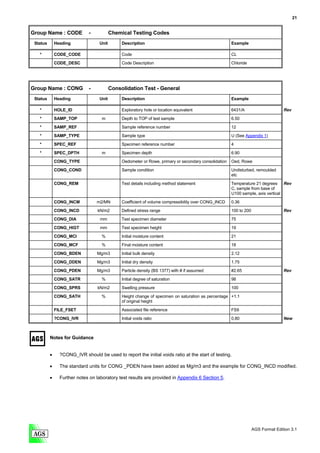
  • 123.
    A6/11 5 The use of linked pairs of Groups a) The AGS Format uses pairs of Groups to report some test results where the test can be divided into general information, and detailed data. The paired Groups are: • CBRG and CBRT for CBR tests. • CMPG and CMPT for compaction tests. • CONG and CONS for consolidation tests. • DPRG and DPRB for dynamic probe tests. • MCVG and MCVT for MCV tests. • PRTG and PRTL for pressuremeter tests. • SHBG and SHBT for shear box tests. • TRIG and TRIX for triaxial tests. For each of these pairs, the first Group of the pair, with the 'G' suffix, is used to present the general information for the test and the overall test results. The second Group of the pair is used to present the detailed data for each stage of the test. The second Group includes a Key Field for stage number (or increment or point or loop number or depth etc). The first Group will always only have one line of data for each test, whereas the second Group will have several lines of data for each test. When reporting the results of these tests it is normal practice to include both Groups in order to report the test fully. However, if the detailed data is not required or not available, then the general Group may be reported on its own by agreement between the Provider and the Receiver (except for DPRG which gives only the dynamic probe equipment and no results). The detailed Group must not be provided without the general Group. These paired Groups are handled readily by dedicated geotechnical relational database programs. However, they are not easily created or viewed using spreadsheets. If spreadsheets are being used, then care must be taken to ensure data integrity and the correct splitting and merging of the data when creating and viewing the AGS Format files. If user defined Headings are added to these paired Groups, you should ensure that the Heading is added to the correct Group. b) One exception to the paired Groups is the GRAD Group for particle size distribution analysis data. For this test the general information and detailed data have been combined into one group. If user defined Headings are added to this group for general items, such as percentage clay fraction, then this data must be repeated in the data set for every point on the grading curve. It is therefore, better practice to put such user defined general fields into another Group, for example into the CLSS Group. c) A similar paired Group approach is adopted for monitoring test results, where a general Group is used to report the monitoring installation information and a detailed Group is used to report the monitoring test results. The paired Groups of this type are: • HPGI and HPGO for horizontal profile gauge installations and readings. • INST and IOBS for single point instrumentation installations and readings. • PREF and POBS for piezometer installations and readings. • PROF and PROB for profiling instrument installations and readings. The first Group of the pair will always have only one line of data for each instrument, whereas the second Group of the pair will have many lines of data for the readings taken in that instrument. It is usual practice to present both Groups of the pair. However, if the instrument has been installed but no readings are available, then only the first Group need be presented. The second Group for readings must not be presented without the corresponding first Group for installation details. For all of these instruments it is possible to have more than one instrument in a borehole, therefore Key Fields are required in both Groups of the pair to indicate which instrument is being referred to. These Key Fields are: • The instrument reference number for horizontal profile gauges. • The instrument depth and reference number for single point instruments. • The piezometer tip depth for piezometers. • The instrument reference number for profiling instruments. AGS Format Edition 3.1
  • 124.
    A6/12 These Key Fields must be reported for all installations and all readings otherwise data integrity is not satisfied. The individual readings are identified by reading date and time and these must be recorded and reported. In addition for profiling instruments and horizontal profile gauges, each reading requires a depth or distance to identify it. 6 Reporting test units A <UNITS> line must be included in every data Group except ABBR, CODE, DICT and UNIT. If you are creating or viewing an AGS Format file in a spreadsheet this line of information will be visible below the column Headings and should be carefully checked. Further checks are also required for the CNMT Group which handles test units in a different way from all other Groups. a) All data Groups apart from CNMT and ?ICCT • Import the AGS file into a spreadsheet using the Comma Separated Value (CSV) import filter. • If the <UNITS> continues onto a second line, you must first cut and paste the second line into the correct columns. • Are the units lined up under the correct column Heading? • Are the units the same as defined in the AGS Format? This is desirable, but it is not essential. For example the testing may have been carried out overseas, or to a different standard method and therefore different units may have been used. The same units must be used as given in the paper version of the report. • Are the units correct for the data that is given beneath? Experience has shown that this is a common error. • The units given in the <UNITS> line must be defined in the UNIT Group. Standard units are given in the ‘pick’ list in Appendix 1. Where standard units are used the format must comply exactly with that given in the ‘pick’ list in Appendix 1. • If you are creating or viewing data in a dedicated geotechnical relational database program, the units embedded in the AGS data file may not be displayed by the program in all views of the data. The program may assume that the units stated in the AGS Format have been used and display these units, rather than those in the AGS file. Similarly, when creating an AGS format file, the program may automatically generate the <UNITS> information, assuming the AGS default values, irrespective of the units actually used. There is therefore potential for significant systematic errors, which will only be avoided by careful checking by the data Provider and Receiver. • Authors of dedicated geotechnical relational database programs should ensure that their software requires the data Provider to input the units, or confirm the default units, for each parameter. The program should also display the units as embedded in the received AGS file. b) The CNMT and ?ICCT Groups The procedure for checking the test units for chemical test results reported in the CNMT or ?ICCT Groups are different to that used for all other data Groups. The following points should be recognised: • The <UNITS> line in the CNMT Group gives only the units of the SAMP_TOP and SPEC_DPTH fields (preferred units are "m"). The <UNITS> line in the ?ICCT Group gives only the units of the ?MONP_DIS, ?ICCT_DATE and ?ICCT_TIME fields (preferred units are "m", "dd/mm/yyyy" and "hhmmss" respectively). • The <UNITS> line does not give the units of the test results and is left blank for CNMT_RESL or ?ICCT_RESL (ie a null "" is given). The units of the test results are given in the CNMT_UNIT or ?ICCT_UNIT field of the CNMT or ?ICCT Group for every test result. It is necessary to check the units for every test result, not just the <UNITS> line. AGS Format Edition 3.1
  • 125.
    A6/13 • The units used for a particular test should follow the appropriate testing standard that has been specified and should be agreed between the data Provider and Receiver. The AGS Format does not specify preferred units for the tests reported in the CNMT or ?ICCT Groups. • The units used in the AGS Format submission should be the same as those used in the paper report. • For each test type the same units should be used throughout an AGS Format submission. The units given in CNMT_UNIT or ?ICCT_UNIT for a given test type should not be different on different samples. • If several partial data submissions are made, then the units for a given test type should remain the same. • The units given in CNMT_UNIT or ?ICCT_UNIT must be defined in the UNIT Group. Standard units are given in the ‘pick’ list in Appendix 1. Where standard units are used the format must comply exactly with that given in the ‘pick’ list in Appendix 1. c) The UNIT Group All units used in an AGS Format submission must be defined in the UNIT Group; this includes standard units given in the ‘pick’ list in Appendix 1, and user defined units. The following guidelines should be followed for all units: • Where standard units are used, the format must be exactly as given in the ‘pick’ list in Appendix 1. This is required so that computer software can be programmed to automatically recognise the units. • User defined units must be composed of only standard ASCII characters. No non-ASCII or extended ASCII characters shall be used. For example, do not use the Greek mu symbol for 1/1000000, but instead use the abbreviation "u", e.g. ug/kg. • Do not use any superscripted characters. For example do not use kN/m2 but instead use kN/m2. • The units are case sensitive, therefore ensure that you exactly match the case of the standard units and that you have the correct case for any user defined units. For example, the standard unit is kN/m2 and therefore KN/m2 or kn/m2 are not acceptable. • Before creating new user defined units, consult the Discussion Forum of the AGS web site at http://www.ags.org.uk to see if anybody else has already suggested an appropriate style of presentation for the unit. If not, add details to the Discussion Forum of what you propose to do. The AGS Format committee will consider all suggestions posted in the Discussion Forum when preparing the next revision of the AGS Format. See Appendix 5 for further details. 7 Standard abbreviation ‘pick’ lists and user defined abbreviations All abbreviations used within the AGS Format data files of a submission must be defined in the ABBR and CODE Groups, including the standard abbreviations given in the ‘pick’ lists in Appendix 1. Chemical test codes are defined in the CODE Group, and all other abbreviations are defined in the ABBR Group. a) User defined abbreviations in the ABBR Group The ‘pick’ lists in Appendix 1 define a set of standard abbreviations, and indicate which Headings they should be used in. The data Group definitions indicate the Headings for which ‘pick’ lists of abbreviations are available. Headings which are indicated to have ‘pick’ lists available can also contain text items which are not taken from the relevant ‘pick’ list. If an abbreviation is used, then it must come from the ‘pick’ list, or a user defined abbreviation must be created. If a standard abbreviation exists for an item, then the abbreviation should be used not a full text equivalent. AGS Format Edition 3.1
  • 126.
    A6/14 User defined abbreviations must be given in the ABBR Group and should follow these guidelines: • User defined abbreviations should not duplicate an item for which a standard abbreviation is already given in the ‘pick’ lists. • The abbreviation given in ABBR_CODE must not duplicate a code already given in the ‘pick’ lists for the same Heading. For example in the ‘pick’ lists "W" is given as an abbreviation for "Wash boring" in HOLE_TYPE and for "Water sample" in SAMP_TYPE. "W" must not be used as a user defined abbreviation in either of these Headings but could be used for other Headings, for example, as an abbreviation for "Well" in PREF_TYPE. • ABBR_CODE should be considered as not case sensitive. Therefore "Cp" and "cp" are the same as the existing code "CP" and should not be used as a user defined abbreviation within HOLE_TYPE where "CP" is already defined in the ‘pick’ lists. • ABBR_CODE should be restricted to the letters A to Z and the numbers 0 to 9 and should not contain spaces. • The abbreviations should be agreed between the Provider and Receiver. • All abbreviations must be defined in the ABBR Group including the standard abbreviations given in the ‘pick’ lists in Appendix 1, for example: "**ABBR" "*ABBR_HDNG", "*ABBR_CODE", "*ABBR_DESC" "SAMP_TYPE", "M", "Mazier type sample" "SAMP_TYPE", "VS", "Vial sample" "SAMP_TYPE", "W", "Water sample" "HOLE_TYPE","OWCP","Overwater cable percussion boring" "MONP_TYPE","TS","Total station point" "MONP_TYPE","LC","Load cell" • Before creating new abbreviations, consult the Discussion Forum of the AGS web site at http://www.ags.org.uk to see if anybody else has already suggested an appropriate abbreviation. If not, add details to the Discussion Forum of what you propose to do. The AGS Format committee will consider all suggestions posted in the Discussion Forum when preparing the next revision of the AGS Format. See Appendix 5 for further details. b) User defined chemical codes in the CODE Group User defined chemical codes must be given in the CODE Group and should follow these guidelines: • User defined chemical codes must not duplicate a standard code which is already given in the ‘pick’ lists. • CODE_CODE should be considered as not case sensitive. Therefore "Tol" and "tol" are the same as the existing code "TOL" and should not be used. • CODE_CODE must be restricted to the letters A to Z and the numbers 0 to 9 and must not contain spaces. • The codes should be agreed between the Provider and Receiver. • All codes must be defined in the CODE Group including the standard codes given in Appendix 1, for example: "**CODE" "*CODE_CODE","*CODE_DESC” "BIOXW","Biochemical oxygen demand" AGS Format Edition 3.1
  • 127.
    A6/15 • Before creating new codes, consult the Discussion Forum of the AGS web site at www.ags.org.uk to see if anybody else has already suggested an appropriate code. If not, add details to the Discussion Forum of what you propose to do. The AGS Format committee will consider all suggestions posted in the Discussion Forum when preparing the next revision of the AGS Format. See Appendix 5 for further details. 8 Geology Codes The code Headings within the GEOL Group may be used as follows, although alternative applications are possible. a) The geology code GEOL_GEOL may be used as an abbreviation for the Geological Name of each geological unit, for example: RA as an abbreviation for Recent Alluvium LC as an abbreviation for London Clay User defined abbreviations or standard national abbreviations may be used. For example, in the United Kingdom the computer code given in the British Geological Survey lexicon of named rock units may be used (see the BGS web site at http://www.bgs.ac.uk). b) The second geology code GEOL_GEO2 may be used as an abbreviation for the material type of each stratum, for example: SC for Sandy CLAY C for CLAY c) The stratum code GEOL_STAT may be used as the reference letter or number of each stratum on a trial pit log. Its sole purpose is to link the stratum shown on the face sketch of the trial pit to the stratum description given elsewhere on the log. It is therefore not used on borehole logs and it is not used on simple trial pit logs which are presented in borehole log format, without a face sketch. GEOL_STAT is usually just the numbers 1, 2, 3 etc or the letters A, B, C etc. GEOL_STAT also appears in the SAMP Group and several of the in situ testing Groups so that it is possible to indicate which stratum on a trial pit face a sample was taken from, or an in situ test carried out in. d) The way that GEOL_GEOL, GEOL_GEO2 and GEOL_STAT are used should be agreed between the Provider and the Receiver. e) All GEOL_GEOL and GEOL_GEO2 codes must be defined in the ABBR Group (see Section 7 above), for example: "**ABBR" "*ABBR_HDNG","*ABBR_CODE","*ABBR_DESC" "GEOL_GEOL","RA","Recent Alluvium" "GEOL_GEOL","LC","London Clay" "GEOL_GEO2","SC","Sandy CLAY" "GEOL_GEO2","C","CLAY" 9 Associated files Data may be included in an AGS compatible submission for items that are not covered by the AGS Format by including the data in an associated file and referencing it in the AGS Format. The associated files may be in any file format that is acceptable to the Provider and Receiver. It is preferable that associated files are not compressed, however, large files that will not fit on to a single disk may be compressed using the ZIP file format. Zipped files must indicate the original file format plus the zipped file format. Compressed files should only be used in agreement between the Provider and Receiver. The AGS Format files in a submission should not be compressed. All associated files must have an up to 8 character file name and a 3 character file type extension. Long file names must not be used. AGS Format Edition 3.1
  • 128.
    A6/16 The referencing procedureis in two parts: a) The associated data files are collected together into data sets. Each data set must have a unique reference number and this reference number is given in the FILE_FSET field of the relevant Group as follows: • General data files that refer to the whole site should be collected together in a file set that is referenced in the FILE_FSET field of the PROJ Group. Such data files may include the report text as a word processor file, the site plan as a CAD file, a set of general site photographs as JPG files or the investigation Bill of Quantities as a spreadsheet file. For example: "**PROJ" "*PROJ_ID","*PROJ_NAME","*PROJ_LOC","*PROJ_DATE","*PROJ_AGS","*FILE_FSET" "<UNITS>","","","dd/mm/yyyy","","" "7845","Trumpington Sewerage","Trumpington","28/05/1999","3","FS1" • Data files that refer to specific boreholes or trial pits should be collected together in a file set that is referenced in the FILE_FSET field of the HOLE Group. Such data files may include a set of borehole geophysics files in LAS format, the trial pit photographs as JPG files, or a detailed location plan as a CAD file. It is recommended that core photograph files are collected together as part of the FILE_FSET in the HOLE Group, rather than being placed in the CORE Group, as each core box generally contains more than one core run. "**HOLE" "*HOLE_ID","*HOLE_TYPE","*HOLE_NATE","*HOLE_NATN","*HOLE_GL", "*FILE_FSET" "<UNITS>","","m","m","m","" "BH1","CP+RC","532154","176163","78.4","FS2" "TP2","TP","532246","176047","64.9","FS3" "H1","INST","532154","176163","78.4","FS2M" "BH10","CP","532246","176047","64.9","FS3M" • Data files that refer to specific samples should be collected together in a file set that is referenced in the FILE_FSET field of the SAMP Group. Such data files may include close up fabric photographs of a split piston sample as JPG files, or the text of a separate report on the petrographic analysis of an aggregate bulk sample as a word processor document. "**SAMP" "*HOLE_ID","*SAMP_TOP","*SAMP_REF","*SAMP_TYPE","*FILE_FSET" "<UNITS>", "m","","","" "BH1","2.50","5","P","FS205" "TP2","3.50","3","B","FS314" • Data files that refer to specific tests should be collected together in a file set that is referenced in the FILE_FSET field of the relevant test results Group. Such data may include close up photographs of a shear box sample after failure as a JPG file referenced in the SHBG Group, or a spreadsheet file of the detailed results and calculations of an in situ permeability test referenced in the IPRM Group. Where Groups occur as linked pairs (see Section 5) the file set should be referenced in the general Group of the pair. • Data files that refer to specific monitoring points should be collected together in a file set that is referenced in the ?FILE_FSET field of ?MONP. Such data may include calibration files for the instrument or a detailed specification of the instrument type. "**?MONP" "*?HOLE_ID","*?MONP_DIS","*?MONP_TYPE","*?FILE_FSET" "<UNITS>."m","","" "H1","0","TS","FS21M" "BH10","12.50","SP","FS204M" AGS Format Edition 3.1
  • 129.
    A6/17 b) The contents of each file set are described in the FILE Group. The File Name within each File Set must be unique, so that the combination of the Key Fields of FILE_FSET and FILE_NAME is unique. "**FILE" "*FILE_FSET","*FILE_NAME","*FILE_DESC","*FILE_TYPE","*FILE_PROG", "FILE_DATE", "?FILE_DOCT" "<UNITS>","","","","","dd/mm/yyyy" "FS1","trumptxt.doc","Factual report text","DOC","Word 97","27/05/1999","REP" "FS1","trumpsi.zip","Site plan","DWG+ZIP","AutoCAD ver 14 + PKZip ver 2.04g","24/05/1999","DRAW" "FS1","trump011.jpg","Photo of site looking North","JPG","Paintshop Pro ver 5","02/05/1999","PH" "FS1","trump021.jpg","Photo of site looking South","JPG","Paintshop Pro ver 5","02/05/1999","PH" "FS1","trumpboq.xls","Final BOQ","XLS","Excel 97","27/05/1999","PH" "FS2","bh1geoph.zip","BH1 geophysics","LAS+ZIP","GLog ver 3 + PKZip ver 2.04g","02/05/1999","DATA" "FS2","bh1p01.jpg","BH1 core photo box 1","JPG","Paintshop Pro ver 5","09/05/1999","PH" "FS2","bh1p02.jpg","BH1 core photo box 2","JPG","Paintshop Pro ver 5","09/05/1999","PH" "FS2","bh1plan.dwg","BH1 location plan","DWG","AutoCAD ver 14","06/05/1999","DRAW" "FS3","tp2p01.jpg","TP2 photo north face","JPG","Paintshop Pro ver 5","02/05/1999","PH" "FS2M","h1p01.jpg","H1 location photograph","JPG","Paintshop Pro ver 5","09/05/2001","PH" "FS3N","bh10plan.dwg","BH10 location plan","DWG","AutoCAD ver 14","06/05/2001","DRAW" "FS205","bh1p26.jpg","BH1 sample P5 split piston","JPG","Paintshop Pro ver 5","09/05/1999","PH" "FS314","tp2pet1.doc","TP2 sample B3 petrographic report text","DOC","Word 97","21/05/1999","REP" "FS21M","h1.xls","Tiltmeter H1 calibration file","XLS","Excel 2000","09/05/2001","CAL" "FS204M","bh10inst.doc","BH10 pneumatic piezometer installation details","DOC","Word 97","21/05/2001","CR" 10 Geophysical data The AGS Format does not cater for geophysical data (other than resistivity) as there are already well established international standards for the digital exchange of geophysical data. a) The most widely used standards are: • LAS (Log ASCII Standard). Originated by the Canadian Well Logging Society for the interchange of geophysical wireline logs in a simple ASCII format on floppy disc. • LIS (Log Information Standard) and DLIS (Digital Log Interchange Standard). LIS was originated by Schlumberger for the interchange of geophysical wireline logs. It has been largely superseded by DLIS developed by the American Petroleum Institute, but now maintained by the Petrotechnical Open Software Corporation. DLIS is also known as POSC RP66. These are more complete and complex formats than LAS, and were designed for magnetic tape use. • SEGY (Society of Exploration Geophysicists Y Format) for the exchange of seismic data. This is a tape based format. • Refer to the AGS web site at http://www.ags.org.uk for internet links to further information on these interchange formats. Of the above, LAS is the only one that is suitable for a submission on floppy disc, the others require magnetic tape. b) To include associated geophysical data files in any of the above formats in an AGS Format compatible submission: • For borehole wireline geophysical logs reference the data set of geophysical files under the FILE_FSET Heading of the relevant borehole in the HOLE Group. Detail all the files contained within the data set in the FILE Group (see Section 9 above). • For surface geophysical data sets (seismic, gravity etc) give a unique HOLE_ID in the HOLE Group for each data run, profile or point and then reference the data set of files under the FILE_FSET Heading of the HOLE Group. If the data set covers a linear run or profile then give the start and end co-ordinates of the line using the HOLE_NATE, HOLE_NATN, HOLE_ETRV and HOLE_NTRV Headings. The ground levels of the start and end of the line should be given using the HOLE_GL and HOLE_LTRV Headings. Detail all the files contained within the data set in the FILE Group (see Section 9 above). • For in situ resistivity profile data use the IRES Group of the AGS Format. AGS Format Edition 3.1
  • 130.
    A6/18 11 Amalgamated samples It may be necessary to amalgamate two or more samples for laboratory testing. The samples may come from the same, or different, boreholes or trial pits. The procedure for reporting tests on these samples is given below: • All the original samples (before amalgamation) must be detailed in the SAMP Group with their original borehole/trial pit numbers, depth, sample type and sample number. • Then select one of the group of samples to be amalgamated as the "Primary sample" and put a duplicate entry for it into the SAMP Group, but change the sample type to AMAL. In the SAMP_REM field list all the samples that have been amalgamated to create this one combined sample. Include in the list the sample used as the "Primary sample". The format of the SAMP_REM list should be as follows: HOLE_ID , SAMP_REF , SAMP_TYPE , SAMP_TOP units of SAMP_TOP + HOLE_ID , SAMP_REF , SAMP_TYPE , SAMP_TOP units of SAMP_TOP etc For example: "**SAMP" "*HOLE_ID","*SAMP_TOP","*SAMP_REF","*SAMP_TYPE","*SAMP_REM" "<UNITS>", "m","","","" "TP1","2.50","1","B","" "TP2","3.50","3","B","" "TP2","4.50","5","B","" "TP2","3.50","3","AMAL","TP1,1,B,2.50m+TP2,3,B,3.50m+TP2,5,B,4.50m" • All amalgamated samples must be defined in SAMP before test results can be given elsewhere. • In reporting test results on the amalgamated sample in other Groups, use the "Primary sample" details with the sample type as AMAL. 12 The use of DREM and DETL The Groups DREM and DETL both include detailed information for inclusion on the borehole or trial pit log. Guidance on the use of these two Groups is given below, but alternative usages are possible. a) Group DETL may be used for adding geological details to the geological description of a stratum. • A geological description in DETL_DESC should be considered as a supplement to the main stratum description given in GEOL_DESC of the GEOL Group. • Detailed descriptions should be given a top and bottom depth if the feature has thickness. For example, "19.30 to 19.60m Sandstone boulder". • Detailed descriptions should be given a single depth (which is repeated in both the DETL_TOP and DETL_BASE fields), only if it has no significant thickness, or if it marks the top of a gradational change in the nature of the stratum. For example, "27.65m Marl parting" or "35.65m Becoming very sandy". • If the change in the stratum is not gradational it is generally preferable to give depth ranges. For example, "6.50 to 8.70m Sandy", is generally preferable to "Sandy below 6.50m". • The depth or depth range of the detailed feature may be repeated within the description if it is to be printed on the log. • Since the detailed descriptions are a supplement to the main description, detailed description depth ranges should not cross main stratum boundaries. AGS Format Edition 3.1
  • 131.
    A6/19 b) Group DREM may be used for all remarks and notes that are related to a specific depth in the borehole or trial pit, that are not geological. • DREM is used for reporting incidents during drilling (such as "Fishing for broken U100 3.00 to 3.70m"), drilling records that don't readily fit in any other groups (such as "Pushing boulder ahead of casing 7.80 to 8.15m"), observations that are not strictly geological (such as "Strong petrol smell at 5.00m"). 13 Reporting trial pits Simple trial pits where the geology is treated as horizontal, continuous layers can be reported in a borehole type log, which is a one dimensional record of the ground conditions, the only dimension being depth. These logs readily convert into the AGS Format. For more complex trial pits where the geology is not in horizontal, continuous layers, the log will normally include a (two dimensional) sketch of the faces to show the disposition of the strata, and the location of the samples and in situ tests. The stratum descriptions will be referenced to the sketch. Such trial pit logs require some compromises to convert them to a one dimensional borehole log in order to report them in the AGS Format. The following procedure may be used, but alternative methods are possible. • On the face sketch give each stratum a stratum code number or letter. This is used to link the sketch to the stratum description, and is recorded as GEOL_STAT. • In your log production software produce a (one dimensional) borehole style log. The stratum code GEOL_STAT should be prominently displayed at the start of, or adjacent to, each stratum description. The strata should be presented in the same vertical sequence that they are seen in the trial pit faces. The stratum boundary depths on this log should be "approximate average depths" for each stratum boundary, as seen in the trial pit faces. This may be difficult to achieve where the strata boundaries are complex. However, every stratum must be included in the depth log, with some nominal thickness, and there must be no gaps in the log. Where strata are very limited in extent they could be included as a detail in the DETL Group, rather than as a separate stratum in the GEOL Group. • Samples are recorded in the SAMP Group as normal, but also include the stratum code in GEOL_STAT of the SAMP Group to indicate which stratum the sample has been taken from. If you also wish to indicate which face of the trial pit the sample was taken from, then include this as a remark in SAMP_REM. • In situ CBR, density, redox, resistivity and vane tests can be carried out in a trial pit, rather than at the ground surface. The tests should be recorded in the relevant Group as normal, but also include the stratum code in GEOL_STAT of the Group to indicate which stratum the test was carried out in. If required, the trial pit face number should be given in the REM field of the Group. • If the face sketch has been produced on computer software, then this could be included in the AGS file as an associated file (see Section 9 above), and referenced in the FILE_FSET field of the HOLE Group for the trial pit. 14 Reporting SPT tests The following guidelines may be applied to the reporting of SPT tests in the ISPT Group, but alternative usages are possible. • When full test penetration of 450mm has been achieved the N value should be reported in the ISPT_NVAL field as a number. That is, report 35, do not report N=35. • When full test penetration has not been achieved, then leave the ISPT_NVAL field empty. • In the ISPT_REP field put the test result as reported on the paper borehole log. This may be in a format specific to the Provider. For example, an N Value of 35 may be reported on the log as: 35, N=35, [35] or 3,5/9,7,9,10=35 etc. An incomplete test may be reported on the log as: 50/160mm, 50/160, (50) or 8,10/15,12,23 for 10mm etc. AGS Format Edition 3.1
  • 132.
    A6/20 • The ISPT_INC1, ISPT_INC2, ISPT_PEN1 and ISPT_PEN2 fields should only be used for reporting the seating drive. If the seating drive is terminated during the first increment (as BS1377 permits in certain circumstances), then ISPT_INC2 and ISPT_PEN2 are left blank. The first increment of the main test drive is always reported in ISPT_INC3 and ISPT_PEN3. • In some countries the test procedure requires three increments of 150mm each, rather than six increments of 75mm each. If this procedure is adopted, then report the increments in ISPT_INC1, ISPT_INC3 and ISPT_INC5, and the corresponding ISPT_PEN fields. 15 Reporting chemical test results Routine chemical testing for geotechnical purposes (in accordance with BS1377) and chemical tests carried out for geo-environmental purposes, to standards other than BS1377, are reported using the CNMT Group. The CNMT Group has a structure that is different from all the other Groups in the AGS Format. The reported tests are identified by a code which is defined in the ‘pick’ lists in Appendix 1. The codes used must be defined in the CODE Group, as described in Section 7 above, even if standard codes defined in Appendix 1 are being used. There has been a change in the way that the codes are used between Version 2 and Version 3 of the AGS Format. In Version 2 the codes were often a combination of determinand and test type; therefore, there were several different codes for sulphate tests carried out on soil or water samples, and by different test methods. In Version 3 the codes used in CNMT_TYPE and defined in CODE_CODE solely indicate the determinand. In addition to the CNMT_TYPE code, a test type code must be used in CNMT_TTYP and defined in ABBR_CODE, which distinguishes between the different types of sulphate test. CNMT_TYPE and CNMT_TTYP are both KEY fields and must be included for every test result. Further information may optionally be given on the test method and sample preparation method in CNMT_METH and CNMT_PREP. Examples of the use of these four fields are given below: Version 2 Version 3 equivalent CNMT_TYPE CNMT_TTYP CNMT_METH CNMT_PREP CNMT_TYPE SO3 WATER Filtered SULAW SO3 SOLID_21WAT 2:1 soil/water Air dried SULWS extract SO3 SOLID_TOT BS1377 Acid Oven dried SULTS extract The results of the chemical tests are given in the CNMT_RESL field, and the units of each result must be stated in the CNMT_UNIT field. The abbreviations for the units must be defined in the UNIT Group (see Section 6 above). The AGS wishes to promote the wider adoption of CAS numbers (Chemical Abstracts Service registry numbers), which uniquely identify many chemical compounds. The separation of determinand code and test type code in Version 3 of the AGS Format is compatible with the approach of the CAS number system. However, CAS numbers are not available for all the determinands listed in Appendix 1, and therefore CAS numbers may be used to supplement the CNMT_TYPE codes, but not replace them. CAS numbers may be included in the CNMT_CAS field. References to further information on CAS numbers are given on the AGS web site at http://www.ags.org.uk. 16 Reporting linear traverse, scanline or slope strip logs The AGS Format can handle the reporting of logs of linear traverses (eg of a quarry face or foundation excavation), or scanline logs (eg for a detailed rock discontinuity survey) or a slope strip log (where the surface protection is stripped off a cutting face to log the underlying geology). Geological logging, discontinuity logging, sampling and in situ testing can all be included using the following guidelines. a) The location and orientation of the traverse is recorded in the HOLE Group. The traverse should be given a unique reference number in HOLE_ID. The HOLE_TYPE is TRAV (for a traverse or scanline) or CH (for a surface slope protection strip). The co-ordinates of the start of the traverse are given in HOLE_NATE, HOLE_NATN and the co-ordinates for the end are given in HOLE_ETRV and HOLE_NTRV. The level of the start of the traverse is given in HOLE_GL and the level of the end is given in HOLE_LTRV. The AGS Format Edition 3.1
  • 133.
    A6/21 compass bearing of the traverse is given in HOLE_ORNT and the inclination of the traverse line from the horizontal is given in HOLE_INCL (eg 0 deg for a horizontal scanline, or 90 deg for a vertical slope strip). b) Strata boundaries, weathering divisions, discontinuities, samples and in situ test locations are measured along the length of the traverse from the start for a subhorizontal traverse and down the traverse from the top for a subvertical traverse. These measurements are then entered as depths in the appropriate AGS fields (eg GEOL_TOP, GEOL_BASE, WETH_TOP, WETH_BASE, DISC_TOP, DISC_BASE, SAMP_TOP, IVAN_DPTH etc). 17 Reporting discontinuity logging data Discontinuity logging may be carried out as part of a scanline survey of a rock face, or as a detailed fracture log of borehole core. a) The logging may take one of three forms, the first two being the commonest: • The recording of the nature of individual discontinuities. All discontinuity descriptions are given in the DISC Group. The FRAC Group is not used. The spacing between individual discontinuities may be assessed from their depths. • The recording of the typical nature of sets of discontinuities. The typical description for a discontinuity set is given in the DISC Group and the typical spacing is given in the FRAC Group. Individual discontinuities are not described. • The recording of the nature of individual discontinuities, with each discontinuity assigned to a discontinuity set. The individual discontinuity descriptions are given in the DISC Group and the typical spacing of a discontinuity set is given in the FRAC Group. b) If individual discontinuities have been logged along a scanline or in a borehole, then the reporting procedure is as follows: • The nature of the individual discontinuities is recorded in the DISC Group. • The location of each discontinuity is given in DISC_TOP, either as depth in a borehole, or as distance from the start of the traverse along a scanline. The DISC_BASE field is left empty. • Each discontinuity is numbered sequentially in DISC_NUMB from the top of the borehole, or from the start of the traverse. • If each discontinuity has been assigned to a discontinuity set, then the set reference number should be given in FRAC_SET (see Section 17c below). The use of FRAC_SET is optional when individual discontinuities are logged. • The orientation and nature of each discontinuity is reported using the remaining fields in DISC. The descriptive scheme is derived from the ISRM (1978) Suggested methods for the quantitative description of discontinuities in rock masses. International Journal of Rock Mechanics and Mining Science. Volume 15. No 6 pp 319-368. • For borehole logs the surface nature of the discontinuity is described using a combination of DISC_RGH, DISC_PLAN, DISC_JRC, DISC_APP, DISC_STR and DISC_WETH. It is generally not reliable to measure the aperture of a discontinuity in borehole core as the effect of drilling disturbance is unknown. However, the thickness of any discontinuity infill should be given in DISC_APT, and the nature of the infill given in DISC_INFM. Discontinuity dip can be given in DISC_DIP for vertical boreholes, and inclined boreholes with orientated core. Discontinuity dip direction can only be given in DISC_DIR if the core is orientated. In an inclined borehole with unorientated core only relative discontinuity dip can be given with respect to the core axis. • For scanline logs all the above details of discontinuity orientation and nature can be given, together with the large scale waviness, true discontinuity aperture, discontinuity termination (using the terms given in the ‘pick’ list in Appendix 1), and water seepage observations. • The format of the DISC Group is applicable to most descriptive schemes, other than ISRM (1978). Alternative schemes may be used on agreement between the Provider and Receiver. AGS Format Edition 3.1
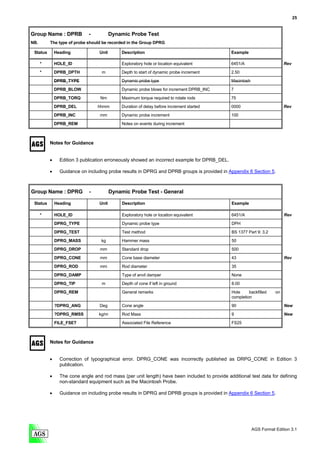
  • 134.
    A6/22 c) If sets or zones of discontinuities have been logged along a scanline or in a borehole, then the reporting procedure is as follows: • The discontinuity sets or zones are recorded in a combination of the DISC and FRAC Groups. The DISC Group is used to record either the typical orientation and nature of each set or zone of discontinuities, or the individual discontinuities. The FRAC Group is used to record the spacing of the discontinuities in each set or zone. • The start and end of each set or zone of discontinuities of similar nature is given in DISC_TOP and DISC_BASE, either as depth in a borehole, or as distance from the start of the traverse along a scanline. The start and end of each set or zone of discontinuities with a similar spacing is given in FRAC_TOP and FRAC_BASE. Normally the "nature" and "spacing" zones will coincide, and therefore DISC_TOP and DISC_BASE will be the same as FRAC_TOP and FRAC_BASE. • DISC_NUMB is left blank when logging discontinuity sets or zones. • Each discontinuity set or zone must be given a unique set reference number in FRAC_SET. For example, joint sets may be numbered J1, J2, J3 etc, bedding discontinuities as B1, B2 etc. The use of FRAC_SET provides the link between the DISC and FRAC Groups. • The typical orientation and nature of each discontinuity set or zone is reported using the remaining fields in DISC. • The spacing of the discontinuities within each discontinuity set or zone is reported in the FRAC Group, giving the minimum, average (typical), and maximum spacing in mm of the fractures in that set or zone, using the FRAC_IMIN, FRAC_IAVE and FRAC_IMAX fields. Alternatively, the average (typical) number of fractures per metre can be given in FRAC_FI. 18 Reporting in situ tests not carried out in a borehole or trial pit In situ tests are mostly carried out in boreholes or trial pits, but this is not always the case, and some tests can be carried out on their own, from the surface, without a borehole or trial pit. a) The tests that can be carried out from the surface are: • In situ CBR test reported in Group ICBR • In situ density test reported in Group IDEN • In situ redox test reported in Group IRDX • In situ resistivity test reported in Group IRES • In situ vane test reported in Group IVAN Static cone and dynamic probe tests are treated in the same way as boreholes. b) Where these tests are carried out from the surface the following reporting procedure should be used: • Each test should be given its own unique HOLE_ID. • In the HOLE Group the HOLE_ID of each test is given, together with its co-ordinates and ground level. Under the HOLE_TYPE Heading the abbreviation given in the ‘pick’ list in Appendix 1 should be used. For example: "**HOLE" "*HOLE_ID", "*HOLE_TYPE", "*HOLE_NATE", "HOLE_NATN", "*HOLE_GL" "<UNITS>","","m","m","m" "ID124","IDEN","521356","176478","34.6" "ID125","IDEN","521364","176459","38.3" "IC063","ICBR","521357","176477","34.5" AGS Format Edition 3.1
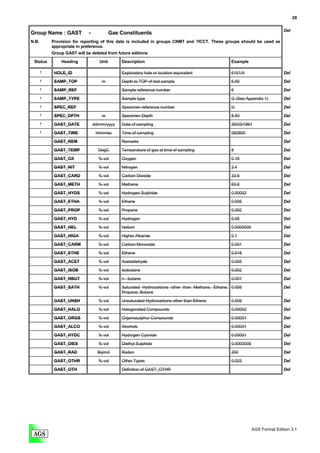
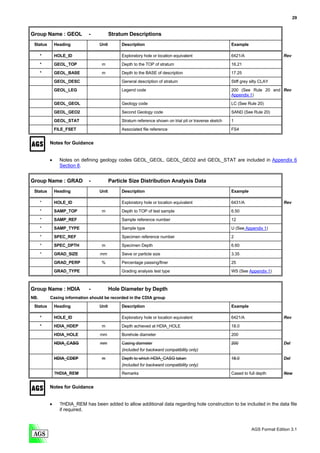

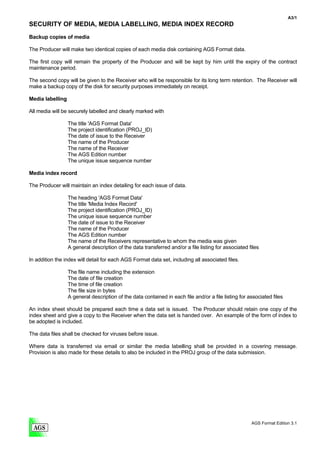
  • 135.
    A6/23 • The test results are reported in the appropriate Group as normal, but using the unique HOLE_ID defined in the HOLE Group. For example: "**IDEN" "*HOLE_ID", "*IDEN_DPTH", "*IDEN_IDEN", "*IDEN_MC", "*IDEN_REM" "<UNITS>", "m", "Mg/m3", "%", "" "ID124","0.00","1.75","17","Sand replacement. Test at ground level" "ID125","0.00","1.73","15","Sand replacement. Test at ground level" 19 Transfer of monitoring data The addition of the groups originally defined in AGS-M (ref CIRIA Project Report 82, 2002) permit the transfer of sufficient information to allow the receiver to recreate the factual engineering plots that are included in the paper version of the instrumentation monitoring report. Most of these plots will show the variation with time of a physical parameter or a geochemical determinand. The raw instrument readings that the data provider has taken in the field, or the calibration factors that have been applied to the raw readings, are not transferred as part of the AGS Format. Similarly, interpreted information which has been derived from the factual data is not transferred by the AGS Format. However, the Format is flexible and data outside the scope of the Format may be transferred as associated files which are referenced in the AGS data, if this is agreed between the data provider and receiver (Appendix 4). The following types of monitoring data are defined, and may be transferred using the AGS Format or as associated files as indicated below: • General information about the project. Given in the PROJ Group. • Location of each instrument reference point. Given in the HOLE Group. • Details of each monitoring point. Given in the ?MONP Group. • The readings (after the application of any calibrations or corrections) of physical parameters from each monitoring point. Given in the ?MONR Group. • The results of in situ measurements of geochemical determinands (after the application of any calibrations or corrections) from each monitoring point. Given in the ?ICCT Group. • The raw instrument readings (prior to the application of any calibrations or corrections) of physical parameters or geochemical determinands from each monitoring point. These are not given in the AGS Format, but may be included in an attached file referenced from the FILE_FSET in either ?MONR or ?ICCT with the associated calibrated result. • Calibration information or initial base readings for the instrument which are used to obtain the corrected readings. These are not given in the AGS Format, but may be included in an attached file referenced from the ?FILE_FSET in ?MONP or HOLE, depending on the instrument type. For instruments where there are single entries in ?MONP the data is referenced from ?MONP eg a single earth pressure cell. For installations where multiple monitoring points are defined in ?MONP, each with their own calibration, the data is referenced in ?MONP, eg a series of tiltmeters up a bridge abutment. For installations where multiple monitoring points are defined in ?MONP, but they combine to act as one instrument, then the data is referenced in HOLE eg a manually read borehole inclinometer. • Calibration information for a readout unit or measurement gauge which is used to read many installations across the project. This is not given in the AGS Format, but may be included in an attached file referenced from the FILE_FSET in PROJ. AGS Format Edition 3.1
  • 136.
    A6/24 20 Reference points, monitoring points and key fields The AGS Format makes the distinction between reference points and monitoring points as follows: • The monitoring point is the precise location at which a reading is taken. It may be a single instrument such as a precise levelling point, or it may be an individual location within a long instrument, such as a particular depth within a borehole inclinometer at which readings are taken. • The reference point is the general location of the instrument that has been surveyed in with coordinates and a level. For example, in the case of an instrument installed in a borehole, the reference point would be the top of the borehole. For a set of tiltmeters installed up a bridge pier, the reference point may be the base of the pier. For a precise levelling point the reference point and the monitoring point locations are likely to be the same. Each reference point can have one or more monitoring points. But each monitoring point must have only one reference point. The monitoring points are related to their respective reference point by an off-set distance. For an instrument in a borehole the off-set distance is the depth down the borehole to the monitoring point (or points). For a set of tiltmeters installed up a bridge pier the off-set distance is the distance up the pier to the tiltmeter from the reference point at the pier base. For a precise levelling point, where the reference point and the monitoring point are the same, the off-set distance is zero. The position of any monitoring point should ideally be uniquely defined by a combination of its reference point and off-set distance; these are the main Key Fields which uniquely identify the instrument, and are used in the to make the link between the instrument details and its associated readings. If it is not possible to uniquely identify an instrument by these two Key Fields alone, then the ?MONP_ID Key Field may be added to produce a unique combination of the three Key Fields. The reference point name is given in HOLE_ID, and the location of the reference point is defined by its nominal co-ordinates and level given in the HOLE_NATE, HOLE_NATN and HOLE_GL fields in the HOLE Group. The HOLE_ID is repeated in the ?MONP, ?MONR and ?ICCT Groups. If the reference point moves (for example a borehole installed in an active landslip) the nominal co-ordinates and level given in HOLE should not be changed. To record the movement create a monitoring point at the top of the borehole and record the relative movement or absolute position with time using the appropriate fields in ?MONR. The off-set distance between the reference point and the monitoring point is given in ?MONP_DIS in the ?MONP Group, and is repeated in the ?MONR and ?ICCT Groups with the readings. ?MONP_DIS is a Key Field and must always be included. If the off-set distance is zero, then ?MONP_DIS must be given as 0. ?MONP_ID may be the instrument serial number, or some other reference, and is optional if the instrument can be uniquely identified by a combination of its reference point and off-set distance alone. If the instrument can not be uniquely identified without ?MONP_ID then it must be included in the ?MONP, ?MONR and ?ICCT Groups. 21 Instrument orientations and sign conventions Where a reference point relates to a line of monitoring points, the orientation of the line is given in the HOLE Group. For example: • An inclinometer installed in a vertical borehole: the inclination given in HOLE_INCL is 90, the orientation given in HOLE_ORNT is NA (not applicable). • An extensometer installed at an angle of 45 degrees upwards on a bearing to the east in the roof of a tunnel: the inclination in HOLE_INCL is -45 (down is +ve, up is -ve for HOLE_INCL), and the orientation given in HOLE_ORNT is 090 (bearings are given as three digits). • A set of strain gauges installed along a horizontal excavation prop orientated north-south: HOLE_INCL is 0 and HOLE_ORNT is 180. AGS Format Edition 3.1
  • 137.
    A6/25 The orientation ofthe reading axis of a monitoring point is given in the ?MONP Group. If the monitoring point has more than one reading axis, the orientation of each axis is given in ?MONP. For example: • A horizontally mounted tiltmeter on the east-west wall of a building: the bearing of the measuring axis given in ?MONP_BRGA is 090 and the inclination of the axis given in ?MONP_INCA is 0. • A strain rosette with two reading axes, glued on to the vertical side of an east-west trending excavation prop: the bearing of the horizontal measuring axis is 090 (given in ?MONP_BRGA), and of the vertical axis is NA (not applicable, given in ?MONP_BRGB). The inclination of the horizontal axis is 0 (given in ?MONP_INCA) and of the vertical axis is 90 (given in ?MONP_INCB). The AGS Format does not define any sign conventions for instrument readings reported in ?MONR. The sign conventions for each measuring point must be defined in ?MONP. For some instruments a sign convention is not relevant, if the reading can only ever be positive. For monitoring points with more than one axis, the sign convention must be given for each axis. The sign convention is defined in words and must be unambiguous. The sign convention, orientation and inclination of the reading axis must be mutually compatible. For example: • A horizontally mounted tiltmeter on the east-west wall of a building: with a reading axis bearing 090 and an inclination of 0, the sign convention (given in ?MONP_RSCA) may be "Clockwise tilt down to the east is +ve". • A precise levelling point installed on the side of a building with a reading axis bearing of NA, and an inclination of 90, the sign convention (given in ?MONP_RSCA) may be "Displacement up is +ve". Instruments for in situ geochemical measurements are omni-directional and the measured values can only be +ve, therefore the bearing, inclination and reading sign convention in ?MONP are not applicable (NA). 22 ?MONP and ?MONR Examples The following examples illustrate how to report the installation details and readings of physical parameters for common instruments using the ?MONP and ?MONR Groups. General concepts are not repeated in subsequent examples. Detailed, worked examples for most common instrument types are given on the AGS web site at http://www.ags.org.uk. a) Total station survey point on a building • The reference point and the monitoring point locations are the same. • The reference point ID is given in HOLE_ID. • The off-set of the monitoring point from the reference point is zero and is given as 0 in ?MONP_DIS. • The combination of HOLE_ID and ?MONP_DIS uniquely define the survey point, so no ?MONP_ID is required, and may be left blank. • The co-ordinates and level of the reference point given in HOLE (in HOLE_NATE, HOLE_NATN and HOLE_GL) may be the initial precise readings on the point, or may be rounded readings. • The co-ordinates and level of the reference point may additionally, or alternatively, be given to a local grid and datum in HOLE using HOLE_LOCX, HOLE_LOCY and HOLE_LOCZ. • The orientation and inclination of the reference point in HOLE_ORNT and HOLE_INCL are not relevant, and are given as NA (Not applicable). • Photographs of the reference point may be given as an associated file and referenced in FILE_FSET in HOLE. • The date that the survey point was installed is given in ?MONP_DATE. • The HOLE_TYPE is INST to indicate Instrument. • The type of instrument is given using the pick list code TS for Total station survey point in ?MONP_TYPE. AGS Format Edition 3.1
  • 138.
    A6/26 • If the readings are reported as Easting, Northing and Level then the bearings and inclinations of the measurement axes are: ?MONP_BRGA = 090 (ie Eastings) ?MONP_BRGB = 000 (ie Northings) ?MONP_BRGC = NA (ie Level, bearing is Not Applicable) ?MONP_INCA = 0 (ie Eastings, horizontal axis) ?MONP_INCB = 0 (ie Northings, horizontal axis) ?MONP_INCC = 90 (ie Level, vertical axis) • If absolute readings of Easting, Northing and Level are being reported, then there are no sign conventions and ?MONP_RSCA, ?MONP_RSCB and ?MONP_RSCC are NA (Not applicable). • Absolute readings of Easting, Northing and Level are reported in ?MONR_EAST, ?MONR_NRTH and ?MONR_LEV. • If relative displacements from an initial base reading are being reported, then the sign conventions for displacements in each axis must be given, for example: ?MONP_RSCA = Displacement to East +ve. ?MONP_RSCB = Displacement to South +ve ?MONP_RSCC = Displacement up +ve. • Relative displacements would be reported in ?MONR_DSPA, ?MONR_DSPB and ?MONR_DSPC. • The date and time of every set of readings must be given in ?MONR_DATE and ?MONR_TIME. The date is always given in the format dd/mm/yyyy eg 05/12/2001, the following formats are not acceptable 5/12/2001, 05/12/01, 5 Dec 2001 or 12/05/2001. The time is always given to the 24 hour clock in the format hhmmss eg 104500, the following formats are not acceptable 1045, 10:45:00, 1045am. b) Bi-axial tiltmeter on a building • If the tiltmeter is installed on its own near ground level, then the reference point and monitoring point locations will be the same, and ?MONP_DIS will be zero. Inclination and orientation of the reference line (HOLE_INCL and HOLE_ORNT) are not relevant. • The HOLE_TYPE is INST to indicate Instrument. • The instrument type given in ?MONP_TYPE is TMB. • The serial number of the tiltmeter can be given in ?MONP_ID, but it is not required to uniquely define the instrument, and so may be left blank. • The calibration details of the instrument can be given as an associated file and referenced in FILE_FSET in ?MONP. • If one axis of the tiltmeter is horizontal, aligned east-west, and the second axis is horizontal, aligned north-south, the bearing, inclination and sign conventions given in ?MONP may be as follows: ?MONP_BRGA = 090 ?MONP_BRGB = 180 ?MONP_INCA = 0 ?MONP_INCB = 0 ?MONP_RSCA = Clockwise rotation down to the east is +ve ?MONP_RSCB = Anticlockwise rotation down to the south is +ve • The readings will be reported using ?MONR_ANGA and ?MONR_ANGB. AGS Format Edition 3.1
  • 139.
    A6/27 c) Manually readinclinometer in a borehole • The reference point is the top of the borehole. The reference point ID is the borehole number. There are multiple monitoring points, one at each depth down the inclinometer at which readings are taken. Each monitoring point is identified by its depth below ground level, given in ?MONP_DIS. ?MONP_ID is not relevant and is left blank. • The HOLE_TYPE given in HOLE is CP for cable percussion borehole. • The co-ordinates and ground level of the top of the borehole are given in HOLE. • The instrument type given in ?MONP_TYPE is ICM for inclinometer - manual. • The inclination and orientation of the borehole are given in HOLE. If the borehole is vertical HOLE_INCL is 90 and HOLE_ORNT is NA. • Each depth at which readings are taken in the inclinometer is considered to be a separate monitoring point and must be defined in ?MONP, even though the orientations, inclinations and reading sign conventions will be the same for every point. The nominal bearings of the keyways are given in ?MONP_BRGA and ?MONP_BRGB. ?MONP_BRGC is not applicable. The inclination of the measuring direction for both keyways is horizontal (ie 0), as the resultant horizontal displacements are reported. The reading sign convention for the two keyway directions must be stated. An example partial data set for ?MONP would be as follows: ?HOLE_ID ?MONP_DIS ?MONP_BRGA ?MONP_BRG ?MONP_INCA ?MONP_INCB ?MONP_RSC ?MONP_RSC A A B BH10 6.00 100 190 0 0 Towards east Towards +ve south +ve BH10 7.00 100 190 0 0 Towards east Towards +ve south +ve BH10 8.00 100 190 0 0 Towards east Towards +ve south +ve • The readings, given as displacements in mm from the base reading at each depth, are reported in ?MONR_DSPA and ?MONR_DSPB, observing the sign conventions given in ?MONP. • A set of base readings will be taken for each inclinometer installation which define the initial shape of the tube in the ground and which are then used in the calculation procedure to determine the incremental displacement for each subsequent set of readings. These base readings may be considered as calibration data for the installation and are therefore not reported in the AGS Format. If they are required they may be given as an attached file and referenced in the FILE_FSET of the HOLE Group. • The raw instrument readings of the angle of the measuring torpedo in the keyways at each depth are not reported in the AGS Format. Similarly, the intermediate calculated readings of absolute shape of the inclinometer installation at each reading date are not reported. The only results reported are the final relative displacements after application of the calibration factors and subtraction of the base readings. • If spiral twist is measured it provides additional detail on the configuration of the installation, and is required by the data receiver to fully understand the incremental displacement data ie although the keyways may be nominally aligned at 100/190 degrees at the surface, they may be rotated to 150/240 degrees at 50m depth. Spiral twist information is therefore part of the instrument definition, and is not calibration data. It is reported in ?MONP by giving the precise, rather than the nominal, keyway bearing at each measurement depth in ?MONP_BRGA and ?MONP_BRGB. AGS Format Edition 3.1
  • 140.
    A6/28 d) Piezometer ina borehole • The reference point is the top of the borehole, and the reference ID is the borehole number. • The off-set from the reference point given in ?MONP_DIS is the depth below ground level to the piezometer tip; this allows multiple piezometers in a borehole to be uniquely identified. • The combination of HOLE_ID and ?MONP_DIS uniquely define the piezometer, so no ?MONP_ID is required, and may be left blank. • The top and bottom of the piezometer response zone (sand filter pocket) are given as depths below ground level in ?MONP_TRZ and ?MONP_BRZ. • The HOLE_TYPE is CP for cable percussion borehole. • The instrument type is given as SPIE for a standpipe piezometer in ?MONP_TYPE. • The orientation and inclination of the borehole are given in HOLE_ORNT and HOLE_INCL. • Bearing and inclination of the piezometer are not relevant as the instrument is omnidirectional, so ?MONP_BRGA and ?MONP_INCA may be left blank or given as NA. • The reading sign convention is only relevant with piezometers that can measure negative heads, in which case ?MONP_RSCA would be "Positive head is +ve". • The readings are reported as either depth to water from reference point datum (ie depth below ground level) in ?MONR_WDEP or as head of water above tip level in ?MONR_WHD. e) Slip indicator in a borehole • The readings are reported in ?MONR using fields ?MONR_DSTA and ?MONR_DSTB. The depth below ground level that the top of the bottom rod gets stopped is reported in ?MONR_DSTB, and the depth below ground level that the bottom of the top rod gets stopped is reported in ?MONR_DSTA. • The length of the top rod used is reported in ?MONR_GAUG; so the results of using several top rods of different lengths can be reported. • The monitoring point is defined as at the base of the slip indicator tube, and is given as the depth of the installation in ?MONP_DIS. The combination of HOLE_ID and ?MONP_DIS uniquely define the survey point, so no ?MONP_ID is required, and may be left blank. f) Set of strain gauges on an excavation prop • The reference point is located at the end of the prop, and the set of strain gauges may all be given the same HOLE_ID. • The strain rosettes on the side and top of the prop are both at the same distance from the reference point, given in ?MONP_DIS. • The combination of HOLE_ID and ?MONP_DIS does not uniquely identify each strain rosette, therefore each rosette must additionally be given a monitoring point identifier in ?MONP_ID to make the combination of HOLE_ID, ?MONP_DIS and ?MONP_ID unique. The ?MONP_ID may simply be "Top" and "Side", or "A" and "B", or some project specific referencing system. • The strain measurements are reported after they have been resolved to the measurement axes defined in ?MONP_BRGA, ?MONP_BRGB, ?MONP_BRGC, ?MONP_INCA, ?MONP_INCB and ?MONP_INCC, and are reported using the sign conventions defined in ?MONP_RSCA, ?MONP_RSCB and ?MONP_RSCC. The raw readings from each strain arm in each rosette are not reported in AGS. AGS Format Edition 3.1
  • 141.
    A6/29 g) Set ofcrack monitoring pins manually measured by a Demec gauge • A set of three or four pins are installed to straddle a crack. The distance between pairs of pins is manually measured by a Demec gauge and this data is used to calculate the displacement across the crack, and the shear displacement along the crack. The orientation of these two axes of displacement are defined in ?MONP. For a horizontal crack in a north-south trending, vertical wall the ?MONP entries would be as follows: ?MONP_BRGA = NA ?MONP_BRGB = 180 ?MONP_INCA = 90 ?MONP_INCB = 0 ?MONP_RSCA = Crack opening +ve ?MONP_RSCB = Right lateral shear +ve • The displacement and shear displacement would be reported in ?MONR_DSPA and ?MONR_DSPB. • The readings of distance between pairs of pins is raw data and is not reported in AGS. If this information is required it may be included as an attached file referenced in the FILE_FSET of ?MONR. 23 In situ gas and geochemical monitoring If samples of soil, water or gas are taken in the field for subsequent geochemical analysis in the laboratory, then the sampling and testing may be fully reported using the HOLE, SAMP and CNMT Groups. However, if testing is carried out in situ and no samples are taken, then the results are reported as follows: • The location of the reference point is defined using the various Headings in the HOLE Group. • The details of the monitoring point installation are given in ?MONP. This applies to both fixed installations and readings taken with a handheld instrument. • The results of physical readings such as flow, temperature and pressure, are given in ?MONR. • The results of chemical readings are given in ?ICCT. The ?ICCT Group uses the same concepts and pick list items for reporting chemical test results as does the CNMT Group, however, instead of sample details it includes date and time Headings, and links to the monitoring point definitions given in ?MONP. Examples a) Gas monitoring well A series of gas monitoring wells at a landfill site are periodically monitored for gas flow, pressure and composition using a handheld readout unit. Barometric pressure is also recorded. • Each well is given a borehole number in HOLE_ID. The reference point is ground level. The monitoring point is the base of the response zone of the well screen, and therefore ?MONP_DIS and ?MONP_BRZ are the same. ?MONP_TRZ gives the top of the response zone of the well screen. The instrument ?MONP_TYPE is GMP for gas monitoring point. If the installation is also used for groundwater monitoring then the instrument ?MONP_TYPE is GMP+GWMP. • The installation is omni-directional therefore bearing and inclination are not relevant in ?MONP. The parameters being measured can only be +ve, and therefore the reading sign convention in ?MONP is also not relevant. • Each set of readings is given a consistent pair of date and time values ie the time reading is nominal, rather than precise to the second. ?MONR_TIME and ?ICCT_TIME (as well as ?MONR_DATE and ?ICCT_DATE) must be identical for a group of readings in a single installation which are to be considered as a set. • The gas pressure and flow from the installation are recorded in ?MONR_PRES and ?MONR_FLOW respectively. AGS Format Edition 3.1
  • 142.
    A6/30 • The gas composition is recorded using the relevant ?ICCT Headings. The pick list codes for ?CNMT_TYPE and ?CNMT_TTYP are given in Appendix 1. An example partial set of readings is given below: ?HOLE_ID ?MONP_DIS ?ICCT_DATE ?ICCT_TIME ?CNMT_TYPE ?CNMT_TTYP ?ICCT_RESL ?ICCT_UNIT ?ICCT_METH GW02 10.50 21/06/2001 143500 GMETH GAS 64.23 %vol Handheld infrared gas analyzer GW02 10.50 21/06/2001 143500 GOX GAS 33.82 %vol Handheld infrared gas analyzer GW02 10.50 21/06/2001 143500 GCARD GAS 0.12 %vol Handheld infrared gas analyzer • If barometric pressure is recorded at the site each day that readings are taken, then a monitoring point is defined for the barometer with its own HOLE_ID. The readings are reported in ?MONR_PRES. b) Water gauging station at a tunnel outlet An automatic data logger is used to record every 12 hours the water flowing out of a tunnel drainage system. The flow rate is determined by an instrumented float on a v-notch weir and the pH and conductivity are measured by electrical probes. • The reference point is the weir, and its location is defined in HOLE. The reference point and monitoring point are the same, therefore ?MONP_DIS is zero. • HOLE_TYPE is INST, and ?MONP_TYPE is GWMP. • In ?MONP the bearing, inclination and reading sign convention are not relevant. • The flow over the weir is reported in ?MONR_FLOW, expressed as l/s. • The pH and conductivity are reported in ?ICCT with ?CNMT_TYPE of PHS and CONDW respectively, and with ?CNMT_TTYP of WATER. • The raw electrical output from the transducers is not reported. Similarly, the float level on the weir is not reported, nor are the calibration or conversions factors by which the electrical outputs are converted to the reported readings. 24 Time related remarks If there is a notable occurance that effects a particular exploratory location or measurements then it is best reported as a remark in the appropriate group/heading, for example HOLE_REM or DREM, or associated with the particular data that is affected. If an incident affects a particular instrument or a particular data reading in a single instrument then it is best reported as a remark in ?MONR_REM on the date and time at which it occurred or was noted, and associated with the particular reading that is affected eg 'Installation vandalised. Cover damaged'. If there is an event on the site that is of a more general nature that may affect the results on a number of instruments then this can be reported in ?TREM as a time related remark. ?TREM can be used to report a site diary of key events eg 'Heavy rain for 2 days, site flooded'. To associate these remarks to site locations other than exploratory holes, additional HOLE_IDs will need to be defined. AGS Format Edition 3.1
  • 143.
    A6/31 25 User defined Headings and Groups The AGS Format contains Groups and Headings covering all the common investigation techniques and tests. However, if you find that you have carried out some work that is not covered by the Format it is possible to customise the Format to include your additional requirements. a) Any additions you make should use these guidelines: • If the AGS Format already includes the Headings you want to use, but you would prefer them to be in a different Group, for example, because your laboratory test results spreadsheet includes both index test results and chemical test results. Do not change the AGS Format to fit your software. Instead, change your software, or write a conversion routine to output the data in correct AGS Format. • If you need to add some additional Headings, try to put them into an existing AGS Group, rather than create a new Group for them. • If your new Headings do not readily fit into an existing Group, then you may create a new Group. Follow the same structure as the majority of the existing Groups in the AGS Format. Do not use the structure of the CNMT Group, which is different from all the other AGS Groups, and requires specific program code in the Receivers software to handle it. • If you are adding Groups to handle a test that has both an overall test result, and detailed data for multiple points within the test, use a linked pair of groups (see Section 5 above). • Any new Headings or Groups created should be specifically agreed between the Provider and Receiver. • Do not create a new Group which only has PROJ_ID as the Key Field. Instead, add new Headings to the PROJ Group. • Do not create a new Group which only has HOLE_ID as the Key Field. Instead, add new Headings to the HOLE Group. • Do not create a new Group which only has HOLE_ID, SAMP_TOP, SAMP_REF and SAMP_TYPE as the Key Fields. Instead, add new Headings to the SAMP Group. • Do not create a new Group which only has ?HOLE_ID, ?MONP_DIS and ?MONP_ID as the Key Fields. Instead, add new Headings to ?MONP Group. • Do not create a new Group which only has ?HOLE_ID, ?MONP_DIS, ?MONP_ID, ?MONR_DATE and ?MONR_TIME as the Key Fields. Instead, add new Headings to ?MONR Group. • Do not create a new Group for in situ chemical test results. Instead add new Headings to ?ICCT. • If the new Group you propose to create has the same Key Fields as an existing Group, consider whether it is possible to add new Headings to the existing Group, rather than creating a new Group. b) When creating a new Group, the most important aspect is to get the right Key Fields for the Group. Most new Groups should fit into one of the following four formats: • In situ test results should have Key Fields of HOLE_ID and a depth field. • Laboratory test results should have Key Fields of HOLE_ID, SAMP_TOP, SAMP_REF, SAMP_TYPE, SPEC_REF and SPEC_DPTH. • In linked pairs of Groups for laboratory test results the general Group should have Key Fields of HOLE_ID, SAMP_TOP, SAMP_REF, SAMP_TYPE, SPEC_REF and SPEC_DPTH. In the Group for the detailed test results the Key Fields should be HOLE_ID, SAMP_TOP, SAMP_REF, SAMP_TYPE, SPEC_REF, SPEC_DPTH plus test stage number. AGS Format Edition 3.1
  • 144.
    A6/32 • In linked pairs of Groups for monitoring readings, the Group for the instrument installation information should have Key Fields of HOLE_ID, instrument depth and/or reference number. In the Group for the detailed monitoring readings the Key Fields should be HOLE_ID, instrument depth and/or reference number plus date and time. • If your new Group does not satisfy one of the above patterns of Key Fields, then review your database structure very carefully, it should probably be changed. c) Before adding a new Heading or Group consult the Discussion Forum of the AGS web site at http://www.ags.org.uk, to see if anybody else has already suggested a solution to your requirements. If not, then add details to the Discussion Forum of what you propose to do. The AGS Format committee will consider all suggestions posted in the Discussion Forum when preparing the next revision of the AGS Format. See Appendix 5 for further details on the AGS web site. d) To add a new Heading to an existing Group. • Define the new Heading in the DICT Group. Indicate whether the new field is a KEY field or a COMMON field. For example, to add a new field for corrected SPT N value to the ISPT group, create the following line in the DICT Group. "**DICT" "*DICT_TYPE", "*DICT_GRP", "*DICT_HDNG","*DICT_STAT", "*DICT_DESC", "*DICT_UNIT", "*DICT_EXMP",”?DICT_PGRP” "HEADING","ISPT","ISPT_CORN","COMMON","Corrected N value"," ","20",”” • Add the new Heading to the existing Group, together with its data. The new Heading contains the prefix *? "**ISPT" "*HOLE_ID", "*ISPT_TOP", "*ISPT_SEAT", "*ISPT_MAIN", *ISPT_NPEN", "*ISPT_NVAL", "*?ISPT_CORN" "<UNITS>","m","","","mm","","" "BH1A","2.00","10","14","450","14","14" "BH1A","3.00","13","21","450","21","18" "BH1A","4.00","8","18","450","18","16.5" "BH1A","4.00","16","32","450","32","23.5" e) To add a new Group and Headings. • Define the new Group and its new Headings in the DICT Group. For example, to define a new Group for plate loading test results. "**DICT" "*DICT_TYPE", "*DICT_GRP", "*DICT_HDNG", "*DICT_STAT","*DICT_DESC", "*DICT_UNIT", "*DICT_EXMP",”?DICT_PGRP” "GROUP","PLTT","","","Plate loading test results","","",”HOLE” "HEADING","PLTT","HOLE_ID","KEY","Test location number","","PLT01",”” "HEADING","PLTT","PLTT_DPTH","KEY","Test depth","m","2.55",”” "HEADING","PLTT","PLTT_DIAM","COMMON","Plate diameter","m","0.95",”” "HEADING","PLTT","PLTT_INTE","COMMON","Initial loading modulus","MN/m2","55.6",”” "HEADING","PLTT","PLTT_UNRE","COMMON","Unload/reload modulus","MN/m2","127.4",”” "HEADING","PLTT","PLTT_REM","COMMON","Notes","","Maintained load test.",”” AGS Format Edition 3.1
  • 145.
    A6/33 • Create the new Group. The Group name contains the prefix **? and add the new Headings with the corresponding data. Each new Heading contains the prefix *? "**?PLTT" "*?HOLE_ID", "*?PLTT_DPTH", "*?PLTT_DIAM", "*?PLTT_INTE", *?PLTT_UNRE", "*?PLTT_REM" "<UNITS>","m","m","MN/m2","MN/m2","" "PLT15","0.50","0.95","4.76","11.8","Maintained load test" "PLT15","1.60","0.95","62.6","178","Maintained load test" "PLT15","3.40","0.95","137","279","Maintained load test" 26 Text formatting, fonts and special characters a) Text formatting The AGS Format is designed to transfer only the geotechnical and geoenvironmental data. It is not intended to transfer any formatting of the data. If your data includes any formatting it will either be lost, or could cause problems to the Receiver. To minimise such problems use the following guidelines. • When entering data into your software, do not add any formatting in the data. Let your software control formatting of the output. • Do not use Tabs to horizontally position your data. • Do not use multiple spaces to horizontally position your data. • Do not use multiple carriage returns to vertically position your data. • Do not embed columns or tables in your data. • Ensure that your software does not output any formatting or format control codes when creating an AGS Format file. b) Fonts The AGS Format does not transfer any font information. Use the following guidelines: • When entering data into your software do not add any font information, let your software control fonts within its in-built output formatting. • Do not use bold, italic or underline in your data. • Do not use superscripted or subscripted numbers. For example, use MN/m3 and CaCO3. • When entering data in Scientific Notation, do not use 10 to the power something, but use the exponent format eg 6.1E-6. • Ensure that your software does not output any font information or font control codes when creating an AGS Format file. c) Special characters Rule 1 of the AGS Format Rules states that the extended ASCII character set must not be used. The extended character set includes characters such as accented letters, Greek letters and symbols. The way that extended characters are displayed in your software may depend on the language setting of your operating system, the code page set up, the font you are using and your printer set up. The results can be unpredictable, with either the wrong character being displayed, or no character being shown. The Rules therefore require you to avoid the extended ASCII character set. Some suggestions follow: • When typing an angle, do not use the degree symbol, but use "deg" instead; eg 45 deg. • When entering units do not use the superscripted 2 or 3, but use a normal 2 or 3 instead; eg kN/m2. AGS Format Edition 3.1
  • 146.
    A6/34 • When entering units do not use the Greek mu symbol for 1/1000000, but instead use the abbreviation "u"; e.g. ug/kg. • Do not use accented letters. • Do not use the special mathematical or copyright symbols, but replace them with composites made from the standard keyboard symbols, or with words. E.g. Greater than or equal to: >= Plus or minus: +/- Approximately: approx Copyright: (c) Trade Mark: (TM) Registered TradeMark: (R) • Do not use any characters or symbols that are not on your keyboard or that require you to use an "Insert symbol" option in your software. 27 Declaration of AGS Format data files The AGS wishes to encourage data Providers to declare on their paper reports when the data contained within the report is also available in AGS Format. This will become of considerable benefit to third party Receivers, who are not the primary Receivers that commissioned the report. To this end the AGS provides the following AGS Format logo to Registered Users of the Format. The logo should be used as follows: • The logo should be included in a prominent position on the front cover, or inside front cover, of the Factual Report to indicate that the data contained within the report has also been provided to the primary Receiver in AGS Format. • The logo should also be included on every log within the report, as logs are frequently separated from the main text of the report. • The logo is only to be used by Registered Users of the Format. A list of Registered Users is given on the AGS web site at http://www.ags.org.uk. AGS Format Edition 3.1
  • 147.
    A7 APPENDIX 7 Summary of Amendments Contained within AGS 3.1 AGS Format Edition 3.1
  • 149.
    A7/1 The main additionswithin this revision of the AGS Format are New groups. New groups have been added for the recording of: • Backfill information - ?BKFL • Depth Related Drilling Information - ?HDPH • In situ Contamination testing – ?ICCT • In situ FID readings -?IFID • In situ PID readings - ?IPID • Monitor Points – ?MONP • Monitor Point readings – ?MONR • Time related remarks – ?TREM ?MONP, ?MONR, ?ICCT and ?TREM have been appended from the AGS-M documentation (ref CIRIA Project Report 82, 2002). New fields. New fields have been added to the following groups: • PROJ • HOLE • CBRG • ICBR • CBRT • IPRM • CLSS • IDEN • CNMT • IPRM • CONG • IRDX • CONS • IRES • DICT • ISPT • DPRG • IVAN • DREM • SAMP • FILE • SHBT • HDIA • TRIX Additional fields have also been added in PROJ to include the information traditionally transmitted on the media labelling (Appendix 3) within the AGS format data file when transmitted by email. Pick lists. A standard pick list has been supplied for the geology legend codes (GEOL_LEG) field. This field has historically caused problems as it is often coded but has not had a standard set of codes before now. Additions have also been made to the pick list items for the following fields: • ?BKFL_LEG • CNMT_TTYP • ?FILE_DOCT • HOLE_TYPE • ?MONP_TYPE • ROCK_PLTF • SAMP_TYPE New unit definitions have also been added. Codes. Additional determinand codes (CNMT_TYPE) have been added to the code table (Appendix 1) Notes for Guidance. Additional notes for guidance have been added amoungst the group details in the main text to describe the application of the new headings and link to other sections of the document that provide further information. Appendix 6 has also been updated to reflect field changes. AGS Website. The AGS data format website (http://www.ags.org.uk) has been updated to display all the additions in this document together will the appropriate guidance notes. The website also allows the visitor to view the field version history and an appropriate discussion threads that have contributed to the changes. AGS Format Edition 3.1
  • 150.
    A7/2 Corrections made postinitial publication, May 2005 • ?ICCT - removed key field markings against ?ICCT_UNIT and ?ICCT_METH and added ?ICCT_ULIM to maintain compatibility with CNMT group, page 34. • ?IFID - added ?IFID_TESN as key field and added ?GEOL_STAT to maintain consistency with other in situ test data groups, page 35. • ?IPID - added ?IPID_TESN as key field and added ?GEOL_STAT to maintain consistency with other in situ test data groups, page 37. • ppmv - parts per million volume used in example of ?IFID_RES added to UNITS listing in Appendix 1. • Change to description of HOLE_ID throughout document marked as Rev. • Revised examples for ?BKFL_LEG, ?CBRT_REM, ?CLSS_REM, CONG_REM and ?TRIX_CU. • Added missing Del flags to deleted fields in INST and STCN. • Removed reference to a 'SPEC_TYPE' field in Appendix 6 discussion on user defined abbreviations (Section 7). • Removed duplicate entries for HCARS and PAHS from CODE listing in Appendix 1. • Amended Appendix footers to AGS Edition 3.1 • Corrected spelling errors on ABBR table. AGS Format Edition 3.1