Elements and
factors of USA
and Pakistan
Submited to
Ma’m Abida Khalid
Submitted by
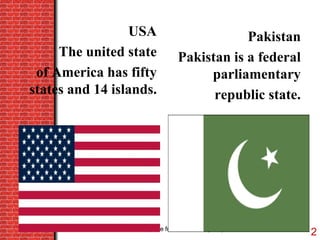
USA
The united state
of America has fifty
states and 14 islands.
Pakistan
Pakistan is a federal
parliamentary
republic state.
9/26/2018 Free template from www.brainybetty.com
2
Introduction of USA and Pakistan
• state has a capital
and the country
• CapitalWashingt
on, D.C.
• Population(2010
) 308,745,538;
(2014est.)
318,636,000
• Official religion
• none
• Pakistan is a
federation country
• compromise 5
provinces
• Punjab, Khyber-
Pakhtunkhwa,
Sindh, and
Balochistan. four
territories: Gilgit–
Baltistan,and
kashmir
• The United
States is a
country located
in North
America
bordering the
Atlantic Ocean
and Pacific
Ocean south of
Canada and
north of Mexico.
• Capital
• Islamabad
Population (2014
est.): 196,174,38
0 (growth rate:
1.49
• Religion
• Islam
9/26/2018 Free template from www.brainybetty.com
4
Introduction of pakistan and USA
USA
• USA, country in
North America,
consisting of 48
contiguous states
and the
noncontiguous
states of Alaska
and Hawaii. and
north of Mexico.
PAKISTAN
• Pakistan is
situated in the
western part of
the Indian
subcontinent,
with Afghanistan
and Iran on the
west, India on
the east, and the
Arabian Sea on
the south. 5
Objectives of
U.S.A
Our main objective
is to provide a high
quality education.
• Reform the U.S.
education system to
help make it the
best in the world.
• Make the education
department a high
performance
organization
Objective of
Pakistan
To make the Quran
principles and
Islamic practices an
integral part of
curriculum.
To meet the basic
learning needs of
children in terms of
learning tools and
contents
Curriculum of
U.S.A
• curriculum is all
the learning
experiences
planned and
directed by the
school to attain
goals.(Tyler,1957)
• American School’s
innovative paper-
based and online
curriculum.
Curriculum of
Pakistan
• Curriculum
objectives are
basically derived
from the
recommendations of
National Education
Policy
• National framework:
syllabus and weight
age
7
Teaching methods
of U.S.A
• term Teaching
method refers to
the general
principles,
pedagogy and
Management
Instructional
strategies
Sheltered
Instruction
Active Learning
Teaching methods
of Pakistan
• We have traditional
style of teaching
technique and
methodology in
Pakistan. There is a
desire and extreme
need that we should
change this teaching
criterion
Problem-Solving
Cooperative learning8
• Sheltered English
is an instructional
approach that
engages English
Language Learners
(ELLs) above the
beginner
• Active Learning
• The New America
Schools instruction
is built on the idea
of active, not
passive learning
Cooperative
Learning Get
information on
cooperative learning,
instructional strategy
in which small
groups of students
work together on a
common task.
• Problem-solving is
the ability to identify
and solve problems
by appropriate skills
9
Evaluation in U.S.A
• The SAT is a
standardized test for
most college
admissions in the
United States.
• The ACT originally
an abbreviation of
American College
Testing) assessment
is a standardized test
for high school
achievement.
Evaluation in
Pakistan
The examination
system evaluates the
students and, through
a process of analysis
of result and audit,
examines Curriculum
Teaching method and
techniques to evaluate
the knowledge and
competence of
students.
Educational
Facilities of U.S.A
• An effective school
facility responsive to
the changing
programs of
Educational delivery
and at a minimum
provide environment
safe, secure, well
Ventilated illuminated
classroom for all
Educational
facilities of
Pakistani
• In Pakistan many
educational facilities
are provide such as
• Safe Classroom
• Libraries
• Computer lab
• Playground
• cafeteria
• Transportation
Teacher
education in
U.S.A
• The aims and
objectives of
American Teacher
Education include
• (a) Preparing
teachers for the
needs and
aspirations of
American as a
democratic nation.
 Teacher Education
in Pakistan
• Teacher education is
conducted in
institutions under
the control of the
Provincial Education
the purpose of teacher
education is best
fulfilled when
teacher preparation
necessarily include
Role of teacher in
U.S.A
An effective teacher
understands that
teaching involves
multiple hats to
ensure that the school
day runs smoothly
and all students
receive a quality
education.
Planning, Instruction
Student Interaction
• Role of teacher in
Pakistan
• The teacher is the
yardstick that
measures the
achievements and
aspirations of the
nation.
Resource Provider
Instructional
Specialist, Curriculum
Specialist ,Classroom
Supporter
Planning
At the planning
stage, teachers play
multiple roles.
Instruction Teacher
Give information and
tools they need to
master a Subject.
Student Interaction
teachers involve
interacting with
Resource Provider
• Teachers help their
colleagues by sharing
Instructional
Resources.
• Instructional
Specialists. An
instructional
specialist helps
colleagues implement
Teaching strategies
The structure of
U.S. education
includes 12 years
of regular
schooling,
preceded by a year
or two of pre-
school education.
• School Entry
• U.S. children
enter formal
schooling around
age 6
Structure of
Pakistan Education
• The education system
• divided into five
levels:-Primary
(Grades one to
Grade 5). Middle
(Grades six to Grade
8).High (Grade Nine to
Grade 10)
Intermediate(Grade
eleven to 12)University.
Duration of School
• Formal schooling
lasts 12 years, until
around age 18.
Formal primary
education is called
Elementary
Education and
ranges from first
grade through
grade 4, 5, or 6,
depending on state
regulations.
• Primary level of
education
Pre-School education
is designed for 3-5
years old and usually
consists of three stages
(Play Group, Nursery
and Kindergarten.
• Middle
students are promoted
in to Middle Level
grade 6 to 8.
• Compulsory
Schooling
• Compulsory
schooling ends by
law at age 16 in 30
states, at age 17 in
nine states, and at
age 18 in 11 states
plus the District of
Columbia
• High level
• Students are promoted
to High/Secondary
Level ie grade 9 to 10
which is also known
Secondary School
Certificate (SSC).
Students are required
administered by a
regional Board of
Intermediate &
Secondary Education
(BISE)
17
• At the school
levels, around 6
million students
receive some
form of special
needs instruction
and support for
diagnosed
disabilities
• Intermediate
The students are
promoted to grade 11
after passing of grade
10.This level of
education is FSc/FA
University level
After HSSC students
may study in a
Professional college
University for bachelor
degree courses
Administrative
and financial set up
in U.S.A
• The programs in
Administration
provide the skills
needed for careers
in administration in
post-secondary as
well as for research
and teaching in
higher education
Administration
and financial set up
in Pakistan
Public Administration
training institutions
established under
government control
were given theresearch
task instead of using
universities‘
departments of Public
Administration.
Linguistic factor
of U.S.A
• total population
speaking that
language English
82.1%, Spanish
10.7%, other Indo-
European 3.8%,
Asian and Pacific
island 2.7%, other
0.7% (2000
census) Engish
has required
education state
Linguistic factor of
Pakistan
• Official Language:
Urdu, English
Punjabi (spoken by
48% of country’s
population), Sindhi
(12%),Siraiki(10%),
Pashtu
(8%), Balochi (3%),
Hindko (2%), Brahui
(1%), Burushaski
Other (8%)
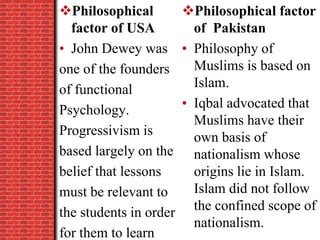
Philosophical
factor of USA
• John Dewey was
one of the founders
of functional
Psychology.
Progressivism is
based largely on the
belief that lessons
must be relevant to
the students in order
for them to learn
Philosophical factor
of Pakistan
• Philosophy of
Muslims is based on
Islam.
• Iqbal advocated that
Muslims have their
own basis of
nationalism whose
origins lie in Islam.
Islam did not follow
the confined scope of
nationalism.
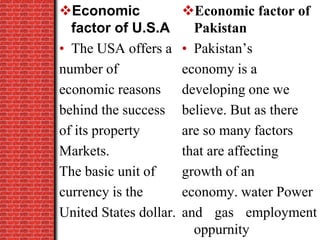
Economic
factor of U.S.A
• The USA offers a
number of
economic reasons
behind the success
of its property
Markets.
The basic unit of
currency is the
United States dollar.
Economic factor of
Pakistan
• Pakistan’s
economy is a
developing one we
believe. But as there
are so many factors
that are affecting
growth of an
economy. water Power
and gas employment
oppurnity
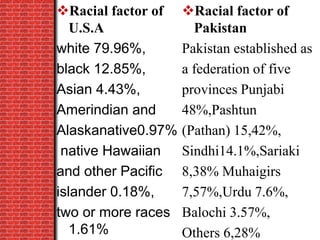
Racial factor of
U.S.A
white 79.96%,
black 12.85%,
Asian 4.43%,
Amerindian and
Alaskanative0.97%
native Hawaiian
and other Pacific
islander 0.18%,
two or more races
1.61%
Racial factor of
Pakistan
Pakistan established as
a federation of five
provinces Punjabi
48%,Pashtun
(Pathan) 15,42%,
Sindhi14.1%,Sariaki
8,38% Muhaigirs
7,57%,Urdu 7.6%,
Balochi 3.57%,
Others 6,28%
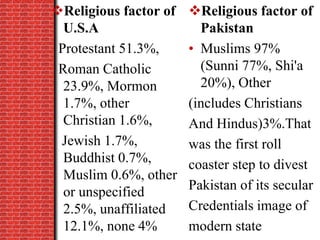
Religious factor of
U.S.A
Protestant 51.3%,
Roman Catholic
23.9%, Mormon
1.7%, other
Christian 1.6%,
Jewish 1.7%,
Buddhist 0.7%,
Muslim 0.6%, other
or unspecified
2.5%, unaffiliated
12.1%, none 4%
Religious factor of
Pakistan
• Muslims 97%
(Sunni 77%, Shi'a
20%), Other
(includes Christians
And Hindus)3%.That
was the first roll
coaster step to divest
Pakistan of its secular
Credentials image of
modern state
Democratic
factors in U.S.A
• The United
States
government is
based on
federalism, with
governmental
power divided
between several
entities.
Democratic factor
of Pakistan
its founders
intended it to be a
“democratic state”,
but the political
Evolution of
Pakistan—as is well
known—has taken a
complex and Multi
faceted path
the several efforts to
establish democratic
systems in Pakistan
were “short-lived”,
except that of “Zardari
Gilani era” (2008-2013)
and never really
operational and
functional enough to
test their suitability,
stability, and solidity.
• Federalism
• The United States
government is
based
on federalism.
Federalism is a
method of
government that
allows two or
more entities to
share control over
the same
geographic region

Usa & Pakistan education system

  • 1.
    Elements and factors ofUSA and Pakistan Submited to Ma’m Abida Khalid Submitted by
  • 2.
    USA The united state ofAmerica has fifty states and 14 islands. Pakistan Pakistan is a federal parliamentary republic state. 9/26/2018 Free template from www.brainybetty.com 2
  • 3.
    Introduction of USAand Pakistan • state has a capital and the country • CapitalWashingt on, D.C. • Population(2010 ) 308,745,538; (2014est.) 318,636,000 • Official religion • none • Pakistan is a federation country • compromise 5 provinces • Punjab, Khyber- Pakhtunkhwa, Sindh, and Balochistan. four territories: Gilgit– Baltistan,and kashmir
  • 4.
    • The United Statesis a country located in North America bordering the Atlantic Ocean and Pacific Ocean south of Canada and north of Mexico. • Capital • Islamabad Population (2014 est.): 196,174,38 0 (growth rate: 1.49 • Religion • Islam 9/26/2018 Free template from www.brainybetty.com 4
  • 5.
    Introduction of pakistanand USA USA • USA, country in North America, consisting of 48 contiguous states and the noncontiguous states of Alaska and Hawaii. and north of Mexico. PAKISTAN • Pakistan is situated in the western part of the Indian subcontinent, with Afghanistan and Iran on the west, India on the east, and the Arabian Sea on the south. 5
  • 6.
    Objectives of U.S.A Our mainobjective is to provide a high quality education. • Reform the U.S. education system to help make it the best in the world. • Make the education department a high performance organization Objective of Pakistan To make the Quran principles and Islamic practices an integral part of curriculum. To meet the basic learning needs of children in terms of learning tools and contents
  • 7.
    Curriculum of U.S.A • curriculumis all the learning experiences planned and directed by the school to attain goals.(Tyler,1957) • American School’s innovative paper- based and online curriculum. Curriculum of Pakistan • Curriculum objectives are basically derived from the recommendations of National Education Policy • National framework: syllabus and weight age 7
  • 8.
    Teaching methods of U.S.A •term Teaching method refers to the general principles, pedagogy and Management Instructional strategies Sheltered Instruction Active Learning Teaching methods of Pakistan • We have traditional style of teaching technique and methodology in Pakistan. There is a desire and extreme need that we should change this teaching criterion Problem-Solving Cooperative learning8
  • 9.
    • Sheltered English isan instructional approach that engages English Language Learners (ELLs) above the beginner • Active Learning • The New America Schools instruction is built on the idea of active, not passive learning Cooperative Learning Get information on cooperative learning, instructional strategy in which small groups of students work together on a common task. • Problem-solving is the ability to identify and solve problems by appropriate skills 9
  • 10.
    Evaluation in U.S.A •The SAT is a standardized test for most college admissions in the United States. • The ACT originally an abbreviation of American College Testing) assessment is a standardized test for high school achievement. Evaluation in Pakistan The examination system evaluates the students and, through a process of analysis of result and audit, examines Curriculum Teaching method and techniques to evaluate the knowledge and competence of students.
  • 11.
    Educational Facilities of U.S.A •An effective school facility responsive to the changing programs of Educational delivery and at a minimum provide environment safe, secure, well Ventilated illuminated classroom for all Educational facilities of Pakistani • In Pakistan many educational facilities are provide such as • Safe Classroom • Libraries • Computer lab • Playground • cafeteria • Transportation
  • 12.
    Teacher education in U.S.A • Theaims and objectives of American Teacher Education include • (a) Preparing teachers for the needs and aspirations of American as a democratic nation.  Teacher Education in Pakistan • Teacher education is conducted in institutions under the control of the Provincial Education the purpose of teacher education is best fulfilled when teacher preparation necessarily include
  • 13.
    Role of teacherin U.S.A An effective teacher understands that teaching involves multiple hats to ensure that the school day runs smoothly and all students receive a quality education. Planning, Instruction Student Interaction • Role of teacher in Pakistan • The teacher is the yardstick that measures the achievements and aspirations of the nation. Resource Provider Instructional Specialist, Curriculum Specialist ,Classroom Supporter
  • 14.
    Planning At the planning stage,teachers play multiple roles. Instruction Teacher Give information and tools they need to master a Subject. Student Interaction teachers involve interacting with Resource Provider • Teachers help their colleagues by sharing Instructional Resources. • Instructional Specialists. An instructional specialist helps colleagues implement Teaching strategies
  • 15.
    The structure of U.S.education includes 12 years of regular schooling, preceded by a year or two of pre- school education. • School Entry • U.S. children enter formal schooling around age 6 Structure of Pakistan Education • The education system • divided into five levels:-Primary (Grades one to Grade 5). Middle (Grades six to Grade 8).High (Grade Nine to Grade 10) Intermediate(Grade eleven to 12)University.
  • 16.
    Duration of School •Formal schooling lasts 12 years, until around age 18. Formal primary education is called Elementary Education and ranges from first grade through grade 4, 5, or 6, depending on state regulations. • Primary level of education Pre-School education is designed for 3-5 years old and usually consists of three stages (Play Group, Nursery and Kindergarten. • Middle students are promoted in to Middle Level grade 6 to 8.
  • 17.
    • Compulsory Schooling • Compulsory schoolingends by law at age 16 in 30 states, at age 17 in nine states, and at age 18 in 11 states plus the District of Columbia • High level • Students are promoted to High/Secondary Level ie grade 9 to 10 which is also known Secondary School Certificate (SSC). Students are required administered by a regional Board of Intermediate & Secondary Education (BISE) 17
  • 18.
    • At theschool levels, around 6 million students receive some form of special needs instruction and support for diagnosed disabilities • Intermediate The students are promoted to grade 11 after passing of grade 10.This level of education is FSc/FA University level After HSSC students may study in a Professional college University for bachelor degree courses
  • 19.
    Administrative and financial setup in U.S.A • The programs in Administration provide the skills needed for careers in administration in post-secondary as well as for research and teaching in higher education Administration and financial set up in Pakistan Public Administration training institutions established under government control were given theresearch task instead of using universities‘ departments of Public Administration.
  • 20.
    Linguistic factor of U.S.A •total population speaking that language English 82.1%, Spanish 10.7%, other Indo- European 3.8%, Asian and Pacific island 2.7%, other 0.7% (2000 census) Engish has required education state Linguistic factor of Pakistan • Official Language: Urdu, English Punjabi (spoken by 48% of country’s population), Sindhi (12%),Siraiki(10%), Pashtu (8%), Balochi (3%), Hindko (2%), Brahui (1%), Burushaski Other (8%)
  • 21.
    Philosophical factor of USA •John Dewey was one of the founders of functional Psychology. Progressivism is based largely on the belief that lessons must be relevant to the students in order for them to learn Philosophical factor of Pakistan • Philosophy of Muslims is based on Islam. • Iqbal advocated that Muslims have their own basis of nationalism whose origins lie in Islam. Islam did not follow the confined scope of nationalism.
  • 22.
    Economic factor of U.S.A •The USA offers a number of economic reasons behind the success of its property Markets. The basic unit of currency is the United States dollar. Economic factor of Pakistan • Pakistan’s economy is a developing one we believe. But as there are so many factors that are affecting growth of an economy. water Power and gas employment oppurnity
  • 23.
    Racial factor of U.S.A white79.96%, black 12.85%, Asian 4.43%, Amerindian and Alaskanative0.97% native Hawaiian and other Pacific islander 0.18%, two or more races 1.61% Racial factor of Pakistan Pakistan established as a federation of five provinces Punjabi 48%,Pashtun (Pathan) 15,42%, Sindhi14.1%,Sariaki 8,38% Muhaigirs 7,57%,Urdu 7.6%, Balochi 3.57%, Others 6,28%
  • 24.
    Religious factor of U.S.A Protestant51.3%, Roman Catholic 23.9%, Mormon 1.7%, other Christian 1.6%, Jewish 1.7%, Buddhist 0.7%, Muslim 0.6%, other or unspecified 2.5%, unaffiliated 12.1%, none 4% Religious factor of Pakistan • Muslims 97% (Sunni 77%, Shi'a 20%), Other (includes Christians And Hindus)3%.That was the first roll coaster step to divest Pakistan of its secular Credentials image of modern state
  • 25.
    Democratic factors in U.S.A •The United States government is based on federalism, with governmental power divided between several entities. Democratic factor of Pakistan its founders intended it to be a “democratic state”, but the political Evolution of Pakistan—as is well known—has taken a complex and Multi faceted path
  • 26.
    the several effortsto establish democratic systems in Pakistan were “short-lived”, except that of “Zardari Gilani era” (2008-2013) and never really operational and functional enough to test their suitability, stability, and solidity. • Federalism • The United States government is based on federalism. Federalism is a method of government that allows two or more entities to share control over the same geographic region