MOHAMMAD SALMANMOHAMMAD SALMAN
JHANG- LS-001JHANG- LS-001
Improvement inImprovement in
Education in PakistanEducation in Pakistan
2
Contents
PART - I
• Definition of Education
• Constitution of Pakistan
PART – II
• Education Scenario
• Role of HEC
• Role of PEC
3
Definition of Education
The definition of education in common
usage, that education is merely the
delivery of knowledge, skills and
information from teachers to students, is
inadequate to capture what is really
important about being and becoming
educated.
4
The proper definition of education is the
process of becoming an educated
person.
Being an educated person means you
have access to optimal states of mind
regardless of the situation you are in.
5
Constitution of Pakistan
6
Constitution of the Islamic Republic of
Pakistan, 1973 – Article 37-b
“The State shall remove illiteracy and
provide free and compulsory
secondary education within
minimum possible period”
7
Curriculum, syllabus, planning,
policy, centers of excellence,
standard of education & Islamic
education
Concurrent Legislative List:
8
PART – II
EDUCATION SCENARIO
9
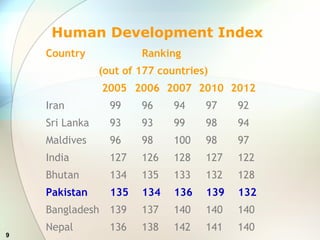
Human Development Index
Country Ranking
(out of 177 countries)
2005 2006 2007 2010 2012
Iran 99 96 94 97 92
Sri Lanka 93 93 99 98 94
Maldives 96 98 100 98 97
India 127 126 128 127 122
Bhutan 134 135 133 132 128
Pakistan 135 134 136 139 132
Bangladesh 139 137 140 140 140
Nepal 136 138 142 141 140
10
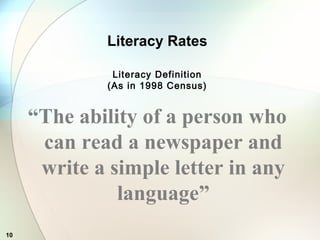
Literacy Rates
Literacy Definition
(As in 1998 Census)
“The ability of a person who
can read a newspaper and
write a simple letter in any
language”
11
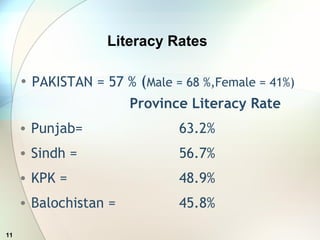
Literacy Rates
• PAKISTAN = 57 % (Male = 68 %,Female = 41%)
Province Literacy Rate
• Punjab= 63.2%
• Sindh = 56.7%
• KPK = 48.9%
• Balochistan = 45.8%
12
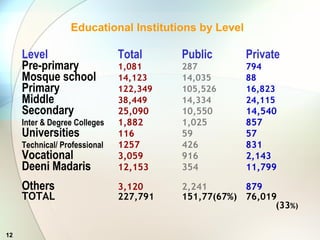
Educational Institutions by Level
Level Total Public Private
Pre-primary 1,081 287 794
Mosque school 14,123 14,035 88
Primary 122,349 105,526 16,823
Middle 38,449 14,334 24,115
Secondary 25,090 10,550 14,540
Inter & Degree Colleges 1,882 1,025 857
Universities 116 59 57
Technical/ Professional 1257 426 831
Vocational 3,059 916 2,143
Deeni Madaris 12,153 354 11,799
Others 3,120 2,241 879
TOTAL 227,791 151,77(67%) 76,019
(33%)
13
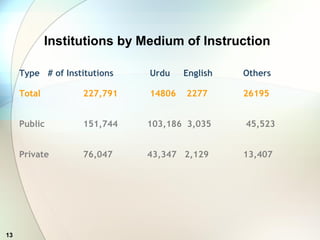
Institutions by Medium of Instruction
Type # of Institutions Urdu English Others
Total 227,791 14806 2277 26195
Public 151,744 103,186 3,035 45,523
Private 76,047 43,347 2,129 13,407
14
Role of HEC in Educational Development
15
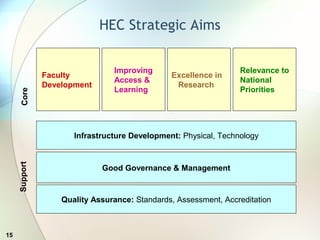
HEC Strategic Aims
Infrastructure Development: Physical, Technology
Good Governance & Management
Quality Assurance: Standards, Assessment, Accreditation
Faculty
Development
Improving
Access &
Learning
Excellence in
Research
Relevance to
National
Priorities
CoreSupport
16
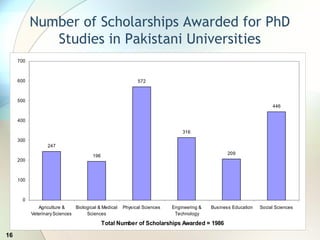
Number of Scholarships Awarded for PhD
Studies in Pakistani Universities
247
196
572
316
209
446
0
100
200
300
400
500
600
700
Agriculture &
Veterinary Sciences
Biological & Medical
Sciences
Physical Sciences Engineering &
Technology
Business Education Social Sciences
Total Number of Scholarships Awarded = 1986
Achievements: Faculty Development
17
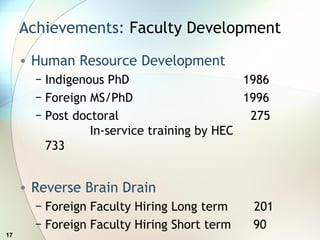
• Human Resource Development
− Indigenous PhD 1986
− Foreign MS/PhD 1996
− Post doctoral 275
In-service training by HEC
733
• Reverse Brain Drain
− Foreign Faculty Hiring Long term 201
− Foreign Faculty Hiring Short term 90
Role of PEC in Education Development
18
19
SALIENT FEATURES OF PEC
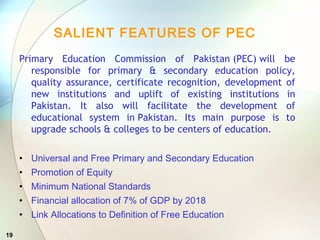
Primary Education Commission of Pakistan (PEC) will be
responsible for primary & secondary education policy,
quality assurance, certificate recognition, development of
new institutions and uplift of existing institutions in
Pakistan. It also will facilitate the development of
educational system in Pakistan. Its main purpose is to
upgrade schools & colleges to be centers of education.
• Universal and Free Primary and Secondary Education
• Promotion of Equity
• Minimum National Standards
• Financial allocation of 7% of GDP by 2018
• Link Allocations to Definition of Free Education
20
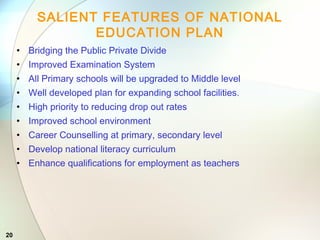
SALIENT FEATURES OF NATIONAL
EDUCATION PLAN
• Bridging the Public Private Divide
• Improved Examination System
• All Primary schools will be upgraded to Middle level
• Well developed plan for expanding school facilities.
• High priority to reducing drop out rates
• Improved school environment
• Career Counselling at primary, secondary level
• Develop national literacy curriculum
• Enhance qualifications for employment as teachers
21
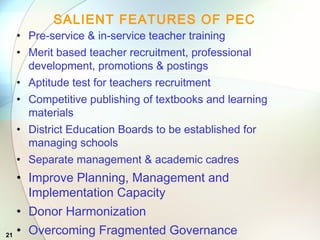
SALIENT FEATURES OF PEC
• Pre-service & in-service teacher training
• Merit based teacher recruitment, professional
development, promotions & postings
• Aptitude test for teachers recruitment
• Competitive publishing of textbooks and learning
materials
• District Education Boards to be established for
managing schools
• Separate management & academic cadres
• Improve Planning, Management and
Implementation Capacity
• Donor Harmonization
• Overcoming Fragmented Governance
22
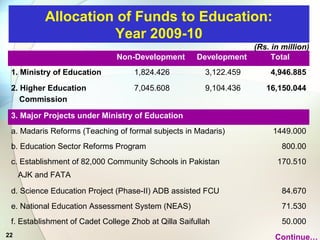
Non-Development Development Total
1. Ministry of Education 1,824.426 3,122.459 4,946.885
2. Higher Education
Commission
7,045.608 9,104.436 16,150.044
(Rs. in million)
Allocation of Funds to Education:
Year 2009-10
3. Major Projects under Ministry of Education
a. Madaris Reforms (Teaching of formal subjects in Madaris) 1449.000
b. Education Sector Reforms Program 800.00
c. Establishment of 82,000 Community Schools in Pakistan
AJK and FATA
170.510
d. Science Education Project (Phase-II) ADB assisted FCU 84.670
e. National Education Assessment System (NEAS) 71.530
f. Establishment of Cadet College Zhob at Qilla Saifullah 50.000
Continue…
23
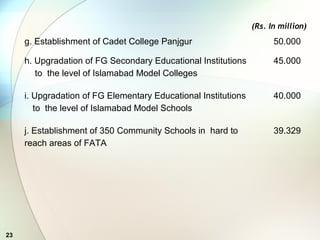
g. Establishment of Cadet College Panjgur 50.000
h. Upgradation of FG Secondary Educational Institutions
to the level of Islamabad Model Colleges
45.000
i. Upgradation of FG Elementary Educational Institutions
to the level of Islamabad Model Schools
40.000
j. Establishment of 350 Community Schools in hard to
reach areas of FATA
39.329
(Rs. In million)
24
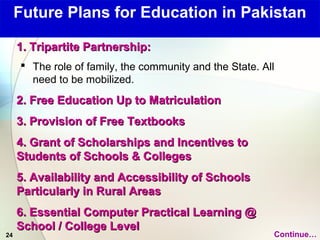
1. Tripartite Partnership:1. Tripartite Partnership:
 The role of family, the community and the State. All
need to be mobilized.
2. Free Education Up to Matriculation2. Free Education Up to Matriculation
3. Provision of Free Textbooks3. Provision of Free Textbooks
4. Grant of Scholarships and Incentives to4. Grant of Scholarships and Incentives to
Students of Schools & CollegesStudents of Schools & Colleges
5. Availability and Accessibility of Schools5. Availability and Accessibility of Schools
Particularly in Rural AreasParticularly in Rural Areas
6. Essential Computer Practical Learning @6. Essential Computer Practical Learning @
School / College LevelSchool / College Level
Future Plans for Education in Pakistan
Continue…
25
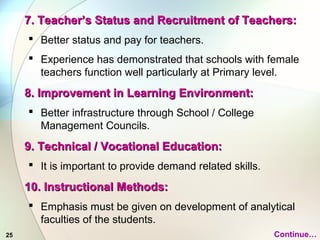
7. Teacher’s Status and Recruitment of Teachers:7. Teacher’s Status and Recruitment of Teachers:
 Better status and pay for teachers.
 Experience has demonstrated that schools with female
teachers function well particularly at Primary level.
8. Improvement in Learning Environment:8. Improvement in Learning Environment:
 Better infrastructure through School / College
Management Councils.
9. Technical / Vocational Education:9. Technical / Vocational Education:
 It is important to provide demand related skills.
10. Instructional Methods:10. Instructional Methods:
 Emphasis must be given on development of analytical
faculties of the students.
Continue…
26
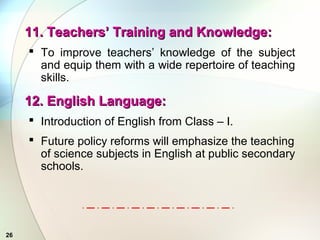
11. Teachers’ Training and Knowledge:11. Teachers’ Training and Knowledge:
 To improve teachers’ knowledge of the subject
and equip them with a wide repertoire of teaching
skills.
12. English Language:12. English Language:
 Introduction of English from Class – I.
 Future policy reforms will emphasize the teaching
of science subjects in English at public secondary
schools.
27
Thank You AllThank You All

How Education in Pakistan can be improved?

  • 1.
    MOHAMMAD SALMANMOHAMMAD SALMAN JHANG-LS-001JHANG- LS-001 Improvement inImprovement in Education in PakistanEducation in Pakistan
  • 2.
    2 Contents PART - I •Definition of Education • Constitution of Pakistan PART – II • Education Scenario • Role of HEC • Role of PEC
  • 3.
    3 Definition of Education Thedefinition of education in common usage, that education is merely the delivery of knowledge, skills and information from teachers to students, is inadequate to capture what is really important about being and becoming educated.
  • 4.
    4 The proper definitionof education is the process of becoming an educated person. Being an educated person means you have access to optimal states of mind regardless of the situation you are in.
  • 5.
  • 6.
    6 Constitution of theIslamic Republic of Pakistan, 1973 – Article 37-b “The State shall remove illiteracy and provide free and compulsory secondary education within minimum possible period”
  • 7.
    7 Curriculum, syllabus, planning, policy,centers of excellence, standard of education & Islamic education Concurrent Legislative List:
  • 8.
  • 9.
    9 Human Development Index CountryRanking (out of 177 countries) 2005 2006 2007 2010 2012 Iran 99 96 94 97 92 Sri Lanka 93 93 99 98 94 Maldives 96 98 100 98 97 India 127 126 128 127 122 Bhutan 134 135 133 132 128 Pakistan 135 134 136 139 132 Bangladesh 139 137 140 140 140 Nepal 136 138 142 141 140
  • 10.
    10 Literacy Rates Literacy Definition (Asin 1998 Census) “The ability of a person who can read a newspaper and write a simple letter in any language”
  • 11.
    11 Literacy Rates • PAKISTAN= 57 % (Male = 68 %,Female = 41%) Province Literacy Rate • Punjab= 63.2% • Sindh = 56.7% • KPK = 48.9% • Balochistan = 45.8%
  • 12.
    12 Educational Institutions byLevel Level Total Public Private Pre-primary 1,081 287 794 Mosque school 14,123 14,035 88 Primary 122,349 105,526 16,823 Middle 38,449 14,334 24,115 Secondary 25,090 10,550 14,540 Inter & Degree Colleges 1,882 1,025 857 Universities 116 59 57 Technical/ Professional 1257 426 831 Vocational 3,059 916 2,143 Deeni Madaris 12,153 354 11,799 Others 3,120 2,241 879 TOTAL 227,791 151,77(67%) 76,019 (33%)
  • 13.
    13 Institutions by Mediumof Instruction Type # of Institutions Urdu English Others Total 227,791 14806 2277 26195 Public 151,744 103,186 3,035 45,523 Private 76,047 43,347 2,129 13,407
  • 14.
    14 Role of HECin Educational Development
  • 15.
    15 HEC Strategic Aims InfrastructureDevelopment: Physical, Technology Good Governance & Management Quality Assurance: Standards, Assessment, Accreditation Faculty Development Improving Access & Learning Excellence in Research Relevance to National Priorities CoreSupport
  • 16.
    16 Number of ScholarshipsAwarded for PhD Studies in Pakistani Universities 247 196 572 316 209 446 0 100 200 300 400 500 600 700 Agriculture & Veterinary Sciences Biological & Medical Sciences Physical Sciences Engineering & Technology Business Education Social Sciences Total Number of Scholarships Awarded = 1986
  • 17.
    Achievements: Faculty Development 17 •Human Resource Development − Indigenous PhD 1986 − Foreign MS/PhD 1996 − Post doctoral 275 In-service training by HEC 733 • Reverse Brain Drain − Foreign Faculty Hiring Long term 201 − Foreign Faculty Hiring Short term 90
  • 18.
    Role of PECin Education Development 18
  • 19.
    19 SALIENT FEATURES OFPEC Primary Education Commission of Pakistan (PEC) will be responsible for primary & secondary education policy, quality assurance, certificate recognition, development of new institutions and uplift of existing institutions in Pakistan. It also will facilitate the development of educational system in Pakistan. Its main purpose is to upgrade schools & colleges to be centers of education. • Universal and Free Primary and Secondary Education • Promotion of Equity • Minimum National Standards • Financial allocation of 7% of GDP by 2018 • Link Allocations to Definition of Free Education
  • 20.
    20 SALIENT FEATURES OFNATIONAL EDUCATION PLAN • Bridging the Public Private Divide • Improved Examination System • All Primary schools will be upgraded to Middle level • Well developed plan for expanding school facilities. • High priority to reducing drop out rates • Improved school environment • Career Counselling at primary, secondary level • Develop national literacy curriculum • Enhance qualifications for employment as teachers
  • 21.
    21 SALIENT FEATURES OFPEC • Pre-service & in-service teacher training • Merit based teacher recruitment, professional development, promotions & postings • Aptitude test for teachers recruitment • Competitive publishing of textbooks and learning materials • District Education Boards to be established for managing schools • Separate management & academic cadres • Improve Planning, Management and Implementation Capacity • Donor Harmonization • Overcoming Fragmented Governance
  • 22.
    22 Non-Development Development Total 1.Ministry of Education 1,824.426 3,122.459 4,946.885 2. Higher Education Commission 7,045.608 9,104.436 16,150.044 (Rs. in million) Allocation of Funds to Education: Year 2009-10 3. Major Projects under Ministry of Education a. Madaris Reforms (Teaching of formal subjects in Madaris) 1449.000 b. Education Sector Reforms Program 800.00 c. Establishment of 82,000 Community Schools in Pakistan AJK and FATA 170.510 d. Science Education Project (Phase-II) ADB assisted FCU 84.670 e. National Education Assessment System (NEAS) 71.530 f. Establishment of Cadet College Zhob at Qilla Saifullah 50.000 Continue…
  • 23.
    23 g. Establishment ofCadet College Panjgur 50.000 h. Upgradation of FG Secondary Educational Institutions to the level of Islamabad Model Colleges 45.000 i. Upgradation of FG Elementary Educational Institutions to the level of Islamabad Model Schools 40.000 j. Establishment of 350 Community Schools in hard to reach areas of FATA 39.329 (Rs. In million)
  • 24.
    24 1. Tripartite Partnership:1.Tripartite Partnership:  The role of family, the community and the State. All need to be mobilized. 2. Free Education Up to Matriculation2. Free Education Up to Matriculation 3. Provision of Free Textbooks3. Provision of Free Textbooks 4. Grant of Scholarships and Incentives to4. Grant of Scholarships and Incentives to Students of Schools & CollegesStudents of Schools & Colleges 5. Availability and Accessibility of Schools5. Availability and Accessibility of Schools Particularly in Rural AreasParticularly in Rural Areas 6. Essential Computer Practical Learning @6. Essential Computer Practical Learning @ School / College LevelSchool / College Level Future Plans for Education in Pakistan Continue…
  • 25.
    25 7. Teacher’s Statusand Recruitment of Teachers:7. Teacher’s Status and Recruitment of Teachers:  Better status and pay for teachers.  Experience has demonstrated that schools with female teachers function well particularly at Primary level. 8. Improvement in Learning Environment:8. Improvement in Learning Environment:  Better infrastructure through School / College Management Councils. 9. Technical / Vocational Education:9. Technical / Vocational Education:  It is important to provide demand related skills. 10. Instructional Methods:10. Instructional Methods:  Emphasis must be given on development of analytical faculties of the students. Continue…
  • 26.
    26 11. Teachers’ Trainingand Knowledge:11. Teachers’ Training and Knowledge:  To improve teachers’ knowledge of the subject and equip them with a wide repertoire of teaching skills. 12. English Language:12. English Language:  Introduction of English from Class – I.  Future policy reforms will emphasize the teaching of science subjects in English at public secondary schools.
  • 27.