COURSE CODE# BBA-202
PRESENTATION OF BUSINESS
COMMUNICATION
 Submitted To:
Maim, Shehzeeda Shoukat Bajwa
 Submitted By:
Hina Pervez
Reg# 2013-ag-4830
Maimoona Azhar
Reg# 2013-ag-4848
Arooj Fatima
Reg#2013-ag-4842
Saliha Iftikhar
Reg#2013-ag-4818
Azka Riaz
Reg#2013-ag-4878
Definition of Education
 The process of receiving or giving
systematic instruction, especially at a
school or university.
Levels of Education
 Primary ( grade 1 through 5 )
 Middle ( grade 6 through 8 )
 Secondary ( grade 9 & 10 )
 Higher Secondary ( grade 11 & 12 )
 University Programs
Education in Pakistan
• Education in Pakistan is overseen by
Ministry of Education of government of
Pakistan.
• The academic institution are the
responsibility of provisional government.
• Federal government is responsible for
curriculum development, recognition &
some finance research.
Constitution of Pakistan
• Article 25-A deals with the educational
standards and policies
“The State shall provide free and
compulsory education to all children
of the age of five to sixteen years in such
a manner as may be determined by law”
 Constitution of the Islamic Republic of
Pakistan, 1973 – Article 37-b
“ The State shall remove illiteracy and
Provide free and compulsory
secondary
education within minimum possible
period”
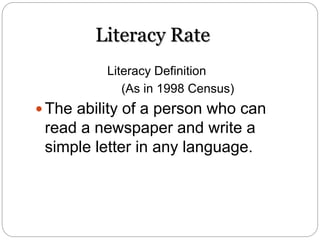
Literacy Rate
Literacy Definition
(As in 1998 Census)
 The ability of a person who can
read a newspaper and write a
simple letter in any language.
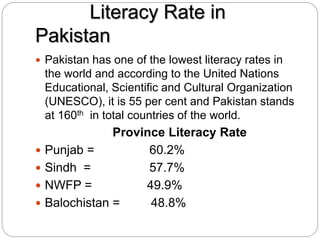
Literacy Rate in
Pakistan
 Pakistan has one of the lowest literacy rates in
the world and according to the United Nations
Educational, Scientific and Cultural Organization
(UNESCO), it is 55 per cent and Pakistan stands
at 160th in total countries of the world.
Province Literacy Rate
 Punjab = 60.2%
 Sindh = 57.7%
 NWFP = 49.9%
 Balochistan = 48.8%
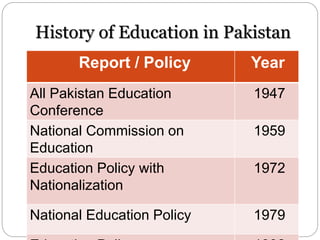
History of Education in Pakistan
Report / Policy Year
All Pakistan Education
Conference
1947
National Commission on
Education
1959
Education Policy with
Nationalization
1972
National Education Policy 1979
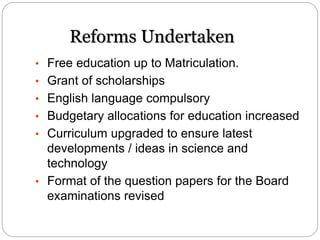
Reforms Undertaken
• Free education up to Matriculation.
• Grant of scholarships
• English language compulsory
• Budgetary allocations for education increased
• Curriculum upgraded to ensure latest
developments / ideas in science and
technology
• Format of the question papers for the Board
examinations revised
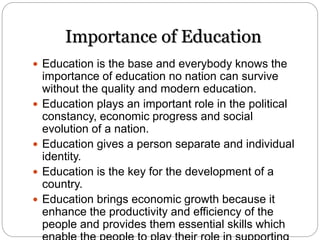
Importance of Education
 Education is the base and everybody knows the
importance of education no nation can survive
without the quality and modern education.
 Education plays an important role in the political
constancy, economic progress and social
evolution of a nation.
 Education gives a person separate and individual
identity.
 Education is the key for the development of a
country.
 Education brings economic growth because it
enhance the productivity and efficiency of the
people and provides them essential skills which
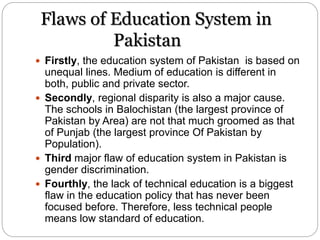
Flaws of Education System in
Pakistan
 Firstly, the education system of Pakistan is based on
unequal lines. Medium of education is different in
both, public and private sector.
 Secondly, regional disparity is also a major cause.
The schools in Balochistan (the largest province of
Pakistan by Area) are not that much groomed as that
of Punjab (the largest province Of Pakistan by
Population).
 Third major flaw of education system in Pakistan is
gender discrimination.
 Fourthly, the lack of technical education is a biggest
flaw in the education policy that has never been
focused before. Therefore, less technical people
means low standard of education.
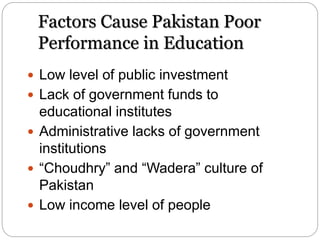
Factors Cause Pakistan Poor
Performance in Education
 Low level of public investment
 Lack of government funds to
educational institutes
 Administrative lacks of government
institutions
 “Choudhry” and “Wadera” culture of
Pakistan
 Low income level of people
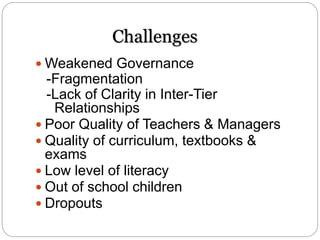
Challenges
 Weakened Governance
-Fragmentation
-Lack of Clarity in Inter-Tier
Relationships
 Poor Quality of Teachers & Managers
 Quality of curriculum, textbooks &
exams
 Low level of literacy
 Out of school children
 Dropouts
Recommendations
 Decentralized Education System
 Uniform and Updated Syllabi for all Pakistan
 Budget should be increased up to 8% and must be
well organized.
 Primary education for all
 Girls education should be encouraged
 Incentives for teachers
 Promotion of technical education
 Security for the education institutes
 Special Attention for the rural areas
 Examination System should be clean
 Expansion in Universities
Advantages of Education
 An educated person can lead an educated, manner
able life without any difficulty.
 Education builds up our confidence, so an educated
person can talk to anyone with more confidently
instead of any illiterate person.
 An educated person can go anywhere in the world
without any hesitation. Because he knows, how to
deal anyone at that place & how to live there.
 Educated person knows, how to use modern
technologies. So he can use any type of technology.
 It build our personality and bring a huge change in our
talking style.
Future Plans for Education in
Pakistan
 Free Education Up to Matriculation.
 Provision of Free Textbooks.
 Grant of Scholarships and Incentives to Girl
Students.
 Availability and Accessibility of Schools
Particularly in Rural Areas.
 Teacher’s Status and Recruitment of Female
Teachers:
 Better status and pay for teachers.
 Experience has demonstrated that schools with
female teachers function well particularly at
Primary level.
 Improvement in Learning Environment:
 Better infrastructure through School
Management Councils.
 Technical / Vocational Education:
 It is important to provide demand related skills.
 Instructional Methods:
 Emphasis must be given on development of analytical
faculties of the students.
 Teachers’ Training and Knowledge:
 To improve teachers’ knowledge of the subject and
equip them with a wide repertoire of teaching skills.
 English Language:
 Introduction of English from Class – I.
 Future policy reforms will emphasize the teaching of
science subjects in English at public secondary
schools.
Presentation of-business-communication

Presentation of-business-communication

  • 2.
    COURSE CODE# BBA-202 PRESENTATIONOF BUSINESS COMMUNICATION
  • 3.
     Submitted To: Maim,Shehzeeda Shoukat Bajwa  Submitted By: Hina Pervez Reg# 2013-ag-4830 Maimoona Azhar Reg# 2013-ag-4848 Arooj Fatima Reg#2013-ag-4842 Saliha Iftikhar Reg#2013-ag-4818 Azka Riaz Reg#2013-ag-4878
  • 5.
    Definition of Education The process of receiving or giving systematic instruction, especially at a school or university.
  • 6.
    Levels of Education Primary ( grade 1 through 5 )  Middle ( grade 6 through 8 )  Secondary ( grade 9 & 10 )  Higher Secondary ( grade 11 & 12 )  University Programs
  • 7.
    Education in Pakistan •Education in Pakistan is overseen by Ministry of Education of government of Pakistan. • The academic institution are the responsibility of provisional government. • Federal government is responsible for curriculum development, recognition & some finance research.
  • 8.
    Constitution of Pakistan •Article 25-A deals with the educational standards and policies “The State shall provide free and compulsory education to all children of the age of five to sixteen years in such a manner as may be determined by law”
  • 9.
     Constitution ofthe Islamic Republic of Pakistan, 1973 – Article 37-b “ The State shall remove illiteracy and Provide free and compulsory secondary education within minimum possible period”
  • 10.
    Literacy Rate Literacy Definition (Asin 1998 Census)  The ability of a person who can read a newspaper and write a simple letter in any language.
  • 11.
    Literacy Rate in Pakistan Pakistan has one of the lowest literacy rates in the world and according to the United Nations Educational, Scientific and Cultural Organization (UNESCO), it is 55 per cent and Pakistan stands at 160th in total countries of the world. Province Literacy Rate  Punjab = 60.2%  Sindh = 57.7%  NWFP = 49.9%  Balochistan = 48.8%
  • 12.
    History of Educationin Pakistan Report / Policy Year All Pakistan Education Conference 1947 National Commission on Education 1959 Education Policy with Nationalization 1972 National Education Policy 1979
  • 13.
    Reforms Undertaken • Freeeducation up to Matriculation. • Grant of scholarships • English language compulsory • Budgetary allocations for education increased • Curriculum upgraded to ensure latest developments / ideas in science and technology • Format of the question papers for the Board examinations revised
  • 14.
    Importance of Education Education is the base and everybody knows the importance of education no nation can survive without the quality and modern education.  Education plays an important role in the political constancy, economic progress and social evolution of a nation.  Education gives a person separate and individual identity.  Education is the key for the development of a country.  Education brings economic growth because it enhance the productivity and efficiency of the people and provides them essential skills which
  • 15.
    Flaws of EducationSystem in Pakistan  Firstly, the education system of Pakistan is based on unequal lines. Medium of education is different in both, public and private sector.  Secondly, regional disparity is also a major cause. The schools in Balochistan (the largest province of Pakistan by Area) are not that much groomed as that of Punjab (the largest province Of Pakistan by Population).  Third major flaw of education system in Pakistan is gender discrimination.  Fourthly, the lack of technical education is a biggest flaw in the education policy that has never been focused before. Therefore, less technical people means low standard of education.
  • 16.
    Factors Cause PakistanPoor Performance in Education  Low level of public investment  Lack of government funds to educational institutes  Administrative lacks of government institutions  “Choudhry” and “Wadera” culture of Pakistan  Low income level of people
  • 17.
    Challenges  Weakened Governance -Fragmentation -Lackof Clarity in Inter-Tier Relationships  Poor Quality of Teachers & Managers  Quality of curriculum, textbooks & exams  Low level of literacy  Out of school children  Dropouts
  • 18.
    Recommendations  Decentralized EducationSystem  Uniform and Updated Syllabi for all Pakistan  Budget should be increased up to 8% and must be well organized.  Primary education for all  Girls education should be encouraged  Incentives for teachers  Promotion of technical education  Security for the education institutes  Special Attention for the rural areas  Examination System should be clean  Expansion in Universities
  • 19.
    Advantages of Education An educated person can lead an educated, manner able life without any difficulty.  Education builds up our confidence, so an educated person can talk to anyone with more confidently instead of any illiterate person.  An educated person can go anywhere in the world without any hesitation. Because he knows, how to deal anyone at that place & how to live there.  Educated person knows, how to use modern technologies. So he can use any type of technology.  It build our personality and bring a huge change in our talking style.
  • 20.
    Future Plans forEducation in Pakistan  Free Education Up to Matriculation.  Provision of Free Textbooks.  Grant of Scholarships and Incentives to Girl Students.  Availability and Accessibility of Schools Particularly in Rural Areas.  Teacher’s Status and Recruitment of Female Teachers:  Better status and pay for teachers.  Experience has demonstrated that schools with female teachers function well particularly at Primary level.
  • 21.
     Improvement inLearning Environment:  Better infrastructure through School Management Councils.  Technical / Vocational Education:  It is important to provide demand related skills.  Instructional Methods:  Emphasis must be given on development of analytical faculties of the students.  Teachers’ Training and Knowledge:  To improve teachers’ knowledge of the subject and equip them with a wide repertoire of teaching skills.  English Language:  Introduction of English from Class – I.  Future policy reforms will emphasize the teaching of science subjects in English at public secondary schools.