Georgia History * Trinity Christian School * Mrs. Christie Soles
 1770: March - Boston Massacre
 1770: April – Townsend Acts repealed
 1772: Committees of Correspondence est.
 1773: May – Tea Act
 1773: Dec – Boston Tea Party
 1774: First Continental Congress
1763: Treaty of Paris, 1763
 Ends French & Indian War
 L140,000,000 British war debt
 1764: Sugar Act
 sugar, molasses, coffee, indigo, wine
 1765: Stamp Act
 Printed documents
 1765: Quartering Act
 Requirement to house redcoats
 1767: Townshend Acts
 Glass, lead, paper, paints, tea

 Post-French & Indian War:
 Colonists expected to participate in mercantile

system
 Smuggling (illegal) with French & other
merchants
 TAXES:

▪ Sugar Act, Tea Act, Townsend Acts, Stamp Act
▪ Duties: taxes on imports


Results:





Colonists boycott (refuse to buy) British goods
Colonists protest Parliament
Formation of Sons & Daughters of Liberty
ANTI-BRITISH ATTITUDE ESTABLISHED!
 British concepts about government:
 Consent of the Governed: government should

rule only so long as its citizens consent to be
governed
 Representative Government: people have the
right to elect persons to represent them and make
political decisions
 Limited Government: the power of government
is limited by “natural law”
▪ Natural Rights: life, liberty & property
 American ideas on Self-Government:
 Town meetings for local matters
 Colonial legislatures
▪ Militia
▪ Taxes
 Result: only elected representatives should pass

laws and set taxes in the colonies
 Americans resent Britain because:
 Taxes
▪ “No taxation without representation!”
 Legal rights as British citizens are ignored
▪ Trial by jury suspended in smuggling cases
▪ Searches allowed without warrants
 British troops are sent for law enforcement
 N. colonies react more strongly to British actions
 1770: Boston Massacre
 1773: Tea Act
 Monopoly (exclusive right to sell)

 Dec. 16, 1773: Boston Tea Party (Sons of Liberty)
 Parliament’s reaction: “Intolerable Acts”
▪ (1) Port of Boston closed
▪ (2) MA forbidden from holding town meetings or electing
officials
▪ (3) Colonists required to quarter soldiers





Colonial Reaction:
 1st Continental Congress
 British officials targeted
▪ Britain sends more troops
4/19/1775: Lexington & Concord
 “the shot heard round the world”
Georgia Chooses Sides:
 Reluctant to join fight:
▪ Relatively young colony
▪ Backcountry Settlers more in favor of independence
▪ Whigs: anti-British; “patriots”
▪ Tories: pro-British; “loyalists”
 Locating the Main Ideas, p.107
 In what ways did American colonists gain

experience in self-government?

 Why was the Georgia colony at first reluctant to

join with the other colonies in gaining freedom
from Great Britain?
 Locating the Main Ideas, p. 107
 Define:
 Smuggling
 Duties
 Boycott
 Natural law
 Militia
 Monopoly
 Whig
 Tory
 Locating the Main Ideas, p.107
 Identify:
▪ Sons of Liberty
▪ Crispus Attucks
▪ Paul Revere
▪ Representative Government
▪ Boston Massacre


1775: Start of Revolutionary War
 4/1775: Lexington & Concord
 5/1775: Second Continental Congress
▪ Georgia sends 2 delegates
▪ Decision made to draft a Declaration of Independence
▪ Organization of army – George Washington to be Commander
▪ Petition (formal written request) sent to George III
 George refuses; Parliament bans trade with America

 6/1775: Washington appt. head of Continental Army
 6/1775: Battles of Bunker Hill & Breed’s Hill



Royal Government Comes to an End
 July 1775: “Provincial Congress” @ Savannah
▪ Vote to:
▪ (1) Join other colonies in boycott of British goods
▪ (2) “Council of Safety” est. to enforce boycott
 2 Governments rule Georgia:




▪ British government – Governor Sir James Wright
▪ Colonial government
 8/1775: King George III declares the colonies in rebellion
 January 1776: Thomas Paine’s Common Sense
January 1776: Whigs arrest Governor Wright
 Wright escapes
April 1776: “Rules & Regulations” adopted
 Temporary constitution
 Preamble (introduction)
 Popular Sovereignty (gov’t rests on the people’s will)
 July 4 1776: Declaration of Independence adopted by 2nd Continental Congress


Georgia signers:
 Button Gwinnett
 Lyman Hall
 George Walton



Authored by Thomas Jefferson
1. All men are created equal
2. Everyone is born with certain rights that government cannot take away (life,
liberty & the pursuit of happiness)
3. Government gets its power from the people
4. The people can do away with a government they no longer approve of!



“These colonies are … Free and Independent States.”



State = nation
 Independent country with its own government
Button Gwinnett
 Button Gwinnett served in Georgia's colonial legislature, in the Second Continental Congress, and
as president of Georgia's Revolutionary Council of Safety. He was one of three Georgia signers of
the Declaration of Independence.
 Button Gwinnett's signature is said to be one of the rarest and most valuable of the signers of the
Declaration of Independence. The signature is housed at the Georgia Archives in Morrow.
 Define:
 Preamble
 Popular Sovereignty
 Petition
 Declaration of Independence
 State
 Nation
 Identify:
 Button Gwinnett
 Lyman Hall
 George Walton
 Thomas Jefferson

 Why was it important to the rebelling Georgia

colonists to include the concept of popular
sovereignty in their temporary constitution?
 8/1776: Declaration of Independence read in

Savannah
 Mock funeral for George III, cannons fired
 Split families
▪ 1st generation: pro-British Tories (James Habersham)
▪ 2nd generation: anti-British (Habersham’s sons)
 Tories leave
▪ 1,500 leave Georgia for W. FL, Carribbean, or Britain
 Election called to author a new constitution
 Constitution: fundamental plan of operation for a

government
▪ What can (or cannot) the government do?
▪ Branches of government
▪ How are offices to be filled?

 2/1777: Georgia Constitution of 1777
▪ Preamble
▪ Separation of Powers: “The Legislative, executive & judicial
departments shall be separate and distinct, so that neither
exercises the powers belonging to the others.”


Reality of the Georgia Constitution of 1777
 Unicameral (one-house) Legislative Branch
▪ Powers of the House of Assembly
▪ Enact Laws
▪ Appoint Executive Branch Officials
▪ Appoint Judicial Branch Officials
▪ Grant pardons
 Weak Executive Branch (name only)
▪ Elected by the Legislature
▪ 1-year term, could not succeed himself in office
▪ 12-man Legislative Executive Council could veto governor
 8 counties replace parishes
▪ Officials, courthouse, schools, militia, Superior Court
 5/1777: New Constitution goes into effect
 Challenges
▪ 1000s still loyal to King George III
▪ Struggle amongst Whig groups
▪ 5/16/1777: duel - Lachlan McIntosh vs. Button Gwinnett
 Lachlan to Gwinnett: “scoundrel & lying rascal”
 Both wounded, Gwinnett dies
 1777-1778: Valley Forge & Baron von Steuben
 1778: Savannah recaptured by British
 1779: Royal Governor returns
Siege of Savannah
 Count Pulaski killed

 Define:
 Constitution
 Separation of powers
 Unicameral

 Identify:
 July 4, 1776
 House of Assembly
 John Adam Treutlen
 Why were some Georgia families divided in

their loyalty to Great Britain?

 Why was Georgia’s Constitution of 1777

written to give the legislative branch the
most power?
 Georgia Loyalties:
 1/3 Whigs
 1/3 Tories
▪ 1776-1778: Tories driven out of GA

 1/3 Neutral

 Fighting in Georgia
 b/w Georgians
 b/w GA Patriots & E.FL Loyalists
▪ 3 attempts to capture British St.Augustine


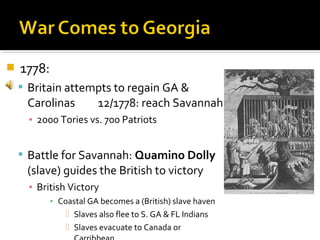
1778:
 Britain attempts to regain GA &

Carolinas

12/1778: reach Savannah

▪ 2000 Tories vs. 700 Patriots

 Battle for Savannah: Quamino Dolly

(slave) guides the British to victory
▪ British Victory
▪ Coastal GA becomes a (British) slave haven
 Slaves also flee to S. GA & FL Indians
 Slaves evacuate to Canada or


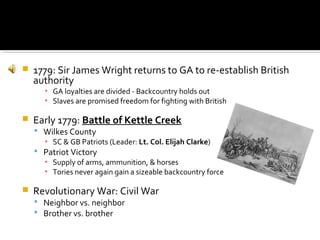
1779: Sir James Wright returns to GA to re-establish British
authority
▪ GA loyalties are divided - Backcountry holds out
▪ Slaves are promised freedom for fighting with British



Early 1779: Battle of Kettle Creek

 Wilkes County
▪ SC & GB Patriots (Leader: Lt. Col. Elijah Clarke)
 Patriot Victory
▪ Supply of arms, ammunition, & horses
▪ Tories never again gain a sizeable backcountry force



Revolutionary War: Civil War
 Neighbor vs. neighbor
 Brother vs. brother
Elijah Clarke
 In early 1794 Elijah Clarke, in an attempt to claim Creek lands west of the Oconee River,
established as many as six settlements in areas of present-day Greene, Morgan, Putnam, and
Baldwin counties. The state militia intervened in September 1794, and the settlements, which
came to be known as the Trans-Oconee Republic, were disbanded peacefully.


Elijah Clarke was among the few heroes of the Revolutionary War from Georgia. Clarke County is
named for him.
 Fall 1779: Siege of Savannah (3 weeks)
 Patriots & French try to re-take Savannah
▪ Patriot Leader: Count Casimir Pulaski
 Result: Pulaski storms Savannah
▪ Patriots fail
▪ Pulaski is killed
▪ 1000 Patriot casualties

▪ British losses:
▪ 150 casualties
The End of War


1780: Britain controls all of GA

 We are the ONLY colony still controlled by the crown



1781: Whigs recapture Augusta
 In the meantime … Washington accepts Cornwallis’ surrender at

Yorktown = End of War



Spring 1782: British give up GA

 2000 GA Tories & Slaves depart the state



1783: Treaty of Paris

 Formal end of the war
 “free and independent states”
 Treaty of Paris, 1783

Britain
▪ Ousted from N. America
▪ Indian allies remain loyal & will pester Americans

 Spain
▪ Gains W. FL, & E. FL
▪ To be disputed: N. boundary of W. FL
Building a New Nation
Recap:
 Sept. 1774: 1st Continental Congress


April 1775: Battles of Lexington & Concord



May 1775: 2nd Continental Congress

 Declaration of Independence to be written



June 1775: Washington, Commander in Chief



June 1775: Battle of Bunker Hill



Nov. 1777: Articles of Confederation Adopted



March 1781: Articles of Confederation ratified by 13 states
Building a New Nation


Articles of Confederation

 States remain wary of a strong, central government!
▪ Confederation: Partnership

 Weak union:

▪ Legislature (Congress)

▪ Unicameral
▪ Could not levy taxes
▪ Could not regulate trade

Challenges:
• Shaky Economy
• American business @ standstill
• Interstate Trade

▪ Executive (President)

▪ Virtually non-existent (for show)

▪ Judicial (Courts)
▪ None

▪ Representation: Equal (1 vote per state)
Building a New Nation



1786: MA levies a tax to pay war debt
1787: Shays Rebellion

 Citizens rebel against the tax
 Lesson Learned: Regulation of interstate trade is needed!



May 1787: Philadelphia Convention

 Purpose: Revise the Articles of Confederation
 Result: The US Constitution is drafted
 Convention Compromises
▪ Representation: Size Based? Equal Representation? Slaves?
▪ House: Size Based
▪ Senate: Equal Representation

▪ Federal System

▪ National: defense, interstate commerce, foreign affairs, etc.
▪ State: roads & taxes
▪ Separation Of Powers and Checks & Balances
 Legislative: Enacts (Makes)
 Executive: Enforces
 Judicial: Interprets
Key Constitutional Compromises
Problem

Solution

The Great
Compromise

In the legislative branch,
states with large populations
wanted representation based
on population. States with
small populations wanted
equal representation.

Congress was created with
a Senate (2 Senators per
state) and a House of
Representatives (with the
number of representatives
based on population)

The 3/5ths
Compromise

How to count the slaves for
the purposes of taxation and
representation in the House of
Representatives

Only three out of every 5
slaves were counted for
taxation and
representation purposes.
Key Constitutional Compromises
Problem

Solution

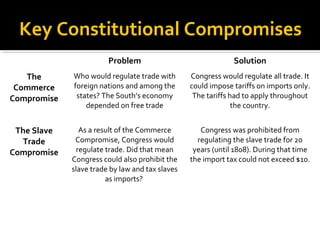
The
Commerce
Compromise

Who would regulate trade with
foreign nations and among the
states? The South’s economy
depended on free trade

Congress would regulate all trade. It
could impose tariffs on imports only.
The tariffs had to apply throughout
the country.

The Slave
Trade
Compromise

As a result of the Commerce
Compromise, Congress would
regulate trade. Did that mean
Congress could also prohibit the
slave trade by law and tax slaves
as imports?

Congress was prohibited from
regulating the slave trade for 20
years (until 1808). During that time
the import tax could not exceed $10.
 Define:
 Articles of Confederation
 Levy
 Confederation
 Federal
 Legislative
 Executive
 judicial
 checks and balances
2. Why were Americans interested in creating a weak
union of states under the Articles of Confederation?
3.List three problems that made political leaders
realize a strong central government was needed for
the new nation.
4. Why did delegates to the constitutional convention
divide the new government into three separate
branches?
GA Ratifies the Constitution
 9/17/1787: Delegates approve the Constitution and

send it out to the 13 states for ratification (formal
approval)
 Concerns of Americans
▪ Strength of Central Government
▪ No list of citizens’ guaranteed rights and liberties
▪ Solution: A Bill of Rights is promised!

 1/2/1788: GA is #4 to ratify the Constitution!
State Government


1789: New State Constitution
 3 branches of government

▪ Legislature: General Assembly

▪ Bicameral
▪ Most powerful
 Appropriations bills
 Selection of governor, judges & state officials

▪ Executive
▪ Judicial

▪ Superior Courts: Serious cases; organized into circuits
▪ Inferior Courts: Less serious cases; located in each county
 1789
 New Constitutions for US & GA

 Georgia’s Territory
 Spreads to MS River
▪ Cherokee, Creek, Chickasaw
▪ Lowest white population in the states
▪ New settlers are needed to protect the frontier!
 Georgia & the US Constitution

 http://www.gpb.org/georgiastories/stories/georgia_an

 Siege of Savannah
▪ http://
www.gpb.org/georgiastories/story/savannah_under_attack
 Define:
 Ratification
 Bill of Rights
 Bicameral
 General Assembly
 Superior Court
 Inferior Court
 Why were Georgians in favor of the new

Constitution and a stronger national
government?
 What was Georgia’s population ranking

among the 13 states? Why was population
growth important to Georgia’s future?

Chapter 8

  • 1.
    Georgia History *Trinity Christian School * Mrs. Christie Soles
  • 2.
     1770: March- Boston Massacre  1770: April – Townsend Acts repealed  1772: Committees of Correspondence est.  1773: May – Tea Act  1773: Dec – Boston Tea Party  1774: First Continental Congress
  • 3.
    1763: Treaty ofParis, 1763  Ends French & Indian War  L140,000,000 British war debt  1764: Sugar Act  sugar, molasses, coffee, indigo, wine  1765: Stamp Act  Printed documents  1765: Quartering Act  Requirement to house redcoats  1767: Townshend Acts  Glass, lead, paper, paints, tea 
  • 4.
     Post-French &Indian War:  Colonists expected to participate in mercantile system  Smuggling (illegal) with French & other merchants  TAXES: ▪ Sugar Act, Tea Act, Townsend Acts, Stamp Act ▪ Duties: taxes on imports
  • 5.
     Results:     Colonists boycott (refuseto buy) British goods Colonists protest Parliament Formation of Sons & Daughters of Liberty ANTI-BRITISH ATTITUDE ESTABLISHED!
  • 6.
     British conceptsabout government:  Consent of the Governed: government should rule only so long as its citizens consent to be governed  Representative Government: people have the right to elect persons to represent them and make political decisions  Limited Government: the power of government is limited by “natural law” ▪ Natural Rights: life, liberty & property
  • 7.
     American ideason Self-Government:  Town meetings for local matters  Colonial legislatures ▪ Militia ▪ Taxes  Result: only elected representatives should pass laws and set taxes in the colonies
  • 8.
     Americans resentBritain because:  Taxes ▪ “No taxation without representation!”  Legal rights as British citizens are ignored ▪ Trial by jury suspended in smuggling cases ▪ Searches allowed without warrants  British troops are sent for law enforcement  N. colonies react more strongly to British actions  1770: Boston Massacre
  • 9.
     1773: TeaAct  Monopoly (exclusive right to sell)  Dec. 16, 1773: Boston Tea Party (Sons of Liberty)  Parliament’s reaction: “Intolerable Acts” ▪ (1) Port of Boston closed ▪ (2) MA forbidden from holding town meetings or electing officials ▪ (3) Colonists required to quarter soldiers
  • 10.
       Colonial Reaction:  1stContinental Congress  British officials targeted ▪ Britain sends more troops 4/19/1775: Lexington & Concord  “the shot heard round the world” Georgia Chooses Sides:  Reluctant to join fight: ▪ Relatively young colony ▪ Backcountry Settlers more in favor of independence ▪ Whigs: anti-British; “patriots” ▪ Tories: pro-British; “loyalists”
  • 11.
     Locating theMain Ideas, p.107  In what ways did American colonists gain experience in self-government?  Why was the Georgia colony at first reluctant to join with the other colonies in gaining freedom from Great Britain?
  • 12.
     Locating theMain Ideas, p. 107  Define:  Smuggling  Duties  Boycott  Natural law  Militia  Monopoly  Whig  Tory
  • 13.
     Locating theMain Ideas, p.107  Identify: ▪ Sons of Liberty ▪ Crispus Attucks ▪ Paul Revere ▪ Representative Government ▪ Boston Massacre
  • 14.
     1775: Start ofRevolutionary War  4/1775: Lexington & Concord  5/1775: Second Continental Congress ▪ Georgia sends 2 delegates ▪ Decision made to draft a Declaration of Independence ▪ Organization of army – George Washington to be Commander ▪ Petition (formal written request) sent to George III  George refuses; Parliament bans trade with America  6/1775: Washington appt. head of Continental Army  6/1775: Battles of Bunker Hill & Breed’s Hill  Royal Government Comes to an End  July 1775: “Provincial Congress” @ Savannah ▪ Vote to: ▪ (1) Join other colonies in boycott of British goods ▪ (2) “Council of Safety” est. to enforce boycott
  • 15.
     2 Governmentsrule Georgia:   ▪ British government – Governor Sir James Wright ▪ Colonial government  8/1775: King George III declares the colonies in rebellion  January 1776: Thomas Paine’s Common Sense January 1776: Whigs arrest Governor Wright  Wright escapes April 1776: “Rules & Regulations” adopted  Temporary constitution  Preamble (introduction)  Popular Sovereignty (gov’t rests on the people’s will)  July 4 1776: Declaration of Independence adopted by 2nd Continental Congress
  • 16.
     Georgia signers:  ButtonGwinnett  Lyman Hall  George Walton  Authored by Thomas Jefferson 1. All men are created equal 2. Everyone is born with certain rights that government cannot take away (life, liberty & the pursuit of happiness) 3. Government gets its power from the people 4. The people can do away with a government they no longer approve of!  “These colonies are … Free and Independent States.”  State = nation  Independent country with its own government
  • 17.
    Button Gwinnett  ButtonGwinnett served in Georgia's colonial legislature, in the Second Continental Congress, and as president of Georgia's Revolutionary Council of Safety. He was one of three Georgia signers of the Declaration of Independence.  Button Gwinnett's signature is said to be one of the rarest and most valuable of the signers of the Declaration of Independence. The signature is housed at the Georgia Archives in Morrow.
  • 18.
     Define:  Preamble Popular Sovereignty  Petition  Declaration of Independence  State  Nation
  • 19.
     Identify:  ButtonGwinnett  Lyman Hall  George Walton  Thomas Jefferson  Why was it important to the rebelling Georgia colonists to include the concept of popular sovereignty in their temporary constitution?
  • 20.
     8/1776: Declarationof Independence read in Savannah  Mock funeral for George III, cannons fired  Split families ▪ 1st generation: pro-British Tories (James Habersham) ▪ 2nd generation: anti-British (Habersham’s sons)  Tories leave ▪ 1,500 leave Georgia for W. FL, Carribbean, or Britain
  • 21.
     Election calledto author a new constitution  Constitution: fundamental plan of operation for a government ▪ What can (or cannot) the government do? ▪ Branches of government ▪ How are offices to be filled?  2/1777: Georgia Constitution of 1777 ▪ Preamble ▪ Separation of Powers: “The Legislative, executive & judicial departments shall be separate and distinct, so that neither exercises the powers belonging to the others.”
  • 22.
     Reality of theGeorgia Constitution of 1777  Unicameral (one-house) Legislative Branch ▪ Powers of the House of Assembly ▪ Enact Laws ▪ Appoint Executive Branch Officials ▪ Appoint Judicial Branch Officials ▪ Grant pardons  Weak Executive Branch (name only) ▪ Elected by the Legislature ▪ 1-year term, could not succeed himself in office ▪ 12-man Legislative Executive Council could veto governor  8 counties replace parishes ▪ Officials, courthouse, schools, militia, Superior Court
  • 23.
     5/1777: NewConstitution goes into effect  Challenges ▪ 1000s still loyal to King George III ▪ Struggle amongst Whig groups ▪ 5/16/1777: duel - Lachlan McIntosh vs. Button Gwinnett  Lachlan to Gwinnett: “scoundrel & lying rascal”  Both wounded, Gwinnett dies  1777-1778: Valley Forge & Baron von Steuben  1778: Savannah recaptured by British  1779: Royal Governor returns Siege of Savannah  Count Pulaski killed 
  • 24.
     Define:  Constitution Separation of powers  Unicameral  Identify:  July 4, 1776  House of Assembly  John Adam Treutlen
  • 25.
     Why weresome Georgia families divided in their loyalty to Great Britain?  Why was Georgia’s Constitution of 1777 written to give the legislative branch the most power?
  • 26.
     Georgia Loyalties: 1/3 Whigs  1/3 Tories ▪ 1776-1778: Tories driven out of GA  1/3 Neutral  Fighting in Georgia  b/w Georgians  b/w GA Patriots & E.FL Loyalists ▪ 3 attempts to capture British St.Augustine
  • 27.
     1778:  Britain attemptsto regain GA & Carolinas 12/1778: reach Savannah ▪ 2000 Tories vs. 700 Patriots  Battle for Savannah: Quamino Dolly (slave) guides the British to victory ▪ British Victory ▪ Coastal GA becomes a (British) slave haven  Slaves also flee to S. GA & FL Indians  Slaves evacuate to Canada or
  • 28.
     1779: Sir JamesWright returns to GA to re-establish British authority ▪ GA loyalties are divided - Backcountry holds out ▪ Slaves are promised freedom for fighting with British  Early 1779: Battle of Kettle Creek  Wilkes County ▪ SC & GB Patriots (Leader: Lt. Col. Elijah Clarke)  Patriot Victory ▪ Supply of arms, ammunition, & horses ▪ Tories never again gain a sizeable backcountry force  Revolutionary War: Civil War  Neighbor vs. neighbor  Brother vs. brother
  • 29.
    Elijah Clarke  Inearly 1794 Elijah Clarke, in an attempt to claim Creek lands west of the Oconee River, established as many as six settlements in areas of present-day Greene, Morgan, Putnam, and Baldwin counties. The state militia intervened in September 1794, and the settlements, which came to be known as the Trans-Oconee Republic, were disbanded peacefully.  Elijah Clarke was among the few heroes of the Revolutionary War from Georgia. Clarke County is named for him.
  • 30.
     Fall 1779:Siege of Savannah (3 weeks)  Patriots & French try to re-take Savannah ▪ Patriot Leader: Count Casimir Pulaski  Result: Pulaski storms Savannah ▪ Patriots fail ▪ Pulaski is killed ▪ 1000 Patriot casualties ▪ British losses: ▪ 150 casualties
  • 31.
    The End ofWar  1780: Britain controls all of GA  We are the ONLY colony still controlled by the crown  1781: Whigs recapture Augusta  In the meantime … Washington accepts Cornwallis’ surrender at Yorktown = End of War  Spring 1782: British give up GA  2000 GA Tories & Slaves depart the state  1783: Treaty of Paris  Formal end of the war  “free and independent states”
  • 33.
     Treaty ofParis, 1783 Britain ▪ Ousted from N. America ▪ Indian allies remain loyal & will pester Americans  Spain ▪ Gains W. FL, & E. FL ▪ To be disputed: N. boundary of W. FL
  • 35.
    Building a NewNation Recap:  Sept. 1774: 1st Continental Congress  April 1775: Battles of Lexington & Concord  May 1775: 2nd Continental Congress  Declaration of Independence to be written  June 1775: Washington, Commander in Chief  June 1775: Battle of Bunker Hill  Nov. 1777: Articles of Confederation Adopted  March 1781: Articles of Confederation ratified by 13 states
  • 36.
    Building a NewNation  Articles of Confederation  States remain wary of a strong, central government! ▪ Confederation: Partnership  Weak union: ▪ Legislature (Congress) ▪ Unicameral ▪ Could not levy taxes ▪ Could not regulate trade Challenges: • Shaky Economy • American business @ standstill • Interstate Trade ▪ Executive (President) ▪ Virtually non-existent (for show) ▪ Judicial (Courts) ▪ None ▪ Representation: Equal (1 vote per state)
  • 37.
    Building a NewNation   1786: MA levies a tax to pay war debt 1787: Shays Rebellion  Citizens rebel against the tax  Lesson Learned: Regulation of interstate trade is needed!  May 1787: Philadelphia Convention  Purpose: Revise the Articles of Confederation  Result: The US Constitution is drafted  Convention Compromises ▪ Representation: Size Based? Equal Representation? Slaves? ▪ House: Size Based ▪ Senate: Equal Representation ▪ Federal System ▪ National: defense, interstate commerce, foreign affairs, etc. ▪ State: roads & taxes ▪ Separation Of Powers and Checks & Balances  Legislative: Enacts (Makes)  Executive: Enforces  Judicial: Interprets
  • 38.
    Key Constitutional Compromises Problem Solution TheGreat Compromise In the legislative branch, states with large populations wanted representation based on population. States with small populations wanted equal representation. Congress was created with a Senate (2 Senators per state) and a House of Representatives (with the number of representatives based on population) The 3/5ths Compromise How to count the slaves for the purposes of taxation and representation in the House of Representatives Only three out of every 5 slaves were counted for taxation and representation purposes.
  • 39.
    Key Constitutional Compromises Problem Solution The Commerce Compromise Whowould regulate trade with foreign nations and among the states? The South’s economy depended on free trade Congress would regulate all trade. It could impose tariffs on imports only. The tariffs had to apply throughout the country. The Slave Trade Compromise As a result of the Commerce Compromise, Congress would regulate trade. Did that mean Congress could also prohibit the slave trade by law and tax slaves as imports? Congress was prohibited from regulating the slave trade for 20 years (until 1808). During that time the import tax could not exceed $10.
  • 40.
     Define:  Articlesof Confederation  Levy  Confederation  Federal  Legislative  Executive  judicial  checks and balances
  • 41.
    2. Why wereAmericans interested in creating a weak union of states under the Articles of Confederation? 3.List three problems that made political leaders realize a strong central government was needed for the new nation. 4. Why did delegates to the constitutional convention divide the new government into three separate branches?
  • 42.
    GA Ratifies theConstitution  9/17/1787: Delegates approve the Constitution and send it out to the 13 states for ratification (formal approval)  Concerns of Americans ▪ Strength of Central Government ▪ No list of citizens’ guaranteed rights and liberties ▪ Solution: A Bill of Rights is promised!  1/2/1788: GA is #4 to ratify the Constitution!
  • 43.
    State Government  1789: NewState Constitution  3 branches of government ▪ Legislature: General Assembly ▪ Bicameral ▪ Most powerful  Appropriations bills  Selection of governor, judges & state officials ▪ Executive ▪ Judicial ▪ Superior Courts: Serious cases; organized into circuits ▪ Inferior Courts: Less serious cases; located in each county
  • 44.
     1789  NewConstitutions for US & GA  Georgia’s Territory  Spreads to MS River ▪ Cherokee, Creek, Chickasaw ▪ Lowest white population in the states ▪ New settlers are needed to protect the frontier!
  • 45.
     Georgia &the US Constitution  http://www.gpb.org/georgiastories/stories/georgia_an  Siege of Savannah ▪ http:// www.gpb.org/georgiastories/story/savannah_under_attack
  • 46.
     Define:  Ratification Bill of Rights  Bicameral  General Assembly  Superior Court  Inferior Court
  • 47.
     Why wereGeorgians in favor of the new Constitution and a stronger national government?  What was Georgia’s population ranking among the 13 states? Why was population growth important to Georgia’s future?