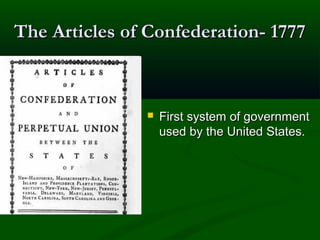
The Articles of Confederation- 1777



First system of government
used by the United States.
The Main Ideas










Only one branch of government (unicameral) called
Congress.
States controlled most of the power.
Congress could declare war, make treaties, print
money, deliver mail.
Congress controlled Indian affairs.
Congress could not tax the states, enforce laws,
regulate trade between states.
Any decisions or changes made by Congress had to be
approved by 9 of the 13 states. Made it very difficult to make
any changes for the nation.
Problems









Without taxes the Country could not pay off debts.
Without trade rules, arguments between states hurt
commerce.
Congress could pass laws but not enforce them.
Each state had one vote regardless of its size.
No executive branch or court system.
Congress could not raise an army without the states’
permission.
Articles of Confederation






In short, the national government did not have
enough authority to effectively rule.
Things were a mess!
States were not united as a country.
Something had to change.
A Constitutional Convention-1787






Delegates met to revise
(change) the Articles of
Confederation.
Instead they agreed to
create a new constitution.
They created the US
Constitution, which we
still use today.








Debating the Framework
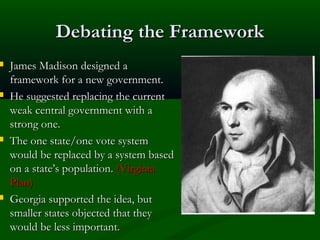
James Madison designed a
framework for a new government.
He suggested replacing the current
weak central government with a
strong one.
The one state/one vote system
would be replaced by a system based
on a state’s population. (Virginia
Plan)
Georgia supported the idea, but
smaller states objected that they
would be less important.
Two Plans for the Constitution






Virginia Plan – called for a bicameral legislature (2
houses), with representation in the houses based on
state population. More populated states get more votes
in the legislature.
New Jersey Plan – called for a unicameral legislature (1
house), with each state getting only vote. Votes not
determined by population.
States had a hard time agreeing, because the smaller less
populated states did not agree with the Virginia Plan,
and the more populated states did not agree with the
New Jersey Plan.
The Great Compromise






A compromise was reached that satisfied both sides.
A bicameral (two house) legislature was created.
The House of Representatives would be based on a state’s
population. (Virginia Plan)
The Senate would include two representatives from each state
regardless of the states population. (New Jersey Plan)
The Constitution







Three branches of government were also created to
provide a system of checks and balances.
Congress was divided into two houses to balance
power between the states.
House of Representatives decided by population.
(satisfied the large states)
Senate gave each state two representatives. (satisfied
the smaller states)
Approved a 3/5ths compromise for all slaves.
William Few and Abraham Baldwin signed for Georgia.
William Few




Was elected to the Georgia Assembly (legislature
for the state) and helped establish Georgia’s
Constitution in 1777.
In 1780, he was elected to the Continental
Congress, before eventually representing
Georgia at the Constitutional Convention in
1787.
Abraham Baldwin








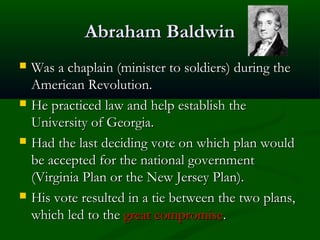
Was a chaplain (minister to soldiers) during the
American Revolution.
He practiced law and help establish the
University of Georgia.
Had the last deciding vote on which plan would
be accepted for the national government
(Virginia Plan or the New Jersey Plan).
His vote resulted in a tie between the two plans,
which led to the great compromise.
Improvements with the
Constitution





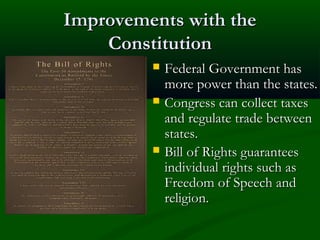
Federal Government has
more power than the states.
Congress can collect taxes
and regulate trade between
states.
Bill of Rights guarantees
individual rights such as
Freedom of Speech and
religion.
The Bill of Rights
(Secured the freedom fought for during the American
Revolution)
1.
2.
3.
4.
5.
6.
7.
8.
9.
10.

Freedom of Speech, Press, Religion and Petition
Right to keep and bear arms
Conditions for quarters of soldiers
Right of search and seizure regulated
Provisons concerning prosecution
Right to a speedy trial, witnesses, etc.
Right to a trial by jury
Excessive bail, cruel punishment
Rule of construction of Constitution
Rights of the States under Constitution
Creating a Government Note Check

Choose either A (Articles of Confederation) or C (Constitution) to identify which form
of government is represented by each statement or phrase.
______
______
______
______
______
______
______
______
______
______

1. The first system of government used by the United States.
2. A bicameral Congress helped balance power between states.
3. Had a strong central (federal) government.
4. Could pass laws but not enforce them.
5. Was signed by Abraham Baldwin and William Few.
6. Created a system of checks and balances.
7. Used only a legislative branch of government.
8. Required 9 of 13 states to approve any changes.
9. Did not have the power to collect taxes.
10. Included the Bill of Rights.

Statehood Power

  • 1.
    The Articles ofConfederation- 1777  First system of government used by the United States.
  • 2.
    The Main Ideas       Onlyone branch of government (unicameral) called Congress. States controlled most of the power. Congress could declare war, make treaties, print money, deliver mail. Congress controlled Indian affairs. Congress could not tax the states, enforce laws, regulate trade between states. Any decisions or changes made by Congress had to be approved by 9 of the 13 states. Made it very difficult to make any changes for the nation.
  • 3.
    Problems       Without taxes theCountry could not pay off debts. Without trade rules, arguments between states hurt commerce. Congress could pass laws but not enforce them. Each state had one vote regardless of its size. No executive branch or court system. Congress could not raise an army without the states’ permission.
  • 5.
    Articles of Confederation     Inshort, the national government did not have enough authority to effectively rule. Things were a mess! States were not united as a country. Something had to change.
  • 6.
    A Constitutional Convention-1787    Delegatesmet to revise (change) the Articles of Confederation. Instead they agreed to create a new constitution. They created the US Constitution, which we still use today.
  • 7.
        Debating the Framework JamesMadison designed a framework for a new government. He suggested replacing the current weak central government with a strong one. The one state/one vote system would be replaced by a system based on a state’s population. (Virginia Plan) Georgia supported the idea, but smaller states objected that they would be less important.
  • 8.
    Two Plans forthe Constitution    Virginia Plan – called for a bicameral legislature (2 houses), with representation in the houses based on state population. More populated states get more votes in the legislature. New Jersey Plan – called for a unicameral legislature (1 house), with each state getting only vote. Votes not determined by population. States had a hard time agreeing, because the smaller less populated states did not agree with the Virginia Plan, and the more populated states did not agree with the New Jersey Plan.
  • 9.
    The Great Compromise     Acompromise was reached that satisfied both sides. A bicameral (two house) legislature was created. The House of Representatives would be based on a state’s population. (Virginia Plan) The Senate would include two representatives from each state regardless of the states population. (New Jersey Plan)
  • 10.
    The Constitution       Three branchesof government were also created to provide a system of checks and balances. Congress was divided into two houses to balance power between the states. House of Representatives decided by population. (satisfied the large states) Senate gave each state two representatives. (satisfied the smaller states) Approved a 3/5ths compromise for all slaves. William Few and Abraham Baldwin signed for Georgia.
  • 11.
    William Few   Was electedto the Georgia Assembly (legislature for the state) and helped establish Georgia’s Constitution in 1777. In 1780, he was elected to the Continental Congress, before eventually representing Georgia at the Constitutional Convention in 1787.
  • 12.
    Abraham Baldwin     Was achaplain (minister to soldiers) during the American Revolution. He practiced law and help establish the University of Georgia. Had the last deciding vote on which plan would be accepted for the national government (Virginia Plan or the New Jersey Plan). His vote resulted in a tie between the two plans, which led to the great compromise.
  • 13.
    Improvements with the Constitution    FederalGovernment has more power than the states. Congress can collect taxes and regulate trade between states. Bill of Rights guarantees individual rights such as Freedom of Speech and religion.
  • 14.
    The Bill ofRights (Secured the freedom fought for during the American Revolution) 1. 2. 3. 4. 5. 6. 7. 8. 9. 10. Freedom of Speech, Press, Religion and Petition Right to keep and bear arms Conditions for quarters of soldiers Right of search and seizure regulated Provisons concerning prosecution Right to a speedy trial, witnesses, etc. Right to a trial by jury Excessive bail, cruel punishment Rule of construction of Constitution Rights of the States under Constitution
  • 15.
    Creating a GovernmentNote Check Choose either A (Articles of Confederation) or C (Constitution) to identify which form of government is represented by each statement or phrase. ______ ______ ______ ______ ______ ______ ______ ______ ______ ______ 1. The first system of government used by the United States. 2. A bicameral Congress helped balance power between states. 3. Had a strong central (federal) government. 4. Could pass laws but not enforce them. 5. Was signed by Abraham Baldwin and William Few. 6. Created a system of checks and balances. 7. Used only a legislative branch of government. 8. Required 9 of 13 states to approve any changes. 9. Did not have the power to collect taxes. 10. Included the Bill of Rights.