Anne SaputraAnne SaputraA
Historic Perspective
Peripheral vascular injuries:
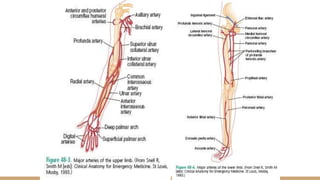
Upper extremity -> axillobrachial and branches
Lower extremity -> femoropopliteal and branches
1759, First repair performed by Hallowell -> site “blood letting”
1912, Alexis Carrel and Charles C -> developed techniques of arterial repair
World war I, reported by George H. Makins
1946 World war II, reported by DeBakey and Simeone
*Noszczyk W, Witkowski M, Weglowski R. The Zamosc period in the work of Romuald Weglowski. Polski Przegl Chir. 1985;57:440-
445
Etiology:
Cases peripheral vascular injury (75-80%), Mechanism:
1. Penetrating Trauma :
• Handguns (Low velocity - low kinetic energy) : 50%
• Stab wounds : 30%
• Shotgun : 5%
2. Blunt Trauma : 5% (Fractures, Dislocation, Crush injuries, and traction)
Most common location : EXTREMITIES -> 50-60% femoral/popliteal, and 30% brachial
*Frykberg ER, Schinco MA. Peripheral vascular injury, In: Feliciano DV, Mattox KL, Moore EE, eds. Trauma. 6th ed. New york, NY: McGraw Hill; 2008:941-971
14 April 2016 Cedera Pembuluh Darah Perifer
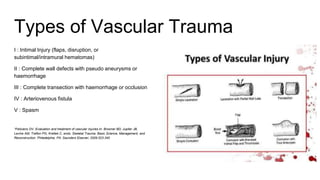
Types of Vascular Trauma
I : Intimal Injury (flaps, disruption, or
subintimal/intramural hematomas)
II : Complete wall defects with pseudo aneurysms or
haemorrhage
III : Complete transection with haemorrhage or occlusion
IV : Arteriovenous fistula
V : Spasm
*Feliciano DV. Evaluation and treatment of vascular injuries.In: Browner BD, Jupiter JB,
Levine AM, Trafton PG, Krettek C, ends. Skeletal Trauma. Basic Science, Management, and
Reconstruction. Philadelphia, PA: Saunders Elsevier; 2009:323-340
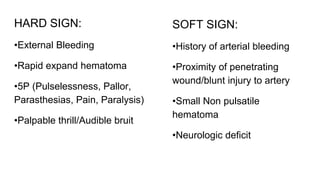
HARD SIGN:
•External Bleeding
•Rapid expand hematoma
•5P (Pulselessness, Pallor,
Parasthesias, Pain, Paralysis)
•Palpable thrill/Audible bruit
SOFT SIGN:
•History of arterial bleeding
•Proximity of penetrating
wound/blunt injury to artery
•Small Non pulsatile
hematoma
•Neurologic deficit
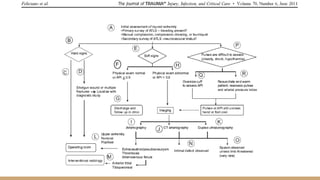
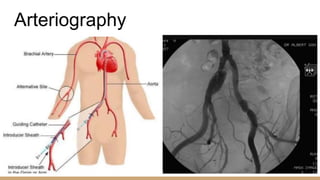
Arteriography
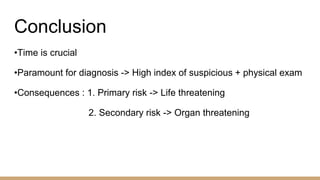
Conclusion
•Time is crucial
•Paramount for diagnosis -> High index of suspicious + physical exam
•Consequences : 1. Primary risk -> Life threatening
2. Secondary risk -> Organ threatening
THANK YOU

Evaluation and Management Peripheral vascular injury

  • 1.
  • 2.
    Historic Perspective Peripheral vascularinjuries: Upper extremity -> axillobrachial and branches Lower extremity -> femoropopliteal and branches 1759, First repair performed by Hallowell -> site “blood letting” 1912, Alexis Carrel and Charles C -> developed techniques of arterial repair World war I, reported by George H. Makins 1946 World war II, reported by DeBakey and Simeone *Noszczyk W, Witkowski M, Weglowski R. The Zamosc period in the work of Romuald Weglowski. Polski Przegl Chir. 1985;57:440- 445
  • 3.
    Etiology: Cases peripheral vascularinjury (75-80%), Mechanism: 1. Penetrating Trauma : • Handguns (Low velocity - low kinetic energy) : 50% • Stab wounds : 30% • Shotgun : 5% 2. Blunt Trauma : 5% (Fractures, Dislocation, Crush injuries, and traction) Most common location : EXTREMITIES -> 50-60% femoral/popliteal, and 30% brachial *Frykberg ER, Schinco MA. Peripheral vascular injury, In: Feliciano DV, Mattox KL, Moore EE, eds. Trauma. 6th ed. New york, NY: McGraw Hill; 2008:941-971
  • 4.
    14 April 2016Cedera Pembuluh Darah Perifer
  • 5.
    Types of VascularTrauma I : Intimal Injury (flaps, disruption, or subintimal/intramural hematomas) II : Complete wall defects with pseudo aneurysms or haemorrhage III : Complete transection with haemorrhage or occlusion IV : Arteriovenous fistula V : Spasm *Feliciano DV. Evaluation and treatment of vascular injuries.In: Browner BD, Jupiter JB, Levine AM, Trafton PG, Krettek C, ends. Skeletal Trauma. Basic Science, Management, and Reconstruction. Philadelphia, PA: Saunders Elsevier; 2009:323-340
  • 7.
    HARD SIGN: •External Bleeding •Rapidexpand hematoma •5P (Pulselessness, Pallor, Parasthesias, Pain, Paralysis) •Palpable thrill/Audible bruit SOFT SIGN: •History of arterial bleeding •Proximity of penetrating wound/blunt injury to artery •Small Non pulsatile hematoma •Neurologic deficit
  • 9.
  • 10.
    Conclusion •Time is crucial •Paramountfor diagnosis -> High index of suspicious + physical exam •Consequences : 1. Primary risk -> Life threatening 2. Secondary risk -> Organ threatening
  • 12.