URLLC
Ultra-reliable low latency communication
URLLC (Ultra-reliable low latency
communication)
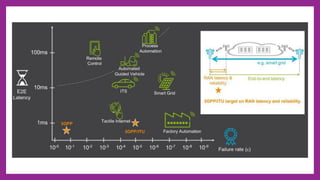
• Ultra Reliable → BLERs as low as 10^-9 (10^-5 on [ITU-R M.2410.0])
• Ultra Low Latency →Very low latency
• Relate to mission-critical applications, where interrupted and robust exchange of
data is of outmost importance.
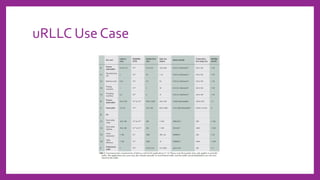
uRLLC Use Case
Source of Delay
• transmission delay
• coding delay
• computing delay
• propagation delay
• backhaul delay
• DL transmission delay
Source of Packet Loss
• transmission error -> depends on resource allocation
• queueing delay violation
Scheduled/Non-ScheduledTraffic
• Scheduled traffic
• Non-scheduled traffic
• Connected/disconnected devices that have critical data, usually have short payload size
• Devices that request access reservation for subsequent scheduled transmissions of
critical data
• Critical device-to-device communications
• Effect of non-scheduled traffic:
• Queuing delay violation for scheduled traffic
• Delay and packet error probability for the first transmission
URLLC SCHEDULING
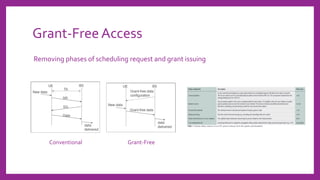
Grant-FreeAccess
Removing phases of scheduling request and grant issuing
Conventional Grant-Free
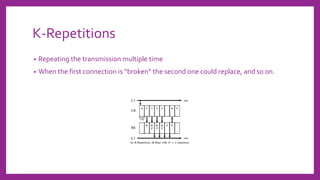
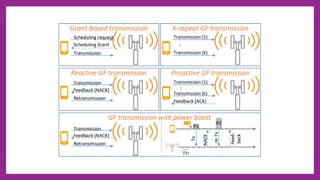
K-Repetitions
• Repeating the transmission multiple time
• When the first connection is “broken” the second one could replace, and so on.
CO-EXISTENCEWITH
EMBB SCHEDULING
Co-Existence with eMBB Schedulling
• Why it’s important? uRLLC traffic could be bursting,
• Types of scheduling:
• Instant Scheduling
• Ongoing transmission interrupted
• (-) Performance Degradation on the other transmission
• (+)outperform the reservation based
• Reservation Based Scheduling
• Resource are reserved before
• Types:
• Semi-static
• Dynamic
SCHEDULING
ALGORITHMS
+ Comp Sci Algorithms Related to Scheduling and Resource
Greedy algorithms
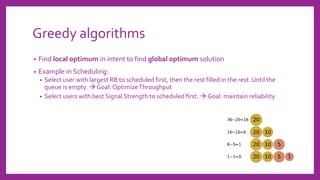
• Find local optimum in intent to find global optimum solution
• Example in Scheduling:
• Select user with largest RB to scheduled first, then the rest filled in the rest. Until the
queue is empty. → Goal: OptimizeThroughput
• Select users with best Signal Strength to scheduled first. → Goal: maintain reliability
Knapsack
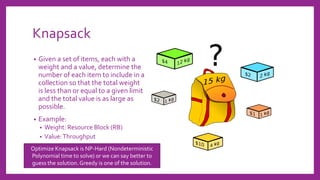
• Given a set of items, each with a
weight and a value, determine the
number of each item to include in a
collection so that the total weight
is less than or equal to a given limit
and the total value is as large as
possible.
• Example:
• Weight: Resource Block (RB)
• Value:Throughput
Optimize Knapsack is NP-Hard (Nondeterministic
Polynomial time to solve) or we can say better to
guess the solution. Greedy is one of the solution.

Urllc 20190709

  • 1.
  • 2.
    URLLC (Ultra-reliable lowlatency communication) • Ultra Reliable → BLERs as low as 10^-9 (10^-5 on [ITU-R M.2410.0]) • Ultra Low Latency →Very low latency • Relate to mission-critical applications, where interrupted and robust exchange of data is of outmost importance.
  • 3.
  • 5.
    Source of Delay •transmission delay • coding delay • computing delay • propagation delay • backhaul delay • DL transmission delay
  • 6.
    Source of PacketLoss • transmission error -> depends on resource allocation • queueing delay violation
  • 7.
    Scheduled/Non-ScheduledTraffic • Scheduled traffic •Non-scheduled traffic • Connected/disconnected devices that have critical data, usually have short payload size • Devices that request access reservation for subsequent scheduled transmissions of critical data • Critical device-to-device communications • Effect of non-scheduled traffic: • Queuing delay violation for scheduled traffic • Delay and packet error probability for the first transmission
  • 8.
  • 9.
    Grant-FreeAccess Removing phases ofscheduling request and grant issuing Conventional Grant-Free
  • 10.
    K-Repetitions • Repeating thetransmission multiple time • When the first connection is “broken” the second one could replace, and so on.
  • 12.
  • 13.
    Co-Existence with eMBBSchedulling • Why it’s important? uRLLC traffic could be bursting, • Types of scheduling: • Instant Scheduling • Ongoing transmission interrupted • (-) Performance Degradation on the other transmission • (+)outperform the reservation based • Reservation Based Scheduling • Resource are reserved before • Types: • Semi-static • Dynamic
  • 14.
    SCHEDULING ALGORITHMS + Comp SciAlgorithms Related to Scheduling and Resource
  • 16.
    Greedy algorithms • Findlocal optimum in intent to find global optimum solution • Example in Scheduling: • Select user with largest RB to scheduled first, then the rest filled in the rest. Until the queue is empty. → Goal: OptimizeThroughput • Select users with best Signal Strength to scheduled first. → Goal: maintain reliability
  • 17.
    Knapsack • Given aset of items, each with a weight and a value, determine the number of each item to include in a collection so that the total weight is less than or equal to a given limit and the total value is as large as possible. • Example: • Weight: Resource Block (RB) • Value:Throughput Optimize Knapsack is NP-Hard (Nondeterministic Polynomial time to solve) or we can say better to guess the solution. Greedy is one of the solution.