UNIT-3
Packet Scheduling Algorithms
• Introduction
• What is Packet Scheduling?
• Why is Packet Scheduling Important?
• Packet Scheduling in Networks
• Types of Packet Scheduling Algorithms
• Key Requirements for Packet Scheduling
• Real-World Applications
• Future Trends
Introduction
• Packet scheduling refers to the process of
managing the order and timing with which
packets are transmitted from queues in a
network device (router, switch).
Goals of Packet Scheduling:
• Maintain Quality of Service (QoS)
• Prevent congestion
• Ensure fairness among data flows
• Optimize network utilization
• What is Packet Scheduling?
• Packet scheduling is the process used by
network devices to decide the order in which
packets are transmitted.
• It determines:
– Which packet to send next
– How resources (bandwidth, buffer) are shared
– Delay and jitter performance
Why is Packet Scheduling Important?
• Ensures Quality of Service (QoS)
• Prevents congestion
• Achieves fairness among multiple users/flows
• Meets real-time delivery requirements (e.g.,
VoIP, gaming)
• Efficient use of limited network resources
Packet Scheduling in Networks
• Context:
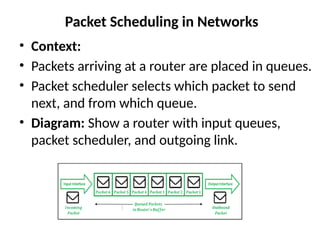
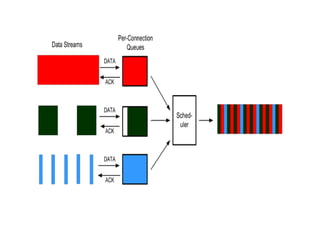
• Packets arriving at a router are placed in queues.
• Packet scheduler selects which packet to send
next, and from which queue.
• Diagram: Show a router with input queues,
packet scheduler, and outgoing link.
• Challenges:
• Bandwidth sharing among users
• Delays for time-sensitive applications
• Limited buffer space
Types of Packet Scheduling Algorithms
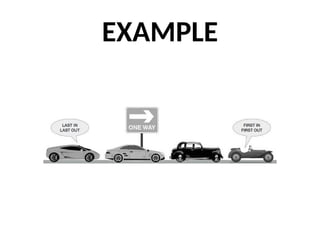
• FIFO (First-In-First-Out)
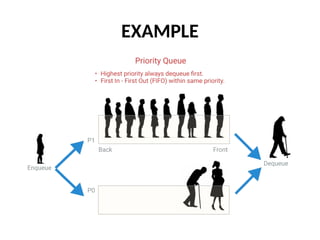
• Priority Queuing (PQ)
• Round Robin (RR)
• Weighted Fair Queuing (WFQ)
• Deficit Round Robin (DRR)
• Earliest Deadline First (EDF) (optional)
• Custom scheduling (e.g., AI/ML-based)
FIFO – First-In, First-Out
• Simplest scheduling method
• Processes packets in the order they arrive
• No priority handling
Pros:
• Easy to implement
• Fair in low-load scenarios
Cons:
• No support for QoS
• Time-sensitive packets may face delays
Use Case: Best-effort delivery networks
EXAMPLE
Priority Queuing (PQ)
• Packets assigned different priority levels
• High-priority packets are served first
Pros:
• Good for real-time traffic (VoIP, video)
Cons:
• Lower-priority packets can starve
• Not inherently fair
Use Case: Voice over IP, emergency systems
EXAMPLE
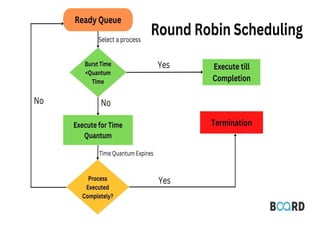
Round Robin (RR)
• Packets served from each queue in turn
• All flows treated equally
Pros:
• Simple and fair
• Reduces starvation
Cons:
• Doesn’t account for flow priority or bandwidth
needs
• Doesn’t work well with variable packet sizes
Weighted Fair Queuing (WFQ)
• Assigns weights to each flow/queue
• Allocates bandwidth proportionally
• Suitable for variable-length packets
Pros:
• Fair bandwidth allocation
• QoS-friendly
Cons:
• More complex to implement
Use Case: Multimedia streaming, MPLS, ATM networks
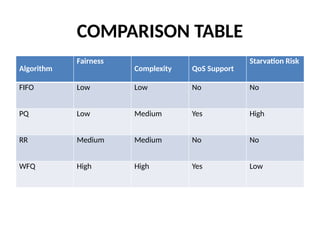
COMPARISON TABLE
Algorithm
Fairness
Complexity QoS Support
Starvation Risk
FIFO Low Low No No
PQ Low Medium Yes High
RR Medium Medium No No
WFQ High High Yes Low
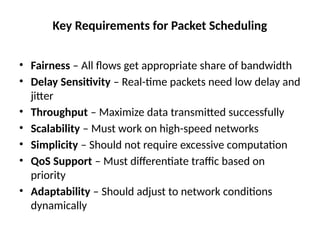
Key Requirements for Packet Scheduling
• Fairness – All flows get appropriate share of bandwidth
• Delay Sensitivity – Real-time packets need low delay and
jitter
• Throughput – Maximize data transmitted successfully
• Scalability – Must work on high-speed networks
• Simplicity – Should not require excessive computation
• QoS Support – Must differentiate traffic based on
priority
• Adaptability – Should adjust to network conditions
dynamically
Real-World Applications
• Routers – Scheduling outgoing packets for
multiple flows
• Data Centers – Managing tenant-level QoS
• 5G Networks – Ensuring latency for URLLC
services
• Streaming & Gaming – Bandwidth guarantees
for media flows
Future Trends
• Future Trends
• AI/ML-based dynamic schedulers
• Software-defined networking (SDN) for
centralized control
• Adaptive, predictive scheduling based on flow
behavior
Scheduling for Guaranteed Services Connections
• What Are Guaranteed Services?
• Key Requirements
• Algorithms Used for Guaranteed Services
• Example: WFQ for Guaranteed Bandwidth
• Integrated Services (IntServ) Model
• Limitations
• Real-world Use Cases
What Are Guaranteed Services?
• Guaranteed services provide strict delay and
bandwidth assurances.
• Often used in Integrated Services (IntServ)
architecture, where flows are reserved in
advance.
• Example: VoIP, remote surgery, financial
trading.
Key Requirements
• To support guaranteed services, the
scheduling algorithm must:
• Bound delay and jitter precisely
• Reserve bandwidth per flow
• Avoid packet loss due to queue overflow
• Enforce admission control
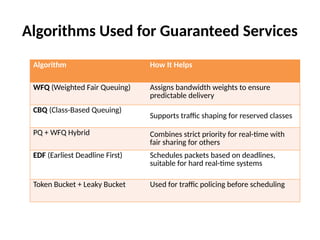
Algorithms Used for Guaranteed Services
Algorithm How It Helps
WFQ (Weighted Fair Queuing) Assigns bandwidth weights to ensure
predictable delivery
CBQ (Class-Based Queuing)
Supports traffic shaping for reserved classes
PQ + WFQ Hybrid Combines strict priority for real-time with
fair sharing for others
EDF (Earliest Deadline First) Schedules packets based on deadlines,
suitable for hard real-time systems
Token Bucket + Leaky Bucket Used for traffic policing before scheduling
Example: WFQ for Guaranteed Bandwidth
• Each flow gets a weight corresponding to its
reserved bandwidth.
• Packet timestamps are calculated to simulate
virtual finish time.
• Scheduler picks the packet with the earliest
finish time.
• Guarantees low jitter and bounded latency
when properly configured.
Integrated Services (IntServ) Model
• Resource Reservation Protocol (RSVP) is used
to reserve resources.
• Each router along the path enforces the
reservation using WFQ or similar.
• Guaranteed Service Class provides:
– Delay bound
– Minimal packet loss
– Bandwidth guarantee
Limitations
• High complexity and state maintenance for
each flow
• Scalability issues in large networks
• Supplanted in modern networks by
Differentiated Services (DiffServ) with simpler
enforcement
Real-world Use Cases
• Healthcare IoT: Real-time monitoring with
delay sensitivity
• Video Streaming: Premium user streams with
guaranteed resolution & frame rates
• Industrial Automation: Machine-to-machine
communication with strict deadlines
GPS, WFQ, and Rate-Proportional
Scheduling Algorithms
Agenda
• Introduction to Scheduling Algorithms
• Generalized Processor Sharing (GPS)
• Weighted Fair Queuing (WFQ)
• Rate-Proportional Scheduling Algorithms
• Comparison of the Algorithms
• Use Cases and Applications
• Conclusion
Introduction to Scheduling Algorithms
• Scheduling is essential in networking and
operating systems to efficiently share resources.
• Types of scheduling:
– Fair sharing of resources
– Balancing performance
– Ensuring QoS (Quality of Service)
• Focus: GPS, WFQ, and Rate-Proportional
Scheduling.
Generalized Processor Sharing (GPS)
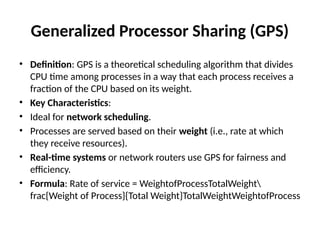
• Definition: GPS is a theoretical scheduling algorithm that divides
CPU time among processes in a way that each process receives a
fraction of the CPU based on its weight.
• Key Characteristics:
• Ideal for network scheduling.
• Processes are served based on their weight (i.e., rate at which
they receive resources).
• Real-time systems or network routers use GPS for fairness and
efficiency.
• Formula: Rate of service = WeightofProcessTotalWeight
frac{Weight of Process}{Total Weight}TotalWeightWeightofProcess​
Advantages of GPS
• Provides guaranteed bandwidth for each flow.
• Fair distribution of resources.
• No starvation for processes.
• Works well in high-speed networks.
Weighted Fair Queuing (WFQ)
• Definition: WFQ is a practical implementation of
GPS in packet-switching networks, used to provide
fair bandwidth distribution.
• Key Characteristics:
– Fairness: Ensures that each flow gets bandwidth
proportional to its weight.
– Implementation: Uses virtual time to track the service
rate of each flow.
– Suitable for network traffic scheduling in routers and
switches.
• WFQ in Action:
• Packets are assigned a virtual finish time based on
their weight and arrival time.
• Packets with lower finish times are transmitted first.
• Guaranteed throughput for each flow.
• Advantages of WFQ:
• Efficient use of network resources.
• Fair allocation of bandwidth among multiple traffic
sources.
• Low delay for high-priority traffic.
• Ensures quality of service (QoS).
Rate-Proportional Scheduling
• Definition: A family of scheduling algorithms
where processes are served based on their rate or
share of resources, proportional to their allocated
weight.
• Key Characteristics:
– Similar to GPS, but implemented with different
algorithms.
– Each flow gets bandwidth proportional to its rate.
– Dynamic adjustment of rates based on traffic load and
priority.
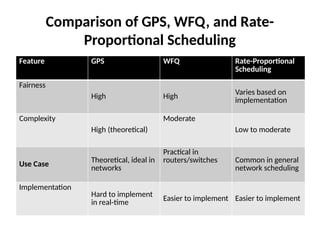
Comparison of GPS, WFQ, and Rate-
Proportional Scheduling
Feature GPS WFQ Rate-Proportional
Scheduling
Fairness
High High
Varies based on
implementation
Complexity
High (theoretical)
Moderate
Low to moderate
Use Case
Theoretical, ideal in
networks
Practical in
routers/switches Common in general
network scheduling
Implementation
Hard to implement
in real-time
Easier to implement Easier to implement
Applications of Scheduling Algorithms
GPS:
• Theoretical model for internet traffic scheduling.
• Used in quality of service (QoS) designs.
WFQ:
• Routers and network switches for traffic management.
• Voice over IP (VoIP), streaming, and real-time data
applications.
Rate-Proportional Scheduling:
• Used in fair allocation of system resources in both
network and OS-level scheduling
Theory of latency rate servers and delay
bounds in packet switched networks for LBAP
traffic
Introduction
• Packet-switched networks forward packets
hop-by-hop.
• Key delay components: processing, queuing,
transmission, propagation.
• Real-time traffic requires delay guarantees.
LBAP Traffic Model
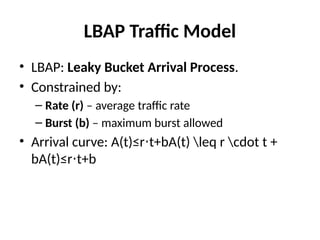
• LBAP: Leaky Bucket Arrival Process.
• Constrained by:
– Rate (r) – average traffic rate
– Burst (b) – maximum burst allowed
• Arrival curve: A(t)≤r t+bA(t) leq r cdot t +
⋅
bA(t)≤r t+b
⋅
Latency Rate Servers (LR Servers)
‑ ‑
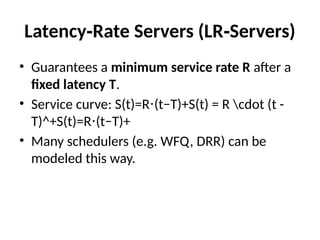
• Guarantees a minimum service rate R after a
fixed latency T.
• Service curve: S(t)=R (t−T)+S(t) = R cdot (t -
⋅
T)^+S(t)=R (t−T)+
⋅
• Many schedulers (e.g. WFQ, DRR) can be
modeled this way.
Delay Bound for LBAP over LR Server
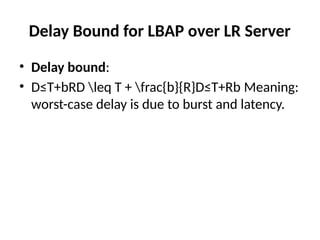
• Delay bound:
• D≤T+bRD leq T + frac{b}{R}D≤T+Rb​Meaning:
worst-case delay is due to burst and latency.
Cascading LR Servers
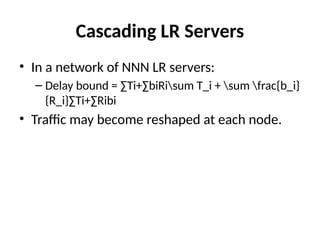
• In a network of NNN LR servers:
– Delay bound = ∑Ti+∑biRisum T_i + sum frac{b_i}
{R_i}∑Ti​
+∑Ri​
bi​
​
• Traffic may become reshaped at each node.
Application in Deterministic Networks
(DetNet/TSN)
• Standards like AVB/DetNet use similar
models.
• Delay bounds are calculated per hop using LR
server analysis.
• Ensures bounded latency for time-sensitive
traffic.
Active Queue Management (AQM) focusing on
RED, WRED, and Virtual Clock
What is Active Queue Management (AQM)?
• AQM proactively manages packet queues in
routers to avoid congestion.
• It drops or marks packets before queues are
full.
• Goals:
• Reduce latency
• Prevent bufferbloat
• Improve fairness and throughput
RED (Random Early Detection)
• Drops packets probabilistically as average
queue size grows.
• Key Parameters:
– min_thresh: start dropping
– max_thresh: full drop probability
– max_p: max drop probability
• Helps avoid global synchronization of TCP
flows.
How RED Works
• Maintains average queue size using
exponential moving average.
• If avg_queue < min_thresh → no drop
• If avg_queue > max_thresh → drop all
• Between thresholds → random drop with
increasing probability
WRED (Weighted RED)
• Extension of RED for QoS support.
• Packets are classified by priority or DSCP
values.
• Each class gets its own RED parameters.
• Higher-priority traffic → lower drop
probability
Benefits of WRED
• Provides differentiated services
• Avoids dropping high-priority traffic early
• Used in DiffServ and enterprise routers for
traffic shaping
Virtual Clock Algorithm
• Rate-based scheduling algorithm
• Assigns each flow a virtual finish time for
packets
• Packets are scheduled in order of their finish
times
• Ensures fair bandwidth allocation among
flows
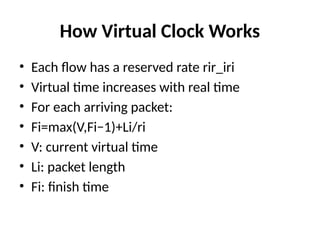
How Virtual Clock Works
• Each flow has a reserved rate rir_iri​
• Virtual time increases with real time
• For each arriving packet:
• Fi​
=max(V,Fi−1​
)+Li/ri​
​
• V: current virtual time
• Li​
: packet length
• Fi​
: finish time
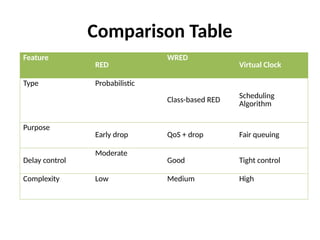
Comparison Table
Feature
RED
WRED
Virtual Clock
Type Probabilistic
Class-based RED
Scheduling
Algorithm
Purpose
Early drop QoS + drop Fair queuing
Delay control
Moderate
Good Tight control
Complexity Low Medium High

Packet Scheduling Algorithms Unit-3.pptx

  • 1.
  • 2.
    Packet Scheduling Algorithms •Introduction • What is Packet Scheduling? • Why is Packet Scheduling Important? • Packet Scheduling in Networks • Types of Packet Scheduling Algorithms • Key Requirements for Packet Scheduling • Real-World Applications • Future Trends
  • 3.
    Introduction • Packet schedulingrefers to the process of managing the order and timing with which packets are transmitted from queues in a network device (router, switch). Goals of Packet Scheduling: • Maintain Quality of Service (QoS) • Prevent congestion • Ensure fairness among data flows • Optimize network utilization
  • 4.
    • What isPacket Scheduling? • Packet scheduling is the process used by network devices to decide the order in which packets are transmitted. • It determines: – Which packet to send next – How resources (bandwidth, buffer) are shared – Delay and jitter performance
  • 5.
    Why is PacketScheduling Important? • Ensures Quality of Service (QoS) • Prevents congestion • Achieves fairness among multiple users/flows • Meets real-time delivery requirements (e.g., VoIP, gaming) • Efficient use of limited network resources
  • 6.
    Packet Scheduling inNetworks • Context: • Packets arriving at a router are placed in queues. • Packet scheduler selects which packet to send next, and from which queue. • Diagram: Show a router with input queues, packet scheduler, and outgoing link.
  • 7.
    • Challenges: • Bandwidthsharing among users • Delays for time-sensitive applications • Limited buffer space
  • 8.
    Types of PacketScheduling Algorithms • FIFO (First-In-First-Out) • Priority Queuing (PQ) • Round Robin (RR) • Weighted Fair Queuing (WFQ) • Deficit Round Robin (DRR) • Earliest Deadline First (EDF) (optional) • Custom scheduling (e.g., AI/ML-based)
  • 9.
    FIFO – First-In,First-Out • Simplest scheduling method • Processes packets in the order they arrive • No priority handling Pros: • Easy to implement • Fair in low-load scenarios Cons: • No support for QoS • Time-sensitive packets may face delays Use Case: Best-effort delivery networks
  • 10.
  • 11.
    Priority Queuing (PQ) •Packets assigned different priority levels • High-priority packets are served first Pros: • Good for real-time traffic (VoIP, video) Cons: • Lower-priority packets can starve • Not inherently fair Use Case: Voice over IP, emergency systems
  • 12.
  • 13.
    Round Robin (RR) •Packets served from each queue in turn • All flows treated equally Pros: • Simple and fair • Reduces starvation Cons: • Doesn’t account for flow priority or bandwidth needs • Doesn’t work well with variable packet sizes
  • 15.
    Weighted Fair Queuing(WFQ) • Assigns weights to each flow/queue • Allocates bandwidth proportionally • Suitable for variable-length packets Pros: • Fair bandwidth allocation • QoS-friendly Cons: • More complex to implement Use Case: Multimedia streaming, MPLS, ATM networks
  • 17.
    COMPARISON TABLE Algorithm Fairness Complexity QoSSupport Starvation Risk FIFO Low Low No No PQ Low Medium Yes High RR Medium Medium No No WFQ High High Yes Low
  • 18.
    Key Requirements forPacket Scheduling • Fairness – All flows get appropriate share of bandwidth • Delay Sensitivity – Real-time packets need low delay and jitter • Throughput – Maximize data transmitted successfully • Scalability – Must work on high-speed networks • Simplicity – Should not require excessive computation • QoS Support – Must differentiate traffic based on priority • Adaptability – Should adjust to network conditions dynamically
  • 19.
    Real-World Applications • Routers– Scheduling outgoing packets for multiple flows • Data Centers – Managing tenant-level QoS • 5G Networks – Ensuring latency for URLLC services • Streaming & Gaming – Bandwidth guarantees for media flows
  • 20.
    Future Trends • FutureTrends • AI/ML-based dynamic schedulers • Software-defined networking (SDN) for centralized control • Adaptive, predictive scheduling based on flow behavior
  • 21.
    Scheduling for GuaranteedServices Connections • What Are Guaranteed Services? • Key Requirements • Algorithms Used for Guaranteed Services • Example: WFQ for Guaranteed Bandwidth • Integrated Services (IntServ) Model • Limitations • Real-world Use Cases
  • 22.
    What Are GuaranteedServices? • Guaranteed services provide strict delay and bandwidth assurances. • Often used in Integrated Services (IntServ) architecture, where flows are reserved in advance. • Example: VoIP, remote surgery, financial trading.
  • 23.
    Key Requirements • Tosupport guaranteed services, the scheduling algorithm must: • Bound delay and jitter precisely • Reserve bandwidth per flow • Avoid packet loss due to queue overflow • Enforce admission control
  • 24.
    Algorithms Used forGuaranteed Services Algorithm How It Helps WFQ (Weighted Fair Queuing) Assigns bandwidth weights to ensure predictable delivery CBQ (Class-Based Queuing) Supports traffic shaping for reserved classes PQ + WFQ Hybrid Combines strict priority for real-time with fair sharing for others EDF (Earliest Deadline First) Schedules packets based on deadlines, suitable for hard real-time systems Token Bucket + Leaky Bucket Used for traffic policing before scheduling
  • 25.
    Example: WFQ forGuaranteed Bandwidth • Each flow gets a weight corresponding to its reserved bandwidth. • Packet timestamps are calculated to simulate virtual finish time. • Scheduler picks the packet with the earliest finish time. • Guarantees low jitter and bounded latency when properly configured.
  • 26.
    Integrated Services (IntServ)Model • Resource Reservation Protocol (RSVP) is used to reserve resources. • Each router along the path enforces the reservation using WFQ or similar. • Guaranteed Service Class provides: – Delay bound – Minimal packet loss – Bandwidth guarantee
  • 27.
    Limitations • High complexityand state maintenance for each flow • Scalability issues in large networks • Supplanted in modern networks by Differentiated Services (DiffServ) with simpler enforcement
  • 28.
    Real-world Use Cases •Healthcare IoT: Real-time monitoring with delay sensitivity • Video Streaming: Premium user streams with guaranteed resolution & frame rates • Industrial Automation: Machine-to-machine communication with strict deadlines
  • 29.
    GPS, WFQ, andRate-Proportional Scheduling Algorithms
  • 30.
    Agenda • Introduction toScheduling Algorithms • Generalized Processor Sharing (GPS) • Weighted Fair Queuing (WFQ) • Rate-Proportional Scheduling Algorithms • Comparison of the Algorithms • Use Cases and Applications • Conclusion
  • 31.
    Introduction to SchedulingAlgorithms • Scheduling is essential in networking and operating systems to efficiently share resources. • Types of scheduling: – Fair sharing of resources – Balancing performance – Ensuring QoS (Quality of Service) • Focus: GPS, WFQ, and Rate-Proportional Scheduling.
  • 32.
    Generalized Processor Sharing(GPS) • Definition: GPS is a theoretical scheduling algorithm that divides CPU time among processes in a way that each process receives a fraction of the CPU based on its weight. • Key Characteristics: • Ideal for network scheduling. • Processes are served based on their weight (i.e., rate at which they receive resources). • Real-time systems or network routers use GPS for fairness and efficiency. • Formula: Rate of service = WeightofProcessTotalWeight frac{Weight of Process}{Total Weight}TotalWeightWeightofProcess​
  • 33.
    Advantages of GPS •Provides guaranteed bandwidth for each flow. • Fair distribution of resources. • No starvation for processes. • Works well in high-speed networks.
  • 34.
    Weighted Fair Queuing(WFQ) • Definition: WFQ is a practical implementation of GPS in packet-switching networks, used to provide fair bandwidth distribution. • Key Characteristics: – Fairness: Ensures that each flow gets bandwidth proportional to its weight. – Implementation: Uses virtual time to track the service rate of each flow. – Suitable for network traffic scheduling in routers and switches.
  • 35.
    • WFQ inAction: • Packets are assigned a virtual finish time based on their weight and arrival time. • Packets with lower finish times are transmitted first. • Guaranteed throughput for each flow. • Advantages of WFQ: • Efficient use of network resources. • Fair allocation of bandwidth among multiple traffic sources. • Low delay for high-priority traffic. • Ensures quality of service (QoS).
  • 36.
    Rate-Proportional Scheduling • Definition:A family of scheduling algorithms where processes are served based on their rate or share of resources, proportional to their allocated weight. • Key Characteristics: – Similar to GPS, but implemented with different algorithms. – Each flow gets bandwidth proportional to its rate. – Dynamic adjustment of rates based on traffic load and priority.
  • 37.
    Comparison of GPS,WFQ, and Rate- Proportional Scheduling Feature GPS WFQ Rate-Proportional Scheduling Fairness High High Varies based on implementation Complexity High (theoretical) Moderate Low to moderate Use Case Theoretical, ideal in networks Practical in routers/switches Common in general network scheduling Implementation Hard to implement in real-time Easier to implement Easier to implement
  • 38.
    Applications of SchedulingAlgorithms GPS: • Theoretical model for internet traffic scheduling. • Used in quality of service (QoS) designs. WFQ: • Routers and network switches for traffic management. • Voice over IP (VoIP), streaming, and real-time data applications. Rate-Proportional Scheduling: • Used in fair allocation of system resources in both network and OS-level scheduling
  • 39.
    Theory of latencyrate servers and delay bounds in packet switched networks for LBAP traffic
  • 40.
    Introduction • Packet-switched networksforward packets hop-by-hop. • Key delay components: processing, queuing, transmission, propagation. • Real-time traffic requires delay guarantees.
  • 41.
    LBAP Traffic Model •LBAP: Leaky Bucket Arrival Process. • Constrained by: – Rate (r) – average traffic rate – Burst (b) – maximum burst allowed • Arrival curve: A(t)≤r t+bA(t) leq r cdot t + ⋅ bA(t)≤r t+b ⋅
  • 42.
    Latency Rate Servers(LR Servers) ‑ ‑ • Guarantees a minimum service rate R after a fixed latency T. • Service curve: S(t)=R (t−T)+S(t) = R cdot (t - ⋅ T)^+S(t)=R (t−T)+ ⋅ • Many schedulers (e.g. WFQ, DRR) can be modeled this way.
  • 43.
    Delay Bound forLBAP over LR Server • Delay bound: • D≤T+bRD leq T + frac{b}{R}D≤T+Rb​Meaning: worst-case delay is due to burst and latency.
  • 44.
    Cascading LR Servers •In a network of NNN LR servers: – Delay bound = ∑Ti+∑biRisum T_i + sum frac{b_i} {R_i}∑Ti​ +∑Ri​ bi​ ​ • Traffic may become reshaped at each node.
  • 45.
    Application in DeterministicNetworks (DetNet/TSN) • Standards like AVB/DetNet use similar models. • Delay bounds are calculated per hop using LR server analysis. • Ensures bounded latency for time-sensitive traffic.
  • 46.
    Active Queue Management(AQM) focusing on RED, WRED, and Virtual Clock
  • 47.
    What is ActiveQueue Management (AQM)? • AQM proactively manages packet queues in routers to avoid congestion. • It drops or marks packets before queues are full. • Goals: • Reduce latency • Prevent bufferbloat • Improve fairness and throughput
  • 48.
    RED (Random EarlyDetection) • Drops packets probabilistically as average queue size grows. • Key Parameters: – min_thresh: start dropping – max_thresh: full drop probability – max_p: max drop probability • Helps avoid global synchronization of TCP flows.
  • 49.
    How RED Works •Maintains average queue size using exponential moving average. • If avg_queue < min_thresh → no drop • If avg_queue > max_thresh → drop all • Between thresholds → random drop with increasing probability
  • 50.
    WRED (Weighted RED) •Extension of RED for QoS support. • Packets are classified by priority or DSCP values. • Each class gets its own RED parameters. • Higher-priority traffic → lower drop probability
  • 51.
    Benefits of WRED •Provides differentiated services • Avoids dropping high-priority traffic early • Used in DiffServ and enterprise routers for traffic shaping
  • 52.
    Virtual Clock Algorithm •Rate-based scheduling algorithm • Assigns each flow a virtual finish time for packets • Packets are scheduled in order of their finish times • Ensures fair bandwidth allocation among flows
  • 53.
    How Virtual ClockWorks • Each flow has a reserved rate rir_iri​ • Virtual time increases with real time • For each arriving packet: • Fi​ =max(V,Fi−1​ )+Li/ri​ ​ • V: current virtual time • Li​ : packet length • Fi​ : finish time
  • 54.
    Comparison Table Feature RED WRED Virtual Clock TypeProbabilistic Class-based RED Scheduling Algorithm Purpose Early drop QoS + drop Fair queuing Delay control Moderate Good Tight control Complexity Low Medium High