Noname manuscript No.
(will be inserted by the editor)
A Joint Allocation, Assignment and Admission
Control (AAA) Framework for Next Generation
Networks
M. V. Ramkumar · Rasmus Hjorth
Nielsen · Andrei Lucian Stefan · Neeli
R. Prasad · Ramjee Prasad
Received: date / Accepted: date
Abstract In this paper, we propose a framework for performing Allocation,
Assignment and Admission control (AAA) in next generation cellular net-
works. A novel heuristic method for resource allocation is proposed. The al-
location is done in a semi-distributed manner consisting of central allocation
(CA) and local allocation (LA). The role of the assignment module is to esti-
mate the amount of resources needed by a user in order to satisfy the quality
of service (QoS) requirements of the application. To that end, a Markov based
approach which calculates the dropping probability of packets by consider-
ing the effects of queuing in the medium access control (MAC) layer and the
adaptive modulation and coding (AMC) in the physical layer is presented. In
order to estimate the required resources, the predicted throughput and delay
are calculated based on the dropping probability and the predicted values are
mapped to the required ones. The admission control module is responsible for
admitting or rejecting a new or handoff user and is based on a mean resource
calculation. The calculation takes into account the mean number of resources
used by existing users as well as the buffer conditions of the individual users.
By combining the three novel contributions on allocation, assignment and ad-
mission control into the AAA framework the overall network as well as the
M. V. Ramkumar
Aalborg University, CTIF, Denmark
Tel.: +4599408606
E-mail: rk@es.aau.dk
Rasmus Hjorth Nielsen
Cisco Systems, Denmark
Andrei Lucian Stefan
Aalborg University, CTIF, Denmark
Neeli R. Prasad
Aalborg University, CTIF, Denmark
Ramjee Prasad
Aalborg University, CTIF, Denmark
2 M. V. Ramkumar et al.
cell-edge throughput have been improved and the number of admitted users
have been increased while still guaranteeing QoS for new users as well as ex-
isting users.
Keywords Radio Resource Management · Admission Control · Next
Generation Cellular Networks · LTE
1 Introduction
Next generation cellular networks are facing severe challenges due to the ex-
ponential increase in the number of mobile terminals and the variety of ap-
plications [1]. One of the most challenging tasks in such networks is to meet
the quality of service (QoS) requirements of the users while improving the ef-
ficiency of the overall network. This has to be achieved in the highly dynamic
environments characterizing wireless networks which include rapidly changing
fading, user mobility, traffic conditions, network conditions, etc. Future wire-
less networks must be able to provide services to a vast number of mobile users
in different scenarios including both indoor and outdoor. In order to do so, cell
sizes must be decreased which in turn results in an increase in the number of
base stations needed to service a certain area [16]. At the same time, spectrum
scarcity requires the reuse of resources among multiple cells and base stations
in both the up and downlink. This potential overlap of resource usage causes
inter-cell interference (ICI) between cells, which decreases the QoS and also
the cell throughput [3]. This problem is especially significant for cell-edge users
which require high transmit power from the serving cell and thus potentially
creating high interference on the neighboring cells utilizing the same resources.
In order to address the aforementioned challenges, there is a strong need for
efficient radio resource management (RRM).
RRM includes, among other tasks, the allocation of the right resources to
the individual cells in the network and in turn to the individual users served in
each cell [4] [5]. The allocation of resources should be done in such a way that
the overall throughput of the network is maximized while still maintaining
the QoS of the users. If the resources are allocated orthogonally without any
overlap between cells, the ICI will be zero, but the overall throughput is not
maximized due to lack of resources. On the other hand, a 1:1 reuse results
in a high ICI which decreases the throughput. Therefore, a tradeoff on the
percentage of overlap should be obtained. As mentioned, users near the cell
edge are sensitive to interference as they are close to the neighboring cell and
experience weak signal strength due to path loss. Cell-center users, however,
are not as sensitive to interference and the allocation of resources to each cell
should take these effects into consideration.
If the allocation is done in a decentralized and distributed manner, then
each cell does not have sufficient knowledge regarding the neighboring cells
and the allocation performed may not be optimal [6] [7]. The advantage of a
centralized allocation is that it has knowledge of the overall network including
A Joint AAA framework for NGN 3
the load and user distribution in each cell [5]. However, the centralized alloca-
tion has disadvantages in terms of signaling overhead [7]. A hybrid approach
could therefore provide an optimized solution and a tradeoff between the sig-
naling overhead and the optimal allocation [5]. The amount of resources to be
allocated to each cell and its users depends on the load of the cell and should
be determined prior to the actual allocation. The resources are a function of
the QoS requirements, fading conditions, etc. of the users in the cell. With
respect to maintaining the QoS of users, another important challenge is the
admission and allocation of resources to new users. New or handoff users can
decrease the QoS for existing users by creating congestion in the network [1]
and the admission should therefore be carefully considered.
The rest of the paper is organized as follows. Section 2 discusses the related
work and Section 3 explains the AAA framework and the interfaces between
the individual modules. Sections 4, 5, 6 explain the allocation, assignment and
admission control modules of the AAA framework. Section 7 is concerned with
the priority based scheduler (PBS) and Section 8 presents the simulation setup
and the results obtained, while Section 9 concludes the paper.
2 Related Work
The allocation of resources can be done in a static way using fixed reuse meth-
ods or in a dynamic way by considering the network conditions. Dynamic
channel allocation methods are less efficient than fixed allocation methods un-
der high load conditions but provide more flexibility and traffic adaptability
[7]. In fixed frequency reuse (FFR), physical resource blocks (PRBs) are allo-
cated without overlap and hence the ICI is significantly lower, but at the cost
of reduced spectral efficiency. In [8] [9] [10], users in a cell are classified into
different classes based on their geometrical position and different bandwidth
allocation patterns are assigned for different user classes. The most promising
approach divides the users into two groups: interior cell-center users and exte-
rior cell-edge users. One third of the available bandwidth in each cell is fixed
for cell-edge users and the rest for cell-center users [8] [9]. This approach is
called soft frequency reuse (SFR). However, when the traffic load changes, it
is desirable for the allocation of sub bands to cell-edge users not to be done
statically, but rather dynamically in order to take advantage of varying traffic
load in the network. This is not addressed in [8] and [10]. In [9], an adaptive
SFR scheme dynamically adapts to changing traffic load and user distributions
among neighbor cells. In [6], two methods for flexible spectrum usage (FSU)
are proposed; spectrum load balancing (SLB) and resource chunk selection
(RCS). In [11], partial frequency reuse (PFR) based on network load is pro-
posed. In [5], a hybrid method for dynamic resource allocation is proposed. In
all the above mentioned methods, the allocation in the current frame is done
based on the signal to interference plus noise ratio (SINR) measurements of
the previous frame. This approach does not guarantee the optimal allocation
of resources for the current frame.
4 M. V. Ramkumar et al.
Whether the assignment or the admission modules are being discussed,
the QoS requirements for a new user should be guaranteed without violating
the QoS of existing users. The QoS achieved by a user depends on a series
of factors, out of which the most notable are the channel conditions of the
user. The channel conditions cause packet errors and buffer overflow and thus
packet drops or increased delay in packet delivery [1]. Both channel and buffer
conditions affect the throughput and delay of a user and traditional queuing
models do not consider their effects. At the same time, channel models do
not consider the effects of the status of the queue [12]. As an example, if the
channel is in deep fade, adaptive modulation and coding (AMC) will select
a lower modulation order, which will reduce the outflow of packets from the
buffer and thus the throughput of the user will be reduced. On the other hand,
as the number of packets going out of the buffer reduces, the dropping rate
of the packets increases which, in turn, will increase the delay. The previous
example was meant to show how the QoS experienced by the users is dependent
on the channel and the queue characteristics.
The novelty of this work is the proposal of a joint AAA framework and
the system model explaining the interfaces between the modules. For central
allocation, a heuristic method of allocation is proposed, which works with the
local allocation module in a semi-distributed way. A novel admission control
scheme based on mean resource method is proposed by taking into account the
buffer conditions of the users. The AAA framework and the proposed methods
are validated on a long term evolution (LTE) platform.
3 AAA FRAMEWORK
In this paper, a new framework for allocation, assignment and admission con-
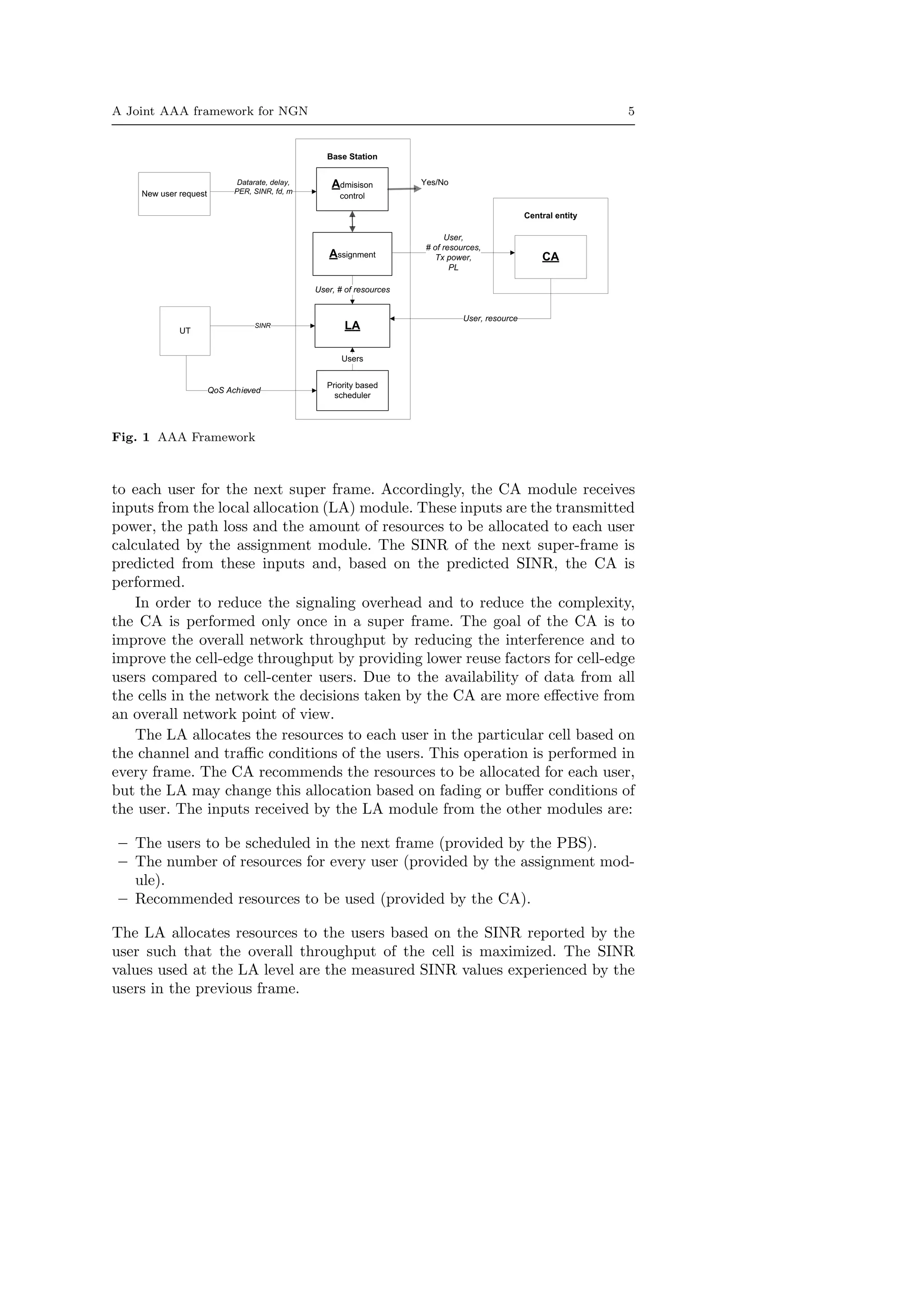
trol (AAA) is proposed as shown in Fig. 1. The main objectives of the proposed
framework are:
– Dynamic and autonomous allocation of resources to each base station and
to each user in the downlink by considering ICI, SINR, load of the network,
location and downlink transmit power etc. such that the overall network
throughput is maximized.
– Assignment of resources to each user, which includes estimating the number
of resources based on QoS requirements of the user, type of user, target
SINR, fading conditions, etc. such that the QoS requirements of the user
are met.
– Admission of a new or handoff user such that the network does not experi-
ence congestion, QoS of existing users is not violated and QoS of the new
user is achieved.
The allocation of resources in the network is done at two time scales, super-
frame and frame. The central allocation (CA) is done for every super-frame by
predicting the SINR of the next super-frame from path loss and shadowing.
Based on the predicted SINR, the CA allocates resources to each cell and
A Joint AAA framework for NGN 5
Fig. 1 AAA Framework
to each user for the next super frame. Accordingly, the CA module receives
inputs from the local allocation (LA) module. These inputs are the transmitted
power, the path loss and the amount of resources to be allocated to each user
calculated by the assignment module. The SINR of the next super-frame is
predicted from these inputs and, based on the predicted SINR, the CA is
performed.
In order to reduce the signaling overhead and to reduce the complexity,
the CA is performed only once in a super frame. The goal of the CA is to
improve the overall network throughput by reducing the interference and to
improve the cell-edge throughput by providing lower reuse factors for cell-edge
users compared to cell-center users. Due to the availability of data from all
the cells in the network the decisions taken by the CA are more effective from
an overall network point of view.
The LA allocates the resources to each user in the particular cell based on
the channel and traffic conditions of the users. This operation is performed in
every frame. The CA recommends the resources to be allocated for each user,
but the LA may change this allocation based on fading or buffer conditions of
the user. The inputs received by the LA module from the other modules are:
– The users to be scheduled in the next frame (provided by the PBS).
– The number of resources for every user (provided by the assignment mod-
ule).
– Recommended resources to be used (provided by the CA).
The LA allocates resources to the users based on the SINR reported by the
user such that the overall throughput of the cell is maximized. The SINR
values used at the LA level are the measured SINR values experienced by the
users in the previous frame.
6 M. V. Ramkumar et al.
The next module in the AAA framework is the assignment module which
is based on a two-dimensional Markov modeling of the queue. This model-
ing takes into account the effects of AMC in the physical layer. Given that a
new user is requesting admission to the network or that a handover has been
initiated, the assignment module is triggered by the admission control (AC)
module. The AC forwards the request on behalf of the user with the QoS re-
quirements and channel conditions to the assignment module. The assignment
module then estimates the number of resources required by the user such that
its QoS requirements are met and it keeps providing this information to the
CA module once every super frame and to the LA module every frame.
The next module of the AAA is the admission control module, which deals
with admission/rejection of a new or handoff user. For each new request, the
assignment module calculates the number of resources required by the user and
forwards it to the admission control module. The admission control module
estimates the mean number of resources used by existing users by taking ad-
vantage of multi user diversity based on buffer conditions. Based on the mean
number of resources used by existing users and the number of resources esti-
mated for a new user (information provided by the assignment module), this
module decides if admission is possible. The method of mean resource calcu-
lation therefore increases the number of admitted users in the system without
violating QoS of existing users and hence decreases the dropping probability.
Another important module of the system model in Fig 1 that interfaces
with AAA framework is the PBS. Every frame, the PBS selects the users
to be scheduled based on the assigned priority and accordingly forwards this
information to the assignment module. The priority of the user is inverse pro-
portional with the level of user satisfaction which is quantified by the achieved
QoS level. The users with the highest priority are scheduled first in the next
frame. By scheduling the users with least satisfaction, fairness is obtained.
The goal of this section was to propose a generic framework (AAA) which
can be used for any radio access technology (RAT) or for heterogeneous RATs.
The modules and the interfaces between them have been described.
4 ALLOCATION
4.1 Central Allocation
In previous works [3] [4] [5], dynamic resource allocation is done based on the
SINR experienced by the user in a previous frame or slot. This approach does
not guarantee maximum throughput as the SINR changes completely for one
frame to another and there is not a function mapping the current SINR to
the previous SINR value or the previous allocations. Even if the allocation
converges or stabilizes after a few frames, this cannot be guaranteed to be
optimal as path loss and fading change due to user mobility, leading to new
values of interference.
A Joint AAA framework for NGN 7
Hence a new allocation scheme is proposed, in which interference is pre-
dicted by the central entity located inside the radio access network (RAN)
[13] based on the current allocation of resources for the users. The allocation
module receives input from the assignment module with a list of users and
downlink transmit power for each user, number of resources that need to be
allocated in order to achieve the QoS and the path loss for each user. The
output of the allocation module is a mapping of available resources for each
base station and the recommended resources for each user. Given that the
user has sufficient packets to be sent in his buffer or given that the user is
not experiencing deep fade, the base station may follow the recommendation
of the CA module. The base station also has the possibility of taking its own
decision about the users to be scheduled and the resources to be allocated at
each frame level. This local decision depends on traffic conditions of the user,
the channel fading conditions and the user satisfaction levels.
Furthermore, the interference experienced by a user in the next frame is
estimated from the channel gain which is based on the path loss of the user
from its own base station and neighboring base station. The allocation of
resources first considers the users experiencing the highest downlink transmit
power (which are most probably cell-edge users) and thus potentially creating
the most interference in the system. Once the resources for the user have been
allocated, the effect of this allocation on other users in the system is calculated.
The reason for allocating the far off users first is that the interference
created by far off users is higher compared to the nearby users. This way of
allocating resources, based on geographic position, ensures a low reuse factor
(e.g. 1/3) for cell-edge users and a high reuse factor (e.g. 1) for cell-center users.
The increase in reuse factor from cell-edge to cell-center increases depending
on the load of the network and distribution of the load in the network. The
proposed heuristic method of CA is explained for an orthogonal frequency
division multiple access (OFDMA) scheme based system (LTE).
Consider a network consisting of L base stations and a set of M users, with
users served by base station l denoted as Ml, where M =
L
l=1 Ml. The base
station l ∈ L that serves user m ∈ M is denoted as l(m). Let Gm,j denote
long term channel gain, which includes path loss and shadowing, from base
station j ∈ L to user m ∈ M. Gm,j is calculated from dm,j as shown in eq. 1,
where dm,j is the distance from user base station j to user m. The downlink
transmit power of user m from l(m) is denoted as Pm.
Gm,j = 44.9−6.55log10(hBS) log10(dm,j)+34.46+5.83log(hBS)+23(fc/5)
(1)
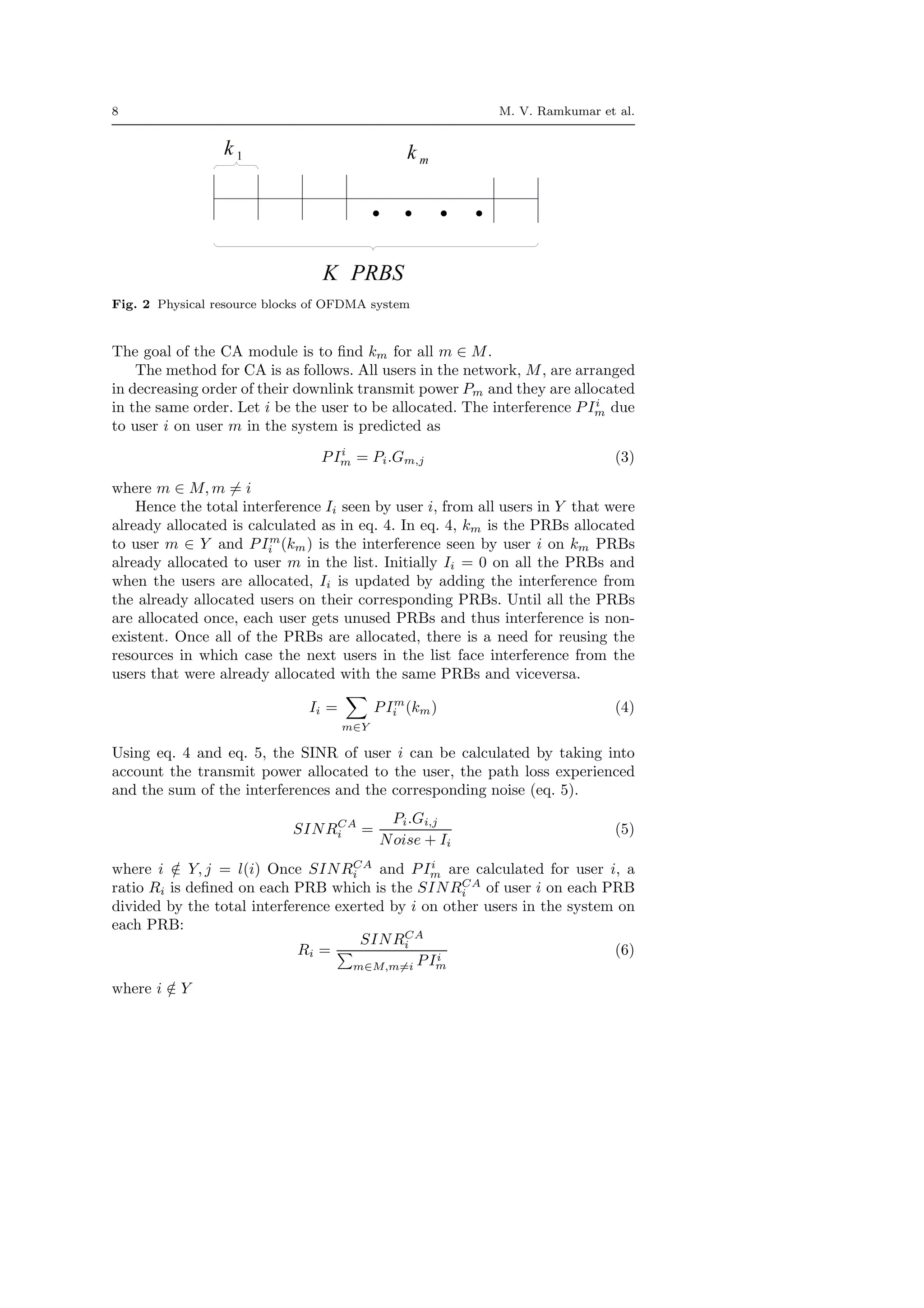
The multiple access scheme used is OFDMA with K PRBs in each frame,
with user m allocated with a set of km PRBs, of length |km| obtained from
the assignment module, as shown in Fig. 2 where
m∈M
|km| ≤ K (2)
8 M. V. Ramkumar et al.
Fig. 2 Physical resource blocks of OFDMA system
The goal of the CA module is to find km for all m ∈ M.
The method for CA is as follows. All users in the network, M, are arranged
in decreasing order of their downlink transmit power Pm and they are allocated
in the same order. Let i be the user to be allocated. The interference PIi
m due
to user i on user m in the system is predicted as
PIi
m = Pi.Gm,j (3)
where m ∈ M, m = i
Hence the total interference Ii seen by user i, from all users in Y that were
already allocated is calculated as in eq. 4. In eq. 4, km is the PRBs allocated
to user m ∈ Y and PIm
i (km) is the interference seen by user i on km PRBs
already allocated to user m in the list. Initially Ii = 0 on all the PRBs and
when the users are allocated, Ii is updated by adding the interference from
the already allocated users on their corresponding PRBs. Until all the PRBs
are allocated once, each user gets unused PRBs and thus interference is non-
existent. Once all of the PRBs are allocated, there is a need for reusing the
resources in which case the next users in the list face interference from the
users that were already allocated with the same PRBs and viceversa.
Ii =
m∈Y
PIm
i (km) (4)
Using eq. 4 and eq. 5, the SINR of user i can be calculated by taking into
account the transmit power allocated to the user, the path loss experienced
and the sum of the interferences and the corresponding noise (eq. 5).
SINRCA
i =
Pi.Gi,j
Noise + Ii
(5)
where i /∈ Y, j = l(i) Once SINRCA
i and PIi
m are calculated for user i, a
ratio Ri is defined on each PRB which is the SINRCA
i of user i on each PRB
divided by the total interference exerted by i on other users in the system on
each PRB:
Ri =
SINRCA
i
m∈M,m=i PIi
m
(6)
where i /∈ Y
A Joint AAA framework for NGN 9
The PRBs to be allocated for user i, ki, are selected such that the ratio
Ri is maximized. This ensures that the user is allocated the optimum PRBs
with a good SINR and the total interference exerted by user i on the system
is minimum. Once ki is found the interference due to user i on other users in
M on ki PRBs is updated, and Y is updated with i. For the next user in the
list the same procedure is repeated, until all the users are allocated.
This method reuses the PRBs if the load in each cell increases, such that the
interference from the users already allocated is minimum and the interference
created by this user on other users in the system is also minimum. Hence
this method guarantees that, when PRBs are reused, the users in the cell-
center obtain a lower reuse factor and the users near the cell edge experience a
higher reuse factor. The proposed method can be applied to cells with uneven
distribution of loads. This heuristic approach improves the overall throughput
of the network and guarantees cell-edge throughput, which is verified from
simulation results shown in Section 8.2. This approach is suitable in a network
with dynamic variation of traffic conditions and network load.
The complexity of the method in terms of the number of multiplications is
considered. For the Mth
user, eq. 4 needs M −1 multiplications. By considering
division also as multiplication, eq. 5 needs K multiplications, one for each PRB.
Similarly denominator of eq. 6 needs M − 1 multiplications and the division
requires K multiplications. Hence the total number of multiplications for the
Mth
user is 2(M + K − 1). Hence the complexity of the proposed heuristic
method grows linearly with M and K.
4.2 Local Allocation
Due to the signaling overhead, the CA module takes the path loss and shad-
owing into consideration but not the fading effects of users. Hence this mod-
ule takes advantage of channel conditions by allocating resources having high
SINR to users. Even though the CA module in the RAN recommends the
resources to be used by each user in every super frame, the LA may change
the allocation by considering the changes in signal conditions. This module
takes the input from the PBS and from the assignment module and allocates
resources to each user. The allocation of resources to the users is based on the
SINRLA
i,k reported to the LA module of user i on PRB k, which also takes
channel gain due to fading into consideration. Hence the goal of this module
is to maximize the overall SINRLA
i,k of the base station by allocating resources
to the users having the best SINRLA
i,k conditions, which in turn maximizes the
overall throughput of the base station.
eq. (7) explains the SINR measured by the user where hk
i,l(i) is the channel
gain due to fading between user i and its own base station l(i) on PRB k.
|Ml| is the total number of users to be scheduled in base station l with user
i allocated with |ki| PRBs and Pk
l is the downlink transmit power from base
10 M. V. Ramkumar et al.
station l on PRB k.
SINRLA
i,k =
Pk
l(i).Gi,j.hk
i,j
Noise + l∈L,l=l(i) Pk
l .Gi,l
(7)
The goal of the LA is to find ki PRBs for user i such that the overall SINRLA
i,k
in each base station is maximized, as shown in eq. (8).
max
|Ml|
i=1
ki
k=1
SINRLA
i,k where ki ∈ K, |ki| < |K|, Ml ∈ M, |Ml| < |M|
(8)
5 Assignment
The assignment module estimates the number of resources required by each
user in order to have its QoS requirements met. This estimation is based
on a Markov-based modeling of the queue in the MAC layer by taking into
account the effects of AMC in the physical layer. Hence, this module guarantees
meeting the QoS requirements for the existing users and also for the new user
as this module is triggered at the time of admission. The assignment module
gets input from the PBS regarding the users to be scheduled in the next frame
and it forwards to the LA the number of resources required for every user.
Every super-frame it also sends to the CA module the user information, the
number of resources required by each user, downlink transmit power of the
user and the path loss of the user.
The estimation of the amount of resources takes into account the AMC in
the physical layer and the effects of the queue in the MAC layer. Each user
is given b resources in each frame and the goal of the assignment module is
to find suitable value of b that guarantees the QoS to the user. By using a
Markov-based analysis for the queue [16] as shown in Fig. 3, the assignment
module estimates the probability of dropping a packet (Pd). From the dropping
probability the estimation for throughput and delay for different values of b
are then derived. The most suitable value of b that matches the requested QoS
is selected.
Each state of a Markov chain is defined as (U, C) where U is the number of
packets waiting in the queue (can range from 0 to B where B is the buffer size)
and C represents the number of packets transmitted in the next frame. The
number of packets transmitted in a frame depends on the number of resources
allotted to the user and the AMC mode of the user in that particular frame.
Cn = bBn n = 1, 2...N (9)
where Bn is the number of bits per symbol depending on the AMC mode.
Hence C can take any value in C1, C2, ..., CN where N is the number of AMC
modes.
A Joint AAA framework for NGN 11
Fig. 3 State transitions of two-dimensional Markov chain of a queue
Each user is allotted a buffer in the MAC layer and the size of the buffer
B depends on the type of user. For high data rate applications like video
conferencing, the buffer size B is large compared to low data rate applications
like voice. The number of packets waiting in the queue depends on the arrival
process A, the service process and the buffer length allocated to the user. The
arrival process is modeled with a Poisson distribution:
P(a) =
λa
e−λ
a!
(10)
where a ≥ 0 and E(A) = λ is the packet arrival rate, defined as the average
number of packets arriving during one frame, depending on the traffic model.
The service process depends on the AMC and on the SINR of the user
in the frame. The probability of the service process changing from one state
to another depends on the transition probability of a user changing from one
AMC mode to another by assuming that the number of resources allotted
to the user is fixed. In [14], the signal to noise ratio (SNR) was divided into
adjacent regions based on the desired bit error rate (BER). The transition
probabilities between the various SNR regions were determined based on the
Level Crossing Rate (LCR) of the channel fading distribution. Also it is as-
sumed that a user can transition one AMC mode at a time which can be seen
in the two-dimensional Markov chain of the queue in Fig. 3
Based on the probability of packet arrival, P(a), from the arrival process
and the transition probability between AMC modes, the steady state distribu-
tion of the two-dimensional Markov chain is calculated. From the steady state
distribution of the two-dimensional Markov chain P(U = u, C = c) [15], the
expected number of packets dropped from queue E(D) can be expressed as
E(D) =
a∈A,u∈U,c∈C
max(0, a−B+max(0, u−c))P(A = a)×P(U = u, C = c)
(11)
12 M. V. Ramkumar et al.
The dropping probability of packets, Pd, from the queue is calculated from
the expected number of packets dropped from the queue and expected arrival
rate of packets as
Pd =
E(D)
λTf
(12)
where Tf is the frame duration. From the above dropping probability, Pd, the
packet loss rate (PLR) is calculated, which is defined as the probability that a
packet is lost and is composed of two factors: packet error rate (PER), which
is the ratio of packets lost due to radio environment, noise, etc. and the packet
dropping rate (PDR), which is the ratio of packets dropped due to timeouts
in the queue or due to the finite buffer length B. The packet is assumed to be
lost when there are bit errors in the packet and/or when the waiting time of a
packet in the buffer is more than a certain timeout. The PLR is calculated as
PLR = 1 − (1 − Pd)(1 − P0) (13)
where P0 is the PER due to channel fading and Pd is the dropping probability.
From PLR, the prior throughput is estimated as:
ηprior = λ(1 − PLR) (14)
From Little’s Theorem [17], the average number of packets waiting in the queue
is equal to the product of arrival rate of the packets and the average delay of
each packet. From this the expected prior delay is estimated as
τprior =
Nw
E(A)(1 − Pd)
(15)
where Nw is the average number of packets waiting in the queue plus the
average number of packets transmitted in one frame obtained from the steady
state probability P(U = u, C = c). ηprior and τprior are calculated for different
values of b. The minimum value of b that achieves the required QoS in terms
of throughput and delay requested by the user is selected. The assignment
module is triggered during admission to a new user and hence the estimated
value of b is sent to the admission control module. It is assumed that delay
in the transmission is only due to waiting time in the buffer, hence only Pd is
considered for the delay calculations. The delay caused due to retransmissions
caused by CRC errors is not considered.
6 Admission Control
The admission control [1] module is triggered when an admission request from
a new user is received. The user sends a request with the QoS requirements
needed for its application such as target SINR, data rate, delay, PER and
channel conditions (fading rate fd and fading index m). After receiving these
inputs the assignment module estimates the amount of resources needed to
obtain the QoS requested. Thus the assignment module checks whether the
A Joint AAA framework for NGN 13
required resources are available in the network and accordingly takes the de-
cision to either admit or reject the user.
The admission control algorithm increases the number of connections that
can be served by taking the buffer conditions of each user into consideration
[12]. A user may not need to utilize all the resources allocated due to lack
of packets in the buffer. Thus, in order to obtain an efficient utilization of
the bandwidth, a mean resource calculation which finds the average number
of resources used by all the users in the system is performed. The number
of resources actually scheduled [11] can be expressed in the following way,
depending on the current channel conditions and the previous buffer status:
k(Ut−1, Ct) =



0; if Ct = 0,
km; if Ut−1 ≥ Ct,
floor(km∗Ut−1
Ct
); if Ut−1 < Ct.
(16)
where Ut−1 is the number of packets that are in the queue for user m at the
time moment t−1, km is the number of resources estimated by the assignment
module for user m and Ct is the number of packets that can be accommodated
in the next frame with the selected AMC mode. If km is the maximum number
of resources that can be allocated to user m, then the maximum number of
resources that can be allocated to all the users in a system is kM = m∈M km.
The users are admitted until kM reaches the maximum number of resources
in the system. The goal of the mean resource allocation is to find the average
value of kM , such that a maximum number of users can be accommodated in
the system.
The mean number of resources used by all users, or average value of kM , is
estimated from the steady state distribution of kM , which can be determined
from the Z-transform Dm(z) of km. The Z-transform of km can be expressed
as:
Dm(z) =
j
P(km = j)z−j
(17)
where P(km = j) is the probability that the user m is allocated with j re-
sources. The Z transform of kM is expressed as DM (z) = m∈M Dm(z). By
calculating the inverse Z-transform, the steady state distribution of kM is ob-
tained as:
P(kM = j) = Z−1
DM (z) (18)
From the steady state distribution of kM the mean number of resources kmean
M
used by all the users in the system is obtained. Based on the estimated value
of kmean
M , a new user m which requires km resources is admitted according to:
km + kmean
M ≤ Ktotal (19)
where Ktotal is the total number of resources available in the system.
14 M. V. Ramkumar et al.
Table 1 Weight Coefficients
Service type Notes ωrt
u ωnrt
u
1 High rate and low delay 1 0
2 Low delay 1 1
3 High rate 0 1
4 Best Effort 0 0
7 Priority Based Scheduler
The main function of the PBS is to schedule the users based on the estimated
priority so that the user with highest priority is scheduled first. The amount
of resources to be allocated to each user is estimated by the admission control
algorithm based on the achieved QoS. For each user a satisfaction index (SI)
which gives the level of user satisfaction and indicates how throughput and
delay of a user is achieved w.r.t. the desired values is calculated. The desired
QoS values are assumed to be dependent on the type of service. From the SI
values the PBS calculates the priorities for each user and sends them to the
LA module. The SI is represented as a function of delay Γu(t) or as a function
of rate Ψu(t) [12]. In either case, the lower the SI, the higher the priority user
will be assigned.
The delay component SI is expressed with regards to the head of line (HOL)
delay ωu, which is the longest delay experienced by a packet at the HOL, and
the maximum delay for service u, T (u), as shown below:
Γu(t) =
T (u)−∆T (u)
ωu(t) ; if ωu(t) < T (u) − ∆T (u),
1; otherwise.
(20)
where ∆T (u) is a safety margin. The rate component is expressed in terms of
the average rate measured, ηu, and the desired data rate, ˆηu:
Ψu(t) =
ηu
ˆηu − ∆ ˆηu
(21)
where ∆ ˆηu is the margin coefficient. The safety margin and margin coefficient
are used due to the variations in the radio link conditions.
The priority function has two components Φrt
u and Φnrt
u as shown in eq. 23
and eq. 24, where Φrt
u is the real time component based on the delay and Φnrt
u
is the non real time component based on the data rate.
Φu = ωrt
u φrt
u + ωnrt
u φnrt
u (22)
where the weight coefficients ωrt
u and ωnrt
u are determined based on the service
type as shown in Table 1. The expressions for Φrt
u and Φnrt
u are
Φrt
u =



Ru
1
Γu(t) ; if Γu(t) ≥ 1; Ru = 0,
1; if 0 < Γu(t) < 1; Ru = 0,
0; if Ru = 0
(23)
A Joint AAA framework for NGN 15
Φnrt
u =



Ru
1
Ψu(t) ; if Ψu(t) ≥ 1; Ru = 0,
1; if 0 < Ψu(t) < 1; Ru = 0,
0; if Ru = 0
(24)
where Ru is the normalized channel quality in the range [0 1], as high received
SNR induces high capacity which results in high priority.
Using the above equations, the calculation of the priority function Φu is
performed. From the above calculations, the users with least satisfaction are
given the highest priority and scheduled first. This approach ensures fairness
for each user.
8 Simulation Results
8.1 Simulation Setup
The setup simulated in MATLAB is a 4-cell network, with users distributed
randomly in each cell as shown in Fig. 4. LTE-TDD is used with 10MHz
bandwidth at 3.5GHz center frequency. The number of PRBs used in each cell
depends on the load of the cell. The PRBs are distributed uniformly among
users in the cell based on the type of the user. The users are moving with 3
km/h speed within the cell with a 250m radius in urban scenario. The users
move straight in random directions and bounce back when a cell boundary
is reached. The path loss model used for the urban scenario is C2 NLOS
developed in Winner [18] as shown in eq. 1.
Each user is assigned a buffer of length 15, 30 or 60 packets depending
on the type of user. Three types of users are selected based on the data rate
400kbps, 800kbps or 2Mbps. Based on the type of user the λ of the poisson
distribution is chosen, which decides the packet arrival rate. The number of
users depends on the load of the cell with each type of user randomly selected.
The transmit power of the base station is 43dBm, which is equally dis-
tributed on all PRBs. In each frame the SINR is measured on each PRB by
calculating the received signal from the current base station and interfering
signal from neighbor base stations on each PRB. Based on the measured SINR
the LA assigns the PRBs to each user such that the overall SINR in each cell
is maximized.
The CA module allocates the PRBs to each cell once in every super frame
based on the predicted SINR. A super frame consists of 20 frames. The pro-
posed CA+LA is compared with an existing method [5] in the literature which
is also a hybrid approach, with a standalone LA complemented by a random
allocation. The base station transmits to each user on the allocated PRBs. The
SINR is measured in each frame and mapped to the Shannon throughput. The
simulation parameters used in the simulation are given in the Table 2. The
simulation is run for 1000 frames and averaged over 100 runs.
16 M. V. Ramkumar et al.
Fig. 4 4-cell network
Table 2 Simulation Parameters
Parameter Value
Carrier frequency fc 3.5Ghz
Deployment scenario Urban macro
Intersite distance 500m
Path loss model C2 NLOS
Mobility 3 Kmph
Bandwidth 10 Mhz
Antenna Omni directional
downlink Tx power 43 dBm
UL Tx power 24 dBm
target SINR 15 dB
Noise figure 9dB
Buffer length B [15, 30, 60] for Type 1,2,3
Packet length 84 bits
Packet arrival rate, λ [3, 5, 12] for Type 1,2,3
Number of AMC modes BPSK, 4, 8, 16, 32, 64 QAM
SINR thresholds [dB] [7.2 10.1 12.5 16.1 18.7 22.2]
8.2 Cell Throughput
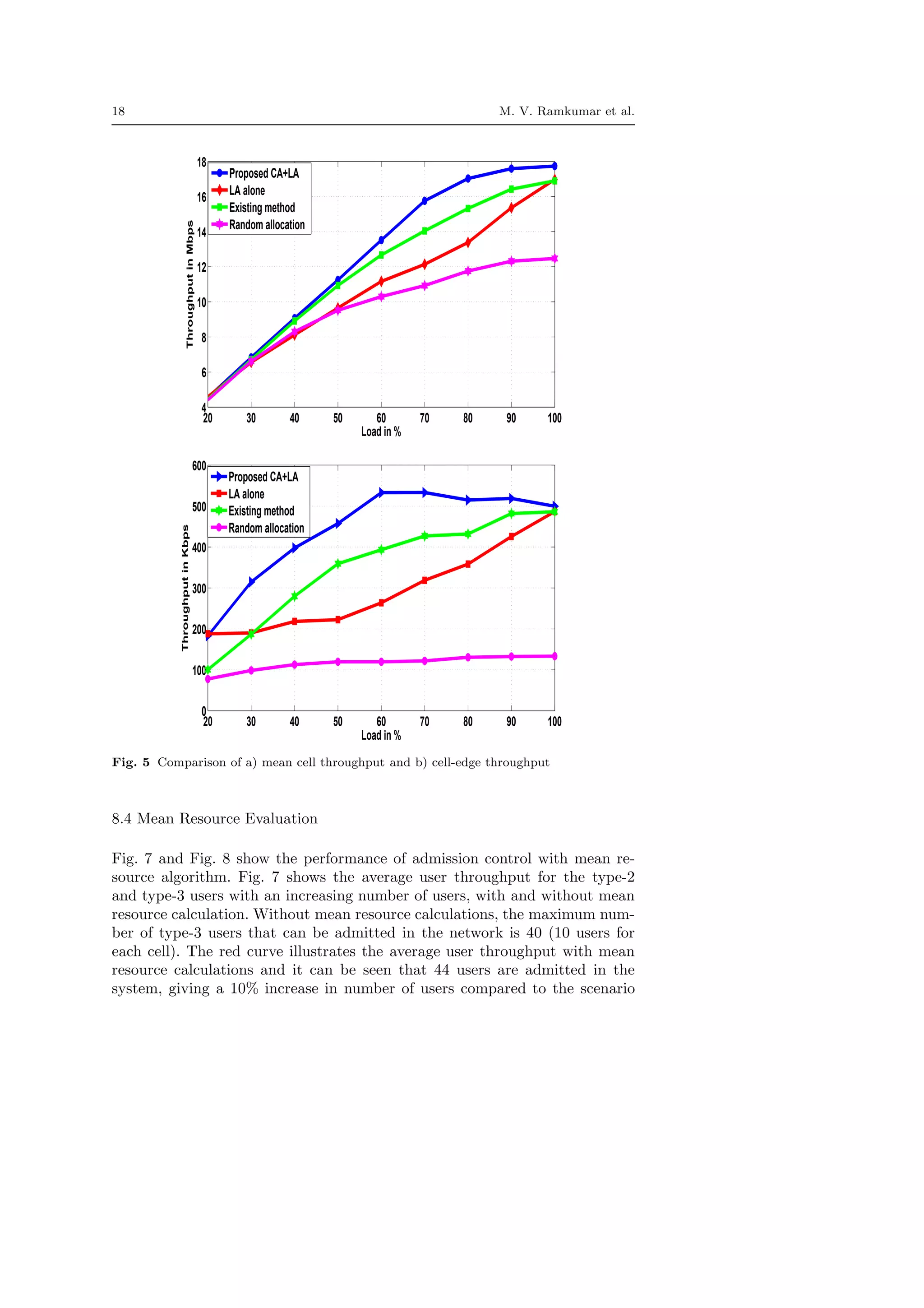
Fig. 5.a shows the mean cell throughput and average cell-edge throughput of
the network with increasing load. The load is varied by varying the number
of PRBs used in the cell. The existing hybrid method is compared with the
proposed CA+LA method, and it can be seen that at 70% and 80% load, the
proposed approach performs around 2Mbps or 14% better than the existing
method.
A Joint AAA framework for NGN 17
Also with CA+LA the performance of mean cell throughput is around
4Mbps better than LA alone at 60% and 70% loads. The CA recommends the
PRBs to be used by each cell for every super frame and, as load reaches 100%,
the CA has to recommend all of the PRBs for each cell; hence the performance
of CA+LA and LA standalone merges at 100% load. At lower loads, as the
effect of interference is low, the difference in performance between CA+LA and
LA standalone is lower when compared to higher loads. The proposed solution
is also compared with a random allocation. It can be seen that LA standalone
and CA+LA perform around 5Mbps better than random allocation at 100%
load. At 90% load CA+LA performs 6Mbps better than random allocation,
whereas LA standalone performs 4Mbps better than random allocation.
The cell-edge throughput shown in Fig. 5.b is defined as the outage through-
put of users below 5%. From the CDF of the average user throughput of all
users, the value at 5% is outage throughput, which is assumed as cell edge
throughput. The performance of cell-edge user for the proposed approach is
better by 125kbps or around 30% compared to the existing method [5] at 60%
load. As explained above, the difference in performance can be better observed
at medium loads. At 100% load the performance of the proposed heuristic
method for CA with LA and the LA standalone is the same. At 90% load, the
proposed CA+LA performs around 400kbps better than random allocation,
whereas LA standalone performs 300kbps better than random allocation. The
dip at lower loads is due to less or zero number of cell-edge users at the lower
loads. Due to the less number of users, cell edge throughput is low at lower
loads.
8.3 User Throughput
The assignment module estimates the number of PRBs required by each type
of user for a given target SINR. We assume three types of users with data
rates 400kbps, 800kbps and 2Mbps. For each user type the number of PRBs
required in order to obtain the target throughput is estimated by the assign-
ment module. For each user type the parameters chosen are shown in Table 2.
For AMC, if the SINR is below 7.2dB, then there will be no transmission.
By using the above values the assignment module estimates the probability
of dropping the packets for various values of b, where b is the number of
PRBs allotted to each user. From the dropping probability the throughput is
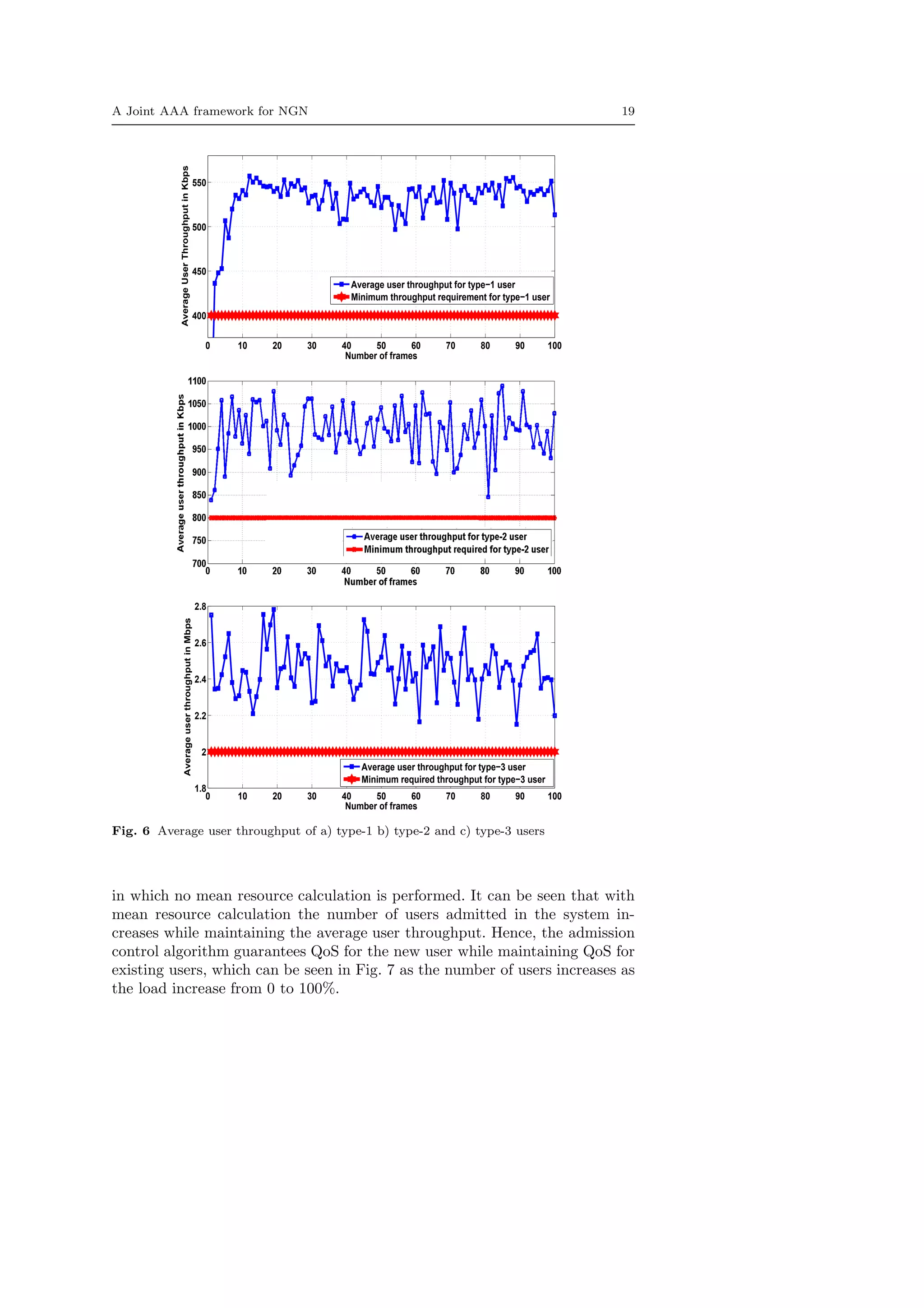
calculated. Fig. 6.a, Fig. 6.b and Fig. 6.c show the average throughput of type-
1, type-2 and type-3 users in the system with required throughput of 400kbps,
800kbps and 2Mbps respectively. The red line shows the required throughput
of the user and the blue line shows the achieved throughput. It can be seen that
on an average all users in each type obtain the required throughput. Hence
the assignment module guarantees the QoS for the user.
18 M. V. Ramkumar et al.
20 30 40 50 60 70 80 90 100
4
6
8
10
12
14
16
18
Load in %
ThroughputinMbps
Proposed CA+LA
LA alone
Existing method
Random allocation
20 30 40 50 60 70 80 90 100
0
100
200
300
400
500
600
Load in %
ThroughputinKbps
Proposed CA+LA
LA alone
Existing method
Random allocation
Fig. 5 Comparison of a) mean cell throughput and b) cell-edge throughput
8.4 Mean Resource Evaluation
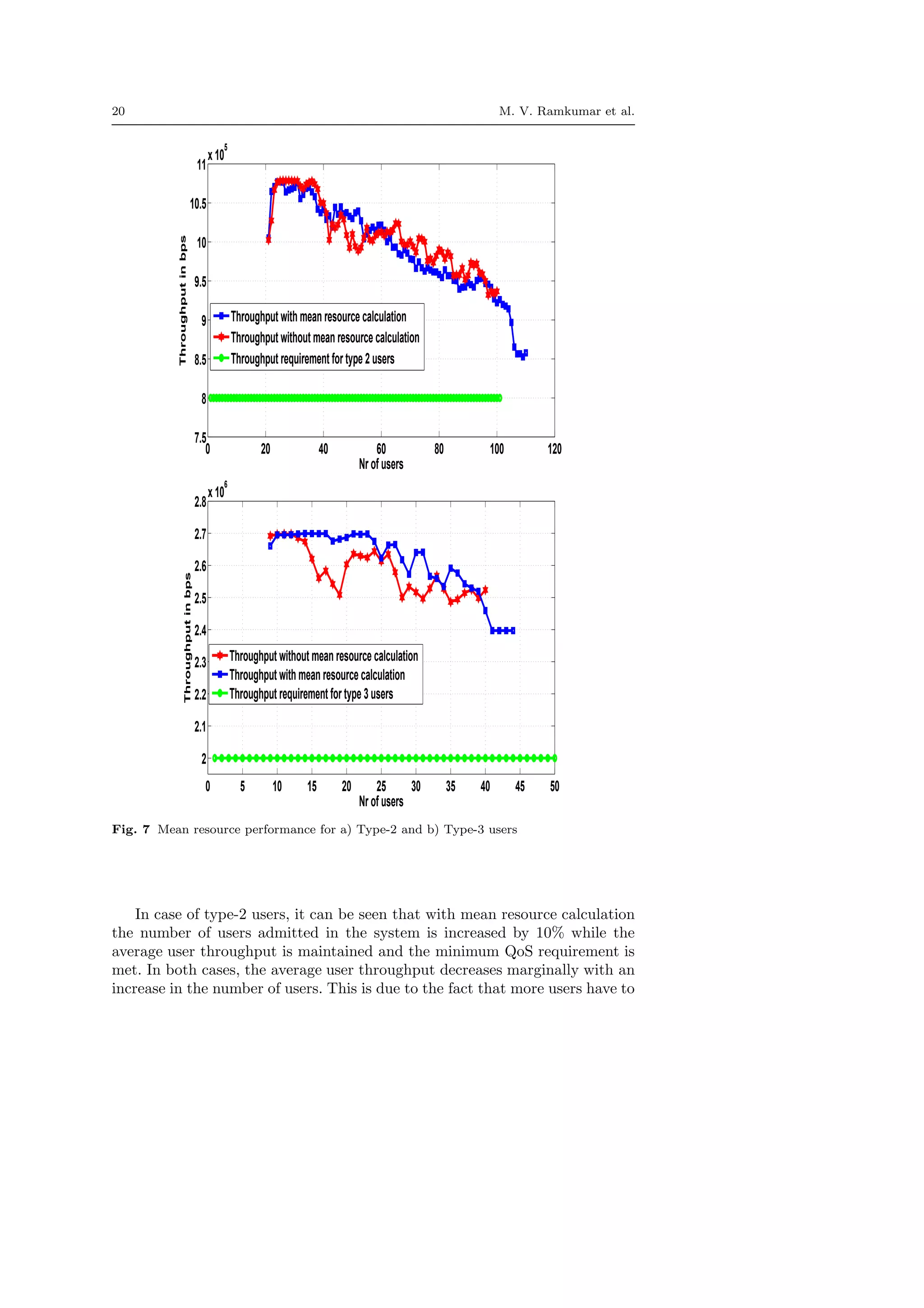
Fig. 7 and Fig. 8 show the performance of admission control with mean re-
source algorithm. Fig. 7 shows the average user throughput for the type-2
and type-3 users with an increasing number of users, with and without mean
resource calculation. Without mean resource calculations, the maximum num-
ber of type-3 users that can be admitted in the network is 40 (10 users for
each cell). The red curve illustrates the average user throughput with mean
resource calculations and it can be seen that 44 users are admitted in the
system, giving a 10% increase in number of users compared to the scenario
A Joint AAA framework for NGN 19
0 10 20 30 40 50 60 70 80 90 100
400
450
500
550
Number of frames
AverageUserThroughputinKbps
Average user throughput for type−1 user
Minimum throughput requirement for type−1 user
0 10 20 30 40 50 60 70 80 90 100
1.8
2
2.2
2.4
2.6
2.8
Number of frames
AverageuserthroughputinMbps
Average user throughput for type−3 user
Minimum required throughput for type−3 user
Fig. 6 Average user throughput of a) type-1 b) type-2 and c) type-3 users
in which no mean resource calculation is performed. It can be seen that with
mean resource calculation the number of users admitted in the system in-
creases while maintaining the average user throughput. Hence, the admission
control algorithm guarantees QoS for the new user while maintaining QoS for
existing users, which can be seen in Fig. 7 as the number of users increases as
the load increase from 0 to 100%.
20 M. V. Ramkumar et al.
0 20 40 60 80 100 120
7.5
8
8.5
9
9.5
10
10.5
11
x 10
5
Nr of users
Throughputinbps
Throughput with mean resource calculation
Throughput without mean resource calculation
Throughput requirement for type 2 users
0 5 10 15 20 25 30 35 40 45 50
2
2.1
2.2
2.3
2.4
2.5
2.6
2.7
2.8
x 10
6
Nr of users
Throughputinbps
Throughput without mean resource calculation
Throughput with mean resource calculation
Throughput requirement for type 3 users
Fig. 7 Mean resource performance for a) Type-2 and b) Type-3 users
In case of type-2 users, it can be seen that with mean resource calculation
the number of users admitted in the system is increased by 10% while the
average user throughput is maintained and the minimum QoS requirement is
met. In both cases, the average user throughput decreases marginally with an
increase in the number of users. This is due to the fact that more users have to
A Joint AAA framework for NGN 21
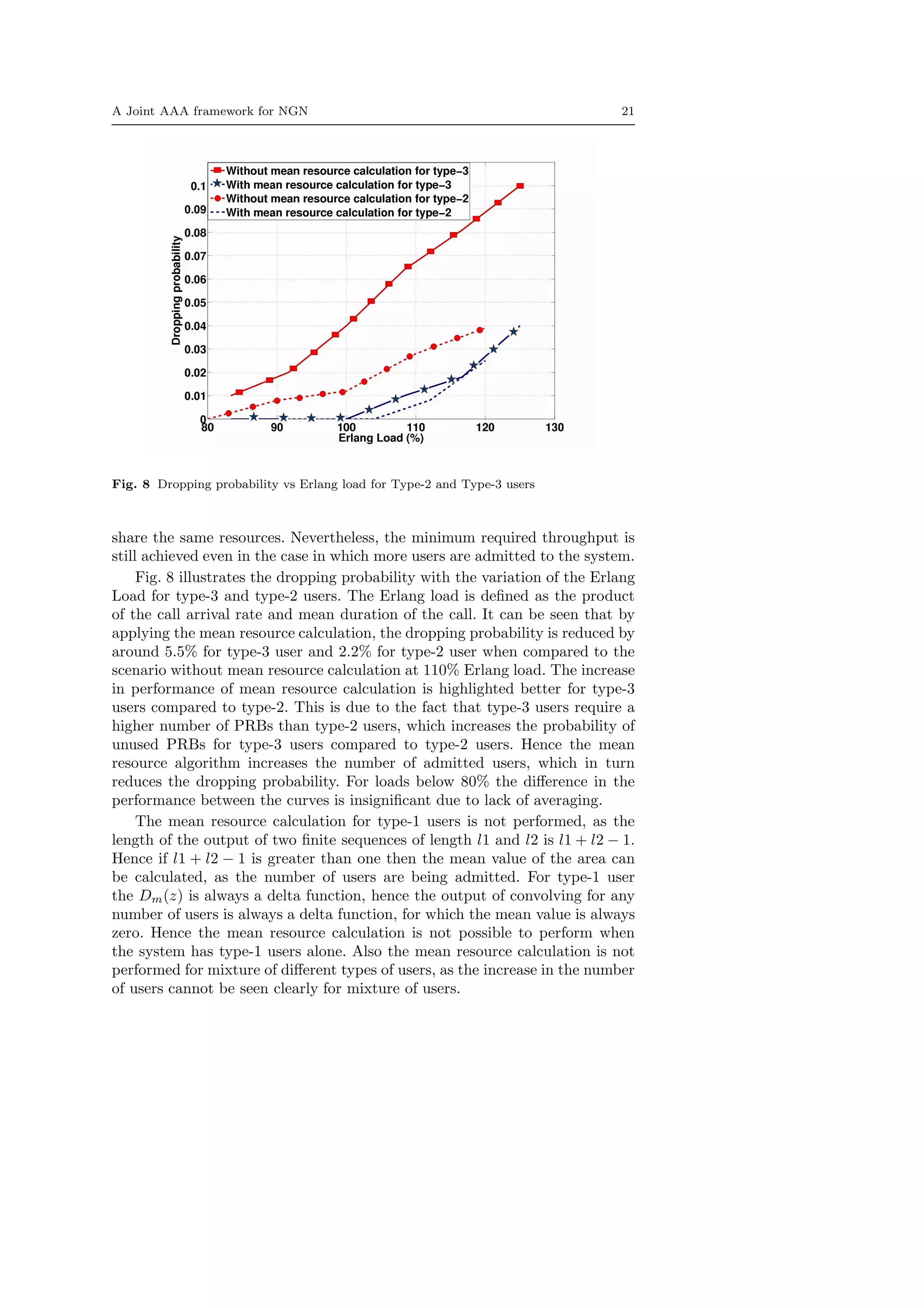
Fig. 8 Dropping probability vs Erlang load for Type-2 and Type-3 users
share the same resources. Nevertheless, the minimum required throughput is
still achieved even in the case in which more users are admitted to the system.
Fig. 8 illustrates the dropping probability with the variation of the Erlang
Load for type-3 and type-2 users. The Erlang load is defined as the product
of the call arrival rate and mean duration of the call. It can be seen that by
applying the mean resource calculation, the dropping probability is reduced by
around 5.5% for type-3 user and 2.2% for type-2 user when compared to the
scenario without mean resource calculation at 110% Erlang load. The increase
in performance of mean resource calculation is highlighted better for type-3
users compared to type-2. This is due to the fact that type-3 users require a
higher number of PRBs than type-2 users, which increases the probability of
unused PRBs for type-3 users compared to type-2 users. Hence the mean
resource algorithm increases the number of admitted users, which in turn
reduces the dropping probability. For loads below 80% the difference in the
performance between the curves is insignificant due to lack of averaging.
The mean resource calculation for type-1 users is not performed, as the
length of the output of two finite sequences of length l1 and l2 is l1 + l2 − 1.
Hence if l1 + l2 − 1 is greater than one then the mean value of the area can
be calculated, as the number of users are being admitted. For type-1 user
the Dm(z) is always a delta function, hence the output of convolving for any
number of users is always a delta function, for which the mean value is always
zero. Hence the mean resource calculation is not possible to perform when
the system has type-1 users alone. Also the mean resource calculation is not
performed for mixture of different types of users, as the increase in the number
of users cannot be seen clearly for mixture of users.
22 M. V. Ramkumar et al.
Table 3 Overhead Comparison
Scenario Overhead in kbps
1 - less info every frame 920
2 - less info every super frame 46
3 - full info every frame 6400
4 - full info every super frame 320
8.5 Overhead Analysis
The CA module receives inputs from different base stations in the network.
The amount of overhead information sent by each base station is estimated for
four scenarios. In scenarios 1 and 2 less information which includes userids,
number of resources, downlink transmit power, path loss, is sent once for
every frame and super frame respectively. In scenarios 3 and 4 full information
which includes the channel gain information on all the PRBs apart from the
information in scenario 1 or 2, is sent once for every frame and super frame
respectively. eq. 25 and eq. 26 show the overhead with less information for
scenarios 1 and 2, OVless, and overhead with full information for scenarios 3
and 4, OVfull respectively. Here it is assumed that 64 bit IMSI (International
mobile subscriber identity) is used as user id and 32 bits are used for floating
point representation of path loss and downlink transmit power.
OVless = 64 ∗ |M| + floor(log2(K)) ∗ |M| + 32 ∗ |M| + 32 ∗ |M| ∗ |L|
(25)
OVfull = 64∗|M|+floor(log2(K))∗|M|+32∗|M|+32∗|M|∗|L|+32∗|M|∗K
(26)
where |M| is the number of users, K is the number of PRBs and |L| is the
number of base stations.
The overhead values calculated with the parameters used in the simulation
for four scenarios are shown in Table 3. It can be seen that scenario 2 has the
least overhead (46kbps). The overhead of scenario 3 is higher compared to the
other three scenarios, which is impractical from an implementation point of
view. In scenario 2, although there is an overhead of 46kbps due to CA, the
proposed method gives 4Mbps improvement in overall cell throughput when
compared to the LA standalone solution. Hence the overhead of 46 kbps can
be justified.
9 Conclusion
The proposed AAA framework considers the combination of the three main
aspects of RRM - allocation, assignment and admission control. In proposing
the joint framework, we have successfully managed to address many of the
challenges experienced by next generation cellular networks.
A Joint AAA framework for NGN 23
The proposed heuristic method for allocation of resources adapts to dif-
ferent load conditions and distribution of users across multiple base stations.
The prediction of SINR in the next super frame guarantees that the new allo-
cation performed centrally (CA) is optimal and based on both path loss and
shadowing while small scale fading effects are considered locally (LA). The
proposed system model considers the traffic, channel, buffer conditions and
QoS requirements of all users in order to estimate the required resources. By
using the Markov based estimation of resources required by each user, band-
width utilization is improved in terms of efficiency. At the same time the QoS
requirements for both new as well as existing users are met. Furthermore,
the proposed admission control method increases the total number of users
admitted in to the system without violating the QoS of users.
Based on the simulation results from an LTE network, it can be con-
cluded that the AAA framework provides better overall network and cell-edge
throughput than comparable methods. The framework also increases the to-
tal number of users in the system, hence decreasing the dropping probability
of new and handoff users while guaranteeing QoS for existing users. From
the overhead analysis it can be seen that the improved performance does not
come at the expense of increased overhead. The framework can be extended to
any next generation wireless network and for heterogeneous network scenarios
through common RRM approaches.
Acknowledgements The authors would like to thank ”Fibre-Optic Networks for Dis-
tributed Extendible Heterogeneous Radio Architectures and Service Provisioning (FUTON)”
- an EU funded FP7 project (ICT-2007-215533) and ”Research and Development on Con-
verged network of wireless and wired systems using frequency sharing type wireless tech-
nologies” - a research project funded by NICT, Japan.
References
1. Ramkumar. M. V, Bayu Anggorati, Andrei Lucian Stefan, Neeli R. Prasad, Ramjee
Prasad. QoS-Guaranteed admission control for OFDMA-based systems. Globecom 2010;
606-610. DOI: 10.1109/GLOCOMW.2010.5700392
2. FP7 ICT Project FUTON, at http: www.ict-futon.eu.
3. Elayoubi SE, Ben Haddada O, Fourestie B. Performance evaluation of frequency plan-
ning schemes in OFDMA-based networks. IEEE transactions on wireless communications
2008; 7(5): 1623-1633. DOI: 10.1109/TWC.2008.060458.
4. Guoqing li, Hui Liu. Downlink radio resource allocation for multi-cell OFDMA sys-
tem. IEEE transactions on wireless communications 2006; 5(12): 3451-3459. DOI:
10.1109/TWC.2006.256968.
5. Koutsimanis C, Fodor G. Dynamic Resource Allocation Scheme for Guaranteed Bit Rate
Services in OFDMA Networks. International Conference of Communication Workshops
ICC 2009; 2524-2530. DOI: 10.1109/ICC.2008.478.
6. Kumar S, Yuanye Wang, Marchetti N, Kovacs IZ, Pedersen KI, Mogensen PE. Spectrum
Load balancing for Flexible spectrum usage in Local area deployment scenario. 3rd IEEE
Symposium on New Frontiers in Dynamic Spectrum Access Networks DySPAN 2008; 1-5.
DOI: 10.1109/DYSPAN.2008.93.
7. Katzela I, Naghshineh M. Channel Assignment schemes for cellular mobile Telecommu-
nication systems: A comprehensive survey. IEEE personal communications June 1996;
3(3): 10-31. DOI: 10.1109/98.511762.
24 M. V. Ramkumar et al.
8. E3 project deliverable
9. Xuehong Mao, Maaref A, Koon Hoo Teo. Adaptive Soft Frequency Reuse for Inter-Cell
Interference Coordination in SC-FDMA based 3GPP LTE Uplinks. Globecom 2008; 1-6.
DOI: 10.1109/GLOCOM.2008.ECP.916.
10. R1-050507, ”Soft frequency Reuse scheme for UTRAN LTE”; Huawei, 3gpp TSG RAN
WG1 Meeting 41, Athens , Greece, May 2005.
11. Krasniqi B, Wrulich M, Mecklenbrauker CF. Network-load dependent Partial frequency
reuse for LTE. International Symposium on Commnucations and Information Technology
ISCIT 2009; 672-676. DOI: 10.1109/ISCIT.2009.5341160.
12. Qingwen Liu, Xin Wang, Giannakis GB. A Cross-Layer Scheduling algorithm with QoS
Support in Wireless Networks. IEEE Transactions on Vehicular technology 2006; 55(3):
839-847. DOI: 10.1109/TVT.2006.873832.
13. IEEE 1900.4. Architectural building blocks enabling network-device distributed decision
making for optimized radio resource usage in heterogeneous wireless access networks
14. Q. Zhang, S. Kassam. Finite-state Markov model for Rayleigh fading channels. IEEE
Transactions on Communications 1999; 47(11): 1688-1692. DOI: 10.1109/26.803503.
15. Qingwen Liu, Shengli Zhou, Giannakis GB. Cross-Layer Scheduling With Prescribed
QoS Guarantees in Adaptive Wireless Networks. IEEE Journal on selected areas 2005;
23(5): 1056-1066. DOI: 10.1109/JSAC.2005.845430.
16. Qingwen Liu, Shengli Zhou and Georgios B. Giannakis. Queuing With Adaptive Mod-
ulation and Coding Over Wireless Links: Cross-Layer Analysis and Design, IEEE Trans-
action on Wireless Communications, 4(3):1142-1153, may 2005
17. R. B. Cooper, Introduction to Queuing Theory, 2nd ed. Elsevier North-Holland, 1981
18. IST-4-027756 WINNER II, D1.1.2, WINNER II Channel Models part I, September
2007.
A Joint AAA framework for NGN 25
AAA Allocation Assignment and Admission control
AC Admission control
AMC Adaptive Modulation and Coding
BER Bit Error Rate
BS Base Station
BW Bandwidth
FFR Fixed Frequency Reuse
FSU Flexible spectrum usage
Hz Hertz
ICI Inter Carrier Interference
KBps Kilo byte per second
kbps kilo bits per second
LTE Long Term Evolution
MAC Medium Access Control
mbps mega bit per second
ms millisecond
OFDMA Orthogonal Frequency-Division Multiple Access
PBS Priority based scheduler
PER Packet Error Rate
PHY Physical Layer
PRB Physical resource block
PLR Packet Loss Rate
QAM Quadrature Amplitude Modulation
QoS Quality of Service
RAN Radio Access Network
RAT Radio Access Technology
RRM Radio Resource Management
SFR Soft Frequency Reuse
SNR Signal-to-Noise Ratio
SINR Signal to Interference plus Noise Ratio

AAA (Allocation, Admission and Assignment Control) for Network management

  • 1.
    Noname manuscript No. (willbe inserted by the editor) A Joint Allocation, Assignment and Admission Control (AAA) Framework for Next Generation Networks M. V. Ramkumar · Rasmus Hjorth Nielsen · Andrei Lucian Stefan · Neeli R. Prasad · Ramjee Prasad Received: date / Accepted: date Abstract In this paper, we propose a framework for performing Allocation, Assignment and Admission control (AAA) in next generation cellular net- works. A novel heuristic method for resource allocation is proposed. The al- location is done in a semi-distributed manner consisting of central allocation (CA) and local allocation (LA). The role of the assignment module is to esti- mate the amount of resources needed by a user in order to satisfy the quality of service (QoS) requirements of the application. To that end, a Markov based approach which calculates the dropping probability of packets by consider- ing the effects of queuing in the medium access control (MAC) layer and the adaptive modulation and coding (AMC) in the physical layer is presented. In order to estimate the required resources, the predicted throughput and delay are calculated based on the dropping probability and the predicted values are mapped to the required ones. The admission control module is responsible for admitting or rejecting a new or handoff user and is based on a mean resource calculation. The calculation takes into account the mean number of resources used by existing users as well as the buffer conditions of the individual users. By combining the three novel contributions on allocation, assignment and ad- mission control into the AAA framework the overall network as well as the M. V. Ramkumar Aalborg University, CTIF, Denmark Tel.: +4599408606 E-mail: rk@es.aau.dk Rasmus Hjorth Nielsen Cisco Systems, Denmark Andrei Lucian Stefan Aalborg University, CTIF, Denmark Neeli R. Prasad Aalborg University, CTIF, Denmark Ramjee Prasad Aalborg University, CTIF, Denmark
  • 2.
    2 M. V.Ramkumar et al. cell-edge throughput have been improved and the number of admitted users have been increased while still guaranteeing QoS for new users as well as ex- isting users. Keywords Radio Resource Management · Admission Control · Next Generation Cellular Networks · LTE 1 Introduction Next generation cellular networks are facing severe challenges due to the ex- ponential increase in the number of mobile terminals and the variety of ap- plications [1]. One of the most challenging tasks in such networks is to meet the quality of service (QoS) requirements of the users while improving the ef- ficiency of the overall network. This has to be achieved in the highly dynamic environments characterizing wireless networks which include rapidly changing fading, user mobility, traffic conditions, network conditions, etc. Future wire- less networks must be able to provide services to a vast number of mobile users in different scenarios including both indoor and outdoor. In order to do so, cell sizes must be decreased which in turn results in an increase in the number of base stations needed to service a certain area [16]. At the same time, spectrum scarcity requires the reuse of resources among multiple cells and base stations in both the up and downlink. This potential overlap of resource usage causes inter-cell interference (ICI) between cells, which decreases the QoS and also the cell throughput [3]. This problem is especially significant for cell-edge users which require high transmit power from the serving cell and thus potentially creating high interference on the neighboring cells utilizing the same resources. In order to address the aforementioned challenges, there is a strong need for efficient radio resource management (RRM). RRM includes, among other tasks, the allocation of the right resources to the individual cells in the network and in turn to the individual users served in each cell [4] [5]. The allocation of resources should be done in such a way that the overall throughput of the network is maximized while still maintaining the QoS of the users. If the resources are allocated orthogonally without any overlap between cells, the ICI will be zero, but the overall throughput is not maximized due to lack of resources. On the other hand, a 1:1 reuse results in a high ICI which decreases the throughput. Therefore, a tradeoff on the percentage of overlap should be obtained. As mentioned, users near the cell edge are sensitive to interference as they are close to the neighboring cell and experience weak signal strength due to path loss. Cell-center users, however, are not as sensitive to interference and the allocation of resources to each cell should take these effects into consideration. If the allocation is done in a decentralized and distributed manner, then each cell does not have sufficient knowledge regarding the neighboring cells and the allocation performed may not be optimal [6] [7]. The advantage of a centralized allocation is that it has knowledge of the overall network including
  • 3.
    A Joint AAAframework for NGN 3 the load and user distribution in each cell [5]. However, the centralized alloca- tion has disadvantages in terms of signaling overhead [7]. A hybrid approach could therefore provide an optimized solution and a tradeoff between the sig- naling overhead and the optimal allocation [5]. The amount of resources to be allocated to each cell and its users depends on the load of the cell and should be determined prior to the actual allocation. The resources are a function of the QoS requirements, fading conditions, etc. of the users in the cell. With respect to maintaining the QoS of users, another important challenge is the admission and allocation of resources to new users. New or handoff users can decrease the QoS for existing users by creating congestion in the network [1] and the admission should therefore be carefully considered. The rest of the paper is organized as follows. Section 2 discusses the related work and Section 3 explains the AAA framework and the interfaces between the individual modules. Sections 4, 5, 6 explain the allocation, assignment and admission control modules of the AAA framework. Section 7 is concerned with the priority based scheduler (PBS) and Section 8 presents the simulation setup and the results obtained, while Section 9 concludes the paper. 2 Related Work The allocation of resources can be done in a static way using fixed reuse meth- ods or in a dynamic way by considering the network conditions. Dynamic channel allocation methods are less efficient than fixed allocation methods un- der high load conditions but provide more flexibility and traffic adaptability [7]. In fixed frequency reuse (FFR), physical resource blocks (PRBs) are allo- cated without overlap and hence the ICI is significantly lower, but at the cost of reduced spectral efficiency. In [8] [9] [10], users in a cell are classified into different classes based on their geometrical position and different bandwidth allocation patterns are assigned for different user classes. The most promising approach divides the users into two groups: interior cell-center users and exte- rior cell-edge users. One third of the available bandwidth in each cell is fixed for cell-edge users and the rest for cell-center users [8] [9]. This approach is called soft frequency reuse (SFR). However, when the traffic load changes, it is desirable for the allocation of sub bands to cell-edge users not to be done statically, but rather dynamically in order to take advantage of varying traffic load in the network. This is not addressed in [8] and [10]. In [9], an adaptive SFR scheme dynamically adapts to changing traffic load and user distributions among neighbor cells. In [6], two methods for flexible spectrum usage (FSU) are proposed; spectrum load balancing (SLB) and resource chunk selection (RCS). In [11], partial frequency reuse (PFR) based on network load is pro- posed. In [5], a hybrid method for dynamic resource allocation is proposed. In all the above mentioned methods, the allocation in the current frame is done based on the signal to interference plus noise ratio (SINR) measurements of the previous frame. This approach does not guarantee the optimal allocation of resources for the current frame.
  • 4.
    4 M. V.Ramkumar et al. Whether the assignment or the admission modules are being discussed, the QoS requirements for a new user should be guaranteed without violating the QoS of existing users. The QoS achieved by a user depends on a series of factors, out of which the most notable are the channel conditions of the user. The channel conditions cause packet errors and buffer overflow and thus packet drops or increased delay in packet delivery [1]. Both channel and buffer conditions affect the throughput and delay of a user and traditional queuing models do not consider their effects. At the same time, channel models do not consider the effects of the status of the queue [12]. As an example, if the channel is in deep fade, adaptive modulation and coding (AMC) will select a lower modulation order, which will reduce the outflow of packets from the buffer and thus the throughput of the user will be reduced. On the other hand, as the number of packets going out of the buffer reduces, the dropping rate of the packets increases which, in turn, will increase the delay. The previous example was meant to show how the QoS experienced by the users is dependent on the channel and the queue characteristics. The novelty of this work is the proposal of a joint AAA framework and the system model explaining the interfaces between the modules. For central allocation, a heuristic method of allocation is proposed, which works with the local allocation module in a semi-distributed way. A novel admission control scheme based on mean resource method is proposed by taking into account the buffer conditions of the users. The AAA framework and the proposed methods are validated on a long term evolution (LTE) platform. 3 AAA FRAMEWORK In this paper, a new framework for allocation, assignment and admission con- trol (AAA) is proposed as shown in Fig. 1. The main objectives of the proposed framework are: – Dynamic and autonomous allocation of resources to each base station and to each user in the downlink by considering ICI, SINR, load of the network, location and downlink transmit power etc. such that the overall network throughput is maximized. – Assignment of resources to each user, which includes estimating the number of resources based on QoS requirements of the user, type of user, target SINR, fading conditions, etc. such that the QoS requirements of the user are met. – Admission of a new or handoff user such that the network does not experi- ence congestion, QoS of existing users is not violated and QoS of the new user is achieved. The allocation of resources in the network is done at two time scales, super- frame and frame. The central allocation (CA) is done for every super-frame by predicting the SINR of the next super-frame from path loss and shadowing. Based on the predicted SINR, the CA allocates resources to each cell and
  • 5.
    A Joint AAAframework for NGN 5 Fig. 1 AAA Framework to each user for the next super frame. Accordingly, the CA module receives inputs from the local allocation (LA) module. These inputs are the transmitted power, the path loss and the amount of resources to be allocated to each user calculated by the assignment module. The SINR of the next super-frame is predicted from these inputs and, based on the predicted SINR, the CA is performed. In order to reduce the signaling overhead and to reduce the complexity, the CA is performed only once in a super frame. The goal of the CA is to improve the overall network throughput by reducing the interference and to improve the cell-edge throughput by providing lower reuse factors for cell-edge users compared to cell-center users. Due to the availability of data from all the cells in the network the decisions taken by the CA are more effective from an overall network point of view. The LA allocates the resources to each user in the particular cell based on the channel and traffic conditions of the users. This operation is performed in every frame. The CA recommends the resources to be allocated for each user, but the LA may change this allocation based on fading or buffer conditions of the user. The inputs received by the LA module from the other modules are: – The users to be scheduled in the next frame (provided by the PBS). – The number of resources for every user (provided by the assignment mod- ule). – Recommended resources to be used (provided by the CA). The LA allocates resources to the users based on the SINR reported by the user such that the overall throughput of the cell is maximized. The SINR values used at the LA level are the measured SINR values experienced by the users in the previous frame.
  • 6.
    6 M. V.Ramkumar et al. The next module in the AAA framework is the assignment module which is based on a two-dimensional Markov modeling of the queue. This model- ing takes into account the effects of AMC in the physical layer. Given that a new user is requesting admission to the network or that a handover has been initiated, the assignment module is triggered by the admission control (AC) module. The AC forwards the request on behalf of the user with the QoS re- quirements and channel conditions to the assignment module. The assignment module then estimates the number of resources required by the user such that its QoS requirements are met and it keeps providing this information to the CA module once every super frame and to the LA module every frame. The next module of the AAA is the admission control module, which deals with admission/rejection of a new or handoff user. For each new request, the assignment module calculates the number of resources required by the user and forwards it to the admission control module. The admission control module estimates the mean number of resources used by existing users by taking ad- vantage of multi user diversity based on buffer conditions. Based on the mean number of resources used by existing users and the number of resources esti- mated for a new user (information provided by the assignment module), this module decides if admission is possible. The method of mean resource calcu- lation therefore increases the number of admitted users in the system without violating QoS of existing users and hence decreases the dropping probability. Another important module of the system model in Fig 1 that interfaces with AAA framework is the PBS. Every frame, the PBS selects the users to be scheduled based on the assigned priority and accordingly forwards this information to the assignment module. The priority of the user is inverse pro- portional with the level of user satisfaction which is quantified by the achieved QoS level. The users with the highest priority are scheduled first in the next frame. By scheduling the users with least satisfaction, fairness is obtained. The goal of this section was to propose a generic framework (AAA) which can be used for any radio access technology (RAT) or for heterogeneous RATs. The modules and the interfaces between them have been described. 4 ALLOCATION 4.1 Central Allocation In previous works [3] [4] [5], dynamic resource allocation is done based on the SINR experienced by the user in a previous frame or slot. This approach does not guarantee maximum throughput as the SINR changes completely for one frame to another and there is not a function mapping the current SINR to the previous SINR value or the previous allocations. Even if the allocation converges or stabilizes after a few frames, this cannot be guaranteed to be optimal as path loss and fading change due to user mobility, leading to new values of interference.
  • 7.
    A Joint AAAframework for NGN 7 Hence a new allocation scheme is proposed, in which interference is pre- dicted by the central entity located inside the radio access network (RAN) [13] based on the current allocation of resources for the users. The allocation module receives input from the assignment module with a list of users and downlink transmit power for each user, number of resources that need to be allocated in order to achieve the QoS and the path loss for each user. The output of the allocation module is a mapping of available resources for each base station and the recommended resources for each user. Given that the user has sufficient packets to be sent in his buffer or given that the user is not experiencing deep fade, the base station may follow the recommendation of the CA module. The base station also has the possibility of taking its own decision about the users to be scheduled and the resources to be allocated at each frame level. This local decision depends on traffic conditions of the user, the channel fading conditions and the user satisfaction levels. Furthermore, the interference experienced by a user in the next frame is estimated from the channel gain which is based on the path loss of the user from its own base station and neighboring base station. The allocation of resources first considers the users experiencing the highest downlink transmit power (which are most probably cell-edge users) and thus potentially creating the most interference in the system. Once the resources for the user have been allocated, the effect of this allocation on other users in the system is calculated. The reason for allocating the far off users first is that the interference created by far off users is higher compared to the nearby users. This way of allocating resources, based on geographic position, ensures a low reuse factor (e.g. 1/3) for cell-edge users and a high reuse factor (e.g. 1) for cell-center users. The increase in reuse factor from cell-edge to cell-center increases depending on the load of the network and distribution of the load in the network. The proposed heuristic method of CA is explained for an orthogonal frequency division multiple access (OFDMA) scheme based system (LTE). Consider a network consisting of L base stations and a set of M users, with users served by base station l denoted as Ml, where M = L l=1 Ml. The base station l ∈ L that serves user m ∈ M is denoted as l(m). Let Gm,j denote long term channel gain, which includes path loss and shadowing, from base station j ∈ L to user m ∈ M. Gm,j is calculated from dm,j as shown in eq. 1, where dm,j is the distance from user base station j to user m. The downlink transmit power of user m from l(m) is denoted as Pm. Gm,j = 44.9−6.55log10(hBS) log10(dm,j)+34.46+5.83log(hBS)+23(fc/5) (1) The multiple access scheme used is OFDMA with K PRBs in each frame, with user m allocated with a set of km PRBs, of length |km| obtained from the assignment module, as shown in Fig. 2 where m∈M |km| ≤ K (2)
  • 8.
    8 M. V.Ramkumar et al. Fig. 2 Physical resource blocks of OFDMA system The goal of the CA module is to find km for all m ∈ M. The method for CA is as follows. All users in the network, M, are arranged in decreasing order of their downlink transmit power Pm and they are allocated in the same order. Let i be the user to be allocated. The interference PIi m due to user i on user m in the system is predicted as PIi m = Pi.Gm,j (3) where m ∈ M, m = i Hence the total interference Ii seen by user i, from all users in Y that were already allocated is calculated as in eq. 4. In eq. 4, km is the PRBs allocated to user m ∈ Y and PIm i (km) is the interference seen by user i on km PRBs already allocated to user m in the list. Initially Ii = 0 on all the PRBs and when the users are allocated, Ii is updated by adding the interference from the already allocated users on their corresponding PRBs. Until all the PRBs are allocated once, each user gets unused PRBs and thus interference is non- existent. Once all of the PRBs are allocated, there is a need for reusing the resources in which case the next users in the list face interference from the users that were already allocated with the same PRBs and viceversa. Ii = m∈Y PIm i (km) (4) Using eq. 4 and eq. 5, the SINR of user i can be calculated by taking into account the transmit power allocated to the user, the path loss experienced and the sum of the interferences and the corresponding noise (eq. 5). SINRCA i = Pi.Gi,j Noise + Ii (5) where i /∈ Y, j = l(i) Once SINRCA i and PIi m are calculated for user i, a ratio Ri is defined on each PRB which is the SINRCA i of user i on each PRB divided by the total interference exerted by i on other users in the system on each PRB: Ri = SINRCA i m∈M,m=i PIi m (6) where i /∈ Y
  • 9.
    A Joint AAAframework for NGN 9 The PRBs to be allocated for user i, ki, are selected such that the ratio Ri is maximized. This ensures that the user is allocated the optimum PRBs with a good SINR and the total interference exerted by user i on the system is minimum. Once ki is found the interference due to user i on other users in M on ki PRBs is updated, and Y is updated with i. For the next user in the list the same procedure is repeated, until all the users are allocated. This method reuses the PRBs if the load in each cell increases, such that the interference from the users already allocated is minimum and the interference created by this user on other users in the system is also minimum. Hence this method guarantees that, when PRBs are reused, the users in the cell- center obtain a lower reuse factor and the users near the cell edge experience a higher reuse factor. The proposed method can be applied to cells with uneven distribution of loads. This heuristic approach improves the overall throughput of the network and guarantees cell-edge throughput, which is verified from simulation results shown in Section 8.2. This approach is suitable in a network with dynamic variation of traffic conditions and network load. The complexity of the method in terms of the number of multiplications is considered. For the Mth user, eq. 4 needs M −1 multiplications. By considering division also as multiplication, eq. 5 needs K multiplications, one for each PRB. Similarly denominator of eq. 6 needs M − 1 multiplications and the division requires K multiplications. Hence the total number of multiplications for the Mth user is 2(M + K − 1). Hence the complexity of the proposed heuristic method grows linearly with M and K. 4.2 Local Allocation Due to the signaling overhead, the CA module takes the path loss and shad- owing into consideration but not the fading effects of users. Hence this mod- ule takes advantage of channel conditions by allocating resources having high SINR to users. Even though the CA module in the RAN recommends the resources to be used by each user in every super frame, the LA may change the allocation by considering the changes in signal conditions. This module takes the input from the PBS and from the assignment module and allocates resources to each user. The allocation of resources to the users is based on the SINRLA i,k reported to the LA module of user i on PRB k, which also takes channel gain due to fading into consideration. Hence the goal of this module is to maximize the overall SINRLA i,k of the base station by allocating resources to the users having the best SINRLA i,k conditions, which in turn maximizes the overall throughput of the base station. eq. (7) explains the SINR measured by the user where hk i,l(i) is the channel gain due to fading between user i and its own base station l(i) on PRB k. |Ml| is the total number of users to be scheduled in base station l with user i allocated with |ki| PRBs and Pk l is the downlink transmit power from base
  • 10.
    10 M. V.Ramkumar et al. station l on PRB k. SINRLA i,k = Pk l(i).Gi,j.hk i,j Noise + l∈L,l=l(i) Pk l .Gi,l (7) The goal of the LA is to find ki PRBs for user i such that the overall SINRLA i,k in each base station is maximized, as shown in eq. (8). max |Ml| i=1 ki k=1 SINRLA i,k where ki ∈ K, |ki| < |K|, Ml ∈ M, |Ml| < |M| (8) 5 Assignment The assignment module estimates the number of resources required by each user in order to have its QoS requirements met. This estimation is based on a Markov-based modeling of the queue in the MAC layer by taking into account the effects of AMC in the physical layer. Hence, this module guarantees meeting the QoS requirements for the existing users and also for the new user as this module is triggered at the time of admission. The assignment module gets input from the PBS regarding the users to be scheduled in the next frame and it forwards to the LA the number of resources required for every user. Every super-frame it also sends to the CA module the user information, the number of resources required by each user, downlink transmit power of the user and the path loss of the user. The estimation of the amount of resources takes into account the AMC in the physical layer and the effects of the queue in the MAC layer. Each user is given b resources in each frame and the goal of the assignment module is to find suitable value of b that guarantees the QoS to the user. By using a Markov-based analysis for the queue [16] as shown in Fig. 3, the assignment module estimates the probability of dropping a packet (Pd). From the dropping probability the estimation for throughput and delay for different values of b are then derived. The most suitable value of b that matches the requested QoS is selected. Each state of a Markov chain is defined as (U, C) where U is the number of packets waiting in the queue (can range from 0 to B where B is the buffer size) and C represents the number of packets transmitted in the next frame. The number of packets transmitted in a frame depends on the number of resources allotted to the user and the AMC mode of the user in that particular frame. Cn = bBn n = 1, 2...N (9) where Bn is the number of bits per symbol depending on the AMC mode. Hence C can take any value in C1, C2, ..., CN where N is the number of AMC modes.
  • 11.
    A Joint AAAframework for NGN 11 Fig. 3 State transitions of two-dimensional Markov chain of a queue Each user is allotted a buffer in the MAC layer and the size of the buffer B depends on the type of user. For high data rate applications like video conferencing, the buffer size B is large compared to low data rate applications like voice. The number of packets waiting in the queue depends on the arrival process A, the service process and the buffer length allocated to the user. The arrival process is modeled with a Poisson distribution: P(a) = λa e−λ a! (10) where a ≥ 0 and E(A) = λ is the packet arrival rate, defined as the average number of packets arriving during one frame, depending on the traffic model. The service process depends on the AMC and on the SINR of the user in the frame. The probability of the service process changing from one state to another depends on the transition probability of a user changing from one AMC mode to another by assuming that the number of resources allotted to the user is fixed. In [14], the signal to noise ratio (SNR) was divided into adjacent regions based on the desired bit error rate (BER). The transition probabilities between the various SNR regions were determined based on the Level Crossing Rate (LCR) of the channel fading distribution. Also it is as- sumed that a user can transition one AMC mode at a time which can be seen in the two-dimensional Markov chain of the queue in Fig. 3 Based on the probability of packet arrival, P(a), from the arrival process and the transition probability between AMC modes, the steady state distribu- tion of the two-dimensional Markov chain is calculated. From the steady state distribution of the two-dimensional Markov chain P(U = u, C = c) [15], the expected number of packets dropped from queue E(D) can be expressed as E(D) = a∈A,u∈U,c∈C max(0, a−B+max(0, u−c))P(A = a)×P(U = u, C = c) (11)
  • 12.
    12 M. V.Ramkumar et al. The dropping probability of packets, Pd, from the queue is calculated from the expected number of packets dropped from the queue and expected arrival rate of packets as Pd = E(D) λTf (12) where Tf is the frame duration. From the above dropping probability, Pd, the packet loss rate (PLR) is calculated, which is defined as the probability that a packet is lost and is composed of two factors: packet error rate (PER), which is the ratio of packets lost due to radio environment, noise, etc. and the packet dropping rate (PDR), which is the ratio of packets dropped due to timeouts in the queue or due to the finite buffer length B. The packet is assumed to be lost when there are bit errors in the packet and/or when the waiting time of a packet in the buffer is more than a certain timeout. The PLR is calculated as PLR = 1 − (1 − Pd)(1 − P0) (13) where P0 is the PER due to channel fading and Pd is the dropping probability. From PLR, the prior throughput is estimated as: ηprior = λ(1 − PLR) (14) From Little’s Theorem [17], the average number of packets waiting in the queue is equal to the product of arrival rate of the packets and the average delay of each packet. From this the expected prior delay is estimated as τprior = Nw E(A)(1 − Pd) (15) where Nw is the average number of packets waiting in the queue plus the average number of packets transmitted in one frame obtained from the steady state probability P(U = u, C = c). ηprior and τprior are calculated for different values of b. The minimum value of b that achieves the required QoS in terms of throughput and delay requested by the user is selected. The assignment module is triggered during admission to a new user and hence the estimated value of b is sent to the admission control module. It is assumed that delay in the transmission is only due to waiting time in the buffer, hence only Pd is considered for the delay calculations. The delay caused due to retransmissions caused by CRC errors is not considered. 6 Admission Control The admission control [1] module is triggered when an admission request from a new user is received. The user sends a request with the QoS requirements needed for its application such as target SINR, data rate, delay, PER and channel conditions (fading rate fd and fading index m). After receiving these inputs the assignment module estimates the amount of resources needed to obtain the QoS requested. Thus the assignment module checks whether the
  • 13.
    A Joint AAAframework for NGN 13 required resources are available in the network and accordingly takes the de- cision to either admit or reject the user. The admission control algorithm increases the number of connections that can be served by taking the buffer conditions of each user into consideration [12]. A user may not need to utilize all the resources allocated due to lack of packets in the buffer. Thus, in order to obtain an efficient utilization of the bandwidth, a mean resource calculation which finds the average number of resources used by all the users in the system is performed. The number of resources actually scheduled [11] can be expressed in the following way, depending on the current channel conditions and the previous buffer status: k(Ut−1, Ct) =    0; if Ct = 0, km; if Ut−1 ≥ Ct, floor(km∗Ut−1 Ct ); if Ut−1 < Ct. (16) where Ut−1 is the number of packets that are in the queue for user m at the time moment t−1, km is the number of resources estimated by the assignment module for user m and Ct is the number of packets that can be accommodated in the next frame with the selected AMC mode. If km is the maximum number of resources that can be allocated to user m, then the maximum number of resources that can be allocated to all the users in a system is kM = m∈M km. The users are admitted until kM reaches the maximum number of resources in the system. The goal of the mean resource allocation is to find the average value of kM , such that a maximum number of users can be accommodated in the system. The mean number of resources used by all users, or average value of kM , is estimated from the steady state distribution of kM , which can be determined from the Z-transform Dm(z) of km. The Z-transform of km can be expressed as: Dm(z) = j P(km = j)z−j (17) where P(km = j) is the probability that the user m is allocated with j re- sources. The Z transform of kM is expressed as DM (z) = m∈M Dm(z). By calculating the inverse Z-transform, the steady state distribution of kM is ob- tained as: P(kM = j) = Z−1 DM (z) (18) From the steady state distribution of kM the mean number of resources kmean M used by all the users in the system is obtained. Based on the estimated value of kmean M , a new user m which requires km resources is admitted according to: km + kmean M ≤ Ktotal (19) where Ktotal is the total number of resources available in the system.
  • 14.
    14 M. V.Ramkumar et al. Table 1 Weight Coefficients Service type Notes ωrt u ωnrt u 1 High rate and low delay 1 0 2 Low delay 1 1 3 High rate 0 1 4 Best Effort 0 0 7 Priority Based Scheduler The main function of the PBS is to schedule the users based on the estimated priority so that the user with highest priority is scheduled first. The amount of resources to be allocated to each user is estimated by the admission control algorithm based on the achieved QoS. For each user a satisfaction index (SI) which gives the level of user satisfaction and indicates how throughput and delay of a user is achieved w.r.t. the desired values is calculated. The desired QoS values are assumed to be dependent on the type of service. From the SI values the PBS calculates the priorities for each user and sends them to the LA module. The SI is represented as a function of delay Γu(t) or as a function of rate Ψu(t) [12]. In either case, the lower the SI, the higher the priority user will be assigned. The delay component SI is expressed with regards to the head of line (HOL) delay ωu, which is the longest delay experienced by a packet at the HOL, and the maximum delay for service u, T (u), as shown below: Γu(t) = T (u)−∆T (u) ωu(t) ; if ωu(t) < T (u) − ∆T (u), 1; otherwise. (20) where ∆T (u) is a safety margin. The rate component is expressed in terms of the average rate measured, ηu, and the desired data rate, ˆηu: Ψu(t) = ηu ˆηu − ∆ ˆηu (21) where ∆ ˆηu is the margin coefficient. The safety margin and margin coefficient are used due to the variations in the radio link conditions. The priority function has two components Φrt u and Φnrt u as shown in eq. 23 and eq. 24, where Φrt u is the real time component based on the delay and Φnrt u is the non real time component based on the data rate. Φu = ωrt u φrt u + ωnrt u φnrt u (22) where the weight coefficients ωrt u and ωnrt u are determined based on the service type as shown in Table 1. The expressions for Φrt u and Φnrt u are Φrt u =    Ru 1 Γu(t) ; if Γu(t) ≥ 1; Ru = 0, 1; if 0 < Γu(t) < 1; Ru = 0, 0; if Ru = 0 (23)
  • 15.
    A Joint AAAframework for NGN 15 Φnrt u =    Ru 1 Ψu(t) ; if Ψu(t) ≥ 1; Ru = 0, 1; if 0 < Ψu(t) < 1; Ru = 0, 0; if Ru = 0 (24) where Ru is the normalized channel quality in the range [0 1], as high received SNR induces high capacity which results in high priority. Using the above equations, the calculation of the priority function Φu is performed. From the above calculations, the users with least satisfaction are given the highest priority and scheduled first. This approach ensures fairness for each user. 8 Simulation Results 8.1 Simulation Setup The setup simulated in MATLAB is a 4-cell network, with users distributed randomly in each cell as shown in Fig. 4. LTE-TDD is used with 10MHz bandwidth at 3.5GHz center frequency. The number of PRBs used in each cell depends on the load of the cell. The PRBs are distributed uniformly among users in the cell based on the type of the user. The users are moving with 3 km/h speed within the cell with a 250m radius in urban scenario. The users move straight in random directions and bounce back when a cell boundary is reached. The path loss model used for the urban scenario is C2 NLOS developed in Winner [18] as shown in eq. 1. Each user is assigned a buffer of length 15, 30 or 60 packets depending on the type of user. Three types of users are selected based on the data rate 400kbps, 800kbps or 2Mbps. Based on the type of user the λ of the poisson distribution is chosen, which decides the packet arrival rate. The number of users depends on the load of the cell with each type of user randomly selected. The transmit power of the base station is 43dBm, which is equally dis- tributed on all PRBs. In each frame the SINR is measured on each PRB by calculating the received signal from the current base station and interfering signal from neighbor base stations on each PRB. Based on the measured SINR the LA assigns the PRBs to each user such that the overall SINR in each cell is maximized. The CA module allocates the PRBs to each cell once in every super frame based on the predicted SINR. A super frame consists of 20 frames. The pro- posed CA+LA is compared with an existing method [5] in the literature which is also a hybrid approach, with a standalone LA complemented by a random allocation. The base station transmits to each user on the allocated PRBs. The SINR is measured in each frame and mapped to the Shannon throughput. The simulation parameters used in the simulation are given in the Table 2. The simulation is run for 1000 frames and averaged over 100 runs.
  • 16.
    16 M. V.Ramkumar et al. Fig. 4 4-cell network Table 2 Simulation Parameters Parameter Value Carrier frequency fc 3.5Ghz Deployment scenario Urban macro Intersite distance 500m Path loss model C2 NLOS Mobility 3 Kmph Bandwidth 10 Mhz Antenna Omni directional downlink Tx power 43 dBm UL Tx power 24 dBm target SINR 15 dB Noise figure 9dB Buffer length B [15, 30, 60] for Type 1,2,3 Packet length 84 bits Packet arrival rate, λ [3, 5, 12] for Type 1,2,3 Number of AMC modes BPSK, 4, 8, 16, 32, 64 QAM SINR thresholds [dB] [7.2 10.1 12.5 16.1 18.7 22.2] 8.2 Cell Throughput Fig. 5.a shows the mean cell throughput and average cell-edge throughput of the network with increasing load. The load is varied by varying the number of PRBs used in the cell. The existing hybrid method is compared with the proposed CA+LA method, and it can be seen that at 70% and 80% load, the proposed approach performs around 2Mbps or 14% better than the existing method.
  • 17.
    A Joint AAAframework for NGN 17 Also with CA+LA the performance of mean cell throughput is around 4Mbps better than LA alone at 60% and 70% loads. The CA recommends the PRBs to be used by each cell for every super frame and, as load reaches 100%, the CA has to recommend all of the PRBs for each cell; hence the performance of CA+LA and LA standalone merges at 100% load. At lower loads, as the effect of interference is low, the difference in performance between CA+LA and LA standalone is lower when compared to higher loads. The proposed solution is also compared with a random allocation. It can be seen that LA standalone and CA+LA perform around 5Mbps better than random allocation at 100% load. At 90% load CA+LA performs 6Mbps better than random allocation, whereas LA standalone performs 4Mbps better than random allocation. The cell-edge throughput shown in Fig. 5.b is defined as the outage through- put of users below 5%. From the CDF of the average user throughput of all users, the value at 5% is outage throughput, which is assumed as cell edge throughput. The performance of cell-edge user for the proposed approach is better by 125kbps or around 30% compared to the existing method [5] at 60% load. As explained above, the difference in performance can be better observed at medium loads. At 100% load the performance of the proposed heuristic method for CA with LA and the LA standalone is the same. At 90% load, the proposed CA+LA performs around 400kbps better than random allocation, whereas LA standalone performs 300kbps better than random allocation. The dip at lower loads is due to less or zero number of cell-edge users at the lower loads. Due to the less number of users, cell edge throughput is low at lower loads. 8.3 User Throughput The assignment module estimates the number of PRBs required by each type of user for a given target SINR. We assume three types of users with data rates 400kbps, 800kbps and 2Mbps. For each user type the number of PRBs required in order to obtain the target throughput is estimated by the assign- ment module. For each user type the parameters chosen are shown in Table 2. For AMC, if the SINR is below 7.2dB, then there will be no transmission. By using the above values the assignment module estimates the probability of dropping the packets for various values of b, where b is the number of PRBs allotted to each user. From the dropping probability the throughput is calculated. Fig. 6.a, Fig. 6.b and Fig. 6.c show the average throughput of type- 1, type-2 and type-3 users in the system with required throughput of 400kbps, 800kbps and 2Mbps respectively. The red line shows the required throughput of the user and the blue line shows the achieved throughput. It can be seen that on an average all users in each type obtain the required throughput. Hence the assignment module guarantees the QoS for the user.
  • 18.
    18 M. V.Ramkumar et al. 20 30 40 50 60 70 80 90 100 4 6 8 10 12 14 16 18 Load in % ThroughputinMbps Proposed CA+LA LA alone Existing method Random allocation 20 30 40 50 60 70 80 90 100 0 100 200 300 400 500 600 Load in % ThroughputinKbps Proposed CA+LA LA alone Existing method Random allocation Fig. 5 Comparison of a) mean cell throughput and b) cell-edge throughput 8.4 Mean Resource Evaluation Fig. 7 and Fig. 8 show the performance of admission control with mean re- source algorithm. Fig. 7 shows the average user throughput for the type-2 and type-3 users with an increasing number of users, with and without mean resource calculation. Without mean resource calculations, the maximum num- ber of type-3 users that can be admitted in the network is 40 (10 users for each cell). The red curve illustrates the average user throughput with mean resource calculations and it can be seen that 44 users are admitted in the system, giving a 10% increase in number of users compared to the scenario
  • 19.
    A Joint AAAframework for NGN 19 0 10 20 30 40 50 60 70 80 90 100 400 450 500 550 Number of frames AverageUserThroughputinKbps Average user throughput for type−1 user Minimum throughput requirement for type−1 user 0 10 20 30 40 50 60 70 80 90 100 1.8 2 2.2 2.4 2.6 2.8 Number of frames AverageuserthroughputinMbps Average user throughput for type−3 user Minimum required throughput for type−3 user Fig. 6 Average user throughput of a) type-1 b) type-2 and c) type-3 users in which no mean resource calculation is performed. It can be seen that with mean resource calculation the number of users admitted in the system in- creases while maintaining the average user throughput. Hence, the admission control algorithm guarantees QoS for the new user while maintaining QoS for existing users, which can be seen in Fig. 7 as the number of users increases as the load increase from 0 to 100%.
  • 20.
    20 M. V.Ramkumar et al. 0 20 40 60 80 100 120 7.5 8 8.5 9 9.5 10 10.5 11 x 10 5 Nr of users Throughputinbps Throughput with mean resource calculation Throughput without mean resource calculation Throughput requirement for type 2 users 0 5 10 15 20 25 30 35 40 45 50 2 2.1 2.2 2.3 2.4 2.5 2.6 2.7 2.8 x 10 6 Nr of users Throughputinbps Throughput without mean resource calculation Throughput with mean resource calculation Throughput requirement for type 3 users Fig. 7 Mean resource performance for a) Type-2 and b) Type-3 users In case of type-2 users, it can be seen that with mean resource calculation the number of users admitted in the system is increased by 10% while the average user throughput is maintained and the minimum QoS requirement is met. In both cases, the average user throughput decreases marginally with an increase in the number of users. This is due to the fact that more users have to
  • 21.
    A Joint AAAframework for NGN 21 Fig. 8 Dropping probability vs Erlang load for Type-2 and Type-3 users share the same resources. Nevertheless, the minimum required throughput is still achieved even in the case in which more users are admitted to the system. Fig. 8 illustrates the dropping probability with the variation of the Erlang Load for type-3 and type-2 users. The Erlang load is defined as the product of the call arrival rate and mean duration of the call. It can be seen that by applying the mean resource calculation, the dropping probability is reduced by around 5.5% for type-3 user and 2.2% for type-2 user when compared to the scenario without mean resource calculation at 110% Erlang load. The increase in performance of mean resource calculation is highlighted better for type-3 users compared to type-2. This is due to the fact that type-3 users require a higher number of PRBs than type-2 users, which increases the probability of unused PRBs for type-3 users compared to type-2 users. Hence the mean resource algorithm increases the number of admitted users, which in turn reduces the dropping probability. For loads below 80% the difference in the performance between the curves is insignificant due to lack of averaging. The mean resource calculation for type-1 users is not performed, as the length of the output of two finite sequences of length l1 and l2 is l1 + l2 − 1. Hence if l1 + l2 − 1 is greater than one then the mean value of the area can be calculated, as the number of users are being admitted. For type-1 user the Dm(z) is always a delta function, hence the output of convolving for any number of users is always a delta function, for which the mean value is always zero. Hence the mean resource calculation is not possible to perform when the system has type-1 users alone. Also the mean resource calculation is not performed for mixture of different types of users, as the increase in the number of users cannot be seen clearly for mixture of users.
  • 22.
    22 M. V.Ramkumar et al. Table 3 Overhead Comparison Scenario Overhead in kbps 1 - less info every frame 920 2 - less info every super frame 46 3 - full info every frame 6400 4 - full info every super frame 320 8.5 Overhead Analysis The CA module receives inputs from different base stations in the network. The amount of overhead information sent by each base station is estimated for four scenarios. In scenarios 1 and 2 less information which includes userids, number of resources, downlink transmit power, path loss, is sent once for every frame and super frame respectively. In scenarios 3 and 4 full information which includes the channel gain information on all the PRBs apart from the information in scenario 1 or 2, is sent once for every frame and super frame respectively. eq. 25 and eq. 26 show the overhead with less information for scenarios 1 and 2, OVless, and overhead with full information for scenarios 3 and 4, OVfull respectively. Here it is assumed that 64 bit IMSI (International mobile subscriber identity) is used as user id and 32 bits are used for floating point representation of path loss and downlink transmit power. OVless = 64 ∗ |M| + floor(log2(K)) ∗ |M| + 32 ∗ |M| + 32 ∗ |M| ∗ |L| (25) OVfull = 64∗|M|+floor(log2(K))∗|M|+32∗|M|+32∗|M|∗|L|+32∗|M|∗K (26) where |M| is the number of users, K is the number of PRBs and |L| is the number of base stations. The overhead values calculated with the parameters used in the simulation for four scenarios are shown in Table 3. It can be seen that scenario 2 has the least overhead (46kbps). The overhead of scenario 3 is higher compared to the other three scenarios, which is impractical from an implementation point of view. In scenario 2, although there is an overhead of 46kbps due to CA, the proposed method gives 4Mbps improvement in overall cell throughput when compared to the LA standalone solution. Hence the overhead of 46 kbps can be justified. 9 Conclusion The proposed AAA framework considers the combination of the three main aspects of RRM - allocation, assignment and admission control. In proposing the joint framework, we have successfully managed to address many of the challenges experienced by next generation cellular networks.
  • 23.
    A Joint AAAframework for NGN 23 The proposed heuristic method for allocation of resources adapts to dif- ferent load conditions and distribution of users across multiple base stations. The prediction of SINR in the next super frame guarantees that the new allo- cation performed centrally (CA) is optimal and based on both path loss and shadowing while small scale fading effects are considered locally (LA). The proposed system model considers the traffic, channel, buffer conditions and QoS requirements of all users in order to estimate the required resources. By using the Markov based estimation of resources required by each user, band- width utilization is improved in terms of efficiency. At the same time the QoS requirements for both new as well as existing users are met. Furthermore, the proposed admission control method increases the total number of users admitted in to the system without violating the QoS of users. Based on the simulation results from an LTE network, it can be con- cluded that the AAA framework provides better overall network and cell-edge throughput than comparable methods. The framework also increases the to- tal number of users in the system, hence decreasing the dropping probability of new and handoff users while guaranteeing QoS for existing users. From the overhead analysis it can be seen that the improved performance does not come at the expense of increased overhead. The framework can be extended to any next generation wireless network and for heterogeneous network scenarios through common RRM approaches. Acknowledgements The authors would like to thank ”Fibre-Optic Networks for Dis- tributed Extendible Heterogeneous Radio Architectures and Service Provisioning (FUTON)” - an EU funded FP7 project (ICT-2007-215533) and ”Research and Development on Con- verged network of wireless and wired systems using frequency sharing type wireless tech- nologies” - a research project funded by NICT, Japan. References 1. Ramkumar. M. V, Bayu Anggorati, Andrei Lucian Stefan, Neeli R. Prasad, Ramjee Prasad. QoS-Guaranteed admission control for OFDMA-based systems. Globecom 2010; 606-610. DOI: 10.1109/GLOCOMW.2010.5700392 2. FP7 ICT Project FUTON, at http: www.ict-futon.eu. 3. Elayoubi SE, Ben Haddada O, Fourestie B. Performance evaluation of frequency plan- ning schemes in OFDMA-based networks. IEEE transactions on wireless communications 2008; 7(5): 1623-1633. DOI: 10.1109/TWC.2008.060458. 4. Guoqing li, Hui Liu. Downlink radio resource allocation for multi-cell OFDMA sys- tem. IEEE transactions on wireless communications 2006; 5(12): 3451-3459. DOI: 10.1109/TWC.2006.256968. 5. Koutsimanis C, Fodor G. Dynamic Resource Allocation Scheme for Guaranteed Bit Rate Services in OFDMA Networks. International Conference of Communication Workshops ICC 2009; 2524-2530. DOI: 10.1109/ICC.2008.478. 6. Kumar S, Yuanye Wang, Marchetti N, Kovacs IZ, Pedersen KI, Mogensen PE. Spectrum Load balancing for Flexible spectrum usage in Local area deployment scenario. 3rd IEEE Symposium on New Frontiers in Dynamic Spectrum Access Networks DySPAN 2008; 1-5. DOI: 10.1109/DYSPAN.2008.93. 7. Katzela I, Naghshineh M. Channel Assignment schemes for cellular mobile Telecommu- nication systems: A comprehensive survey. IEEE personal communications June 1996; 3(3): 10-31. DOI: 10.1109/98.511762.
  • 24.
    24 M. V.Ramkumar et al. 8. E3 project deliverable 9. Xuehong Mao, Maaref A, Koon Hoo Teo. Adaptive Soft Frequency Reuse for Inter-Cell Interference Coordination in SC-FDMA based 3GPP LTE Uplinks. Globecom 2008; 1-6. DOI: 10.1109/GLOCOM.2008.ECP.916. 10. R1-050507, ”Soft frequency Reuse scheme for UTRAN LTE”; Huawei, 3gpp TSG RAN WG1 Meeting 41, Athens , Greece, May 2005. 11. Krasniqi B, Wrulich M, Mecklenbrauker CF. Network-load dependent Partial frequency reuse for LTE. International Symposium on Commnucations and Information Technology ISCIT 2009; 672-676. DOI: 10.1109/ISCIT.2009.5341160. 12. Qingwen Liu, Xin Wang, Giannakis GB. A Cross-Layer Scheduling algorithm with QoS Support in Wireless Networks. IEEE Transactions on Vehicular technology 2006; 55(3): 839-847. DOI: 10.1109/TVT.2006.873832. 13. IEEE 1900.4. Architectural building blocks enabling network-device distributed decision making for optimized radio resource usage in heterogeneous wireless access networks 14. Q. Zhang, S. Kassam. Finite-state Markov model for Rayleigh fading channels. IEEE Transactions on Communications 1999; 47(11): 1688-1692. DOI: 10.1109/26.803503. 15. Qingwen Liu, Shengli Zhou, Giannakis GB. Cross-Layer Scheduling With Prescribed QoS Guarantees in Adaptive Wireless Networks. IEEE Journal on selected areas 2005; 23(5): 1056-1066. DOI: 10.1109/JSAC.2005.845430. 16. Qingwen Liu, Shengli Zhou and Georgios B. Giannakis. Queuing With Adaptive Mod- ulation and Coding Over Wireless Links: Cross-Layer Analysis and Design, IEEE Trans- action on Wireless Communications, 4(3):1142-1153, may 2005 17. R. B. Cooper, Introduction to Queuing Theory, 2nd ed. Elsevier North-Holland, 1981 18. IST-4-027756 WINNER II, D1.1.2, WINNER II Channel Models part I, September 2007.
  • 25.
    A Joint AAAframework for NGN 25 AAA Allocation Assignment and Admission control AC Admission control AMC Adaptive Modulation and Coding BER Bit Error Rate BS Base Station BW Bandwidth FFR Fixed Frequency Reuse FSU Flexible spectrum usage Hz Hertz ICI Inter Carrier Interference KBps Kilo byte per second kbps kilo bits per second LTE Long Term Evolution MAC Medium Access Control mbps mega bit per second ms millisecond OFDMA Orthogonal Frequency-Division Multiple Access PBS Priority based scheduler PER Packet Error Rate PHY Physical Layer PRB Physical resource block PLR Packet Loss Rate QAM Quadrature Amplitude Modulation QoS Quality of Service RAN Radio Access Network RAT Radio Access Technology RRM Radio Resource Management SFR Soft Frequency Reuse SNR Signal-to-Noise Ratio SINR Signal to Interference plus Noise Ratio