Presented By –
MOUNIKA.M
NURSING TUTOR
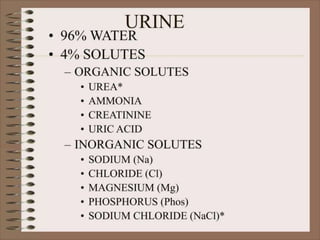
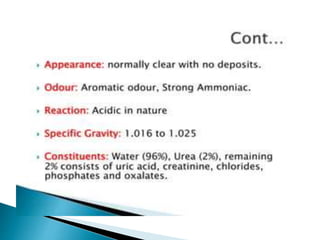
 URINE
Urine is a liquid product of the body secreted
by kidney
Through the process is called urination
Excreted through urethra
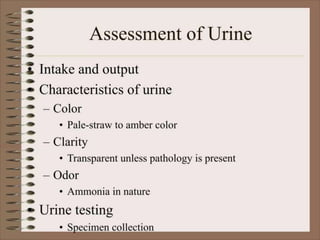
 Colour and transparency

. Clear, pale to deep yellow (due to urochrome)
. Concentrated urine has a deeper yellow/amber
colour
. A red or red-brown (abnormal) colour could be from
a food dye, eating fresh beets, a drug, or the
presence of either hemoglobin or myoglobin.
. If the sample contained many red blood cells, it
would be cloudy as well as red.
. Turbidity or cloudiness may be caused by
excessive cellular material or protein in the urine
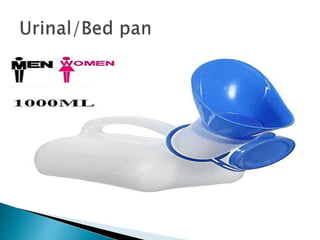
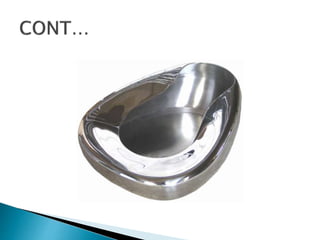
 A bedpan or bed pan is a article used for
the toileting of a bedridden patient in
a health care facility, and is usually made of
metal, glass, ceramic, or plastic.
 A bedpan can be used for both urinary and
faecal discharge.
 Male external catheters, Texas catheters or
condom catheters are made of silicone or
latex (depending on the brand/manufacturer)
and cover the penis just like a condom but
with an opening at the end to allow the
connection to the urine bag.
 Perineal care in the nursing interventions
classification, a nursing intervention defined
as maintenance of perienal skin integrity and
relief of perineal discomfort.
 1. Gather necessary equipment.
 2. Wash your hands. Put on gloves.
 3. Explain what you are going to do.
 4. Provide privacy.
 5. Client should be in back-lying or side-lying
position; place towel or bedpan under hips.
 6. Fill basin with warm water.
 7. Cover client with a towel or sheet.
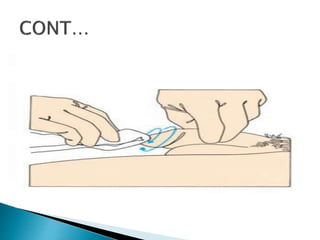
 8. Expose perineal area. Using a circular motion,
gently wash the penis by lifting it and cleaning
from the tip downward.
 9. Wash and rinse the scrotum.

 10. Wash and rinse other skin areas between the legs.
 11. Wash and rinse the anal area.
 12. Leave the perineal area dry.
 13. May apply a light dusting of powder under
scrotum to prevent rubbing on skin (optional) as per
service plan.
 14. Remove towel or sheet.
 15. Remove and dispose of gloves.
 16. Remove, clean, and store equipment.
 17. Wash hands.
 18. Make the client comfortable.
 19.Record observations and report anything unusual
to nurse/supervisor.
 1. Gather necessary equipment.
 2. Wash your hands. Put on gloves.
 3. Explain what you are going to do And provide
privacy.
 4. Assist client to back-lying or side-lying
position; place towel or bedpan under hips.
 5. Cover client with a towel or sheet.
 6. Expose perineal area. Gently wash the inner
legs and outer perineal area along the outside of
the labia.
 7. Wash the outer skin folds from front to back.
 8. Wash the inner labia from front to back
 9. Gently open all skin folds and wash the inner area
from front to back.
 10. Rinse the area well, starting with innermost area
and proceeding outward.
 11. Wash and rinse the anal area.
 12. Leave the perineal area dry.
 13. Remove towel, bedpan, or sheet.
 14. Remove and dispose of gloves.
 15. Remove, clean, and store equipment.
 16. Wash your hands.
 17. Make the client comfortable.
 18. Record observations and report anything unusual
to nurse/supervisor.
 In urinary
catheterization a latex, polyurethane,
or silicone tube known as a urinary catheter is
inserted into a patient's bladder via
the urethra. Catheterization allows the
patient's urine to drain freely from the
bladder for collection. It may be used to
inject liquids used for treatment or diagnosis
of bladder conditions.
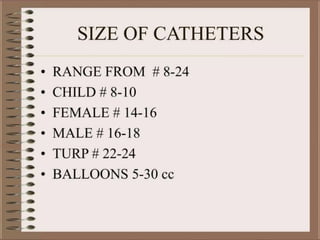
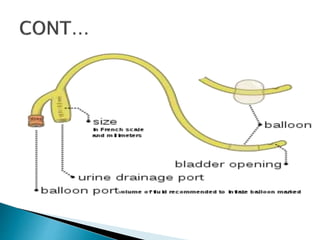
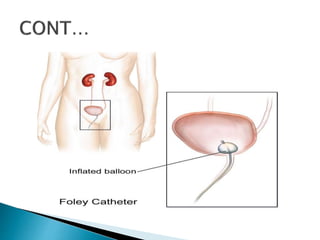
 A Foley catheter (indwelling urinary catheter)
is retained by means of a balloon at the tip
that is inflated with sterile water. The
balloons typically come in two different sizes:
5 cm3 and 30 cm3. They are commonly made
in silicone rubber or natural rubber.
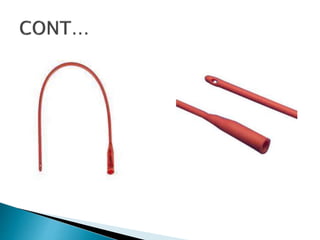
 An intermittent catheter/Robinson catheter is
a flexible catheter used for short-term
drainage of urine. Unlike the Foley catheter, it
has no balloon on its tip and therefore cannot
stay in place unaided. These can be non-
coated or coated (e.g., hydrophilic coated and
ready to use).
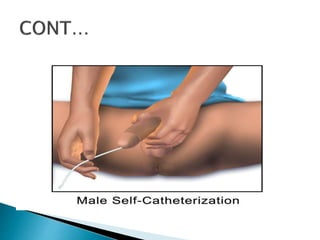
 Intermittent self-catheterization in males is
best performed with a flexible catheter to
drain the bladder periodically. The procedure
should not be attempted by a patient without
guidance in maintaining cleanliness of the
catheter and surrounding area and specific
instruction regarding catheter insertion from
meatus to bladder entry.
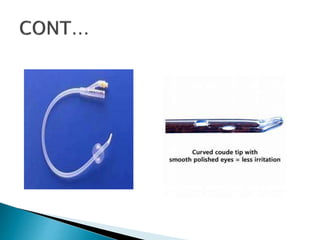
 A coudé catheter, including Tiemann's
catheter, is designed with a curved tip that
makes it easier to pass through the curvature
of the prostatic urethra.
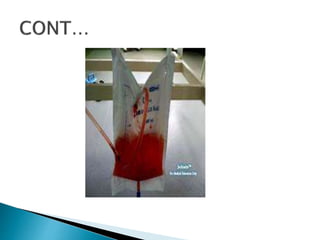
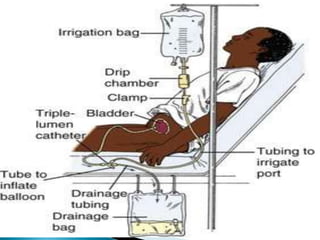
 A hematuria (or haematuria) catheter is a type
of Foley catheter used for Post-
TURP hemostasis. This is useful following
endoscopic surgical procedures, or in the
case of gross hematuria. There are both two-
way and three-way hematuria catheters
(double and triple lumen).
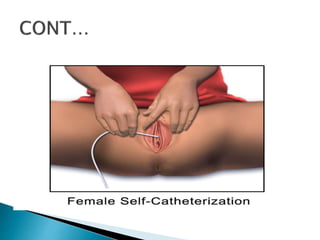
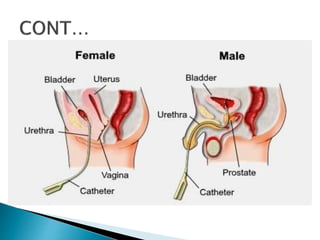
 In males, the catheter tube is inserted into the
urinary tract through the penis. A condom-type
catheter (also known as a 'Texas catheter'), if
used, fits around the tip of the penis, rather than
being inserted. In females, the catheter is
inserted into the urethral meatus, after a
cleansing using povidone-iodine or Dakin
solution. The procedure can be complicated in
females due to varying layouts of
the genitalia (due to age, obesity, female genital
cutting, childbirth, or other factors), but a good
clinician would rely on anatomical landmarks and
patience when dealing with such a patient.
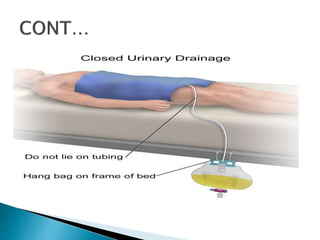
 A catheter that is left in place for more than a
short period of time is generally attached to a
drainage bag to collect the urine. This also
allows for measurement of urine volume.
 Cleansing the urethral area (the area where the
catheter exits body) and the catheter itself.
 Disconnecting drainage bag from catheter only with
clean hands
 Disconnecting drainage bag as seldom as possible.
 Keeping drainage bag connector as clean as possible
and cleaning the drainage bag periodically.
 Use of a thin catheter where possible to reduce the
risk of harming the urethra during insertion.
 Drinking sufficient liquid to produce at least two
litres of urine daily.
 Sexual activity is very high risk for urinary infections,
especially for catheterized women.
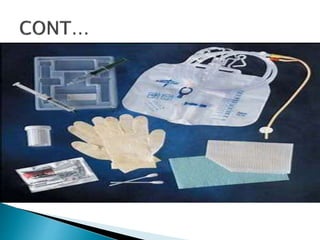
 Dressing trolley
 Catheterization pack and drapes
 Sterile Lubricant and/or Xylocaine jelly syringe (plain sterile lubricant for
infants)
 Sterile water to inflate the balloon (normal saline can crystallise and
render the balloon porous, causing its deflation and the risk of catheter
loss)
 10 ml Syringe
 Urinary Drainage Bag
 Specimen Jar
 Sterile saline
 Cotton balls
 Tape to secure the catheter to the patient’s leg
 Sterile gloves
 Urinary Catheter (appropriate size and type)
◦ Common catheter size in adult men: 14 to 16 french
◦ Common catheter size in adult women: 12 to 14 french
 Before you begin an assessment be sure to
introduce yourself to the patient.
 Verify that you have the right patient
by verifying the patient’s ID and date of birth.
 Proceed to explain how the entire procedure
will be done so that the patient is well aware
and knows what to expect.
 Get consent from the patient before
proceeding with the procedure.
 Perform hand hygiene. Maintain privacy,
confidentiality, and dignity.
 Place the patient in the supine position with
the knees flexed and separated and feet flat
on the bed, about 60 cm apart.
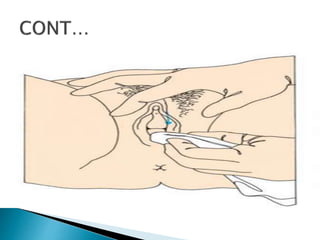
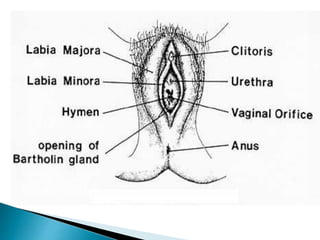
 With the thumb, middle and index fingers of
the non-dominant hand, separate the labia
major and labia minora. Pull slightly upward
to locate the urinary meatus.
 With your dominant hand, cleanse the urinary
meatus, using forceps and chlorhexidine
soaked cotton balls. Use each cotton ball for
a single downward stroke only.
 Place the drainage basin containing the
catheter between the patient’s thighs.
 Pick up the catheter with your dominant
hand.
 Insert the lubricated tip of the catheter into
the urinary meatus.
 Advance the catheter about 5-5.75 cm, until
urine begins to flow then advance the
catheter a further 1-2 cm.
 Attach the syringe with the sterile water and
inflate the balloon. It is recommended to
inflate the 5cc balloon with 7-10cc of sterile
water.
 Gently pull back on the catheter until the
balloon engages the bladder neck.
 Improperly inflated balloons can cause
drainage and leakage difficulties.
 Put the sterile gloves on.
 Take the sterile drape and tear a hole in the
centre, draping over the penis.
 Using at least 5 cotton wool balls, clean the
glans of the penis and penile shaft from tip to
base.
 Hold the penis erect and inject 11ml
instillagel into the urethra and gently squeeze
the tip to prevent leakage.
 Remove your gloves and decontaminate your
hands
 Carefully open the catheter and syringe onto
your sterile field
 Open another sterile gloves package
 Decontaminate your hands
 Put the sterile gloves on and open up the
syringe
 Place the J-tray between the patients legs
 Carefully open the catheter from its sterile
packaging, exposing only the catheter tip
 Without touching the catheter directly, insert
the catheter along the urethra into the
bladder
◦ If any resistance is felt, ask the patient to cough to
ease insertion
 Once the urine begins to flow, advance the
catheter a further 5cm
 Inject the contents of the syringe into the
catheter to inflate the balloon in the catheter
◦ Monitor the patient for any signs of discomfort
◦ Gently withdraw the catheter to ensure the balloon is
secure against the bladder neck
 Attach the catheter to the drainage bag
◦ Attach the drainage bag to the patients leg, patients
bed, or catheter stand
 Replace the foreskin
 Discard all waste into the correction disposal bins
and ensure the patient is comfortable
 Remove your gloves and decontaminate your
hands
 1. Be sure the balloon is deflated before
attempting to remove the catheter. This may
be done by inserting a syringe into the
balloon valve or by cutting the balloon valve
 2. Have the patient take several deep breaths
to help him relax while gently removing the
catheter. Wrap the catheter in a towel or
disposable, waterproof drape
 3. Clean the area at the meatus thoroughly
with antiseptic swabs after the catheter is
removed
 4. See to it that the patient’s fluid intake is
generous and record the patient’s intake and
output. Instruct the patient to void into the
bedpan or urinal
 5. Observe the urine carefully for any signs of
abnormality
 6. Record and report any usual signs such as
discomfort, a burning sensation when
voiding, bleeding and changes in vital signs,
especially the patient’s temperature. Be alert to
any signs of infection and report them promptly
 Explain procedure to patient before doing.
 Give proper position to patient.
 Give perennial care to patient at regular
interval of time.
 Use proper solution for perennial care.
 Use proper technique of perennial care
according to patient.
 Observe for lesion or wound .
 Report and document procedure and finding.
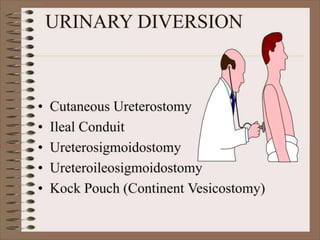
 urinary diversion-Urinary diversion is a
surgical procedure that reroutes the normal
flow of urine out of the body when urine flow
is blocked
 an enlarged prostate
 injury to the urethra
 birth defects of the urinary tract
 kidney, ureter, or bladder stones
 tumors of the genitourinary tract—which
includes the urinary tract and reproductive
organs—or adjacent tissues and organs
 conditions causing external pressure to the
urethra or one or both ureters.
 Bladder removal or a malfunctioning bladder
may also cause blocked urine flow. When
urine cannot flow out of the body, it can
accumulate in the bladder, ureters, and
kidneys. As a result, body wastes and extra
water do not empty from the body,
potentially resulting in pain, urinary tract
infections, kidney failure, or, if left untreated,
death. Urinary diversion can be temporary or
permanent, depending on the reason for the
procedure.
 Temporary urinary diversion reroutes the flow
of urine for several days or weeks. Temporary
urinary diversions drain urine until the cause
of blockage is treated or after urinary tract
surgery. This type of urinary diversion
includes a nephrostomy and urinary
catheterization.
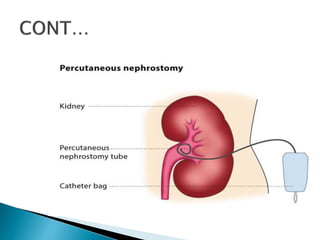
 A nephrostomy involves a small tube inserted
through the skin directly into a kidney. The
nephrostomy tube drains urine from the
kidney into an external drainage pouch.
Nephrostomy tubes are often used for less
than a week after a percutaneous
nephrolithotomy—a surgical procedure to
break up and remove a kidney stone.
 Urinary catheterization involves placing a
thin, flexible tube—called a catheter—into the
bladder to drain urine.
 Permanent urinary diversion requires surgery
to reroute urine flow to an external pouch
through an opening in the wall of the
abdomen, called a stoma, or to a surgically
created internal reservoir. Stomas range from
three-fourths of an inch to 3 inches wide.
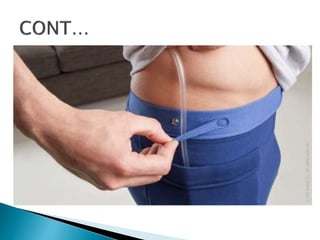
 Verify that dressing is dry, clean, and secure.
If it’s wet, dirty, or loose, it will need to be
changed.
 Check skin around the dressing to make sure
there’s no redness or rash.
 Look at the urine that has collected in
drainage bag. It shouldn’t have changed in
colour.
 Be sure there are no kinks or twists in the
tubing that leads from dressing to the
drainage bag.
URINARY ELIMINATION.pptx NURSING FOUNDATION

URINARY ELIMINATION.pptx NURSING FOUNDATION

  • 1.
  • 4.
     URINE Urine isa liquid product of the body secreted by kidney Through the process is called urination Excreted through urethra
  • 7.
     Colour andtransparency  . Clear, pale to deep yellow (due to urochrome) . Concentrated urine has a deeper yellow/amber colour . A red or red-brown (abnormal) colour could be from a food dye, eating fresh beets, a drug, or the presence of either hemoglobin or myoglobin. . If the sample contained many red blood cells, it would be cloudy as well as red. . Turbidity or cloudiness may be caused by excessive cellular material or protein in the urine
  • 27.
     A bedpanor bed pan is a article used for the toileting of a bedridden patient in a health care facility, and is usually made of metal, glass, ceramic, or plastic.  A bedpan can be used for both urinary and faecal discharge.
  • 29.
     Male externalcatheters, Texas catheters or condom catheters are made of silicone or latex (depending on the brand/manufacturer) and cover the penis just like a condom but with an opening at the end to allow the connection to the urine bag.
  • 30.
     Perineal carein the nursing interventions classification, a nursing intervention defined as maintenance of perienal skin integrity and relief of perineal discomfort.
  • 31.
     1. Gathernecessary equipment.  2. Wash your hands. Put on gloves.  3. Explain what you are going to do.  4. Provide privacy.  5. Client should be in back-lying or side-lying position; place towel or bedpan under hips.  6. Fill basin with warm water.  7. Cover client with a towel or sheet.  8. Expose perineal area. Using a circular motion, gently wash the penis by lifting it and cleaning from the tip downward.
  • 33.
     9. Washand rinse the scrotum.  10. Wash and rinse other skin areas between the legs.  11. Wash and rinse the anal area.  12. Leave the perineal area dry.  13. May apply a light dusting of powder under scrotum to prevent rubbing on skin (optional) as per service plan.  14. Remove towel or sheet.  15. Remove and dispose of gloves.  16. Remove, clean, and store equipment.  17. Wash hands.  18. Make the client comfortable.  19.Record observations and report anything unusual to nurse/supervisor.
  • 34.
     1. Gathernecessary equipment.  2. Wash your hands. Put on gloves.  3. Explain what you are going to do And provide privacy.  4. Assist client to back-lying or side-lying position; place towel or bedpan under hips.  5. Cover client with a towel or sheet.  6. Expose perineal area. Gently wash the inner legs and outer perineal area along the outside of the labia.  7. Wash the outer skin folds from front to back.
  • 36.
     8. Washthe inner labia from front to back  9. Gently open all skin folds and wash the inner area from front to back.  10. Rinse the area well, starting with innermost area and proceeding outward.  11. Wash and rinse the anal area.  12. Leave the perineal area dry.  13. Remove towel, bedpan, or sheet.  14. Remove and dispose of gloves.  15. Remove, clean, and store equipment.  16. Wash your hands.  17. Make the client comfortable.  18. Record observations and report anything unusual to nurse/supervisor.
  • 37.
     In urinary catheterizationa latex, polyurethane, or silicone tube known as a urinary catheter is inserted into a patient's bladder via the urethra. Catheterization allows the patient's urine to drain freely from the bladder for collection. It may be used to inject liquids used for treatment or diagnosis of bladder conditions.
  • 39.
     A Foleycatheter (indwelling urinary catheter) is retained by means of a balloon at the tip that is inflated with sterile water. The balloons typically come in two different sizes: 5 cm3 and 30 cm3. They are commonly made in silicone rubber or natural rubber.
  • 41.
     An intermittentcatheter/Robinson catheter is a flexible catheter used for short-term drainage of urine. Unlike the Foley catheter, it has no balloon on its tip and therefore cannot stay in place unaided. These can be non- coated or coated (e.g., hydrophilic coated and ready to use).
  • 42.
     Intermittent self-catheterizationin males is best performed with a flexible catheter to drain the bladder periodically. The procedure should not be attempted by a patient without guidance in maintaining cleanliness of the catheter and surrounding area and specific instruction regarding catheter insertion from meatus to bladder entry.
  • 44.
     A coudécatheter, including Tiemann's catheter, is designed with a curved tip that makes it easier to pass through the curvature of the prostatic urethra.
  • 46.
     A hematuria(or haematuria) catheter is a type of Foley catheter used for Post- TURP hemostasis. This is useful following endoscopic surgical procedures, or in the case of gross hematuria. There are both two- way and three-way hematuria catheters (double and triple lumen).
  • 48.
     In males,the catheter tube is inserted into the urinary tract through the penis. A condom-type catheter (also known as a 'Texas catheter'), if used, fits around the tip of the penis, rather than being inserted. In females, the catheter is inserted into the urethral meatus, after a cleansing using povidone-iodine or Dakin solution. The procedure can be complicated in females due to varying layouts of the genitalia (due to age, obesity, female genital cutting, childbirth, or other factors), but a good clinician would rely on anatomical landmarks and patience when dealing with such a patient.
  • 53.
     A catheterthat is left in place for more than a short period of time is generally attached to a drainage bag to collect the urine. This also allows for measurement of urine volume.
  • 55.
     Cleansing theurethral area (the area where the catheter exits body) and the catheter itself.  Disconnecting drainage bag from catheter only with clean hands  Disconnecting drainage bag as seldom as possible.  Keeping drainage bag connector as clean as possible and cleaning the drainage bag periodically.  Use of a thin catheter where possible to reduce the risk of harming the urethra during insertion.  Drinking sufficient liquid to produce at least two litres of urine daily.  Sexual activity is very high risk for urinary infections, especially for catheterized women.
  • 56.
     Dressing trolley Catheterization pack and drapes  Sterile Lubricant and/or Xylocaine jelly syringe (plain sterile lubricant for infants)  Sterile water to inflate the balloon (normal saline can crystallise and render the balloon porous, causing its deflation and the risk of catheter loss)  10 ml Syringe  Urinary Drainage Bag  Specimen Jar  Sterile saline  Cotton balls  Tape to secure the catheter to the patient’s leg  Sterile gloves  Urinary Catheter (appropriate size and type) ◦ Common catheter size in adult men: 14 to 16 french ◦ Common catheter size in adult women: 12 to 14 french
  • 59.
     Before youbegin an assessment be sure to introduce yourself to the patient.  Verify that you have the right patient by verifying the patient’s ID and date of birth.  Proceed to explain how the entire procedure will be done so that the patient is well aware and knows what to expect.  Get consent from the patient before proceeding with the procedure.  Perform hand hygiene. Maintain privacy, confidentiality, and dignity.
  • 60.
     Place thepatient in the supine position with the knees flexed and separated and feet flat on the bed, about 60 cm apart.  With the thumb, middle and index fingers of the non-dominant hand, separate the labia major and labia minora. Pull slightly upward to locate the urinary meatus.  With your dominant hand, cleanse the urinary meatus, using forceps and chlorhexidine soaked cotton balls. Use each cotton ball for a single downward stroke only.
  • 61.
     Place thedrainage basin containing the catheter between the patient’s thighs.  Pick up the catheter with your dominant hand.  Insert the lubricated tip of the catheter into the urinary meatus.  Advance the catheter about 5-5.75 cm, until urine begins to flow then advance the catheter a further 1-2 cm.
  • 62.
     Attach thesyringe with the sterile water and inflate the balloon. It is recommended to inflate the 5cc balloon with 7-10cc of sterile water.  Gently pull back on the catheter until the balloon engages the bladder neck.  Improperly inflated balloons can cause drainage and leakage difficulties.
  • 63.
     Put thesterile gloves on.  Take the sterile drape and tear a hole in the centre, draping over the penis.  Using at least 5 cotton wool balls, clean the glans of the penis and penile shaft from tip to base.  Hold the penis erect and inject 11ml instillagel into the urethra and gently squeeze the tip to prevent leakage.
  • 64.
     Remove yourgloves and decontaminate your hands  Carefully open the catheter and syringe onto your sterile field  Open another sterile gloves package  Decontaminate your hands  Put the sterile gloves on and open up the syringe
  • 65.
     Place theJ-tray between the patients legs  Carefully open the catheter from its sterile packaging, exposing only the catheter tip  Without touching the catheter directly, insert the catheter along the urethra into the bladder ◦ If any resistance is felt, ask the patient to cough to ease insertion  Once the urine begins to flow, advance the catheter a further 5cm
  • 66.
     Inject thecontents of the syringe into the catheter to inflate the balloon in the catheter ◦ Monitor the patient for any signs of discomfort ◦ Gently withdraw the catheter to ensure the balloon is secure against the bladder neck  Attach the catheter to the drainage bag ◦ Attach the drainage bag to the patients leg, patients bed, or catheter stand  Replace the foreskin  Discard all waste into the correction disposal bins and ensure the patient is comfortable  Remove your gloves and decontaminate your hands
  • 67.
     1. Besure the balloon is deflated before attempting to remove the catheter. This may be done by inserting a syringe into the balloon valve or by cutting the balloon valve  2. Have the patient take several deep breaths to help him relax while gently removing the catheter. Wrap the catheter in a towel or disposable, waterproof drape  3. Clean the area at the meatus thoroughly with antiseptic swabs after the catheter is removed
  • 68.
     4. Seeto it that the patient’s fluid intake is generous and record the patient’s intake and output. Instruct the patient to void into the bedpan or urinal  5. Observe the urine carefully for any signs of abnormality  6. Record and report any usual signs such as discomfort, a burning sensation when voiding, bleeding and changes in vital signs, especially the patient’s temperature. Be alert to any signs of infection and report them promptly
  • 71.
     Explain procedureto patient before doing.  Give proper position to patient.  Give perennial care to patient at regular interval of time.  Use proper solution for perennial care.  Use proper technique of perennial care according to patient.  Observe for lesion or wound .  Report and document procedure and finding.
  • 72.
     urinary diversion-Urinarydiversion is a surgical procedure that reroutes the normal flow of urine out of the body when urine flow is blocked
  • 73.
     an enlargedprostate  injury to the urethra  birth defects of the urinary tract  kidney, ureter, or bladder stones  tumors of the genitourinary tract—which includes the urinary tract and reproductive organs—or adjacent tissues and organs  conditions causing external pressure to the urethra or one or both ureters.
  • 74.
     Bladder removalor a malfunctioning bladder may also cause blocked urine flow. When urine cannot flow out of the body, it can accumulate in the bladder, ureters, and kidneys. As a result, body wastes and extra water do not empty from the body, potentially resulting in pain, urinary tract infections, kidney failure, or, if left untreated, death. Urinary diversion can be temporary or permanent, depending on the reason for the procedure.
  • 75.
     Temporary urinarydiversion reroutes the flow of urine for several days or weeks. Temporary urinary diversions drain urine until the cause of blockage is treated or after urinary tract surgery. This type of urinary diversion includes a nephrostomy and urinary catheterization.
  • 76.
     A nephrostomyinvolves a small tube inserted through the skin directly into a kidney. The nephrostomy tube drains urine from the kidney into an external drainage pouch. Nephrostomy tubes are often used for less than a week after a percutaneous nephrolithotomy—a surgical procedure to break up and remove a kidney stone.
  • 79.
     Urinary catheterizationinvolves placing a thin, flexible tube—called a catheter—into the bladder to drain urine.
  • 80.
     Permanent urinarydiversion requires surgery to reroute urine flow to an external pouch through an opening in the wall of the abdomen, called a stoma, or to a surgically created internal reservoir. Stomas range from three-fourths of an inch to 3 inches wide.
  • 81.
     Verify thatdressing is dry, clean, and secure. If it’s wet, dirty, or loose, it will need to be changed.  Check skin around the dressing to make sure there’s no redness or rash.  Look at the urine that has collected in drainage bag. It shouldn’t have changed in colour.  Be sure there are no kinks or twists in the tubing that leads from dressing to the drainage bag.